

 Download PDF
 Download PDF
Market Overview
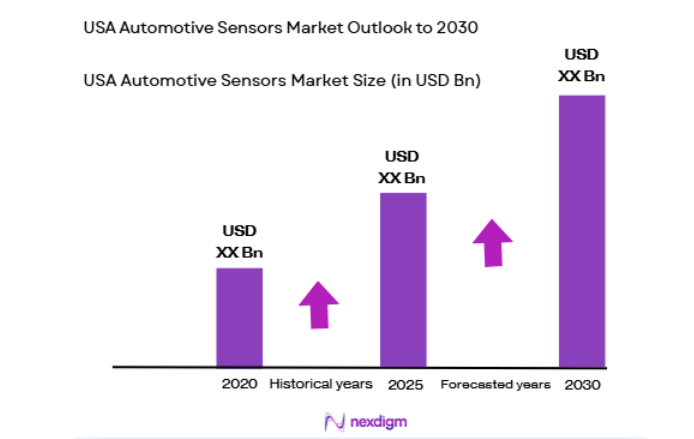
The USA Automotive Sensors market is a substantial segment of the broader automotive electronics industry, underpinned by growing integration of sensor technologies in modern vehicles. Based on a recent historical assessment, the U.S. automotive sensors market was valued at approximately USD ~ billion in 2024, driven by rising demand for safety and efficiency enhancements in vehicles. The increase in advanced driver‑assistance systems (ADAS), vehicle connectivity, and emissions control systems has accelerated sensor adoption across passenger and commercial vehicles.
Based on a recent historical assessment, the United States maintains a leading position in automotive sensor deployment due to its large automotive manufacturing base, advanced technological ecosystem, and stringent vehicle safety standards. States with major automotive hubs such as Michigan, Ohio, and California play pivotal roles in driving sensor integration across OEM and aftermarket segments. The presence of leading auto manufacturers, robust R&D infrastructure, and supportive regulatory frameworks further fortify the U.S. market’s dominance in automotive sensor technology development and adoption.
Market Segmentation
By Product Type
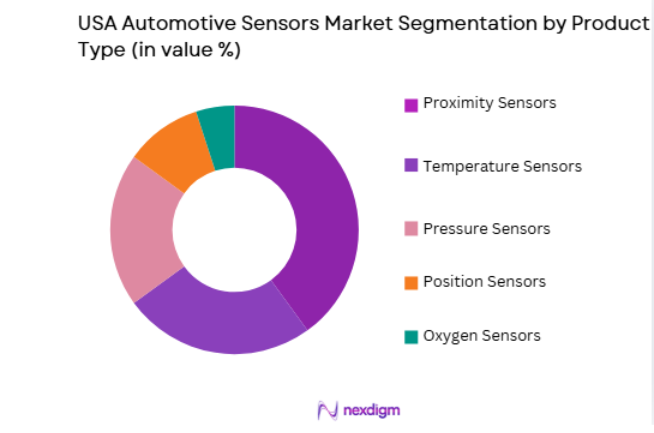
The USA Automotive Sensors Market is segmented by product type into proximity sensors, temperature sensors, pressure sensors, position sensors, and oxygen sensors. Among these, proximity sensors hold a dominant market share due to their critical role in safety features such as collision avoidance and parking assistance. This sub-segment has gained prominence due to the increased demand for ADAS technologies and the growing importance of autonomous vehicles, where proximity sensors are vital for real-time object detection and hazard identification. The expansion of sensor usage in electric vehicles further fuels the demand for proximity sensors, making them a key driver in the market.
By Application
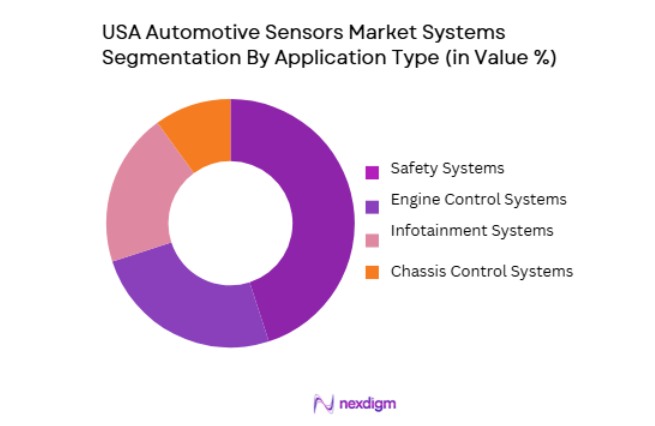
USA Automotive Sensors market is segmented by application into safety systems, engine control systems, infotainment systems, and chassis control systems. Recently, safety systems have dominated the market share due to increased government regulations and consumer demand for advanced safety features in vehicles. These systems are equipped with various sensors to support features such as collision avoidance, lane departure warnings, and adaptive cruise control. The rising focus on vehicle safety, combined with stringent regulatory standards, has contributed significantly to the rapid growth of safety-related sensor applications in the automotive sector.
Competitive Landscape
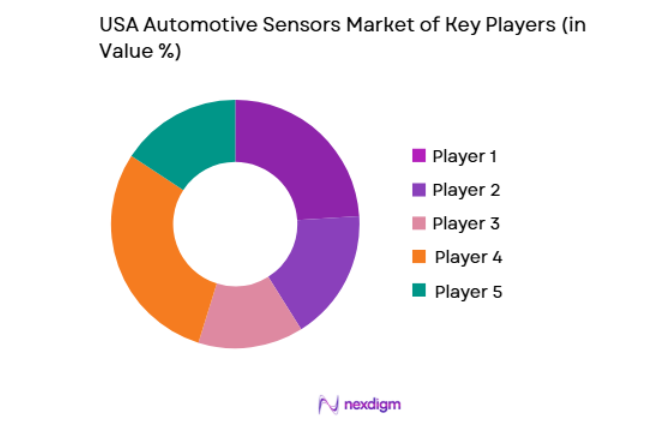
The competitive landscape of the USA Automotive Sensors Market is characterized by strong competition among key players who are focusing on innovation, strategic collaborations, and enhancing product portfolios. Major companies have been consolidating their positions by entering partnerships and expanding their manufacturing capabilities. The market is also driven by the increasing demand for high-performance sensors that meet regulatory standards for vehicle safety. Key players such as Bosch, Continental, and Denso continue to dominate, focusing on expanding their reach and improving sensor technology to meet the growing demand for advanced automotive systems.
| Company Name | Establishment Year | Headquarters | Technology Focus | Market Reach | Key Products | Revenue (USD) |
| Bosch | 1886 | Germany | ~ | ~ | ~ | ~ |
| ~Continental | 1871 | Germany | ~ | ~ | ~ | ~ |
| Denso | 1949 | Japan | ~ | ~ | ~ | ~ |
| Delphi Technologies | 1994 | USA | ~ | ~ | ~ | ~ |
| STMicroelectronics | 1987 | Switzerland | ~ | ~ | ~ | ~ |
USA Automotive Sensors Market Analysis
Growth Drivers
Technological Advancements in Sensor Technologies
The continuous development of automotive sensors has led to improved performance and efficiency in vehicles. With innovations such as miniaturization, integration of IoT capabilities, and enhanced sensor accuracy, the automotive industry is adopting more advanced sensors, particularly for autonomous driving and safety applications. These technological advancements have expanded the potential of automotive sensors, contributing to their growing adoption in modern vehicles, where sensors are integral to functions like collision avoidance and automated driving systems.
Shift Toward Electric and Autonomous Vehicles
The rising popularity of electric vehicles (EVs) and autonomous vehicles (AVs) has significantly increased the demand for automotive sensors. These vehicles require highly sophisticated sensor technologies for functions such as autonomous navigation, adaptive cruise control, and energy efficiency. As governments push for sustainability and stricter emission regulations, automotive manufacturers are investing in EVs and AVs, further driving the demand for advanced automotive sensors that can meet the requirements of these next-generation vehicles.
Market Challenges
High Initial Costs of Automotive Sensors
The integration of advanced sensors into vehicles comes with a high upfront cost, which can deter manufacturers, especially in developing regions, from adopting the latest technologies. While the long-term benefits of enhanced vehicle safety and automation are clear, the initial costs of sensor systems can be a barrier for both manufacturers and consumers. The premium pricing for advanced sensor systems has slowed their widespread adoption, particularly in lower-end vehicles, limiting market growth to higher-end vehicle segments.
Regulatory Compliance and Safety Standards
Automotive sensors are subject to a range of safety and regulatory standards, which vary by region and country. Compliance with these standards adds complexity to the manufacturing process and increases costs for sensor producers. Additionally, the pace of changing regulations, especially those related to autonomous vehicles and safety systems, poses a challenge for automotive sensor manufacturers in maintaining compliance while innovating new products. This regulatory landscape can delay product development and market entry.
Opportunities
Growing Demand for Smart Vehicle Integration
With the automotive industry’s shift towards more connected and intelligent systems, the demand for automotive sensors is expected to grow. The integration of sensors in smart vehicle systems for enhanced connectivity, remote diagnostics, and real-time data sharing presents significant opportunities. Automotive manufacturers are looking to create seamless in-vehicle experiences, driving sensor demand for functions like driver assistance, vehicle-to-vehicle (V2V) communication, and predictive maintenance. As vehicles become more connected, sensors will play an essential role in supporting these smart technologies.
Rising Investment in Autonomous Vehicle Research
Investment in autonomous vehicle development continues to increase as technology companies and automotive manufacturers race to develop fully autonomous driving solutions. Sensors are crucial for the operation of autonomous vehicles, where they provide real-time environmental data, map out obstacles, and ensure safe navigation. As this technology evolves, the demand for automotive sensors is expected to rise, creating growth opportunities for manufacturers specializing in high-precision sensors for self-driving cars. The growing interest in autonomous vehicle research offers a long-term market opportunity.
Future Outlook
The future outlook for the USA Automotive Sensors Market is positive, with expected growth driven by technological advancements in sensor technologies, increasing demand for smart and autonomous vehicles, and regulatory support for vehicle safety systems. Over the next five years, the market is anticipated to expand as manufacturers integrate more advanced sensors into their vehicles, particularly in safety-critical applications. Key trends such as the rise of electric vehicles and autonomous driving technologies will continue to influence the market, resulting in more investment in automotive sensor solutions to meet the evolving needs of the automotive industry.
Major Players
- Bosch
- Continental
- Denso
- Delphi Technologies
- STMicroelectronics
- Autoliv
- Infineon Technologies
- NXP Semiconductors
- Honeywell
- Magna International
- Valeo
- Sensata Technologies
- ZF Friedrichshafen
- Texas Instruments
- Renesas Electronics
Key Target Audience
- Investments and venture capitalist firms
- Government and regulatory bodies
- Automobile manufacturers
- Tier 1 suppliers
- Fleet operators
- Vehicle component suppliers
- Aftermarket automotive retailers
- OEM suppliers
Research Methodology
Step 1: Identification of Key Variables
The key variables in the automotive sensors market are identified, including sensor types, technology trends, and regulatory factors.
Step 2: Market Analysis and Construction
The market is analyzed by segmenting it based on product type, vehicle types, and geographical regions.
Step 3: Hypothesis Validation and Expert Consultation
Consultation with industry experts and validation of hypotheses ensures accurate insights and data reliability.
Step 4: Research Synthesis and Final Output
The collected data is synthesized to form the final report, highlighting trends, forecasts, and market dynamics.

- Executive Summary
- Research Methodology (Definitions, Scope, Industry Assumptions, Market Sizing Approach, Primary & Secondary Research Framework, Data Collection & Verification Protocol, Analytic Models & Forecast Methodology, Limitations & Research Validity Checks)

- Market Definition and Scope
- Value Chain & Stakeholder Ecosystem
- Regulatory / Certification Landscape
- Sector Dynamics Affecting Demand
- Strategic Initiatives & Infrastructure Growth

- Growth Drivers
Technological Advancements in Automotive Sensors
Rising Demand for Autonomous Vehicles
Increasing Focus on Vehicle Safety Features - Market Challenges
High Cost of Advanced Sensor Technologies
Integration Complexity in Vehicle Systems
Regulatory Compliance and Standards - Market Opportunities
Growth in Electric Vehicle Market
Partnerships for Sensor Integration with Autonomous Systems
Expansion of Sensors in Vehicle Maintenance Systems - Trends
Increased Adoption of IoT in Automotive Sensors
Shift Towards Wireless Sensor Technologies
Rising Demand for AI-powered Sensors - Government regulations
- SWOT analysis
- Porters 5 forces

- By Market Value, 2019-2025
- By Installed Units, 2019-2025
- By Average System Price, 2019-2025
- By System Complexity Tier, 2019-2025

- By System Type (In Value%)
Proximity Sensors
Temperature Sensors
Pressure Sensors
Position Sensors
Oxygen Sensors - By Platform Type (In Value%)
Passenger Vehicles
Commercial Vehicles
Electric Vehicles
Autonomous Vehicles
Heavy-duty Vehicles - By Fitment Type (In Value%)
OEM
Aftermarket
Retrofitted Systems
Custom Fitment
Integrated Solutions - By EndUser Segment (In Value%)
Automobile Manufacturers
Tier 1 Suppliers
Repair & Maintenance Service Providers
Fleet Operators
Automotive Aftermarket Retailers - By Procurement Channel (In Value%)
Direct Procurement
Third-party Distributors
OEM Suppliers

- Market Share Analysis
- Cross Comparison Parameters (System Type, Platform Type, Procurement Channel, EndUser Segment, Fitment Type, Sensor Technology, Sensor Application, Geographical Region, Vehicle Type, Manufacturing Process)
- SWOT Analysis of Key Competitors
- Pricing & Procurement Analysis
- Key Players
Bosch
Continental
Denso
Delphi Technologies
Autoliv
STMicroelectronics
Analog Devices
NXP Semiconductors
Infineon Technologies
Honeywell
Aptiv
Texas Instruments
BorgWarner
Veoneer
Magneti Marelli

- Growing Demand from Automobile Manufacturers for Advanced Sensors
- Rising Adoption of Sensors in Fleet Operations
- Focus on Smart and Connected Vehicle Solutions
- Increasing Preference for Aftermarket Sensor Upgrades

- Forecast Market Value, 2026-2030
- Forecast Installed Units, 2026-2030
- Price Forecast by System Tier, 2026-2030
- Future Demand by Platform, 2026-2030


 Request a Sample
 Ask for Customization
 Get a Quote
 Enquire Now