
 Download PDF
Market Overview
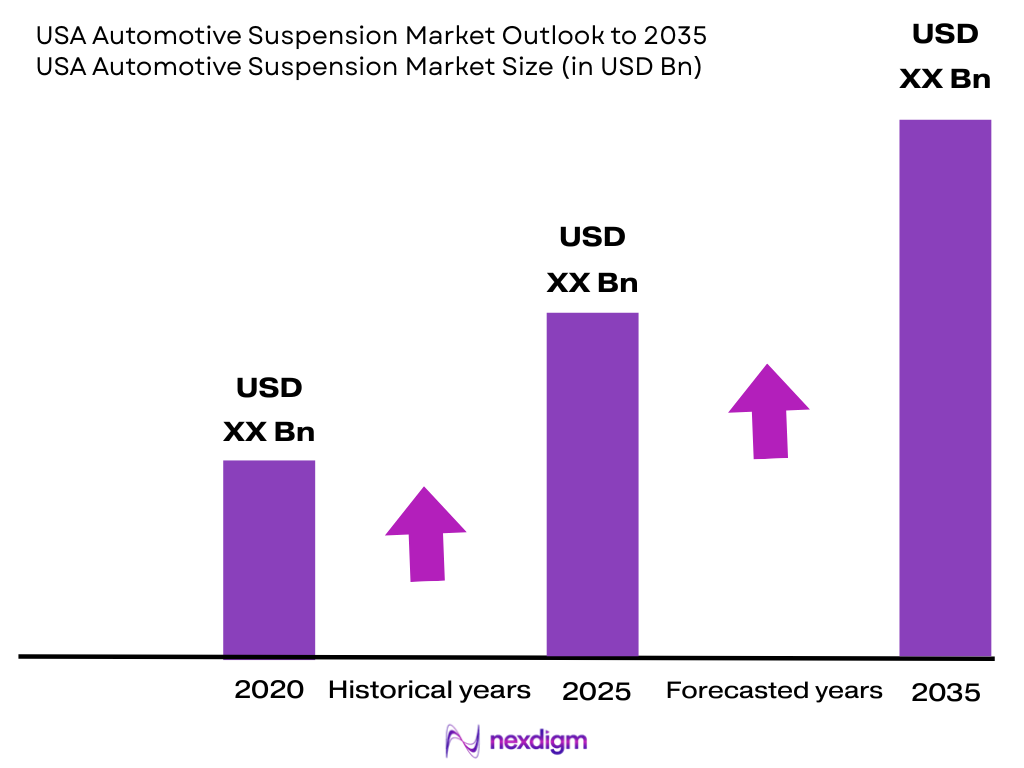
The USA Automotive Suspension Market is valued at approximately USD ~ billion, compared with USD ~ billion in the preceding annual benchmark. New light-vehicle sales reached 15.79 million units, while total registered vehicles stood near 284 million units, versus approximately 284.6 million registrations in the preceding benchmark. Demand is supported by high pickup/SUV penetration, an aging vehicle fleet, OE suspension content, shock-and-strut replacement, and expanding electronically controlled ride systems. Michigan, Ohio, Indiana, Kentucky, Tennessee, Texas and the Southeast automotive corridor dominate USA Automotive Suspension Market activity because they combine vehicle assembly, chassis engineering and Tier-1 supplier manufacturing. Light trucks represented 81.3% of new light-vehicle demand, compared with 79.9% in the preceding annual benchmark, strengthening suspension requirements associated with SUVs and pickups. Michigan and surrounding Midwest states additionally benefit from dense OEM engineering, validation and suspension-component supply networks.
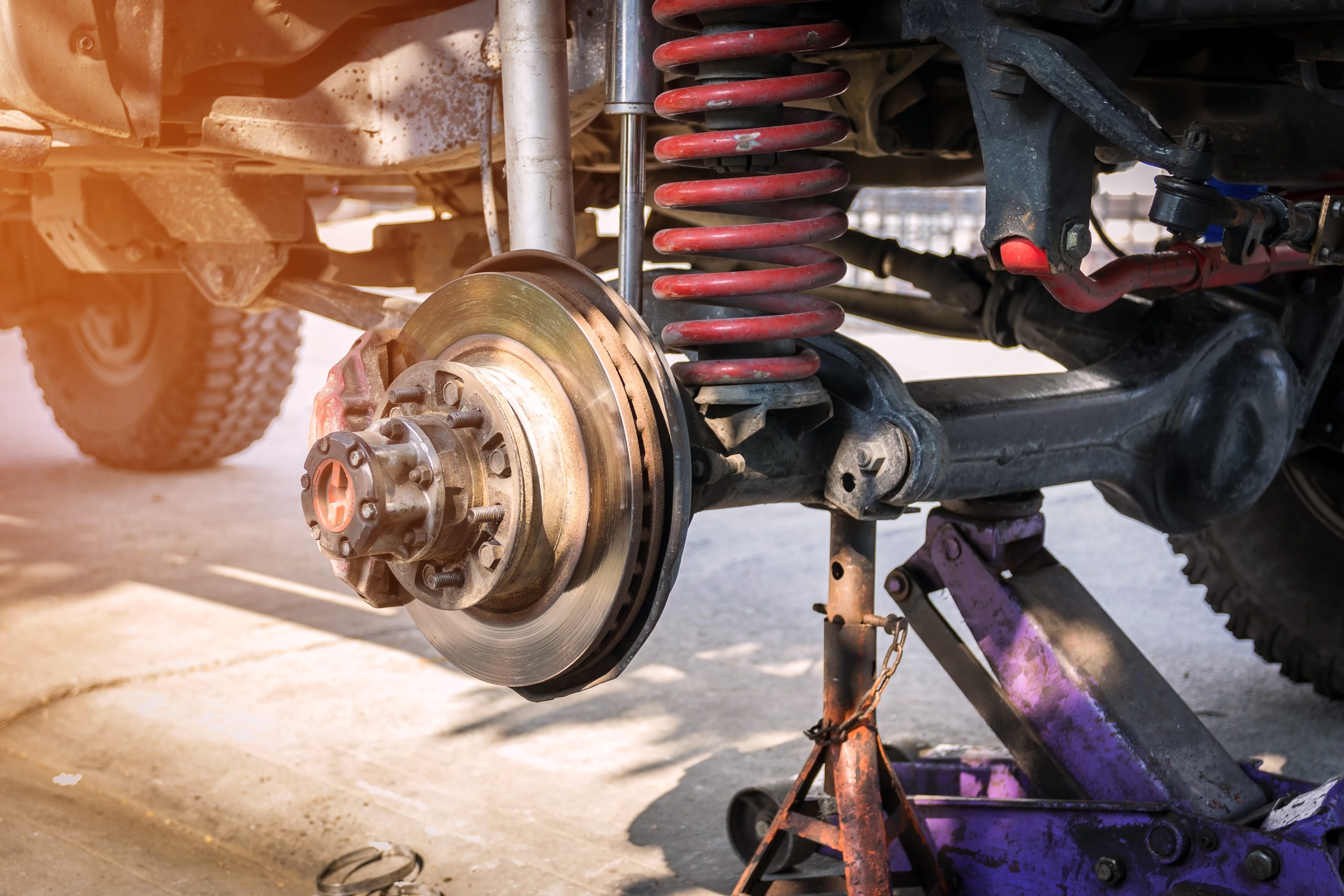
The USA Automotive Suspension Market includes shock absorbers, struts, springs, control arms, ball joints, stabilizer systems, air springs, electronic dampers, suspension sensors and complete active or semi-active chassis solutions supplied through original-equipment and replacement channels. The market is increasingly transitioning from purely mechanical ride-control components toward electronically controlled systems integrated with vehicle motion-control software.
Market Segmentation
By Suspension Technology
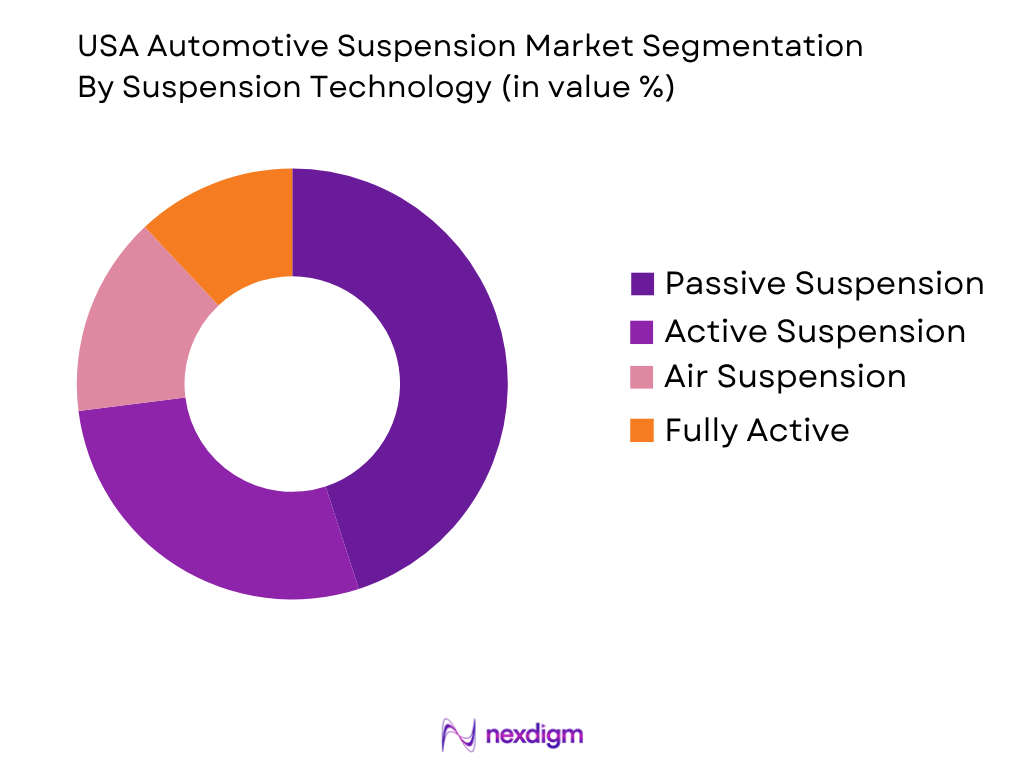
The USA Automotive Suspension Market is segmented into passive suspension, semi-active suspension, fully active suspension and air suspension systems. Passive suspension holds the dominant market share because conventional hydraulic shocks and struts remain standard across large volumes of mass-market cars, crossovers, pickups and commercial vehicles. Passive systems offer proven durability, comparatively simple packaging and extensive OE and replacement coverage. However, semi-active systems are gaining importance as premium and increasingly upper-mainstream vehicles adopt continuously controlled damping. ZF’s CDC technology adjusts damping at each wheel, while Tenneco’s Monroe Intelligent Suspension portfolio electronically regulates compression and rebound behavior. Fully active systems remain concentrated in premium applications due to their higher electronic and actuator content.
By Vehicle Type
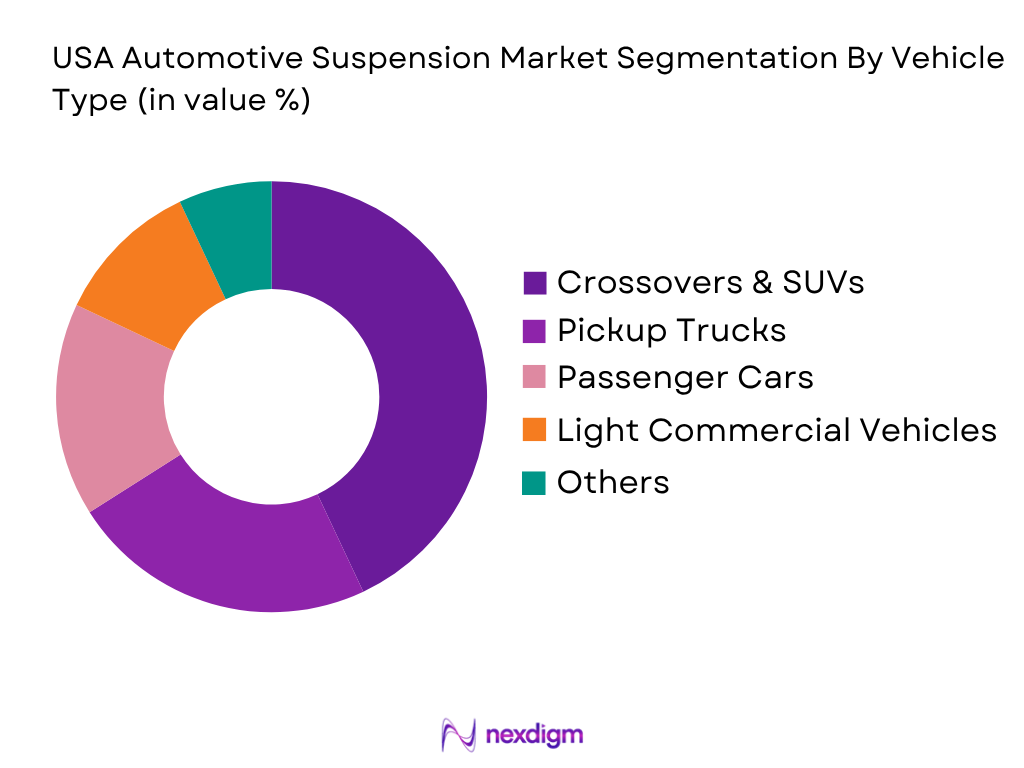
The USA Automotive Suspension Market is segmented into passenger cars, crossovers and SUVs, pickup trucks, light commercial vehicles, and medium/heavy commercial vehicles. Crossovers and SUVs hold the dominant market share, supported by the structural shift of U.S. buyers toward light trucks. Light trucks represented 81.3% of new light-vehicle sales, the highest recorded level in Alliance for Automotive Innovation’s series. SUVs also create comparatively high suspension content because premium trims increasingly incorporate adaptive damping, self-leveling systems and air suspension. Pickup trucks form another substantial segment because payload, towing and off-road requirements encourage heavier-duty springs, monotube dampers, remote-reservoir shocks and load-leveling technologies. The aftermarket opportunity is also significant because the registered U.S. vehicle base remains extremely large.
Competitive Landscape
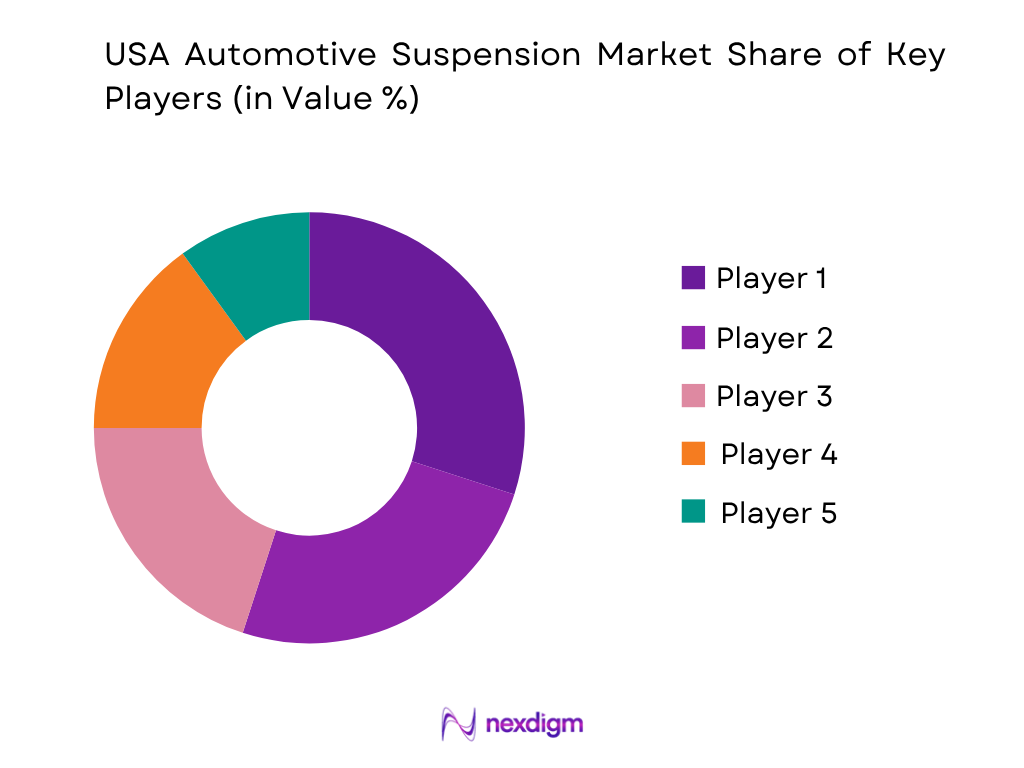
The USA Automotive Suspension Market is led by global Tier-1 chassis suppliers and specialized ride-control companies with established OE relationships, manufacturing footprints and aftermarket distribution. ZF, Tenneco/Monroe, KYB, Astemo and BILSTEIN compete across passive dampers, electronically controlled suspension and replacement components. Competition is moving beyond mechanical component performance toward software integration, continuously variable damping, active body control, EV-specific tuning, lightweighting and vehicle-motion management.
| Major Player | Established | Headquarters | Suspension Focus | OE / Aftermarket Presence | Electronic Suspension Capability | Air / Active Suspension Capability | USA Footprint | Core Market Strength |
| ZF Friedrichshafen AG | 1915 | Friedrichshafen, Germany | ~ | ~ | ~ | ~ | ~ | ~ |
| Tenneco / Monroe Ride Solutions | Tenneco heritage | Northville, Michigan, USA | ~ | ~ | ~ | ~ | ~ | ~ |
| KYB Corporation / KYB Americas | 1974 North American subsidiary | Franklin, Indiana, USA | ~ | ~ | ~ | ~ | ~ | ~ |
| Astemo Ltd. / Astemo Americas | 2021 current entity | Farmington Hills, Michigan, USA | ~ | ~ | ~ | ~ | ~ | ~ |
| thyssenkrupp BILSTEIN | 1873 heritage | Ennepetal, Germany / Hamilton, Ohio U.S. HQ | ~ | ~ | ~ | ~ | ~ | ~ |
USA Automotive Suspension Market Analysis
Growth Drivers
Dominance of SUVs, Pickups and Light Trucks Driving Higher Suspension Content
The USA Automotive Suspension Market is being structurally supported by the country’s continuing preference for SUVs, crossovers and pickup trucks, which require more robust suspension architectures than conventional passenger cars because of higher curb weight, payload, towing capability and off-road requirements. Alliance for Automotive Innovation reported 15.79 million new light-vehicle sales in 2024, while light trucks represented more than 8 vehicles out of every 10 new vehicles sold. The installed vehicle base is even more significant for suspension suppliers: Alliance data identify approximately 288.97 million registered light-duty vehicles, including 283.03 million ICE and hybrid vehicles, 4.44 million battery-electric vehicles, 1.48 million plug-in hybrids and 16,735 fuel-cell vehicles. The average vehicle age stands at approximately 12.2 years, creating a large population moving through the wear cycle for shocks, struts, control arms, ball joints, bushings and springs. The light-truck bias changes suspension content per vehicle as well. Pickups and SUVs frequently use heavier-duty dampers, larger-diameter piston assemblies, multi-link rear layouts, load-leveling systems, air springs or electronically adjustable shocks. Higher-end SUVs increasingly employ continuously controlled damping or adaptive air suspension to combine ride comfort with body control. The concentration of the U.S. automotive parts ecosystem reinforces this demand. Bureau of Labor Statistics trade data show that U.S. motor-vehicle-parts exports totaled USD 60.9 billion in 2024, with Michigan alone contributing USD 10.5 billion, Texas USD 8.4 billion, Ohio USD 5.2 billion and Indiana USD 4.9 billion, demonstrating the depth of the domestic chassis and component manufacturing base. Suspension demand is therefore supported simultaneously by OE production and the very large aging replacement fleet. Macroeconomic conditions also provide a supportive consumption environment: the IMF records U.S. real GDP expansion of 2.8 units for every 100 units of output in 2024, while the World Bank records national GDP above USD 29 trillion and GDP per capita above USD 85,000 for the same period. These indicators support continued consumer expenditure on vehicle maintenance and higher-specification vehicle content. For suspension suppliers, the strongest demand pockets are therefore not basic passenger-car dampers alone but SUV and pickup applications requiring higher load capacity, adaptive damping, performance upgrades and recurring aftermarket replacement.
Electrification and Rising Vehicle Mass Increasing Suspension Engineering Requirements
Electrification represents a second major growth driver because battery-electric and plug-in hybrid vehicles impose materially different weight distribution, axle-load and ride-control requirements compared with conventional ICE platforms. Alliance for Automotive Innovation records approximately 4.44 million battery-electric light-duty vehicles and 1.48 million plug-in hybrids within the U.S. registered fleet, while more than 730,000 EVs were sold during the first six months of 2024. The Department of Energy additionally reported that more than 1.4 million electric vehicles were sold in the United States in the preceding annual benchmark, showing that electrified platforms are no longer confined to low-volume niche applications. Electric SUVs are especially important because DOE data show that SUVs represented the majority of electrified utility-vehicle demand, meaning suspension suppliers must increasingly engineer systems for vehicles combining battery mass with larger body structures. Battery packs typically occupy the vehicle floor and alter the center of gravity, axle loading and vertical body dynamics. This creates demand for higher spring rates, more sophisticated damping curves, lightweight control arms, adaptive ride-height control and improved pitch and roll management. EV manufacturers also place strong emphasis on ride refinement because electric drivetrains generate less engine noise, making road-impact noise, damper friction and suspension harshness more perceptible to occupants. This increases the value of premium bushings, hydraulic rebound stops, frequency-selective dampers and electronically controlled suspension systems. Electrification also supports lightweighting opportunities because every kilogram removed from control arms, knuckles, springs or subframes can improve vehicle efficiency and partially offset battery weight. Consequently, forged aluminum suspension arms, hollow stabilizer bars, composite springs and integrated corner modules are becoming strategically important. The technology opportunity extends beyond mechanical hardware. Modern EV platforms increasingly use chassis domain controllers combining suspension, steering and braking information, creating opportunities for semi-active dampers and active body-control systems whose software can be tuned through electronic architecture rather than fixed mechanical calibration alone. The broader macroeconomic backdrop supports investment in such advanced vehicle technologies. The IMF reports U.S. real GDP growth of 2.8 units per 100 units in 2024, while the country’s population exceeds 340 million people, sustaining one of the world’s largest premium and technology-intensive vehicle markets. U.S. automotive manufacturing also maintains a large skilled labor base: Bureau of Labor Statistics data identify approximately 152,670 production-related jobs in motor-vehicle manufacturing and another 138,530 in motor-vehicle parts manufacturing among key manufacturing occupations. For suspension suppliers, electrification therefore expands value per vehicle by increasing the importance of weight control, adaptive damping, NVH optimization and software-enabled chassis management.
Market Challenges
OEM Cost Pressure, Material Inflation and Platform Consolidation
A major challenge for the USA Automotive Suspension Market is the continuing cost pressure placed on Tier-1 and Tier-2 suppliers even as suspension systems become more technologically complex. Suspension components remain highly material-intensive, using large quantities of steel, spring steel, aluminum, rubber, engineered elastomers and precision-machined metals. Bureau of Labor Statistics data show that motor-vehicle-parts export prices increased 3.3 units for every 100 units in 2024, following an increase of 5.5 units per 100 in 2023, while BLS specifically identifies higher metals prices as a major contributor to cumulative automotive-parts cost increases. Import prices for motor-vehicle parts also rose 3.5 units per 100 during 2024. These pressures affect shock tubes, piston rods, springs, forged aluminum control arms, knuckles, stabilizer bars and mounting hardware, yet vehicle manufacturers continue to demand annual cost reductions from suppliers through platform sourcing and value engineering. At the same time, U.S. motor-vehicle-parts exports fell to USD 60.9 billion in 2024, down from the preceding annual benchmark, demonstrating softer trade conditions despite higher unit costs. Suspension suppliers therefore face a squeeze between rising engineering/material inputs and OEM purchasing pressure. The challenge becomes greater as vehicle architectures consolidate around fewer global platforms. A supplier losing a major platform nomination may lose several years of OE revenue because shock absorbers, springs and control arms are frequently sourced for the life of a vehicle program. Platform consolidation also increases customer concentration risk because suppliers may depend heavily on a limited number of Detroit, Japanese, European or EV OEM contracts. Advanced technologies exacerbate this cost burden. Semi-active dampers require sensors, solenoid valves, electronic controllers and vehicle-level calibration; active systems add pumps, motors or hydraulic actuators and greater software content. Warranty exposure rises at the same time because failure can involve both mechanical hardware and electronics. Macroeconomic conditions remain positive but are less expansionary than earlier post-pandemic periods. The IMF records U.S. real GDP growth of 2.8 units per 100 units in 2024, moderating to around 2.1 units per 100 in 2025, while unemployment increased from approximately 4.1 people per 100 workers at the end of 2024 to around 4.5 people per 100 workers during 2025. Slower economic momentum can make OEMs even more aggressive on supplier pricing and capital discipline. For suspension manufacturers, maintaining profitability therefore depends on material substitution, localization, manufacturing automation, platform reuse and engineering systems that can serve multiple vehicle architectures without duplicating development expenditure.
Electronic Complexity, Calibration Burden and Aftermarket Service Challenges
The shift from passive mechanical suspension toward semi-active, active and air-suspension systems creates a technical challenge because the suspension system is increasingly dependent on sensors, electronic controllers, software and cross-domain vehicle integration. Traditional shock absorbers can be replaced mechanically, but electronically controlled systems may use ride-height sensors, wheel-acceleration sensors, body accelerometers, camera inputs, electronically controlled valves and central chassis controllers. This adds development cost at the OE level and diagnostic complexity in the replacement market. The challenge is magnified by the size and age of the U.S. vehicle fleet. Alliance for Automotive Innovation reports roughly 289 million registered light-duty vehicles and a national average vehicle age of approximately 12.2 years. As electronically controlled suspension systems migrate into older vehicles, repair shops must diagnose electronic faults in addition to mechanical wear. Air suspension adds compressors, reservoirs and valve blocks; semi-active suspension may require electronic calibration; ride-height changes can interact with wheel alignment and advanced driver-assistance sensors. The replacement market therefore increasingly needs technician capability, scan tools and correct calibration procedures rather than straightforward component swapping. Labor availability represents another constraint. Bureau of Labor Statistics data identify approximately 152,670 workers in motor-vehicle manufacturing occupations and 138,530 in motor-vehicle-parts manufacturing occupations within key manufacturing categories, while the wider automotive service industry competes for technicians with electronics, EV and ADAS skills. At the same time, vehicle architectures are becoming more software-centric. NHTSA’s regulatory work increasingly addresses connected and automated vehicle systems, while modern chassis controllers integrate suspension behavior with steering, braking and stability control. This creates functional-safety and cybersecurity considerations that did not exist for purely hydraulic dampers. Suppliers must therefore maintain expertise in embedded software, sensors, diagnostics and electronic validation alongside conventional mechanical engineering. Warranty management is another issue because electronic suspension failures can generate expensive component replacement and customer dissatisfaction, especially on premium air-suspension systems. Macroeconomic conditions provide scale but also intensify competitive expectations. World Bank data indicate a U.S. economy above USD 29 trillion in 2024, while IMF data show a population exceeding 340 million people, supporting a large vehicle-service market but also encouraging rapid technology adoption. Suppliers that cannot support diagnostics, software calibration and electronic replacement procedures risk losing premium OE contracts and aftermarket credibility. The technical challenge therefore shifts competition from manufacturing dampers and springs toward managing the entire mechatronic chassis lifecycle.
Market Opportunities
Semi-Active, Active and Software-Defined Suspension Systems
The strongest technology-led opportunity in the USA Automotive Suspension Market is the expansion of electronically controlled damping and active body-control systems from luxury models into broader SUV, pickup and EV applications. The addressable vehicle base is substantial: the United States recorded 15.79 million new light-vehicle sales in 2024, and light trucks represented more than 8 vehicles out of every 10 units sold. These larger vehicles benefit disproportionately from active damping because higher mass and center-of-gravity height increase body roll, pitch and vertical motion. EV expansion adds another layer of opportunity; more than 730,000 EVs were sold in the first six months of 2024, while approximately 4.44 million battery-electric vehicles are already registered in the national fleet. These platforms provide suspension suppliers with a natural opportunity to introduce continuously variable dampers, active roll control, road-preview functionality and electronically adjustable ride height. The commercial value lies not only in selling higher-priced hardware but in increasing content per vehicle through sensors, valves, control units and software. Semi-active systems can use wheel and body acceleration inputs to alter damping continuously, while advanced systems coordinate chassis behavior with steering and braking controllers. This enables manufacturers to create selectable comfort, sport, towing and off-road modes using one hardware platform, improving differentiation across trim levels. Active systems take this further by generating suspension forces rather than simply varying resistance, creating the ability to counteract pitch and roll more directly. The migration toward software-defined vehicles makes these systems especially attractive because calibration can increasingly be changed electronically rather than through different fixed damper tunes. Suspension suppliers can therefore generate recurring engineering and software value in addition to manufacturing revenue. The U.S. macroeconomic and manufacturing environment supports this opportunity. The IMF records real GDP growth of 2.8 units per 100 units in 2024, while BLS data show that motor-vehicle and parts manufacturing retains hundreds of thousands of skilled workers and a major domestic engineering footprint. Motor-vehicle-parts exports reached USD 60.9 billion, highlighting the continuing scale of the component ecosystem. For suppliers, the strategic opportunity is to combine mechanical dampers, electronic valves, sensors and centralized vehicle-motion software into integrated chassis packages. Companies capable of offering modular systems that can scale from premium SUVs to electric pickups and upper-mainstream crossovers can expand content per platform while reducing OEM calibration complexity.
Aging Vehicle Fleet, Pickup/SUV Aftermarket and Premium Replacement System
The U.S. aftermarket represents a major future growth opportunity because the country combines an exceptionally large vehicle population with high average vehicle age and strong ownership of pickups and SUVs. Alliance for Automotive Innovation records approximately 289 million registered light-duty vehicles, with an average vehicle age of approximately 12.2 years. This creates recurring demand for suspension replacement even if new-vehicle production is flat. Shocks, struts, control arms, bushings, ball joints and stabilizer links are wear components whose performance deteriorates as mileage accumulates. The opportunity becomes particularly attractive in pickups and SUVs because these vehicles commonly operate under heavier loads, towing conditions, poor road surfaces or off-road usage. Their suspension components can also carry greater dollar content per corner than small passenger cars. New vehicle sales further reinforce the installed-base mix: light trucks represented more than 8 of every 10 new light vehicles sold in 2024, meaning future aftermarket cohorts will contain increasingly high shares of SUVs and pickups. Performance and lifestyle applications expand the opportunity beyond simple replacement. Consumers use lift kits, leveling kits, remote-reservoir shocks, monotube dampers, coilovers and upgraded springs to modify ride height, towing capability and off-road performance. Air-suspension replacement represents another high-value niche because aging premium SUVs and trucks eventually require replacement of air springs, compressors, valve blocks and electronic dampers. Electrified vehicles will add a new replacement category as the approximately 4.44 million BEVs and 1.48 million plug-in hybrids already on U.S. roads age into their suspension-maintenance cycles. Because these vehicles can carry substantial battery mass, replacement dampers and springs may require tighter specification control than generic mechanical parts. The wider economic environment supports a large maintenance market. World Bank data place U.S. GDP above USD 29 trillion in 2024, while IMF data record real growth of 2.8 units per 100 units and a population of more than 340 million people. The motor-vehicle-parts supply network is also extensive: Michigan exported USD 10.5 billion of motor-vehicle parts in 2024, Texas USD 8.4 billion, Ohio USD 5.2 billion and Indiana USD 4.9 billion. For suspension manufacturers, the strongest opportunity lies in expanding SKU coverage, e-commerce fitment accuracy, premium OE-equivalent replacement, complete strut assemblies and electronically compatible replacement solutions. Suppliers that also support installer training and diagnostic guidance can differentiate as the aftermarket transitions from basic passive components toward electronic dampers and air-suspension systems.
Future Outlook
The USA Automotive Suspension Market is expected to expand at approximately ~ CAGR during 2026–2035. Growth will increasingly reflect higher suspension content per vehicle rather than only increases in vehicle production. Semi-active damping, active suspension, air suspension, EV-specific chassis tuning and electronically integrated vehicle-motion systems should account for a larger portion of market value. The sustained dominance of SUVs and pickups provides a favorable platform for advanced suspension technologies. Larger vehicles require greater control of pitch, roll and vertical movement, while premium truck and SUV customers increasingly value selectable ride modes, load leveling and off-road capability. Light trucks already account for more than four-fifths of new U.S. light-vehicle demand.
EV growth should further increase suspension engineering intensity. U.S. EVs represented 10.2% of new light-duty sales in the latest annual benchmark, with 144 electric models available. Electric SUVs and pickups create specific challenges related to battery mass, wheel loads and ride-quality expectations. Active technology is also moving toward production maturity. ZF has started production of its sMOTION active chassis technology, which actively counteracts vehicle pitch and roll, while Tenneco continues expanding Monroe electronic suspension architectures capable of separately controlling compression and rebound damping. Software-defined chassis architecture should become another strategic battlefield. Suspension data will increasingly be combined with steering, braking, camera, accelerometer and road-profile inputs through centralized vehicle-motion controllers. This changes the supplier value proposition from selling an isolated damper toward supplying an integrated corner or chassis-control system. The aftermarket should remain resilient because the U.S. vehicle population is large and mature. A national average vehicle age of approximately 12.2 years means a substantial population regularly enters the mileage and wear range associated with shock, strut, bushing and control-arm replacement.
Major Players
- ZF Friedrichshafen AG / ZF North America
- Tenneco Inc. / Monroe Ride Solutions
- KYB Corporation / KYB Americas
- Astemo Ltd. / Astemo Americas
- thyssenkrupp BILSTEIN / BILSTEIN of America
- BWI Group
- HL Mando Corporation / HL Mando America
- Hendrickson
- Fox Factory Holding Corp.
- Magna International
- Multimatic Inc.
- BENTELER International
- Gabriel / MAT Holdings
- Sogefi Group
- American Axle & Manufacturing
Key Target Audience
- Automotive OEM Manufacturers
- Automotive Suspension and Chassis Tier-1 Suppliers
- Shock Absorber, Strut and Spring Manufacturers
- Automotive Aftermarket Parts Distributors and Retailers
- Performance, Off-Road and Commercial Vehicle Suspension Companies
- Fleet Operators and Automotive Service Networks
- Investments and Venture Capitalist Firms
- Government and Regulatory Bodies (National Highway Traffic Safety Administration, U.S. Department of Transportation, Federal Highway Administration, U.S. Department of Energy and U.S. Department of Commerce)
Research Methodology
Step 1: Identification of Key Variables
The initial phase constructs an ecosystem map covering vehicle manufacturers, suspension Tier-1 suppliers, damper companies, spring manufacturers, chassis-electronics providers, aftermarket distributors and service workshops. Core variables include vehicle production, vehicles in operation, suspension architecture, components per vehicle, OE fitment, replacement cycle and electronic-suspension penetration.
Secondary and proprietary databases are used to establish the addressable vehicle population and map component supply across passenger cars, SUVs, pickups and commercial vehicles. Technology differentiation between passive, semi-active, active and air suspension is separately defined.
Step 2: Market Analysis and Construction
The top-down model assesses overall U.S. chassis and suspension expenditure before isolating suspension-system revenue. The bottom-up model multiplies vehicle production and existing vehicle populations by component fitment, replacement incidence and average suspension content.
OE and aftermarket demand are modeled separately because their pricing, replacement frequency and competitive structure differ materially. Cross-checks are conducted against vehicle sales, registrations, body-style mix and supplier product portfolios.
Step 3: Hypothesis Validation and Expert Consultation
Market hypotheses are validated through computer-assisted telephone interviews with suspension manufacturers, automotive OEM sourcing teams, chassis engineers, distributors, repair shops and performance-suspension specialists. Interviews assess OE sourcing, platform wins, replacement cycles, technology adoption and pricing structures.
Expert feedback is used to test assumptions concerning semi-active penetration, air-suspension adoption, EV-specific suspension requirements and differences between passenger-car, SUV, pickup and commercial-vehicle demand.
Step 4: Research Synthesis and Final Output
Primary findings are triangulated with official vehicle-registration information, automotive-production indicators and supplier disclosures. The final market model quantifies OE and replacement demand across suspension technology, vehicle type, component type, propulsion and distribution channel.
Forecasting incorporates light-truck mix, vehicle age, EV platform development, electronic-damper penetration and active-suspension adoption. Scenario analysis evaluates alternative outcomes for vehicle production, technology migration and aftermarket replacement activity.

- Executive Summary
- Research Methodology (Market Definitions and Assumptions, Suspension System Market Boundary, Abbreviations, Top-Down Market Sizing, Bottom-Up Vehicle Platform Mapping, Vehicle Production Assessment, Vehicles-in-Operation Assessment, OE Fitment Analysis, Replacement-Rate Modeling, Shock and Strut Replacement Cycle, Demand-Side Assessment, Supply-Side Assessment, OEM and Tier-1 Interviews, Distributor and Repair-Shop Interviews, Product-Level Benchmarking, Data Triangulation, Forecasting Framework, Scenario Analysis, Limitations and Future Conclusions)

- Definition and Scope
- Market Evolution and Industry Genesis
- Evolution from Mechanical to Electronically Controlled Suspension
- USA Vehicle Manufacturing Ecosystem
- Passenger Car Suspension Ecosystem

- Growth Drivers (Pickup and SUV Demand, Aging Vehicle Fleet, Increasing Vehicle Weight, EV Platform Development, Premium Ride Technologies, Aftermarket Replacement)
- Market Challenges (Raw Material Cost, OEM Price Pressure, Vehicle Platform Consolidation, Electronic Complexity, Calibration Cost, Warranty Risk, EV Architecture Changes)
- Market Opportunities (Adaptive Damping, Active Suspension, EVs, Software-Defined Chassis, Lightweight Components, Replacement Market, Pickup/SUV Upgrades)
- Market Trends (Software Control, Continuous Damping, Air Suspension, Vehicle Motion Control, Sensorization, Lightweighting, Modular Chassis)
- SWOT Analysis
- Porter’s Five Forces Analysis
- PESTLE Analysis

- By Market Value (2020-2025)
- By Suspension System Units (2020-2025)
- By Shock Absorber and Strut Units (2020-2025)

- By Suspension System Type (In Value %)
Passive Suspension Systems
Semi-Active Suspension Systems
Fully Active Suspension Systems
Air Suspension Systems - By Vehicle Type (In Value %)
Passenger Cars
Crossovers
Compact SUVs
Mid-Size SUVs - By Price / Positioning (In Value %)
Economy Replacement Suspension
OE-Equivalent Suspension
Premium Replacement Suspension
Performance Suspension
Off-Road Suspension - By Region (In Value %)
Midwest
South
Northeast
West

- Market Share of Major Players by Market Value
- Cross Comparison Parameters (Suspension Technology Portfolio Breadth, North American OE Platform Wins, Passive-to-Active Damping Capability, Air Suspension and Ride-Height Control Capability, USA Manufacturing and Engineering Footprint, EV and High-Mass Vehicle Suspension Capability, Aftermarket SKU Coverage and Distribution Reach, Chassis Software–Sensor–Vehicle Motion Control Integration)
- SWOT Analysis of Major Players
- Detailed Profiles of Major Companies
ZF Friedrichshafen AG / ZF North America
Tenneco Inc. / Monroe Ride Solutions
KYB Corporation / KYB Americas
Astemo Ltd. / Astemo Americas
thyssenkrupp Bilstein / BILSTEIN of America
BWI Group
HL Mando Corporation / HL Mando America
Hendrickson
Fox Factory Holding Corp.
Magna International
Multimatic Inc.
BENTELER International
Gabriel / MAT Holdings
Sogefi Group
American Axle & Manufacturing
OEM–Suspension Supplier Mapping

- Ride Comfort Preference
- Handling and Steering Response
- Vehicle Height Preference
- Payload and Towing Requirement
- Off-Road Capability Requirement

- By Market Value (2026-2035)
- By Suspension System Units (2026-2035)
- By Shock and Strut Units (2026-2035)


 Request a Sample
 Ask for Customization
 Get a Quote
 Enquire Now