

 Download PDF
Market Overview
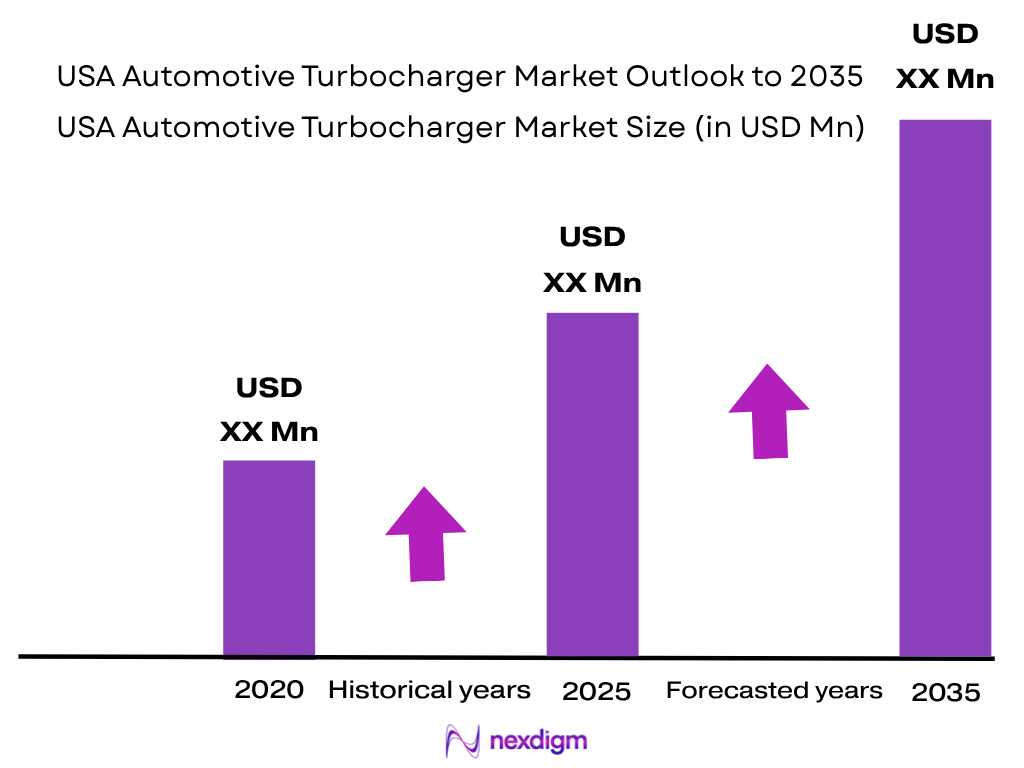
The USA Automotive Turbocharger Market is valued at approximately ~USD XX billion, based on the historical market assessment. Turbocharged gasoline engines expanded from more than 35% of light-duty production in the preceding model period to 44.4% in the latest finalized model period, demonstrating their mainstream role in U.S. powertrains. Domestic automobile and light-truck assemblies averaged 10.3874 million units and 10.2173 million units, respectively, across the corresponding periods, sustaining substantial OEM turbocharger fitment and replacement demand.
Michigan, Indiana and Illinois, particularly the Detroit-Auburn Hills automotive corridor, Franklin and Shelbyville, are important centers influencing the USA Automotive Turbocharger Market because they combine OEM engineering, Tier-1 supplier operations, turbocharger manufacturing and technical support. Mitsubishi operates U.S. turbocharger manufacturing in Franklin, Indiana, while IHI Turbo America operates in Shelbyville, Illinois. The broader U.S. automotive base averaged 10.2173 million automobile and light-truck assemblies, providing these manufacturing corridors with concentrated access to vehicle and engine programs.
Market Segmentation
By Turbocharger Technology
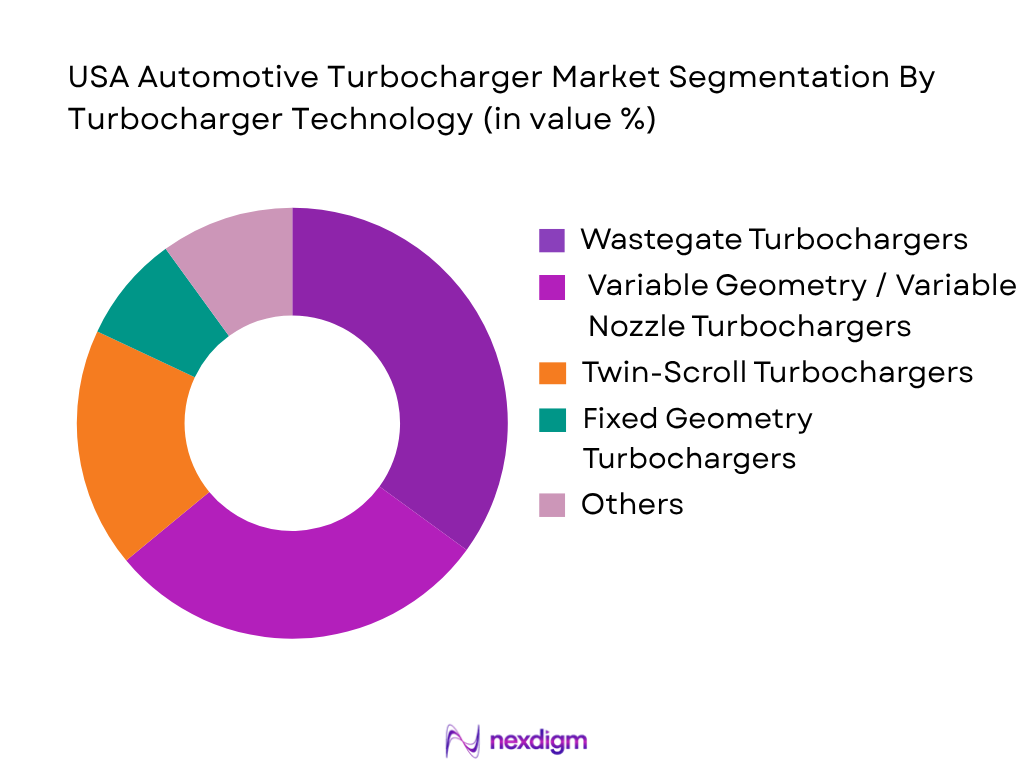
The USA Automotive Turbocharger Market is segmented by technology into wastegate turbochargers, variable geometry turbochargers, twin-scroll turbochargers, fixed geometry turbochargers, two-stage systems and electrically assisted boosting systems. Wastegate turbochargers hold the dominant position because the U.S. light-duty market has moved extensively toward downsized turbocharged gasoline engines across passenger cars, crossovers, SUVs and pickup trucks. These systems offer a commercially effective combination of boost control, manufacturing scalability, packaging flexibility and compatibility with gasoline direct-injection engines. EPA data demonstrate the depth of this application base, with gasoline turbocharged engines representing 44.4% of total light-duty production in model year 2024. Variable geometry technology maintains a particularly strong role in diesel pickups and commercial engines because it provides low-speed boost, exhaust-flow control and engine-braking functionality. Twin-scroll architectures are increasingly important for gasoline applications requiring rapid transient response, while advanced electrically assisted systems remain comparatively specialized and are primarily positioned for hybridized and higher-performance powertrains.
By Vehicle Type
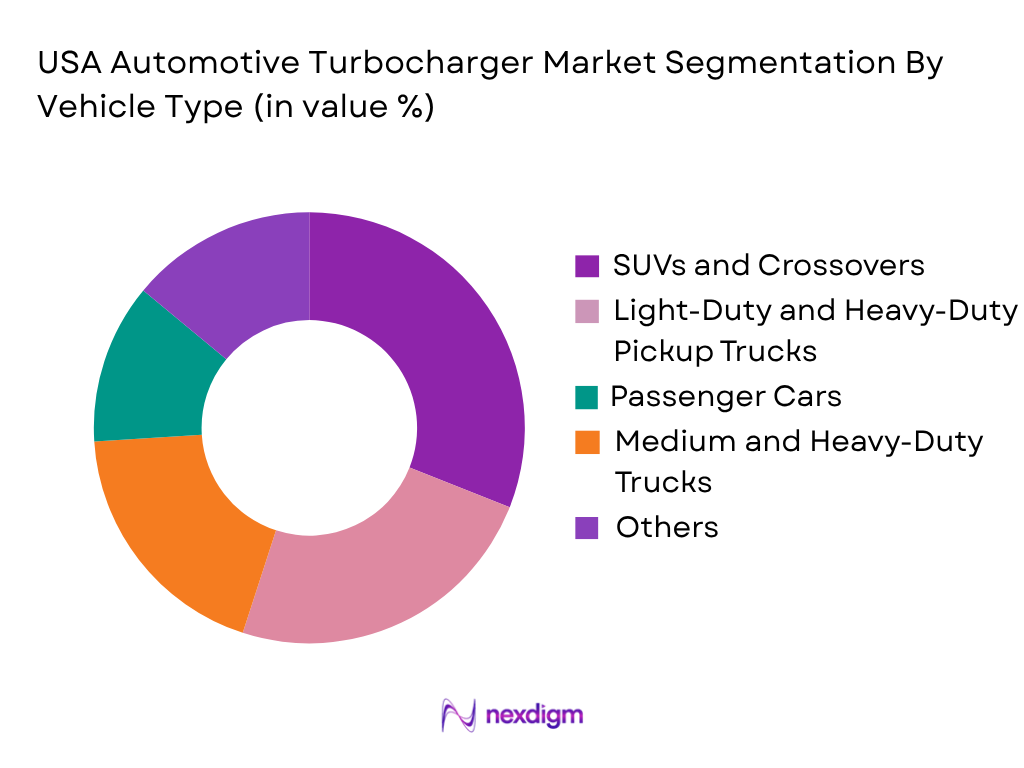
The USA Automotive Turbocharger Market is segmented by vehicle type into passenger cars, SUVs and crossovers, light-duty pickups, heavy-duty pickups, commercial vans, medium and heavy-duty trucks, buses and specialty vehicles. SUVs and crossovers represent the dominant individual application segment, reflecting the structural shift of U.S. light-vehicle production toward truck-classified and utility vehicles. EPA reports that 66% of new light-duty vehicles in model year 2024 were classified as trucks, while truck SUVs alone accounted for approximately half of new vehicle production. Turbocharged four- and six-cylinder engines are widely used across compact, midsize and larger utility vehicles to provide high torque while avoiding substantially larger naturally aspirated engines. Pickup trucks provide another critical demand pool through turbo-gasoline engines in light-duty platforms and variable-geometry diesel turbochargers in heavy-duty pickups. Commercial trucks remain strategically important because turbocharging is fundamental to modern high-torque diesel powertrains used for freight and vocational operations.
Competitive Landscape
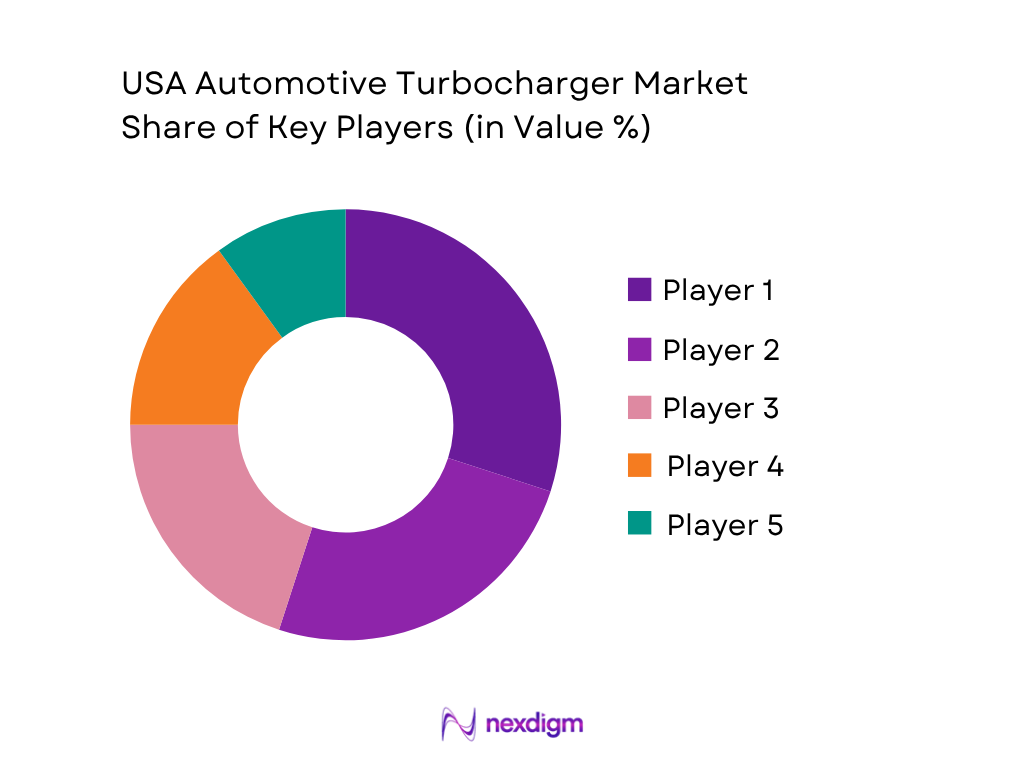
The USA Automotive Turbocharger Market is led by technologically established global suppliers with deep relationships across North American vehicle and engine manufacturers. Garrett Motion, BorgWarner, Mitsubishi Turbocharger and Engine America, IHI and Cummins Turbo Technologies compete across gasoline downsizing, diesel VGT, pickup, heavy-duty and aftermarket applications. Competition increasingly depends on OEM engineering integration, electronic actuation, high-temperature gasoline capability, North American production, remanufacturing coverage and the ability to extend traditional turbo expertise into electrically assisted air-management technologies. Mitsubishi and IHI maintain physical turbocharger manufacturing operations in the United States, while BorgWarner operates its global headquarters and propulsion technical infrastructure in Michigan.
| Major Player | Establishment Year | Headquarters | Wastegate / Gasoline Turbo | VGT / VNT Capability | Heavy-Duty Diesel Capability | U.S. Manufacturing / Engineering | Aftermarket / Remanufacturing | Electrified Boosting Readiness |
| Garrett Motion Inc. | 1954 | Rolle, Switzerland | ~ | ~ | ~ | ~ | ~ | ~ |
| BorgWarner Inc. | 1928 | Auburn Hills, Michigan, USA | ~ | ~ | ~ | ~ | ~ | ~ |
| Mitsubishi Heavy Industries / MTEA | 1884 | Tokyo, Japan | ~ | ~ | ~ | ~ | ~ | ~ |
| IHI Corporation / IHI Turbo America | 1853 | Tokyo, Japan | ~ | ~ | ~ | ~ | ~ | ~ |
| Cummins Turbo Technologies | 1919 | Columbus, Indiana, USA | ~ | ~ | ~ | ~ | ~ | ~ |
USA Automotive Turbocharger Market Analysis
Growth Drivers
Large Light-Vehicle Production Base Supporting Mainstream Turbocharger Fitment
The large U.S. light-vehicle production base is a direct growth driver for automotive turbochargers because gasoline turbocharging is embedded across mainstream cars, crossovers, SUVs and pickups rather than limited to performance models. The U.S. Environmental Protection Agency reports that 14,799,239 light-duty vehicles were produced for sale in the United States in model year 2024. EPA also identifies turbocharging as a major engine-efficiency technology used with gasoline direct injection and variable valve timing, particularly in downsized four-cylinder engines. The U.S. Bureau of Economic Analysis recorded a December 2024 light-vehicle sales pace of 16.840 million units at a seasonally adjusted annual rate, demonstrating the scale of new-vehicle demand feeding OEM turbocharger fitment. The World Bank records U.S. GDP at USD 28.75 trillion, GDP per capita at USD 84,534, and population at 340,110,988 in 2024. This combination of high vehicle output, purchasing capacity and a large consumer base supports recurring demand for wastegate, twin-scroll, variable-geometry, electronic-actuator and replacement turbocharger systems across original-equipment and aftermarket channels. The continuing transition toward smaller boosted engines also increases demand for precise boost-control hardware, thermal-management integration and replacement actuators as these vehicles accumulate mileage in the national fleet.
Heavy-Duty Truck Fleet Sustaining Diesel Turbocharger and VGT Demand
Heavy-duty truck activity is another market-specific growth driver because contemporary diesel truck engines depend on turbocharging for low-speed torque, combustion efficiency, exhaust-gas management and engine-braking performance. U.S. Bureau of Economic Analysis monthly data show 482,054 heavy-weight trucks were sold during 2024 when the twelve non-seasonally adjusted monthly observations are summed, including 44,969 units in December alone. Federal Highway Administration data further show 12,599,614 single-unit trucks with six or more tires and 3,482,896 combination trucks registered in the United States in 2024. Those fleets create a substantial installed base for variable-geometry turbochargers, actuators, center housing rotating assemblies, bearings and remanufactured units. The same FHWA dataset records 55,276 average annual miles traveled per combination truck, highlighting the intensive operating conditions that accelerate turbocharger service requirements. Macroeconomic capacity remains supportive: World Bank data place 2024 U.S. GDP at USD 28.75 trillion and population at 340,110,988. Freight-intensive economic activity therefore sustains both OEM heavy-duty turbocharger demand and a recurring replacement market tied to high-utilization diesel fleets. Because heavy trucks operate under sustained load and high exhaust temperatures, turbocharger durability, vane control, shaft balancing and lubrication integrity remain critical purchasing criteria for fleets and service providers.
Market Challenges
Battery-Electric Vehicle Adoption Reducing the Addressable Exhaust-Turbo Base
Battery-electric vehicle adoption creates a structural challenge for the USA Automotive Turbocharger Market because a battery-electric drivetrain eliminates the exhaust-driven turbocharger used in gasoline and diesel engines. U.S. Energy Information Administration data show electricity consumed by light-duty battery-electric vehicles reached 14,289,717 megawatt-hours in 2024 and increased to 19,341,255 megawatt-hours in 2025. Plug-in hybrid electric vehicles consumed another 3,510,497 megawatt-hours in 2024 and 4,191,600 megawatt-hours in 2025. These absolute usage figures show that electrified drivetrains are becoming a larger part of U.S. road transportation, creating substitution risk for conventional turbocharger fitment as fully electric vehicles displace internal-combustion platforms. The pressure is especially relevant in passenger cars and urban crossovers, where powertrain electrification can proceed faster than in heavy-duty diesel applications. World Bank data show the United States had GDP of USD 28.75 trillion, GDP per capita of USD 84,534 and population of 340,110,988 in 2024, giving manufacturers a large addressable vehicle market in which powertrain shifts can materially alter component demand. Turbocharger suppliers must therefore diversify toward hybrid boosting, electric compressors and fuel-cell air systems. This forces suppliers to redirect engineering toward technologies that remain relevant when exhaust energy is no longer available for boosting.
Emissions Compliance and Calibration Complexity Constraining the Performance Aftermarket
Aftermarket emissions compliance and calibration complexity present a specific challenge for U.S. turbocharger distributors, performance specialists and repair businesses. Modern turbocharged engines integrate boost pressure, electronic wastegate or VGT actuation, fuel injection, catalyst operation and onboard diagnostics, meaning improper tuning can move a vehicle outside its certified emissions configuration. The U.S. Environmental Protection Agency reported in September 2024 that COBB Tuning had manufactured or sold more than 90,000 aftermarket defeat devices since January 2015, illustrating the scale at which non-compliant performance modifications can reach the vehicle parc. In January 2025, EPA stated that White’s Diesel Performance had sold or installed at least 748 aftermarket defeat devices, reinforcing continued federal enforcement in diesel-oriented aftermarket channels. The operating base is large: Federal Highway Administration data record 297,525,836 registered motor vehicles in the United States in 2024, including 65,534,861 long-wheelbase light-duty vehicles and 12,599,614 larger single-unit trucks. World Bank data place 2024 U.S. GDP at USD 28.75 trillion. This environment raises compliance, diagnostic and documentation requirements for turbocharger upgrades, actuator replacement, remanufacturing and performance calibration businesses. Suppliers therefore need validated applications, software compatibility and emissions-safe calibration before upgraded turbo hardware can be marketed confidently.
Market Opportunities
Expanding Vehicle Parc Supporting Replacement, CHRA and Remanufacturing Demand
The expanding U.S. vehicle parc creates a strong future opportunity for turbocharger replacement, remanufacturing, CHRA supply and specialist diagnostics because installed vehicles continue generating service demand long after original production. Federal Highway Administration statistics show 297,525,836 registered motor vehicles in 2024, up from 284,614,269 in 2023, while registered long-wheelbase light-duty vehicles reached 65,534,861 and combination trucks reached 3,482,896. FHWA also records 3,294,031 million vehicle-miles of travel in 2024, indicating extremely high cumulative utilization across the national fleet. Turbocharged pickups, SUVs, passenger vehicles and commercial trucks operating within this parc require replacement bearings, seals, compressor wheels, turbine assemblies, electronic actuators, oil lines and complete turbochargers as mileage accumulates. Heavy commercial applications are especially attractive for remanufacturing because component housings can often be retained while rotating assemblies and actuators are restored or replaced. World Bank data record U.S. GDP of USD 28.75 trillion, GDP per capita of USD 84,534 and population of 340,110,988 in 2024. These current indicators support future expansion of specialized repair capacity, high-speed balancing, actuator calibration and nationwide aftermarket distribution. An aging parc also favors suppliers with broad application catalogs, rapid parts availability and strong workshop support.
Hybridization Creating Scope for Electrically Assisted and Advanced Boosting Systems
Advanced boosting for hybridized and emissions-constrained powertrains represents a future growth opportunity because U.S. manufacturers still require high-efficiency combustion engines even as electrification expands. The U.S. Environmental Protection Agency reports 14,799,239 light-duty vehicles produced for the U.S. market in model year 2024, providing a large engineering base for technologies that improve torque, transient response and engine downsizing. The U.S. Energy Information Administration records 3,510,497 megawatt-hours of electricity consumption by plug-in hybrid light-duty vehicles in 2024, rising to 4,191,600 megawatt-hours in 2025, showing that combustion engines and electrified components increasingly coexist in the same powertrain architecture. This creates room for electronically actuated wastegates, variable-geometry gasoline turbochargers, electrically assisted turbochargers and e-compressors that can reduce lag and support smaller engines. World Bank data place U.S. GDP at USD 28.75 trillion, GDP per capita at USD 84,534 and population at 340,110,988 in 2024, supporting continued investment in advanced vehicle technology. Suppliers that combine traditional high-speed turbine expertise with electric motors, power electronics and compressor controls can extend their addressable applications beyond conventional turbocharged ICE vehicles. Hybrid architectures can preserve combustion-engine boosting demand while adding electrical assistance, extending supplier participation beyond conventional exhaust-only systems.
Future Outlook
The USA Automotive Turbocharger Market is expected to expand at approximately ~X.X% CAGR during 2026–2035, although the market will increasingly balance conventional turbocharged ICE demand against vehicle electrification. Turbo-gasoline engines, SUVs, pickup trucks, hybrids and heavy-duty diesel vehicles should sustain the addressable market, while replacement and remanufacturing demand will extend beyond new-vehicle production cycles. Gasoline turbocharging remains one of the strongest foundations for future demand. EPA’s finalized technology data show gasoline turbocharged engines accounted for 44.4% of U.S. light-duty vehicle production in model year 2024, compared with 37.3% in model year 2023. Most gasoline turbocharged vehicles increasingly use four-cylinder engines, reflecting continued downsizing while maintaining required horsepower and torque.
SUVs and pickups will be particularly important. EPA reports that trucks represented 66% of new light-duty production in model year 2024, and truck SUVs alone accounted for approximately half of production. This vehicle mix favors turbocharger suppliers because utility vehicles require strong low-speed torque, towing capability and acceleration despite continuing pressure on fuel consumption and emissions. Heavy-duty diesel turbocharging should remain resilient because medium- and heavy-duty engines depend strongly on boost pressure for torque, combustion efficiency, exhaust-gas management and engine braking. Variable geometry turbochargers and electronically controlled actuators will remain important for pickups, trucks, buses and vocational equipment.
Major Players
- Garrett Motion Inc.
- BorgWarner Inc.
- Mitsubishi Turbocharger and Engine America, Inc.
- IHI Corporation / IHI Turbo America
- Cummins Turbo Technologies
- BMTS Technology GmbH & Co. KG
- MAHLE GmbH / MAHLE Aftermarket North America
- Standard Motor Products, Inc.
- Melett Ltd. / Wabtec Corporation
- Rotomaster International
- Precision Turbo & Engine
- Turbosmart USA
- Turbo Energy Private Limited
- Weifu Tianli Turbocharging Technology Co., Ltd.
- Keyyang Precision Co., Ltd.
Key Target Audience
- Automotive Turbocharger and Advanced Boosting System Manufacturers
- Passenger Vehicle SUV and Pickup Truck OEMs
- Medium and Heavy-Duty Vehicle and Diesel Engine Manufacturers
- Automotive Tier-1 and Precision Turbocharger Component Manufacturers
- Turbocharger Distributors Remanufacturers and Automotive Aftermarket Networks
- Commercial Vehicle Fleet Operators and Fleet Maintenance Organizations
- Investments and Venture Capitalist Firms
- Government and Regulatory Bodies (U.S. Environmental Protection Agency, National Highway Traffic Safety Administration, U.S. Department of Transportation, U.S. Department of Energy, California Air Resources Board)
Research Methodology
Step 1: Identification of Key Variables
The initial phase involves constructing an ecosystem map of vehicle OEMs, engine manufacturers, turbocharger manufacturers, component suppliers, distributors, remanufacturers, workshops and fleet operators within the USA Automotive Turbocharger Market. Secondary and proprietary information is analyzed to establish the key variables influencing demand, including turbocharged engine penetration, vehicle production, engine displacement, gasoline-diesel applications, technology architecture, OEM fitment and replacement cycles.
Step 2: Market Analysis and Construction
Historical demand is constructed by assessing U.S. light-vehicle production, turbocharged engine fitment, pickup and SUV applications, medium- and heavy-duty diesel fleets and replacement requirements. A top-down automotive-production framework is reconciled with bottom-up estimates developed from engine architecture, turbocharger units per vehicle, OEM fitment, vehicle survival, aftermarket replacement and remanufacturing activity to establish internally consistent market estimates.
Step 3: Hypothesis Validation and Expert Consultation
Market hypotheses are validated through computer-assisted telephone interviews with turbocharger suppliers, automotive component distributors, engine specialists, fleet maintenance organizations, remanufacturers and independent repair facilities. Consultation focuses on wastegate and VGT adoption, gasoline versus diesel applications, replacement intervals, CHRA usage, electronic actuator demand, remanufacturing penetration, OEM sourcing patterns and changes in technical requirements across major vehicle categories.
Step 4: Research Synthesis and Final Output
The final stage triangulates vehicle production, engine technology, turbocharger fitment, component supply and replacement-market observations. Supplier-side assessments are reconciled with distributor and service-channel information to minimize double counting between OE, OES, independent aftermarket and remanufactured units. The resulting framework provides a comprehensive evaluation of technology, vehicle application, competitive positioning, replacement behavior and future strategic developments across the USA Automotive Turbocharger Market.

- Executive Summary
- Research Methodology (Market Definition and Scope, USA Automotive Turbocharger Taxonomy, Fixed Geometry and Variable Geometry Turbocharger Classification, Gasoline and Diesel Turbocharged Engine Mapping, Turbocharged Vehicle Parc Assessment, New Vehicle Registration Assessment, OEM Production and Turbocharger Fitment Mapping, Pickup and Commercial Vehicle Turbocharger Demand Assessment, Passenger Vehicle Turbocharger Demand Assessment, Replacement and Remanufacturing Analysis, OE OES and Independent Aftermarket Mapping, North American Manufacturing and Distribution Network Assessment, Market Sizing Framework)

- Definition and Scope
- USA Automotive Turbocharger Industry Evolution and Technology Development
- Automotive Turbocharger Manufacturing and Assembly Process
- Automotive Turbocharger Value Chain Analysis
- USA Automotive Turbocharger Supply Chain Analysis
- Compressor Wheel, Turbine Wheel, CHRA, Shaft, Bearing Housing, Turbine Housing,
- Actuator and Variable Vane Ecosystem Analysis
- USA Turbocharged Engine and Vehicle Manufacturing Footprint and Localization Assessment
- OEM Procurement, Distributor, Remanufacturer and Automotive Turbocharger Service Framework

- Growth Drivers (High Penetration of Turbo-Gasoline Engines, Downsized Engine Adoption, Pickup and SUV Turbo Applications, Heavy-Duty Diesel Fleet Demand, OEM Fuel-Efficiency Technology Deployment, Turbocharged Gasoline Direct-Injection Engine Adoption, Commercial Fleet Replacement Demand, Advanced Boost-Control Technology)
- Market Challenges (Battery Electric Vehicle Substitution, High Turbocharger Thermal Loading, Oil Contamination and Lubrication Failures, Variable Geometry Actuator Complexity, Engine-Specific Calibration Requirements, Aftermarket Quality Variability, Counterfeit Replacement Components, Skilled Turbocharger Repair Requirements)
- Market Opportunities (Gasoline Variable Geometry Turbochargers, Turbocharger Replacement for High-Volume Light Vehicles, Heavy-Duty Diesel Remanufacturing, Electronic Wastegate and VGT Actuators, Electric Turbochargers and E-Boosters, Hybrid Powertrain Boosting Systems, Performance Turbocharger Applications, North American Turbocharger Localization)
- Market Trends (Turbocharged Gasoline Engine Mainstream Adoption, Three- and Four-Cylinder Engine Downsizing, Gasoline VGT Deployment, Twin-Scroll Turbo Adoption, Electronic Wastegate Actuation, Integrated Exhaust Manifold Systems, Two-Stage Diesel Turbocharging, Electrically Assisted Boosting)
- Regulatory and Standards Landscape (Environmental Protection Agency Light-Duty Greenhouse Gas Requirements, Environmental Protection Agency Heavy-Duty Engine and Vehicle Requirements, National Highway Traffic Safety Administration Fuel Economy Requirements, On-Board Diagnostics Requirements, Federal Emission Warranty Requirements, California Air Resources Board Emission Requirements, North American Content and USMCA Supply Requirements, Aftermarket Emission Compliance)
- SWOT Analysis
- Porter’s Five Forces Analysis
- PESTLE Analysis
- Stakeholder Ecosystem
- Competition Ecosystem

- By Market Value (2020-2025)
- By Automotive Turbocharger Installation Volume (2020-2025)
- By OEM Turbocharger Fitment Volume (2020-2025)
- By Replacement Turbocharger Volume (2020-2025)
- By Gasoline Turbocharger Volume (2020-2025)
- By Diesel Turbocharger Volume (2020-2025)

- By Turbocharger Technology (In Value %)
Wastegate Turbochargers
Variable Geometry Turbochargers
Variable Nozzle Turbochargers
Fixed Geometry Turbochargers
Twin-Scroll Turbochargers
Two-Stage Turbocharging Systems
Sequential Turbocharging Systems
Parallel Twin-Turbo Systems
Electronically Actuated Turbochargers
Electric Turbochargers and E-Boosting Systems - By Vehicle Type (In Value %)
Passenger Cars
Compact SUVs and Crossovers
Mid-Size SUVs
Full-Size SUVs
Light-Duty Pickup Trucks
Heavy-Duty Pickup Trucks
Passenger Vans
Light Commercial Vans
Medium-Duty Trucks
Heavy-Duty Trucks
Buses and Coaches
Vocational and Severe-Service Vehicles
Specialty and Performance Vehicles - By Fuel and Powertrain Type (In Value %)
Turbocharged Gasoline Internal Combustion Vehicles
Turbocharged Diesel Internal Combustion Vehicles
48V Mild Hybrid Turbocharged Vehicles
Full Hybrid Turbocharged Vehicles
Plug-In Hybrid Turbocharged Vehicles
Natural Gas Turbocharged Vehicles
Ethanol-Compatible Turbocharged Vehicles
Other Turbocharged Combustion Powertrains - By Engine Displacement (In Value %)
Below 1.5-Liter Engines
1.5-Liter to 2.0-Liter Engines
Above 2.0-Liter to 3.0-Liter Engines
Above 3.0-Liter to 5.0-Liter Engines
Above 5.0-Liter to 7.0-Liter Engines
Above 7.0-Liter to 10.0-Liter Engines
Above 10.0-Liter Engines - By Sales Channel (In Value %)
Vehicle OEM Direct Fitment
Engine Manufacturer Direct Fitment
Original Equipment Service Channel
Authorized Turbocharger Distributors
Automotive Parts Distributors
Heavy-Duty Parts Distributors
Independent Automotive Aftermarket
Turbocharger Repair Specialists
Turbocharger Remanufacturing Companies
Fleet Maintenance Networks
Performance Automotive Specialists
Online Automotive Parts Platforms - By Application Type (In Value %)
Engine Downsizing and Fuel-Efficiency Applications
Passenger Vehicle Performance Enhancement
SUV and Crossover Torque Enhancement
Pickup Truck Towing Applications
Heavy-Duty Diesel Power Applications
Commercial Fleet Applications
Vocational and Severe-Duty Applications
Performance and Motorsport Applications
Emission-Control Optimization Applications
Hybrid Engine Boosting Applications

- Market Share of Major Players (By Revenue, Unit Volume, OEM Fitment, Gasoline Turbochargers, Diesel Turbochargers, Light-Duty Applications, Pickup and Commercial Vehicle Applications, Replacement Channel)
- Cross Comparison Parameters (USA OEM Fitment and North American Turbocharger Manufacturing Footprint, Wastegate Twin-Scroll and Variable Geometry Turbocharger Technology Breadth, Passenger SUV Pickup and Heavy-Duty Commercial Vehicle Application Coverage, High-Temperature Gasoline and Heavy-Duty Diesel Turbo Capability, Electronic Wastegate VGT and Advanced Boost-Control Capability, USA Authorized Distribution Parts Availability and Technical Support Network, Replacement Remanufacturing CHRA and Turbo Diagnostics Capability, Hybrid E-Turbo Fuel-Cell Air Management and Future Boosting Readiness)
- SWOT Analysis of Major Players
- Competitive Positioning Matrix
- Product and Technology Portfolio Benchmarking
- Pricing and Distribution Network Benchmarking
- Market Entry Strategy Assessment
- Detailed Profiles of Major Companies
Garrett Motion Inc. – Wastegate / VNT Variable Geometry / Twin-Stage / Gasoline and Diesel Turbochargers
BorgWarner Inc. – Wastegate / Variable Turbine Geometry / Gasoline / Diesel / Electrified Boosting Systems
Mitsubishi Turbocharger and Engine America, Inc. – Wastegate / Variable Geometry / Twin-Scroll Turbochargers / USA Manufacturing
IHI Corporation / IHI Turbo America – Gasoline / Diesel / Passenger Vehicle / Light-Truck Turbochargers
Cummins Turbo Technologies – Holset Fixed Geometry / Wastegate / VGT / Heavy-Duty Commercial Vehicle Turbochargers
BMTS Technology GmbH & Co. KG – Wastegate / Variable Geometry / Electrically Actuated Turbochargers
MAHLE GmbH / MAHLE Aftermarket North America – Gasoline / Diesel / Replacement Turbochargers / CHRA Systems
Standard Motor Products, Inc. – New and Remanufactured Gasoline / Diesel Turbocharger Kits / Turbo Components
Melett Ltd. / Wabtec Corporation – CHRA / Turbocharger Core Assemblies / Precision Replacement Components
Rotomaster International – New and Remanufactured Turbochargers / CHRA / Light and Heavy-Duty Applications
Precision Turbo & Engine – Performance Turbochargers / Ball-Bearing Systems / Motorsport and High-Performance Applications
Turbosmart USA – Performance Turbochargers / Wastegates / Boost-Control Systems / High-Output Applications
Turbo Energy Private Limited – Passenger Vehicle / Diesel / Gasoline / OEM and Replacement Turbochargers
Weifu Tianli Turbocharging Technology Co., Ltd. – Diesel / Commercial Vehicle / Passenger Vehicle Turbocharging Systems
Keyyang Precision Co., Ltd. – Automotive Turbochargers / Compressor and Turbine Assemblies / Replacement Applications

- Automotive Turbocharger Buyer Segmentation
- OEM and Engine Manufacturer Procurement Behaviour
- Turbocharger Supplier and Distributor Selection Criteria
- Fleet and Aftermarket Buyer Pain Points
- Turbocharger Technology Adoption Assessment
- Replacement and Repurchase Behaviour

- By Market Value (2026-2035)
- By Automotive Turbocharger Installation Volume (2026-2035)
- By OEM Turbocharger Fitment Volume (2026-2035)
- By Replacement Turbocharger Volume (2026-2035)
- By Gasoline Turbocharger Volume (2026-2035)
- By Diesel Turbocharger Volume (2026-2035)


 Request a Sample
 Ask for Customization
 Get a Quote
 Enquire Now