
 Download PDF
Market Overview
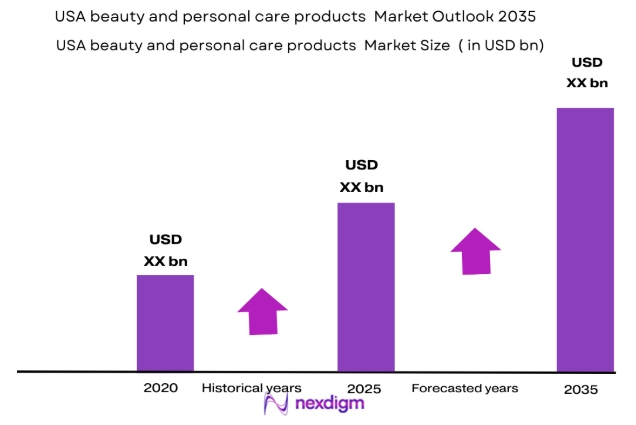
The USA beauty and personal care products market is valued at approximately USD ~ billion, based on aggregated consumption data from U.S. Bureau of Economic Analysis and U.S. Census Bureau. The market expanded from nearly USD 98 billion, driven by rising consumer expenditure on personal grooming and wellness. Personal consumption expenditures on personal care products exceeded USD 120 billion, reflecting strong domestic demand. Growth is supported by increased spending on skincare, premium cosmetics, and hygiene products, alongside rapid expansion of digital retail channels.
The market is dominated by states such as California, New York, and Texas due to high population density, strong retail infrastructure, and concentration of beauty brands. California leads due to its innovation ecosystem and proximity to beauty startups and influencers, while New York benefits from its role as a fashion and retail hub. Texas contributes through its large consumer base and expanding retail networks, supporting strong product penetration across diverse consumer segments.
Market Segmentation
By Product Type
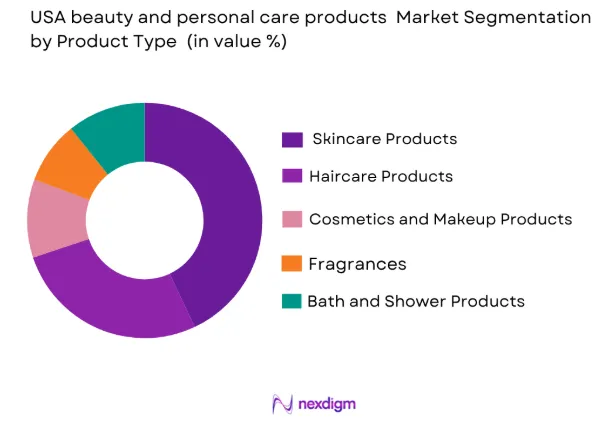
USA beauty and personal care products market is segmented by product type into skincare products, haircare products, cosmetics and makeup, fragrances, bath and shower products, and oral care products. Skincare products dominate the market due to increasing consumer focus on wellness, anti-aging, and dermatological health. The influence of clinical skincare brands and dermatologist-backed formulations has strengthened this segment. Additionally, rising demand for sunscreens, serums, and moisturizers driven by awareness campaigns and social media trends has increased consumption frequency. The availability of premium and organic skincare solutions further reinforces the dominance of this segment, supported by strong product innovation and consumer loyalty.
By Distribution Channel
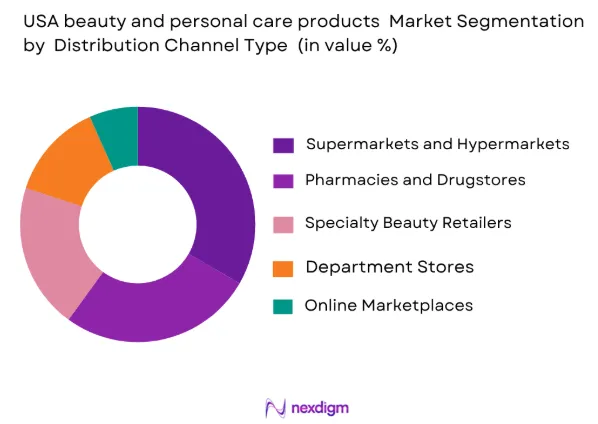
USA beauty and personal care products market is segmented by distribution channel into supermarkets and hypermarkets, online marketplaces, specialty beauty retailers, pharmacies and drugstores, department stores, and direct-to-consumer. Supermarkets and hypermarkets hold a dominant share due to their widespread presence and accessibility to a broad consumer base. Retail giants provide extensive product assortments, competitive pricing, and convenience, making them a preferred choice for everyday purchases. However, online marketplaces are rapidly gaining traction due to increasing internet penetration and consumer preference for convenience, offering a wide range of products, discounts, and personalized recommendations, contributing significantly to overall market growth.
Competitive Landscape
The USA beauty and personal care products market is highly competitive, characterized by the presence of established multinational corporations and emerging niche brands. Companies such as The Estée Lauder Companies and Procter & Gamble dominate the market through strong brand portfolios, extensive distribution networks, and continuous product innovation. The competitive intensity is further increased by direct-to-consumer brands leveraging digital platforms and influencer marketing.
| Company | Established | Headquarters | Product Portfolio | Distribution Reach | Innovation Capability | Brand Strength | Online Presence | Sustainability Initiatives |
| Estée Lauder Companies | 1946 | USA | ~ | ~ | ~ | ~ | ~ | ~ |
| Procter & Gamble | 1837 | USA | ~ | ~ | ~ | ~ | ~ | ~ |
| L’Oréal USA | 1953 | USA | ~ | ~ | ~ | ~ | ~ | ~ |
| Unilever | 1929 | UK/Netherlands | ~ | ~ | ~ | ~ | ~ | ~ |
| Coty Inc. | 1904 | USA | ~ | ~ | ~ | ~ | ~ | ~ |
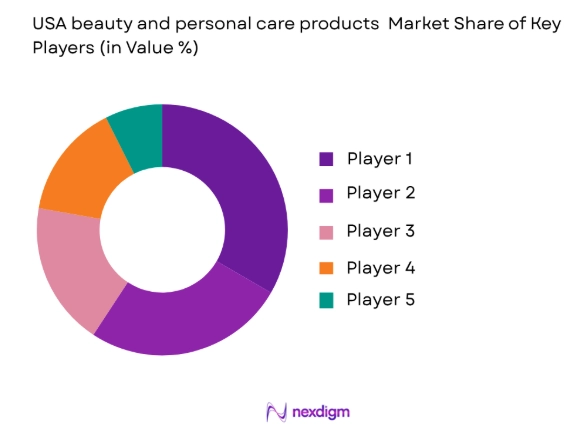
USA Beauty and Personal Care Products Market Analysis
Growth Drivers
Rising Consumer Spending on Personal Grooming and Self-Care
Rising consumer spending on personal grooming and self-care is strengthening demand across skincare, haircare, fragrances, bath products, cosmetics, and personal hygiene categories in the USA. BEA data published through FRED shows personal consumption expenditures on personal care reached USD 412.696 billion in 2024, compared with USD 387.556 billion in 2023 and USD 354.158 billion in 2022. In real terms, personal care expenditure reached USD 328.895 billion chained 2017 dollars in 2024, compared with USD 320.462 billion in 2023, indicating continued volume-backed consumption despite inflationary pressure. This supports frequent replenishment-led demand across everyday beauty and grooming products.
Expansion of E-Commerce and Social Commerce Beauty Channels
Expansion of e-commerce and digital retail channels is supporting beauty and personal care product penetration because consumers increasingly purchase skincare, makeup, haircare, fragrances, and grooming products through online marketplaces, brand websites, and mobile-led shopping journeys. The U.S. Census Bureau reported USD 352.9 billion in retail e-commerce sales during the fourth quarter of 2024, while total retail sales reached USD 1,883.3 billion in the same quarter. The Census Bureau also reported that total e-commerce sales reached USD 1,233.7 billion in 2025, confirming the large digital retail base available for beauty brands using online discovery, repeat ordering, subscriptions, and creator-linked product launches.
Market Challenges
Regulatory and Ingredient Compliance Requirements
Regulatory and ingredient compliance requirements are becoming more demanding for USA beauty and personal care brands as the FDA implements the Modernization of Cosmetics Regulation Act of 2022. FDA guidance issued in 2024 explains statutory requirements covering cosmetic product facility registration, product listing submissions, responsible parties, submission content, timing, and exemptions. FDA also states that manufacturers and processors must register facilities and renew registrations every 2 years, while the Cosmetics Direct portal was launched in December 2023 to support electronic submissions. This increases documentation, safety substantiation, adverse-event readiness, and operational compliance burden for cosmetics, skincare, haircare, fragrance, and grooming product suppliers.
Supply Chain Disruptions and Raw Material Volatility
Supply chain disruptions and raw material volatility remain a challenge because the USA beauty and personal care sector depends on imported finished products, fragrance inputs, essential oils, packaging materials, and specialized chemical ingredients. BEA reported that U.S. goods imports reached USD 3,295.6 billion in 2024, rising by USD 187.1 billion from the previous year, indicating continued exposure to international shipping and sourcing cycles. UN Comtrade data shows U.S. imports of essential oils, perfumes, cosmetics, and toiletries reached USD 23.21 billion in 2024. This dependence can affect production planning, SKU availability, supplier diversification, and launch timelines for brands using globally sourced ingredients and packaging.
Opportunities
Growth of Personalized and AI-Driven Beauty Solutions
Growth of personalized and AI-driven beauty solutions presents a future opportunity as U.S. consumers already operate within a large digital commerce ecosystem that supports quizzes, virtual try-ons, AI skin analysis, automated shade matching, and personalized product bundles. The U.S. Census Bureau reported USD 352.9 billion in retail e-commerce sales in the fourth quarter of 2024, alongside USD 1,883.3 billion in total quarterly retail sales. BEA-linked FRED data also shows personal consumption expenditures on personal care services reached USD 233.061 billion in 2024, compared with USD 214.609 billion in 2023. This creates a strong base for omnichannel personalization combining product retail, salons, dermatology-linked services, and loyalty data.
Rising Demand for Sustainable and Refillable Packaging
Rising demand for sustainable and refillable packaging presents a growth opportunity for USA beauty and personal care brands because cosmetics, skincare, haircare, and bath products rely heavily on jars, bottles, tubes, pumps, caps, cartons, and secondary packaging. EPA states that containers and packaging generated 82.2 million tons of municipal solid waste in its latest national materials dataset, while plastic containers and packaging accounted for more than 14.5 million tons. In 2024, EPA released the National Strategy to Prevent Plastic Pollution, with objectives covering plastic production reduction, product design innovation, waste reduction, improved management, capture, and reduced waterway impacts. These conditions support refillable, recyclable, and lower-plastic beauty packaging formats.
Future Outlook
Over the next five years, the USA beauty and personal care products market is expected to experience steady growth driven by increasing consumer focus on self-care, wellness, and premiumization. Advancements in product formulations, including clean beauty and dermatologist-approved solutions, will continue to shape consumer preferences. The expansion of digital platforms and influencer-driven marketing will further enhance market reach and engagement.The market is projected to grow at a CAGR of approximately 5.8% during the 2024-2030 period, supported by innovation in personalized beauty solutions, sustainable packaging, and the expansion of direct-to-consumer channels. Increasing disposable income and changing lifestyle patterns will continue to drive demand across various product categories.
Major Players
- Estée Lauder Companies
- Procter & Gamble
- L’Oréal USA
- Unilever
- Coty Inc.
- Johnson & Johnson Consumer Health
- Colgate-Palmolive
- Revlon
- e.l.f. Beauty
- Shiseido Americas
- Amorepacific US
- Kao USA
- Beiersdorf North America
- Edgewell Personal Care
- Bath & Body Works
Key Target Audience
- Beauty and personal care product manufacturers
- Retail chains and supermarket groups
- E-commerce platforms and online marketplaces
- Pharmaceutical and dermatology product distributors
- Luxury and specialty beauty retailers
- Investments and venture capitalist firms
- Government and regulatory bodies (U.S. Food and Drug Administration, Federal Trade Commission)
- Cosmetics and skincare product importers and exporters
Research Methodology
Step 1: Identification of Key Variables
The initial phase involves constructing an ecosystem map encompassing all major stakeholders within the USA beauty and personal care products market. This step is supported by extensive secondary research using government databases, trade reports, and company filings to identify key variables influencing demand and supply.
Step 2: Market Analysis and Construction
In this stage, historical consumption and revenue data are analyzed to estimate market size. Sector-wise demand across skincare, haircare, and cosmetics is evaluated to ensure accurate representation of revenue generation patterns and consumer preferences.
Step 3: Hypothesis Validation and Expert Consultation
Market assumptions are validated through interviews with industry experts, including manufacturers, distributors, and retailers. These consultations provide insights into pricing trends, product demand, and market challenges.
Step 4: Research Synthesis and Final Output
The final stage integrates findings from primary and secondary research to deliver a comprehensive market analysis. Data triangulation ensures accuracy and reliability, resulting in a validated market outlook.

- Executive Summary
- Research Methodology (Market Definitions and Assumptions, Abbreviations, Market Sizing Approach, Consolidated Research Approach, Understanding Market Potential Through In-Depth Industry Interviews, Primary Research Approach, Limitations and Future Conclusions)

- Definition and Scope
- Market Dynamics Overview
- Market Genesis
- Major Players and Market Timeline
- Business Cycle and Trends
- Supply Chain and Value Chain Analysis

- Growth Drivers
Rising Consumer Spending on Personal Grooming and Self-Care
Increasing Demand for Natural, Clean, and Organic Beauty Products
Expansion of E-Commerce and Social Commerce Beauty Channels - Market Challenges
High Competition and Brand Saturation
Regulatory and Ingredient Compliance Requirements
Supply Chain Disruptions and Raw Material Volatility - Opportunities
Growth of Personalized and AI-Driven Beauty Solutions
Expansion of Men’s Grooming and Gender-Neutral Products
Rising Demand for Sustainable and Refillable Packaging - Trends
Shift toward clean-label and dermatologist-backed products
Rising influence of beauty creators and social media platforms - Government Regulations
- SWOT Analysis
- Porter’s Five Forces

- By Value, 2020-2025
- By Volume, 2020-2025
- By Average Price, 2020-2025

- By Product Type (In Value %)
Skincare Products
Haircare Products
Cosmetics and Makeup Products
Fragrances
Bath and Shower Products - By Category (In Value %)
Mass Beauty and Personal Care
Premium Beauty and Personal Care
Dermo cosmetics
Natural and Organic Products - By Consumer Group (In Value %)
Women
Men
Children and Baby Care
Unisex Consumers - By Distribution Channel (In Value %)
Supermarkets and Hypermarkets
Pharmacies and Drugstores
Specialty Beauty Retailers
Department Stores
Online Marketplaces - By Region (In Value %)
California
New York
Texas
Florida
Illinois

- Market Share of Major Players by Value/Volume
- Market Share of Major Players by Product Type
- Cross Comparison Parameters (Company Overview, Business Strategies, Recent Developments, Strength, Weakness, Organizational Structure, Revenues, Revenues by Product Type, Number of Touchpoints, Distribution Channels, Number of Retail Partners and Distributors, Margins, Production Plant, Capacity, Unique Value Offering and Others)
- SWOT Analysis of Major Players
- Pricing Analysis Based on Product Categories for Major Players
- Detailed Profiles of Major Companies
L’Oréal USA
Estée Lauder Companies
Procter & Gamble
Unilever
Coty Inc.
Johnson & Johnson Consumer Health
Colgate-Palmolive
Revlon
e.l.f. Beauty
Shiseido Americas
Amorepacific US
Kao USA
Beiersdorf North America
Edgewell Personal Care
Bath & Body Works

- Market Demand and Utilization
- Purchasing Power and Budget Allocations
- Regulatory and Compliance Requirements
- Needs, Desires, and Pain Point Analysis
- Decision-Making Process

- By Value, 2026-2035
- By Volume, 2026-2035
- By Average Price, 2026-2035


 Request a Sample
 Ask for Customization
 Get a Quote
 Enquire Now