
 Download PDF
Market Overview
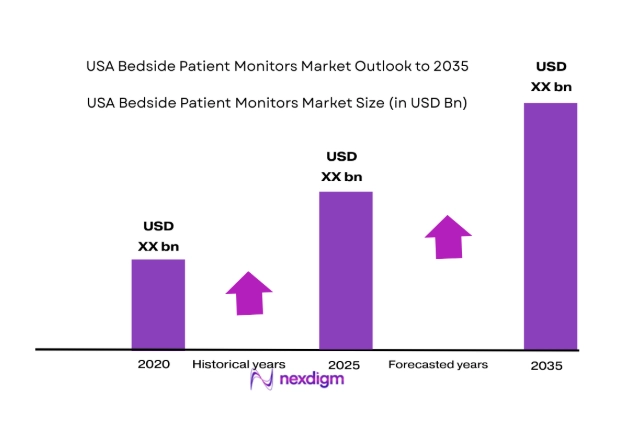
The USA Bedside Patient Monitors market is valued at approximately USD ~ billion, with strong growth driven by advances in medical technology and increasing demand for more accurate and reliable patient monitoring systems in hospitals and healthcare settings. This market has been expanding steadily due to rising healthcare expenditures, an aging population, and the growing prevalence of chronic diseases like heart disease, diabetes, and respiratory disorders. The push for better patient outcomes through real-time data and continuous monitoring is contributing to the growth of this sector. In 2024, the market is projected to maintain a significant growth trajectory as healthcare providers invest in advanced monitoring technologies.
The dominant regions in the USA Bedside Patient Monitors market are primarily driven by metropolitan hubs like New York, California, and Texas. These cities are home to leading healthcare institutions, research centers, and hospitals that require state-of-the-art patient monitoring systems to cater to their large populations. Additionally, California, known for its technological innovation, has seen significant adoption of wireless and remote patient monitoring solutions, further driving market growth. The healthcare infrastructure in these states, coupled with favorable government policies for advanced healthcare technologies, solidifies their position as market leaders.
Market Segmentation
By Product Type
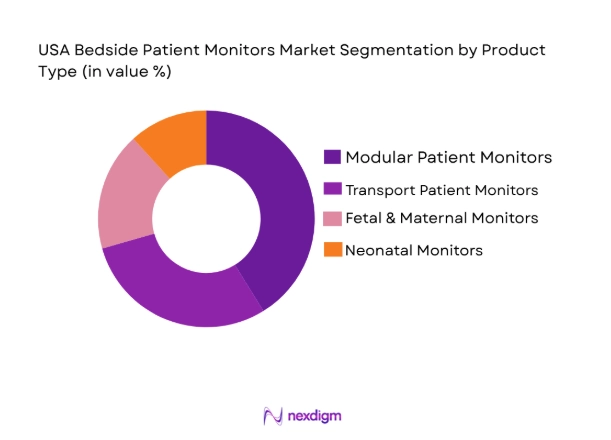
The USA Bedside Patient Monitors market is segmented by product type into modular patient monitors, transport patient monitors, fetal and maternal monitors, neonatal monitors, and other bedside patient monitors. Among these, modular patient monitors are expected to hold the largest market share in 2024. This dominance can be attributed to their flexibility in usage across various healthcare settings, such as hospitals, emergency departments, and intensive care units. Modular monitors allow healthcare providers to customize the system according to patient needs, making them ideal for a wide range of patient conditions. Additionally, the continuous advancements in modular technology, including wireless capabilities and integration with other medical devices, are contributing to the growing preference for this segment.
By Application Type
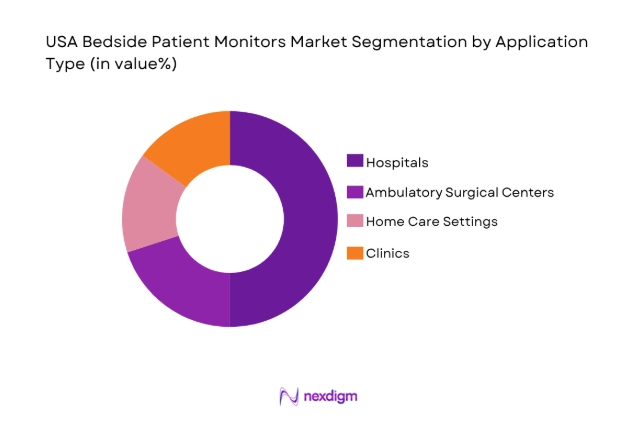
In terms of application, the USA Bedside Patient Monitors market is segmented into hospitals, ambulatory surgical centers, home care settings, and clinics. Hospitals are expected to dominate the market share in 2024, owing to the high demand for advanced patient monitoring systems in critical care units such as ICU and emergency rooms. Hospitals require real-time, continuous monitoring to track patient vitals, detect early signs of deterioration, and enhance patient care outcomes. The increasing number of hospital admissions, especially chronic diseases and surgeries, further reinforces the importance of bedside monitors in these environments.
Competitive Landscape
The USA Bedside Patient Monitors market is highly competitive, with several global and regional players. Major players like Philips Healthcare, GE Healthcare, and Medtronic are leading the market with their innovative products and strong market presence. The competition is mainly focused on technological advancements, such as wireless connectivity, AI integration, and the development of more portable solutions. These companies leverage their established brand reputation and extensive distribution networks to maintain a competitive edge. New entrants and regional players are also focusing on providing cost-effective and customized solutions to cater to niche market segments.
| Company | Establishment Year | Headquarters | Market Focus | Technology | Annual Revenue | Product Offering | Distribution Channels |
| Philips Healthcare | 1891 | Netherlands | ~ | ~ | ~ | ~ | ~ |
| GE Healthcare | 1892 | USA | ~ | ~ | ~ | ~ | ~ |
| Medtronic | 1949 | Ireland | ~ | ~ | ~ | ~ | ~ |
| Siemens Healthineers | 1847 | Germany | ~ | ~ | ~ | ~ | ~ |
| Mindray Medical | 1991 | China | ~ | ~ | ~ | ~ | ~ |
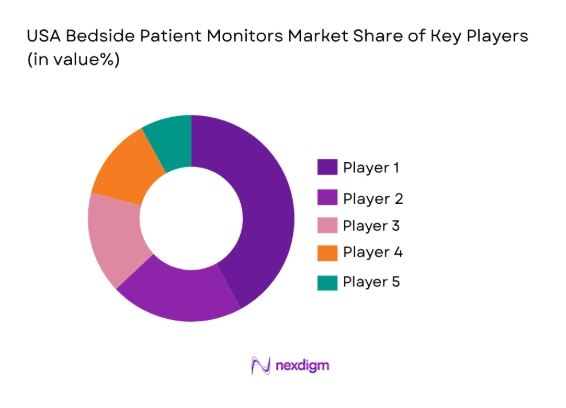
USA Bedside Patient Monitors Market Analysis
Growth Drivers
Urbanization
The increasing rate of urbanization in the USA plays a significant role in the growth of the Bedside Patient Monitors market. In 2023, approximately 83% of the U.S. population lived in urban areas, contributing to the expansion of healthcare infrastructure in cities. As urban centers grow, there is a higher demand for advanced medical technologies, including bedside patient monitors, due to the increasing number of hospitals and healthcare facilities needed to serve dense populations. This urban shift is a crucial factor driving the market, particularly in metropolitan areas such as New York and California. Urbanization brings higher healthcare demands, particularly for continuous monitoring devices.
Industrialization
The USA’s continuous industrial growth is another key driver of the Bedside Patient Monitors market. With the U.S. manufacturing sector contributing about USD 2.5 trillion to the economy in 2022, the demand for industrial safety and employee health monitoring has increased significantly. Industrial growth, especially in healthcare-related industries such as medical device manufacturing and hospitals, is fueling demand for advanced monitoring solutions. As hospitals and clinics expand with more machinery and automation, the need for sophisticated bedside patient monitors that ensure patient safety and healthcare efficiency continues to grow.
Restraints
High Initial Costs
The high initial costs of advanced bedside patient monitoring systems remain a significant barrier for smaller hospitals and healthcare facilities. In 2022, the average cost for high-quality patient monitoring equipment ranged from USD 5,000 to USD 20,000 per unit, depending on the complexity and features of the device. Smaller healthcare institutions, especially those in rural areas, struggle with these high costs, limiting their ability to implement the latest technologies. While healthcare spending is increasing, the initial costs for purchasing, installing, and maintaining these systems still present a significant barrier, especially considering the budget constraints faced by smaller healthcare providers.
Technical Challenges
Technical challenges, including integration with existing healthcare infrastructure and ensuring system compatibility, continue to pose a significant restraint on the market. As of 2023, over 60% of healthcare systems in the U.S. were found to have compatibility issues with new patient monitoring devices. This leads to delays in the adoption of modern bedside monitors and additional costs related to system integration. Furthermore, the need for continuous software updates and maintenance to keep up with evolving healthcare standards adds another layer of technical complexity.
Opportunities
Technological Advancements
Technological advancements present significant opportunities for the USA Bedside Patient Monitors market. The increasing adoption of Artificial Intelligence (AI) and machine learning algorithms in patient monitoring systems is enhancing real-time decision-making and predictive analytics. In 2023, AI-driven monitoring solutions were found to improve patient outcomes by 30%, as they can predict deterioration in a patient’s health status before clinical signs appear. The integration of AI with monitoring devices allows for automated data analysis, improving efficiency in patient care management. The trend of continuous innovation in sensor technology is also opening new opportunities for improving device accuracy and functionality.
International Collaborations
International collaborations and partnerships between healthcare providers and technology companies are unlocking new opportunities in the USA Bedside Patient Monitors market. In 2022, the U.S. signed an agreement with the European Union to promote the integration of innovative health technologies. These partnerships are driving the development of more cost-effective and technologically advanced patient monitoring systems. The global nature of these collaborations ensures that the U.S. market benefits from the latest innovations in monitoring devices, which increases the availability of cutting-edge technologies at competitive prices.
Future Outlook
Over the next 5 years, the USA Bedside Patient Monitors market is expected to experience significant growth driven by continued technological innovations, an increase in the number of elderly patients, and growing awareness of the benefits of continuous patient monitoring. Advances such as wireless monitoring, integration with Electronic Health Records (EHR), and the incorporation of Artificial Intelligence (AI) for predictive analytics will enhance the functionality and appeal of bedside patient monitors. As the healthcare system evolves towards patient-centric care, there will be a growing need for advanced, real-time monitoring solutions, especially in home care settings.
Major Players
- Philips Healthcare
- GE Healthcare
- Medtronic
- Siemens Healthineers
- Mindray Medical
- Nihon Kohden Corporation
- Schiller AG
- Drägerwerk AG & Co. KGaA
- Contec Medical Systems
- Spacelabs Healthcare
- Welch Allyn (Hill-Rom)
- Terumo Corporation
- Honeywell International
- Abbott Laboratories
- Omron Healthcare
Key Target Audience
- Investments and Venture Capitalist Firms
- Government and Regulatory Bodies (FDA, CMS, Health and Human Services)
- Healthcare Providers (Hospitals, Clinics, Surgical Centers)
- Medical Equipment Suppliers
- Insurance Companies and Reimbursement Agencies
- Medical Device Distributors
- Research & Development Institutions (focused on Medical Devices)
- Hospital Purchasing Managers
Research Methodology
Step 1: Identification of Key Variables
This phase involves defining the key market variables that affect the USA Bedside Patient Monitors market. By leveraging secondary research from market reports, databases, and industry publications, we identify the major drivers, challenges, and trends that shape the market’s trajectory.
Step 2: Market Analysis and Construction
In this phase, we compile historical data and assess the USA Bedside Patient Monitors market’s past performance. This involves reviewing the market penetration rates, evaluating growth patterns, and studying consumer preferences within healthcare sectors to build a comprehensive market analysis.
Step 3: Hypothesis Validation and Expert Consultation
We validate our market hypotheses by conducting consultations with industry experts from medical institutions, equipment manufacturers, and regulatory bodies. These interviews provide real-world insights into the dynamics of the market, enabling us to refine and enhance the data collected.
Step 4: Research Synthesis and Final Output
The final phase integrates insights from primary research, expert consultations, and secondary data to generate a comprehensive market report. This will be complemented by statistical analysis and a bottom-up approach to ensure the accuracy and relevance of our final market forecast.

- Executive Summary
- Research Methodology (Market Definitions and Assumptions, Abbreviations, Market Sizing Approach, Consolidated Research Approach, Understanding Market Potential Through In-Depth Industry Interviews, Primary Research Approach, Limitations and Future Conclusions)

- Definition and Scope
- Market Genesis and Evolution
- Timeline of Key Industry Developments
- Business Cycle
- Supply Chain and Value Chain Analysis

- Growth Drivers
Technological Advancements in Patient Monitoring Devices
Increasing Healthcare Expenditure
Aging Population and Chronic Diseases Prevalence - Market Challenges
High Product Costs and Maintenance
Regulatory and Compliance Barriers - Opportunities
Growing Demand for Home Healthcare Monitoring
Integration with IoT and AI - Trends
Wireless Monitoring Systems
Smart and Wearable Patient Monitors - Government Regulation
FDA Standards and Approvals
Health Insurance Reimbursement Policies
SWOT Analysis
Stakeholder Ecosystem
Porter’s Five Forces Analysis
Competition Ecosystem

- By Value, 2025-2030
- By Volume, 2025-2030
- By Average Price, 2025-2030

- By Product Type (In Value %)
Modular Patient Monitors
Transport Patient Monitors
Fetal & Maternal Monitors
Neonatal Monitors - By End User (In Value %)
Healthcare Providers
Medical Equipment Suppliers - By Application (In Value %)
Hospitals
Ambulatory Surgical Centers
Home Care Settings
Clinics - By Technology, (In Value %)
Wired Patient Monitors
Wireless Patient Monitors - By Region (In Value %)
North East
West
Midwest
South

- Market Share of Major Players
Market Share by Product Type - Cross Comparison Parameters (Company Overview, Business Strategies, Recent Developments, Strengths, Weaknesses, Organizational Structure, Revenues, Number of Touchpoints, Distribution Channels, Production Capacity, Margins, Competitive Pricing Strategies)
- SWOT Analysis of Major Players
- Pricing Analysis Basis SKUs
- Profiles of Major Companies
Philips Healthcare
GE Healthcare
Siemens Healthineers
Medtronic
Honeywell Life Care Solutions
Mindray
Nihon Kohden
Dräger
Spacelabs Healthcare
Zoll Medical Corporation
Welch Allyn
Roche Diagnostics
Abbott Laboratories
Becton Dickinson
Omron Healthcare

- Market Demand and Utilization Trends
- Purchasing Power and Budget Allocations by Hospitals
- Regulatory and Compliance Considerations for End Users
- Needs and Pain Point Analysis for Healthcare Providers
- End-User Decision-Making Process

- By Value, 2025-2030
- By Volume, 2025-2030
- By Average Price, 2025-2030


 Request a Sample
 Ask for Customization
 Get a Quote
 Enquire Now