

 Download PDF
 Download PDF
Market Overview
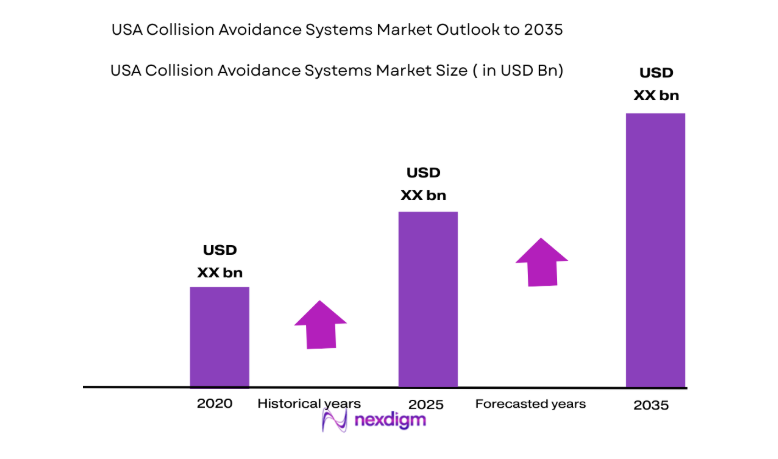
The USA Collision Avoidance Systems market is valued at approximately USD ~ billion based on a recent historical assessment, supported by data from the National Highway Traffic Safety Administration and the U.S. Department of Transportation regarding advanced driver assistance system adoption. Growth is driven by mandatory safety regulations, rising vehicle production, and increasing integration of radar, camera, and sensor fusion technologies across passenger and commercial vehicles, strengthening demand for preventive automotive safety platforms nationwide.
Major automotive hubs such as Michigan, California, and Texas dominate the USA Collision Avoidance Systems market due to strong OEM presence, advanced research infrastructure, and high vehicle registration volumes. Detroit remains central because of established manufacturing ecosystems, while Silicon Valley contributes through autonomous vehicle innovation and software development. Texas supports commercial fleet adoption owing to extensive logistics operations, reinforcing technological deployment and regional concentration of safety system manufacturing and integration activities.
Market Segmentation
By Product Type
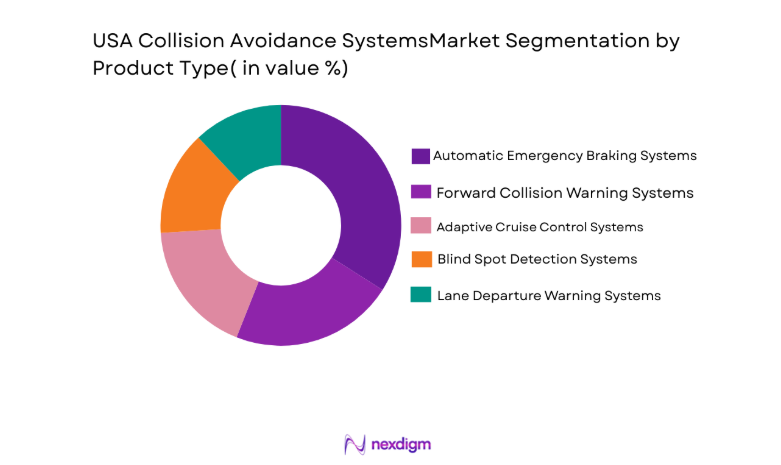
USA Collision Avoidance Systems market is segmented by product type into Forward Collision Warning Systems, Automatic Emergency Braking Systems, Blind Spot Detection Systems, Lane Departure Warning Systems, and Adaptive Cruise Control Systems. Recently, Automatic Emergency Braking Systems have a dominant market share due to factors such as regulatory mandates, strong OEM integration, infrastructure readiness, and consumer preference for active safety technologies. Automatic Emergency Braking Systems benefit from federal safety performance recommendations and insurance incentives that encourage installation across vehicle categories. Their ability to autonomously prevent rear-end collisions enhances driver confidence and reduces accident severity. OEM manufacturers increasingly integrate these systems as standard equipment in mid-range and premium vehicles. Commercial fleet operators also prioritize these systems to minimize liability costs and downtime. Sensor cost reductions and advancements in radar and camera fusion technology further accelerate widespread deployment across new vehicle platforms.
By Platform Type
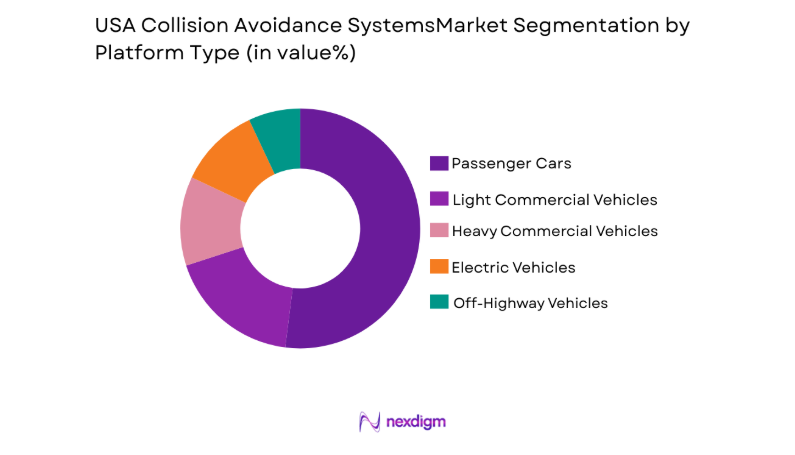
USA Collision Avoidance Systems market is segmented by platform type into Passenger Vehicles, Light Commercial Vehicles, Heavy Commercial Vehicles, Electric Vehicles, and Off-Highway Vehicles. Recently, Passenger Vehicles have a dominant market share due to higher production volumes, widespread consumer adoption, established dealership infrastructure, and increasing regulatory emphasis on advanced driver assistance technologies. Automakers are standardizing collision avoidance features across sedans, SUVs, and crossover models to meet safety expectations and compliance requirements. Growing integration of sensor fusion systems within mainstream vehicle models further strengthens this dominance across the national automotive landscape.
Competitive Landscape
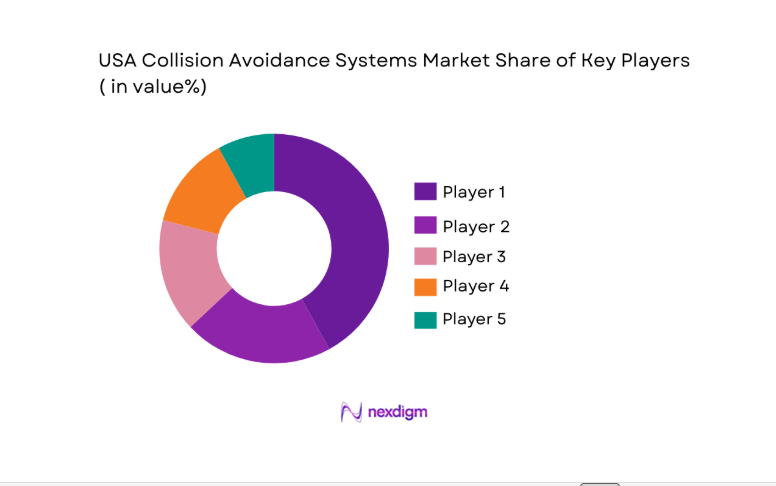
The USA Collision Avoidance Systems market is moderately consolidated, with major automotive technology suppliers and OEM-integrated safety divisions controlling significant portions of system development and deployment. Strategic collaborations between semiconductor manufacturers, AI software developers, and automotive OEMs shape competitive positioning. Continuous investments in sensor fusion, radar imaging, and autonomous driving platforms influence differentiation, while regulatory compliance and large-scale manufacturing capabilities determine long-term competitiveness across domestic and international markets.
|
Company Name |
Establishment Year | Headquarters | Technology Focus | Market Reach | Key Products | Revenue | ADAS Integration Capability |
| Robert Bosch LLC | 1886 | Germany | ~ | ~ | ~ | ~ | ~ |
| Continental AG | 1871 | Germany | ~ | ~ | ~ | ~ | ~ |
| Aptiv PLC | 1994 | Ireland | ~ | ~ | ~ | ~ | ~ |
| ZF Friedrichshafen | 1915 | Germany | ~ | ~ | ~ | ~ | ~ |
| Mobileye | 1999 | Israel | ~ | ~ | ~ | ~ | ~ |
USA Collision Avoidance Systems Market Analysis
Growth Drivers
Federal Safety Mandates and Regulatory Enforcement
The USA Collision Avoidance Systems market is significantly driven by expanding federal safety mandates that encourage or require the integration of advanced driver assistance technologies in new vehicles. Regulatory bodies such as the National Highway Traffic Safety Administration continue to promote performance standards for automatic emergency braking and forward collision warning systems, compelling manufacturers to accelerate deployment across vehicle categories. Insurance institutions and safety rating agencies further reinforce compliance by linking premium reductions and consumer safety scores to the presence of these systems. Automotive OEMs respond by embedding collision avoidance technologies as standard equipment in mid-range models, expanding penetration beyond premium segments. The regulatory environment also fosters transparency in crash prevention data, encouraging continuous improvement in sensor reliability and software responsiveness. Increasing public awareness of road safety and accident statistics amplifies consumer demand for vehicles equipped with preventive systems. Fleet operators and logistics providers align procurement strategies with regulatory expectations to reduce liability exposure and operational downtime. These combined regulatory, institutional, and consumer pressures collectively strengthen sustained investment in research, integration, and scaling of collision avoidance technologies nationwide.
Rapid Advancements in Sensor Fusion and Artificial Intelligence Integration
Technological progress in radar, LiDAR, camera systems, and artificial intelligence algorithms is transforming the operational effectiveness of collision avoidance systems across the USA automotive sector. Modern vehicles increasingly rely on multi-sensor fusion platforms that combine radar imaging, high-resolution cameras, ultrasonic sensors, and AI-based decision engines to deliver real-time situational awareness. Semiconductor innovation enhances processing speeds and reduces latency, enabling faster hazard detection and automated braking responses. Artificial intelligence models improve object recognition accuracy under complex driving conditions, including low visibility, dense traffic, and unpredictable pedestrian movement. Continuous over-the-air software updates allow system refinement without hardware replacement, extending lifecycle value for consumers and fleet operators. Partnerships between automotive manufacturers and technology companies accelerate integration of advanced machine learning architectures within safety systems. The declining cost of sensor components supports broader deployment across economy and mid-range vehicle categories. These cumulative technological improvements increase reliability, consumer confidence, and manufacturer competitiveness, reinforcing long-term growth momentum for the USA Collision Avoidance Systems market.
Market Challenges
High System Integration Costs and Calibration Complexity
The USA Collision Avoidance Systems market faces challenges associated with high development, integration, and calibration costs that can restrict adoption, particularly among smaller manufacturers and aftermarket providers. Advanced radar modules, high-resolution cameras, and AI-driven processors require precise engineering and compatibility with vehicle electronic architectures. Calibration procedures following installation or vehicle repair demand specialized equipment and trained technicians, increasing operational expenses for service centers. These technical requirements raise total system cost, influencing pricing strategies for both OEM and retrofit applications. Small fleet operators may delay upgrades due to upfront investment constraints. Rapid technology evolution also creates risk of obsolescence, requiring continuous capital allocation for upgrades and redesign. Supply chain disruptions in semiconductor manufacturing add further cost volatility. Collectively, these financial and technical burdens slow universal adoption despite regulatory encouragement.
Cybersecurity Risks and System Reliability Concerns
Increasing connectivity within modern vehicles introduces cybersecurity vulnerabilities that present operational and reputational risks for collision avoidance system providers. Connected vehicle architectures rely on software communication between sensors, control units, and cloud-based platforms, creating potential exposure to hacking or unauthorized data access. A compromised safety system can undermine public trust and lead to regulatory scrutiny. Manufacturers must invest heavily in encryption protocols, secure software frameworks, and continuous vulnerability monitoring to safeguard system integrity. Reliability under extreme weather conditions or sensor obstruction remains another concern affecting system performance. False positives or delayed braking responses can reduce consumer confidence. Compliance with evolving cybersecurity standards requires additional research and testing expenditures. These combined technological and security challenges necessitate sustained investment and oversight to maintain system credibility and operational resilience.
Opportunities
Expansion of Collision Avoidance Integration in Electric and Autonomous Vehicles
The accelerating development of electric and semi-autonomous vehicles presents substantial growth opportunities for the USA Collision Avoidance Systems market as manufacturers prioritize integrated safety architectures. Electric vehicle platforms typically incorporate centralized electronic control systems that facilitate seamless deployment of advanced driver assistance modules. Autonomous driving research intensifies demand for sophisticated collision mitigation technologies capable of real-time environmental mapping and predictive analytics. Federal incentives supporting electric mobility indirectly encourage adoption of embedded safety systems. Technology partnerships between EV manufacturers and sensor developers accelerate innovation in high-resolution imaging and AI processing. Consumer perception of electric vehicles as technologically advanced products further strengthens expectations for comprehensive safety features. Continuous investment in autonomous testing infrastructure across select states promotes real-world validation of advanced collision avoidance platforms. These interconnected trends create a favorable environment for long-term expansion and system standardization across emerging vehicle categories.
Development of Fleet-Based Predictive Safety Analytics Platform
Commercial fleet operators represent a significant opportunity segment as data-driven predictive safety analytics become central to risk management strategies. Advanced collision avoidance systems generate large volumes of operational data that can be analyzed to predict driver behavior patterns and accident probabilities. Fleet managers increasingly adopt telematics-integrated safety platforms to optimize route planning, reduce insurance premiums, and enhance driver accountability. Integration with cloud-based analytics enables centralized monitoring of vehicle performance and hazard detection trends. Regulatory compliance pressures within logistics and transportation sectors further encourage investment in preventive technologies. Collaboration between software providers and automotive manufacturers facilitates customized fleet solutions. Predictive analytics enhances return on investment by reducing accident-related downtime and maintenance costs. These value-added capabilities position collision avoidance systems as strategic assets within commercial mobility ecosystems.
Future Outlook
The USA Collision Avoidance Systems market is expected to witness sustained expansion over the next five years, driven by regulatory reinforcement, technological advancements, and rising consumer safety expectations. Increasing integration of AI-enabled sensor fusion platforms will enhance system reliability and performance. Federal transportation policies are likely to continue encouraging adoption across passenger and commercial vehicles. Growth in electric and semi-autonomous vehicle production will further stimulate demand for embedded collision mitigation technologies.
Major Players
- Robert Bosch LLC
- Continental AG
- AptivPLC
- ZF Friedrichshafen AG
- Mobileye
- Magna International Inc
- Denso Corporation
- Valeo SA
- Autoliv Inc
- VeoneerInc
- Texas Instruments Automotive
- NVIDIA Automotive
- General Motors Safety Division
- Ford Motor Company ADAS Division
- Hyundai Mobis USA
Key Target Audience
- Investments and venture capitalist firms
- Government and regulatory bodies
- Automotive OEM manufacturers
- Fleet management companies
- Electric vehicle manufacturers
- Automotivecomponentsuppliers
- Transportationauthorities
- Defense and homeland security agencies
Research Methodology
Step 1: Identification of Key Variables
Primary and secondary data sources were examined to identify production volumes, safety mandates, sensor technology adoption, and pricing structures influencing the USA Collision Avoidance Systems market. Key performance indicators were established to measure system penetration and regulatory impact.
Step 2: Market Analysis and Construction
Quantitative modeling integrated vehicle production statistics, regulatory data, and supplier revenue disclosures to construct a structured market framework. Segmentation was validated through industry benchmarking and supplier portfolio assessment.
Step 3: Hypothesis Validation and Expert Consultation
Industry experts, automotive engineers, and regulatory specialists were consulted to validate assumptions regarding adoption trends, technological development, and cost structures. Feedback ensured alignment with real-world deployment dynamics.
Step 4: Research Synthesis and Final Output
All validated insights were consolidated into a structured analytical framework, ensuring accuracy, consistency, and compliance with data integrity standards. Final outputs were reviewed for coherence and policy alignment.

- Executive Summary
- Research Methodology (Definitions, Scope, Industry Assumptions, Market Sizing Approach, Primary & Secondary Research Framework, Data Collection & Verification Protocol, Analytic Models & Forecast Methodology, Limitations & Research Validity Checks)

- Market Definition and Scope
- Value Chain & Stakeholder Ecosystem
- Regulatory / Certification Landscape
- Sector Dynamics Affecting Demand
- Strategic Initiatives & Infrastructure Growth

- Growth Drivers
Increasing federal safety mandates for advanced driver assistance systems
Rising road traffic accidents prompting adoption of preventive safety technologies
Growing consumer demand for premium vehicle safety features
Expansion of autonomous vehicle research and pilot programs
Technological advancements in sensor fusion and real-time data analytics - Market Challenges
High system integration and calibration costs
Complexity in retrofitting older vehicle fleets
Cybersecurity risks associated with connected vehicle systems
Sensor performance limitations in adverse weather conditions
Supply chain volatility affecting semiconductor availability - Market Opportunities
Integration of collision avoidance systems in electric and autonomous vehicles
Expansion of fleet safety compliance programs across logistics sectors
Development of AI-driven predictive collision analytics platforms - Trends
Increasing deployment of Level 2 and Level 3 automation features
Growth in sensor fusion combining radar, camera, and LiDAR inputs
Adoption of over-the-air software updates for safety enhancements
Miniaturization of high-resolution sensors for compact vehicles
Partnerships between automotive OEMs and technology firms - Government Regulations & Defense Policy
National Highway Traffic Safety Administration safety performance standards
Federal Motor Carrier Safety Administration compliance requirements
Department of Transportation initiatives promoting advanced driver assistance adoption - SWOT Analysis
- Stakeholder and Ecosystem Analysis
- Porter’s Five Forces Analysis
- Competition Intensity and Ecosystem Mapping

- By Market Value, 2019-2025
- By Installed Units, 2019-2025
- By Average System Price, 2019-2025
- By System Complexity Tier, 2019-2025

- By System Type (In Value%)
Forward Collision Warning Systems
Automatic Emergency Braking Systems
Blind Spot Detection Systems
Lane Departure Warning and Lane Keeping Assist Systems
Adaptive Cruise Control Systems - By Platform Type (In Value%)
Passenger Vehicles
Light Commercial Vehicles
Heavy Commercial Vehicles
Off-Highway Vehicles
Rail and Transit Vehicles - By Fitment Type (In Value%)
OEM Integrated Systems
Aftermarket Retrofit Systems
Embedded ADAS Modules
Standalone Sensor Units
Software-Based Upgrade Packages - By End User Segment (In Value%)
Private Vehicle Owners
Fleet Operators and Logistics Companies
Public Transportation Authorities
Construction and Mining Operators
Defense and Homeland Security Agencies - By Procurement Channel (In Value%)
Direct OEM Contracts
Supplier Agreements
Aftermarket Distribution Networks
Government Tenders
Online Automotive Retail Platforms - By Material / Technology (in Value %)
Radar-Based Systems
LiDAR-Based Systems
Ultrasonic Sensor Systems
Camera-Based Vision Systems
Sensor Fusion and AI-Enabled Platforms

- Market structure and competitive positioning
Market share snapshot of major players - Cross Comparison Parameter (System Integration Capability, Sensor Technology Portfolio, AI Software Strength, OEM Partnerships, Aftermarket Presence, Geographic Reach, Pricing Strategy, R&D Investment Intensity, Regulatory Compliance Expertise)
- SWOT Analysis of Key Competitors
- Pricing & Procurement Analysis
- Key Players
Robert Bosch LLC
Continental Automotive Systems Inc
Aptiv PLC
ZF North America Inc
Magna International Inc
Denso North America Inc
Mobileye Vision Technologies Inc
Autoliv Inc
Veoneer US Inc
Valeo North America Inc
Texas Instruments Automotive Division
NVIDIA Automotive Solutions
General Motors Advanced Safety Systems
Ford Motor Company ADAS Division
Hyundai Mobis USA

- Fleet operators prioritizing collision avoidance to reduce insurance liabilities
- Private consumers increasingly valuing safety ratings in purchasing decisions
- Public transport authorities integrating systems to meet federal compliance standards
- Defense agencies adopting advanced collision avoidance for tactical vehicle safety

- Forecast Market Value, 2026-2030
- Forecast Installed Units, 2026-2030
- Price Forecast by System Tier, 2026-2030
- Future Demand by Platform, 2026-2030


 Request a Sample
 Ask for Customization
 Get a Quote
 Enquire Now