

 Download PDF
Market Overview
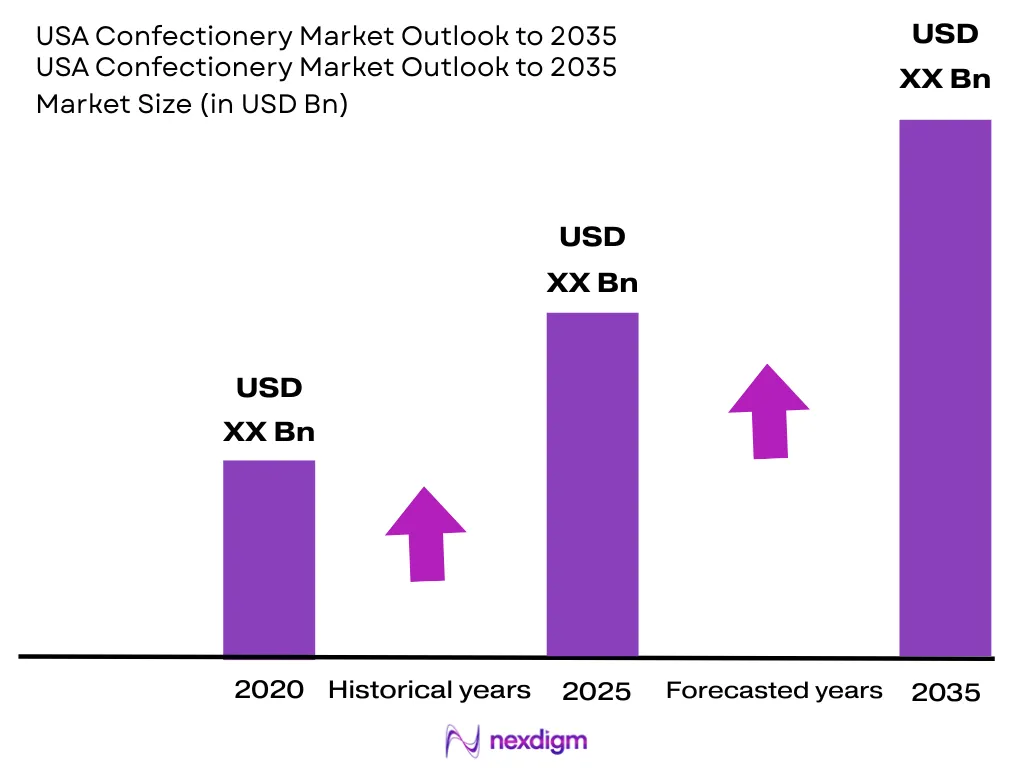
The USA confectionery market was valued at USD ~ billion in 2024 and is projected to expand at a CAGR of ~% during the 2026–2035 forecast period. According to industry statistics published by the National Confectioners Association (NCA), the United States confectionery industry generated retail sales exceeding USD 50 billion, making it the world’s largest confectionery market by value. Data from the NCA indicates that chocolate confectionery accounted for the majority share of total sales, while non-chocolate sugar confectionery, gum, and seasonal products continued to benefit from impulse purchasing, gifting occasions, and expanding convenience retail networks. Growth is supported by strong seasonal and gifting traditions, premiumization, product innovation, and rising consumer demand for functional, sugar-free, and better-for-you confectionery formats.
Market Segmentation
By Product Type
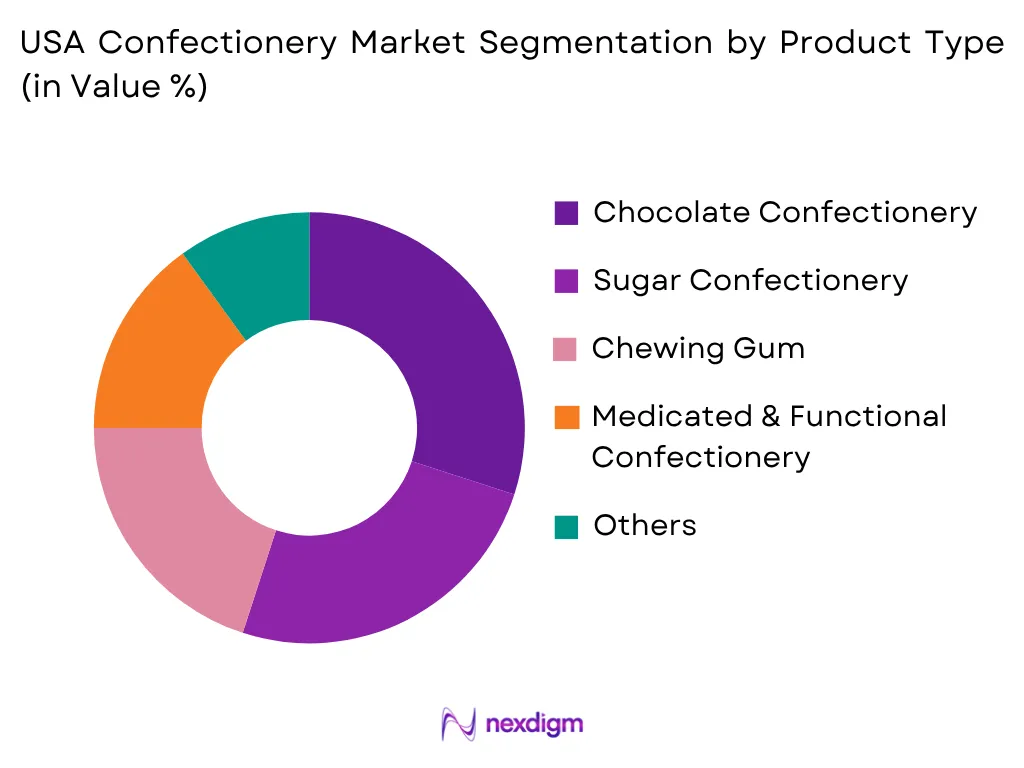
Chocolate confectionery dominates the United States confectionery market owing to the country’s deeply embedded chocolate gifting culture, strong domestic manufacturing capabilities, and continuously expanding premium and craft chocolate offerings. Consumer demand remains particularly strong during major seasonal occasions such as Halloween, Christmas, Valentine’s Day, and Easter, when chocolate gifting and seasonal merchandising significantly increase retail sales. Large domestic manufacturers including The Hershey Company and Mars Wrigley, alongside multinational companies such as Mondelez International, Nestlé, and Ferrero, continue introducing innovative flavors, premium cocoa formulations, and limited-edition seasonal products that attract both younger and adult consumers. The United States imports the substantial majority of its cocoa bean requirements, supporting a large and sophisticated domestic chocolate manufacturing and grinding industry. Continuous investments in premium chocolates, filled products, bean-to-bar craft offerings, and sustainable cocoa sourcing have further strengthened the segment’s leadership while expanding its presence across supermarkets, convenience stores, specialty chocolate shops, and online retail platforms.
By Distribution Channel
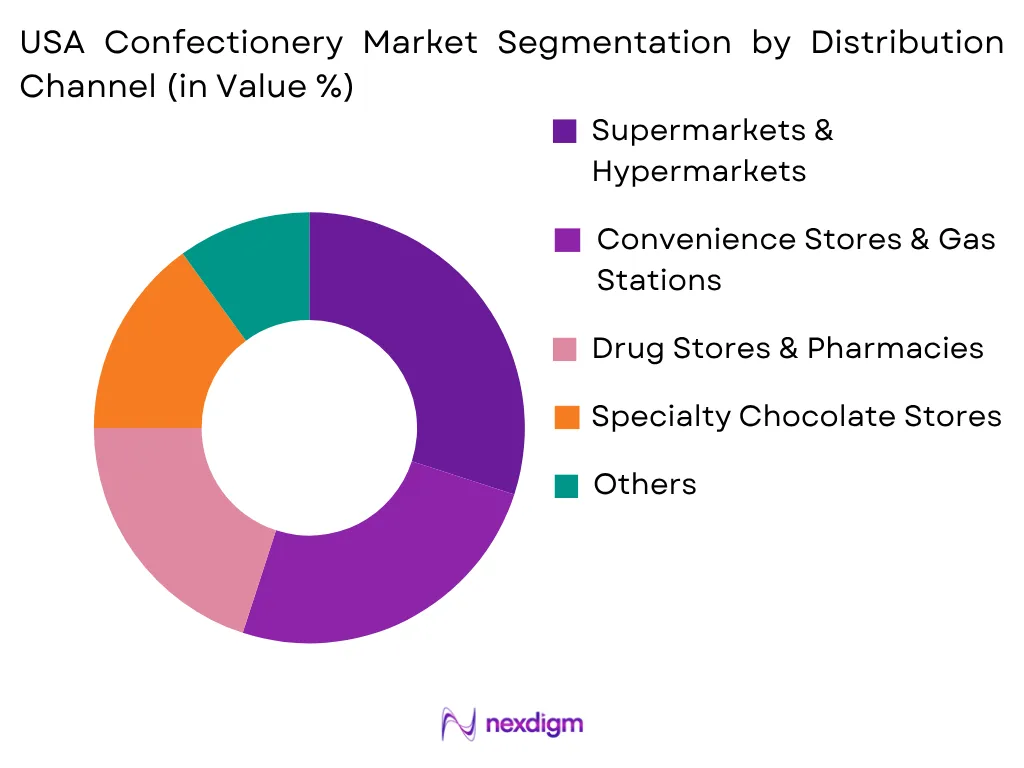
Supermarkets and hypermarkets account for the largest share of confectionery sales in the United States because they provide consumers with extensive product assortments across multiple price segments and brands under one roof. Large retail chains including Walmart, Kroger, Albertsons, and Publix maintain strong procurement relationships with domestic and international confectionery manufacturers, ensuring continuous product availability throughout the year. These stores also capitalize on impulse purchasing by positioning confectionery products near checkout counters and end-cap promotional displays. Seasonal merchandising during Halloween, Christmas, Valentine’s Day, and Easter further boosts sales volumes, with confectionery aisles and seasonal sections expanding significantly ahead of these key gifting occasions. Convenience stores and gas stations also represent a critical channel given the importance of single-serve and impulse-format confectionery purchases for the on-the-go American consumer. Additionally, supermarkets, mass merchandisers, and club stores frequently introduce exclusive promotional campaigns, private-label offerings, multipack discounts, and premium confectionery sections, attracting both value-conscious and premium consumers. Their widespread geographic presence and established cold-chain and distribution infrastructure further reinforce their dominance within the United States confectionery retail landscape.
Competitive Landscape
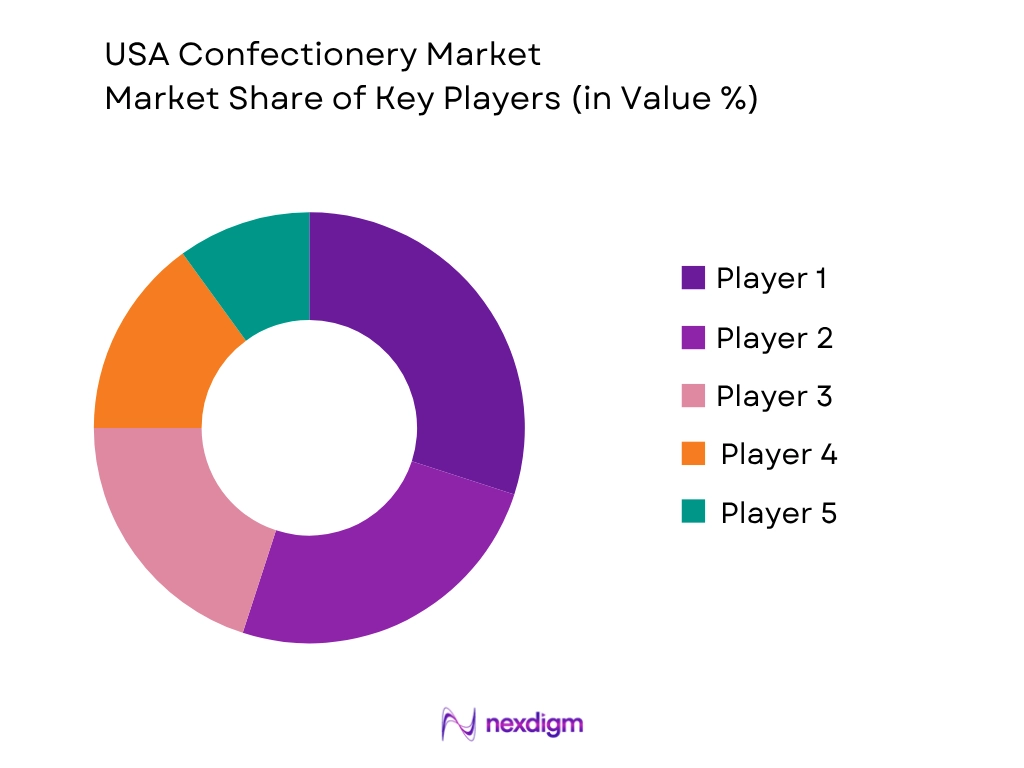
The USA confectionery market is moderately consolidated, with a small number of large multinational and domestic manufacturers accounting for the majority of total sales. Global companies such as Mondelez International, The Hershey Company, Mars Wrigley, Ferrero USA, and Nestlé USA leverage extensive manufacturing scale and distribution networks, while domestic specialty and heritage brands including Ferrara Candy Company, Tootsie Roll Industries, Jelly Belly Candy Company, and See’s Candies maintain strong consumer loyalty through iconic product lines and seasonal innovations. Continuous investments in premium chocolates, sustainable cocoa sourcing, manufacturing automation, and omnichannel retail strategies remain key competitive differentiators.
| Company | Establishment Year | Headquarters | Primary Protein Focus | Processing Facilities
|
Export Presence | Production Integration | Sustainability Programs | Value-Added Product Portfolio |
| Mondelez International | 1923 | ~ | ~ | ~ | ~ | ~ | ~ | ~ |
| The Hershey Company | 1894 | ~ | ~ | ~ | ~ | ~ | ~ | ~ |
| Mars Wrigley | 1911 | ~ | ~ | ~ | ~ | ~ | ~ | ~ |
| Ferrero USA | 2006 | ~ | ~ | ~ | ~ | ~ | ~ | ~ |
| Ferrara Candy Company | 1908 | ~ | ~ | ~ | ~ | ~ | ~ | ~ |
USA Confectionary Market Analysis
Growth Drivers
Strong Seasonal Gifting Culture and Premium Chocolate Consumption
The United States’ deeply embedded seasonal gifting traditions continue to be one of the primary growth drivers for the confectionery market. According to the National Confectioners Association (NCA), Halloween alone generates more than USD 3.6 billion in confectionery sales annually, while Christmas, Valentine’s Day, and Easter collectively account for a substantial share of total annual confectionery revenue. The United States remains the world’s largest chocolate-consuming nation by aggregate value, supported by a population exceeding 335 million people, creating a substantial domestic consumer base for confectionery products. Urbanization further strengthens demand, as the US Census Bureau reports that more than 80% of Americans live in urban and metropolitan areas, encouraging frequent purchases through supermarkets, convenience stores, and specialty retailers. Household consumption also benefits from a labour market that remains comparatively resilient, with the US Bureau of Labor Statistics reporting unemployment at approximately 4% in 2024, supporting purchasing power for discretionary food categories. The World Bank estimated the United States’ nominal GDP at more than USD 28 trillion, while the US Census Bureau estimated GDP per capita above USD 83,000, reflecting an economy capable of supporting premium food consumption. Seasonal celebrations continue to stimulate premium chocolate sales as manufacturers introduce limited-edition products, artisanal collections, and higher cocoa-content offerings. Domestic companies have expanded bean-to-bar craft production and premium gifting portfolios, while multinational manufacturers continue investing in localized product innovation, reinforcing chocolate as the largest revenue-generating category within the United States confectionery industry.
Expansion of Convenience Retail and Omnichannel Distribution
The continuous expansion of convenience retail infrastructure and omnichannel distribution has significantly strengthened confectionery accessibility across the United States. According to the National Association of Convenience Stores (NACS), the United States operates more than 150,000 convenience stores nationwide, providing extensive impulse-purchase access points for single-serve and multipack confectionery products. The US Census Bureau estimates the national population above 335 million, supporting year-round demand for impulse confectionery purchases across all major retail formats. Digital commerce is also transforming product accessibility as e-commerce penetration continues to expand, with the US Department of Commerce reporting continued growth in online grocery and direct-to-consumer food sales. The World Bank projects the United States to remain the world’s largest economy with GDP exceeding USD 28 trillion, supporting investments in modern retail infrastructure, warehouse automation, and digital payment systems. Large retailers increasingly dedicate shelf space to premium chocolates, sugar confectionery, and seasonal products, while convenience stores and dollar stores capitalize on impulse purchases through checkout merchandising. Omnichannel retailing enables manufacturers to combine physical distribution with direct-to-consumer platforms, subscription gifting, and rapid delivery services. These developments allow confectionery companies to broaden geographic reach, improve product availability, launch exclusive online collections, and strengthen consumer engagement, thereby supporting sustained demand across multiple product categories throughout the country.
Market Challenges
Cocoa Supply Volatility and Import Dependency
United States confectionery manufacturers continue facing significant challenges arising from cocoa supply volatility and near-total dependency on imported cocoa beans, given the absence of meaningful domestic cocoa cultivation. According to the International Cocoa Organization (ICCO), global cocoa production fell to approximately 4.37 million tonnes during the latest reporting period, with end-of-season stocks declining to nearly 1.27 million tonnes, the lowest stock-to-grinding ratio recorded in decades. Cocoa futures prices on the ICE exchange reached record highs during 2024, more than doubling year-over-year, directly increasing input costs for US chocolate manufacturers. The United States imports the substantial majority of its cocoa bean, cocoa butter, and cocoa liquor requirements primarily from West African producing nations including Côte d’Ivoire and Ghana, exposing domestic manufacturers to West African weather variability, crop disease pressures including cocoa swollen shoot virus, and geopolitical supply risks. The shortage has forced US processors to compete globally for limited cocoa supplies while passing higher input costs through to consumers via reduced pack sizes and price increases, a phenomenon widely referred to in the industry as shrinkflation. Manufacturers must therefore manage procurement risks, diversify sourcing strategies across multiple origin countries, improve supply-chain resilience through forward contracting, and invest in long-term partnerships with cocoa-producing cooperatives to maintain stable production and ensure uninterrupted availability of chocolate products across retail channels.
Increasing Health Regulations and Consumer Shift Toward Reduced Sugar Products
Growing public health initiatives and evolving nutritional regulations are creating structural challenges for confectionery manufacturers operating in the United States. The country has a population exceeding 335 million, with increasing awareness regarding obesity, diabetes, and excessive sugar intake influencing purchasing decisions. The US Food and Drug Administration (FDA) continues to strengthen Nutrition Facts labeling requirements, including mandatory added sugars disclosure, increasing transparency around products containing high levels of added sugars, encouraging consumers to compare nutritional profiles before purchasing. At the same time, several US states and municipalities have introduced or proposed sugar-sweetened beverage and snack taxes, while school nutrition standards continue to tighten under USDA guidelines, creating additional regulatory complexity for confectionery marketed toward younger consumers. Manufacturers are therefore required to reformulate recipes while maintaining taste, texture, and shelf stability — an increasingly complex technical challenge. The Centers for Disease Control and Prevention (CDC) estimates that more than 40% of American adults are classified as obese, accompanied by growing consumer prioritization of healthier dietary choices, particularly among younger demographic cohorts. In addition, higher education levels and widespread internet and social media access have accelerated consumer awareness regarding food ingredients and nutritional information. These trends require confectionery companies to invest continuously in research and development, alternative sweeteners, innovative ingredient technologies, and transparent labeling practices. While these investments create opportunities for innovation, they also increase formulation complexity and operational requirements across manufacturing and product development activities.
Market Opportunities
Premium, Functional and Better-for-You Confectionery
The United States’ evolving consumer preferences are creating substantial opportunities for premium, functional, and health-oriented confectionery products. With a population of more than 335 million and one of the world’s highest per capita disposable income levels, the country provides the largest addressable market globally for manufacturers introducing premium chocolates, sugar-free confectionery, protein-enriched products, and clean-label innovations. Rising disposable income and an expanding health-conscious consumer base have encouraged greater spending on indulgent products with perceived quality and functional benefits. The World Bank estimates the United States’ nominal GDP at more than USD 28 trillion, supporting stronger household expenditure on premium packaged foods. Simultaneously, increasing awareness of nutrition has accelerated demand for confectionery containing natural ingredients, higher cocoa content, reduced sugar formulations, plant-based ingredients, and functional additives such as vitamins, minerals, and protein. Premium gifting has also become increasingly important during festive occasions, creating opportunities for manufacturers to introduce artisanal collections, personalized gift boxes, and limited-edition products. Expansion of specialty chocolate boutiques such as Godiva and direct-to-consumer digital platforms further enables companies to target affluent urban consumers with differentiated offerings. Manufacturers investing in product innovation, premium packaging, sustainable sourcing, and healthier ingredient profiles are therefore well positioned to capture future demand while strengthening brand loyalty across the domestic market.
Sustainable Cocoa Sourcing and Supply Chain Diversification
The strengthening of sustainable and traceable cocoa supply chains presents a significant long-term opportunity for the United States confectionery industry. Given the country’s complete dependency on imported cocoa, leading manufacturers including Mondelez, The Hershey Company, and Mars Wrigley continue investing heavily in supplier-level sustainability programs, agroforestry support initiatives, and direct-trade sourcing relationships with cocoa-producing cooperatives across West Africa, Latin America, and Southeast Asia. Continued investments in farmer training, productivity enhancement programs, and climate-resilient cocoa varieties are increasing the long-term availability of high-quality, traceable cocoa beans for US processors. Growing consumer and retailer demand for Rainforest Alliance and Fair Trade certified chocolate products provides US manufacturers with opportunities to differentiate premium product lines while strengthening supply chain resilience against future price shocks. Government and industry initiatives, including the International Cocoa Initiative and various public-private sustainability partnerships, are expected to strengthen long-term cocoa supply chain stability. Furthermore, increasing investments in blockchain-enabled traceability, environmental compliance, and responsible sourcing enable US confectionery manufacturers to meet evolving retailer and consumer procurement standards. These developments not only improve resilience against future cocoa price volatility but also support domestic manufacturers seeking to differentiate their products through sustainability, ethical sourcing, and higher-quality cocoa ingredients, thereby creating new avenues for long-term industry growth.
Future Outlook
The USA confectionery market is expected to witness sustained growth throughout the forecast period, supported by enduring seasonal gifting traditions, product premiumization, and evolving consumer preferences toward indulgent and functional confectionery. Manufacturers are increasingly investing in sugar-reduced formulations, premium cocoa products, sustainable sourcing practices, and digital commerce platforms. Growing penetration of convenience and club retail formats, expansion of specialty chocolate stores, and innovation in seasonal gifting products are expected to create additional growth opportunities. Continued investments in manufacturing efficiency, supply chain diversification, and environmentally responsible packaging will further strengthen long-term market competitiveness.
Major Players
- Mondelez International
- The Hershey Company
- Mars Wrigley
- Ferrero USA
- Ferrara Candy Company
- Nestlé USA
- Lindt & Sprüngli USA
- Tootsie Roll Industries
- Jelly Belly Candy Company
- See’s Candies
- Godiva North America
- Russell Stover Chocolates
- Just Born Quality Confections
- Spangler Candy Company
- Perfetti Van Melle USA
Key Target Audience
- Confectionery Manufacturers
- Chocolate Manufacturers
- Cocoa Processors
- Sugar and Ingredient Suppliers
- Modern Retail Chains and Food Distributors
- Packaging Material Manufacturers
- Investments and Venture Capitalist Firms
- Government and Regulatory Bodies (US Food and Drug Administration (FDA), United States Department of Agriculture (USDA), National Confectioners Association (NCA))
Research Methodology
Step 1: Identification of Key Variables
The research begins by identifying the major stakeholders across the USA confectionery value chain, including cocoa suppliers, ingredient manufacturers, confectionery producers, distributors, retailers, and consumers. Extensive secondary research is conducted using government publications, industry associations, trade databases, company reports, and proprietary databases to establish the key variables influencing market performance.
Step 2: Market Analysis and Construction
Historical market information is compiled and evaluated to estimate the overall market size, product penetration, production volumes, consumption trends, pricing dynamics, and revenue generation across major confectionery categories. Both demand-side and supply-side indicators are analyzed using bottom-up and top-down market sizing approaches to ensure comprehensive market coverage.
Step 3: Hypothesis Validation and Expert Consultation
Preliminary market estimates and analytical assumptions are validated through Computer Assisted Telephone Interviews (CATIs) and structured discussions with confectionery manufacturers, cocoa processors, distributors, retail executives, procurement specialists, and industry experts. These interviews provide valuable commercial insights that strengthen the reliability of market estimates.
Step 4: Research Synthesis and Final Output
The final stage integrates primary research findings with secondary information to develop a comprehensive assessment of market size, segmentation, competitive landscape, consumer behavior, and future opportunities. Multiple validation techniques, including data triangulation and cross-verification, are employed to ensure the consistency, accuracy, and credibility of the final market report.

- Executive Summary
- Research Methodology (Market Definitions and Assumptions, Abbreviations, Market Taxonomy, Market Sizing Approach, Top-Down Analysis, Bottom-Up Analysis, Demand-Side Assessment, Supply-Side Assessment, Primary Industry Interviews, Secondary Research Validation, Data Triangulation, Forecasting Framework, Limitations and Future Conclusions)

- Definition and Scope
- Market Evolution and Industry Genesis
- Timeline of Major Industry Developments
- Industry Value Chain Analysis
- Supply Chain Analysis

- Growth Drivers (Strong Seasonal and Gifting Culture, Rising Premium and Craft Chocolate Consumption, Expansion of Convenience and Impulse Retail Channels, Product Innovation and Flavor Diversification, Rising Demand for Functional and Sugar-Free Confectionery, Expanding E-Commerce and Direct-to-Consumer Sales)
- Market Challenges (Volatility in Cocoa Prices, Sugar Price Fluctuations and Tariff-Rate Quota Costs, High Input and Labor Costs, Inflationary Pressure on Consumer Spending, Health Concerns Regarding Sugar Intake, Import Dependency for Cocoa, Private Label Competition, Shelf-Life Management)
- Market Opportunities (Sugar-Free Confectionery Expansion, Functional and Protein Gummies, Premium Chocolate Gifting, Sustainable Cocoa Sourcing, Plant-Based Chocolate, Personalized Gifting, Premium Packaging Innovation, Quick Commerce Expansion)
- Market Trends (Bean-to-Bar Craft Chocolates, Clean Label Ingredients, Premiumization, Limited Edition Seasonal Products, Protein-Enriched Confectionery, Sustainable Packaging Adoption, Reduced Sugar Formulations, Premium Filled Chocolates)
- Government Regulations (FDA Food Safety Standards, Nutrition Facts Labeling Requirements, Sugar Content Disclosure, Allergen Declaration Requirements (FALCPA), Food Additive Regulations, Packaging Compliance Standards, USDA Sugar Tariff-Rate Quota System, State-Level Recycling and Packaging Policies)
- Cocoa Supply and Pricing Analysis (Cocoa Bean Imports, Cocoa Butter Prices, Cocoa Liquor Supply, Processing Capacity, Price Transmission Analysis)
- Sugar Supply Analysis (US Sugar Program and Tariff-Rate Quotas, Domestic Sugar Beet & Cane Availability, Sugar Cost Trends, Alternative Sweetener Adoption)
- Seasonal Demand Analysis (Halloween, Christmas, Valentine’s Day, Easter, Back-to-School, Thanksgiving, Corporate Gifting)
- Retail Shelf Space Analysis (Modern Trade Penetration, Category Allocation, Promotional Displays, Checkout Placement)
- Innovation Landscape (Flavor Innovation, Texture Innovation, Functional Ingredients, Packaging Innovation, Premium Launches)
- Sustainability Analysis (Rainforest Alliance & Fair Trade Adoption, Cocoa Traceability, Sustainable Packaging, Carbon Reduction Initiatives)
- SWOT Analysis
- Porter’s Five Forces Analysis
- PESTLE Analysis
- Stakeholder Ecosystem
- Competition Ecosystem

- By Market Value (2020-2025)
- By Volume Consumption (2020-2025)
- By Average Selling Price (2020-2025)

- By Product Type (In Value %)
Chocolate Confectionery
Sugar Confectionery
Chewing Gum
Medicated & Functional Confectionery
Seasonal Confectionery
Premium & Gourmet Confectionery
Filled and Molded Chocolates
Countlines and Chocolate Bars - By Ingredient Type (In Value %)
Cocoa-Based Confectionery
Sugar-Based Confectionery
Sugar-Free Confectionery
Functional & Fortified Confectionery
Organic & Natural Confectionery
Plant-Based & Vegan Confectionery
- By Distribution Channel (In Value %)
Supermarkets & Hypermarkets
Convenience Stores & Gas Stations
Drug Stores & Pharmacies
Mass Merchandisers & Club Stores
Specialty Chocolate & Candy Stores
Dollar Stores & Discount Retailers
E-Commerce
Direct-to-Consumer - By Packaging Type (In Value %)
Flexible Packs
Flow Wraps
Boxes
Pouches
Gift Packs
Multipacks
Sustainable Packaging - By Region (In Value %)
Northeast
Midwest
South
West

- Market Share Analysis (By Value, Volume, Product Category, Distribution Channel, Price Segment)
- Cross Comparison Parameters (Chocolate Portfolio Breadth, Sugar Confectionery Portfolio, Annual New Product Launches, Cocoa Processing Capability, Distribution Reach Across the United States, Seasonal Product Portfolio Strength, Premium Product Mix, Manufacturing Capacity)
- SWOT Analysis of Major Players
- Pricing Analysis (By SKU, Product Type, Cocoa Content, Premium Positioning, Pack Size)
- Detailed Profiles of Major Companies
Mondelez International
The Hershey Company
Mars Wrigley
Ferrero USA
Ferrara Candy Company
Nestlé USA
Lindt & Sprüngli USA
Tootsie Roll Industries
Jelly Belly Candy Company
See’s Candies
Godiva North America
Russell Stover Chocolates
Just Born Quality Confections
Spangler Candy Company
Perfetti Van Melle USA

- Consumption Pattern Analysis (Consumption Frequency, Chocolate Preference, Sugar Confectionery Preference, Seasonal Buying Behavior, Household Penetration)
- Demographic Consumption Analysis (Age, Gender, Income Level, Household Size, Urban-Rural Distribution)
- Household Expenditure Analysis
- Premium vs Mass Market Consumption Analysis
- Brand Loyalty Analysis
- Health & Wellness Purchase Behaviour
- Product Attribute Preference Analysis (Taste, Cocoa Content, Texture, Sugar Content, Brand Reputation, Packaging, Price, Ingredients)
- Impulse Purchase Behaviour
- Online vs Offline Purchase Behaviour
- Consumer Pain Point Analysis
- Purchase Decision-Making Process

- By Market Value (2026-2035)
- By Volume Consumption (2026-2035)
- By Average Selling Price (2026-2035)


 Request a Sample
 Ask for Customization
 Get a Quote
 Enquire Now