
 Download PDF
Market Overview
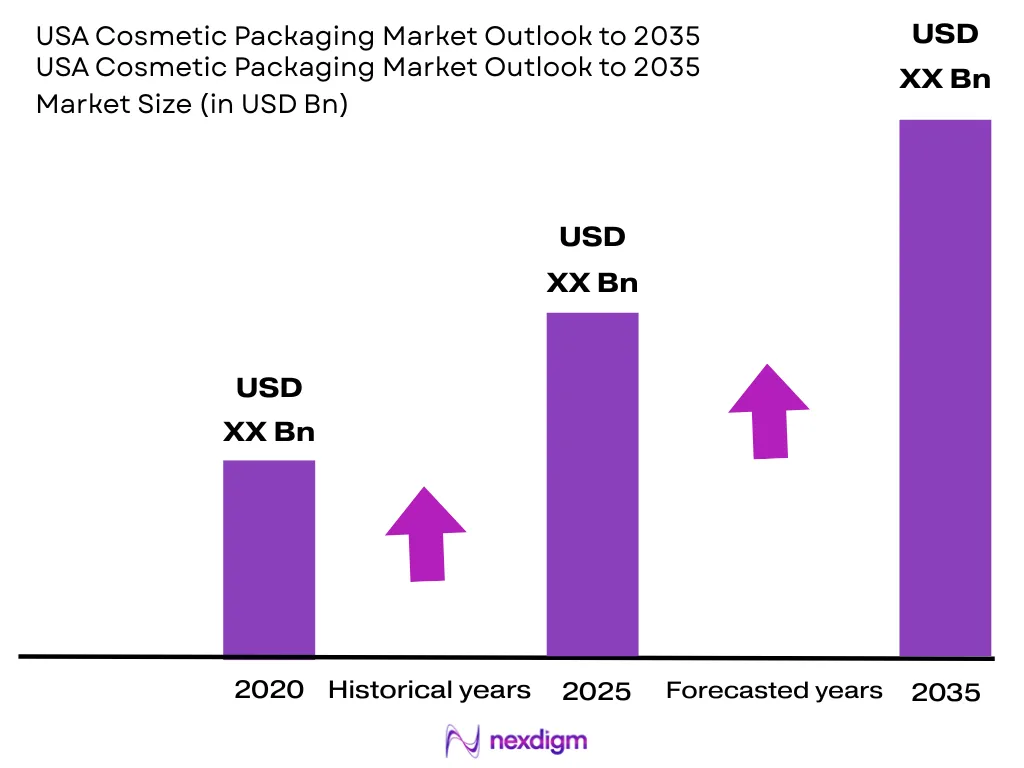
The USA Cosmetic Packaging Market was valued at approximately USD ~ Billion in 2025 and is projected to reach approximately USD ~ Billion by 2030, reflecting a compound annual growth rate of approximately 3.9% during the forecast period. The market is undergoing a significant regulatory transformation driven by the Modernization of Cosmetics Regulation Act of 2022 (MoCRA), which became fully operational in late 2023 and represents the most significant expansion of FDA authority over cosmetics since the Federal Food, Drug, and Cosmetic Act was passed in 1938. MoCRA’s requirements for mandatory facility registration, product listing, safety substantiation, and adverse event reporting, alongside forthcoming Good Manufacturing Practice rulemaking, are compelling packaging manufacturers to innovate with traceable codes and adaptable containers. Corporate consolidation continues to reshape the competitive landscape, exemplified by Amcor’s 2025 merger with Berry Global, which forged an extended platform across flexibles, closures, and healthcare packaging promising approximately USD 650 million in synergies and USD 180 million in annual R&D allocation.
Market Segmentation
By Material
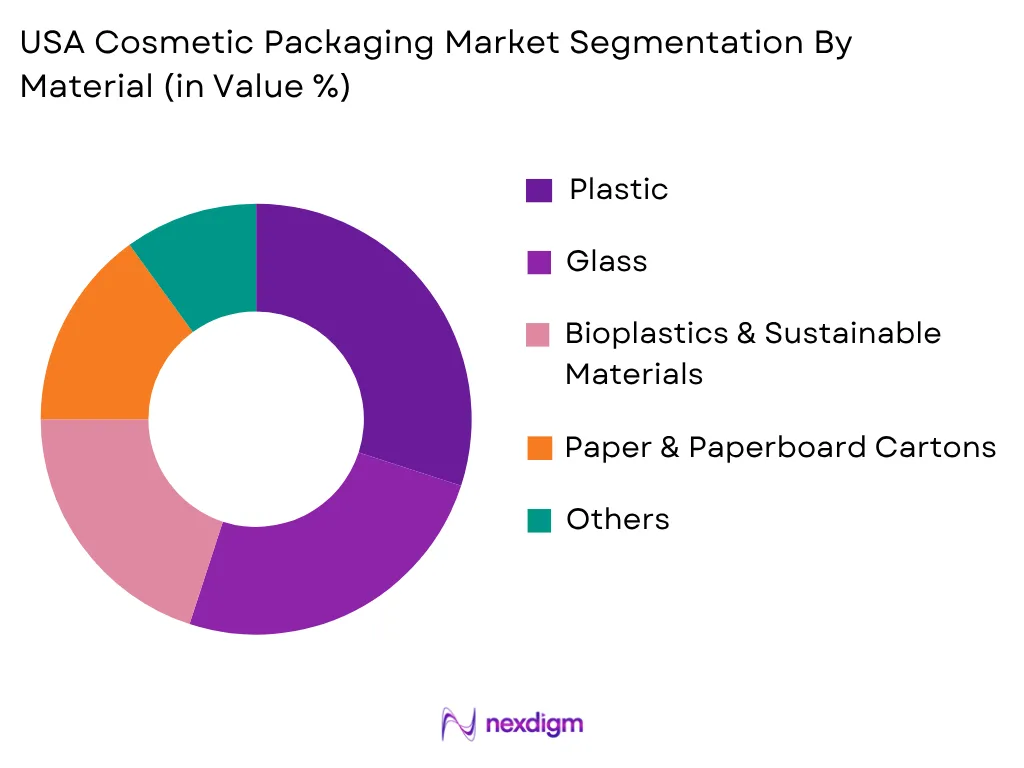
Plastic materials, spanning PET, polypropylene, and polyethylene, continue to hold a substantial share of the USA Cosmetic Packaging Market, favored for their versatility, cost-effectiveness, and compatibility with high-speed molding and filling lines operated by major converters. Glass retains a premium positioning within skincare and fragrance categories, where brands leverage its perceived quality and recyclability to support prestige product positioning. Bioplastics and sustainable materials, including recycled PET (rPET), molded pulp, and sugarcane-based bioplastics, represent the fastest-growing material category as brands respond to MoCRA-era scrutiny of environmental marketing claims and consumer demand for verifiably sustainable packaging. Aluminum and metal packaging maintain a durable niche in premium deodorant, lip, and compact formats, while paper and paperboard secondary packaging continue to expand alongside e-commerce growth, which demands tamper-evident, durable, and visually appealing packaging capable of surviving shipping and enhancing unboxing experiences.
By Product Type
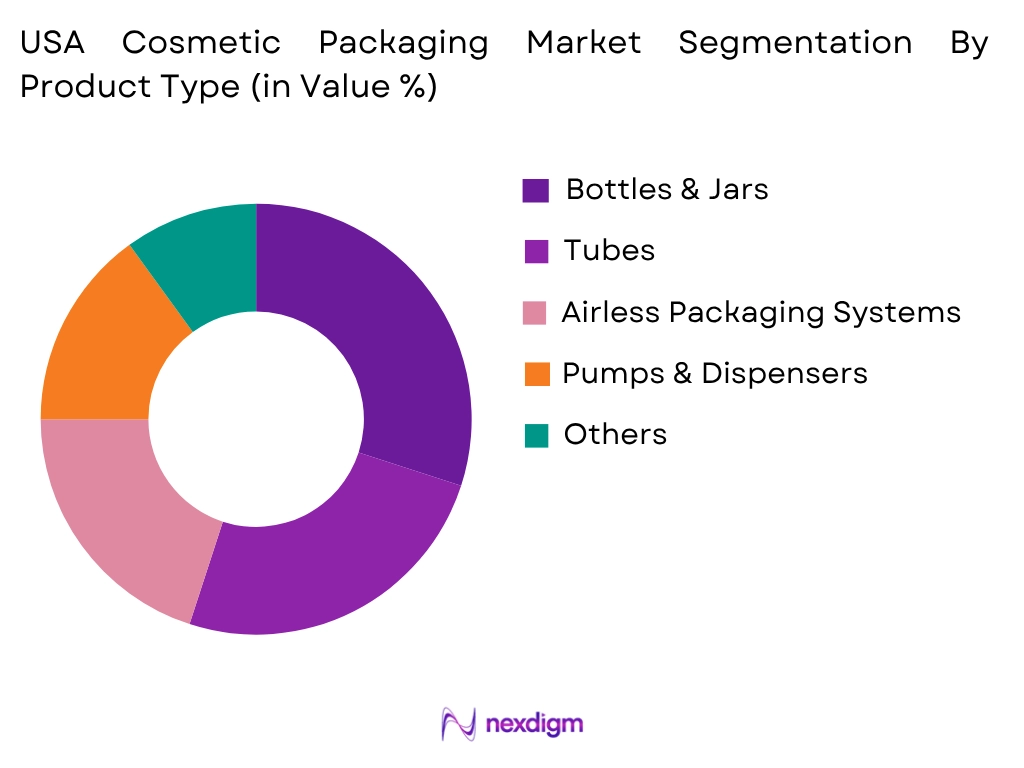
Bottles & Jars lead the USA Cosmetic Packaging Market given their versatility and premium appeal, particularly within the skincare category, which continues to represent the largest application segment by revenue. Tubes represent one of the fastest-growing product formats, valued for their portability, hygiene, and convenience across skincare, haircare, and suncare applications. Airless Packaging Systems continue to gain share as brands prioritize formula preservation and premium dispensing experiences, exemplified by Quadpack’s November 2023 launch of US-based airless production through its partnership with injection molding company Colt’s Plastics, offering its Regula Airless Refill range to regional brands with reduced lead times and carbon footprint. Refillable formats are also expanding rapidly, illustrated by Hairstory’s July 2025 launch of a refillable glass ‘Beer Bottle’ housing its New Wash product, reflecting the broader industry shift toward packaging systems designed explicitly to reduce waste and foster repeat customer engagement.
Competitive Landscape
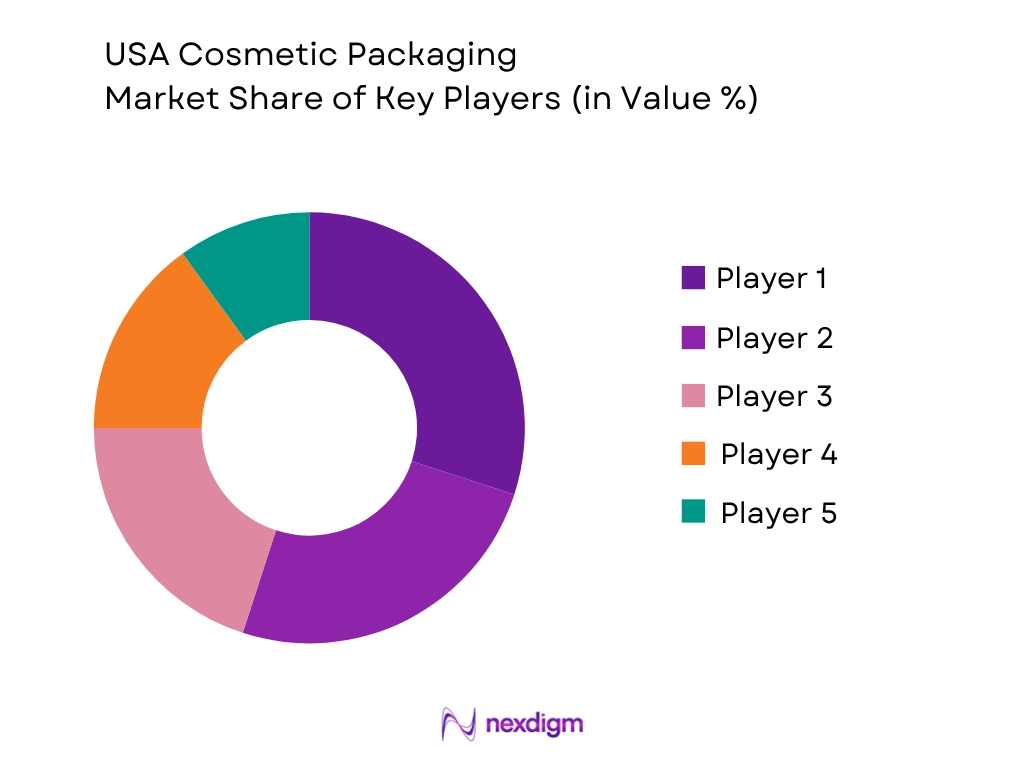
The USA Cosmetic Packaging Market is fragmented, with numerous niche specialty converters coexisting alongside multinational roll-ups that continue to consolidate the industry through strategic mergers and acquisitions. Amcor’s 2025 combination with Berry Global created an extended platform spanning flexibles, closures, and healthcare packaging, promising approximately USD 650 million in cost synergies and pushing competing packaging groups to consider similar scale alignments or specialty tuck-in acquisitions to defend their customer portfolios. AptarGroup continues to leverage its 2024 TIME sustainability ranking to court prestige beauty brands seeking verified low-carbon dispensing and packaging solutions, while private equity continues to reshape the competitive landscape, exemplified by KKR’s approximately USD 528 million acquisition of a Korean cosmetics packaging company. Albéa, Gerresheimer, and Silgan Holdings maintain strong positions across tubes, glass, and rigid packaging respectively, while specialty players such as Quadpack continue to expand US-based manufacturing to serve regional indie and direct-to-consumer beauty brands with shorter lead times.
| Company | Establishment Year | Headquarters | Primary Product Portfolio | Cosmetic Packaging Portfolio
|
Manufacturing Presence | Major End-Use Industries | Key Strategic Focus | Certifications & Compliance |
| Albéa SA | 2012 | ~ | ~ | ~ | ~ | ~ | ~ | ~ |
| AptarGroup, Inc. | 1992 | ~ | ~ | ~ | ~ | ~ | ~ | ~ |
| Amcor plc | 1860 | ~ | ~ | ~ | ~ | ~ | ~ | ~ |
| Silgan Holdings Inc. | 1987 | ~ | ~ | ~ | ~ | ~ | ~ | ~ |
| Gerresheimer AG | 1864 | ~ | ~ | ~ | ~ | ~ | ~ | ~ |
USA Cosmetic Packaging Market Analysis
Growth Drivers
MoCRA-Driven Packaging Compliance Innovation
The USA cosmetic packaging market is experiencing sustained transformation due to the Modernization of Cosmetics Regulation Act of 2022, which became fully operational in late 2023 and represents the most significant expansion of FDA authority over cosmetics since 1938. MoCRA’s requirements, including mandatory facility registration renewed every two years, product listing, safety substantiation, and serious adverse event reporting, are compelling packaging manufacturers to innovate with traceable codes, standardized labeling formats, and adaptable containers capable of accommodating evolving regulatory requirements. The FDA’s ongoing rulemaking to establish mandatory cosmetic Good Manufacturing Practices represents a structural shift from a largely voluntary system toward a compliance model closer to those already established in the European Union, while proposed standardization of asbestos testing in talc-based cosmetics further influences packaging and labeling compliance. As MoCRA implementation continues to mature through 2025 and beyond, with forthcoming rules on fragrance allergen labeling and GMP requirements, packaging suppliers capable of providing compliant, traceable, and rapidly adaptable container and labeling solutions are increasingly well positioned to capture demand from brands navigating this evolving regulatory landscape.
Growth of Indie & DTC Beauty Brands and Digital Printing Adoption
The proliferation of indie and direct-to-consumer beauty brands continues to reshape demand patterns across the USA Cosmetic Packaging Market, with digital printing technology enabling short-run, customizable packaging designs that reduce waste and support personalized product offerings without the volume commitments traditionally required by conventional printing methods. This technological shift has lowered barriers to entry for smaller beauty brands seeking premium, differentiated packaging without the capital investment historically associated with large-scale production runs. E-commerce continues to significantly influence packaging design requirements, as online retail demands tamper-evident, durable, and visually appealing packaging capable of surviving shipping while enhancing the unboxing experience that has become central to digital-first beauty brand marketing strategies. Regional converters such as Quadpack have specifically targeted this demand by establishing US-based airless production capacity through partnerships such as its November 2023 collaboration with Colt’s Plastics, enabling faster lead times and reduced carbon footprint for regional brands increasingly prioritizing supply chain agility alongside sustainability credentials.
Market Challenges
Fragmented State Recycling Infrastructure and Multi-Material Recyclability Limits
The USA Cosmetic Packaging Market continues to face structural challenges from the absence of uniform and effective recycling programs across states, despite increased consumer awareness and demand for sustainable packaging. Complicated packaging formats, including laminated tubes and mixed-material pumps, are frequently not recyclable through conventional municipal recycling streams, contributing to environmental waste even as brands market these products using sustainability-oriented claims. This fragmented recycling infrastructure creates a persistent tension for packaging suppliers and brand owners, who must balance consumer expectations for sustainability, style, and functionality simultaneously while operating within a patchwork of inconsistent state and municipal recycling capabilities. The gap between packaging design innovation and actual end-of-life recyclability infrastructure continues to complicate brands’ ability to substantiate environmental marketing claims, particularly as regulatory scrutiny of terms such as ‘biodegradable’ and ‘recyclable’ intensifies alongside MoCRA’s broader emphasis on truthful labeling and substantiated claims.
Evolving MoCRA GMP Rulemaking and Compliance Cost Burden
The ongoing and still-evolving nature of MoCRA’s Good Manufacturing Practice rulemaking creates planning uncertainty for packaging manufacturers and cosmetic brands alike, as the FDA continues to develop specific requirements that will govern manufacturing and packaging facility operations. This regulatory uncertainty compounds the compliance burden already introduced by mandatory facility registration, product listing, and adverse event reporting requirements that took effect following MoCRA’s passage. State-level regulations add further complexity beyond federal MoCRA requirements, with states including California, Washington, Oregon, and Maryland maintaining additional cosmetic safety laws such as the California Safe Cosmetics Program and various Toxic-Free Cosmetics Acts that packaging suppliers and brands must separately track and satisfy. This layered regulatory environment, combining federal MoCRA implementation with an expanding patchwork of state-level chemical restrictions, requires packaging suppliers to maintain continuously updated compliance capabilities across multiple overlapping jurisdictions, adding cost and complexity particularly for smaller converters and indie brands with limited regulatory affairs resources.
Market Opportunities
Growth in Refillable and Reusable Packaging Systems
Brands across the USA Cosmetic Packaging Market are increasingly investing in refillable and reusable packaging systems designed to reduce waste while fostering customer loyalty and repeat purchase behavior. Hairstory’s July 2025 launch of a refillable glass ‘Beer Bottle’ housing its New Wash product exemplifies this growing trend, combining sustainable packaging characteristics with distinctive brand design to differentiate in a crowded beauty market. Berry Global’s February 2025 expansion of its Stick and Refill product line, introducing smaller 15ml, 20ml, and 25ml formats for cosmetics, lip care, deodorants, and suncare, further illustrates how major packaging suppliers are scaling refillable format innovation to serve a broader range of beauty categories and price points. As brands increasingly recognize that refillable packaging systems can simultaneously address sustainability expectations and strengthen customer retention through recurring refill purchases, packaging suppliers capable of engineering durable, premium refillable systems are well positioned to capture growing demand across both prestige and mass-market beauty segments.
Consolidation-Driven Scale and Sustainable Material Innovation
Continued industry consolidation is creating substantial opportunity for packaging suppliers capable of achieving the scale necessary to fund sustainable material innovation and compliance infrastructure. Amcor’s 2025 merger with Berry Global, promising approximately USD 650 million in synergies and USD 180 million in annual R&D investment, illustrates the scale of innovation funding that combined entities can direct toward recyclable and biodegradable packaging development. AptarGroup’s leverage of its 2024 TIME sustainability ranking to court prestige beauty leaders seeking verified low-carbon solutions demonstrates how sustainability credentials are increasingly becoming a competitive differentiator rather than a secondary consideration. KKR’s approximately USD 528 million acquisition of a Korean cosmetics packaging company further signals continued private equity interest in the sector’s growth potential, particularly as sustainable resin technologies such as Eastman’s molecular recycling processes enable brands to access verified recycled content at commercial scale. Packaging suppliers that can combine post-merger scale advantages with credible, verified sustainability innovation are increasingly well positioned to capture premium contract positioning from both prestige and mass-market beauty brands navigating MoCRA compliance alongside consumer sustainability expectations.
Future Outlook
The USA Cosmetic Packaging Market is expected to witness steady expansion over the forecast period, supported by continued MoCRA implementation driving compliance-oriented packaging innovation, sustained growth of indie and direct-to-consumer beauty brands leveraging digital printing technology, and accelerating adoption of refillable and reusable packaging systems. Continued industry consolidation, exemplified by Amcor’s merger with Berry Global, will further reshape competitive dynamics as combined entities direct greater resources toward sustainable material innovation and regulatory compliance infrastructure. The market is also likely to benefit from growing consumer and brand emphasis on verified sustainability credentials, smart packaging technologies, and premiumization trends across the skincare and prestige beauty segments that continue to anchor USA cosmetic packaging demand.
Major Players
- Albéa SA
- AptarGroup, Inc.
- Amcor plc
- Silgan Holdings Inc.
- Gerresheimer AG
- Berry Global, Inc.
- HCP Packaging Co. Ltd.
- Quadpack Industries
- ALPLA Werke Alwin Lehner GmbH
- Graham Packaging International
- TriMas Corporation
- DS Smith plc
- Graphic Packaging Holding Co.
- Sonoco Products Company
- Libo Cosmetics Co., Ltd.
Key Target Audience
- Cosmetic Packaging Manufacturers
- Beauty & Personal Care Brands
- Indie & Direct-to-Consumer Beauty Companies
- Contract Manufacturing & Fill Partners
- Private Label Manufacturers
- Investment and Venture Capitalist Firms
- Government and Regulatory Bodies (U.S. Food and Drug Administration (FDA), Personal Care Products Council (PCPC), California Department of Public Health)
- Raw Material Suppliers and Resin Producers
Research Methodology
Step 1: Identification of Key Variables
The research process begins with identifying the complete ecosystem of the USA Cosmetic Packaging Market, including raw material suppliers, packaging converters, printing technology providers, beauty brand owners, retailers, and regulatory authorities. Extensive secondary research is conducted using company annual reports, government publications, trade associations, customs statistics, industry journals, and proprietary databases to determine the variables influencing market demand, pricing, production, consumption, and technological developments.
Step 2: Market Analysis and Construction
Historical market information is collected and analyzed to estimate market size, production volumes, import-export activity, application-wise demand, and pricing trends. A combination of top-down and bottom-up approaches is used to estimate market revenues and validate segment-level performance. Consumption patterns across skincare, haircare, makeup, and fragrance packaging are evaluated to establish an accurate representation of the industry.
Step 3: Hypothesis Validation and Expert Consultation
The preliminary findings are validated through Computer-Assisted Telephone Interviews (CATIs) and structured discussions with cosmetic packaging converters, procurement managers, distributors, packaging engineers, regulatory experts, and senior executives operating within the US beauty and personal care industry. These interviews help verify market assumptions, competitive developments, technology adoption trends, pricing dynamics, and future investment opportunities while refining the overall market estimates.
Step 4: Research Synthesis and Final Output
The final stage integrates insights obtained from primary interviews with quantitative information collected through secondary sources. Data triangulation techniques are applied to reconcile differences between supply-side and demand-side estimates, ensuring robust market forecasting. The report is then reviewed through multiple quality assurance checkpoints to deliver a comprehensive analysis covering market size, segmentation, competitive landscape, future outlook, and strategic recommendations for industry stakeholders.

- Executive Summary
- Research Methodology (Market Definitions and Assumptions, Abbreviations, Market Sizing Approach, Top-Down Analysis, Bottom-Up Analysis, Demand-Side Assessment, Supply-Side Assessment, Primary Industry Interviews, Secondary Research Validation, Data Triangulation, Forecasting Framework, Limitations and Future Conclusions)

- Definition and Scope
- Market Evolution and Industry Genesis
- Timeline of Major Industry Developments
- Cosmetic Packaging Industry Value Chain Analysis
- Supply Chain Analysis

- Growth Drivers (MoCRA-Driven Packaging Compliance Innovation, Growth of Indie & DTC Beauty Brands, Rising Demand for Premium & Refillable Packaging, E-Commerce Beauty Growth, Digital Printing & Customization Adoption, Clean Beauty & Ingredient Transparency Trends)
- Market Challenges (Fragmented State Recycling Infrastructure, Multi-Material Packaging Recyclability Limits, Evolving MoCRA GMP Rulemaking Uncertainty, State-Level Regulatory Patchwork, Raw Material Price Volatility, Greenwashing & Environmental Claims Scrutiny)
- Market Opportunities (Growth in Refillable & Reusable Packaging Systems, Consolidation-Driven Scale & Innovation Investment, Sustainable Material Substitution (rPET, Molded Pulp, Bioplastics), Smart & Connected Packaging Development, Prestige Beauty Premiumization, Airless Dispensing Technology Expansion)
- Market Trends (Growth in Refill & Reuse Formats, Rise of Digital & Short-Run Printing, Post-Merger Industry Consolidation, Sustainable Resin Adoption, Minimalist & Premiumized Design, Traceable & Serialized Packaging Codes)
- Government Regulations (Modernization of Cosmetics Regulation Act (MoCRA) Compliance, FDA Facility Registration & Product Listing, Fair Packaging and Labeling Act (FPLA) Requirements, California Safe Cosmetics Program, State-Level Toxic-Free Cosmetics Acts, Fragrance Allergen Labeling Rulemaking)
- Import and Export Analysis (Trade Volume, Major Import Sources, Export Destinations, HS Code Analysis, Trade Balance)
- Raw Material Availability Analysis (Virgin & Recycled PET Resin, Pharma & Cosmetic-Grade Glass, Aluminum Sheet Stock, Molded Pulp & Paperboard, Sugarcane-Based Bioplastics)
- Technology Landscape (Airless Pump Technologies, Digital & Short-Run Printing Systems, Injection & Blow Molding Technologies, Refill Cartridge Engineering, Traceability & Serialization Platforms)
- Sustainability Assessment (Recycled Content (rPET/PCR) Adoption, Refillable System Penetration, Molded Pulp & Fiber Substitution, Carbon Footprint Reduction, Verified Low-Carbon Certification Coverage)
- PESTLE Analysis
- SWOT Analysis
- Porter’s Five Forces Analysis
- Stakeholder Ecosystem
- Competition Ecosystem

- By Market Value (2020-2025)
- By Volume Consumption (2020-2025)
- By Average Selling Price (2020-2025)

- By Material Type (In Value %)
Plastic (PET, PP & PE)
Glass
Metal (Aluminum & Tinplate)
Paper & Paperboard
Bioplastics & Sustainable Materials - By Product Type (In Value %)
Bottles & Jars
Tubes
Compacts & Palettes
Pumps & Dispensers
Caps & Closures
Airless Packaging Systems
Sachets & Sample Packs - By Application (In Value %)
Skincare
Haircare
Makeup & Color Cosmetics
Fragrances
Oral Care
Bath & Body
Men’s Grooming - By Distribution Channel (In Value %)
Direct Sales to Beauty Brands
Packaging Distributors
Contract Manufacturing & Fill Partners
Online B2B Packaging Platforms
Specialty Packaging Suppliers - By Region (In Value %)
Northeast
Midwest
South
West
Pacific

- Market Share of Major Players (By Value, Volume, Material Type, Application, Product Category)
- Cross Comparison Parameters (Product Portfolio Breadth, Sustainability Certification Coverage, Refill & Airless Technology Capability, Application Technical Support, Manufacturing Capacity, Regulatory Compliance & Certifications, Prestige Beauty Customer Base, Innovation & New Product Launch Frequency)
- SWOT Analysis of Major Players
- Pricing Analysis by Product Category and Format
- Production Capacity Analysis
- Manufacturing Footprint Analysis
- Distribution Network Analysis
- Innovation Benchmarking
- Detailed Profiles of Major Companies
Albéa SA
AptarGroup, Inc.
Amcor plc
Silgan Holdings Inc.
Gerresheimer AG
Berry Global, Inc.
HCP Packaging Co. Ltd.
Quadpack Industries
ALPLA Werke Alwin Lehner GmbH
Graham Packaging International
TriMas Corporation
DS Smith plc
Graphic Packaging Holding Co.
Sonoco Products Company
Libo Cosmetics Co., Ltd.

- Consumption Pattern Analysis (Brand Tier Usage, Batch Size, Product Category Penetration, Seasonal & Launch-Driven Demand, Reformulation Activity)
- Purchasing Criteria (Regulatory Compliance, Sustainability Credentials, Cost Efficiency, Design & Shelf Appeal, Recyclability, Lead Time & MOQ Flexibility)
- Procurement and Supplier Selection Analysis
- Recycled-Content Adoption Assessment
- Prestige vs Mass Market Packaging Demand
- Product Attribute Preference Analysis (Dispensing Precision, Tamper-Evidence, Print & Finish Quality, Recyclability, Refillability, Unboxing Experience)
- Sustainability & Regulatory Compliance Influence on Packaging Investment
- Pain Point Analysis
- Decision-Making Process

- By Market Value (2026-2035)
- By Volume Consumption (2026-2035)
- By Average Selling Price (2026-2035)


 Request a Sample
 Ask for Customization
 Get a Quote
 Enquire Now