
 Download PDF
Market Overview
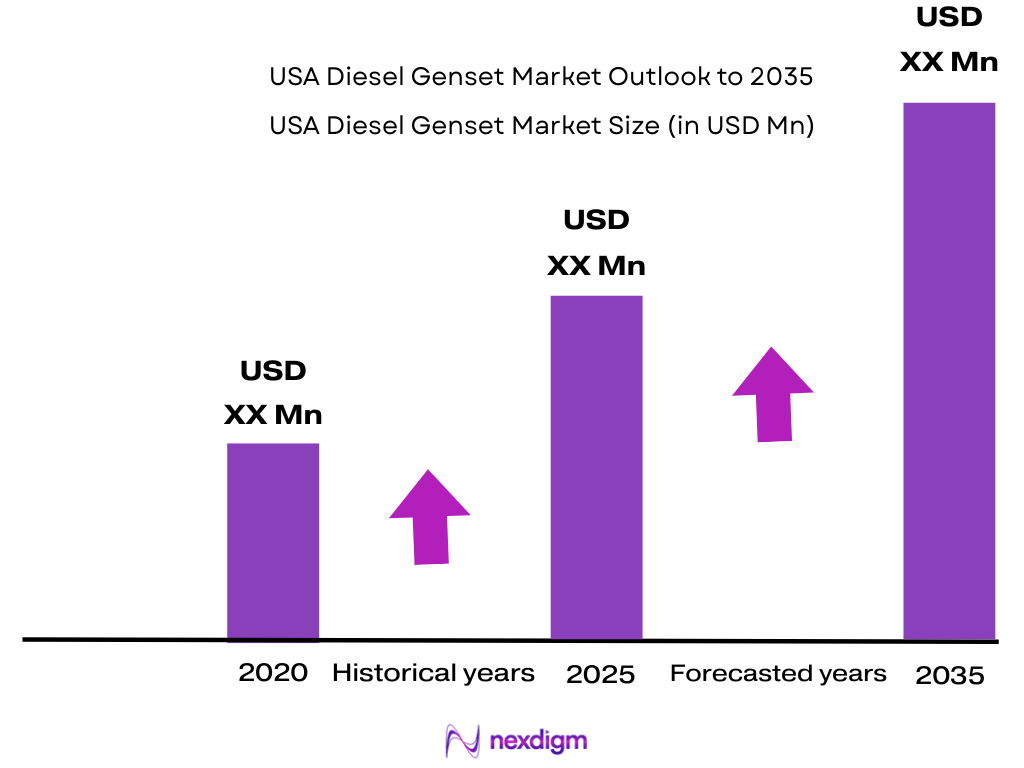
The USA Diesel Genset Market is valued at approximately ~ million, compared with USD ~XX million in the preceding annual benchmark, supported by one of the world’s largest automotive manufacturing ecosystems. U.S. motor-vehicle production increased from approximately 10.61 million units to 10.56 million units across the two latest comparable annual benchmarks, while vehicle sales reached approximately 16.3 million units, sustaining extensive assembly, component, testing, warehousing and powertrain infrastructure requiring dependable standby electricity. Michigan, Ohio, Indiana, Kentucky, Tennessee, Georgia, Alabama and South Carolina form the core demand belt for the USA Diesel Genset Market because they host dense concentrations of vehicle assembly, engine, transmission, component and increasingly battery manufacturing operations. Michigan alone generated USD 10.5 billion of motor-vehicle-parts exports in the latest annual benchmark, while U.S. parts exports totaled USD 60.9 billion, reflecting the industrial depth surrounding these manufacturing clusters and the corresponding requirement for production-resilience infrastructure.
Market Segmentation
By Power Rating
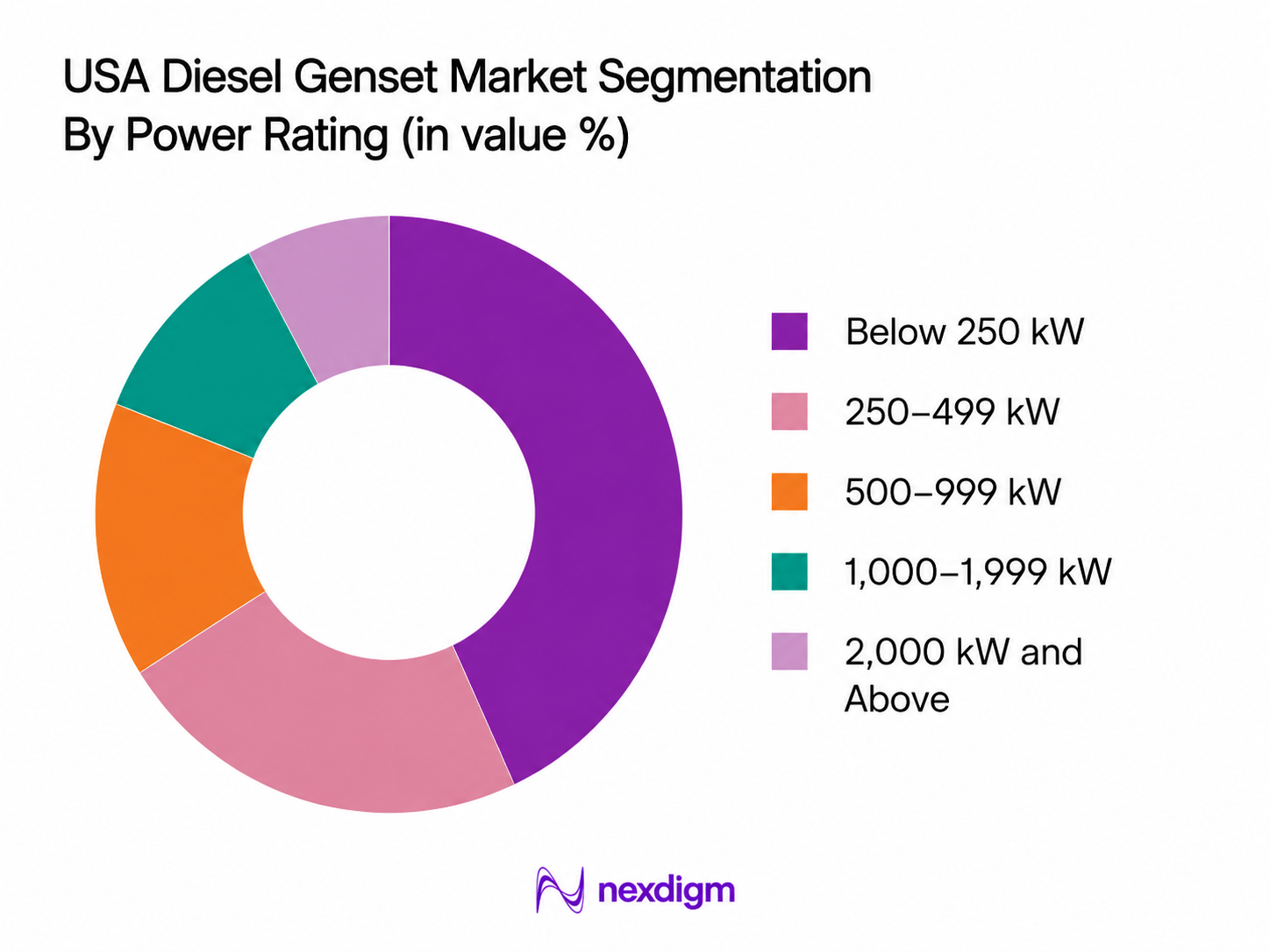
The USA Diesel Genset Market is segmented into below 250 kW, 250–499 kW, 500–999 kW, 1,000–1,999 kW, and 2,000 kW and above. The 500–999 kW category holds the dominant market share in the analytical market model because it offers sufficient capacity for major utility blocks while retaining flexibility for modular parallel configurations. Automotive facilities often avoid relying on one oversized generator and instead deploy multiple sets capable of synchronization, redundancy and staged loading. The segment is particularly relevant to component plants, individual production buildings, paint-shop utilities, compressed-air systems and decentralized backup nodes. Larger assembly and battery facilities increasingly require 1 MW-plus generators in parallel arrangements. Supplier portfolios support this structure: mtu’s Series 1600 covers approximately 500–900 kWe, while major global OEMs provide multiple adjacent industrial power nodes suitable for N+1 configurations.
By Automotive Facility Type
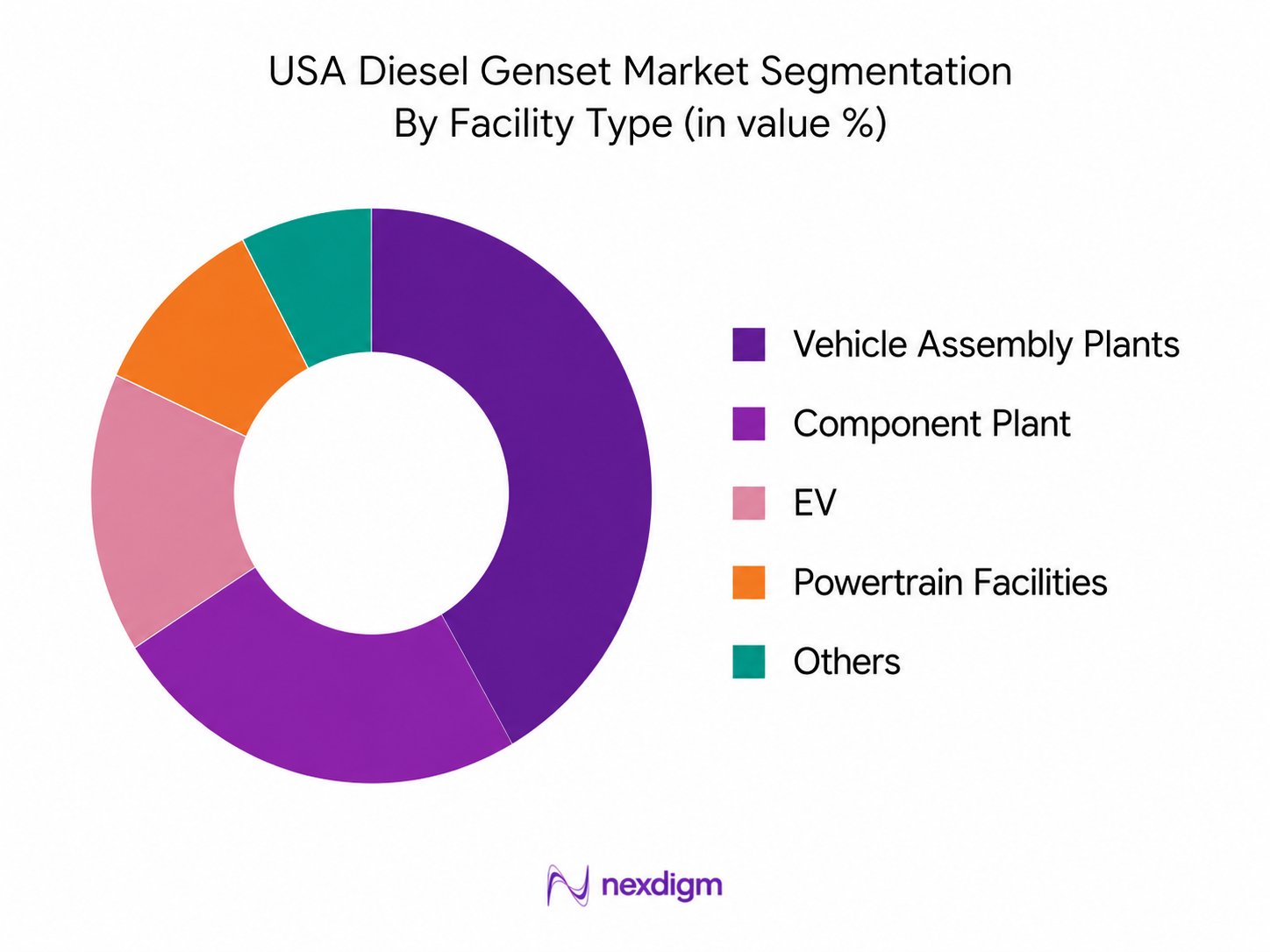
The USA Diesel Genset Market is segmented into vehicle assembly plants, automotive component plants, EV and battery manufacturing facilities, engine and powertrain plants, and automotive logistics/testing facilities. Vehicle assembly plants dominate the market because their integrated manufacturing footprint creates numerous mission-critical electrical loads within a single site. Assembly complexes may combine body shops, robotics, paint lines, HVAC, compressed air, wastewater treatment, fire pumps, network infrastructure and automated logistics. Component plants form the second-largest pool because the U.S. automotive ecosystem extends far beyond final vehicle manufacturers. EV and battery plants are becoming strategically important as domestic battery capacity expands. DOE identifies a pipeline exceeding 1,100 GWh annually, strengthening demand for resilience at battery-cell, module, materials and related component operations, where environmental controls and high-precision production equipment increase the consequences of electrical interruption.
Competitive Landscape
The USA Diesel Genset Market is characterized by established global power-system manufacturers with broad industrial product portfolios, nationwide dealer or distributor networks and extensive aftermarket capabilities. Cummins, Caterpillar, Generac, Rehlko and Rolls-Royce Power Systems’ mtu brand represent prominent participants serving industrial standby applications. Competition extends beyond generator output to paralleling controls, transfer switches, EPA compliance, remote monitoring, service response, renewable-diesel compatibility and capability to support multi-megawatt automotive manufacturing sites.
| Major Player | Established | Headquarters | Diesel Power Position | Standby Capability | Paralleling / Controls | Mobile Offering | Alternative Diesel Readiness | Automotive-Relevant Strength |
| Cummins Inc. | 1919 | Columbus, Indiana, USA | ~ | ~ | ~ | ~ | ~ | ~ |
| Caterpillar Inc. | 1925 | Irving, Texas, USA | ~ | ~ | ~ | ~ | ~ | ~ |
| Generac Holdings | 1959 | Waukesha, Wisconsin, USA | ~ | ~ | ~ | ~ | ~ | ~ |
| Rehlko | 1873 heritage | Wisconsin, USA | ~ | ~ | ~ | ~ | ~ | ~ |
| Rolls-Royce Power Systems – mtu | 1909 heritage | Friedrichshafen, Germany / U.S. operations | ~ | ~ | ~ | ~ | ~ | ~ |
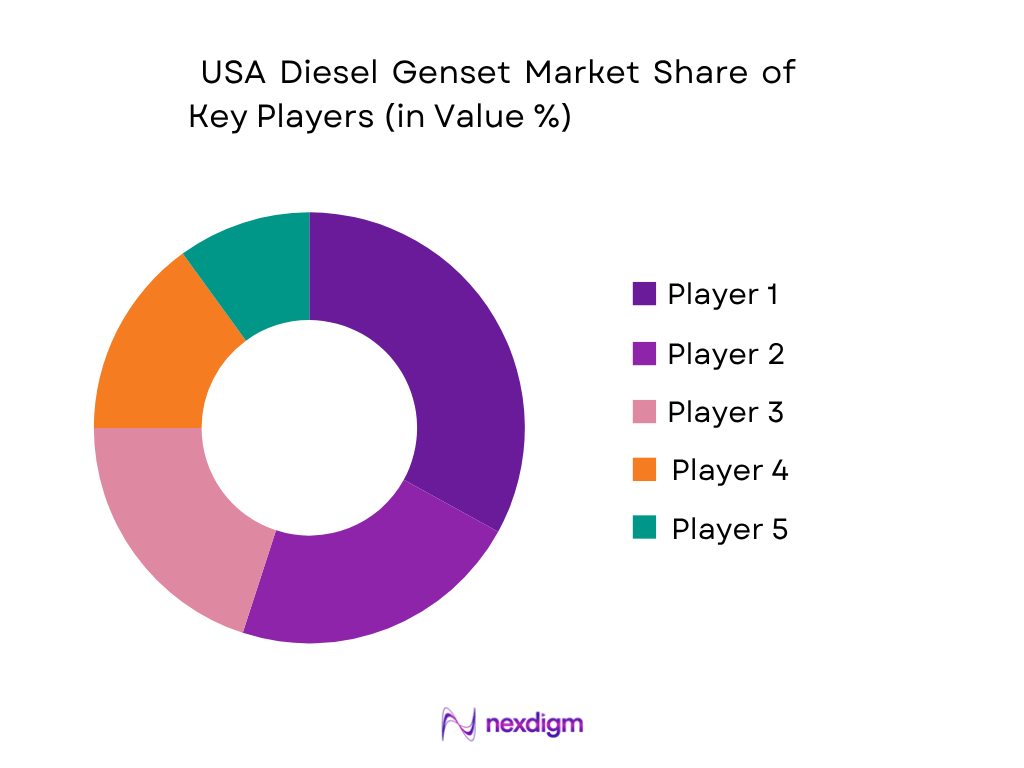
USA Diesel Genset Market Analysis
Growth Drivers
Power Reliability Requirements Across Automotive Manufacturing and Service Infrastructure
The USA Diesel Genset Market is supported by the requirement for dependable backup electricity across vehicle assembly plants, component factories, distribution centres, automotive dealerships, repair facilities, testing operations and other power-sensitive automotive infrastructure. U.S. Energy Information Administration data shows that electricity customers experienced an average of approximately 11 hours of power interruptions during 2024, with major events including Hurricanes Beryl, Helene and Milton accounting for most of the disruption duration. Such outages create a direct operational case for diesel gensets because manufacturing processes involving robotic welding, paint shops, machining centres, compressed-air equipment, computerized production controls and vehicle-testing systems can incur operational disruption when grid power is interrupted. The size of the underlying automotive industrial base further strengthens backup-power requirements. U.S. Census Bureau manufacturing data showed cumulative motor-vehicle and parts shipments of approximately USD 436.98 billion during the first seven months of 2024, compared with USD 426.42 billion during the corresponding prior period, demonstrating the scale of production facilities dependent on stable electricity supplies. The U.S. Bureau of Labor Statistics also recorded more than 152,670 miscellaneous assemblers and fabricators working in motor-vehicle manufacturing and another 138,530 in motor-vehicle-parts manufacturing during May 2024, underscoring the large workforce associated with continuous automotive production activity. From a macroeconomic perspective, current-dollar U.S. GDP reached an annualized USD 29.37 trillion in the third quarter of 2024, while World Bank data places the economy at approximately USD 30.77 trillion in 2025. These figures indicate the substantial industrial and commercial activity requiring resilient infrastructure. Diesel generator systems remain particularly relevant because they can provide high starting torque, rapid emergency response and sustained power for critical loads when utility service is unavailable. Unlike small portable petrol generators, larger diesel units can be engineered for three-phase industrial loads and integrated with automatic transfer switches, paralleling systems, remote controls and fuel-storage infrastructure. Automotive manufacturers also operate complex supply chains in which unplanned downtime at one component plant can disrupt downstream assembly schedules. Backup generation therefore protects not merely individual machinery but synchronized production, inventory movement and vehicle-delivery commitments. As automotive facilities adopt more automation and electronically controlled production equipment, continuity of electricity becomes increasingly important, sustaining demand for stationary and mobile diesel genset systems across the U.S. automotive manufacturing ecosystem.
Expansion of Manufacturing, Construction and Transportation-Equipment Investment
Continued investment in U.S. manufacturing and industrial construction provides a second structural driver for automotive diesel gensets because new factories, battery plants, parts-production facilities, warehouses and automotive infrastructure require temporary and emergency power throughout construction, commissioning and subsequent operations. U.S. Census Bureau data recorded USD 2.1544 trillion of construction work put in place during 2024, compared with USD 2.0237 trillion during the preceding year. Manufacturing-related construction has become particularly important, including computer, electronic and electrical facilities that support increasingly electrified and automated automotive supply chains. Census construction files show computer, electronic and electrical manufacturing construction reaching approximately USD 80.47 billion, illustrating the magnitude of advanced-manufacturing infrastructure development. Diesel gensets are widely used during site preparation, construction and equipment installation because temporary grid connections may not initially provide sufficient capacity for welding systems, cranes, compressors, pumps, lighting, power tools and commissioning equipment. Once facilities enter operation, permanently installed diesel generators can provide emergency power to production lines, server rooms, control systems, fire pumps, ventilation systems and critical material-handling equipment. U.S. manufacturing itself employed more than 12.8 million workers during 2024, according to the Bureau of Labor Statistics, demonstrating the breadth of industrial facilities requiring reliable electricity. Transportation-equipment activity has remained substantial into 2026. Census Bureau durable-goods data reported transportation-equipment unfilled orders reaching approximately USD 1.0024 trillion in June 2026, making transportation equipment the largest contributor to the reported increase in unfilled durable-goods orders. This production backlog is relevant to automotive diesel gensets because manufacturers must sustain high facility uptime while expanding or reconfiguring capacity to fulfil orders. The wider macroeconomic backdrop remains supportive: the International Monetary Fund lists the U.S. economy with an estimated population of 342.942 million people and projected real GDP growth of 2.3 in 2026, while the World Bank reports U.S. GDP of roughly USD 30.77 trillion in 2025. Diesel generator demand therefore benefits from two layers of industrial activity. During construction, mobile and towable gensets provide temporary power where permanent electrical infrastructure is unavailable. After commissioning, stationary diesel systems become resilience assets protecting high-value automotive machinery and electronically controlled production processes. As U.S. vehicle manufacturing incorporates more automation, power electronics, battery assembly and precision machining, individual facilities become increasingly dependent on stable power quality. Generator suppliers that can offer synchronization panels, automatic transfer systems, load management, remote monitoring and emissions-compliant engines are consequently positioned to serve both construction-stage and permanent automotive-facility requirements.
Market Challenges
Tightening Diesel Emission Compliance and Operating Restrictions
Emission regulation represents one of the largest structural challenges confronting the USA Diesel Genset Market because compression-ignition generators must comply with federal and, in some cases, stricter state or local air-quality requirements. The U.S. Environmental Protection Agency regulates nonroad compression-ignition engines used in equipment such as generators under its Tier 4 framework, while stationary compression-ignition generator engines are regulated under 40 CFR Part 60 Subpart IIII and related stationary-engine requirements. Modern nonroad diesel gensets may therefore require advanced combustion controls, diesel oxidation catalysts, diesel particulate filters, selective catalytic reduction or other technologies depending on engine power rating and application. For automotive factories, distribution centres and dealerships, these requirements increase equipment complexity because operators must evaluate generator classification, emissions certification, permitted operating hours and maintenance practices before selecting emergency or non-emergency systems. EPA rules allow emergency stationary engines unlimited operation during genuine emergencies but generally restrict maintenance and testing to 100 hours annually, materially separating backup-power applications from generators used regularly for economic dispatch or prime power. The regulatory environment continued evolving during 2025 when EPA amended standards for compression-ignition engines in remote Alaska, illustrating that generator emission requirements remain an active regulatory area rather than a static compliance issue. The broader environmental context intensifies pressure on diesel technologies. World Bank data records U.S. carbon-dioxide emissions excluding land-use change at approximately 13.6 tonnes per person in 2024, keeping decarbonization and local-air-quality considerations relevant to industrial infrastructure decisions. At the same time, the U.S. economy remained large at an annualized USD 29.37 trillion in current-dollar GDP during the third quarter of 2024, meaning industrial facilities operate under both significant production requirements and increasingly detailed environmental obligations. Automotive manufacturers with corporate decarbonization objectives can therefore face a strategic conflict: diesel gensets remain dependable for emergency backup, yet combustion-based backup assets produce nitrogen oxides, particulate matter and carbon emissions. This can encourage facilities to restrict diesel operation to emergency duty, adopt lower-emission engines or combine diesel generators with batteries and renewable-energy systems. Compliance is particularly demanding in California and other air-quality-sensitive jurisdictions where additional local permitting may apply. Generator manufacturers must consequently engineer products around emissions hardware, after-treatment monitoring, ultra-low-sulfur diesel compatibility and sophisticated electronic control systems. Automotive users must also maintain exhaust systems and fuel quality even though emergency generators may operate only a limited number of hours. This combination of regulation, maintenance complexity and corporate decarbonization creates an important headwind for conventional diesel-only genset adoption.
Competition from Battery Storage, Natural Gas and Emerging Zero-Emission Backup Technologies
The USA Diesel Genset Market increasingly faces competition from battery energy storage, natural-gas generation, renewable-backed microgrids and hydrogen fuel-cell systems as automotive manufacturers pursue lower-emission and digitally integrated resilience solutions. The U.S. Department of Energy identifies fuel cells as commercially relevant for backup power in industrial facilities, businesses, telecommunications infrastructure and data centres, noting that these applications can displace conventional diesel generation where operational requirements and infrastructure allow. DOE demonstrations have also specifically evaluated hydrogen fuel-cell generators as alternatives to diesel backup systems, confirming that zero-emission technologies are moving beyond laboratory development into practical resilience applications. This technology transition affects automotive facilities because modern vehicle plants increasingly incorporate renewable electricity, high-capacity battery systems and sophisticated energy-management platforms. Diesel generators retain advantages in runtime, fuel energy density and mature servicing networks, but alternatives can provide lower local emissions, quieter operation and easier integration with corporate carbon-reduction commitments. U.S. economic scale encourages continued investment in these technologies: World Bank data reports USD 30.77 trillion of GDP in 2025, while IMF data indicates a 2026 economy serving approximately 342.942 million residents. The competing technologies are also being incorporated into microgrid design. DOE’s 2026 microgrid research framework explicitly discusses integrating batteries, diesel generation and other backup-power assets, indicating that diesel gensets may increasingly function as one component of hybrid energy systems instead of the sole backup resource. This changes procurement criteria in the automotive sector. Historically, buyers could evaluate diesel generators largely by kVA rating, runtime, engine reliability and fuel consumption. Newer automotive plants may instead consider total system architecture, including battery duration, grid-interconnection capabilities, renewable-energy availability, emissions limits, generator start frequency and remote energy-management controls. The competitive challenge is therefore not simply that batteries replace diesel gensets one-for-one. Rather, hybrid systems can reduce diesel operating hours and potentially allow facilities to select smaller generator capacity by using batteries to handle instantaneous loads or short-duration outages. Hydrogen presents another longer-term challenge where clean-fuel infrastructure is available, particularly for companies seeking zero tailpipe emissions from backup assets. The automotive sector itself is transitioning toward electrified vehicles, increasing internal expertise in batteries, power electronics and energy management. This expertise can make battery-backed industrial resilience more familiar to automotive companies. Diesel genset manufacturers must respond by offering hybrid-ready controls, microgrid integration, remote dispatch, load-sharing functions and compatibility with renewable and energy-storage systems. Units positioned solely as stand-alone combustion assets risk becoming less competitive in newly designed automotive factories.
Market Opportunities
Hybrid Diesel-Battery Gensets and Intelligent Power Management
Hybridization represents a major growth opportunity in the USA Diesel Genset Market because diesel generators can increasingly be integrated with battery storage, microgrid controls and intelligent load-management systems rather than operating as isolated backup assets. This approach allows automotive manufacturers to retain diesel’s long-duration resilience while using batteries for immediate power transfer, peak-load support and short-duration outages. The need for such systems is supported by the U.S. power-reliability environment: Energy Information Administration data shows the average electricity customer experienced approximately 11 hours of interruptions during 2024, with major weather events causing most outage duration. Automotive plants containing robots, programmable logic controllers, automated guided vehicles, paint systems and precision machining equipment can experience significant production disruption even from short electrical disturbances. A battery can bridge the milliseconds or seconds before a diesel engine reaches operating speed, while the diesel genset can then provide hours or days of sustained backup power. DOE’s 2026 microgrid research strategy explicitly recognizes the integration of batteries and diesel generation as complementary resilience resources, demonstrating the technical relevance of hybrid architectures. The opportunity is reinforced by the scale of U.S. automotive and industrial activity. Census manufacturing data showed motor-vehicle and parts shipments reaching approximately USD 436.98 billion through July 2024, while overall U.S. construction expenditure totalled USD 2.1544 trillion during 2024. These facilities represent potential applications for intelligent backup-power systems during both construction and permanent operations. From a macroeconomic standpoint, U.S. current-dollar GDP reached USD 29.37 trillion at an annualized rate during the third quarter of 2024, and World Bank data records approximately USD 30.77 trillion in 2025, providing a large capital-investment environment for industrial resilience technologies. Hybrid diesel systems create several technical advantages for generator suppliers. Batteries can reduce unnecessary engine starts, allow gensets to operate closer to efficient loading levels and potentially reduce low-load operation that can contribute to wet stacking in diesel engines. Intelligent controllers can forecast facility loads, determine when batteries should discharge, sequence multiple generators and maintain reserve capacity for critical automotive processes. Remote monitoring can provide real-time information on fuel level, oil pressure, coolant temperature, battery state of charge and maintenance intervals. Predictive analytics can further reduce the probability that an emergency genset fails during an outage. These capabilities shift competition from selling engines and alternators toward delivering integrated resilience platforms. Automotive factories with private renewable generation can also combine solar, battery storage and diesel backup in facility microgrids. The diesel unit remains valuable for extended emergencies when battery storage alone is insufficient. Consequently, hybridization offers diesel genset suppliers a route to remain relevant as customers pursue lower operating emissions without sacrificing long-duration backup capability.
High-Resilience Applications in Automotive Manufacturing, Logistics and Advanced-Mobility Facilities
A second major opportunity lies in positioning diesel gensets for high-resilience automotive applications where interruptions cannot be tolerated, including vehicle assembly, battery manufacturing, semiconductor-supported automotive electronics, fleet maintenance hubs, logistics centres and large dealership campuses. U.S. industrial activity provides a substantial current base for these applications. More than 12.8 million workers were employed in manufacturing during 2024, while motor-vehicle manufacturing accounted for approximately 152,670 miscellaneous assembler and fabricator positions and motor-vehicle-parts manufacturing accounted for another 138,530 such positions. The infrastructure surrounding advanced manufacturing is also expanding. Census Bureau construction data identified approximately USD 80.47 billion of annualized construction activity associated with computer, electronic and electrical manufacturing facilities, sectors that increasingly overlap automotive supply chains through semiconductors, battery electronics, charging systems, sensors and advanced driver-assistance components. Diesel gensets can support these sites during grid outages, commissioning operations or periods when utility infrastructure is incomplete. Demand can extend from several-hundred-kilowatt systems serving dealership or warehouse loads to multi-megawatt installations designed around parallel generator banks for major industrial campuses. The opportunity is strengthened by changes in electricity demand. The Department of Energy notes substantial growth in large power loads associated with advanced computing and industrial electrification, while modern manufacturing facilities similarly rely on increasingly dense electrical infrastructure. This makes resilience planning more important because facilities cannot assume that all future electricity requirements will be met solely through conventional utility connections without constraints or disruptions. Economic conditions support continued investment: U.S. GDP reached an annualized USD 29.37 trillion during the third quarter of 2024, increased to approximately USD 30.77 trillion in 2025 according to the World Bank, and the IMF projects an economy of roughly USD 32.38 trillion in current prices for 2026. Generator manufacturers can therefore target automotive customers not only through conventional emergency-generator sales but through engineered resilience solutions. Opportunities include N+1 redundant generator configurations, automatic paralleling, closed-transition transfer systems, remote monitoring, low-temperature starting packages, bulk fuel management and integration with fire-protection and building-management systems. Mobile diesel generators also have applications during plant expansion, equipment commissioning, temporary shutdowns and major maintenance events. Automotive logistics centres provide additional demand because refrigerated materials, IT systems, security equipment, vehicle-charging infrastructure and warehouse automation can require backup electricity. As production becomes increasingly digitized, the financial consequences of electrical interruptions rise even if actual outage frequency does not. This creates a strategic niche for highly reliable diesel gensets that meet EPA requirements while supporting extended-duration resilience. Suppliers capable of combining Tier 4-compliant engines, digital control platforms, hybrid compatibility and nationwide service coverage can address demanding automotive facilities that prioritize uptime over simple equipment acquisition.
Future Outlook
The USA Diesel Genset Market is expected to record a forecast CAGR of approximately ~ during 2026–2035. Growth will increasingly reflect the combination of new EV and battery manufacturing infrastructure, modernization of established vehicle plants, generator replacement cycles and demand for resilient manufacturing systems. A major opportunity will emerge from new battery and advanced-component manufacturing. DOE reported a U.S. battery-manufacturing pipeline above 1,100 GWh annually, alongside substantial public and private capital directed toward battery materials and production facilities. These projects introduce new critical loads that require carefully engineered emergency-power systems. Replacement will be equally important. Mature U.S. automotive factories have operated for decades and contain installed emergency generators, ATS equipment, fuel systems, controls and switchgear that periodically require overhaul or replacement. Suppliers able to combine equipment with load-bank testing, preventative maintenance, controller upgrades, remote diagnostics and multi-year service agreements will be positioned to capture recurring revenue rather than rely solely on greenfield projects. Diesel technology itself will evolve rather than disappear from critical automotive applications. HVO and renewable diesel provide a potential pathway for lowering lifecycle emissions while retaining the operating characteristics of compression-ignition generators. Rehlko identifies HVO compatibility in its industrial generator offering, while Rolls-Royce has approved HVO for major mtu Series 1600 and Series 4000 gensets. Generator-battery hybridization represents another key development. Battery systems can respond instantly to short power-quality events and reduce unnecessary diesel runtime, while diesel gensets provide long-duration energy during extended utility failures. This complementary architecture is particularly applicable to highly automated automotive production environments where both instantaneous ride-through and extended emergency power can be necessary.
Major Players
- Cummins Inc.
- Caterpillar Inc.
- Generac Holdings Inc.
- Rehlko
- Rolls-Royce Power Systems – mtu
- Atlas Copco Group
- Volvo Penta
- Mitsubishi Heavy Industries Engine & Turbocharger
- HIPOWER Systems
- Taylor Power Systems
- Multiquip Inc. – MQ Power
- Wacker Neuson Group
- Doosan Bobcat
- Gillette Generators
- HIMOINSA
Key Target Audience
- Automotive OEM Manufacturers
- Automotive Tier-1, Tier-2 and Tier-3 Component Manufacturers
- EV and Battery Manufacturing Companies
- Diesel Generator Manufacturers, Distributors and Rental Power Providers
- EPC, Electrical and Critical-Power Infrastructure Companies
- Automotive Industrial Property and Manufacturing Facility Developers
- Investments and Venture Capitalist Firms
- Government and Regulatory Bodies (U.S. Environmental Protection Agency, U.S. Department of Energy, U.S. Department of Commerce, Occupational Safety and Health Administration and State Environmental Agencies)
Research Methodology
Step 1: Identification of Key Variables
The research begins with construction of the complete USA Diesel Genset Market ecosystem covering genset OEMs, diesel-engine suppliers, distributors, automotive manufacturers, battery producers, Tier suppliers, EPC contractors and rental-power companies. The exercise identifies core variables including generator rating, automotive facility type, installed base, operating mode, replacement cycle, EPA classification and service requirements.
Step 2: Market Analysis and Construction
Historical market assessment combines top-down and bottom-up approaches. The top-down model evaluates the U.S. industrial diesel-generator ecosystem before isolating automotive manufacturing demand, while the bottom-up model maps vehicle, component, powertrain and battery facilities and assesses typical generator configurations. Equipment shipments, installed kW, replacement requirements and automotive manufacturing activity are triangulated to establish the market structure.
Step 3: Hypothesis Validation and Expert Consultation
Research hypotheses are validated through computer-assisted telephone interviews with generator distributors, automotive facility managers, electrical engineers, EPC contractors, service technicians and rental-power companies. Discussions evaluate installed capacity, preferred generator ratings, emergency runtime, replacement periods, engine requirements, procurement criteria, maintenance practices and competitive positioning to test assumptions derived from secondary analysis.
Step 4: Research Synthesis and Final Output
Primary findings are reconciled with federal industrial, automotive and regulatory datasets to construct the final market model. Demand is segmented by power rating, automotive facility type, installation type and geography. Forecast assumptions incorporate automotive capital expenditure, EV and battery facility development, generator replacement, EPA compliance, alternative-fuel adoption and potential hybridization with battery energy storage.

- Executive Summary
- Research Methodology (Market Definitions and Assumptions, Automotive Diesel Genset Market Boundary, Abbreviations, Market Sizing Approach, Top-Down Analysis, Bottom-Up Automotive Plant Mapping, Demand-Side Assessment, Supply-Side Assessment, Generator Shipment Analysis, Automotive Manufacturing Facility Mapping, Installed-Base Assessment, Replacement Cycle Analysis, OEM and Tier Supplier Interviews, Distributor and Rental Fleet Interviews, Primary Industry Interviews, Data Triangulation, Scenario Forecasting Framework, Limitations and Future Conclusions)

- Definition and Scope
- Market Evolution and Industry Genesis
- Evolution of Backup Power Requirements in Automotive Manufacturing
- USA Automotive Manufacturing Ecosystem Overview
- Vehicle Assembly Plant Landscape

- Growth Drivers (Automotive Manufacturing Reshoring, EV and Battery Plant Construction, Production Automation, Critical Power Reliability, Replacement of Aging Gensets, Extreme Weather Resilience)
- Market Challenges (EPA Compliance, Diesel Emissions, Capital Intensity, Fuel Storage, Generator Lead Time, Skilled Service Workforce, BESS Competition)
- Market Opportunities (EV Plants, Battery Plants, Replacement Market, HVO, Hybrid Systems, Remote Monitoring, AMC Contracts, Mobile Rental Power)
- Market Trends (Digital Controls, HVO Readiness, Modular Paralleling, Remote Monitoring, Tier 4 Systems, Hybridization, Predictive Maintenance)
- SWOT Analysis
- Porter’s Five Forces Analysis
- PESTLE Analysis

- By Market Value (2020-2025)
- By Unit Shipments (2020-2025)
- By Installed Diesel Genset Base (2020-2025)

- By Power Rating (In Value %)
Below 100 kW
100–249 kW
250–499 kW
500–999 kW
1,000–1,999 kW
2,000 kW and Above - By Automotive Facility Type (In Value %)
Passenger Vehicle Assembly Plants
Pickup Truck and SUV Assembly Plants
Commercial Vehicle Manufacturing Plants
Automotive Tier-1 Component Plants
Automotive Tier-2 and Tier-3 Component Plants - By Sales and Procurement Channel (In Value %)
Direct Generator Manufacturer Sales
Authorized Generator Distributors
Industrial Generator Dealers
Electrical and MEP Contractors
EPC and Design-Build Contractors - By Region (In Value %)
Midwest
South
Northeast
West

- Market Share of Major Players by Market Value
- Cross Comparison Parameters (Diesel Genset Power Range, EPA-Certified Engine Portfolio, Automotive Manufacturing Installed References, Stationary and Mobile Product Coverage, Nationwide Dealer and Field-Service Reach, Paralleling and Critical-Power Integration Capability, HVO/Renewable-Diesel Compatibility, Aftermarket Parts and Lifecycle-Service Capability)
- SWOT Analysis of Major Players
- Detailed Profiles of Major Companies
- Cummins Inc.
Caterpillar Inc.
Generac Holdings Inc.
Rehlko
Rolls-Royce Power Systems – mtu
Atlas Copco Group
Volvo Penta
Mitsubishi Heavy Industries Engine & Turbocharger
HIPOWER Systems
Taylor Power Systems
Multiquip Inc. – MQ Power
Wacker Neuson Group
Doosan Bobcat
Gillette Generators
HIMOINSA

- Installed Genset Fleet Assessment
- Average Genset Capacity per Facility
- Average Number of Units per Facility
- Generator Age Profile
- Emergency Operating Hours

- By Market Value (2026-2035)
- By Unit Shipments (2026-2035)
- By Installed Diesel Genset Base (2026-2035)


 Request a Sample
 Ask for Customization
 Get a Quote
 Enquire Now