
 Download PDF
 Download PDF
Market Overview
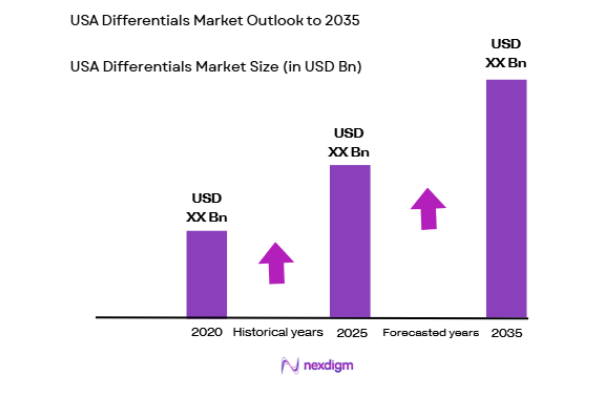
The USA Differentials Market is valued at approximately USD ~ billion, driven by increasing demand in automotive and commercial vehicle applications. Differentials are crucial for ensuring proper torque distribution between wheels, enhancing vehicle stability, and improving performance. The market growth is primarily fueled by the rise in demand for high-performance vehicles, increased production of light trucks and SUVs, and the need for advanced drivetrain systems. Technological advancements in differential designs, such as limited-slip and electronic differentials, are further propelling market growth.
Dominant regions in the USA, such as Michigan and Ohio, lead the USA Differentials Market due to their strong presence of major automotive manufacturers and component suppliers. These states are home to key vehicle manufacturers, such as General Motors and Ford, which have significant production capabilities and R&D centers. Additionally, their robust supply chains and proximity to the North American automotive hubs contribute to the market’s dominance in these regions, as manufacturers focus on high-performance drivetrains and differential systems.
Market Segmentation
By Product Type
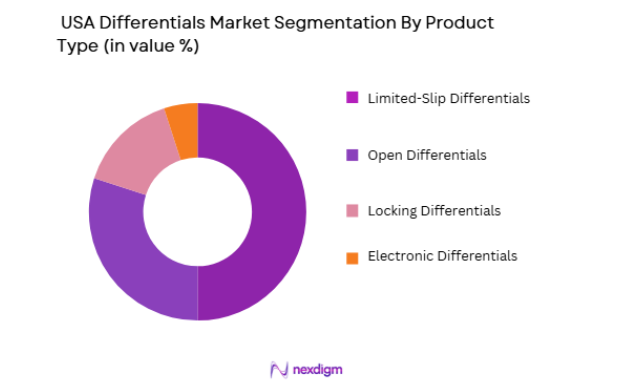
The USA Differentials Market is segmented by product type into open differentials, limited-slip differentials, locking differentials, and electronic differentials. Recently, limited-slip differentials have dominated the market share due to their ability to improve vehicle traction and stability, especially in high-performance and off-road vehicles. These differentials offer superior torque distribution, preventing wheel spin during adverse conditions. The growing demand for off-road vehicles, SUVs, and performance cars, which require better handling and traction control, is further driving the dominance of limited-slip differentials in the market.
By Vehicle Type
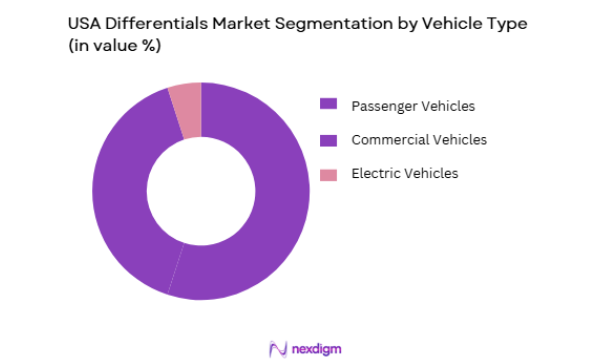
The USA Differentials Market is also segmented by vehicle type into passenger vehicles, commercial vehicles, and electric vehicles. Passenger vehicles dominate the market due to their high production volume and the widespread use of differentials in both front- and rear-wheel-drive configurations. The increasing consumer preference for SUVs, pickup trucks, and off-road vehicles, all of which require advanced differential systems for better performance, further supports the dominance of this segment. Additionally, the rise of hybrid and electric vehicles, which often feature advanced differential technologies for power management, contributes to the growth of this segment.
Competitive Landscape
The USA Differentials Market is highly competitive, with several key players driving innovation in differential technologies. The market is characterized by a mix of established companies with extensive R&D capabilities and smaller niche players specializing in specific applications. Major manufacturers are focusing on improving performance, durability, and efficiency of their differential systems, especially in response to the growing demand for electric and hybrid vehicle drivetrains. Consolidation is occurring as companies seek to expand their technological capabilities and product offerings, especially in the electric vehicle segment.
| Company Name | Establishment Year | Headquarters | Technology Focus | Market Reach | Key Products | Revenue (USD) | Additional Parameter |
| Dana Incorporated | 1904 | Ohio, USA | ~ | ~ | ~ | ~ | ~ |
| ZF Friedrichshafen | 1915 | Germany | ~ | ~ | ~ | ~ | ~ |
| Meritor Inc. | 1909 | Michigan, USA | ~ | ~ | ~ | ~ | ~ |
| BorgWarner | 1928 | Michigan, USA | ~ | ~ | ~ | ~ | ~ |
| GKN Automotive | 1759 | Redditch, UK | ~ | ~ | ~ | ~ | ~ |
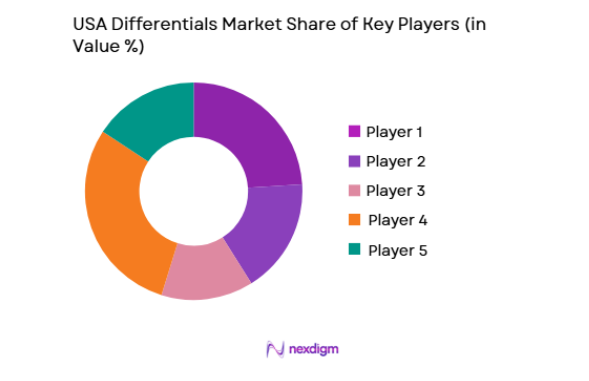
USA Differentials Market Analysis
Growth Drivers
Increasing Demand for High-Performance Vehicles
The rising demand for high-performance vehicles is a key growth driver for the USA Differentials Market. As consumers seek better driving experiences, automakers are increasingly incorporating advanced differential technologies to enhance vehicle performance, handling, and stability. Differentials play a crucial role in distributing torque to the wheels, allowing for smoother acceleration, better cornering, and improved traction control. High-performance vehicles, particularly sports cars, SUVs, and off-road vehicles, require specialized differential systems to optimize performance under different driving conditions. Additionally, the growing popularity of off-road adventures and motorsports has led to a surge in demand for locking and limited-slip differentials, which provide better traction and control. As consumers prioritize driving performance and safety features, the demand for advanced differential systems will continue to grow, providing opportunities for manufacturers to innovate and cater to this segment.
Technological Advancements in Electric Vehicle Drivetrains
Technological advancements in electric vehicle (EV) drivetrains are another significant growth driver for the USA Differentials Market. The rise of EVs has prompted automakers to develop new differential systems tailored for electric powertrains. Unlike traditional internal combustion engine vehicles, EVs require differential systems that can efficiently handle the distribution of power between the electric motor and the wheels. The development of electronic differentials and advanced torque-vectoring systems is crucial for EV performance, as these systems enable better handling, improved range, and reduced energy consumption. As the adoption of electric vehicles continues to rise, particularly in North America, the demand for specialized EV differentials will grow, providing an opportunity for manufacturers to cater to the evolving needs of the electric vehicle market.
Market Challenges
High Manufacturing Costs and Complexity
A major challenge facing the USA Differentials Market is the high manufacturing costs and technological complexity involved in developing advanced differential systems. Differentials, particularly in high-performance vehicles and electric vehicles, require specialized components and materials to ensure optimal performance and reliability. The cost of designing, testing, and producing these systems can be substantial, especially for advanced technologies such as electronic differentials and torque-vectoring systems. Additionally, the need for precision engineering and integration with other drivetrain components adds to the complexity of the manufacturing process. As automakers and suppliers aim to meet consumer demand for better performance and efficiency, the financial burden of producing advanced differentials may limit market access for smaller manufacturers and slow the rate of technological adoption in certain vehicle segments.
Stringent Regulatory Standards and Environmental Concerns
Stringent regulatory standards and environmental concerns present significant challenges for the USA Differentials Market. The automotive industry is subject to increasingly strict emissions and fuel efficiency regulations, which affect the design and performance of drivetrain components, including differentials. In particular, regulations aimed at reducing vehicle emissions and improving fuel efficiency require automakers to develop lightweight and efficient differential systems. Manufacturers must balance the need for performance with the growing demand for environmentally friendly technologies, particularly in electric vehicles, which require specialized differential systems for optimal torque distribution. Adhering to these regulations while maintaining performance and cost efficiency poses a challenge for manufacturers, as it requires continuous innovation and investment in research and development.
Opportunities
Growth of Off-Road and Electric Off-Road Vehicles
The growth of off-road and electric off-road vehicles presents a significant opportunity for the USA Differentials Market. Off-road vehicles, including SUVs, trucks, and recreational vehicles, require robust and reliable differential systems to perform optimally on rugged terrain. The increasing popularity of off-road adventures, combined with the rising demand for high-performance off-road vehicles, is driving the need for advanced differential systems, such as locking and limited-slip differentials. Moreover, the growing popularity of electric off-road vehicles presents new opportunities for manufacturers to develop specialized differential systems for electric powertrains. These vehicles require differentials that can efficiently manage power distribution while maintaining traction and stability. As off-road vehicles and electric off-road vehicles become more popular, the demand for specialized differential solutions will continue to rise, presenting a valuable market opportunity.
Increasing Adoption of Electric and Hybrid Vehicles
The increasing adoption of electric and hybrid vehicles presents another opportunity for the USA Differentials Market. As more consumers switch to EVs and hybrids for their environmental benefits and fuel efficiency, there is a growing need for advanced differential systems tailored to electric powertrains. These systems must handle the unique challenges posed by electric motors, such as higher torque output and more efficient power distribution. Manufacturers are developing electronic differentials and torque-vectoring systems that optimize performance and efficiency in EVs and hybrids. Additionally, the adoption of hybrid vehicles, which combine internal combustion engines and electric motors, requires specialized differential systems that can seamlessly manage the power distribution between the two powertrains. As the electric and hybrid vehicle market continues to grow, the demand for differential systems that meet the performance and efficiency needs of these vehicles will increase, creating significant growth opportunities.
Future Outlook
The future outlook for the USA Differentials Market is promising, with continued growth expected due to the increasing demand for high-performance vehicles, the rise of electric and hybrid vehicles, and the growing popularity of off-road vehicles. Technological advancements in differential systems, particularly in the electric vehicle segment, will drive innovation in the market. Manufacturers will focus on developing efficient, lightweight, and cost-effective differential systems that meet both performance and environmental standards. As consumer preferences shift toward more sustainable and high-performance vehicles, the market for advanced differential technologies will continue to expand.
Major Players
- Dana Incorporated
- ZF Friedrichshafen
- Meritor Inc.
- BorgWarner
- GKN Automotive
- Hyundai Motor Group
- Getrag Transmission Systems
- Toyota Industries Corporation
- Ford Motor Company
- General Motors
- Volkswagen Group
- Allison Transmission
- Magna International
- Jatco Ltd.
- FCA Group
Key Target Audience
- Investments and venture capitalist firms
- Government and regulatory bodies
- Automotive manufacturers
- Differential system suppliers
- Electric vehicle manufacturers
- Automotive technology developers
- Commercial vehicle manufacturers
- Fleet operators
Research Methodology
Step 1: Identification of Key Variables
Identifying the key variables affecting the USA Differentials Market, including technological trends, consumer preferences, and regulatory policies.
Step 2: Market Analysis and Construction
Analyzing historical data and market trends to develop an accurate model for the market, identifying growth opportunities and challenges.
Step 3: Hypothesis Validation and Expert Consultation
Consulting with industry experts and stakeholders to validate hypotheses, ensuring that the market model is both accurate and reliable.
Step 4: Research Synthesis and Final Output
Synthesizing the research findings into a comprehensive report, providing actionable insights and clear guidance for market participants.

- Executive Summary
- Research Methodology (Definitions, Scope, Industry Assumptions, Market Sizing Approach, Primary & Secondary Research Framework, Data Collection & Verification Protocol, Analytic Models & Forecast Methodology, Limitations & Research Validity Checks)

- Market Definition and Scope
- Value Chain & Stakeholder Ecosystem
- Regulatory / Certification Landscape
- Sector Dynamics Affecting Demand
- Strategic Initiatives & Infrastructure Growth

- Growth Drivers
Rising Demand for Fuel-efficient and High-performance Vehicles
Technological Advancements in Automotive Powertrains
Increasing Popularity of All-wheel and Four-wheel Drive Vehicles - Market Challenges
High Manufacturing Costs for Advanced Differential Systems
Integration Issues with Existing Vehicle Platforms
Regulatory and Environmental Compliance Challenges - Market Opportunities
Growth of Electric and Hybrid Vehicle Applications
Expansion of Off-road and Commercial Vehicle Markets
Increasing Demand for Customizable and Durable Differential Systems - Trends
Integration of Electronic Control Systems in Differentials
Focus on Lightweight and Compact Differential Designs
Adoption of Advanced Manufacturing Techniques for Differentials - Government regulations
- SWOT analysis
- Porters 5 forces

By Market Value, 2019-2025
By Installed Units, 2019-2025
By Average System Price, 2019-2025
By System Complexity Tier, 2019-2025

- By System Type (In Value%)
Open Differentials
Limited Slip Differentials
Locking Differentials
Torque Vectoring Differentials
Electronic Differentials - By Platform Type (In Value%)
Passenger Vehicles
Commercial Vehicles
Electric Vehicles
Off-road Vehicles
Heavy Duty Trucks - By Fitment Type (In Value%)
OEM Systems
Aftermarket Systems
Refurbished Systems
Custom-fit Systems
Heavy-duty Systems - By EndUser Segment (In Value%)
Automobile Manufacturers
Fleet Operators
MRO Providers

- Market Share Analysis
- Cross Comparison Parameters (System Type, Platform Type, Procurement Channel, EndUser Segment, Fitment Type, Technological Innovation, Load Capacity, Durability, Environmental Impact, Cost-effectiveness, Manufacturing Lead Time, Product Reliability, Integration Flexibility, Customization Options, Safety Features, Aftermarket Support)
- SWOT Analysis of Key Competitors
- Pricing & Procurement Analysis
- Key Players
BorgWarner Inc.
Dana Incorporated
Eaton Corporation
Meritor, Inc.
GKN Automotive
ZF Friedrichshafen AG
American Axle & Manufacturing
Shaanxi Fast Gear
JTEKT Corporation
AxleTech International
Hyundai Transys
Caterpillar Inc.
Southeast Axle
Knott-Avonride
Rheinmetall Automotive

- Automobile Manufacturers Demanding Efficient and Robust Differentials
- Fleet Operators Seeking Cost-effective and Durable Differentials
- MRO Providers Focusing on Refurbishment and Maintenance
- Off-road Vehicle Manufacturers Requiring Heavy-duty Differentials

- Forecast Market Value, 2026-2030
- Forecast Installed Units, 2026-2030
- Price Forecast by System Tier, 2026-2030
- Future Demand by Platform, 2026-2030


 Request a Sample
 Ask for Customization
 Get a Quote
 Enquire Now