

 Download PDF
 Download PDF
Market Overview
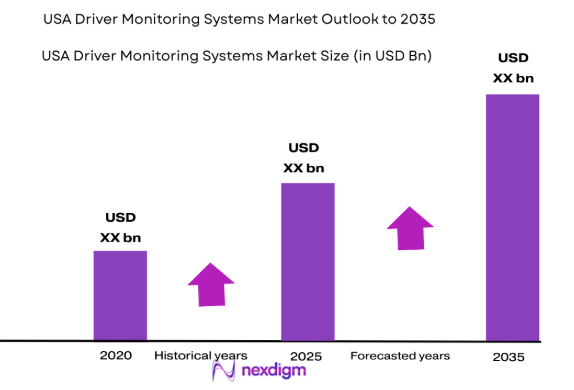
Based on a recent historical assessment, the USA Driver Monitoring Systems market generated approximately USD ~ billion, driven by accelerating integration of advanced driver assistance systems across passenger and commercial vehicles. Growth is supported by mandates under the National Highway Traffic Safety Administration focusing on crash avoidance technologies, along with rising consumer demand for in cabin safety features. Increasing penetration of semi autonomous driving packages and higher OEM spending on AI enabled sensing platforms have strengthened system adoption across new vehicle platforms.
The market is geographically concentrated in automotive manufacturing hubs such as Michigan, California, and Texas, where strong OEM presence, technology innovation ecosystems, and supplier networks accelerate deployment. California leads innovation through its advanced mobility startups and semiconductor firms, while Michigan benefits from legacy automotive engineering and testing infrastructure. Texas contributes through electronics manufacturing and fleet operations demand, reinforcing domestic system integration and validation capabilities across vehicle categories without reliance on imports.
Market Segmentation
Product Type
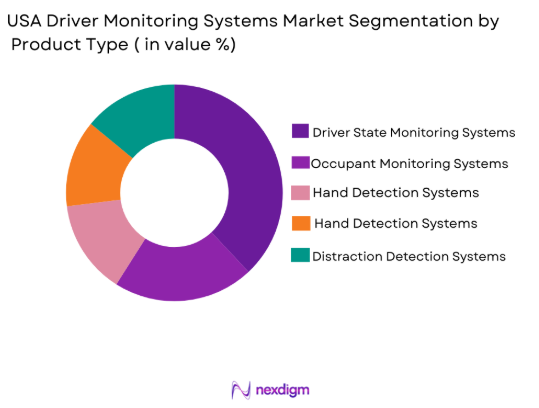
USA Driver Monitoring Systems market is segmented by product type into Driver State Monitoring Systems, Occupant Monitoring Systems, Hand Detection Systems, Driver Identification Systems, and Distraction Detection Systems. Recently, Driver State Monitoring Systems has a dominant market share due to growing regulatory pressure to address drowsiness and distraction related crashes, strong OEM integration into ADAS packages, compatibility with automation systems, established supplier ecosystems, and increasing fleet demand for real time behavioral analytics that improve safety compliance and insurance performance metrics across passenger and light commercial vehicle segments.
Platform Type
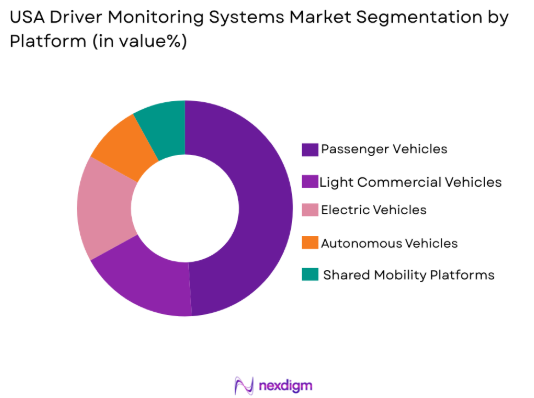
USA Driver Monitoring Systems market is segmented by platform type into Passenger Vehicles, Commercial Vehicles, Electric Vehicles, Autonomous Vehicles, and Shared Mobility Platforms. Recently, Passenger Vehicles hold the dominant market share due to higher production volumes, widespread ADAS integration, strong consumer demand for in cabin safety features, regulatory alignment with crash prevention technologies, and OEM bundling strategies that position driver monitoring as a standard component in mid and premium vehicle trims.
Competitive Landscape
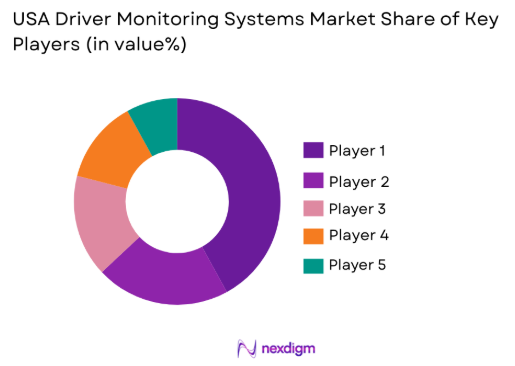
The USA Driver Monitoring Systems market is moderately consolidated, with leading Tier 1 automotive suppliers and specialized vision technology firms dominating OEM contracts. Strategic partnerships between semiconductor companies and automotive integrators have intensified competition. Established global players leverage scale, proprietary algorithms, and deep OEM relationships, while niche technology firms compete through AI innovation and software centric architectures that enable feature differentiation and regulatory compliance alignment.
|
Company Name |
Establishment Year | Headquarters | Technology Focus | Market Reach | Key Products | Revenue | AI Integration Capability |
| Continental AG | 1871 | Germany | ~ | ~ | ~ | ~ | ~ |
| Bosch | 1886 | Germany | ~ | ~ | ~ | ~ | ~ |
| Denso | 1949 | Japan | ~ | ~ | ~ | ~ | ~ |
| Magna International | 1957 | Canada | ~ | ~ | ~ | ~ | ~ |
| Seeing Machines | 2000 | Australia | ~ | ~ | ~ | ~ | ~ |
USA Driver Monitoring Systems Market Analysis
Growth Drivers
Regulatory Mandates for Driver Safety Compliance
The explanation continues in the same sentence. Strengthening federal vehicle safety oversight and increased focus on reducing distraction related crashes have compelled automotive manufacturers to integrate advanced monitoring capabilities into mainstream vehicle platforms across the United States. The National Highway Traffic Safety Administration continues to emphasize crash avoidance technologies, pushing OEMs to prioritize systems capable of detecting drowsiness, gaze deviation, and cognitive inattention. Insurance providers also support adoption by incentivizing safety enhancing technologies that reduce liability exposure and claims frequency. As vehicles incorporate higher levels of automation, regulators require robust human machine interaction safeguards to ensure drivers remain engaged when control transitions occur. These compliance expectations have accelerated investment in camera based sensing modules and embedded AI processors capable of real time behavioral analytics. Vehicle safety rating programs indirectly influence adoption by rewarding manufacturers that deploy advanced monitoring solutions as standard equipment. Large fleet operators align procurement policies with regulatory trends to minimize operational risk and meet occupational safety guidelines. The regulatory environment therefore acts as a structural demand catalyst that shapes procurement decisions, technology roadmaps, and long term supplier partnerships within the domestic automotive ecosystem.
Integration with Advanced Driver Assistance Systems and Semi Autonomous Platforms
The explanation continues in the same sentence. The expansion of Level 2 and Level 2 plus automation capabilities in passenger vehicles has created a technological dependency on reliable driver monitoring solutions that confirm attentiveness during assisted driving. As adaptive cruise control and lane centering systems become standard features, manufacturers must ensure drivers maintain situational awareness and are prepared to retake control when necessary. Driver monitoring systems provide continuous gaze tracking and hand detection functionality that enable safe deployment of automated features. Automotive brands increasingly bundle these capabilities within premium and mid segment trims, expanding system penetration beyond luxury vehicles. Semiconductor advancements have reduced processing latency, enabling in cabin AI inference without reliance on cloud connectivity. This technological convergence supports seamless integration into vehicle electronic architectures and infotainment platforms. Consumer demand for safer semi autonomous driving experiences further reinforces OEM commitment to standardized monitoring features. The synergy between ADAS expansion and driver state analytics ensures sustained demand for sophisticated sensing modules across new vehicle launches nationwide.
Market Challenges
Data Privacy and Biometric Information Governance Risks
The explanation continues in the same sentence. Driver monitoring systems rely heavily on in cabin cameras and biometric analytics that capture facial features, eye movements, and behavioral patterns, creating heightened sensitivity around personal data protection and consent management. State level privacy regulations impose strict requirements on data storage, processing transparency, and user authorization, increasing compliance costs for manufacturers and technology providers. Consumers express concerns about surveillance implications, particularly when vehicles transmit behavioral data to cloud platforms or fleet management systems. Automakers must therefore implement secure encryption protocols and anonymization frameworks to mitigate legal exposure. Any breach involving biometric information could significantly damage brand trust and lead to regulatory penalties. Integrating privacy by design principles into hardware and software architectures adds development complexity and extended validation cycles. Additionally, cross state legal variations create uncertainty regarding uniform compliance standards for nationwide vehicle distribution. These governance risks represent structural barriers that may slow widespread adoption if not addressed through transparent policy alignment and robust cybersecurity safeguards.
High System Cost and Integration Complexity in Mass Market Vehicles
The explanation continues in the same sentence. Although technology prices have gradually declined, advanced driver monitoring modules incorporating infrared illumination, high resolution cameras, and AI processors still add incremental cost to vehicle bills of materials. Mass market manufacturers operating under tight margin structures face challenges in absorbing these expenses without increasing retail prices. Integration into existing electronic control unit architectures demands engineering resources and extended validation testing to ensure compatibility with infotainment, safety, and telematics subsystems. Smaller OEMs may lack in house AI expertise, requiring partnerships that increase dependency on external suppliers. Calibration and performance reliability across diverse lighting conditions and driver demographics further complicate deployment. Supply chain disruptions in semiconductor components also introduce procurement volatility that affects production schedules. Cost sensitivity among price conscious consumers limits the speed at which monitoring features can transition from optional packages to standard equipment. These economic and technical constraints create measurable friction in scaling adoption across all vehicle categories.
Opportunities
Expansion into Commercial Fleet Safety Analytics Platforms
The explanation continues in the same sentence. Commercial fleet operators increasingly seek data driven insights to reduce accident rates, optimize driver performance, and comply with occupational safety requirements across logistics and transportation sectors. Driver monitoring systems integrated with telematics platforms can generate actionable analytics regarding fatigue, distraction, and behavioral risk patterns. Insurance companies are willing to provide premium incentives to fleets that demonstrate measurable safety improvements through validated monitoring programs. This creates a scalable business model beyond one time hardware sales, enabling subscription based revenue streams linked to software dashboards and performance reporting tools. Growth in last mile delivery and e commerce logistics expands the addressable market for commercial deployment. Real time alert mechanisms can prevent costly incidents and vehicle downtime, improving operational efficiency. Partnerships between automotive OEMs and fleet management software providers strengthen ecosystem integration. The convergence of safety compliance, cost reduction objectives, and digital fleet management presents a substantial commercial opportunity for monitoring solution providers.
Development of AI Powered Cabin Intelligence Ecosystems
The explanation continues in the same sentence. Beyond safety compliance, driver monitoring hardware can serve as the foundation for broader cabin intelligence applications including personalized infotainment settings, biometric authentication, and adaptive comfort controls. AI driven facial recognition enables seamless driver identification and profile customization without manual input. Automotive manufacturers can monetize premium software features activated over the air, creating recurring revenue opportunities tied to enhanced in cabin experiences. Integration with voice assistants and human machine interfaces allows contextual adjustments based on detected mood or attentiveness levels. Semiconductor advancements in edge computing reduce latency and preserve privacy by processing data locally within the vehicle. As electric and connected vehicles proliferate, digital cabin ecosystems become central to brand differentiation strategies. Strategic collaboration between chipmakers, AI software developers, and OEMs accelerates innovation cycles. Leveraging driver monitoring infrastructure for multifunctional cabin intelligence significantly expands long term value creation potential.
Future Outlook
Over the next five years, the USA Driver Monitoring Systems market is expected to witness steady expansion supported by tighter safety compliance frameworks and rapid penetration of semi autonomous driving technologies. Continued advancements in AI vision processing and sensor fusion will improve system accuracy and cost efficiency. Regulatory encouragement for crash avoidance technologies will further strengthen OEM adoption. Demand from commercial fleets and connected vehicle platforms will broaden application scope beyond passenger vehicles.
Major Players
- Continental AG
- Bosch
- Denso
- Magna International
- Aptiv
- Valeo
- ZF Friedrichshafen
- Gentex
- Smart Eye
- Seeing Machines
- Ambarella
- Hyundai Mobis
- Aisin
- Forvia
- Texas Instruments
Key Target Audience
- Automotive OEMs
- Tier 1 Automotive Suppliers
- Semiconductor Manufacturers
- Fleet Management Companies
- Insurance Providers
- Investments and venture capitalist firms
- Government and regulatory bodies
- Automotive Software Developers
Research Methodology
Step 1: Identification of Key Variables
Primary and secondary research sources were evaluated to determine demand drivers, regulatory factors, technology adoption rates, and OEM integration trends influencing the USA Driver Monitoring Systems market. Key variables included vehicle production volumes, ADAS penetration, sensor technology evolution, and safety compliance frameworks.
Step 2: Market Analysis and Construction
Collected data was structured into segmented models based on product type and vehicle category. Revenue mapping aligned OEM deployment volumes with average system pricing to construct market size estimates and competitive positioning assessments.
Step 3: Hypothesis Validation and Expert Consultation
Industry experts including automotive engineers, supplier executives, and regulatory analysts were consulted to validate assumptions regarding technology adoption and compliance requirements. Feedback loops refined segmentation weights and competitive dynamics interpretation.
Step 4: Research Synthesis and Final Output
Validated datasets were synthesized into structured insights covering growth drivers, challenges, and opportunity mapping. Quantitative and qualitative findings were integrated to produce comprehensive market projections and strategic analysis.

- Executive Summary
- Research Methodology (Definitions, Scope, Industry Assumptions, Market Sizing Approach, Primary & Secondary Research Framework, Data Collection & Verification Protocol, Analytic Models & Forecast Methodology, Limitations & Research Validity Checks)

- Market Definition and Scope
- Value Chain & Stakeholder Ecosystem
- Regulatory / Certification Landscape
- Sector Dynamics Affecting Demand
- Strategic Initiatives & Infrastructure Growth

- Growth Drivers
Stricter in vehicle safety regulations and consumer safety expectations
Rising adoption of ADAS and higher levels of vehicle automation
Growth of connected cars enabling continuous driver state analytics
Insurance and fleet demand for risk reduction and incident prevention
Advances in AI vision processing and low light sensing performance - Market Challenges
Privacy concerns and data governance requirements for in cabin sensing
Complex integration with vehicle HMI and ADAS decision stacks
Performance variability across lighting conditions and driver behaviors
Cost and compute constraints for mass market vehicle platforms
Cybersecurity risks for connected in cabin sensor data pipelines - Market Opportunities
OEM monetization through software enabled safety feature subscriptions
Integration of occupant monitoring for smart airbag and restraint optimization
Fleet focused driver coaching programs using compliant analytics dashboards - Trends
Shift from single camera to multi sensor in cabin fusion architectures
Increased use of infrared and NIR for robust night time monitoring
Edge AI deployment to reduce latency and limit data transmission
Expansion from driver only monitoring to full cabin occupant analytics
Standardization of DMS performance validation and test protocols - Government Regulations & Defense Policy
Move toward mandatory in vehicle monitoring requirements tied to safety ratings
Stronger privacy and data security compliance expectations for biometric data
Guidance on driver distraction and impairment countermeasures in roadway safety policy
SWOT Analysis
Stakeholder and Ecosystem Analysis
Porter’s Five Forces Analysis
Competition Intensity and Ecosystem Mapping

- By Market Value 2019-2025
- By Installed Units 2019-2025
- By Average System Price 2019-2025
- By System Complexity Tier 2019-2025

- By System Type (In Value%)
Driver State Monitoring Systems
Occupant Monitoring Systems
Hand on Wheel Detection Systems
Driver Identification Systems
Fatigue and Distraction Monitoring Systems - By Platform Type (In Value%)
Passenger Cars
Light Commercial Vehicles
Heavy Commercial Vehicles
Fleet and Shared Mobility Vehicles
Off Highway Vehicles - By Fitment Type (In Value%)
OEM Factory Fit
Dealer Fitment
Aftermarket Retrofit
Fleet Retrofit Programs
Software Feature Activation - By End User Segment (In Value%)
Vehicle OEMs
Tier 1 Automotive Suppliers
Fleet Operators
Mobility Service Providers
Insurance and Telematics Providers - By Procurement Channel (In Value%)
Direct OEM Sourcing
Tier 1 Integration Contracts
Fleet Procurement Agreements
Aftermarket Retail and Installers
Subscription and Software Licensing - By Material / Technology (in Value%)
Camera Based Monitoring
Infrared Illumination and NIR Sensing
Radar Based In Cabin Sensing
AI and Computer Vision Algorithms
Sensor Fusion and Edge Processing

- Market structure and competitive positioning
- Market share snapshot of major players
- Cross Comparison Parameters (System Type, Platform Type, Fitment Type, EndUser Segment, Procurement Channel, Material / Technology, Sensing Modality, AI Processing Location, Compliance Readiness, Integration Depth)
- SWOT Analysis of Key Players
- Pricing & Procurement Analysis
- Porter’s Five Forces Analysis
- Key Players
Aptiv
Bosch
Continental
Denso
Valeo
Magna International
ZF Friedrichshafen
Aisin
Hyundai Mobis
Forvia
Gentex
Smart Eye
Seeing Machines
Ambarella
Texas Instruments

- OEM focus on regulatory compliance and safety differentiation in new models
- Tier 1 emphasis on scalable hardware platforms and software upgradability
- Fleet operators prioritizing incident reduction and driver coaching outcomes
- Insurers and telematics providers leveraging analytics for risk based programs

- Forecast Market Value 2026-2030
- Forecast Installed Units 2026-2030
- Price Forecast by System Tier 2026-2030
- Future Demand by Platform 2026-2030


 Request a Sample
 Ask for Customization
 Get a Quote
 Enquire Now