
 Download PDF
Market Overview
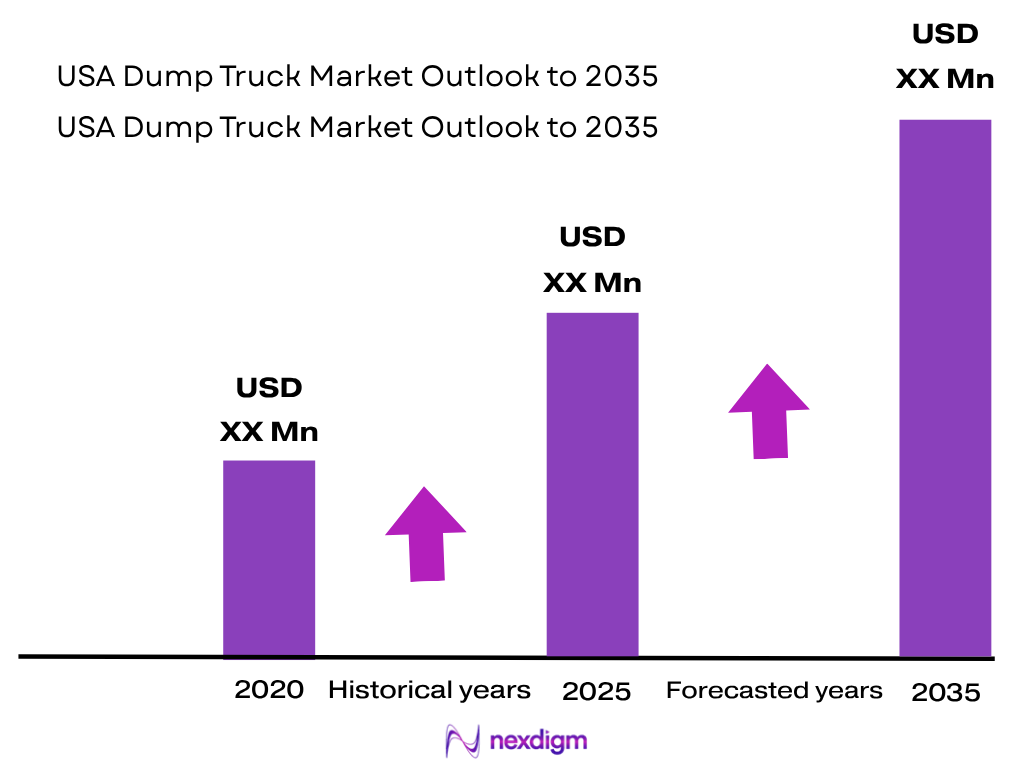
The USA Dump Truck Market is valued at approximately ~USD XX billion, supported by construction, aggregate hauling, mining, quarrying and municipal infrastructure activity. Construction sand and gravel production moved from 967 million metric tons to 890 million metric tons, while crushed-stone production moved from 1.55 billion tons to 1.50 billion tons across the two latest historical periods. These material volumes sustain demand for on-road dump trucks, articulated haulers and rigid mining trucks.
Texas, California, Arizona and Nevada are major USA Dump Truck Market demand hubs because of extensive infrastructure construction, aggregate production and mining activity. State and local construction put in place moved from USD 51.079 billion to USD 61.088 billion in Texas, USD 46.676 billion to USD 56.750 billion in California, USD 4.888 billion to USD 5.534 billion in Arizona, and USD 4.165 billion to USD 5.145 billion in Nevada across the latest historical periods.
Market Segmentation
By Dump Truck Type
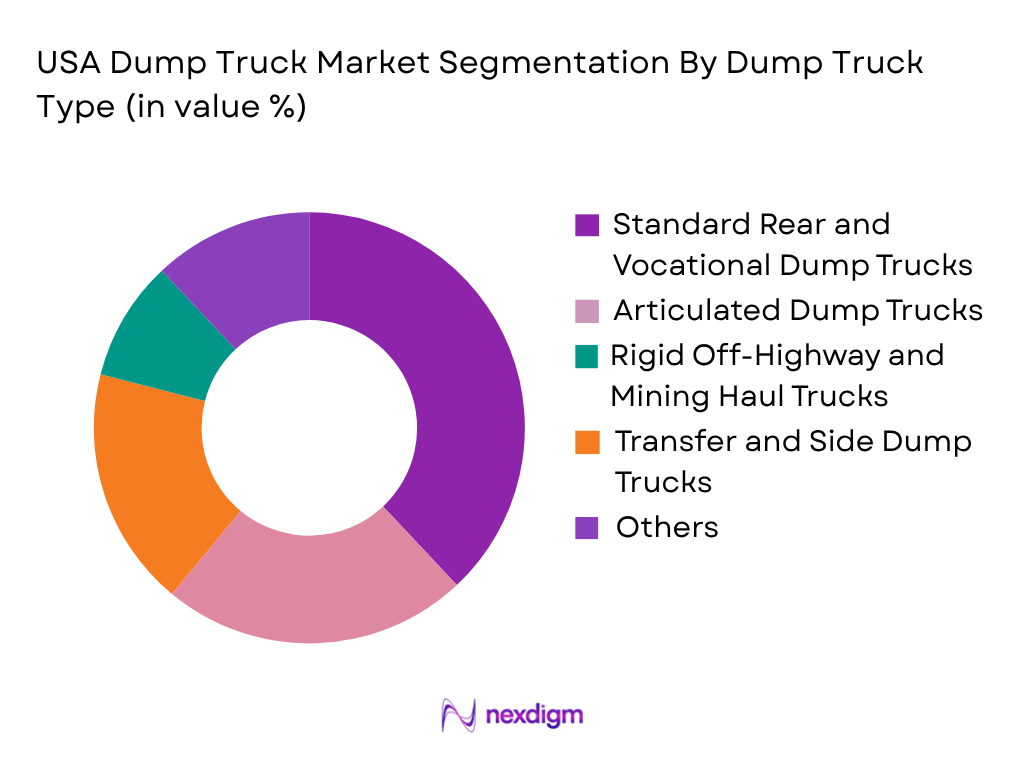
The USA Dump Truck Market is segmented into standard rear dump trucks, transfer and side dump trucks, articulated dump trucks, rigid off-highway dump trucks, mining haul trucks and other specialized configurations. Standard rear dump trucks constitute the dominant segment because they serve the broadest range of construction, roadwork, municipal, aggregate and site-development applications. Their compatibility with Class 7 and Class 8 vocational chassis allows fleets to configure axle arrangements, dump-body materials and hydraulic hoists around state weight regulations and specific payload requirements. Articulated dump trucks are especially important on undeveloped haul roads, quarries and large earthmoving sites where traction and maneuverability are critical. Rigid and mining haul trucks address high-volume material movement where fleets prioritize payload per cycle and continuous operation. The enormous U.S. construction aggregate base, involving around 2.39 billion tons of crushed stone plus construction sand and gravel, creates recurring hauling requirements across both highway-accessible and off-road environments.
By Application Type
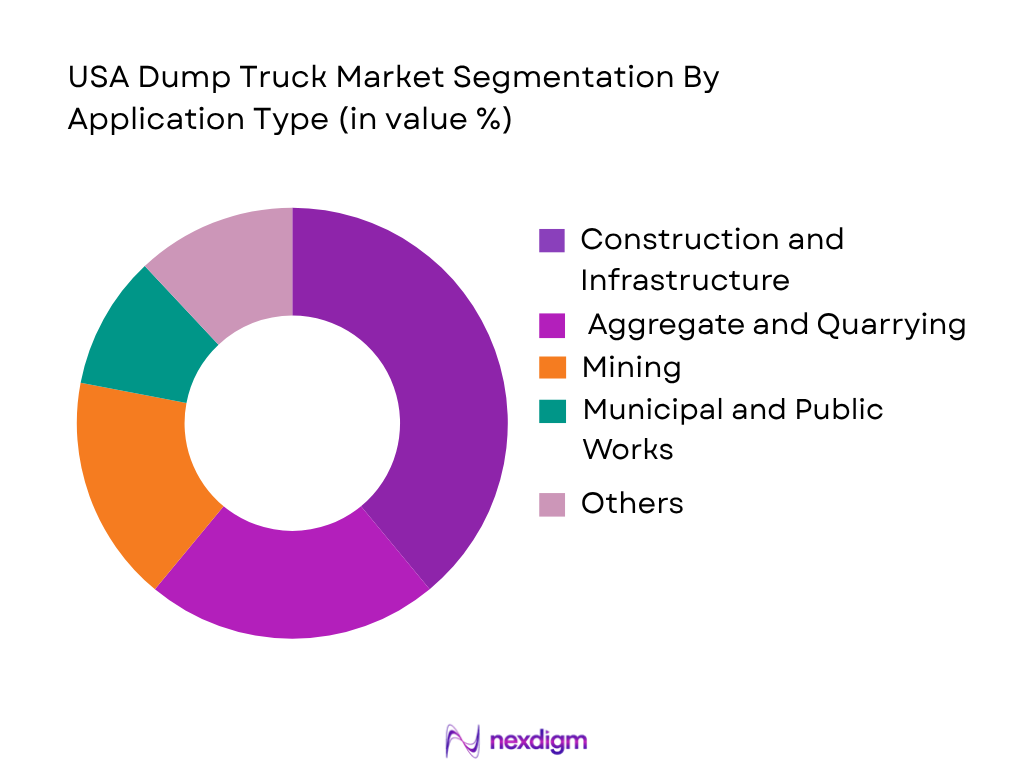
The USA Dump Truck Market is segmented into construction and infrastructure, aggregate and quarrying, mining, municipal and public works, demolition and waste movement, and other specialized applications. Construction and infrastructure represent the dominant application because dump trucks operate throughout excavation, grading, road-base placement, highway construction, utility installation, site preparation and movement of soil, asphalt and aggregate. U.S. state and local construction put in place reached USD 472.635 billion, creating a large operating environment for vocational trucks and articulated haulers. Aggregate and quarry operators constitute another major demand base because the country produced 1.50 billion tons of crushed stone and 890 million tons of construction sand and gravel. Mining applications are smaller in fleet count but significantly heavier in equipment intensity, using rigid haul trucks and large articulated units with substantially greater payload capacities. Municipal fleets additionally procure dump trucks for road maintenance, debris removal, snow operations and public-works material movement.
Competitive Landscape
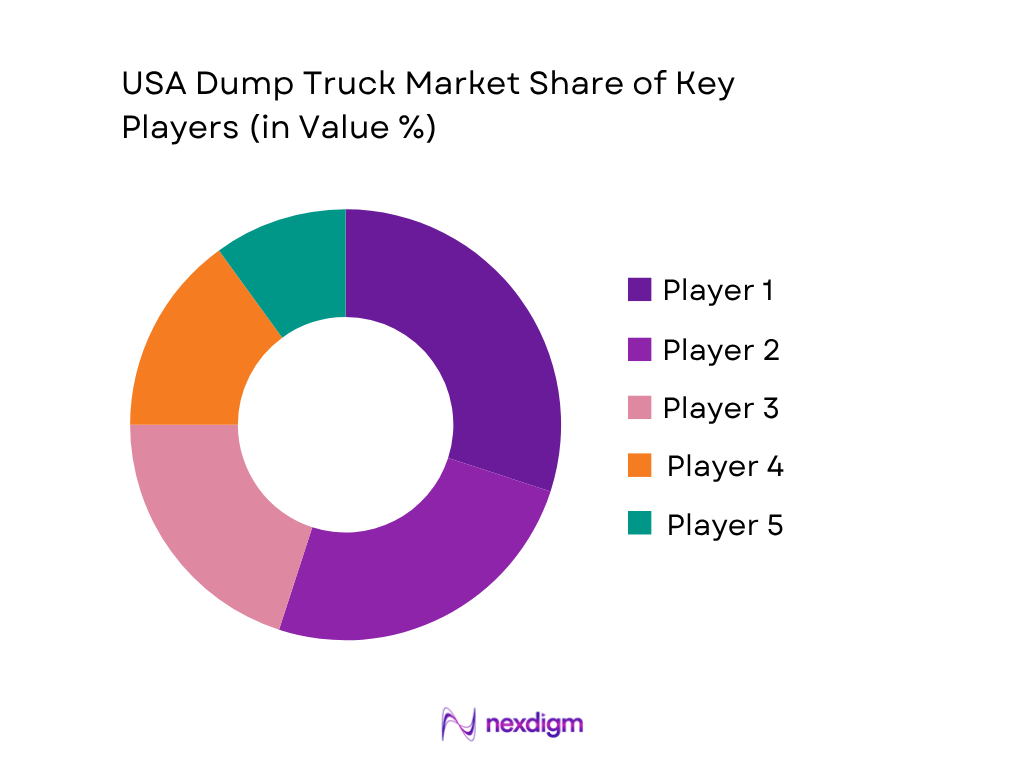
The USA Dump Truck Market has two interconnected competitive structures. Caterpillar, Komatsu, Volvo Construction Equipment, John Deere and Bell Equipment compete in articulated, rigid and mining haulage, while Mack, Kenworth, Peterbilt, Freightliner, Western Star, International and Autocar serve the highway-capable vocational dump-truck segment. Competition is determined by payload coverage, severe-duty capability, traction, body integration, dealer support, fleet uptime, telematics and increasingly autonomous or electrified haulage technology. Caterpillar’s dealer network alone operates through approximately 2,700 branches serving more than 190 countries, illustrating the service intensity required in heavy equipment markets.
| Major Player | Establishment Year | Headquarters | Core Dump Truck Focus | Payload Coverage | Construction / Quarry Capability | Mining Capability | Powertrain Capability | Digital / Autonomous Capability |
| Caterpillar Inc. | 1925 | Irving, Texas, USA | ~ | ~ | ~ | ~ | ~ | ~ |
| Komatsu Ltd. | 1921 | Tokyo, Japan | ~ | ~ | ~ | ~ | ~ | ~ |
| Volvo Construction Equipment | 1832 | Eskilstuna, Sweden | ~ | ~ | ~ | ~ | ~ | ~ |
| Deere & Company | 1837 | Moline, Illinois, USA | ~ | ~ | ~ | ~ | ~ | ~ |
| Bell Equipment | 1954 | Richards Bay, South Africa | ~ | ~ | ~ | ~ | ~ | ~ |
USA Dump Truck Market Analysis
Growth Drivers
Expansion of Public Infrastructure and Highway Construction Sustaining Dump Truck Utilization
The USA Dump Truck Market is strongly supported by the scale of public infrastructure and highway construction, where dump trucks are required continuously for excavation, grading, aggregate delivery, asphalt movement, demolition material removal, embankment construction and site preparation. Public construction activity reached USD 498.7 billion in 2024, including USD 143.2 billion in highway construction, demonstrating the depth of projects requiring vocational dump trucks, transfer dumps, side dumps and articulated haulers. Public construction increased to USD 516.8 billion in 2025, while highway construction remained substantial at USD 141.9 billion. At the beginning of 2025, the annualized level for total construction reached USD 2,192.5 billion, while public construction stood at USD 506.6 billion and highway construction at USD 145.0 billion. These figures are especially relevant because highway, bridge, drainage, utility and civil works involve repeated transportation of soil, crushed stone, sand, asphalt and demolition material. Highway contractors require Class 7 and Class 8 rear-dump trucks for road-accessible operations, while articulated dump trucks address unpaved haul roads and difficult terrain. The U.S. economy generated USD 28.75 trillion in GDP in 2024, with GDP per capita reaching USD 84,534, providing a substantial economic foundation for infrastructure activity. This construction pipeline supports fleet replacement and demand for tandem-axle configurations, high-strength dump bodies, hydraulic hoists, automated transmissions, onboard weighing and severe-duty suspension systems.
Mining, Quarrying and Bulk Material Movement Creating Heavy-Haul Dump Truck Demand
Mining, quarrying and aggregate movement form another major growth driver for the USA Dump Truck Market because these industries require purpose-built equipment capable of carrying large payloads across repetitive haul cycles under severe operating conditions. The United States produced USD 106 billion of nonfuel mineral commodities in 2024, including USD 72.1 billion of industrial minerals and approximately USD 33.5 billion of metal mine output. The mineral-production base strengthened to USD 112 billion in 2025, while mineral-reliant industries represented approximately USD 4.09 trillion of economic activity. Construction sand and gravel production reached 870 million metric tons in 2025, supported by approximately 3,400 producing companies, 6,500 pits and more than 200 sales or distribution yards. This operating structure creates demand for different dump-truck configurations: rigid mining haul trucks serve high-volume surface mines, articulated dump trucks operate across quarries and uneven haul roads, and highway-capable dump trucks transport aggregates from production locations to construction projects. Mining operations also require continuous multi-shift hauling, increasing the importance of payload capacity, traction, braking performance, body durability and fleet uptime. The broader economic environment remains substantial, with USD 28.75 trillion in U.S. GDP in 2024 and USD 84,534 in GDP per capita. High material volumes create opportunities for larger dump bodies, automated payload monitoring, telematics, centralized dispatch and application-specific trucks designed around quarry, aggregate and surface-mining haul cycles.
Market Challenges
Construction Activity Volatility Creating Uneven Dump Truck Fleet Replacement Demand
The USA Dump Truck Market faces significant exposure to construction cycles because dump-truck purchases depend directly on contractor workloads, earthmoving requirements, infrastructure awards and expected equipment utilization. Private construction activity amounted to USD 1,696.0 billion in 2024 before declining to USD 1,647.5 billion in 2025. Residential construction moved from USD 929.5 billion to USD 905.2 billion, while private nonresidential construction moved from USD 766.5 billion to USD 742.4 billion. Highway construction also changed from USD 143.2 billion in 2024 to USD 141.9 billion in 2025, even as public construction increased from USD 498.7 billion to USD 516.8 billion. This divergence matters because specific construction categories generate different requirements for tandem rear dumps, side dumps, transfer dumps and articulated haulers. Contractors facing weaker project pipelines can extend vehicle replacement intervals, rebuild hydraulic systems or temporarily rent equipment rather than purchase new trucks. Construction activity reached an annualized USD 2,139.1 billion in July 2025, compared with USD 2,200.7 billion in July 2024, while activity during the first seven months of 2025 totaled USD 1,232.7 billion, compared with USD 1,259.9 billion during the corresponding period. The broader economy generated USD 28.75 trillion in GDP in 2024, but individual construction segments can still experience significant volatility. This creates inventory, production-planning and fleet-management challenges for dump-truck manufacturers, body upfitters, dealers and rental operators.
Payload Regulation and Severe-Duty Operating Intensity Increasing Fleet Management Complexity
Payload compliance and severe-duty utilization create structural challenges for the USA Dump Truck Market because operators must maximize material transported per trip without exceeding vehicle, axle and bridge restrictions. Interstate operating requirements establish a maximum 80,000-pound gross vehicle weight, 20,000-pound single-axle weight and 34,000-pound tandem-axle weight, subject to axle-spacing and bridge requirements. These limits directly influence dump-truck engineering because the weight of the chassis, dump body, hydraulic equipment, fuel and accessories reduces the payload available within the legal operating envelope. The challenge occurs within an intensive truck environment containing 12,599,614 registered single-unit trucks and 3,482,896 combination trucks in 2024. Single-unit trucks accumulated 137,080 million vehicle-miles, while combination trucks accumulated 192,520 million vehicle-miles. Single-unit trucks averaged 10,880 miles per registered vehicle, while combination trucks averaged 55,276 miles. Single-unit trucks also consumed 17,022,466 thousand gallons of fuel, compared with 27,066,130 thousand gallons for combination trucks. Dump trucks face additional stress because their operating cycles combine loaded travel, repeated braking, PTO operation, hydraulic tipping and travel over uneven surfaces. The U.S. economy generated USD 28.75 trillion in GDP in 2024, with GDP per capita of USD 84,534, supporting extensive commercial trucking activity. Nevertheless, dump-truck operators must continuously optimize axle configuration, lightweight body materials, lift axles and onboard weighing to balance legal payload capacity against equipment durability.
Market Opportunities
Public Infrastructure Activity Creating Opportunities for High-Productivity Vocational and Articulated Dump Trucks
The scale of existing U.S. public infrastructure activity creates a substantial future opportunity for manufacturers and fleets supplying high-productivity vocational and articulated dump trucks. Public construction activity reached USD 498.7 billion in 2024 and increased to USD 516.8 billion in 2025. Highway construction accounted for USD 143.2 billion in 2024 and USD 141.9 billion in 2025, while annualized public construction activity reached USD 524.0 billion in October 2025. These current activity levels establish a large operating base of roads, bridges, utilities and public facilities requiring excavation and bulk material transportation. Future dump-truck growth can consequently emerge through replacement of older vehicles with equipment designed to carry greater usable payloads within legal axle limits, shorten haul cycles and improve fleet utilization. Highway fleets can increase adoption of optimized Class 8 chassis, high-strength-steel and aluminum dump bodies, auxiliary lift axles, automated transmissions and onboard payload systems. Contractors operating on greenfield infrastructure and large earthmoving projects can expand articulated dump-truck deployment where conventional highway trucks face traction limitations. Total construction activity reached an annualized USD 2,175.2 billion in October 2025, providing a substantial active project environment. The U.S. economy generated USD 28.75 trillion in GDP in 2024, with GDP per capita reaching USD 84,534. This creates opportunities extending beyond truck sales into body upfitting, rental fleets, payload monitoring, telematics, remote diagnostics and maintenance services.
Mining and Aggregate Operations Creating Scope for Connected, High-Payload and Advanced Haulage Fleets
Mining, quarrying and aggregate operations create a strong future opportunity for advanced dump-truck systems because current U.S. production volumes support continuous material movement across thousands of operating locations. Domestic mineral production reached USD 112 billion in 2025, while mineral-dependent industries represented approximately USD 4.09 trillion of economic activity. Construction sand and gravel production totaled 870 million metric tons, with approximately 3,400 companies operating 6,500 pits and more than 200 sales and distribution yards. During the first nine months of 2025, construction sand and gravel shipments totaled 657 million metric tons, compared with 673 million metric tons during the corresponding 2024 period. These physical volumes are highly relevant because quarries and surface mines require repetitive transportation between extraction faces, crushers, processing facilities, stockpiles and loading locations. Future growth can come from increasing productivity within these existing haulage cycles. Larger rigid trucks can serve high-throughput mines, while articulated dump trucks can address variable quarry surfaces, wet ground and steep grades. Connected payload systems can reduce underloading and overloading, while telematics can track cycle times, idle hours and maintenance requirements. The wider heavy-truck ecosystem contained 12,599,614 registered single-unit trucks and 3,482,896 combination trucks in 2024, supporting extensive service and component infrastructure. With U.S. GDP at USD 28.75 trillion in 2024, mining and aggregate operators have a substantial industrial environment for adoption of onboard weighing, predictive maintenance, remote diagnostics, diesel-electric haulage and autonomous-ready dump-truck systems.
Future Outlook
The USA Dump Truck Market is expected to expand at approximately ~X.X% CAGR during 2026–2035. Future demand will increasingly differentiate between highway-capable vocational dump trucks, construction-site articulated haulers and high-payload mining trucks. Infrastructure renewal, aggregate transportation, mining activity and fleet replacement will remain central demand foundations, while technology investment will shift toward connected fleets, payload optimization, alternative powertrains and autonomous haulage. Construction and infrastructure will continue to create a broad replacement base because dump trucks remain indispensable for earth removal, aggregate placement, asphalt movement and debris transportation. State and local construction put in place has already reached hundreds of billions of dollars annually, providing a large pipeline of roads, bridges, utility networks, public facilities and civil works where dump trucks operate continuously.
Articulated dump trucks will become increasingly sophisticated as manufacturers integrate onboard weighing, traction automation, digital site optimization and remote fleet management. Volvo’s new-generation A35, A40, A45 and A50 articulated haulers offer rated payloads ranging from 76,059 pounds to 99,208 pounds, while onboard weighing and connected site-management systems demonstrate how productivity measurement is becoming embedded directly into the machine.
Major Players
- Caterpillar Inc. – Cat Articulated Dump Trucks and Mining Haul Trucks
- Komatsu Ltd. – Rigid Mining Dump Trucks and Autonomous Haulage Systems
- Volvo Construction Equipment – Articulated Dump Trucks and Rigid Haulers
- Deere & Company – John Deere Articulated Dump Trucks
- Bell Equipment – Bell Articulated Dump Trucks
- Rokbak – RA Series Articulated Haulers
- Mack Trucks, Inc. – Granite Vocational Dump Trucks
- PACCAR Inc. – Kenworth T880 Vocational Dump Trucks
- PACCAR Inc. – Peterbilt Model 567 and Model 548 Vocational Dump Trucks
- Daimler Truck North America LLC – Freightliner Severe-Duty Dump Trucks
- Daimler Truck North America LLC – Western Star Vocational Dump Trucks
- International Motors, LLC – International HX and HV Dump Truck Platforms
- Autocar, LLC – DC-64 Severe-Duty Dump Truck Platforms
- Liebherr Group – Large Mining Dump Trucks and Haulage Systems
- Hitachi Construction Machinery Co., Ltd. – Rigid Mining Dump Trucks
Key Target Audience
- Dump Truck and Construction Equipment Manufacturers
- Dump Body Manufacturers and Vocational Truck Upfitters
- Construction, Infrastructure and Heavy Civil Contractors
- Mining, Quarrying and Aggregate Producers
- Equipment Dealers, Rental and Leasing Companies
- Fleet Operators and Municipal Public Works Departments
- Investments and Venture Capitalist Firms
- Government and Regulatory Bodies (Federal Highway Administration, Federal Motor Carrier Safety Administration, Mine Safety and Health Administration, Occupational Safety and Health Administration, Environmental Protection Agency, National Highway Traffic Safety Administration)
Research Methodology
Step 1: Identification of Key Variables
The initial phase involves constructing the ecosystem of the USA Dump Truck Market, covering vocational truck OEMs, articulated-hauler producers, mining-truck manufacturers, body builders, hydraulic suppliers, dealers, rental companies, contractors, aggregate producers and mine operators. Secondary research identifies critical variables including payload, GVWR, axle configuration, truck type, construction activity, aggregate output, fleet replacement and application mix.
Step 2: Market Analysis and Construction
Historical demand is constructed through a bottom-up assessment of on-road vocational dump trucks, articulated dump trucks and rigid mining haul trucks. Construction activity, aggregate production, mining operations, truck registrations, equipment replacement patterns and fleet utilization are mapped against applicable vehicle configurations. The resulting analysis is cross-checked through OEM product ranges, dealer networks and major end-user sectors.
Step 3: Hypothesis Validation and Expert Consultation
Market hypotheses are validated through structured interviews and CATIs with construction contractors, quarry operators, mining fleets, vocational truck dealers, dump-body upfitters, equipment rental companies and service providers. Discussions assess equipment utilization, preferred payload ranges, body materials, axle configurations, replacement cycles, rental behavior, dealer selection, maintenance requirements and adoption of telematics or alternative powertrains.
Step 4: Research Synthesis and Final Output
The final phase triangulates primary findings with construction, mining, aggregate and vehicle-registration indicators. Bottom-up unit estimates are reconciled with the broader equipment ecosystem to avoid overstating demand from overlapping applications. The finalized model produces market segmentation, competitive benchmarking, technology assessment and strategic opportunity analysis covering vocational, articulated and rigid-haul dump trucks across the United States.

- Executive Summary
- Research Methodology (Market Definition and Scope, USA Dump Truck Taxonomy, On-Road and Off-Road Dump Truck Classification, Rigid and Articulated Dump Truck Classification, Class 7 and Class 8 Vehicle Mapping, GVWR and Payload Capacity Mapping, Dump Body Configuration Assessment, Construction and Mining Application Mapping, Fleet Population Assessment, New Dump Truck Sales Assessment, Replacement Cycle Analysis, OEM Production and Shipment Mapping, Dealer Rental and Service Network Assessment, Market Sizing Framework)

- Definition and Scope
- USA Dump Truck Industry Evolution and Technology Development
- Dump Truck Manufacturing and Assembly Process
- Dump Truck Value Chain Analysis
- USA Dump Truck Supply Chain Analysis
- Engine, Transmission, Axle, Chassis, Hydraulic Hoist and Dump Body Ecosystem Analysis
- USA Dump Truck Manufacturing, Body-Upfitting and Localization Footprint Assessment
- OEM, Authorized Dealer, Rental Fleet, Independent Aftermarket and Dump Truck Service Framework

- Growth Drivers (Highway and Bridge Construction Activity, Residential and Commercial Earthmoving Demand, Mining and Quarrying Material Movement, Aggregate Transportation Requirements, Municipal Infrastructure Replacement, Fleet Renewal Demand, Heavy Civil Construction Projects, Expansion of Industrial and Logistics Facilities)
- Market Challenges (Construction Cycle Volatility, Mining Commodity Cycle Exposure, High Fleet Capital Requirements, Diesel Emissions Compliance Complexity, Severe-Duty Maintenance Requirements, Tire and Component Availability, Operator Availability, Payload Compliance, Electric Dump Truck Charging Constraints, Battery Weight and Duty-Cycle Limitations)
- Market Opportunities (Battery Electric Vocational Dump Trucks, Electrified Mining Haul Trucks, Autonomous Haulage Systems, High-Payload Lightweight Dump Bodies, Predictive Maintenance, Connected Fleet Management, Trolley-Assist Mining Trucks, Remanufactured Powertrain Components, Advanced Hydraulic Systems, Rental Fleet Expansion)
- Market Trends (Automated Manual Transmission Adoption, Lightweight Dump Body Engineering, High-Strength Steel Bodies, Integrated Engine-Transmission Powertrains, Advanced Traction Management, Onboard Payload Monitoring, Digital Fleet Telematics, Collision Mitigation Systems, 360-Degree Camera Systems, Autonomous Mining Haulage, Remote Diagnostics, Electric Powertrain Development)
- Regulatory and Standards Landscape (Federal Motor Carrier Safety Administration Commercial Vehicle Requirements, Department of Transportation Vehicle Requirements, Federal Highway Administration Size and Weight Regulations, Environmental Protection Agency Heavy-Duty Vehicle Emission Standards, National Highway Traffic Safety Administration Vehicle Safety Standards, Mine Safety and Health Administration Mining Equipment Requirements, Occupational Safety and Health Administration Construction Safety Requirements, State Axle Weight Regulations, Bridge Formula Requirements, Heavy Vehicle Permitting Requirements)
- SWOT Analysis
- Porter’s Five Forces Analysis
- PESTLE Analysis
- Stakeholder Ecosystem
- Competition Ecosystem

- By Market Value (2020-2025)
- By New Dump Truck Unit Sales (2020-2025)
- By On-Road Dump Truck Unit Sales (2020-2025)
- By Articulated Dump Truck Unit Sales (2020-2025)
- By Rigid Dump Truck Unit Sales (2020-2025)
- By Mining Haul Truck Unit Sales (2020-2025)

- By Dump Truck Type (In Value %)
Standard Rear Dump Trucks
Transfer Dump Trucks
Side Dump Trucks
End Dump Trucks
Bottom Dump Trucks
Super Dump Trucks
Roll-Off Dump Trucks
Articulated Dump Trucks
Rigid Off-Highway Dump Trucks
Mining Haul Trucks
Underground Dump Trucks
Specialized Dump Trucks - By Vehicle Class and Operating Type (In Value %)
Class 5 Dump Trucks
Class 6 Dump Trucks
Class 7 Dump Trucks
Class 8 Dump Trucks
Severe-Duty Vocational Dump Trucks
On-Road Dump Trucks
Off-Road Dump Trucks
Articulated Haulers
Rigid Haul Trucks
Ultra-Class Mining Dump Trucks - By Application Type (In Value %)
Residential Construction
Commercial Construction
Road and Highway Construction
Bridge and Infrastructure Construction
Earthmoving and Site Preparation
Aggregate and Sand Transportation
Quarrying
Surface Mining
Coal Mining
Metal and Mineral Mining
Oil and Gas Site Development
Utility Construction
Waste and Debris Transportation
Municipal Public Works
Snow and Road Maintenance
Agriculture and Land Development
Demolition
Heavy Civil Engineering - By Powertrain Type (In Value %)
Diesel Internal Combustion Dump Trucks
Renewable Diesel Compatible Dump Trucks
Natural Gas Dump Trucks
Hybrid-Electric Dump Trucks
Battery Electric Dump Trucks
Diesel-Electric Mining Haul Trucks
Trolley-Assist Mining Dump Trucks
Hydrogen Fuel Cell Dump Trucks
Other Alternative-Powertrain Dump Trucks - By Sales Channel (In Value %)
OEM Direct Sales
Authorized Truck Dealers
Construction Equipment Dealers
Dump Body Upfitters
Vocational Truck Distributors
Mining Equipment Dealers
Equipment Rental Companies
Truck Leasing Networks
Independent Used Equipment Dealers
Auction Channels
Online Equipment Marketplaces
Fleet Direct Procurement - By Region (In Value %)
Northeast USA
Midwest USA
South USA
West USA
Texas Construction and Aggregate Corridor
California Infrastructure and Quarrying Corridor
Arizona Copper Mining Corridor
Nevada Gold Mining Corridor
Appalachian Coal and Quarrying Corridor
Rocky Mountain Mining Corridor
Great Lakes Construction and Materials Corridor
Southeast Infrastructure Development Corridor
Gulf Coast Industrial Construction Corridor
Pacific Northwest Construction and Aggregate Corridor
Other USA

- Market Share of Major Players (By Revenue, Unit Sales, On-Road Dump Trucks, Articulated Dump Trucks, Rigid Dump Trucks, Mining Haul Trucks, Construction Application, Mining Application)
- Cross Comparison Parameters (On-Road Articulated Rigid and Mining Dump Truck Portfolio Breadth, Payload Capacity and Dump Body Volume Coverage, Class 7 Class 8 and Severe-Duty Vocational Chassis Capability, Construction Quarrying Mining and Municipal Application Coverage, Diesel Hybrid Electric and Diesel-Electric Powertrain Capability, Axle Configuration Traction and Off-Road Mobility Capability, Dealer Service Parts Telematics and Fleet-Uptime Support, USA Manufacturing Body-Upfitting and Autonomous-Haulage Readiness)
- SWOT Analysis of Major Players
- Competitive Positioning Matrix
- Pricing and Distribution Network Benchmarking
- Detailed Profiles of Major Companies
Caterpillar Inc. – Articulated Dump Trucks / Mining Haul Trucks / Autonomous Haulage Systems
Komatsu Ltd. – Rigid Mining Dump Trucks / Electric Drive Haul Trucks / Autonomous Haulage Systems
Volvo Construction Equipment – Articulated Dump Trucks / Rigid Haulers / Connected Equipment Systems
Deere & Company – John Deere Articulated Dump Trucks / Construction Hauling Equipment
Bell Equipment – Articulated Dump Trucks / Heavy-Duty Off-Road Haulers
Rokbak – RA Series Articulated Dump Trucks / Construction and Quarry Haulers
Mack Trucks, Inc. – Granite Vocational Dump Trucks / Severe-Duty Construction Trucks
PACCAR Inc. – Kenworth T880 Vocational Dump Trucks / Heavy-Duty Construction Chassis
PACCAR Inc. – Peterbilt Model 567 and Model 548 Vocational Dump Trucks
Daimler Truck North America LLC – Freightliner 114SD Plus Severe-Duty Dump Trucks
Daimler Truck North America LLC – Western Star 47X and 49X Vocational Dump Trucks
International Motors, LLC – International HX and HV Series Dump Truck Platforms
Autocar, LLC – DC-64 Severe-Duty Dump Truck Platforms
Liebherr Group – Large Mining Dump Trucks / Diesel-Electric Haulage Systems
Hitachi Construction Machinery Co., Ltd. – Rigid Mining Dump Trucks / Electric Drive Haulage Systems

- Dump Truck Fleet Buyer Segmentation
- Construction Mining and Municipal Procurement Behaviour
- Dump Truck OEM and Dealer Selection Criteria
- Fleet Buyer and Operator Pain Points
- Payload Powertrain and Technology Adoption Assessment
- Replacement Rental and Repurchase Behaviour

- By Market Value (2026-2035)
- By New Dump Truck Unit Sales (2026-2035)
- By On-Road Dump Truck Unit Sales (2026-2035)
- By Articulated Dump Truck Unit Sales (2026-2035)
- By Rigid Dump Truck Unit Sales (2026-2035)
- By Mining Haul Truck Unit Sales (2026-2035)


 Request a Sample
 Ask for Customization
 Get a Quote
 Enquire Now