
 Download PDF
Market Overview
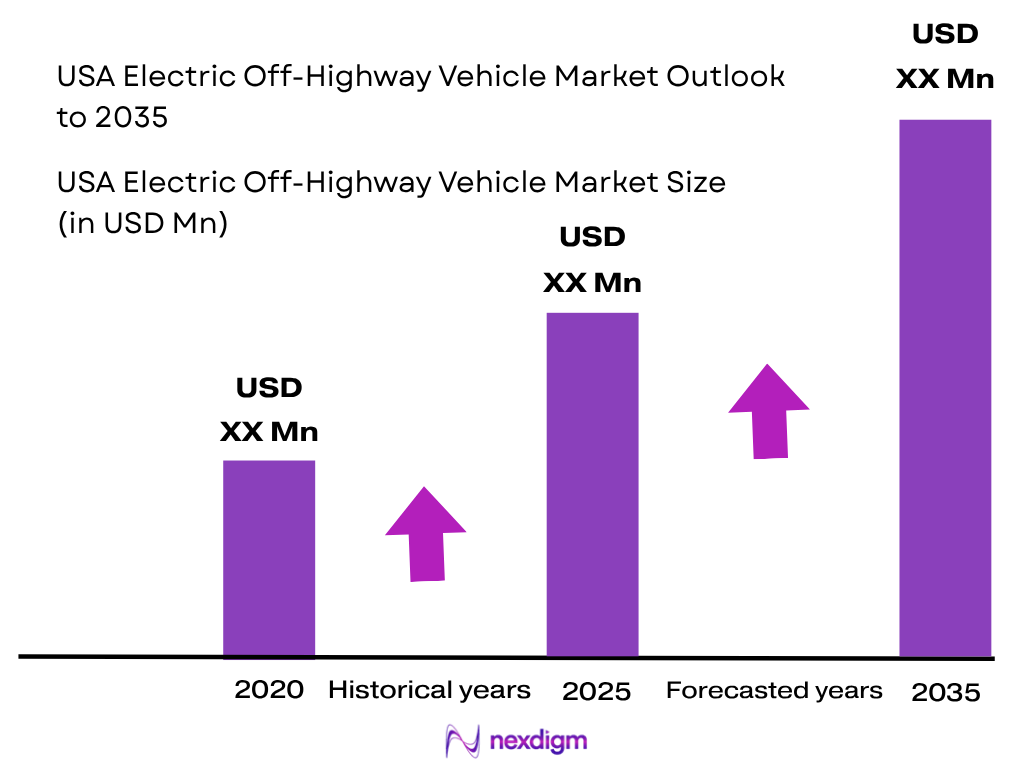
The USA Electric Off-Highway Vehicle Market is valued at ~USD XX billion, supported by the country’s large installed base of construction, agricultural, mining and material-handling equipment. The electrification opportunity varies considerably by duty cycle: the U.S. Department of Energy identifies particularly strong battery-electrification potential in smaller off-road equipment, while approximately 99% of equipment in the small-equipment segment is rated below 25 hp. Forklifts represent approximately 50% of industrial off-road equipment, with indoor operation providing a strong rationale for electric powertrains.
The market is concentrated around major construction, agricultural, logistics, manufacturing and mining equipment ecosystems rather than a single geographic center. Illinois, Texas, California, North Carolina, Georgia and the Midwest manufacturing belt are particularly important because they combine equipment manufacturing, agricultural activity, construction demand, technology development and dealer infrastructure. John Deere reports more than 60 U.S. locations across 16 states and 30,000 U.S. employees, while Caterpillar is headquartered in Irving, Texas and maintains a broad U.S. manufacturing, dealer and technology footprint. Volvo CE is also manufacturing electric equipment in Shippensburg, Pennsylvania.
Market Segmentation
By Equipment Type
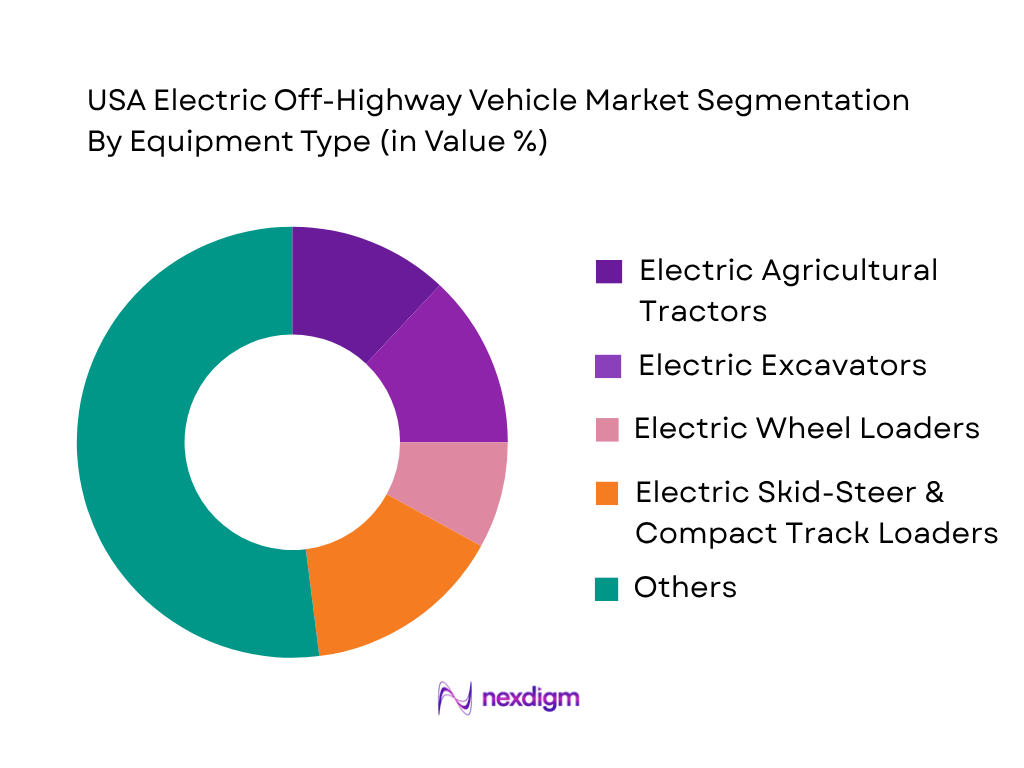
The USA Electric Off-Highway Vehicle Market is segmented by equipment type into electric agricultural tractors, excavators, wheel loaders, skid-steer loaders, compact track loaders, telehandlers, forklifts, mining equipment, compact utility equipment and specialty vehicles. Electric compact construction equipment and forklifts represent the most established electrification applications because their duty cycles are comparatively compatible with current battery capabilities. The DOE identifies significant battery-electrification potential among smaller off-road equipment, while forklifts have already experienced substantial movement toward battery-electric propulsion because they frequently operate indoors where exhaust emissions are undesirable. At the larger end of the market, commercialization is progressing into mid-size construction machines. Volvo CE’s North American portfolio includes electric compact excavators and wheel loaders alongside the 23-ton EC230 Electric excavator and 22-ton L120 Electric wheel loader. The L120 carries a 282-kWh battery and offers approximately 5–9 hours of indicative runtime, demonstrating how electric technology is moving toward higher-duty applications.
By End-Use Application
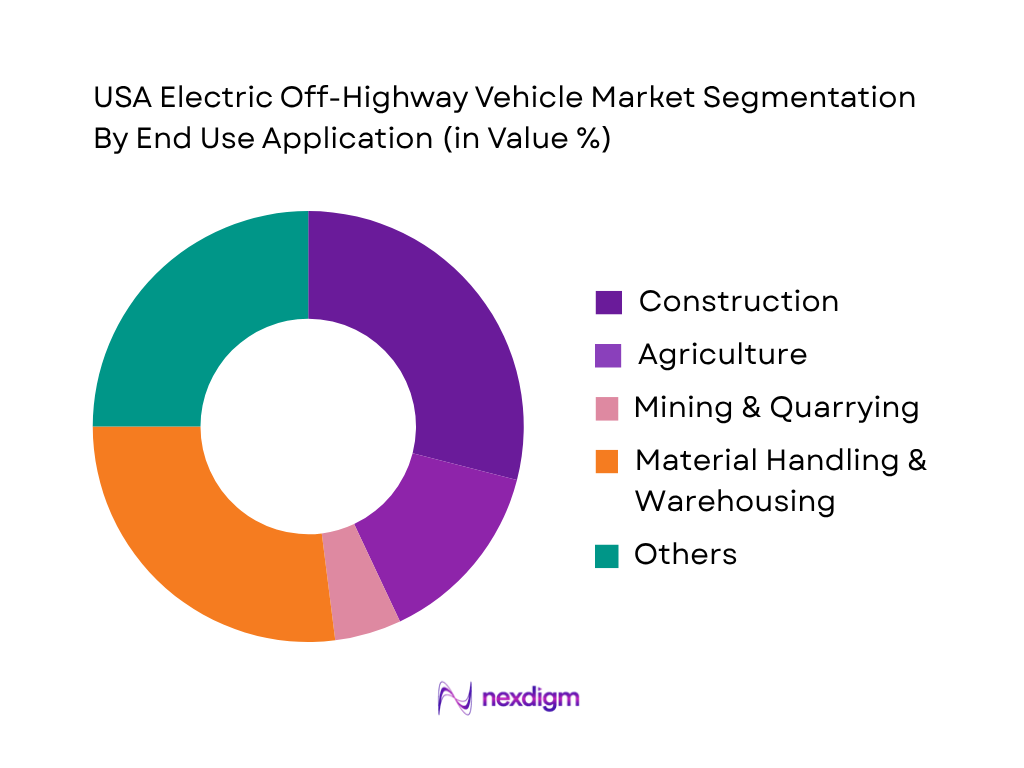
The USA Electric Off-Highway Vehicle Market is segmented by end-use application into construction, agriculture, mining and quarrying, material handling and warehousing, landscaping, utilities, municipal operations, ports and industrial operations, forestry and waste management. Construction and material handling represent the strongest early adoption environments because equipment can frequently operate on predictable routes or within controlled sites, making charging easier to plan. The DOE specifically identifies forklifts as a major industrial equipment category with strong electrification potential, while smaller agricultural tractors can also accommodate battery-electric systems for less demanding farm activities. Construction electrification is progressing toward larger machines: Volvo’s EC230 Electric offers a 450-kWh battery and up to 7–8 hours of indicative runtime, while its L120 Electric provides 5–9 hours depending on application. These developments expand the addressable market beyond compact machines into infrastructure, waste, recycling, agriculture and logistics applications.
Competitive Landscape
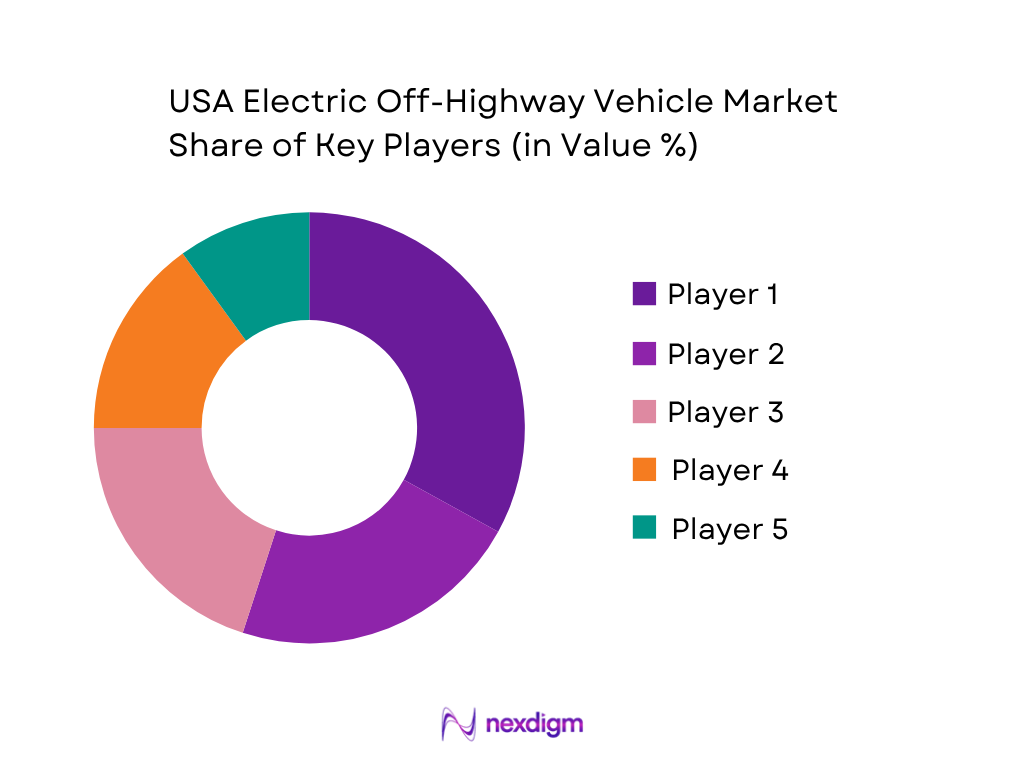
The USA Electric Off-Highway Vehicle Market is characterized by established construction and agricultural OEMs progressively adding electric machines to their conventional portfolios. Caterpillar, Deere & Company, CNH Industrial, AGCO and Komatsu combine substantial installed customer bases, dealer networks, engineering capabilities and access to construction, agriculture or mining applications. Caterpillar, for example, entered a strategic agreement with CRH for 70–100-ton-class battery-electric off-highway trucks, while Komatsu continues to develop electric and autonomous equipment across mining and construction.
| Company | Established | Headquarters | Core Off-Highway Exposure | Electric Technology Focus | Key Equipment | U.S. Manufacturing/Dealer Strength | Digital/Autonomous Capability |
| Caterpillar Inc. | 1925 | Irving, Texas | ~ | ~ | ~ | ~ | ~ |
| Deere & Company | 1837 | Moline, Illinois | ~ | ~ | ~ | ~ | ~ |
| CNH Industrial | 1999 | London, UK | ~ | ~ | ~ | ~ | ~ |
| AGCO Corporation | 1990 | Duluth, Georgia | ~ | ~ | ~ | ~ | ~ |
| Komatsu Ltd. | 1921 | Tokyo, Japan | ~ | ~ | ~ | ~ | ~ |
USA Electric Off-Highway Vehicle Market Analysis
Growth Drivers
Construction Electrification and Zero-Emission Equipment Adoption
Construction electrification is becoming a meaningful demand catalyst for the USA Electric Off-Highway Vehicle Market as public infrastructure, commercial development and contractors’ emissions-reduction requirements increase the attractiveness of electric excavators, loaders, compact track loaders and other battery-powered machinery. U.S. public construction spending reached USD 492.7 billion in 2024, compared with USD 450.7 billion in 2023, while highway construction reached USD 142.7 billion, creating a substantial equipment-use base for electrification. The U.S. economy also generated USD 28.75 trillion of GDP in 2024, according to the World Bank, providing a broad economic foundation for construction and equipment investment. Regulatory pressure reinforces this transition: EPA’s nonroad diesel framework covers excavators, agricultural equipment, forklifts and utility equipment and requires manufacturers to meet stringent Tier 4 emissions standards. The equipment transition is already extending beyond compact machinery; Volvo CE’s EC230 Electric excavator uses a 450-kWh battery, while its L120 Electric wheel loader uses a 282-kWh battery, demonstrating increasing availability of electric machines for higher-duty construction applications. Federal commercial clean-vehicle provisions also recognized mobile machinery within eligible vehicle categories, with qualified vehicles of 14,000 pounds or more potentially eligible for a credit of up to USD 40,000 under the applicable rules.
Warehouse Electrification, Agricultural Activity and OEM Product Expansion
The USA Electric Off-Highway Vehicle Market is supported by electrification opportunities in warehouses, agricultural operations, landscaping and industrial sites where predictable operating cycles make battery-powered equipment easier to deploy. U.S. agricultural activity provides a substantial equipment base: USDA reports USD 244.9 billion in crop cash receipts and USD 268.6 billion in animal and animal-product cash receipts for 2024, while large-scale family farms accounted for 50% of total agricultural production value. Material handling is another important application because forklifts frequently operate inside warehouses and manufacturing facilities, where zero tailpipe emissions and reduced noise can provide operational benefits. At the broader economic level, U.S. GDP reached USD 28.75 trillion in 2024, while industrial electricity averaged 8.13 cents per kWh, according to EIA, providing a measurable energy environment for evaluating electric equipment operating models. Renewable-energy consumption also reached 8.6 quadrillion Btu in 2024, while total U.S. primary energy production reached a record 103.3 quadrillion Btu, strengthening the wider energy-system context for electrification. OEM product expansion is simultaneously reducing availability constraints: manufacturers are moving from compact electric loaders and excavators toward mid-size machines, increasing the range of duty cycles that can be served by battery-electric equipment.
Market Challenges
Battery Energy Density, Charging Infrastructure and Heavy-Duty Duty Cycles
Battery limitations remain a central challenge for the USA Electric Off-Highway Vehicle Market because construction, mining and agricultural machines can require long operating periods, high hydraulic power and substantial energy reserves. Larger machines therefore require significantly larger battery packs, increasing charging requirements and potentially affecting payload and machine utilization. The U.S. Department of Energy identifies substantial differences in electrification suitability across off-road equipment, with smaller machines generally presenting a more favorable pathway than high-power equipment. Electricity infrastructure is another consideration: EIA reports that the average U.S. industrial electricity price was 8.13 cents per kWh in 2024, compared with 8.04 cents in 2023, but regional electricity conditions vary considerably. California’s 2024 industrial electricity price, for example, was 63.09 cents per kWh, illustrating the wide geographic variation that fleet operators must consider when developing charging economics. Charging requirements become particularly difficult for remote construction, agricultural and mining operations where high-power grid connections may not exist. Equipment manufacturers must consequently address battery runtime, charging speed, thermal management and power availability simultaneously. The technical challenge is amplified as OEMs introduce larger machines: Volvo’s EC230 Electric incorporates a 450-kWh battery, highlighting the substantial energy infrastructure required for higher-duty electric equipment.
High Acquisition Requirements, Thermal Management and Limited Resale History
High initial capital requirements and uncertainty around residual values remain significant barriers to wider electric-equipment adoption in the USA Electric Off-Highway Vehicle Market. Fleet operators purchasing excavators, loaders, tractors or mining equipment evaluate not only the machine but also charging infrastructure, electrical upgrades, operator training, battery support and future replacement requirements. The challenge is particularly relevant for equipment operating under demanding duty cycles, where battery thermal management must maintain performance across extended work periods and variable ambient conditions. Battery degradation can also affect long-term asset valuation because the market has limited historical data for establishing residual values of used electric off-highway equipment. The wider battery-material supply chain introduces another risk. USGS reported that the value of U.S. production of critical battery minerals including cobalt, lithium and nickel declined 40–60% in 2024, while the United States remained 100% import-reliant for 12 of its 50 critical minerals. These figures demonstrate continued exposure to international critical-mineral supply conditions. Service capability creates an additional barrier because electric equipment requires technicians familiar with high-voltage systems, battery diagnostics, power electronics and thermal-management systems. EPA’s nonroad regulations already cover excavators, tractors, forklifts and utility equipment, making emissions compliance a continuing engineering requirement alongside electrification.
Market Opportunities
Mid-Size Electric Excavators and Wheel Loaders
The expanding availability of mid-size electric construction equipment creates a significant opportunity for the USA Electric Off-Highway Vehicle Market because it extends electrification into applications previously constrained by battery capacity and machine power requirements. U.S. construction activity provides a substantial installed operating base: public construction spending reached USD 492.7 billion in 2024, including USD 142.7 billion of highway construction, supporting ongoing excavation, loading, grading and material-handling requirements. Current OEM development demonstrates that electric equipment is already progressing into larger machine classes. Volvo CE’s EC230 Electric excavator carries a 450-kWh battery, while the L120 Electric wheel loader incorporates a 282-kWh battery and offers an indicative operating time of 5–9 hours, depending on application. These specifications create opportunities for contractors operating in urban construction, infrastructure projects, indoor demolition, recycling and other locations where emissions and noise are important considerations. Electric machines can also complement existing diesel fleets rather than requiring immediate fleet-wide replacement, allowing contractors to deploy them selectively on suitable duty cycles. The opportunity extends into wheel loaders and excavators used for aggregate handling, material movement and construction-site preparation. As OEMs expand electric models and charging solutions, contractors can increasingly evaluate equipment based on duty-cycle compatibility, utilization and site-energy availability rather than treating electrification as limited to compact machinery.
Mining Electrification, Autonomous Equipment and Mobile Charging
Mining, autonomous operation and mobile charging represent important longer-term opportunity areas because they combine electrification with high equipment utilization, remote monitoring and increasingly automated workflows. U.S. mining provides a substantial industrial base: USGS reported USD 106 billion in domestic nonfuel mineral production in 2024, including USD 72.1 billion of industrial minerals, while crushed stone alone represented USD 24 billion of production value. This activity supports demand for loaders, haulage equipment, drilling machinery and material-handling systems where electrification can be evaluated against defined operating cycles. Battery-material availability remains strategically important: the United States was 100% import-reliant for 12 critical minerals in 2024, creating opportunities for domestic battery-material development and supply-chain diversification alongside equipment electrification. Mobile charging can address one of the largest barriers to deploying electric equipment at remote mines, quarries and construction sites by reducing dependence on permanent grid connections. Autonomous electric equipment provides another pathway because controlled operating zones can simplify route planning, charging and machine supervision. The opportunity therefore extends beyond vehicle sales toward integrated solutions combining electric machines, mobile charging, battery energy storage, telematics, autonomous controls and predictive maintenance. These technologies can allow operators to electrify specific high-utilization applications while progressively developing the infrastructure required for broader fleet deployment.
Future Outlook
The USA Electric Off-Highway Vehicle Market is expected to progress from early-stage adoption toward broader commercialization as OEMs expand machine sizes, battery capacities and application coverage. Compact construction equipment, forklifts, landscaping equipment and selected agricultural applications are likely to remain important adoption areas, while mid-size excavators, wheel loaders and mining equipment create additional growth avenues. Volvo’s North American rollout of 450-kWh and 282-kWh electric machines demonstrates the industry’s movement toward higher-duty applications.
Future market development will increasingly depend on charging infrastructure, battery energy density, machine utilization, total cost of ownership, dealer support and fleet financing rather than vehicle availability alone. Electrification is also expected to intersect with telematics, autonomous operation, predictive maintenance and energy-management platforms. Caterpillar’s battery-electric mining truck program and Komatsu’s development of smart and autonomous mining equipment illustrate the convergence of electrification and automation.
Major Players
- Caterpillar Inc.
- Deere & Company
- CNH Industrial N.V.
- AGCO Corporation
- Komatsu Ltd.
- Volvo Construction Equipment
- Doosan Bobcat
- J.C. Bamford Excavators Ltd. (JCB)
- Kubota Corporation
- Hitachi Construction Machinery Co., Ltd.
- Liebherr Group
- Wacker Neuson SE
- Terex Corporation
- SANY America
- Manitou Group
Key Target Audience
- Construction Equipment OEMs and Electrification Divisions
- Agricultural Machinery Manufacturers and Fleet Procurement Teams
- Equipment Rental and Leasing Companies
- Mining, Quarrying and Aggregates Operators
- Material Handling, Warehousing and Logistics Fleet Operators
- Investments and Venture Capitalist Firms
- Government and Regulatory Bodies (U.S. Environmental Protection Agency, U.S. Department of Energy, Federal Highway Administration)
- Charging Infrastructure, Battery and Electric Powertrain Companies
Research Methodology
Step 1: Identification of Key Variables
The initial stage involves mapping the USA Electric Off-Highway Vehicle ecosystem across OEMs, equipment dealers, battery suppliers, drivetrain manufacturers, charging providers, rental companies and fleet operators. Equipment-specific variables include unit sales, operating weight, power output, battery capacity, runtime, charging configuration and application duty cycle.
Step 2: Market Analysis and Construction
Historical market information is compiled by equipment class, propulsion technology, end-use application and geography. The assessment combines OEM disclosures, government datasets, equipment-registration information, production indicators, fleet information and industry-level operating data to establish the market baseline and identify electrification-ready equipment categories.
Step 3: Hypothesis Validation and Expert Consultation
Market hypotheses are validated through interviews with equipment manufacturers, dealers, rental operators, contractors, agricultural equipment users, mining companies and charging specialists. Discussions focus on purchase criteria, fleet replacement cycles, utilization, charging readiness, battery performance, service requirements and barriers to electric-equipment adoption.
Step 4: Research Synthesis and Final Output
The final analysis triangulates bottom-up equipment volumes with manufacturer-level information and application-level demand indicators. OEM product specifications, electric-equipment launches and real-world demonstrations are evaluated alongside fleet economics and infrastructure requirements to develop market forecasts, competitive positioning and strategic recommendations.

- Executive Summary
- Research Methodology (Market Definition and Scope, Electric Off-Highway Vehicle Classification, Market Sizing Framework, Revenue and Unit-Sales Assessment, Top-Down Analysis, Bottom-Up Analysis, OEM-Level Validation, Fleet and Equipment-Owner Assessment, Primary Industry Interviews, Secondary Data Validation, Data Triangulation, Forecasting Framework, Scenario Analysis, Assumptions and Limitations)

- Definition and Scope
- Evolution of Electric Off-Highway Vehicles in the USA
- USA Electric Off-Highway Vehicle Ecosystem
- Electric Off-Highway Vehicle Value Chain
- Domestic Manufacturing and Technology Landscape
- Battery and Electric Powertrain Ecosystem

- Growth Drivers (Construction Electrification, Federal and State Decarbonization Policies, Demand for Zero-Emission Equipment, Urban Noise Restrictions, Fleet Operating Efficiency, Warehouse Electrification, Agricultural Automation, OEM Product Expansion)
- Market Challenges (High Upfront Acquisition Requirements, Battery Energy Density, Charging Infrastructure Gaps, Long Charging Times, Heavy-Duty Duty Cycles, Battery Thermal Management, Limited Resale History, Skilled Service Requirements)
- Market Opportunities (Mid-Size Electric Excavators, Electric Wheel Loaders, Battery-Electric Agricultural Tractors, Mining Electrification, Autonomous Electric Equipment, Mobile Charging, Battery Energy Storage Integration, Specialty Electric Equipment)
- Emerging Technology Trends (High-Voltage Architectures, LFP Battery Adoption, Fast Charging, Thermal Management, Electric Hydraulic Systems, Integrated E-Axles, Software-Defined Equipment, Autonomous Operation)
- Government Incentives and Regulatory Environment (Federal Tax Incentives, EPA Programs, State Incentives, California Regulations, Zero-Emission Equipment Programs, Infrastructure Funding)
- Porter’s Five Forces Analysis
- PESTLE Analysis
- SWOT Analysis

- By Market Value (2020-2025)
- By Unit Sales (2020-2025)
- By Average Selling Value (2020-2025)
- By Application (2020-2025)
- By End User (2020-2025)
- By Propulsion Technology (2020-2025)
- By Equipment Class (2020-2025)
- By Geography (2020-2025)

- By Vehicle Type (in value %)
Electric Agricultural Tractors
Electric Excavators
Electric Wheel Loaders
Electric Skid-Steer Loaders
Electric Compact Track Loaders
Electric Forklifts
Electric Dumpers
Electric Mining Equipment
Electric Utility and Specialty Vehicles - By Propulsion Type (in value %)
Battery Electric Vehicles
Hybrid Electric Vehicles
Plug-in Hybrid Electric Vehicles
Fuel-Cell Electric Vehicles - By Application (in value %)
Construction
Agriculture
Mining and Quarrying
Material Handling and Warehousing
Waste Management
Utilities and Municipal Operations
Ports and Industrial Operations
Forestry
Other Specialty Applications - By Battery Capacity (in value %)
Below 50 kWh
50–200 kWh
201–500 kWh
Above 500 kWh - By Battery Chemistry (in value %)
Lithium Iron Phosphate
Nickel Manganese Cobalt
Lithium-Ion Other Chemistries
Lead-Acid
Other Battery Technologies - By Power Output (in value %)
Below 50 kW
50–100 kW
101–200 kW
201–400 kW
Above 400 kW

- Market Share of Major Players (By Revenue, Unit Sales, Vehicle Type, Application, Propulsion Type, Battery Capacity, Equipment Weight and Geography)
- Cross Comparison Parameters (Electric Equipment Portfolio Breadth, Battery Capacity Range, Electric Machine Model Count, Maximum Power Output, Operating Runtime, Charging Technology Capability, Dealer and Service Network Coverage, Telematics and Autonomous-Technology Capability)
- SWOT Analysis of Major Players
- Detailed Profiles of Major Companies
Caterpillar Inc.
Deere & Company
CNH Industrial N.V.
AGCO Corporation
Komatsu Ltd.
Volvo Construction Equipment
Doosan Bobcat
J.C. Bamford Excavators Ltd. (JCB)
Kubota Corporation
Hitachi Construction Machinery Co., Ltd.
Liebherr Group
Wacker Neuson SE
Terex Corporation
SANY America
Manitou Group

- Equipment Acquisition Behavior
- Electric Equipment Adoption Assessment
- End-User Segment Analysis
- Equipment Application Preferences
- Fleet Electrification Priorities
- Total Cost of Ownership Considerations

- By Market Value (2026-2035)
- By Unit Sales (2026-2035)
- By Average Selling Value (2026-2035)
- By Application (2026-2035)
- By End User (2026-2035)
- By Propulsion Technology (2026-2035)
- By Equipment Class (2026-2035)
- By Geography (2026-2035)


 Request a Sample
 Ask for Customization
 Get a Quote
 Enquire Now