

 Download PDF
Market Overview
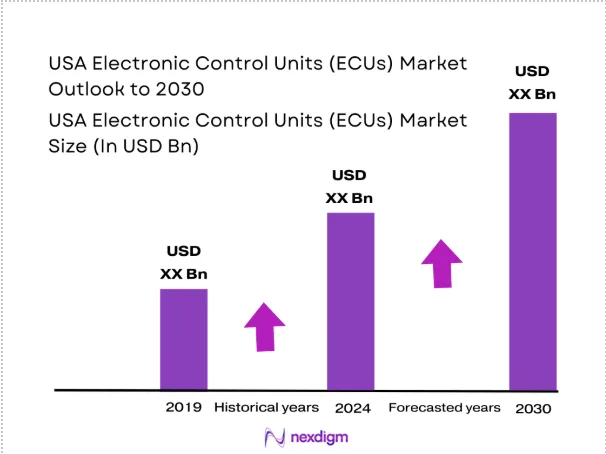
The USA Electronic Control Units (ECUs) market current size stands at around USD ~ million, reflecting sustained demand for embedded automotive electronics across passenger and commercial vehicles. The market is characterized by increasing ECU density per vehicle, expanding software-defined architectures, and ongoing platform consolidation across vehicle programs. OEM adoption of centralized compute and safety-critical control modules continues to elevate integration complexity while reinforcing long-term demand for robust, automotive-grade controllers across propulsion, safety, body, and connectivity domains.
Demand concentration is strongest across major automotive manufacturing and technology hubs in the Midwest and Southeast, supported by dense supplier ecosystems, testing infrastructure, and proximity to OEM assembly plants. California and Texas act as software and validation centers due to advanced mobility ecosystems and regulatory testing environments. Policy alignment around vehicle safety, emissions compliance, and connected vehicle standards further strengthens adoption readiness, while logistics corridors and semiconductor distribution networks reinforce supply chain resilience and delivery reliability nationwide.
Market Segmentation
By ECU Type
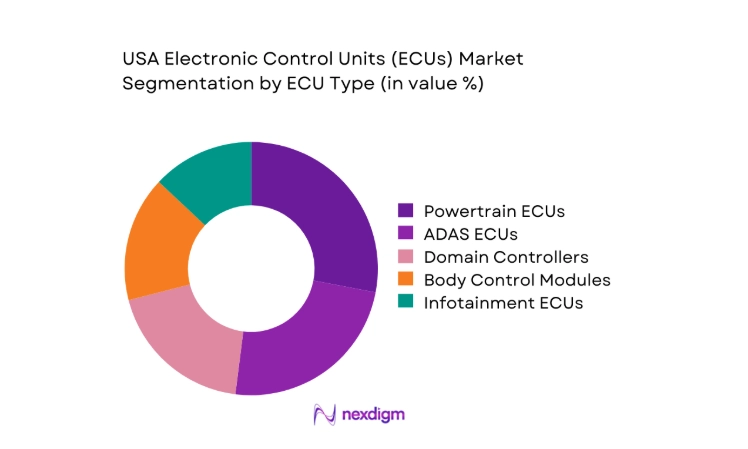
The market is dominated by powertrain, ADAS, and domain controller ECUs due to rising compute requirements and consolidation of distributed architectures into centralized platforms. Powertrain ECUs maintain strong demand across internal combustion and electrified vehicles, while ADAS ECUs expand rapidly as safety mandates and assisted driving features penetrate mid-range vehicles. Domain controllers are gaining preference as OEMs rationalize electronic architectures to reduce wiring complexity and enable over-the-air updates. Body and infotainment ECUs remain stable, driven by feature-rich interiors and connectivity expectations. Telematics ECUs are increasingly embedded within integrated platforms, supporting diagnostics, fleet management, and compliance requirements across commercial fleets and connected services ecosystems.
By Vehicle Type
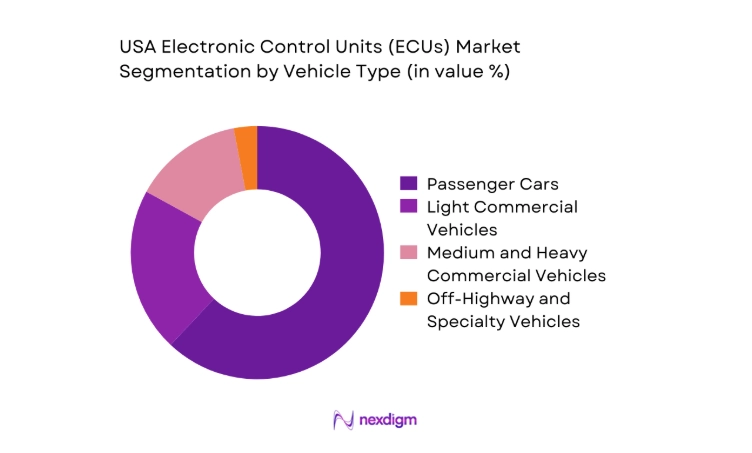
Passenger cars account for the largest ECU deployment base due to higher production volumes, feature density, and accelerated adoption of ADAS and infotainment systems. Light commercial vehicles demonstrate steady ECU integration driven by telematics, diagnostics, and powertrain optimization for urban logistics. Medium and heavy commercial vehicles increasingly deploy safety and connectivity ECUs to comply with fleet safety mandates and operational efficiency goals. Off-highway and specialty vehicles contribute smaller shares but require ruggedized control units for harsh operating environments, including construction and agricultural applications. Electrification initiatives within commercial fleets further reinforce ECU content growth per vehicle platform across diverse operational use cases.
Competitive Landscape
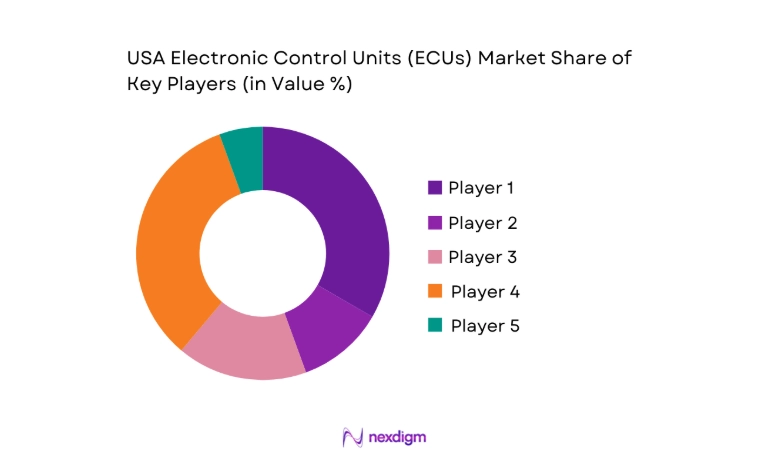
The competitive landscape is shaped by deep system integration capabilities, long-standing OEM relationships, and expanding software and silicon partnerships to support centralized vehicle architectures. Suppliers differentiate through functional safety readiness, cybersecurity compliance, platform scalability, and lifecycle software support aligned with evolving vehicle electronics roadmaps.
| Company Name | Establishment Year | Headquarters | Formulation Depth | Distribution Reach | Regulatory Readiness | Service Capability | Channel Strength | Pricing Flexibility |
| Bosch | 1886 | Germany | ~ | ~ | ~ | ~ | ~ | ~ |
| Continental | 1871 | Germany | ~ | ~ | ~ | ~ | ~ | ~ |
| Denso | 1949 | Japan | ~ | ~ | ~ | ~ | ~ | ~ |
| Aptiv | 1994 | Ireland | ~ | ~ | ~ | ~ | ~ | ~ |
| ZF Friedrichshafen | 1915 | Germany | ~ | ~ | ~ | ~ | ~ | ~ |
USA Electronic Control Units (ECUs) Market Analysis
Growth Drivers
Rising ADAS penetration and compute requirements
ADAS adoption expanded across vehicle segments as national road safety strategies emphasized collision avoidance and driver assistance deployment between 2022 and 2025. New vehicle safety rulemakings accelerated integration of forward collision warning, lane keeping, and automatic emergency braking, increasing onboard compute density. Annual light vehicle registrations exceeded 14000000 in 2023, supporting broader ADAS standardization across trims. The number of sensor inputs per vehicle increased from 8 to 14, driving higher ECU compute loads. Federal safety testing programs expanded track capacity by 3 facilities, increasing validation throughput. State transportation agencies added 120 connected corridors supporting V2X pilots. These conditions elevate demand for higher-performance ECUs supporting perception, fusion, and real-time control workloads.
Electrification of powertrains increasing ECU content per vehicle
Electrified powertrains require multiple control units for battery management, inverter control, thermal management, and energy optimization. In 2024, public charging points exceeded 180000 nationwide, reinforcing EV deployment readiness. Utility interconnection approvals for fast chargers rose by 27 installations per week, supporting fleet electrification pilots. Power electronics controllers per EV platform increased from 5 to 9 units between 2022 and 2025 as architectures diversified. Federal fleet procurement guidelines prioritized zero-emission vehicles across 75 agencies, expanding demand for powertrain ECUs. Grid modernization programs added 420 substations with smart controls, aligning vehicle-to-grid readiness. These institutional and infrastructure indicators sustain elevated ECU content per electrified vehicle platform.
Challenges
Cost pressure from OEMs on ECU hardware margins
OEM purchasing frameworks intensified price-down requirements amid supply normalization between 2022 and 2025. Annual sourcing cycles shortened from 24 to 18 months, compressing negotiation windows. Vehicle program consolidation reduced platform variants from 12 to 7 across major portfolios, increasing volume leverage on suppliers. Localization incentives expanded across 14 states, raising compliance overhead without direct price offsets. Semiconductor lead times normalized from 52 weeks to 26 weeks, restoring OEM bargaining power. Warranty performance thresholds tightened to 2 incidents per 1000 vehicles, increasing validation costs borne by suppliers. These procurement dynamics constrain margin flexibility while sustaining performance and compliance obligations across ECU programs.
Complexity of software integration and validation across domains
Software-defined architectures increased cross-domain dependencies, complicating integration testing. Continuous integration pipelines expanded to 240 automated test suites per release cycle between 2022 and 2025. Functional safety audits increased from 2 to 4 per program, extending validation timelines. Cybersecurity incident reporting requirements triggered 36 compliance updates across vehicle platforms. Over-the-air update cadence rose to quarterly cycles, elevating regression testing workloads. Validation mileage accumulated in closed-course testing surpassed 1800000 miles annually, stressing verification capacity. These factors increase engineering load and time-to-release risk for multi-domain ECUs while maintaining safety and security compliance under evolving regulatory scrutiny.
Opportunities
Migration to zonal architectures reducing wiring complexity
Zonal architectures consolidate distributed controllers into localized compute nodes, reducing harness length and assembly complexity. Pilot programs deployed zonal gateways across 6 manufacturing plants between 2023 and 2025, shortening wiring length by 120 meters per vehicle. Assembly takt time decreased by 9 minutes per unit, improving line efficiency. Ethernet nodes per vehicle increased from 4 to 10, supporting higher bandwidth requirements. Supplier co-development centers expanded to 5 regional hubs to accelerate integration readiness. Regulatory approval cycles for updated architectures completed within 14 months, enabling faster platform refreshes. These operational indicators validate scalable deployment potential for zonal ECUs across next-generation vehicle platforms.
OTA-enabled ECU platforms enabling lifecycle monetization
Over-the-air update frameworks enable post-sale feature activation, diagnostics, and compliance updates. OTA coverage expanded across 11 million connected vehicles in 2024 through nationwide carrier agreements. Update success rates improved from 94 to 98 with resilient rollback protocols. Security patch cycles reduced vulnerability exposure windows from 90 days to 30 days. Fleet operators reported downtime reductions of 18 hours per vehicle annually through remote diagnostics. State telematics compliance pilots covered 23 jurisdictions, accelerating standardized OTA governance. These indicators support scalable service-layer enablement and sustained ECU platform relevance across vehicle lifecycles without physical recalls or workshop interventions.
Future Outlook
The market outlook through 2030 reflects continued architectural consolidation toward domain and zonal controllers, deeper software-defined vehicle adoption, and expanding electrification across fleets. Regulatory momentum around safety, cybersecurity, and emissions compliance will reinforce advanced control requirements. OEM platform strategies will increasingly favor scalable compute and OTA readiness, shaping long-term supplier partnerships. Regional manufacturing incentives and semiconductor localization will further influence sourcing strategies and technology roadmaps.
Major Players
- Bosch
- Continental
- Denso
- Aptiv
- ZF Friedrichshafen
- Magna International
- Valeo
- Hitachi Astemo
- Lear Corporation
- Panasonic Automotive
- Harman International
- Visteon
- NXP Semiconductors
- Infineon Technologies
- Texas Instruments
Key Target Audience
- Automotive OEMs and vehicle platform engineering teams
- Tier-1 automotive electronics system integrators
- Semiconductor and automotive-grade silicon vendors
- Fleet operators and commercial vehicle operators
- Mobility platform providers and connected vehicle service firms
- Investments and venture capital firms
- Government and regulatory bodies with agency names including the National Highway Traffic Safety Administration and the Environmental Protection Agency
- Automotive manufacturing and supply chain program offices
Research Methodology
Step 1: Identification of Key Variables
Key variables included ECU types by domain, vehicle architecture transitions, powertrain mix, software stack maturity, and compliance requirements. Program-level deployment pathways and lifecycle update models were mapped. Supplier capability dimensions and manufacturing localization variables were identified. Regulatory milestones and infrastructure readiness indicators were cataloged.
Step 2: Market Analysis and Construction
Vehicle platform architectures and ECU content models were constructed across segments. Production program pipelines and validation capacity were analyzed to derive deployment readiness. Infrastructure readiness and connectivity enablement were integrated into scenario construction. Policy alignment variables were embedded to reflect compliance-driven adoption pathways.
Step 3: Hypothesis Validation and Expert Consultation
Hypotheses on architectural consolidation, zonal adoption, and OTA enablement were stress-tested with domain engineers and program managers. Validation workshops reviewed safety, cybersecurity, and software lifecycle constraints. Cross-functional reviews reconciled manufacturing feasibility with integration timelines. Iterative feedback refined assumptions across vehicle classes.
Step 4: Research Synthesis and Final Output
Findings were synthesized into coherent narratives linking technology readiness with policy and infrastructure indicators. Scenario outputs were cross-checked for internal consistency and deployment feasibility. Editorial reviews ensured technical accuracy and consulting-grade clarity. Final outputs aligned insights with strategic decision pathways.

- Executive Summary
- Research Methodology (Market Definitions and ECU domain taxonomy mapping, OEM and Tier-1 supplier primary interviews, Teardown and bill of materials analysis of ECU platforms, Production and shipment data triangulation from OEM plants and suppliers, Vehicle parc and installed base modeling by platform and powertrain, ASP benchmarking across ECU types and compute classes, Regulatory and standards tracking for automotive electronics and functional safety)

- Definition and Scope
- Market evolution
- Usage pathways across vehicle architectures
- Ecosystem structure
- Supply chain and channel structure
- Regulatory environment

- Growth Drivers
Rising ADAS penetration and compute requirements
Electrification of powertrains increasing ECU content per vehicle
Shift toward software-defined vehicles and centralized compute
Stricter emissions and safety regulations driving advanced control systems
Consumer demand for connected infotainment and telematics
Platform consolidation by OEMs increasing high-value domain controllers - Challenges
Cost pressure from OEMs on ECU hardware margins
Complexity of software integration and validation across domains
Supply chain disruptions for automotive-grade semiconductors
Cybersecurity and functional safety compliance burdens
Thermal management and reliability constraints for high-performance ECUs
Legacy vehicle architectures limiting zonal controller adoption - Opportunities
Migration to zonal architectures reducing wiring complexity
OTA-enabled ECU platforms enabling lifecycle monetization
Growth in EV platforms requiring new power electronics control ECUs
AI-enabled ADAS compute modules for mid-market vehicles
Localization of ECU manufacturing and sourcing in the US
Partnerships between OEMs and silicon vendors for custom SoCs - Trends
Consolidation of multiple ECUs into domain and zonal controllers
Adoption of automotive Ethernet and high-speed networking
Increased use of multicore SoCs and hardware accelerators
Standardization around AUTOSAR Adaptive and POSIX OS
Lifecycle software updates and feature-on-demand models
Functional safety co-processors and secure enclaves integration - Government Regulations
- SWOT Analysis
- Stakeholder and Ecosystem Analysis
- Porter’s Five Forces Analysis
- Competition Intensity and Ecosystem Mapping

- By Value, 2019–2024
- By Shipment Volume, 2019–2024
- By Installed Base, 2019–2024
- By Average Selling Price, 2019–2024

- By ECU Type (in Value %)
Powertrain ECUs
Body Control Modules
Chassis and Safety ECUs
ADAS and Autonomous ECUs
Infotainment and Telematics ECUs
Domain and Zonal Controllers - By Vehicle Type (in Value %)
Passenger Cars
Light Commercial Vehicles
Medium and Heavy Commercial Vehicles
Off-Highway and Specialty Vehicles - By Powertrain (in Value %)
Internal Combustion Engine Vehicles
Hybrid Electric Vehicles
Battery Electric Vehicles
Fuel Cell Electric Vehicles - By Architecture (in Value %)
Distributed ECU Architecture
Domain-Based Architecture
Zonal Architecture - By Application (in Value %)
Powertrain Management
Vehicle Dynamics and Safety
Body Electronics
Infotainment and Connectivity
ADAS and Autonomous Functions - By Sales Channel (in Value %)
OEM Direct Supply
Tier-1 Integrated Systems
Aftermarket Replacement and Retrofit

- Market structure and competitive positioning
Market share snapshot of major players - Cross Comparison Parameters (portfolio breadth by ECU domain, compute performance and SoC partnerships, software stack and middleware capability, functional safety and cybersecurity certifications, OEM program wins and platform longevity, manufacturing footprint and localization, cost competitiveness and ASP positioning, lifecycle support and OTA enablement)
- SWOT Analysis of Key Players
- Pricing and Commercial Model Benchmarking
- Detailed Profiles of Major Companies
Bosch
Continental
Denso
Aptiv
ZF Friedrichshafen
Magna International
Valeo
Hitachi Astemo
Lear Corporation
Panasonic Automotive
Harman International
Visteon
NXP Semiconductors
Infineon Technologies
Texas Instruments

- Demand and utilization drivers
- Procurement and tender dynamics
- Buying criteria and vendor selection
- Budget allocation and financing preferences
- Implementation barriers and risk factors
- Post-purchase service expectations

- By Value, 2025–2030
- By Shipment Volume, 2025–2030
- By Installed Base, 2025–2030
- By Average Selling Price, 2025–2030


 Request a Sample
 Ask for Customization
 Get a Quote
 Enquire Now