

 Download PDF
 Download PDF
Market Overview
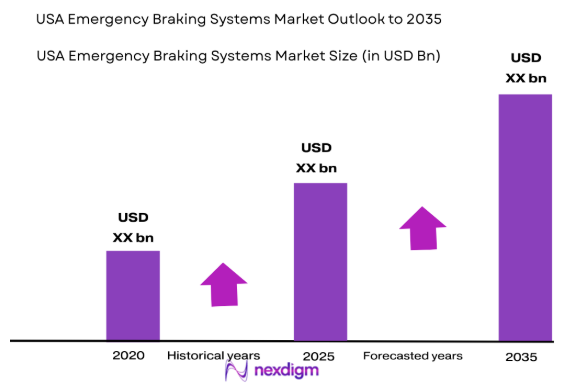
Based on a recent historical assessment, the USA Emergency Braking Systems market generated approximately USD ~ billion in revenue, supported by National Highway Traffic Safety Administration data and financial disclosures from leading ADAS suppliers. Market expansion is driven by mandatory crash avoidance regulations, increasing integration of advanced driver assistance systems in new vehicles, and strong demand from electric vehicle manufacturers. Rising urban traffic density and federal safety rating programs continue to accelerate OEM adoption across passenger and commercial vehicle segments nationwide.
Major automotive production hubs including Michigan, Ohio, California, and Texas play a critical role in system integration and large scale manufacturing due to concentrated OEM facilities and supplier networks. Detroit remains strategically significant because of its established ecosystem and advanced vehicle testing infrastructure. California leads technological innovation through autonomous mobility research and semiconductor development clusters. Southern manufacturing corridors further strengthen supply chain efficiency, enabling faster deployment of emergency braking technologies across multiple vehicle platforms.
By Product Type
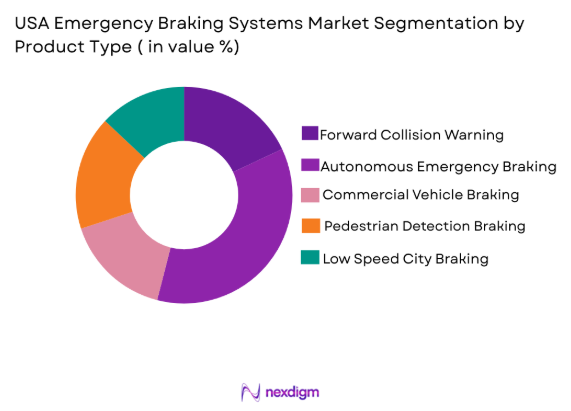
USA Emergency Braking Systems market is segmented by product type into Forward Collision Warning with Automatic Braking, Autonomous Emergency Braking for Passenger Vehicles, Commercial Vehicle Emergency Braking Systems, Pedestrian Detection Integrated Braking Systems, and Low Speed City Emergency Braking Systems. Recently, Autonomous Emergency Braking for Passenger Vehicles has a dominant market share due to widespread OEM standardization, strong consumer preference for advanced safety features, insurance incentives linked to crash reduction, and regulatory testing protocols encouraging default inclusion in new vehicles.
By Platform Type
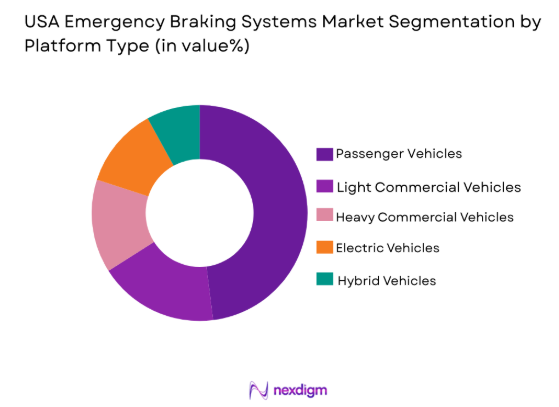
USA Emergency Braking Systems market is segmented by platform type into Passenger Cars, Light Commercial Vehicles, Heavy Commercial Vehicles, Electric Vehicles, and Hybrid Vehicles. Recently, Passenger Cars has a dominant market share due to higher production volumes, regulatory focus on passenger vehicle safety compliance, increasing consumer safety awareness, and broader integration of ADAS suites in mid range and premium vehicle models compared to commercial fleets.
Competitive Landscape
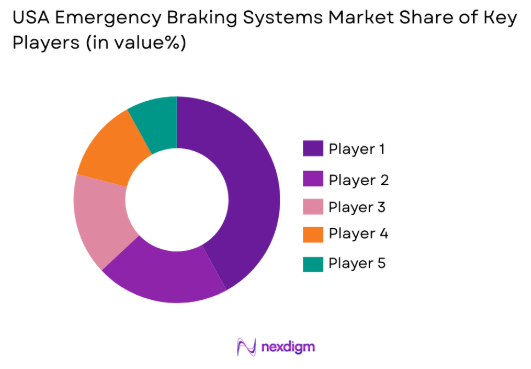
The USA Emergency Braking Systems market demonstrates moderate consolidation, with a limited number of automotive suppliers controlling advanced sensor integration and braking control software platforms. Strategic partnerships between semiconductor providers, ADAS developers, and vehicle manufacturers significantly influence innovation cycles and procurement contracts. Technology leadership, regulatory compliance expertise, and strong OEM relationships define competitive positioning across this market.
|
Company Name |
Establishment Year | Headquarters | Technology Focus | Market Reach | Key Products | Revenue | Sensor Integration Capability |
| Robert Bosch LLC | 1886 | Germany | ~ | ~ | ~ | ~ | ~ |
| Continental AG | 1871 | Germany | ~ | ~ | ~ | ~ | ~ |
| ZF Friedrichshafen AG | 1915 | Germany | ~ | ~ | ~ | ~ | ~ |
| Denso Corporation | 1949 | Japan | ~ | ~ | ~ | ~ | ~ |
| Aptiv PLC | 1994 | Ireland | ~ | ~ | ~ | ~ | ~ |
USA Emergency Braking Systems Market Analysis
Growth Drivers
Federal Safety Mandates and Crash Avoidance Regulations
The increasing enforcement of crash avoidance standards by the National Highway Traffic Safety Administration is significantly accelerating the deployment of emergency braking systems across passenger and commercial vehicles in the United States. Regulatory frameworks encouraging automatic emergency braking integration in new vehicle models are compelling manufacturers to standardize these systems across trim levels rather than limiting them to premium variants. Insurance industry pressure and safety rating programs further reinforce compliance incentives by rewarding manufacturers that meet advanced safety benchmarks. As safety compliance becomes a prerequisite for competitive positioning, OEMs are allocating higher budgets toward advanced braking technologies. Fleet operators are also responding to regulatory oversight by upgrading vehicles to reduce liability exposure and accident rates. The convergence of safety mandates with consumer expectations is narrowing optional feature gaps and making emergency braking systems a baseline requirement. Regulatory harmonization across states is reducing uncertainty for suppliers and facilitating long term production planning. Collectively, these policy driven factors are creating sustained structural demand for technologically advanced emergency braking systems.
Rising Integration of ADAS in Electric and Connected Vehicles
The rapid expansion of electric vehicle production in the United States is strengthening demand for advanced driver assistance technologies, including autonomous emergency braking. Electric vehicle manufacturers typically integrate high end safety suites to differentiate offerings in a competitive mobility landscape. Connected vehicle architectures enable real time data processing and sensor fusion, improving braking response accuracy and predictive collision avoidance capabilities. Consumer preference for technologically sophisticated vehicles encourages OEMs to bundle emergency braking within broader ADAS packages. Semiconductor advancements and software defined vehicle platforms are making integration more scalable across vehicle segments. Investment in artificial intelligence based perception systems enhances reliability under complex traffic conditions. Supply chain localization for EV components further supports stable deployment of braking technologies. These combined factors position emergency braking systems as a foundational element of next generation vehicle platforms in the United States.
Market Challenges
High System Integration and Calibration Costs
The integration of radar, camera, and control unit technologies into vehicle architectures requires complex calibration processes that increase production expenses. Advanced braking systems must be precisely aligned with steering, suspension, and electronic control units to ensure functional accuracy. Manufacturing lines often require specialized testing infrastructure, raising capital expenditure for OEMs and suppliers. Smaller manufacturers may face financial constraints when scaling advanced safety systems across multiple models. Post collision recalibration and maintenance procedures can increase lifecycle service costs for consumers and fleet operators. Variability in vehicle platform design adds engineering complexity, limiting standardized module deployment. Supply chain disruptions in semiconductor availability can further elevate component pricing. These cost pressures may slow adoption among lower priced vehicle segments.
Performance Limitations Under Adverse Environmental Conditions
Emergency braking systems rely heavily on sensor accuracy, which can be compromised by heavy rain, snow, fog, or glare conditions. Radar and camera sensors may experience reduced detection reliability in complex urban environments. False positives or delayed activation can affect consumer trust in automated braking interventions. Continuous software refinement is required to improve predictive modeling and object recognition capabilities. Testing and validation under diverse environmental scenarios increase research and development expenditure. Commercial fleets operating across varied climates require enhanced robustness standards. Regulatory scrutiny over system performance failures may increase compliance burdens. These operational challenges necessitate ongoing innovation to maintain reliability and public confidence.
Opportunities
Expansion into Commercial Fleet Safety Modernization Programs
Growing emphasis on reducing road fatalities and insurance liabilities is encouraging logistics providers and public transportation agencies to modernize fleets with advanced emergency braking systems. Commercial vehicle operators face regulatory oversight that incentivizes the integration of crash avoidance technologies. Fleet wide deployment can deliver measurable reductions in accident related downtime and repair costs. Insurance providers increasingly offer premium adjustments for vehicles equipped with certified safety technologies. Retrofitting programs create additional revenue streams beyond OEM installations. Data analytics from fleet telematics platforms can enhance braking system optimization and predictive maintenance strategies. Partnerships between technology providers and fleet managers support scalable implementation frameworks. This opportunity strengthens long term demand in both private and public sector transportation networks.
Integration with Autonomous and Semi Autonomous Driving Ecosystems
The progression toward higher levels of vehicle autonomy increases reliance on automated braking systems as critical safety redundancies. Emergency braking modules serve as foundational control mechanisms within autonomous driving stacks. Software defined vehicle architectures enable continuous improvement through over the air updates, enhancing braking algorithms over time. Collaboration between semiconductor firms and automotive manufacturers accelerates sensor fusion advancements. Regulatory pilots for autonomous mobility services further expand real world testing environments. Urban smart mobility initiatives support data driven traffic management systems that complement vehicle based braking technologies. Consumer trust in autonomous mobility is strengthened when reliable emergency braking functionality is demonstrated. These dynamics create strategic growth pathways for system providers within the evolving mobility ecosystem.
Future Outlook
The USA Emergency Braking Systems market is expected to experience sustained growth over the next five years driven by regulatory reinforcement, EV adoption, and continuous advancements in sensor fusion technologies. Increasing integration within software defined vehicle platforms will enhance scalability and cost efficiency. Federal safety evaluations and state level incentives are likely to accelerate standardization across mid range vehicles. Demand from fleet modernization programs and autonomous mobility pilots will further strengthen market expansion across passenger and commercial platforms.
Major Players
- Robert Bosch LLC
- Continental AG
- ZF Friedrichshafen AG
- Denso Corporation
- Aptiv PLC
- Magna International Inc
- Valeo SA
- Hyundai Mobis
- Autoliv Inc
- Mobileye Global Inc
- Hitachi Astemo
- NXP Semiconductors
- Texas Instruments Automotive
- Veoneer Inc
- Knorr Bremse AG
Key Target Audience
- Automotive OEM manufacturers
- Automotive suppliers
- Electric vehicle manufacturers
- Fleet operators
- Logistics and transportation companies
- Investments and venture capitalist firms
- Government and regulatory bodies
- Automotive component distributors
Research Methodology
Step 1: Identification of Key Variables
Key performance indicators including installation rates, regulatory mandates, OEM production volumes, and technology penetration were identified to frame the research boundaries. Secondary sources such as federal transportation databases and corporate disclosures were analyzed to establish baseline data integrity.
Step 2: Market Analysis and Construction
Market modeling incorporated vehicle production data, ADAS penetration metrics, and supplier revenue disclosures to construct a comprehensive industry framework. Segmentation analysis was conducted based on product and platform classifications relevant to emergency braking technologies.
Step 3: Hypothesis Validation and Expert Consultation
Industry experts, automotive engineers, and regulatory analysts were consulted to validate assumptions regarding adoption rates and compliance drivers. Cross verification of technology trends ensured realistic forecasting alignment.
Step 4: Research Synthesis and Final Output
Quantitative and qualitative insights were consolidated into structured analytical outputs. Findings were reviewed for internal consistency and regulatory relevance before finalization of the comprehensive market assessment.

- Executive Summary
- Research Methodology (Definitions, Scope, Industry Assumptions, Market Sizing Approach, Primary & Secondary Research Framework, Data Collection & Verification Protocol, Analytic Models & Forecast Methodology, Limitations & Research Validity Checks)

- Market Definition and Scope
- Value Chain & Stakeholder Ecosystem
- Regulatory / Certification Landscape
- Sector Dynamics Affecting Demand
- Strategic Initiatives & Infrastructure Growth

- Growth Drivers
Increasing federal safety mandates for collision avoidance technologies
Rising consumer preference for advanced driver assistance systems
Expansion of electric and hybrid vehicle production
Technological advancements in sensor fusion and artificial intelligence
Growing urban traffic density increasing accident prevention demand - Market Challenges
High system integration and calibration costs
Performance limitations in adverse weather conditions
Cybersecurity risks in connected vehicle architectures
Complex interoperability across vehicle platforms
Liability concerns related to autonomous intervention systems - Market Opportunities
Integration with semi-autonomous and autonomous driving platforms
Expansion in commercial fleet safety upgrades
Collaboration with smart city infrastructure initiatives
- Trends
Increased bundling of emergency braking within ADAS packages
Shift toward AI driven predictive braking algorithms
Adoption of over the air software updates for braking systems
Growth of multi sensor fusion architectures
Rising demand for pedestrian and cyclist detection capabilities
- Government Regulations & Defense Policy
Federal Motor Vehicle Safety Standards related to crash avoidance
National Highway Traffic Safety Administration performance assessments
State level mandates encouraging ADAS adoption in fleet vehicles
SWOT Analysis
Stakeholder and Ecosystem Analysis
Porter’s Five Forces Analysis
Competition Intensity and Ecosystem Mapping

- By Market Value, 2019-2025
- By Installed Units, 2019-2025
- By Average System Price, 2019-2025
- By System Complexity Tier, 2019-2025

- By System Type (In Value%)
Forward Collision Warning with Automatic Braking
Autonomous Emergency Braking for Passenger Vehicles
Commercial Vehicle Emergency Braking Systems
Pedestrian Detection Integrated Braking Systems
Low Speed City Emergency Braking Systems - By Platform Type (In Value%)
Passenger Cars
Light Commercial Vehicles
Heavy Commercial Vehicles
Electric Vehicles
Hybrid Vehicles - By Fitment Type (In Value%)
OEM Factory Installed Systems
Aftermarket Retrofit Systems
Integrated ADAS Suites
Standalone Braking Modules
Software Upgrade Enabled Systems - By End User Segment (In Value%)
Individual Vehicle Owners
Fleet Operators
Logistics and Transportation Companies
Ride Sharing Service Providers
Government and Municipal Transport Agencies - By Procurement Channel (In Value%)
Direct OEM Contracts
Supplier Agreements
Government Safety Mandated Procurement
Aftermarket Distribution Networks
Online Automotive Retail Platforms - By Material / Technology (in Value %)
Radar Based Braking Systems
Camera Based Vision Systems
LiDAR Integrated Braking Systems
Ultrasonic Sensor Assisted Systems
Sensor Fusion and AI Based Systems

- Market structure and competitive positioning
- Market share snapshot of major players
- Cross Comparison Parameters (Technology Integration Level, Sensor Configuration, OEM Partnerships, Aftermarket Presence, Pricing Strategy)
- SWOT Analysis of Key Competitors
- Pricing & Procurement Analysis
- Porter’s Five Forces
- Key Players
Robert Bosch LLC
Continental Automotive Systems
ZF Friedrichshafen AG
Aptiv PLC
Denso Corporation
Magna International Inc
Autoliv Inc
Mobileye Global Inc
Valeo SA
Hyundai Mobis
Hitachi Astemo
NXP Semiconductors
Texas Instruments Automotive
Veoneer Inc
Knorr Bremse AG

- Fleet operators prioritizing accident reduction and insurance cost savings
- Passenger vehicle buyers demanding enhanced safety ratings
- Logistics companies integrating safety technologies to comply with regulations
- Municipal agencies adopting advanced braking systems in public transport fleets

- Forecast Market Value, 2026-2030
- Forecast Installed Units, 2026-2030
- Price Forecast by System Tier, 2026-2030
- Future Demand by Platform, 2026-2030


 Request a Sample
 Ask for Customization
 Get a Quote
 Enquire Now