
 Download PDF
 Download PDF
Market Overview
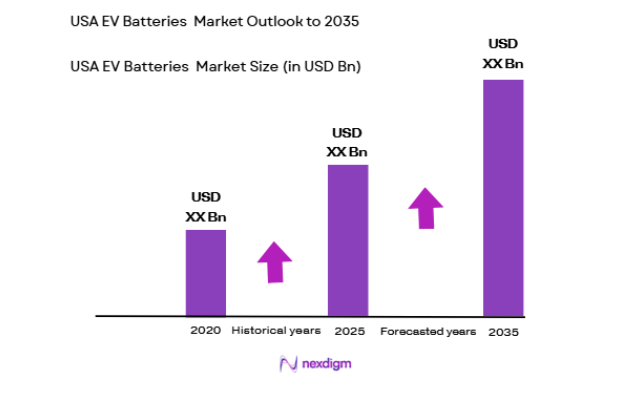
The USA EV Batteries Market is valued at USD ~ billion based on a recent historical assessment, supported by production and shipment data from the U.S. Department of Energy and industry financial disclosures. Growth is primarily driven by accelerating electric vehicle adoption, federal manufacturing incentives under the Inflation Reduction Act, and expanding domestic gigafactory capacity. Increased investments by automotive OEMs in localized battery supply chains further strengthen market momentum.
California, Texas, Michigan, and Georgia dominate the USA EV Batteries Market due to large-scale EV manufacturing clusters, strong policy incentives, and established automotive ecosystems. California leads in EV registrations and charging infrastructure deployment, while Michigan remains central to legacy automotive transformation. Texas and Georgia attract multi-billion-dollar battery plant investments supported by state-level incentives and proximity to logistics corridors, reinforcing their strategic manufacturing significance.
Market Segmentation
By Product Type
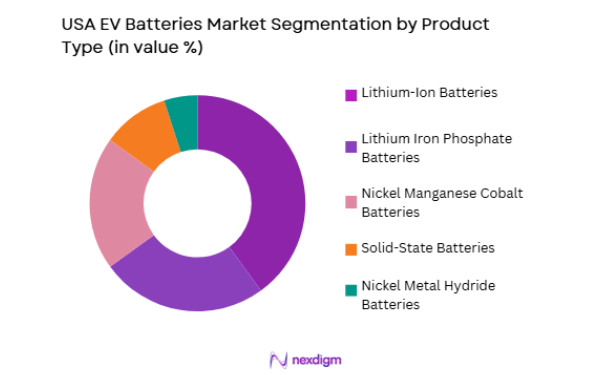
USA EV Batteries Market is segmented by product type into Lithium-Ion Batteries, Lithium Iron Phosphate Batteries, Nickel Manganese Cobalt Batteries, Solid-State Batteries, and Nickel Metal Hydride Batteries. Recently, Lithium-Ion Batteries has a dominant market share due to established supply chains, high energy density, strong OEM integration, and extensive gigafactory investments across multiple states. Major automotive manufacturers prioritize lithium-ion chemistries because of proven scalability, declining cost per kWh, and compatibility with advanced battery management systems. Federal incentives tied to domestic cell production further reinforce lithium-ion dominance, as manufacturers accelerate localization strategies to qualify for tax credits. Continuous improvements in cathode chemistry, thermal stability, and fast-charging performance have strengthened industry preference for lithium-ion systems. Additionally, lithium-ion technology benefits from mature recycling ecosystems and existing intellectual property portfolios, which reduce commercialization risks compared to emerging alternatives such as solid-state systems.
By Platform Type
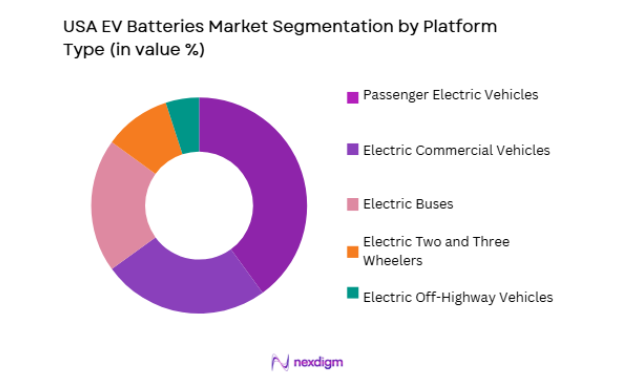
USA EV Batteries Market market is segmented by platform type into Passenger Electric Vehicles, Electric Commercial Vehicles, Electric Buses, Electric Two and Three Wheelers, and Electric Off-Highway Vehicles. Recently, Passenger Electric Vehicles has a dominant market share due to rising consumer demand, expanding model availability, and supportive tax credit eligibility criteria. Automakers have launched multiple battery electric SUV and sedan models, significantly increasing battery pack deployment volumes. Passenger EVs benefit from large-scale fleet electrification initiatives and subscription-based ownership models that stimulate recurring battery demand. Infrastructure expansion, including nationwide fast-charging corridors, further supports passenger EV battery consumption. Commercial platforms are growing steadily; however, passenger vehicles continue to drive higher unit volumes and larger cumulative battery capacity installations. Enhanced driving range expectations and performance-focused battery configurations in premium passenger EVs also contribute to higher battery pack value concentration within this segment.
Competitive Landscape
The USA EV Batteries Market is characterized by strategic consolidation, joint ventures between automotive OEMs and battery manufacturers, and rapid expansion of domestic production capacity. Leading companies leverage vertical integration, long-term mineral supply contracts, and proprietary cell technologies to strengthen market position. Partnerships between technology developers and automakers accelerate innovation in solid-state and high-energy-density chemistries, while large-scale gigafactory deployments create significant competitive entry barriers.
| Company Name | Establishment Year | Headquarters | Technology Focus | Market Reach | Key Products | Revenue (USD) | Gigafactory Presence |
| Tesla | 2003 | Texas | ~ | ~ | ~ | ~ | ~ |
| Panasonic Energy | 1918 | Nevada | ~ | ~ | ~ | ~ | ~ |
| LG Energy Solution | 2020 | Michigan | ~ | ~ | ~ | ~ | ~ |
| SK On | 2021 | Georgia | ~ | ~ | ~ | ~ | ~ |
| General Motors | 1908 | Michigan | ~ | ~ | ~ | ~ | ~ |
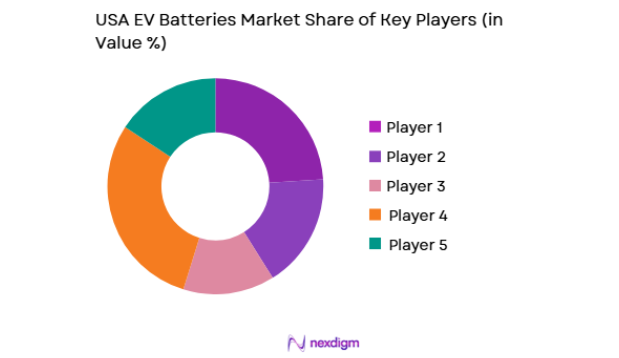
USA EV Batteries Market Analysis
Growth Drivers
Federal Manufacturing Incentives and Tax Credit Acceleration
The Inflation Reduction Act has significantly strengthened domestic battery manufacturing economics by offering production tax credits tied to cell output and mineral sourcing requirements, which directly reduce per-unit battery costs for qualifying manufacturers. These incentives have catalyzed multi-billion-dollar gigafactory investments across several states, encouraging vertical integration between automakers and battery suppliers to secure eligibility benefits. Automakers are restructuring procurement strategies to comply with domestic content thresholds, thereby stimulating local mining, refining, and cell assembly operations. State-level subsidies further amplify federal measures, creating competitive bidding environments among states seeking large-scale manufacturing projects. This coordinated policy framework has enhanced investor confidence and lowered capital risk associated with new battery plants. Domestic production reduces reliance on imported cells, stabilizing supply chains and supporting long-term pricing predictability. Expanded manufacturing capacity improves economies of scale, enabling lower cost per kilowatt-hour and accelerating EV affordability. As consumer adoption increases, production-linked credits reinforce a self-sustaining cycle of higher demand and expanded supply infrastructure, strengthening overall market resilience.
Rapid Expansion of Electric Vehicle Adoption and Model Diversification
Increasing consumer acceptance of electric vehicles, combined with expanding product portfolios across multiple price segments, is significantly elevating battery demand across the United States. Automotive OEMs have launched new electric SUVs, pickup trucks, and performance vehicles, each requiring high-capacity battery packs that increase cumulative battery deployment volume. Improved charging infrastructure availability reduces range anxiety and enhances purchasing confidence among consumers. Fleet electrification initiatives across logistics, municipal services, and corporate mobility programs further contribute to battery demand growth. Advancements in battery management systems improve performance, safety, and lifecycle durability, encouraging broader adoption. Financial incentives at federal and state levels reduce upfront vehicle costs, stimulating higher registration volumes. Consumer awareness regarding environmental sustainability continues to influence purchasing decisions, reinforcing electric vehicle penetration. As automakers phase out internal combustion engine models in certain segments, battery production capacity must expand correspondingly to meet escalating platform electrification targets.
Market Challenges
Critical Mineral Supply Chain Dependency and Price Volatility
The USA EV Batteries Market faces significant exposure to global lithium, cobalt, and nickel supply fluctuations, which influence raw material pricing and overall production costs. Concentration of mineral extraction and refining capacity outside domestic borders introduces geopolitical risk and logistical vulnerability. Price spikes in lithium carbonate and nickel have historically disrupted cost projections, complicating long-term procurement contracts. Domestic mining projects encounter environmental permitting delays, extending development timelines and limiting near-term supply diversification. Recycling initiatives are progressing but have not yet achieved sufficient scale to offset primary mineral dependency. Long-term fixed supply agreements partially mitigate volatility but reduce procurement flexibility. Additionally, evolving trade policies may introduce tariffs or export controls that affect import flows. These structural supply challenges create uncertainty in margin stability and necessitate strategic inventory planning by manufacturers.
High Capital Expenditure and Technology Transition Risks
Establishing battery gigafactories requires multi-billion-dollar investments in land acquisition, automation systems, cleanroom facilities, and workforce training, creating substantial upfront financial exposure. Rapid evolution of battery chemistries introduces the risk of technological obsolescence before full capital recovery is achieved. Companies investing heavily in current lithium-ion architectures must simultaneously allocate resources toward next-generation solid-state research, stretching R&D budgets. Workforce shortages in specialized battery engineering and manufacturing skills increase operational complexity. Equipment calibration, safety compliance, and quality assurance processes demand continuous upgrades to maintain competitive output standards. Unexpected delays in production ramp-up can affect supply agreements with automotive OEMs, resulting in financial penalties. Integration of advanced automation systems also introduces cybersecurity vulnerabilities that require additional safeguards. These capital and technology risks collectively raise entry barriers and intensify financial pressure on emerging players.
Opportunities
Commercialization of Solid-State Battery Technology
The advancement of solid-state battery systems represents a transformative opportunity for the USA EV Batteries Market due to higher energy density, improved safety, and extended lifecycle performance compared to conventional lithium-ion cells. Automakers seek longer driving ranges and faster charging capabilities, both of which solid-state designs promise to deliver. Reduced flammability risk enhances safety compliance and insurance acceptance. Federal research grants and private venture funding are accelerating pilot production lines across multiple states. Integration of solid electrolytes allows more compact battery pack architecture, improving vehicle design flexibility. Intellectual property leadership in solid-state development could provide domestic manufacturers with strategic global advantages. Early commercial deployment in premium vehicle segments may establish proof of concept before large-scale cost reductions are achieved. As manufacturing processes mature, solid-state systems could significantly reshape competitive dynamics and reduce dependence on certain critical minerals.
Expansion of Battery Recycling and Second-Life Energy Storage
Growth in end-of-life battery volumes creates opportunities for large-scale recycling infrastructure that can recover lithium, cobalt, and nickel for reintegration into domestic supply chains. Recycling reduces exposure to global mineral volatility and supports compliance with sustainability targets. Second-life applications, including stationary energy storage systems for grid balancing and renewable integration, extend battery asset value beyond automotive use. Utility companies increasingly adopt battery storage solutions to stabilize renewable generation variability. Government incentives encourage circular economy models that align environmental and economic objectives. Investment in advanced hydrometallurgical recycling processes enhances material recovery efficiency and cost competitiveness. Partnerships between automakers and recycling firms establish closed-loop supply agreements, improving long-term mineral security. As regulatory emphasis on sustainability intensifies, recycling and second-life deployment could become central pillars of industry profitability and resilience.
Future Outlook
The USA EV Batteries Market is expected to expand steadily over the next five years, supported by continued electrification targets and large-scale domestic manufacturing investments. Advancements in solid-state research, battery recycling infrastructure, and thermal management systems will influence next-generation performance benchmarks. Regulatory incentives and supply chain localization strategies are anticipated to sustain capital inflows. Growing consumer acceptance and fleet electrification initiatives will further strengthen long-term demand dynamics.
Major Players
- Tesla
- Panasonic Energy
- LG Energy Solution
- SK On
- General Motors
- Ford Motor Company
- Samsung SDI
- CATL North America
- QuantumScape
- Solid Power
- Envision AESC
- Northvolt
- FREYR Battery
- Sila Nanotechnologies
- Microvast
Key Target Audience
- Automotive OEMs
- Battery Cell Manufacturers
- Investments and venture capitalist firms
- Government and regulatory bodies
- Fleet Operators
- Energy Storage Integrators
- Raw Material Suppliers
- Logistics and Supply Chain Companies
Research Methodology
Step 1: Identification of Key Variables
Comprehensive identification of demand-side and supply-side variables including EV sales, battery production capacity, mineral sourcing, and regulatory incentives. Quantitative metrics such as installed gigawatt-hour capacity and average pack cost were mapped to structural growth indicators.
Step 2: Market Analysis and Construction
Primary interviews with industry participants were combined with secondary data from federal agencies and corporate disclosures. Market sizing incorporated production volume, installed capacity, and revenue benchmarking to ensure accuracy.
Step 3: Hypothesis Validation and Expert Consultation
Findings were validated through consultations with battery technology experts, automotive strategists, and policy analysts. Cross-verification ensured alignment with current investment trends and regulatory developments.
Step 4: Research Synthesis and Final Output
All data streams were synthesized into structured market insights supported by financial modeling and comparative benchmarking. The final report integrates quantitative analysis with strategic evaluation to deliver actionable conclusions.

- Executive Summary
- Research Methodology (Definitions, Scope, Industry Assumptions, Market Sizing Approach, Primary & Secondary Research Framework, Data Collection & Verification Protocol, Analytic Models & Forecast Methodology, Limitations & Research Validity Checks)

- Market Definition and Scope
- Value Chain & Stakeholder Ecosystem
- Regulatory / Certification Landscape
- Sector Dynamics Affecting Demand
- Strategic Initiatives & Infrastructure Growth

- Growth Drivers
Federal and state-level incentives accelerating EV adoption
Rapid expansion of domestic battery manufacturing capacity
Declining lithium-ion battery pack costs improving affordability
- Market Challenges
Supply chain volatility for critical minerals such as lithium and cobalt
High capital expenditure for gigafactory development
Battery recycling and end-of-life management complexities - Market Opportunities
Expansion of solid-state battery commercialization
Growth of battery recycling and second-life energy storage markets
Strategic localization of raw material processing in North America - Trends
Shift toward high energy density battery chemistries
Integration of advanced battery management systems
Increasing investment in domestic gigafactories - Government regulations
- SWOT analysis
- Porters 5 forces

- By Market Value, 2019-2025
- By Installed Units, 2019-2025
- By Average System Price, 2019-2025
- By System Complexity Tier, 2019-2025

- By System Type (In Value%)
Lithium-Ion Batteries
Lithium Iron Phosphate Batteries
Nickel Manganese Cobalt Batteries
Solid-State Batteries
Nickel Metal Hydride Batteries - By Platform Type (In Value%)
Passenger Electric Vehicles
Electric Commercial Vehicles
Electric Buses
Electric Two and Three Wheelers
Electric Off-Highway Vehicles - By Fitment Type (In Value%)
OEM Battery Pack Integration
Aftermarket Battery Replacement
Modular Battery Systems
Swappable Battery Systems
Integrated Battery and Thermal Management Systems - By End User Segment (In Value%)
Automotive OEMs
Fleet Operators
Public Transportation Authorities
Logistics and Delivery Companies
Individual EV Owners - By Procurement Channel (In Value%)
Direct OEM Contracts
Long-Term Supply Agreements
Government Procurement Programs

- Market Share Analysis
- Cross Comparison Parameters (System Type, Energy Density, Procurement Channel, End-User Segment, Battery Lifecycle, Thermal Management Efficiency, Cost per kWh, Charging Speed Capability, Raw Material Sourcing Strategy, Manufacturing Capacity, Recycling Integration, Technology Maturity)
- SWOT Analysis of Key Competitors
- Pricing & Procurement Analysis
- Key Players
Tesla
General Motors
Ford Motor Company
Panasonic Energy
LG Energy Solution
SK On
Samsung SDI
CATL North America
QuantumScape
Solid Power
Envision AESC
Northvolt
FREYR Battery
Sila Nanotechnologies
Microvast

- Automotive OEMs expanding in-house battery sourcing strategies
- Fleet operators accelerating electrification for cost efficiency
- Public transportation authorities adopting large-scale electric bus programs
- Logistics companies investing in battery-backed commercial EV fleets

- Forecast Market Value, 2026-2030
- Forecast Installed Units, 2026-2030
- Price Forecast by System Tier, 2026-2030
- Future Demand by Platform, 2026-2030


 Request a Sample
 Ask for Customization
 Get a Quote
 Enquire Now