
 Download PDF
 Download PDF
Market Overview
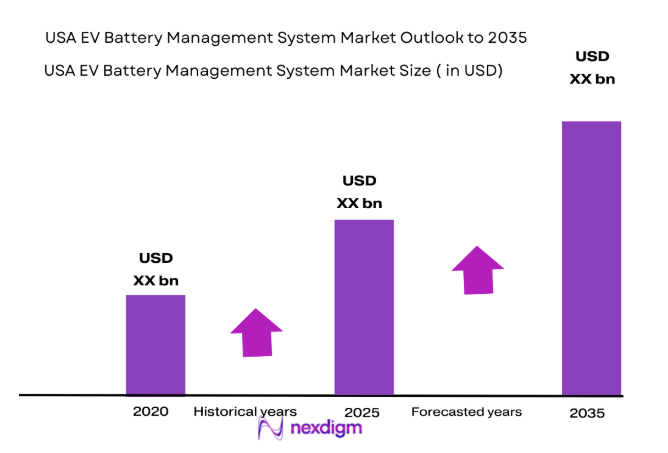
Based on a recent historical assessment, the USA EV Battery Management System market recorded a market size of approximately USD ~ billion, supported by strong electric vehicle production and battery technology innovation across the United States automotive sector. Data published by the International Energy Agency and U.S. Department of Energy highlights rapid EV adoption and expanding battery pack integration, which directly increases demand for advanced battery monitoring and thermal management systems. Growing investments by automakers in high-capacity lithium-ion battery packs and vehicle electrification platforms further accelerate the deployment of battery management systems across electric mobility applications.
Major automotive and technology hubs including California, Michigan, Texas, and Ohio dominate the USA EV Battery Management System market due to strong electric vehicle manufacturing ecosystems and battery innovation clusters. California leads electric mobility adoption through extensive EV deployment and charging infrastructure programs supported by the California Energy Commission and state environmental initiatives. Michigan and Ohio host major automotive manufacturers and battery technology research facilities, while Texas supports large-scale electric vehicle production facilities and semiconductor manufacturing, strengthening the regional supply chain for advanced battery electronics and monitoring systems.
Market Segmentation
By Product Type
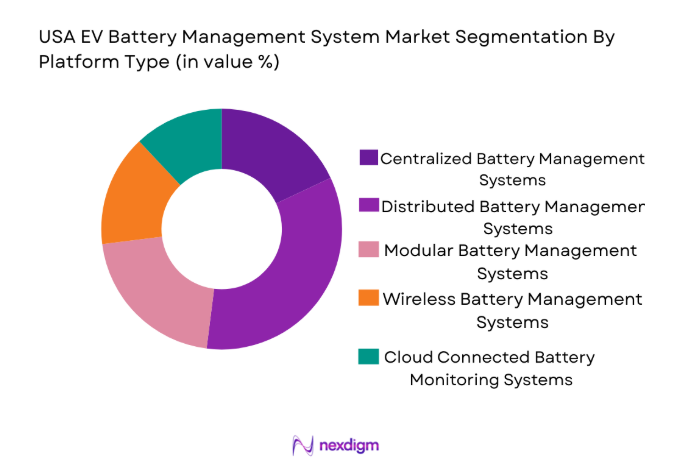
By Product Type: USA EV Battery Management System market is segmented by product type into Centralized Battery Management Systems, Distributed Battery Management Systems, Modular Battery Management Systems, Wireless Battery Management Systems, and Cloud-Connected Battery Monitoring Systems. Recently, Distributed Battery Management Systems have a dominant market share due to factors such as increasing battery pack complexity, growing electric vehicle battery capacities, and demand for improved monitoring accuracy across individual battery cells. Automotive manufacturers increasingly adopt distributed systems because they allow flexible architecture and enable precise monitoring of voltage, temperature, and state of charge across large battery packs used in electric vehicles. Distributed BMS architecture improves safety and reliability by reducing wiring complexity and enabling real-time diagnostics across battery modules. Electric vehicle manufacturers also prefer distributed systems because they support scalable battery pack designs required for passenger vehicles, commercial EV fleets, and electric buses. Increasing demand for long-range electric vehicles further strengthens adoption of distributed battery management technologies across the United States EV ecosystem.
By Platform Type
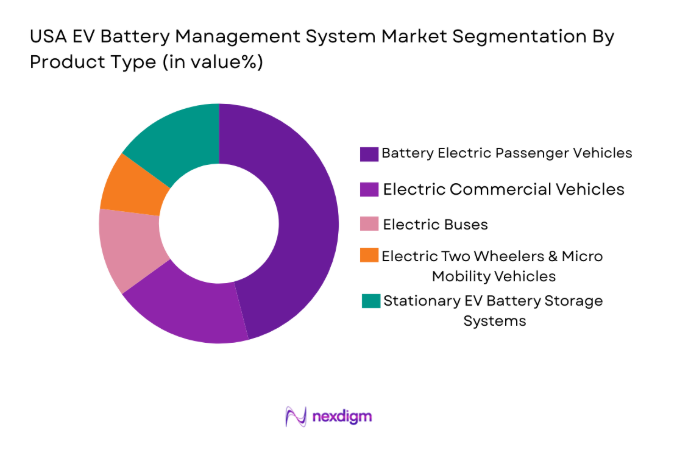
By Platform Type: USA EV Battery Management System market is segmented by platform type into Battery Electric Passenger Vehicles, Electric Commercial Vehicles, Electric Buses, Electric Two Wheelers and Micro-Mobility Vehicles, and Stationary EV Battery Storage Systems. Recently, Battery Electric Passenger Vehicles hold the dominant market share due to strong consumer adoption of electric cars and significant production expansion by major automotive manufacturers across the United States. Passenger electric vehicles require advanced battery monitoring technologies to ensure safety, optimize battery performance, and extend battery lifecycle. Automotive companies also prioritize advanced battery management integration to support fast charging capabilities and improve driving range. Rapid expansion of EV manufacturing plants and growing consumer demand for electric SUVs and passenger cars further increases installation of battery management systems in passenger vehicle platforms. Government incentives for EV adoption and stringent vehicle emission regulations also encourage automakers to expand electric passenger vehicle production, reinforcing the segment’s dominance within the battery management system market.
Competitive Landscape
The USA EV Battery Management System market demonstrates moderate consolidation with several global semiconductor manufacturers, automotive electronics companies, and battery technology developers competing for technological leadership. Major players focus on advanced battery monitoring integrated circuits, wireless battery management systems, and cloud-based battery analytics platforms. Strategic partnerships between automotive manufacturers and semiconductor companies accelerate product development and integration of advanced battery safety technologies. Companies also invest in research and development to enhance battery efficiency, improve thermal management capabilities, and support high-capacity battery architectures used in next-generation electric vehicles.
| Company Name | Establishment Year | Headquarters | Technology Focus | Market Reach | Key Products | Revenue | Battery Management Capability |
| Texas Instruments | 1930 | USA | ~ | ~ | ~ | ~ | ~ |
| Analog Devices | 1965 | USA | ~ | ~ | ~ | ~ | ~ |
| NXP Semiconductors | 2006 | Netherlands | ~ | ~ | ~ | ~ | ~ |
| Infineon Technologies | 1999 | Germany | ~ | ~ | ~ | ~ | ~ |
| STMicroelectronics | 1987 | Switzerland | ~ | ~ | ~ | ~ | ~ |
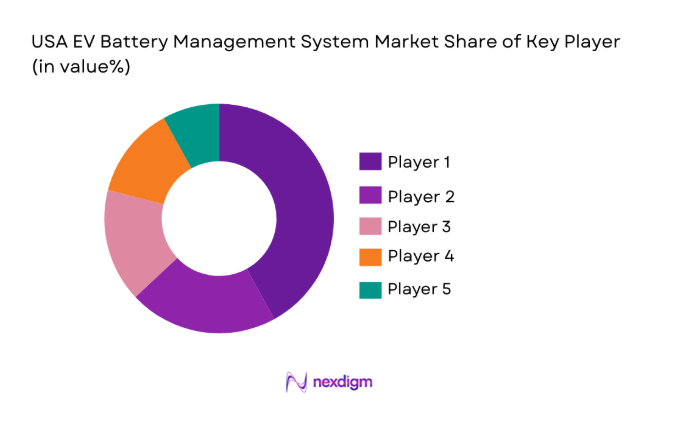
USA EV Battery Management Market Analysis
Growth Drivers
Expansion of Electric Vehicle Manufacturing Across the United States Automotive Industry
The rapid expansion of electric vehicle manufacturing across the United States significantly drives the demand for EV battery management systems because modern electric vehicles rely on advanced battery monitoring technologies to maintain battery safety, efficiency, and performance across large battery packs. Automotive manufacturers across states such as Michigan, California, and Texas increasingly invest in large-scale electric vehicle production facilities to support the transition from internal combustion engine vehicles to electric mobility platforms. These manufacturing expansions require reliable battery monitoring technologies capable of controlling thousands of lithium-ion cells integrated within EV battery packs. Battery management systems monitor voltage, temperature, and state of charge while ensuring optimal battery health during vehicle operation and charging cycles. As electric vehicles incorporate larger battery capacities to increase driving range, battery management complexity increases significantly, making advanced monitoring electronics essential for safe operation. Automotive companies therefore collaborate with semiconductor manufacturers to develop highly integrated battery management integrated circuits and advanced control modules that support real-time monitoring across battery packs. Growing consumer adoption of electric vehicles further accelerates production volumes, which proportionally increases demand for battery management system components. The presence of large automotive manufacturers such as Tesla, General Motors, and Ford Motor Company further strengthens the domestic supply chain for battery electronics and monitoring technologies. Additionally, federal incentives supporting electric vehicle manufacturing expansion encourage automakers to invest heavily in EV platforms, reinforcing the sustained growth of the battery management system market across the United States automotive ecosystem.
Advancements in Lithium-Ion Battery Technology and Increasing Battery Pack Complexity
Continuous advancements in lithium-ion battery technology significantly increase the importance of advanced battery management systems because modern battery packs contain a larger number of cells and operate at higher voltages compared with earlier electric vehicle battery systems. These technological developments allow electric vehicles to achieve longer driving ranges and faster charging speeds, but they also introduce complex safety and performance monitoring requirements. Battery management systems must continuously track voltage balance, temperature distribution, and energy flow across multiple battery modules to ensure safe operation during high-power charging and discharging cycles. As battery chemistries evolve toward high-energy density materials such as nickel-rich cathodes and solid-state battery architectures, monitoring requirements become more sophisticated. Semiconductor companies therefore develop advanced battery monitoring integrated circuits capable of measuring cell-level performance with high accuracy while minimizing power consumption. Wireless battery management systems also emerge as an innovative solution that reduces wiring complexity and improves battery pack architecture flexibility. Automotive manufacturers integrate advanced algorithms within battery management platforms to estimate battery state of health and predict battery degradation over time. These capabilities enable predictive maintenance and improve long-term vehicle reliability, which enhances consumer confidence in electric mobility solutions. Continuous battery innovation combined with increasing battery pack complexity therefore drives strong demand for advanced battery management systems across electric vehicle manufacturing and battery technology development sectors.
Market Challenges
High Development and Integration Costs for Advanced Battery Management Systems
One of the major challenges affecting the USA EV Battery Management System market is the high development cost associated with advanced battery monitoring electronics and integration within complex electric vehicle architectures. Designing battery management systems requires sophisticated semiconductor components, high-precision sensing technologies, and specialized software algorithms capable of monitoring thousands of battery cells simultaneously. Automotive manufacturers must also ensure compliance with stringent safety regulations governing high-voltage battery systems used in electric vehicles. These requirements increase research and development expenditure for semiconductor companies and automotive electronics suppliers. Battery management system design must also address thermal management challenges, electrical isolation requirements, and cybersecurity considerations for connected vehicles. Developing hardware and software platforms capable of meeting these requirements demands significant engineering expertise and testing infrastructure. Additionally, integrating battery management systems into electric vehicle powertrains requires compatibility with vehicle control units, charging systems, and energy management software. These integration complexities increase production costs and extend product development timelines. Smaller automotive suppliers may face difficulties investing in large research and development programs necessary to develop advanced battery monitoring technologies. The high cost structure associated with battery management system innovation therefore creates barriers to entry for new market participants and increases the financial risk associated with technology development projects.
Supply Chain Constraints for Semiconductor and Electronic Components
The EV battery management system market is also affected by supply chain challenges associated with semiconductor manufacturing and electronic component availability. Battery management systems rely heavily on specialized integrated circuits, sensors, microcontrollers, and communication modules to monitor battery pack performance and ensure safe operation of electric vehicles. Global semiconductor supply disruptions can therefore significantly affect the production capacity of battery management system manufacturers and automotive companies. Semiconductor shortages may delay electric vehicle manufacturing schedules because battery monitoring electronics are essential for vehicle safety certification. In addition, many battery management system components require advanced fabrication technologies that depend on complex global semiconductor supply chains. Fluctuations in raw material availability and manufacturing capacity may therefore increase component costs and limit supply stability. Automotive manufacturers must also coordinate supply chains across battery manufacturers, semiconductor companies, and electronics suppliers to ensure reliable battery management integration within EV platforms. These supply chain dependencies increase operational risks and require long-term procurement planning by automotive companies. Addressing semiconductor supply constraints therefore remains a major challenge for the EV battery management system industry as electric vehicle production continues to expand rapidly across the United States.
Opportunities
Development of Wireless Battery Management Systems for Next Generation Electric Vehicles
The emergence of wireless battery management systems represents a major opportunity for companies operating in the EV battery management market because wireless communication technologies can significantly simplify battery pack architecture and reduce wiring complexity. Traditional battery management systems rely on extensive wiring harnesses connecting battery modules to central monitoring units, which increases vehicle weight and assembly complexity. Wireless battery management solutions replace physical communication wiring with secure wireless communication protocols that transmit battery performance data between battery modules and control units. This technology enables automotive engineers to design more compact battery packs and improves manufacturing efficiency. Wireless battery monitoring also supports modular battery architectures that can be easily scaled across different electric vehicle models. Automotive manufacturers increasingly explore wireless battery management technology to improve battery pack design flexibility and reduce manufacturing costs. Semiconductor companies are therefore developing advanced wireless communication chips and battery monitoring modules capable of maintaining reliable data transmission within high-voltage battery environments. As electric vehicle production continues to expand, wireless battery management solutions offer a significant opportunity to improve battery performance monitoring while reducing vehicle complexity and manufacturing cost structures.
Integration of Artificial Intelligence in Predictive Battery Health Monitoring
Artificial intelligence technologies create new opportunities within the EV battery management system market by enabling predictive battery health monitoring and advanced energy optimization capabilities. Traditional battery management systems monitor battery parameters such as voltage and temperature but rely on relatively simple algorithms to estimate battery health. Artificial intelligence and machine learning algorithms allow battery monitoring systems to analyze large volumes of operational data and identify patterns that indicate early battery degradation or performance issues. These predictive analytics capabilities enable automotive manufacturers and fleet operators to detect potential battery failures before they occur, improving vehicle reliability and safety. AI-driven battery management platforms can also optimize charging behavior, extend battery lifecycle, and improve energy efficiency during vehicle operation. Automotive companies increasingly integrate cloud-based battery analytics platforms that collect real-time battery performance data from vehicles operating in different environments. These data-driven insights allow manufacturers to continuously improve battery design and optimize energy management strategies. The integration of artificial intelligence therefore represents a major technological opportunity for battery management system developers seeking to enhance battery safety, performance, and lifecycle management across electric vehicle fleets.
Future Outlook
The USA EV Battery Management System market is expected to experience strong technological advancement and continued demand expansion as electric vehicle adoption accelerates across passenger and commercial transportation sectors. Advancements in battery chemistry, wireless battery monitoring technologies, and artificial intelligence-driven diagnostics will significantly enhance battery safety and efficiency. Government incentives supporting electric mobility and clean transportation will further encourage automotive manufacturers to expand EV production. Increasing integration of smart energy management systems and cloud-based battery analytics platforms will also shape the next generation of battery management technologies.
Major Players
- Texas Instruments
- Analog Devices
- NXP Semiconductors
- Infineon Technologies
- STMicroelectronics
- Renesas Electronics
- Robert Bosch GmbH
- Continental AG
- Denso Corporation
- Sensata Technologies
- Panasonic Energy
- LG Energy Solution
- AVL List GmbH
- Eberspaecher Vecture
- Lithium Balance A/S
Key Target Audience
- Electric vehicle manufacturers
- Automotive component suppliers
- Battery manufacturers
- Semiconductor companies
- Electric mobility infrastructure providers
- Investments and venture capitalist firms
- Government and regulatory bodies
- Energy storage system developers
Research Methodology
Step 1: Identification of Key Variables
The research begins with identifying critical variables influencing the USA EV Battery Management System market including electric vehicle production volumes, battery technology trends, semiconductor supply chains, and government electrification policies. These variables provide the foundation for market sizing and segmentation analysis.
Step 2: Market Analysis and Construction
Market analysis involves evaluating electric vehicle adoption, battery pack technology evolution, and industry supply chains to construct a detailed framework for the battery management system ecosystem. Industry databases, government publications, and company reports contribute to market size estimation.
Step 3: Hypothesis Validation and Expert Consultation
Industry experts including battery technology engineers, automotive manufacturers, and semiconductor specialists are consulted to validate market assumptions and confirm technological developments influencing battery management system demand.
Step 4: Research Synthesis and Final Output
All validated insights are synthesized to generate comprehensive market analysis, competitive landscape assessment, segmentation analysis, and future outlook for the USA EV Battery Management System market.

- Executive Summary
- Research Methodology
(Definitions, Scope, Industry Assumptions, Market Sizing Approach, Primary & Secondary Research Framework, Data Collection & Verification Protocol, Analytic Models & Forecast Methodology, Limitations & Research Validity Checks)

- Market Definition and Scope
- Value Chain & Stakeholder Ecosystem
- Regulatory / Certification Landscape
- Sector Dynamics Affecting Demand
- Strategic Initiatives & Infrastructure Growth

- Growth Drivers
Rapid expansion of electric vehicle manufacturing across the United States automotive sector
Government incentives and emission regulations accelerating EV adoption
Advancements in battery chemistry requiring advanced battery monitoring and safety systems
Increasing investments in EV charging infrastructure and battery energy storage
Growing safety requirements for high voltage EV battery packs - Market Challenges
High development costs associated with advanced battery management electronics
Integration complexity with evolving EV battery architectures
Cybersecurity risks associated with connected battery monitoring platforms
Supply chain constraints in semiconductors and electronic components
Thermal management challenges in high energy density battery systems - Market Opportunities
Development of predictive battery health monitoring using artificial intelligence
Expansion of wireless battery management technologies for next generation EVs
Growth of second life battery management systems for energy storage applications - Trends
Adoption of wireless battery management architectures in electric vehicles
Integration of AI and machine learning in battery diagnostics
Increasing deployment of cloud based battery performance monitoring
Strategic partnerships between automakers and semiconductor companies for BMS innovation
Development of battery digital twin technologies for lifecycle optimization - Government Regulations & Defense Policy
Federal incentives supporting EV manufacturing and battery technology innovation
Safety regulations for high voltage EV battery systems and monitoring technologies
Government funded research programs supporting advanced battery electronics
SWOT Analysis
Stakeholder and Ecosystem Analysis
Porter’s Five Forces Analysis
Competition Intensity and Ecosystem Mapping

- By Market Value, 2020-2025
- By Installed Units, 2020-2025
- By Average System Price, 2020-2025
- By System Complexity Tier, 2020-2025

- By System Type (In Value%)
Centralized Battery Management Systems
Distributed Battery Management Systems
Modular Battery Management Systems
Wireless Battery Management Systems
AI Integrated Battery Management Systems - By Platform Type (In Value%)
Battery Electric Passenger Vehicles
Electric Commercial Vehicles
Electric Buses
Electric Two Wheelers and Micro Mobility Vehicles
Stationary EV Battery Storage Systems - By Fitment Type (In Value%)
OEM Integrated Battery Management Systems
Aftermarket Battery Monitoring Systems
Retrofit Battery Management Units
Integrated Powertrain Battery Controllers
Cloud Connected Battery Monitoring Modules - By EndUser Segment (In Value%)
Electric Passenger Vehicle Manufacturers
Electric Commercial Fleet Operators
Public Transportation Authorities
Energy Storage System Integrators
Automotive Technology Developers - By Procurement Channel (In Value%)
Direct OEM Supply Contracts
Tier 1 Automotive Electronics Suppliers
Technology Licensing Partnerships
Government Procurement Programs
Authorized Automotive Electronics Distributors - By Material / Technology (in Value %)
Lithium Ion Battery Management Platforms
Solid State Battery Monitoring Systems
Wireless Cell Monitoring Technologies
AI Driven Battery Analytics Systems
High Voltage Battery Protection Systems

- Market structure and competitive positioning
Market share snapshot of major players
CrossComparison Parameters (Battery Monitoring Accuracy, Thermal Management Capability, Software Integration, Wireless Communication Capability, System Scalability)
SWOT Analysis of Key Competitors
Pricing & Procurement Analysis - Key Players
Texas Instruments
Analog Devices
Renesas Electronics
NXP Semiconductors
STMicroelectronics
Infineon Technologies
Panasonic Energy
LG Energy Solution
Robert Bosch GmbH
Continental AG
Denso Corporation
Sensata Technologies
AVL List GmbH
Eberspaecher Vecture
Lithium Balance A/S

- Automotive manufacturers increasingly integrate advanced BMS platforms to improve battery safety and performance
- Commercial electric fleet operators rely on battery analytics to optimize lifecycle and operational costs
- Public transportation authorities deploy battery monitoring systems for electric bus fleet reliability
- Energy storage developers integrate EV battery management systems into grid storage solutions

- Forecast Market Value, 2026-2035
- Forecast Installed Units, 2026-2035
- Price Forecast by System Tier, 2026-2035
- Future Demand by Platform, 2026-2035


 Request a Sample
 Ask for Customization
 Get a Quote
 Enquire Now