
 Download PDF
Market Overview
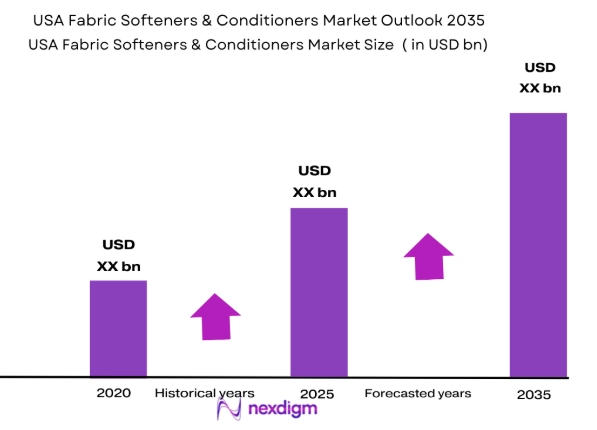
The USA Fabric Softeners & Conditioners Market was valued at USD ~ billion based on a recent historical assessment, supported by rising consumer attention to fabric care, laundry hygiene, softness, fragrance, static reduction, and convenience-led household routines. Demand is driven by frequent laundry cycles, premium scent formats, concentrated formulas, large retail availability, and e-commerce replenishment models that make repeat purchases easier for households.
New York, Los Angeles, Chicago, Houston, Dallas-Fort Worth, Atlanta, Miami, and Phoenix are the dominant demand clusters because they combine dense households, large suburban laundry consumption, broad supermarket and mass-merchandise coverage, and strong online grocery penetration. These cities also contain major retail distribution nodes, diverse income groups, high apartment and multifamily housing density, and large working populations that favor convenient laundry-care products.
Market Segmentation
By Product Type
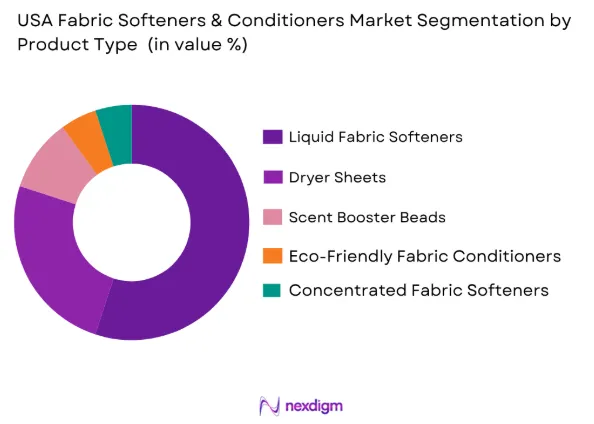
USA Fabric Softeners & Conditioners Market is segmented by product type into liquid fabric softeners, dryer sheets, scent booster beads, eco-friendly fabric conditioners, and concentrated fabric softeners. Recently, liquid fabric softeners have a dominant market share due to their deep integration into household laundry routines, compatibility with washing-machine rinse cycles, and ability to deliver softness, fragrance, anti-static benefits, and perceived garment-care performance in a single format. Liquid formats also benefit from shelf visibility, strong brand investment, wide pack-size availability, and promotional bundling with detergents. Dryer sheets retain relevance among dryer-heavy households, while scent boosters are growing through premium fragrance positioning. Eco-friendly and concentrated variants are gaining attention, but their higher price points and narrower retail penetration keep them behind mainstream liquids. Public sources identify liquid formats as the leading segment, with disclosed global references placing liquids ahead of sheets and other formats.
By Distribution Channel
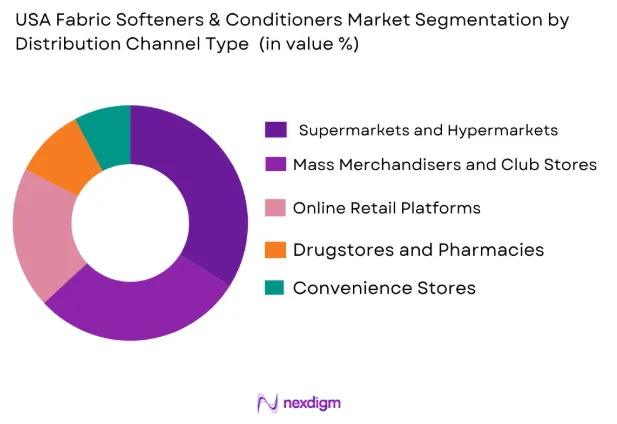
USA Fabric Softeners & Conditioners Market is segmented by distribution channel into supermarkets and hypermarkets, mass merchandisers and club stores, online retail platforms, drugstores and pharmacies, and convenience stores. Recently, supermarkets and hypermarkets have a dominant market share because fabric softeners are usually purchased with detergents, stain removers, paper products, and other recurring household essentials. This channel benefits from high basket attachment, routine grocery trips, private-label competition, promotional endcaps, and broad assortment across budget, mid-tier, and premium products. Mass merchandisers and club stores are especially important for value packs and family households, while online retail platforms are expanding through subscription replenishment and same-day delivery. Drugstores and convenience stores mainly serve smaller baskets and urgent purchases. Walmart’s large U.S. grocery and e-commerce sales base illustrates why broadline retail remains central to household-care distribution.
Competitive Landscape
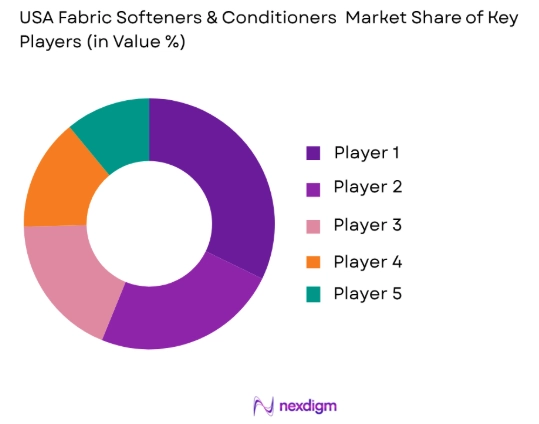
The USA Fabric Softeners & Conditioners Market is moderately consolidated, with large consumer-goods companies controlling the strongest national brands, retailer relationships, shelf visibility, and advertising budgets. Procter & Gamble leads through Downy and Bounce, while Henkel, Church & Dwight, Unilever, and Colgate-Palmolive compete through established laundry-care portfolios, fragrance innovation, value positioning, and sensitive-skin or natural-product propositions. Major players benefit from scale advantages in procurement, formulation science, packaging, retail promotions, and omnichannel availability.
| Company Name | Establishment Year | Headquarters | Technology Focus | Market Reach | Key Products | Revenue | Fabric-Care Brand Strength |
| Procter & Gamble | 1837 | Cincinnati, Ohio, USA | ~ | ~ | ~ | ~ | ~ |
| Henkel | 1876 | Düsseldorf, Germany | ~ | ~ | ~ | ~ | ~ |
| Church & Dwight | 1846 | Ewing, New Jersey, USA | ~ | ~ | ~ | ~ | ~ |
| Unilever | 1929 | London, United Kingdom | ~ | ~ | ~ | ~ | ~ |
| Colgate-Palmolive | 1806 | New York, New York, USA | ~ | ~ | ~ | ~ | ~ |
USA Fabric Softeners & Conditioners Market Analysis
Growth Drivers
Rising Household Laundry Base and Routine Household-Supplies Consumption
The USA Fabric Softeners & Conditioners Market is supported by a large recurring laundry base, as the U.S. Census Bureau reported 129,227,496 households and 2.53 persons per household for 2020–2024. This household base directly supports repeat demand for laundry additives used with regular washing, including fabric conditioners, dryer sheets, and scent boosters. BEA data published through FRED shows personal consumption expenditures on nondurable household supplies reached USD 191.130 billion in 2024, compared with USD 184.395 billion in 2023 and USD 177.788 billion in 2022. This sustained household-supplies spending supports routine purchasing of laundry-care products within grocery, mass retail, club retail, and online replenishment channels. Sources: U.S. Census Bureau; BEA/FRED.
Increasing Focus on Fabric Care and Garment Longevity
The USA Fabric Softeners & Conditioners Market benefits from high apparel ownership and textile-care needs, as fabric conditioners are used to maintain softness, reduce roughness, and improve the feel of clothing, towels, and bedding after repeated washing. BEA data published through FRED shows U.S. personal consumption expenditures on clothing reached USD 437.818 billion in 2024, compared with USD 421.365 billion in 2023 and USD 404.001 billion in 2022. Real clothing expenditure also reached USD 417.108 billion chained 2017 dollars in 2024, compared with USD 405.282 billion in 2023 and USD 401.893 billion in 2022. These figures support continued consumer focus on maintaining purchased textiles through laundry-care routines. Sources: BEA/FRED.
Challenges
Chemical Ingredient Scrutiny and Indoor-Air Concerns
The USA Fabric Softeners & Conditioners Market faces formulation pressure because many products rely on fragrance systems and conditioning agents used inside homes after washing and drying. The U.S. EPA states that volatile organic compounds are emitted by products “numbering in the thousands,” and concentrations of many VOCs are consistently higher indoors, reaching up to 10 times outdoor levels. This matters for scented fabric softeners and conditioners because fragrance intensity is a major purchase driver, but it also raises consumer concern around indoor-air exposure, chemical residues, and sensitive-skin use. The challenge is market specific because brands must preserve softness and long-lasting fragrance while responding to ingredient transparency, safer-formula expectations, and regulatory attention. Source: U.S. EPA.
Competition from Laundry Services and Simplified Laundry Routines
The USA Fabric Softeners & Conditioners Market faces pressure from laundry-service spending and simplified laundry routines that reduce direct household use of separate rinse-cycle conditioners. BEA data published through FRED shows U.S. personal consumption expenditures on laundry and dry-cleaning services reached USD 16.116 billion in 2024, compared with USD 14.815 billion in 2023 and USD 13.619 billion in 2022. Real expenditure on laundry and dry-cleaning services reached USD 11.588 billion chained 2017 dollars in 2024, compared with USD 11.217 billion in 2023 and USD 10.945 billion in 2022. This is relevant because professionally handled laundry and bundled service formats can reduce household purchase occasions for fabric conditioners, dryer sheets, and scent additives. Sources: BEA/FRED.
Opportunities
Online Replenishment of Laundry-Care Essentials
The USA Fabric Softeners & Conditioners Market has a strong opportunity in online replenishment because fabric softeners, dryer sheets, and scent boosters are repeat-purchase household essentials suited to subscriptions, bulk ordering, and scheduled delivery. The U.S. Census Bureau reported U.S. retail e-commerce sales of USD 352.9 billion in the fourth quarter of 2024, showing the scale of digital purchasing infrastructure available for household products. BEA/FRED also reported household-supplies expenditure of USD 191.130 billion in 2024, USD 184.395 billion in 2023, and USD 177.788 billion in 2022. These figures support future growth potential for online laundry-care purchasing, especially for concentrated, hypoallergenic, eco-friendly, and premium fragrance formats. Sources: U.S. Census Bureau; BEA/FRED.
Premium Textile-Care Positioning Through Apparel Protection
The USA Fabric Softeners & Conditioners Market has an opportunity to position fabric conditioners as textile-care products that protect apparel comfort, towels, bedding, and daily-use garments rather than only fragrance enhancers. BEA/FRED data shows personal consumption expenditure on clothing reached USD 437.818 billion in 2024, while personal care and clothing services reached USD 233.061 billion in 2024, compared with USD 214.609 billion in 2023 and USD 190.800 billion in 2022. These official figures indicate a large apparel and clothing-care ecosystem in which consumers continue spending on clothing ownership and maintenance. Fabric conditioner brands can use this base to expand low-residue, garment-care, sensitive-fabric, and premium softness claims for future growth. Sources: BEA/FRED.
Future Outlook
The USA Fabric Softeners & Conditioners Market is expected to remain stable over the next five years as household laundry frequency, retail replenishment systems, fragrance innovation, and fabric-care awareness support continued demand. Growth is likely to be strongest in concentrated liquids, scent boosters, sensitive-skin formats, and eco-positioned conditioners. Regulatory pressure and ingredient scrutiny will push brands toward clearer labeling and safer formulation narratives. Demand-side momentum will come from premium fragrance, omnichannel convenience, and consumers seeking fabric longevity.
Major Players
- Procter & Gamble
- Henkel
- Church & Dwight
- Unilever
- Colgate-Palmolive
- SC Johnson
- Reckitt
- Seventh Generation
- Method
- ECOS
- The Laundress
- Mrs. Meyer’s Clean Day
- Arm & Hammer
- Snuggle
- Suavitel
Key Target Audience
- Fabric softener and conditioner manufacturers
- Laundry-care product brands
- Supermarkets and hypermarkets
- Mass merchandisers and club retailers
- Online grocery and household essentials platforms
- Packaging suppliers for home-care products
- Investments and venture capitalist firms
- Government and regulatory bodies
Research Methodology
Step 1: Identification of Key Variables
The research process identified core demand variables, including product type, format, fragrance positioning, retail channel, household income group, purchase frequency, and ingredient preference.Key supply-side variables included brand portfolio strength, retail footprint, pricing architecture, packaging format, promotional activity, and formulation innovation.The study also considered regulatory, sustainability, and consumer-safety variables that influence fabric-care product adoption.
Step 2: Market Analysis and Construction
The market structure was built by reviewing public market-size references, company reports, retail-channel indicators, and product-segment disclosures.Product and channel segmentation was constructed using available public segment benchmarks and category-level triangulation.The analysis focused on value contribution, dominant formats, distribution dynamics, and the role of national brands versus private labels.
Step 3: Hypothesis Validation and Expert Consultation
Working hypotheses were tested against disclosed company revenues, published market research indicators, and retail-sector evidence.The validation process examined whether segment dominance aligned with consumer behavior, laundry appliance usage, shelf presence, and online replenishment patterns.Where public data was limited, assumptions were checked for consistency with disclosed market direction and competitive positioning.
Step 4: Research Synthesis and Final Output
The final output consolidated market overview, segmentation, competitive benchmarking, demand drivers, challenges, opportunities, and forward outlook.The synthesis prioritized commercially relevant insights for manufacturers, investors, retailers, packaging suppliers, and regulatory stakeholders.The report was structured to support market entry review, portfolio planning, distribution strategy, and future product-positioning decisions.

- Executive Summary
- Research Methodology (Market Definitions and Assumptions, Abbreviations and Terminology, Data Sources and Validation Approach, USA Fabric Softeners & Conditioners Market Sizing Methodology, Primary and Secondary Research Benchmarks, Market Reliability and Confidence Intervals)

- Industry Definition and Scope
- Market Genesis and Evolution in the USA
- Consumer Adoption Patterns
- Market Value Chain and Distribution Architecture
- Import and Export Dynamics

- Growth Drivers
Rising Demand for Convenient Laundry Care Products
Increasing Focus on Fabric Care and Garment Longevity
Growth of Premium Fragrance and Scent Booster Products
Expansion of Online Grocery and Household Essentials Retail
Rising Demand for Eco-Friendly and Hypoallergenic Laundry Products - Challenges
Health and Environmental Concerns Around Chemical Ingredients
High Competition from Detergent Pods and Multi-Functional Laundry Products
Price Sensitivity in Mass-Market Segments
Declining Usage Among Some Consumer Groups Due to Residue Concerns
Regulatory Scrutiny Around Fragrances and Chemical Formulations - Opportunities
Growth of Plant-Based and Biodegradable Fabric Conditioners
Expansion of Fragrance Personalization and Premium Scent Products
Innovation in Dryer Sheets, Beads, and Concentrated Formats
Partnerships with Retail Chains and E-Commerce Platforms
Opportunities in Sensitive Skin and Baby-Safe Fabric Care Products - Trends
Sustainable and Plastic-Free Laundry Care Packaging
Rise of Scent Boosters and Long-Lasting Fragrance Products
Subscription-Based Household Essentials Purchases
Demand for Dermatologist-Tested and Hypoallergenic Products
Growth of Concentrated and Low-Water Formulations
Premiumization of Everyday Laundry Care
- Government Regulations
Chemical Safety and Ingredient Disclosure Requirements
Labeling and Packaging Regulations
Environmental Regulations on Volatile Organic Compounds and Biodegradability
Regulations for Online Sale and Product Claims
Government Initiatives Supporting Sustainable Household Products - SWOT Analysis
- Porter’s Five Forces

- By Market Value, 2020-2025
- By Volume Sold, 2020-2025
- By Average Selling Price, 2020-2025
- By Product Category Revenue Contribution, 2020-2025

- By Product Type (In Value %)
Liquid Fabric Softeners
Dryer Sheets
Fabric Conditioner Beads / Scent Boosters
Eco-Friendly / Plant-Based Fabric Softeners
Concentrated Fabric Softeners - By Distribution Channel (In Value %)
Supermarkets and Hypermarkets
Convenience Stores
Drugstores and Pharmacies
Online Retail Platforms
Club Stores and Wholesale Retailers
- By Consumer Demographic (In Value %)
Urban Households
Suburban Households
Middle-Income Households
Premium Product Consumers
Eco-Conscious Consumers
Large Families and High-Frequency Laundry Users - By Price Tier (In Value %)
Budget / Entry-Level
Mid-Tier
Premium
Natural / Eco-Premium
Luxury / Specialty Fragrance Products - By Region (In Value %)
Northeast
Midwest
South
West
Other Regions

- Market Share by Product Category
- Sales Volume by Major Brands
- Cross Comparison Parameters(Company Overview, Product Portfolio Strength, Retail Footprint, E-Commerce Presence, Pricing Strategy, Brand Equity, Consumer Preference Score, Annual Revenue, and Growth Trajectory)
- Company Profiles
Downy
Snuggle
Gain
Bounce
Suavitel
Mrs. Meyer’s Clean Day
Seventh Generation
Method
Arm & Hammer
All
ECOS
Laundress

- Buying Decision Drivers
- Brand Loyalty and Repeat Purchase Cycle
- Payment Preferences and Pack Size Preferences
- Post-Purchase Usage Patterns
- Pain Points in Product Usage and Repurchase

- By Market Value, 2026-2035
- By Volume Sold, 2026-2035
- By Average Selling Price, 2026-2035
- By Product Category Revenue Contribution, 2026-2035


 Request a Sample
 Ask for Customization
 Get a Quote
 Enquire Now