
 Download PDF
Market Overview
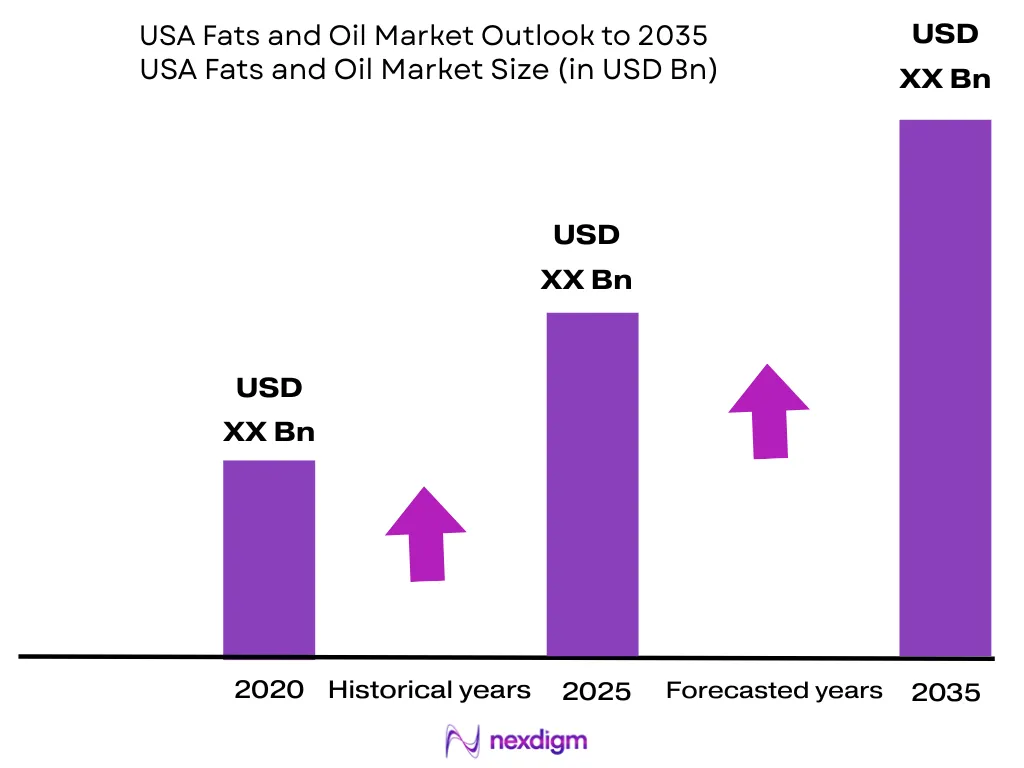
The USA Fats and Oil Market is valued at USD ~ billion, based on a five-year historical analysis, and is forecasted to grow at a CAGR of ~% during the forecast period. Demand is driven by edible oils, bakery fats, foodservice frying oils, animal fats, and biofuel feedstock use. USDA reported soybean production of 4.16 billion bushels and 4.37 billion bushels across the latest historical cycle, while soybean oil demand is supported by food use and biomass-based diesel feedstock demand. The Midwest, Gulf Coast, California, Texas, Illinois, Iowa, Indiana, and Minnesota dominate the USA Fats and Oil Market due to soybean crushing capacity, oilseed farming, food processing clusters, ports, biofuel demand, and large retail consumption bases. USDA states that soybeans account for about 90% of U.S. oilseed production, while national soybean output reached 4.37 billion bushels after 4.16 billion bushels in the previous crop cycle, strengthening Midwest leadership in vegetable oil supply.
Market Segmentation
By Product Type
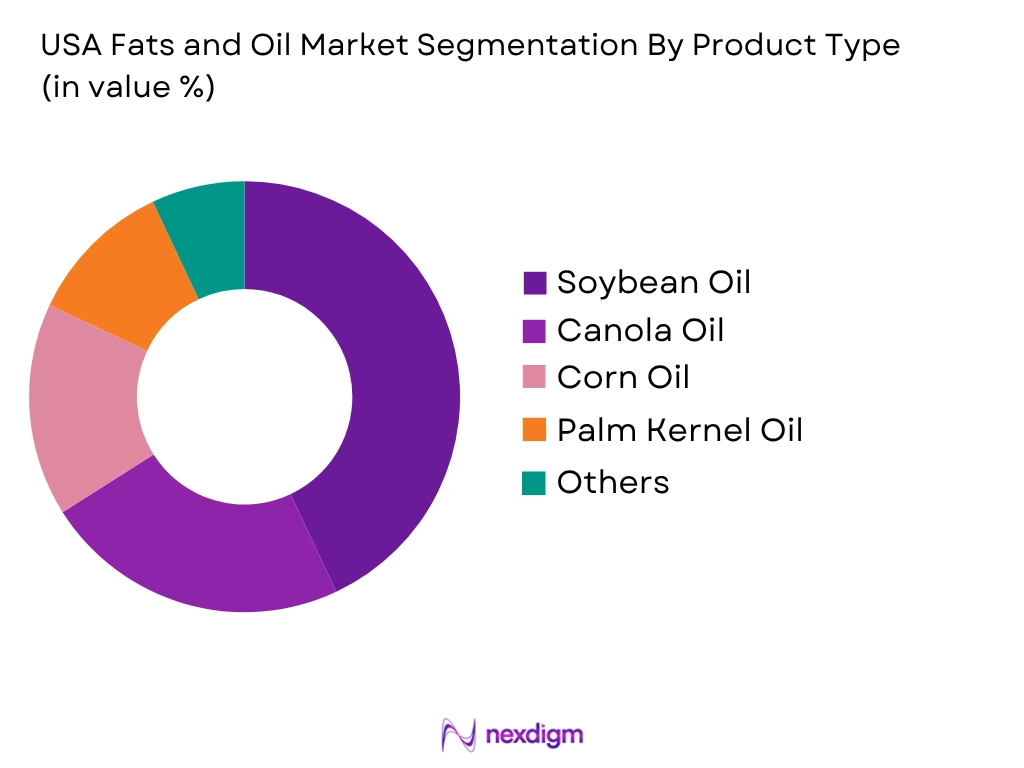
USA Fats and Oil Market is segmented by product type into soybean oil, canola oil, corn oil, sunflower oil, cottonseed oil, peanut oil, olive oil, palm oil, butter, lard, tallow, shortening, margarine and specialty fats. Recently, soybean oil has had the dominant market share under the product type segmentation due to the country’s large domestic soybean crop, integrated crushing infrastructure, extensive use in packaged foods, and increasing demand from renewable diesel and biodiesel feedstock channels. Soybean oil benefits from local availability, stable industrial scale, and strong use across foodservice frying, snacks, sauces, dressings, bakery applications, and processed foods. Imported oils such as palm oil and olive oil remain important in specific applications, but soybean oil’s domestic production base, established refinery network, and multi-industry demand make it the structural anchor of the U.S. fats and oils ecosystem.
By Application
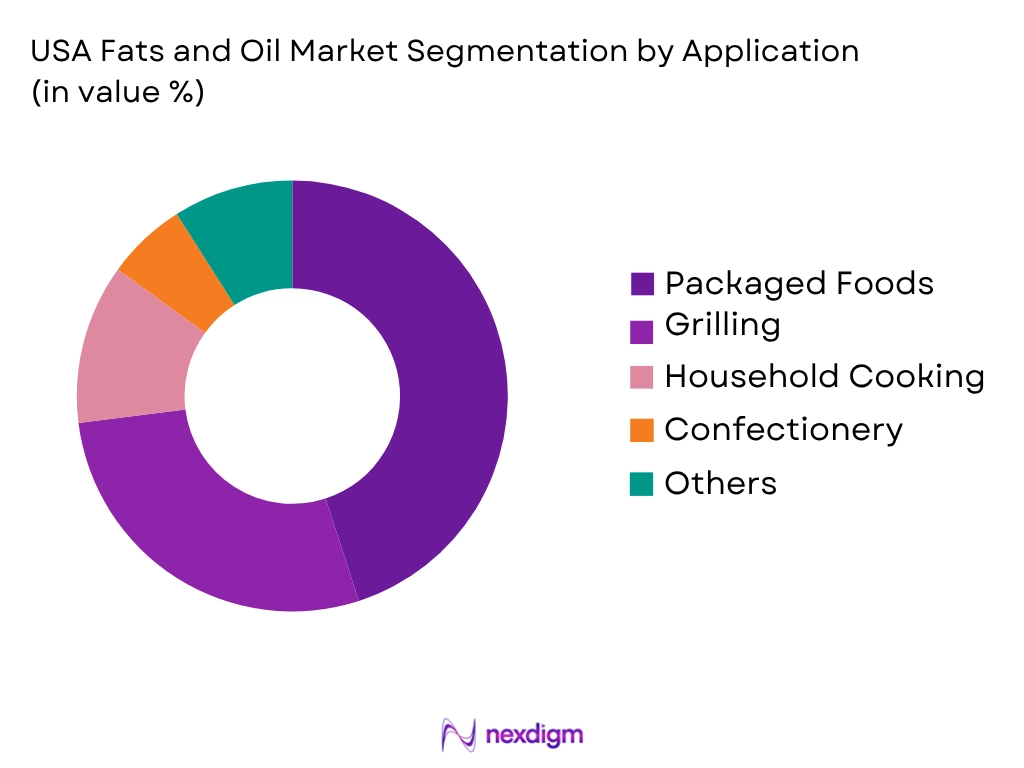
USA Fats and Oil Market is segmented by application into household cooking, foodservice frying, bakery and confectionery, snack food processing, packaged food manufacturing, meat processing, oleochemicals, animal feed, and biofuel feedstock. Recently, food processing and packaged food manufacturing have had the dominant market share under the application segmentation because oils and fats are essential functional ingredients across snacks, baked goods, dressings, frozen foods, sauces, confectionery coatings, margarine, spreads, and ready-to-eat foods. The segment benefits from high-volume industrial procurement, bulk refined oil usage, and precise performance requirements such as oxidative stability, neutral flavor, texture, melting profile, and shelf-life enhancement. Foodservice is also substantial because frying oils are used by QSR chains, restaurants, hotels, and institutional kitchens. Biofuel demand is becoming strategically important, but food manufacturing remains the broadest and most diversified consumption base.
Competitive Landscape
The USA Fats and Oil Market is dominated by integrated agribusiness companies, oilseed crushers, refiners, foodservice oil specialists, specialty fat suppliers, and animal rendering companies. Cargill, ADM, Bunge, CHS, and Richardson International hold strong positions due to crushing scale, commodity origination, refinery capabilities, food ingredient portfolios, and bulk supply relationships with food manufacturers, QSR operators, retailers, and biofuel producers. Competition is shaped by procurement strength, refinery access, logistics, sustainability compliance, private label capability, and high-oleic oil innovation.
| Company | Establishment Year | Headquarters | Core Portfolio | Processing Strength | Key End Users | Channel Strength | Sustainability Focus | Market-Specific Advantage |
| Cargill | 1865 | Minnetonka, Minnesota | ~ | ~ | ~ | ~ | ~ | ~ |
| Archer Daniels Midland Company | 1902 | Chicago, Illinois | ~ | ~ | ~ | ~ | ~ | ~ |
| Bunge | 1818 | St. Louis, Missouri | ~ | ~ | ~ | ~ | ~ | ~ |
| CHS Inc. | 1931 | Inver Grove Heights, Minnesota | ~ | ~ | ~ | ~ | ~ | ~ |
| Richardson International | 1857 | Winnipeg, Canada | ~ | ~ | ~ | ~ | ~ | ~ |
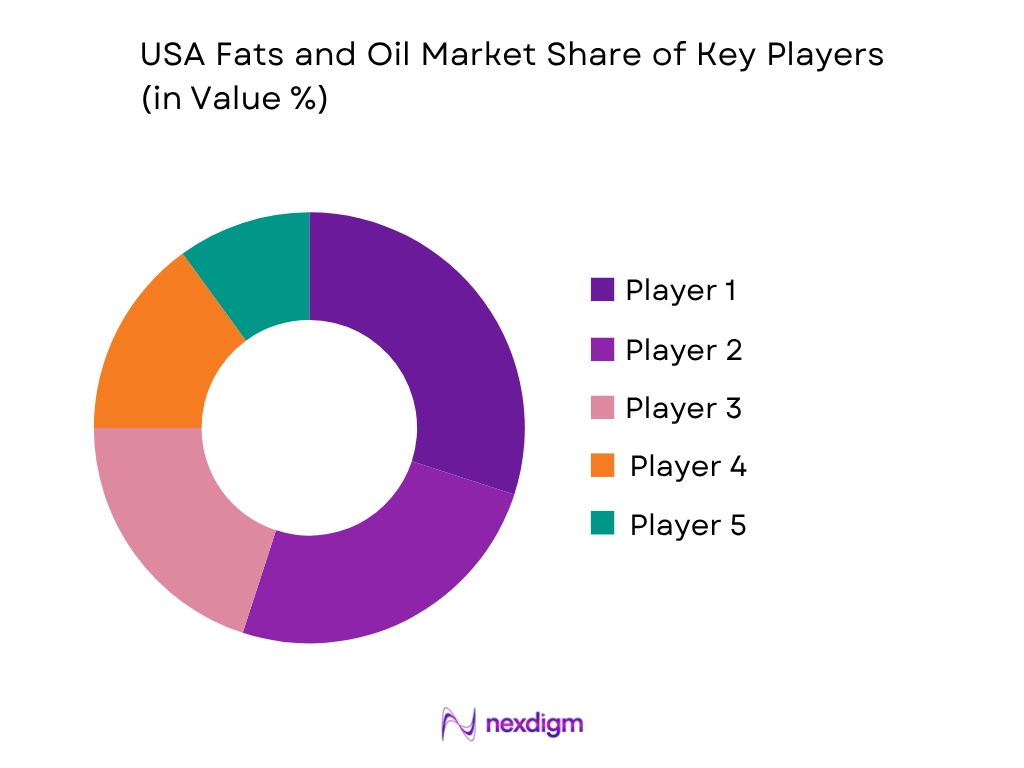
USA Fats and Oil Market Analysis
Growth Drivers
Domestic Oilseed Crushing Scale
Domestic oilseed crushing is a core growth driver for the USA Fats and Oil Market because soybean oil, canola oil and other vegetable oils are structurally linked to U.S. crop production, refining capacity and food manufacturing demand. USDA NASS recorded soybean production of 4.37 billion bushels, planted soybean area of 87.1 million acres and soybean yield of 50.7 bushels per acre, creating a large domestic base for crude and refined soybean oil supply. USDA NASS also reported 70.0 million tons of soybeans crushed for crude oil and 27.6 billion pounds of crude soybean oil production, showing direct conversion from farm output into fats and oils feedstock. The macroeconomic base supports this demand environment, with World Bank data recording U.S. GDP at USD 28.75 trillion, GDP per capita at USD 84,534.0 and total population at 341,784,857. This combination of agricultural scale, processing depth and consumer-market size supports edible oil, shortening, margarine, foodservice frying oil and packaged-food ingredient demand.
Food Processing and Biofuel Feedstock Demand
Food processing and biomass-based diesel demand are major growth drivers because fats and oils are used not only for cooking, but also for frying stability, bakery texture, spreads, sauces, dressings, snacks, confectionery coatings and renewable fuel feedstocks. USDA ERS states that U.S. soybean processors increased crush volumes to meet soybean oil demand for biomass-based diesel production and exportable soybean meal supplies. USDA’s oil crops material also notes that soybean oil use for biofuels reached 11.758 billion pounds in MY 2024/25 after 12.995 billion pounds in MY 2023/24, creating a large non-food demand channel for refined oil and related lipid feedstocks. The market is supported by a large consumption economy, with World Bank data recording U.S. GDP at USD 28.75 trillion and GDP growth at 2.2. Population scale of 341,784,857 further supports household cooking, foodservice meals and packaged-food consumption. This makes the market dependent on both traditional food demand and energy-transition-linked lipid demand.
Market Challenges
Feedstock Availability Pressure
Feedstock availability pressure is a key challenge for the USA Fats and Oil Market because the same soybean oil, tallow, canola oil, used cooking oil and distillers corn oil pools are increasingly contested by food processors, foodservice operators, exporters and biofuel producers. USDA NASS recorded soybean production falling to 4.26 billion bushels after 4.37 billion bushels, while harvested soybean area declined to 80.4 million acres after 2024. At the same time, USDA-linked reporting records soybean oil use in biofuel at 11.758 billion pounds for MY 2024/25, which competes with food, feed and industrial uses. USDA NASS also reported inedible tallow production of 3.88 billion pounds and choice white grease production of 1.25 billion pounds, making animal fat availability strategically important for renewable fuels and oleochemicals. The macro backdrop increases pressure, with World Bank data recording U.S. population at 341,784,857 and GDP per capita at USD 90,026.5. Large food demand and fuel-policy demand therefore create procurement complexity for refiners and industrial buyers.
Technical Processing and Supply Chain Complexity
Technical processing and supply-chain complexity restrain the USA Fats and Oil Market because edible oils and fats require crop origination, crushing, degumming, refining, bleaching, deodorization, hydrogenation or interesterification, bulk storage, food-grade transport, traceability and application-specific quality control. USDA NASS reported 70.0 million tons of soybeans crushed for crude oil, 27.6 billion pounds of crude soybean oil production, 2.42 million tons of canola seed crushed and 1.93 billion pounds of crude canola oil production. These volumes require consistent refinery throughput, tank capacity, rail and truck movement, food-grade handling and quality assurance across multiple product types. Monthly operations add further complexity, with NASS reporting 2.66 billion pounds of crude oil produced in December 2025 and 1.91 billion pounds of once-refined soybean oil production during the same month. The macroeconomic scale compounds logistics requirements, with World Bank data recording U.S. GDP at USD 30.77 trillion and population at 341,784,857. Large-volume edible, industrial and fuel-linked demand makes operational reliability a market-specific constraint.
Market Opportunities
High-Oleic, Refined and Specialty Oil Innovation
Technological advancement in high-oleic oils, refined oil systems and specialty fat formulations creates a future growth opportunity for the USA Fats and Oil Market because food manufacturers and foodservice buyers require oils with better oxidative stability, neutral flavor, longer fry life, clean-label suitability and consistent functionality. USDA ERS identifies soybeans as the dominant U.S. oilseed, accounting for about 90 percent of U.S. oilseed production, while USDA NASS recorded 4.37 billion bushels of soybean output and 27.6 billion pounds of crude soybean oil production. USDA NASS also recorded 1.93 billion pounds of crude canola oil production, giving refiners a broad base for high-oleic canola, soybean and blended oil solutions. Macro conditions support premium and functional food-ingredient demand, with World Bank data recording U.S. GDP per capita at USD 84,534.0 and GDP at USD 28.75 trillion. This opportunity is market specific because refiners can move beyond commodity vegetable oils into application-designed oils for QSR frying, snacks, bakery shortenings, spreads, sauces and health-positioned retail cooking oils.
Circular Feedstocks and Renewable Fuel Integration
Circular feedstocks and renewable fuel integration create a strong opportunity for the USA Fats and Oil Market because animal fats, used cooking oil, soybean oil and other lipid streams are now part of food, oleochemical and low-carbon fuel supply chains. USDA ERS notes that U.S. biofuel policies have increased demand for animal fats and processed oil imports, while NASS reported inedible tallow production of 3.88 billion pounds and choice white grease production of 1.25 billion pounds. USDA-linked data also records soybean oil use for biofuel at 11.758 billion pounds in MY 2024/25, showing a current demand base that supports collection, rendering, refining, pretreatment and traceability services. The macroeconomic environment provides scale for circular systems, with World Bank data recording U.S. GDP at USD 30.77 trillion and population at 341,784,857. This opportunity is directly relevant to refiners, renderers, restaurant oil collectors, renewable diesel producers and ingredient suppliers because lipid waste streams can be upgraded into higher-value feedstocks while supporting foodservice oil recovery and industrial sustainability objectives.
Future Outlook
The USA Fats and Oil Market is expected to expand steadily during the forecast period, supported by food processing demand, foodservice recovery, renewable diesel feedstock usage, and premiumization in specialty cooking oils. Soybean oil will remain central due to domestic crop availability and processing scale. High-oleic soybean and canola oils are expected to gain relevance in foodservice and packaged foods because of frying stability and clean-label reformulation needs. Biofuel demand will remain a major structural influence on the fats and oils supply chain. Renewable diesel and biodiesel producers are increasing competition for soybean oil, tallow, used cooking oil, corn oil, and other lipid feedstocks. This will influence procurement behavior across refiners, renderers, and industrial buyers. Food manufacturers will focus on supply security, formulation flexibility, and cost management as feedstock demand from fuel markets tightens availability.
The retail market will continue shifting toward private label oils, larger club-store packs, premium olive oil, avocado oil, organic oils, and non-GMO positioning. At the same time, consumer debate around seed oils, saturated fat, and ultra-processed foods will influence brand communication. Companies that provide traceability, healthier positioning, transparent labeling, and application-specific performance will gain advantage. Sustainability will become more important across palm oil, tallow, used cooking oil, and renewable fuel-linked feedstocks. Buyers will prioritize certified palm supply, deforestation-risk controls, low-carbon intensity inputs, and documented chain-of-custody systems. Competitive differentiation will depend on integrated sourcing, domestic processing capacity, foodservice oil management, private label flexibility, and innovation in specialty lipid systems.
Major Players
- Cargill
- Archer Daniels Midland Company
- Bunge
- CHS Inc.
- Richardson International
- AAK USA
- Fuji Oil Holdings
- Ventura Foods
- Stratas Foods
- Conagra Brands
- Associated British Foods / ACH Food Companies
- Sovena USA
- Pompeian
- Darling Ingredients
- Perdue AgriBusiness
Key Target Audience
- Edible Oil Manufacturers
- Oilseed Crushers and Refiners
- Food Processing Companies
- Foodservice and QSR Operators
- Retail Chains and Private Label Buyers
- Biofuel and Renewable Diesel Producers
- Investments and Venture Capitalist Firms
- Government and Regulatory Bodies (U.S. Department of Agriculture, U.S. Food and Drug Administration, U.S. Environmental Protection Agency, U.S. International Trade Commission)
Research Methodology
Step 1: Identification of Key Variables
The initial phase involves constructing an ecosystem map encompassing all major stakeholders within the USA Fats and Oil Market. This includes oilseed growers, crushers, refiners, renderers, importers, food manufacturers, foodservice distributors, retailers, biofuel producers, and regulatory bodies. The primary objective is to identify key variables such as product type, source type, application, channel, pricing ladder, and supply-chain structure.
Step 2: Market Analysis and Construction
In this phase, historical data is compiled and analyzed for the USA Fats and Oil Market. The assessment includes edible oil consumption, animal fat usage, foodservice demand, food manufacturing demand, biofuel feedstock usage, retail SKU availability, import exposure, and regional supply concentration. Top-down validation is supported through government and trade datasets, while bottom-up validation uses SKU mapping and channel-level checks.
Step 3: Hypothesis Validation and Expert Consultation
Market hypotheses are developed and validated through interviews with oil refiners, food ingredient suppliers, distributors, retail category managers, foodservice procurement teams, and industrial buyers. These consultations provide operational insight into supply contracts, product substitution, high-oleic oil adoption, private label demand, and biofuel-linked feedstock pressure. This step helps refine assumptions across product and application segments.
Step 4: Research Synthesis and Final Output
The final phase integrates desk research, primary interviews, trade mapping, pricing analysis, and segmentation validation into a consolidated market model. Manufacturer and distributor inputs are compared with observed retail availability, bulk channel dynamics, and industrial demand indicators. The final output provides a validated view of market size, segmentation, competitive intensity, growth outlook, and strategic implications for the USA Fats and Oil Market.

- Executive Summary
- Research Methodology (Market Definitions and Assumptions, Abbreviations, Edible Fats and Oils Classification, Vegetable Oil and Animal Fat Inclusion Criteria, Retail vs Foodservice vs Industrial Demand Mapping, Market Sizing Approach, Top-Down Analysis, Bottom-Up Analysis, Demand-Side Assessment, Supply-Side Assessment, USDA Oilseed and Fats Supply-Use Validation, Refinery Capacity Mapping, Distributor and Foodservice Channel Checks, Retail SKU Audits, Import and Export Assessment, Primary Industry Interviews, Data Triangulation, Forecasting Framework, Limitations and Future Conclusions)

- Definition and Scope
- Market Evolution and Industry Genesis
- Timeline of Major Industry Developments
- Business Cycle and Seasonal Demand Pattern
- Oilseed Crushing and Refining Value Chain Analysis
- Animal Fat Rendering Value Chain Analysis
- Supply Chain Analysis
- Domestic Production vs Import Dependency
- Foodservice, Retail and Industrial Demand Ecosystem

- Growth Drivers (High Soybean Oil Availability, Large Food Processing Base, Foodservice Frying Demand, Renewable Diesel Feedstock Demand, Private Label Cooking Oil Expansion, High-Oleic Oil Adoption, Retail Club Pack Purchases, Bakery and Snack Industry Demand)
- Market Challenges (Oilseed Price Volatility, Weather-Linked Crop Supply Risk, Import Dependence for Palm and Olive Oil, Seed Oil Health Perception Debate, Foodservice Volume Pressure, Freight and Storage Constraints, Sustainability Compliance Pressure, Biofuel and Food Demand Competition)
- Market Opportunities (High-Oleic Soybean and Canola Oil Expansion, Sustainable Palm Oil Sourcing, Used Cooking Oil Collection, Clean Label Bakery Fats, Non-GMO and Organic Cooking Oils, Premium Olive and Avocado Oil Penetration, Private Label Growth, Circular Economy Feedstock Integration)
- Market Trends (Shift Toward Unsaturated Oils, Seed Oil Label Scrutiny, Frying Oil Performance Optimization, Premiumization in Olive and Avocado Oils, Foodservice Oil Management Services, Traceability and Sustainability Claims, Reformulation Away from Partially Hydrogenated Oils, Biofuel Pull on Fats and Oils)
- SWOT Analysis
- Porter’s Five Forces Analysis
- PESTLE Analysis

- By Market Value (2020-2025)
- By Volume Consumption (2020-2025)
- By Average Selling Price (2020-2025)

- By Product Type (In Value %)
Soybean Oil
Canola Oil
Corn Oil
Sunflower Oil
Cottonseed Oil
Peanut Oil - By Source Type (In Value %)
Vegetable Oils
Animal-Based Fats
Dairy-Based Fats
Marine Oils
Blended Oils and Fats - By Application (In Value %)
Household Cooking and Retail Consumption
Foodservice Frying and Grilling
Bakery and Confectionery
Snack Food Processing
Processed and Packaged Foods
Meat Processing
Dairy and Frozen Desserts
Infant Food and Nutrition
Oleochemicals
Animal Feed
Renewable Diesel and Biofuel Feedstock - By Distribution Channel (In Value %)
Supermarkets and Hypermarkets
Club Stores and Warehouse Retailers
Mass Merchandisers
Convenience Stores
Online Retail and Direct-to-Consumer
Foodservice Distributors - By Region (In Value %)
Northeast USA
Midwest USA
South USA
West USA

- Market Share of Major Players (By Value, Volume, Product Type, Application, Channel, Source Type)
- Competitive Positioning Matrix (Oilseed Crushing Scale, Refining Capacity, Foodservice Penetration, Retail Brand Strength, Industrial Ingredient Capability, Sustainability Credentials, Biofuel Feedstock Exposure, Specialty Lipid Innovation)
- Cross Comparison Parameters (Oilseed Crushing Capacity, Refining and RBD Capability, Foodservice Frying Oil Portfolio, Private Label Manufacturing Strength, High-Oleic Oil Portfolio, Sustainable Palm and Traceability Programs, Used Cooking Oil Collection Network, Biofuel Feedstock Integration)
- SWOT Analysis of Major Players
- Detailed Profiles of Major Companies
Cargill
Archer Daniels Midland Company
Bunge
CHS Inc.
Richardson International
AAK USA
Fuji Oil Holdings
Ventura Foods
Stratas Foods
Conagra Brands
Associated British Foods / ACH Food Companies
Sovena USA
Pompeian
Darling Ingredients
Perdue AgriBusiness

- Household Consumption Behavior Assessment Foodservice Demand Assessment
- Industrial Food Manufacturer Demand Assessment
- Health and Wellness Influence on Purchase Decisions
- Purchasing Power and Trade-Down Analysis
- Product Attribute Preference Analysis

- By Market Value (2026-2035)
- By Volume Consumption (2026-2035)
- By Average Selling Price (2026-2035)


 Request a Sample
 Ask for Customization
 Get a Quote
 Enquire Now