
 Download PDF
 Download PDF
Market Overview
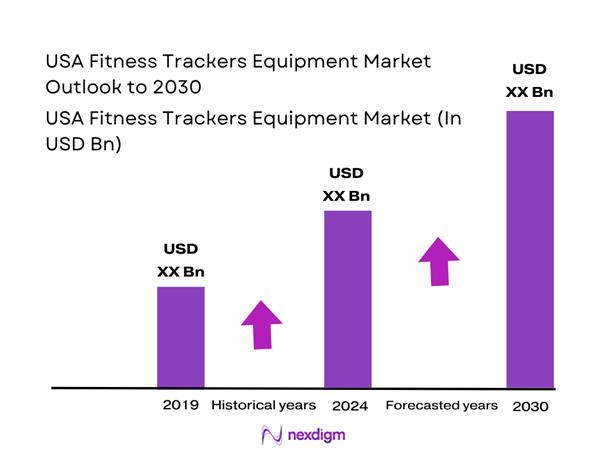
The USA fitness trackers equipment market is valued at USD ~ million, supported by strong demand for smartwatch-led health and activity tracking, deeper sensor stacks (heart rate, sleep, blood oxygen), and continuous device refresh cycles tied to platform upgrades and ecosystem lock-in. In the prior year, the market was reported at approximately USD ~ billion, indicating an acceleration in value driven by premium device mix and higher attach of paid insights across leading ecosystems.
The market is concentrated around California (Bay Area/Cupertino–San Francisco) and Washington (Seattle) due to OEM headquarters, software/data talent, and platform ecosystems that shape product roadmaps, partnerships, and distribution velocity. New York, Los Angeles, Chicago, and Austin dominate adoption through dense fitness participation, retail depth, employer wellness procurement, and higher penetration of connected consumer tech. On the supply side, the USA market is materially influenced by China/Vietnam/Taiwan (manufacturing and electronics supply chains) and South Korea/Japan (components and sensor-tech ecosystems), enabling rapid product scaling.
Market Segmentation
By Product Type
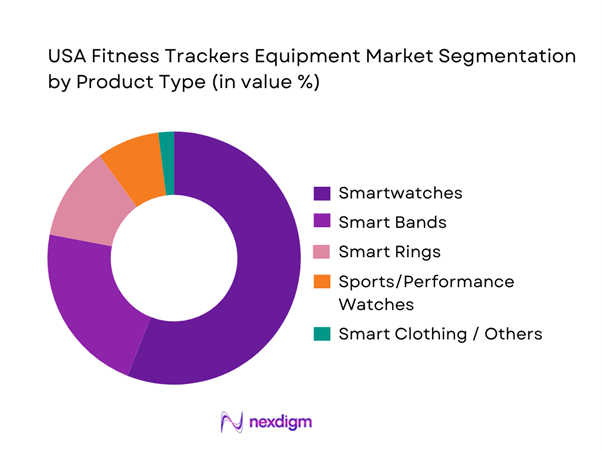
USA fitness trackers equipment market is segmented by product type into smartwatches, smart bands, smart rings, sports/performance watches, and smart clothing/others. Recently, smartwatches hold the dominant market share in the USA due to their role as the primary “all-day” wearable—combining fitness tracking with notifications, payments, safety features, and expanding health capabilities. Their dominance is reinforced by ecosystem integration (apps, cloud analytics, and device pairing), recurring upgrade cycles, and strong retail/online merchandising. US fitness tracker outlook identifies smartwatches as the largest segment and reports a majority revenue share for this category, reflecting premium pricing and broad consumer adoption.
By Distribution Channel
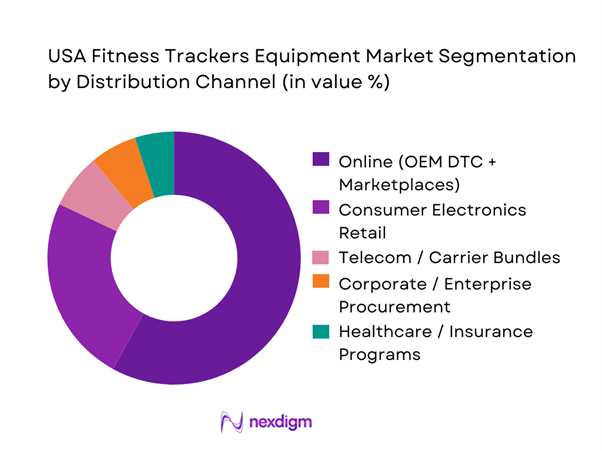
USA fitness trackers equipment market is segmented by distribution channel into online (brand DTC + marketplaces), consumer electronics retail, telecom/carrier bundles, corporate/enterprise procurement, and healthcare/insurance-linked programs. Recently, online channels dominate due to aggressive OEM DTC strategies, fast SKU discovery, subscription bundling at checkout, and marketplace-driven demand capture during peak promotion cycles. Online also supports faster model launches and versioning (colorways, band bundles, limited editions), and enables ecosystem cross-sell (phones, earbuds, services). Broader fitness tracker industry reporting consistently points to online as the leading route-to-market, and this pattern remains structurally strong in the USA given its mature e-commerce infrastructure and consumer comfort with connected device purchases.
Competitive Landscape
The USA fitness trackers equipment market is dominated by a concentrated set of ecosystem-led players, where device differentiation is driven by OS/platform stickiness, sensor credibility, app intelligence, and distribution control. Smartwatches form the core revenue engine in the USA market, with competition expanding into rings and specialized performance wearables as consumers seek higher comfort, passive monitoring, and specialized insights. Market forecasts show a strong growth runway, intensifying rivalry across hardware upgrades, subscriptions, and health/enterprise partnerships.
| Company | Established | Headquarters | Primary Form Factors | Ecosystem / App Strength | Health & Sensor Depth | Subscription / Services Model | USA Channel Strength | Differentiation Lever |
| Apple | 1976 | Cupertino, CA, USA | ~ | ~ | ~ | ~ | ~ | ~ |
| Google (Fitbit) | 1999 | Mountain View, CA, USA | ~ | ~ | ~ | ~ | ~ | ~ |
| Garmin | 1989 | Olathe, KS, USA | ~ | ~ | ~ | ~ | ~ | ~ |
| Samsung | 1938 | Suwon, South Korea | ~ | ~ | ~ | ~ | ~ | ~ |
| Oura | 2013 | San Francisco, CA, USA | ~ | ~ | ~ | ~ | ~ | ~ |
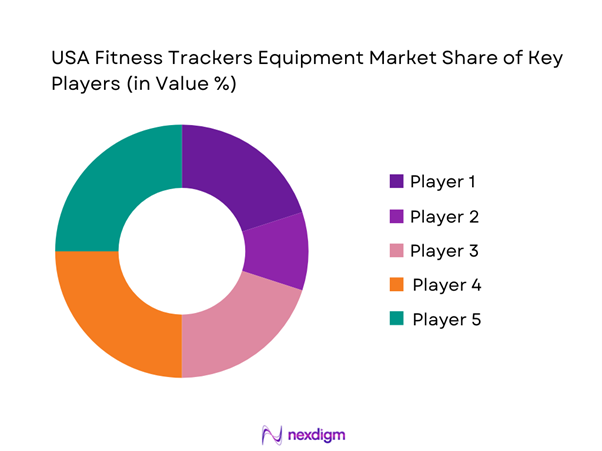
USA Fitness Trackers Equipment Market Analysis
Growth Drivers
Health Data Adoption
The U.S. fitness trackers equipment market is being pulled forward by a healthcare system that is forced to manage large, measurable chronic-disease burdens—conditions where continuous biometrics (heart rate, activity, sleep, SpO₂, ECG features, glucose-adjacent behaviors) are operationally useful. The CDC reports ~ people of all ages in the U.S. had diabetes (with ~ adults), and ~ adults met lab criteria but were undiagnosed—creating a large addressable base for tracking-led engagement and earlier intervention workflows. Separately, CDC reports coronary heart disease killed ~ people, underscoring why cardiometabolic monitoring remains a primary device value proposition. Macro conditions matter because the U.S. can sustain large-scale consumer + employer spending on connected devices: U.S. GDP is reported at ~ (billions of dollars, annual), and GDP per capita is ~ (current U.S. dollars, annual), keeping the market structurally supported by high aggregate output and per-person purchasing power. Together, these “need + ability to pay + measurable outcomes” dynamics are what turns fitness trackers from lifestyle gadgets into recurring-use equipment embedded in daily routines, wellness programs, and clinical pathways.
Consumer Spend Elasticity
Fitness trackers equipment demand in the U.S. is strongly linked to how resilient household consumption is during shifting inflation/interest-rate conditions—because upgrades, ecosystem switching, and multi-device ownership (watch + ring + scale + strap) behave like discretionary tech spend, but are increasingly justified as “health utility.” The U.S. macro base remains large enough to absorb this discretionary-to-semi-essential transition: annual U.S. GDP is ~ (billions of dollars), which translates into a deep consumer market for connected hardware categories that sit adjacent to smartphones and subscription services. At the same time, the health motivation is not abstract—it is tied to large population-level disease burdens that keep consumers engaged even when budgets tighten. For example, the CDC’s diabetes count of ~ people creates a sustained demand backdrop for activity and weight-management tracking behaviors, while cardiometabolic risk keeps “always-on” sensors relevant. The key point for business buyers is that elasticity is increasingly buffered by institutional channels: the U.S. insurance ecosystem is enormous, and Medicare Advantage alone enrolled ~ people, indicating a very large payer-managed population where device-enabled prevention and monitoring programs can be designed, tested, and scaled (even when consumer upgrade cycles slow).
Challenges
Data Accuracy Scrutiny
Fitness trackers equipment in the U.S. faces a credibility hurdle: as devices move from “wellness feedback” to decision-support in healthcare-adjacent settings, accuracy becomes a reputational and compliance issue rather than a marketing claim. The scrutiny is intensified by the fact that U.S. health outcomes are high-stakes and heavily measured; for instance, the CDC reports coronary heart disease killed ~ people—so consumers, employers, and clinicians are less tolerant of false reassurance or noisy alerts in heart-related metrics. Large chronic disease counts, such as ~ people with diabetes, also create pressure for reliable trend tracking because users may make real behavior or care decisions based on what the device reports. At a system level, the U.S. is able to apply this scrutiny because of its scale and resources (GDP ~ in billions; GDP per capita ~), which supports a large regulatory, clinical, and consumer-protection environment that demands defensible performance. In practical market terms, this challenge shows up as higher validation costs, higher returns and complaints sensitivity when readings drift, and greater demand for transparency around sensor limitations (skin tone, motion artifacts, placement, arrhythmia edge cases, and device fit).
Privacy Compliance
Privacy compliance is a core friction point in the U.S. fitness trackers equipment market because devices generate personally identifiable, health-adjacent datasets that can trigger overlapping regulatory expectations (consumer protection, health privacy, state privacy laws, security requirements, and contractual controls for enterprise programs). The U.S. environment is particularly sensitive because healthcare cyber incidents are massive and highly visible; breach impact was reported at about ~ affected individuals, illustrating how high the perceived downside is when sensitive health-linked data is exposed. At the same time, the FTC has explicitly clarified and updated the Health Breach Notification Rule to cover modern health apps and connected-device ecosystems, raising operational expectations for vendors and service providers in the connected health stack. These pressures matter directly for wearables brands and their partners: privacy-by-design, data minimization, encryption, breach response readiness, and vendor risk management become prerequisites to win employer and payer programs. Macro context reinforces why this compliance load is “baked into” U.S. go-to-market: with GDP ~ (billions) and GDP per capita ~, the U.S. market supports both large-scale deployment and large-scale enforcement and litigation risk, so compliance failures are more costly and reputationally damaging.
Opportunities
Clinical-Grade Wearables
The biggest growth opportunity in the U.S. fitness trackers equipment market is the migration of consumer wearables into clinical-grade and care-adjacent use cases—without relying on future projections, the current health burden already supports this expansion. Reported coronary heart disease deaths of ~ and ~ people living with diabetes show why continuous monitoring, risk stratification, and adherence-support features can be valuable at scale today. The opportunity is amplified by U.S. infrastructure capacity: reports indicate ~ fixed connections at least ~ Mbps and ~ fixed connections between ~ Mbps and ~ Mbps, which supports dependable syncing, remote clinician review workflows, and integration into telehealth experiences where higher data reliability reduces operational friction. Macro conditions matter because clinical-grade expansion requires sustained investment in validation, regulatory strategy, and enterprise sales—more feasible in a market with GDP ~ (billions) and GDP per capita ~. Commercially, this opportunity is less about selling “a watch” and more about selling an equipment-enabled pathway: device + app + analytics + alerts + clinician dashboard integration + privacy controls, targeted at cardiometabolic management, post-acute recovery, and early deterioration detection.
Employer and Payer Programs
Employer and payer programs represent a structurally scalable opportunity in the U.S. because large covered populations can be reached through benefits design rather than pure retail acquisition. A concrete indicator of payer-channel scale is Medicare Advantage enrollment: ~ people are enrolled, and the eligible Medicare population referenced is ~ beneficiaries with Parts A and B—creating a massive base where prevention, engagement, and monitoring programs can be operationalized through plan incentives, care management, and provider networks. This matters for fitness trackers equipment because devices can be deployed as “program infrastructure” (onboarding, adherence nudges, rewards, risk identification), not just consumer electronics. The opportunity is backed by the U.S.’s macro capacity to fund and manage large benefits ecosystems (GDP ~ in billions; GDP per capita ~), and by the country’s connectivity depth (~ mobile connections; ~ fixed connections), which reduces program friction for syncing, digital coaching, and reporting. Importantly, this is a “current-stats-backed” opportunity: high chronic disease counts—like ~ people with diabetes—mean employers and payers can justify device programs around measurable outcomes (activity, weight, sleep, vitals trends) and member engagement without needing speculative future assumptions..
Future Outlook
Over the next ~ years, the USA fitness trackers equipment market is expected to expand steadily, supported by premium device refresh cycles, rising adoption of passive health monitoring, and deeper convergence of wearables with digital health programs. Smartwatches will remain the revenue anchor, while rings and specialized performance devices will gain momentum as consumers seek comfort-first form factors and recovery-focused insights. The market’s growth trajectory is reinforced by strong forecasted expansion in total revenue, implying continued opportunity for ecosystem players, component innovators, and channel partners.
Major Players
- Apple
- Garmin
- Samsung Electronics
- Xiaomi
- Huawei
- Amazfit
- Oura
- WHOOP
- Withings
- Polar Electro
- Suunto
- COROS
- Fossil Group
Key Target Audience
- Wearable OEMs and device brands
- Consumer electronics retailers and e-commerce marketplaces
- Telecom operators and device bundle partners
- Digital health platforms and chronic care program operators
- Health insurers and payer innovation teams
- Employer benefits and corporate wellness procurement teams
- Investments and venture capitalist firms
- Government and regulatory bodies
Research Methodology
Step 1: Identification of Key Variables
We map the USA fitness trackers ecosystem across OEMs, platforms, retailers, carriers, employers, and payer-linked programs. Desk research is supported by credible secondary sources and industry databases to identify the variables that shape demand: form factor mix, ASPs, refresh cycles, and platform lock-in.
Step 2: Market Analysis and Construction
We compile historical market values and shipment signals, then model revenue using category mix and channel structure. The model is constructed using triangulation of reported market totals, segment anchors (e.g., smartwatch dominance), and distribution-channel behavior typical to the USA.
Step 3: Hypothesis Validation and Expert Consultation
We validate hypotheses through structured expert interviews with OEM and channel managers, retailer category teams, and ecosystem partners. These consultations test adoption drivers, price and mix shifts, and subscription attach assumptions, improving the reliability of segment splits.
Step 4: Research Synthesis and Final Output
We synthesize findings into a final market model, validate with cross-source reconciliation, and apply scenario checks around platform policy changes, sensor and regulatory shifts, and channel pricing dynamics. Outputs are delivered as market sizing, segmentation, and strategic implications.

- Executive Summary
- Research Methodology (Market Definitions and Assumptions, Industry Taxonomy and Device Classification, Wearable vs Medical Boundary Framework, Market Sizing Logic, Top-Down Demand Mapping, Bottom-Up Installed Base Assessment, Primary Interviews with OEMs Platforms Insurers and Employers, Data Triangulation, Limitations and Forward-Looking Assumptions)

- Definition and Scope
- Market Evolution and Technology Inflection
- Timeline of Wearable Technology Commercialization
- Industry Business Cycle Characteristics
- USA Wearables Supply Chain and Value Chain Analysis

- Growth Drivers
Health Data Adoption
Consumer Spend Elasticity
Platform Expansion - Challenges
Data Accuracy Scrutiny
Privacy Compliance
Hardware Saturation - Opportunities
Clinical-Grade Wearables
Employer and Payer Programs - Trends
AI Coaching
Passive Monitoring
Battery Innovation - Regulatory & Policy Landscape
- SWOT Analysis
- Stakeholder & Ecosystem Analysis
- Porter’s Five Forces Analysis
- Competitive Intensity & Ecosystem Mapping

- By Value, 2019–2024
- By Unit Shipments, 2019–2024
- Installed Base and Active Device Parc, 2019–2024
- ASP Realization and Device Mix Impact, 2019–2024

- By Fleet Type (in Value %)
Smart Bands
Smartwatches with Fitness Core
Advanced Sports Watches
Smart Rings
Clip-on and Niche Wearables - By Application (in Value %)
Heart Rate and HRV
SpO₂ and Respiratory Metrics
ECG and Cardiac Screening
Sleep Staging and Recovery Metrics
Temperature and Stress Indicators - By Technology Architecture (in Value %)
iOS-Centric Devices
Android-Centric Devices
Proprietary OS Ecosystems - By End-Use Industry (in Value %)
Consumer Wellness Users
Fitness Enthusiasts and Athletes
Enterprise and Employer Wellness Programs
Healthcare-Linked Users
Insurance-Affiliated Users - By Region (in Value %)
Northeast
Midwest
South
West

- Competitive Positioning by Installed Base and Active Users
- Cross Comparison Parameters (Device Portfolio Breadth, Sensor Accuracy and Validation, Platform Ecosystem Strength, Subscription Revenue Dependence, Enterprise and Payer Penetration, Data Privacy and Compliance Readiness, Hardware Upgrade Velocity, USA Distribution and Channel Control)
- Strategic SWOT Assessment of Key Players
- Pricing and SKU Architecture Analysis
- Detailed Company Profiles
Apple
Fitbit
Garmin
Samsung Electronics
Xiaomi
Huawei
Polar Electro
WHOOP
Oura Health
Amazfit
Withings
Suunto
COROS
Mobvoi

- Usage Behavior and Engagement Depth
- Willingness to Pay and Upgrade Cycles
- Data Trust Accuracy Perception and Compliance Sensitivity
- Pain Points Across Consumer Enterprise and Clinical Users
- Decision-Making Dynamics and Influencer Mapping

- By Value, 2025–2030
- By Unit Shipments, 2025–2030
- Installed Base and Active Device Parc, 2025–2030
- ASP Realization and Device Mix Impact, 2025–2030


 Request a Sample
 Ask for Customization
 Get a Quote
 Enquire Now