

 Download PDF
Market Overview
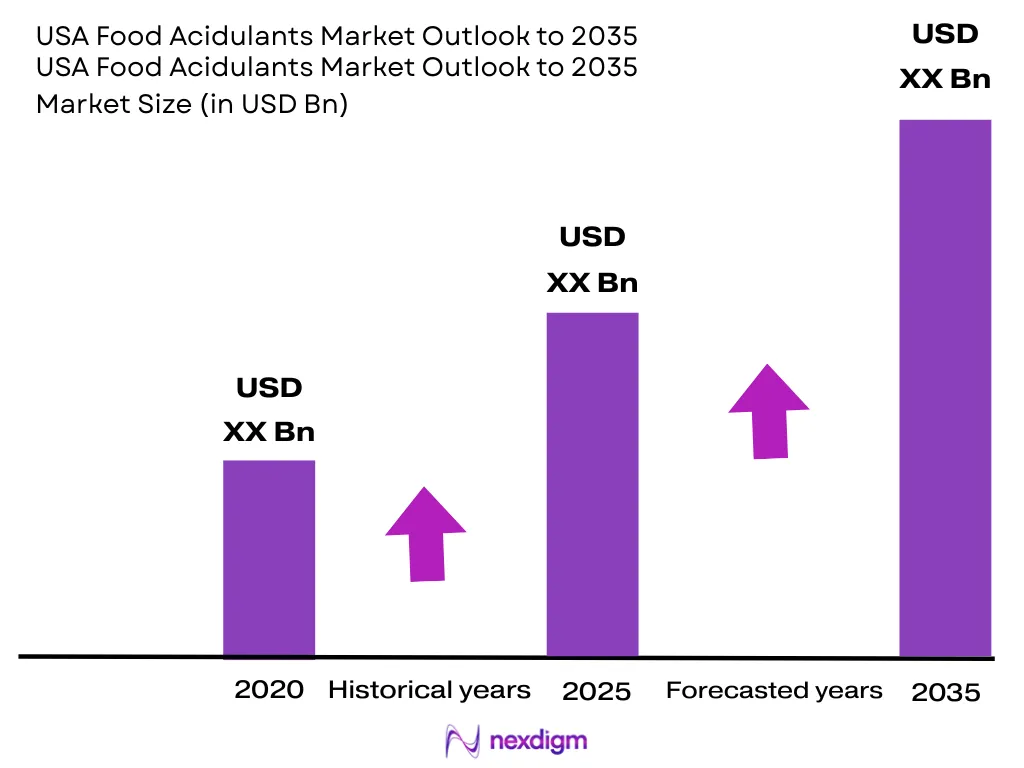
The USA food acidulants market was valued at approximately USD 1.94 billion in 2024 and is projected to expand at a CAGR of ~% during the 2026–2035 forecast period, according to industry data. The United States represents the world’s largest national food acidulants market, accounting for approximately 29.68% of total global food acidulant consumption, underpinned by one of the world’s most sophisticated food and beverage processing industries. According to the U.S. Bureau of Economic Analysis (BEA) and the U.S. Department of Agriculture (USDA), the American food processing and manufacturing sector generates revenues exceeding USD 900 billion annually, with food ingredients including acidulants forming an indispensable component of industrial food formulation. The U.S. Food and Drug Administration (FDA) regulates acidulants under its Generally Recognized as Safe (GRAS) framework and the Food Safety Modernization Act (FSMA), creating a rigorous compliance environment that shapes ingredient procurement, formulation standards, and supply chain management across the food and beverage industry. Growth is driven by rising consumer demand for processed and convenience foods, rapid expansion of functional and energy beverages, increasing preference for natural and clean-label acidulant formulations, and continuous investment in fermentation technology and sustainable ingredient production.
Market Segmentation
By Acidulant Type
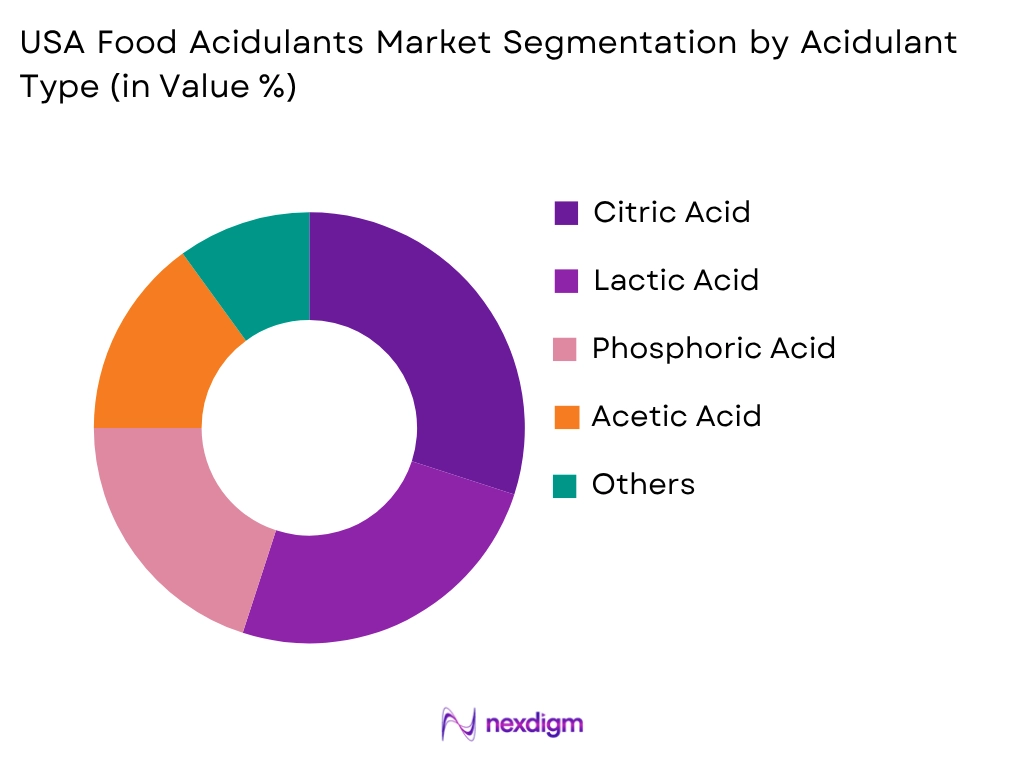
Citric acid dominates the USA food acidulants market, accounting for approximately 35% to 45% of total market value, owing to its exceptional versatility, multifunctional performance, and widespread acceptance across virtually all food and beverage categories. The FDA recognizes citric acid as GRAS, enabling its broad application as a flavor enhancer, pH regulator, chelating agent, preservative, and antioxidant synergist across carbonated beverages, fruit juices, dairy products, confectionery, bakery items, canned foods, and processed meats. All major ingredient companies, including Cargill, ADM, and Tate & Lyle, supply citric acid to the U.S. market, primarily sourcing through fermentation of glucose or corn dextrose. However, the U.S. market faces significant competitive pressure from China-based citric acid producers, which maintain considerable cost advantages in commodity citric acid grades. Malic acid is forecast to deliver the fastest growth among acidulant types through 2035, driven by rising demand in functional snacks, sugar-reduced beverages, and craft food and beverage applications where its distinctive sharp flavor profile provides desirable sensory differentiation. Lactic acid maintains a strong position in the dairy, fermented food, plant-based meat, and bakery segments, with fermentation-derived lactic acid increasingly preferred for its clean-label and organic credentials. Phosphoric acid retains significant share in the carbonated soft drink segment, though its use is gradually being supplanted by citric and malic acid in premium and clean-label beverage reformulations driven by health-conscious consumer demand.
By Application
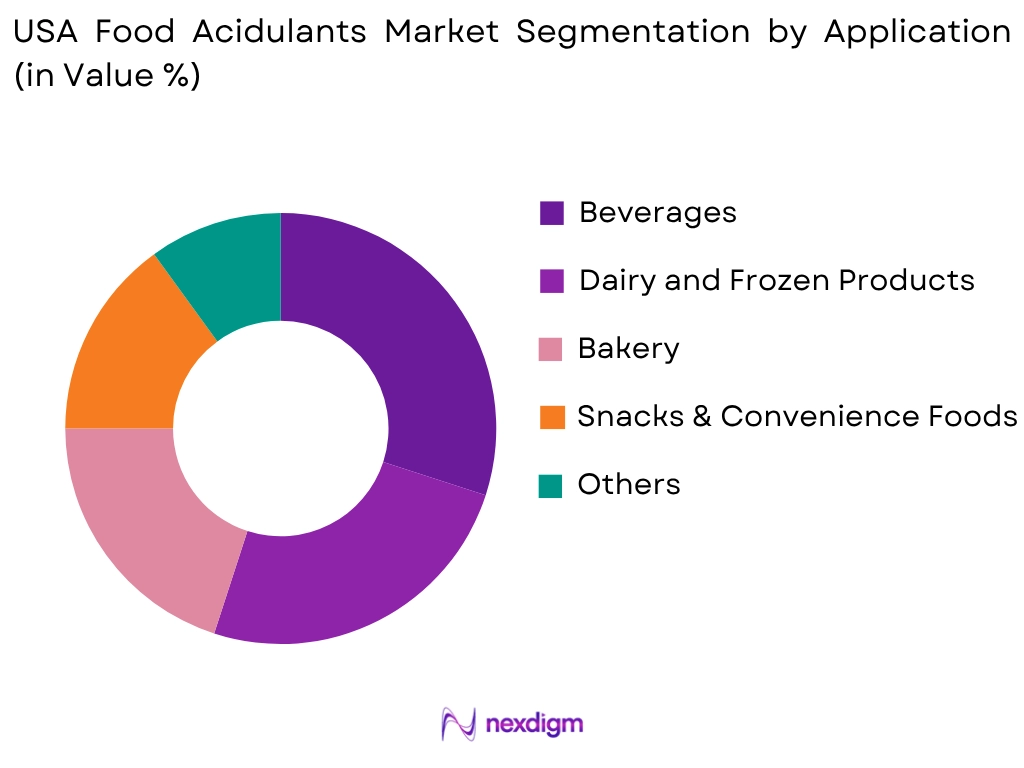
Beverages represent the dominant application segment in the USA food acidulants market, accounting for approximately 42% of total acidulant consumption by value, driven by the extensive use of acidulants in carbonated soft drinks, fruit juices, energy drinks, sports hydration products, flavored waters, and ready-to-drink functional beverages. According to the American Beverage Association, the U.S. beverage industry is among the world’s largest, with more than 4,500 beverage manufacturers utilizing acidulants for pH regulation, flavor balance, preservation, and antimicrobial action across product portfolios. The growing popularity of energy drinks, sparkling waters, and functional probiotic beverages is further expanding acidulant demand into premium and specialty beverage segments. The dairy and frozen products segment represents the second major application category, with lactic acid extensively used in yogurt, cheese, sour cream, and fermented dairy production, while citric acid finds application in flavored milks, ice cream stabilization, and frozen dessert formulations. The bakery segment relies significantly on acidulants for leavening activation, pH modification, mold inhibition, and shelf-life extension across bread, rolls, cakes, cookies, and pastry products. Meat processing represents a further important application, with acidulants used to control pH, inhibit pathogen growth, extend shelf life, and maintain colour stability in processed, cured, and ready-to-eat meat products manufactured in compliance with USDA Food Safety and Inspection Service (FSIS) standards.
Competitive Landscape
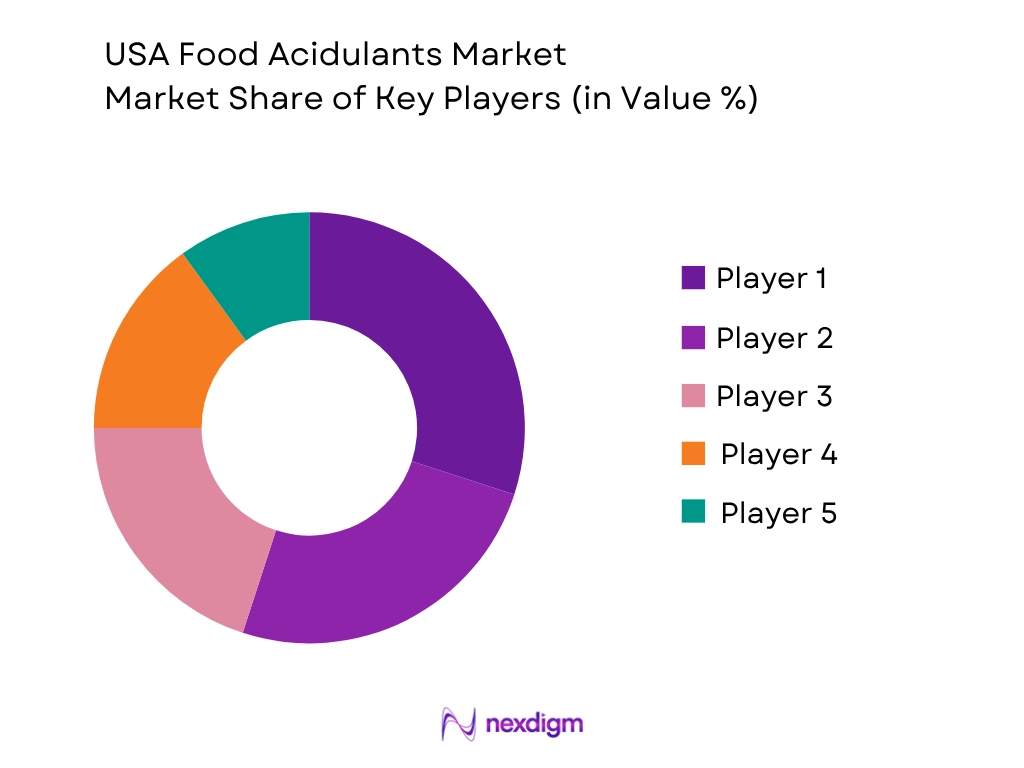
The USA food acidulants market is highly competitive, with major multinational ingredient corporations dominating market share alongside specialized distributors and regional suppliers. Global companies such as Cargill, ADM, Tate & Lyle, Corbion, and Jungbunzlauer compete through comprehensive acidulant portfolios, advanced fermentation and processing technologies, strong regulatory compliance capabilities, and extensive distribution infrastructure across the United States. The market faces significant pricing competition from China-based citric acid producers in commodity segments, compelling domestic suppliers to differentiate through product quality, clean-label credentials, non-GMO certification, technical application support, and customer co-development services. Continuous investments in sustainable fermentation technologies, GRAS documentation, FSMA compliance, and specialty acidulant innovation remain key competitive differentiators across the U.S. food ingredient supply chain.
| Company | Establishment Year | Headquarters | Primary Fat Acidulant Portfolio | Key Application Industries
|
Manufacturing Presence | R&D Capability | Distribution Network | Clean Label Solutions |
| Cargill, Incorporated | 1865 | ~ | ~ | ~ | ~ | ~ | ~ | ~ |
| Tate & Lyle Brasil | 1921 | ~ | ~ | ~ | ~ | ~ | ~ | ~ |
| Archer Daniels Midland (ADM) | 1902 | ~ | ~ | ~ | ~ | ~ | ~ | ~ |
| Corbion NV | 1919 | ~ | ~ | ~ | ~ | ~ | ~ | ~ |
| Jungbunzlauer Suisse AG | 1867 | ~ | ~ | ~ | ~ | ~ | ~ | ~ |
USA Confectionary Market Analysis
Growth Drivers
Expansion of the Processed Food Sector and FSMA-Driven Compliance Demand
The continued expansion of the United States processed and convenience food sector represents the most fundamental structural growth driver for the food acidulants market. According to the USDA Economic Research Service (ERS), American consumer spending on food processed away from home and at home continues to grow, with processed food categories including packaged snacks, ready-to-eat meals, shelf-stable products, and convenience beverages representing the majority of household food expenditure. The U.S. Bureau of Economic Analysis estimates the American food manufacturing industry generates annual revenues exceeding USD 900 billion, providing a vast and diverse industrial base for acidulant consumption across production facilities in the Midwest, South, and Northeast regions. The FDA’s Food Safety Modernization Act (FSMA), enacted to shift the focus of U.S. food safety policy from reactive responses to preventive contamination control, has significantly increased demand for FDA-approved acidulants used as antimicrobial agents, pH regulators, and preservation systems in processed foods. Compliance with FSMA Preventive Controls for Human Food rules requires food manufacturers to implement hazard analysis and risk-based preventive controls, with acidulants representing a key tool for controlling pathogenic microorganism growth and maintaining product safety across multiple food categories. Additionally, the U.S. government allocated USD 100 million in 2024 to support research into sustainable food preservation methods, including development of innovative acidulant formulations, further reinforcing institutional support for the sector’s growth.
Clean-Label Consumer Demand and Natural Acidulant Adoption
The accelerating shift toward clean-label, natural, and non-GMO food and beverage formulations is reshaping the U.S. food acidulants market and creating significant premium growth opportunities for naturally derived and fermentation-produced acidulant products. American consumers have become increasingly health-conscious and skeptical of synthetic food additives, with consumer research indicating growing preference for food products containing recognizable, minimally processed, and naturally sourced ingredients. The FDA’s December 2024 revision of the definition of ‘healthy’ for food labeling, the first such update since 1994, further intensifies the pressure on food and beverage manufacturers to reformulate products using ingredients that align with updated dietary guidelines and consumer wellness expectations. According to market data, natural acidulant sales in the USA have increased by approximately 18,000 metric tons compared to the prior year period, reflecting the scale of the clean-label reformulation trend across the food and beverage industry. Patent filings for innovative acidulant formulations by leading companies including Tate & Lyle and Cargill increased by approximately 45% since 2020, demonstrating the commercial momentum behind acidulant innovation. The growth of the organic food segment, craft beverage sector, and plant-based food category further amplifies demand for organic-certified, non-GMO, and fermentation-derived acidulants that meet the label transparency requirements of premium consumer product brands. Companies investing in organic certification, GRAS documentation for novel natural acidulants, and consumer-facing clean-label communication are well positioned to capture premium market growth across the USA’s evolving food ingredient landscape.
Market Challenges
Import Competition from Chinese Citric Acid Producers and Pricing Pressure
One of the most significant structural challenges facing the USA food acidulants market is intense pricing competition from China-based citric acid manufacturers, who maintain substantial cost advantages in commodity citric acid production due to lower labor costs, abundant feedstock availability, and significant domestic manufacturing scale. China is the world’s leading citric acid producer, accounting for a dominant share of global production capacity, and Chinese exporters have consistently maintained competitive pricing positions in the U.S. import market, creating margin pressure for domestic and other international suppliers competing in the commodity citric acid segment. According to the U.S. International Trade Commission (USITC), citric acid imports from China have historically been subject to antidumping duty investigations, reflecting the scale of the pricing challenge for domestic producers. The presence of numerous other international suppliers from Europe and Asia further intensifies competitive pricing dynamics across the U.S. food acidulant market, particularly in commodity segments serving high-volume food and beverage manufacturers. This competitive environment compels domestic acidulant producers to differentiate through quality assurance, non-GMO certification, clean-label credentials, supply chain transparency, regulatory compliance expertise, and value-added application development services that commodity importers are unable to match. Companies are also investing in cost optimization, production efficiency improvements, and sustainable manufacturing practices to maintain competitiveness against low-cost international suppliers while meeting the more demanding quality and regulatory requirements of U.S. food manufacturers.
Consumer Skepticism About Food Additives and Regulatory Complexity
Despite the well-established safety profiles and functional benefits of food acidulants under FDA GRAS designations, significant consumer skepticism regarding food additives continues to represent a structural challenge for market participants operating in the U.S. food acidulants sector. Consumer research published in 2024 indicated that approximately 40% of U.S. consumers express skepticism about the inclusion of acidulants and other food additives in products, reflecting the broader consumer movement toward whole foods, minimal processing, and ingredient transparency that is reshaping the American food industry. This skepticism creates formulation complexity for food manufacturers navigating the tension between cost-effective acidulant utilization and clean-label positioning requirements demanded by retail partners and end consumers. Simultaneously, the FDA’s comprehensive food additive regulatory framework, which includes GRAS notifications, food additive petitions, prescribed maximum usage levels, and application-specific authorizations, creates ongoing compliance costs and documentation requirements for acidulant producers and food manufacturers alike. The FDA’s evolving nutritional labeling framework and proposed front-of-pack labeling guidance further increase formulation complexity for food manufacturers managing the downstream implications of acidulant usage on product label claims. Companies must invest in regulatory affairs expertise, consumer education initiatives, and transparent ingredient communication to maintain consumer confidence while meeting the FDA’s evolving compliance standards.
Market Opportunities
Malic Acid and Specialty Acidulant Growth in Functional and Premium Applications
Malic acid represents one of the most significant growth opportunities within the USA food acidulants market, with market data indicating it is forecast to deliver the fastest growth among all acidulant types through 2035. Malic acid’s distinctive sharp, lingering tartness profile differentiates it from citric acid’s brighter, shorter acidity, making it increasingly preferred in functional snack applications, sugar-reduced confectionery, craft beverages, and premium fruit-flavored products where sensory differentiation is a key competitive advantage. The rapid growth of sour candy, kettle-cooked chips, functional gummies, sparkling water, hard seltzer, and craft beverage categories has created expanding commercial demand for malic acid as manufacturers seek to deliver intense, complex flavor profiles that align with consumer demand for bold taste experiences. In January 2024, Tate & Lyle introduced a new malic acid-based formulation specifically designed for fruit-flavored snacks and beverages, signaling commercial recognition of the ingredient’s growth potential in these segments. The expansion of reduced-sugar beverage formulations further amplifies malic acid demand, as manufacturers rely on its pronounced acidity to compensate for reduced sweetness from lower sugar or high-intensity sweetener reformulations. Tartaric acid, fumaric acid, and specialty organic acid blends similarly offer premium differentiation opportunities in wine production, craft brewing, functional beverage formulation, and premium bakery applications where cost-in-use efficiency and sensory performance are primary selection criteria for ingredient procurement teams.
Plant-Based Food Expansion and Fermentation Technology Investment
The rapid growth of the U.S. plant-based food and alternative protein market is creating significant new acidulant demand opportunities across multiple application categories. According to the Good Food Institute, the United States remains the world’s largest market for plant-based food products, with consumers increasingly adopting flexitarian, vegan, and plant-forward dietary patterns that drive demand for innovative plant-based meat analogues, dairy alternatives, and fermented protein products that rely on acidulants for pH control, flavor optimization, preservation, and texture management. Lactic acid, citric acid, and acetic acid play critical functional roles in plant-based meat formulation, helping manufacturers achieve the desired pH range, antimicrobial safety margins, and flavour profiles that replicate conventional animal protein products. The expansion of probiotic and fermented food categories also creates growing demand for fermentation-derived lactic acid, which aligns with consumer preference for naturally occurring acids produced through biological processes rather than synthetic chemistry. Investment in advanced fermentation technologies by companies including ADM and Corbion is improving the production efficiency, cost competitiveness, and sustainability profile of bio-based acidulants. In 2023, ADM partnered with a biotechnology firm to develop advanced fermentation techniques for more efficient and sustainable acidulant production, with new products expected to enhance the company’s competitive position in the clean-label ingredient segment. These investments reinforce the long-term commercial opportunity for fermentation-derived acidulants as the U.S. food industry continues transitioning toward more sustainable, bio-based ingredient supply chains.
Future Outlook
The USA food acidulants market is expected to maintain steady long-term growth throughout the forecast period, supported by continued expansion of the processed food and beverage industry, increasing consumer demand for natural and clean-label ingredient formulations, and growing application of acidulants across functional, plant-based, and premium food categories. Manufacturers are increasingly investing in fermentation technology, sustainable feedstock sourcing, non-GMO certification, and specialty acidulant innovation to meet the evolving requirements of U.S. food manufacturers and consumers. The continued growth of functional beverages, premium snacks, reduced-sugar reformulation, and plant-based food categories is expected to drive expanding demand for malic, tartaric, lactic, and fermentation-derived citric acid products. Ongoing compliance with FDA FSMA, GRAS documentation requirements, and evolving nutritional labeling standards will further shape competitive positioning and investment priorities across the U.S. food acidulants supply chain.
Major Players
- Cargill, Incorporated
- Archer Daniels Midland Company (ADM)
- Tate & Lyle PLC
- Corbion NV
- Jungbunzlauer Suisse AG
- Ingredion Incorporated
- Brenntag North America
- Kemin Industries
- BASF Corporation
- Kerry Inc.
- Univar Solutions
- FBC Industries
- Hawkins Watts
- Prinova USA
- Batory Foods
Key Target Audience
- Food and Beverage Manufacturers and Industrial Processors
- Food Ingredient Distributors and Specialty Chemical Distributors
- Pharmaceutical and Nutraceutical Manufacturers
- Dairy, Meat, Bakery, and Snack Food Processing Companies
- Beverage Producers and Functional Food Manufacturers
- Investments and Venture Capitalist Firms
- Government and Regulatory Bodies (U.S. Food and Drug Administration (FDA), U.S. Department of Agriculture (USDA), U.S. Bureau of Economic Analysis (BEA), U.S. International Trade Commission (USITC))
- Research Institutions and Food Technology Innovation Centres
Research Methodology
Step 1: Identification of Key Variables
The research begins by identifying the major stakeholders across the USA food acidulants value chain, including raw material and feedstock suppliers, acidulant producers, specialty ingredient distributors, food and beverage manufacturers, end-user industry associations, and regulatory authorities including the FDA and USDA. Extensive secondary research is conducted using government publications, FDA regulatory databases, USDA agricultural data, industry association publications, trade journals, and proprietary databases to establish the key variables influencing market performance.
Step 2: Market Analysis and Construction
Historical market information is compiled and evaluated to estimate the overall market size, acidulant type penetration, application volumes, consumption trends, pricing dynamics, and revenue generation across major categories. Both demand-side and supply-side indicators are analyzed using bottom-up and top-down market sizing approaches to ensure comprehensive market coverage across the USA’s diverse food and beverage processing sectors and geographic regions.
Step 3: Hypothesis Validation and Expert Consultation
Preliminary market estimates and analytical assumptions are validated through Computer Assisted Telephone Interviews (CATIs) and structured discussions with acidulant producers, ingredient distributors, food and beverage manufacturers, procurement specialists, FDA regulatory affairs professionals, and industry consultants. These interviews provide valuable commercial and regulatory insights that strengthen the reliability and accuracy of market estimates across the U.S. food acidulants landscape.
Step 4: Research Synthesis and Final Output
The final stage integrates primary research findings with secondary information to develop a comprehensive assessment of market size, segmentation, competitive landscape, end-user behaviour, and future opportunities. Multiple validation techniques, including data triangulation and cross-verification against trade data, company financial reports, and FDA submissions, are employed to ensure the consistency, accuracy, and credibility of the final market report.

- Executive Summary
- Research Methodology (Market Definitions and Assumptions, Abbreviations, Market Taxonomy, Market Sizing Approach, Top-Down Analysis, Bottom-Up Analysis, Demand-Side Assessment, Supply-Side Assessment, Primary Industry Interviews, Secondary Research Validation, Data Triangulation, Forecasting Framework, Limitations and Future Conclusions)

- Definition and Scope
- Market Evolution and Industry Genesis
- Timeline of Major Industry Developments
- Industry Value Chain Analysis
- Supply Chain Analysis

- Growth Drivers (Rapid Expansion of Processed and Convenience Food Sector, Strong Beverage Industry Demand, Clean-Label and Natural Acidulant Shift, FSMA-Driven Compliance Demand, Functional and Fortified Food Growth, Rising Demand for Plant-Based and Alternative Protein Foods, Energy Drink and RTD Beverage Expansion, Export of Processed Foods)
- Market Challenges (Import Competition from Chinese Citric Acid Producers, Raw Material and Corn Feedstock Price Volatility, FDA Regulatory Compliance Complexity, Consumer Skepticism About Food Additives, Supply Chain Disruptions, Pricing Pressure in Commodity Acidulant Segments)
- Market Opportunities (Malic Acid Growth in Functional Snacks and Beverages, Fermentation-Derived and Organic Acidulant Premiumization, Plant-Based Food Application Expansion, Multifunctional Acidulant System Innovation, R&D Grant Funding for Sustainable Preservation, Co-Development with Craft Beverage Sector)
- Market Trends (Clean-Label and Non-GMO Formulation, Shift from Phosphoric to Natural Acids in Beverages, Growth of Malic and Tartaric Acid in Premium Applications, Encapsulated Acidulant Technology, Reduced Sugar Formulations Requiring Acidulant Rebalancing, Sustainable Fermentation Technologies)
- Government Regulations (FDA GRAS (Generally Recognized as Safe) Designations, Food Safety Modernization Act (FSMA), FDA Nutritional Labeling Requirements, USDA Organic Certification for Bio-Based Acidulants, FDA Acidified Foods and Low-Acid Canned Foods (LACF/AF) Regulations, Food Facility Registration and Prior Notice Requirements)
- Raw Material Supply Analysis (Corn and Dextrose Feedstock Supply, Citrus Fruit Availability, Import Dependency from China for Citric Acid, Molasses and Sugar Supply, Feedstock Price Dynamics)
- Application Demand Analysis (Beverage Industry Demand, Dairy Sector Usage, Bakery & Confectionery Demand, Meat Processing Volumes, Snack and Convenience Food Demand)
- Innovation Landscape (Malic Acid Innovation in Functional Snacks, Encapsulated Acidulants, Multifunctional Ingredient Systems, Fermentation Technology Advances, Non-GMO Certification, Organic Acidulant Development)
- Sustainability Analysis (Sustainable Fermentation Technologies, Renewable Feedstock Sourcing, Carbon Footprint Reduction, Eco-Friendly Manufacturing Practices, Non-GMO and Organic Certifications)
- SWOT Analysis
- Porter’s Five Forces Analysis
- PESTLE Analysis
- Stakeholder Ecosystem
- Competition Ecosystem

- By Market Value (2020-2025)
- By Volume Consumption (2020-2025)
- By Average Selling Price (2020-2025)

- By Acidulant Type (In Value %)
Citric Acid
Lactic Acid
Phosphoric Acid
Acetic Acid
Malic Acid
Tartaric Acid
Fumaric Acid
Other Acidulant Types - By Source (In Value %)
Natural / Bio-Based Acidulants
Synthetic Acidulants
Fermentation-Derived Acidulants
Mineral-Derived Acidulants
Organic & Clean-Label Acidulants - By Application (In Value %)
Beverages
Dairy and Frozen Products
Bakery
Meat Industry
Confectionery
Snacks & Convenience Foods
Other Applications - By End User (In Value %)
Food & Beverage Manufacturers
Pharmaceutical Companies
Foodservice & Industrial Processors
Nutraceutical Producers
Export-Oriented Processors - By Region (In Value %)
Midwest USA
Northeast USA
South USA
West USA
Southwest USA

- Market Share Analysis (By Value, Volume, Acidulant Type, Application Sector, Price Segment)
- Cross Comparison Parameters (Acidulant Portfolio Breadth, Bio-Based and Organic Product Range, Annual New Product Launches, Fermentation & Processing Capability, Distribution Reach Across the USA, Application-Specific Portfolio Strength, Premium and Non-GMO Product Mix, Manufacturing Capacity)
- SWOT Analysis of Major Players
- Pricing Analysis (By Acidulant Type, Purity Grade, Source, Application, Pack Size)
- Detailed Profiles of Major Companies
Cargill, Incorporated
Archer Daniels Midland Company (ADM)
Tate & Lyle PLC
Corbion NV
Jungbunzlauer Suisse AG
Ingredion Incorporated
Brenntag North America
Kemin Industries
BASF Corporation
Kerry Inc.
Univar Solutions
FBC Industries
Hawkins Watts
Prinova USA
Batory Foods

- End-User Demand Pattern Analysis (Application Frequency, Formulation Preference, Functional Requirement, Seasonal Usage)
- Demographic End-User Analysis (Company Size, Industry Sector, Geographic Concentration, Processing Scale)
- Procurement Expenditure Analysis
- Premium vs Standard Acidulant Preference
- Brand Loyalty and Supplier Relationship Analysis
- Clean-Label and Non-GMO Purchase Behaviour
- Product Attribute Preference Analysis (Purity, Solubility, pH Range, Source, Regulatory Compliance, Price, Consistency)
- Bulk vs Packaged Procurement Behaviour
- Online vs Offline Procurement Behaviour
- Procurement Pain Point Analysis
- Supplier Selection Decision-Making Process

- By Market Value (2026-2035)
- By Volume Consumption (2026-2035)
- By Average Selling Price (2026-2035)


 Request a Sample
 Ask for Customization
 Get a Quote
 Enquire Now