
 Download PDF
Market Overview
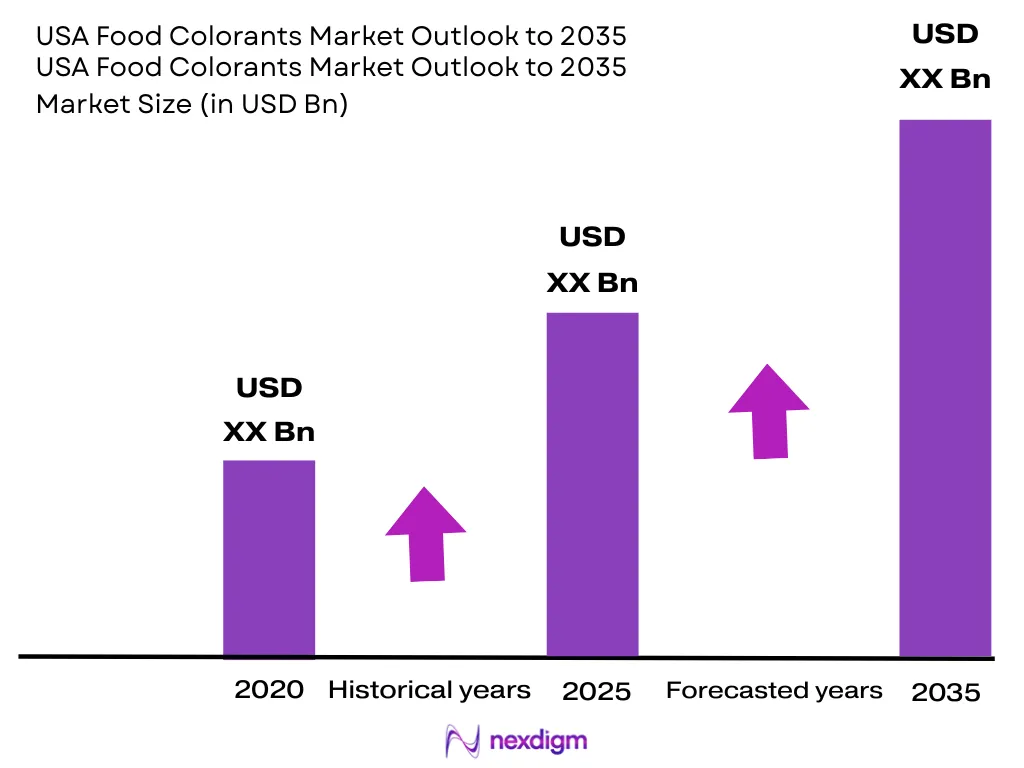
The USA Food Colorants Market was valued at USD ~ Billion in 2024 and is anticipated to expand at a CAGR of ~% during 2026–2035. The market is primarily driven by the country’s large-scale processed food and beverage manufacturing base, the accelerating national transition away from petroleum-based synthetic dyes, and growing consumer preference for naturally derived food additives. According to the U.S. Bureau of Economic Analysis (BEA), agriculture, food, and related industries contributed more than USD 1.5 trillion to the country’s GDP in 2023, representing approximately 5.5% of total U.S. economic output. Meanwhile, the U.S. Bureau of Labor Statistics (BLS) reported that food and beverage manufacturing employed over 2.1 million workers in 2024, making it the largest employment segment within the broader U.S. manufacturing sector, creating sustained demand for functional ingredients such as food colorants across bakery, dairy, confectionery, beverages, snacks, and processed meat applications.
Market Segmentation
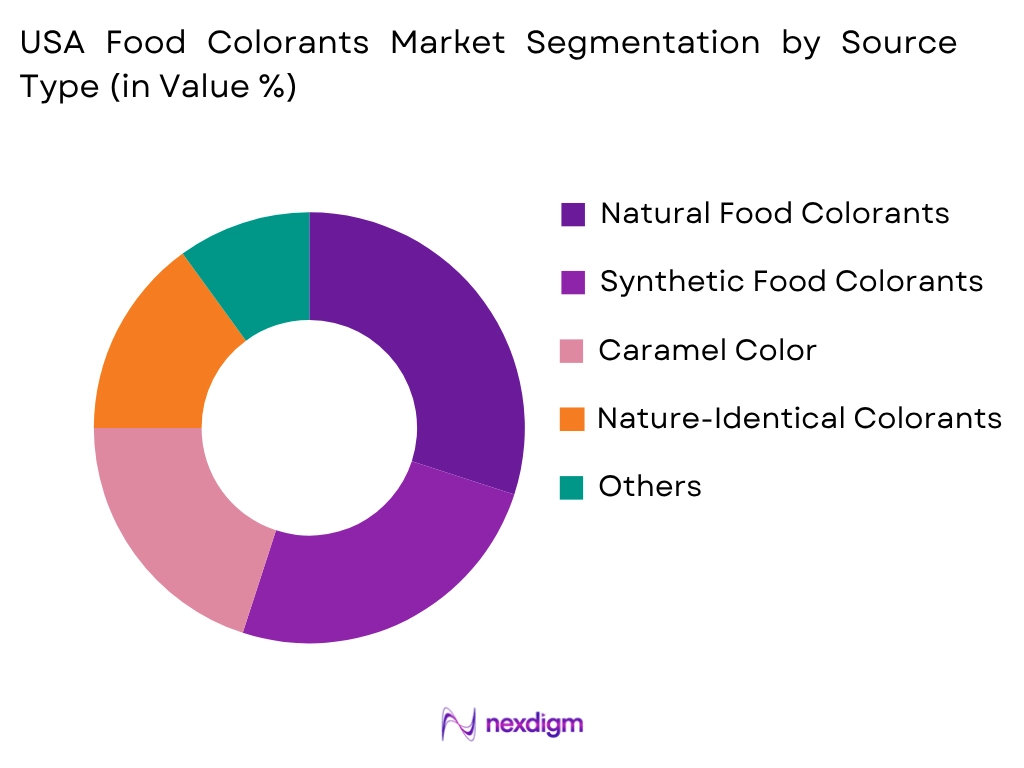
By Source Type
Among these, Natural Food Colorants dominate the USA Food Colorants Market owing to the accelerating regulatory-driven shift away from synthetic dyes, sweeping reformulation commitments from major food manufacturers, and growing consumer awareness regarding naturally sourced ingredients. American food manufacturers are actively reformulating product portfolios by replacing certified synthetic dyes such as Red 40, Yellow 5, Yellow 6, Blue 1, and Blue 2 with botanical extracts including annatto, beetroot, paprika, turmeric, spirulina, and anthocyanins in order to comply with the FDA’s 2025 synthetic dye phase-out roadmap and a growing patchwork of state-level restrictions in California, West Virginia, and Utah. The country’s substantial agricultural base, including large-scale corn, sugar beet, and specialty crop production, supports domestic caramel color and mineral-based colorant manufacturing, while botanical pigment feedstocks such as annatto, turmeric, and paprika are increasingly secured through global supply partnerships. Multinational and domestic ingredient manufacturers operating in the United States have accelerated investments in natural color innovation, capacity expansion, and fermentation-based pigment technologies to comply with the shifting regulatory landscape, further strengthening the dominance of this segment across dairy, confectionery, beverages, bakery, and plant-based food applications.
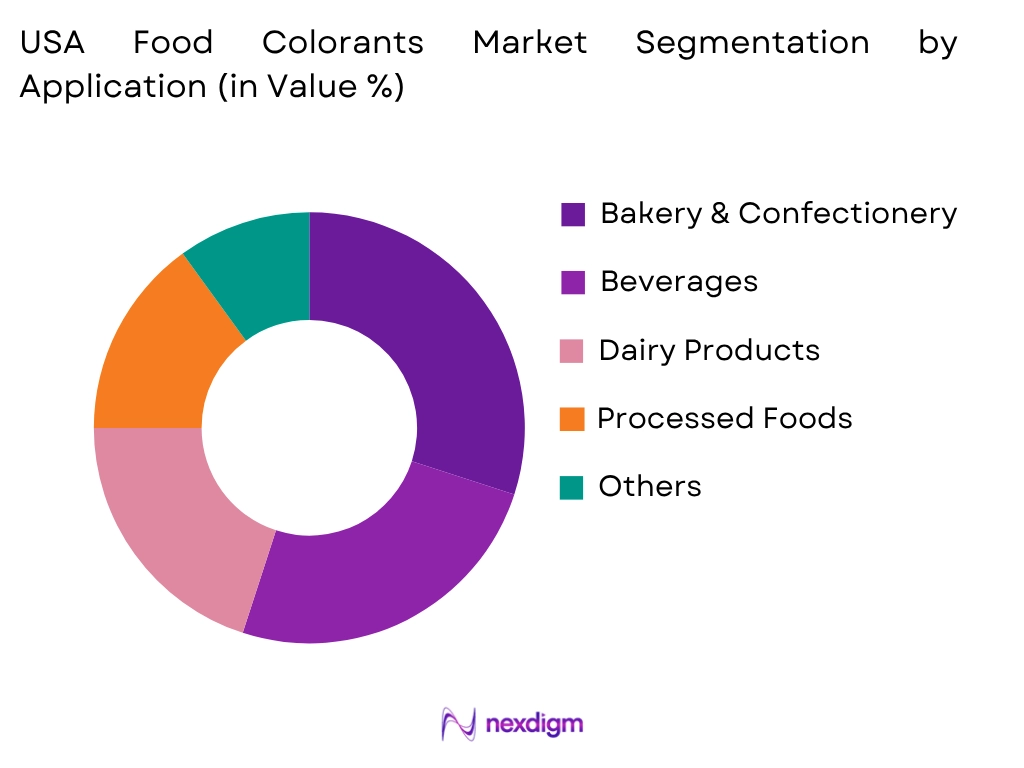
By Application
The Bakery & Confectionery segment holds the largest share owing to the extensive use of food colorants for product differentiation, visual appeal, seasonal product launches, and premium product positioning. Manufacturers increasingly utilize stable natural pigments to enhance cakes, cookies, chocolates, fillings, candies, gummies, frostings, and decorative toppings while maintaining compliance with the FDA’s evolving color additive framework. The growth of premium confectionery, artisanal bakery products, and seasonal product launches has further increased demand for customized color solutions offering heat stability, pH stability, and extended shelf life. In addition, expanding retail bakery chains, club stores, and private-label grocery programs continue introducing visually attractive baked products, making colorants an essential functional ingredient that directly influences consumer purchasing decisions and brand recognition.
Competitive Landscape
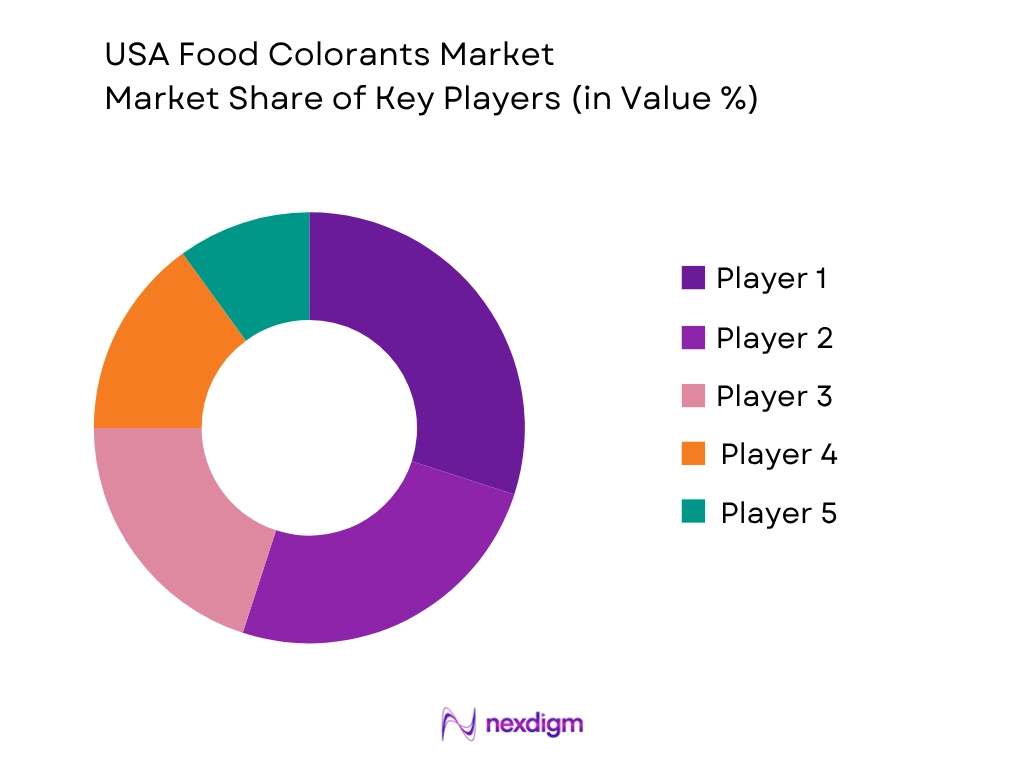
The USA Food Colorants Market is moderately consolidated, with the presence of several multinational ingredient manufacturers alongside domestic natural color specialists. Competition is primarily based on product innovation, regulatory compliance, application-specific formulations, pricing, technical support, and the ability to provide clean-label solutions aligned with the FDA’s synthetic dye phase-out timeline. Companies are increasingly investing in research and development to improve the stability, heat resistance, pH tolerance, and shelf life of natural colorants. Strategic collaborations with food manufacturers, expansion of domestic production capacity, and vertically integrated sourcing of botanical raw materials have become key competitive differentiators. The regulatory-driven transition away from synthetic dyes has also prompted manufacturers to expand their portfolios through acquisitions, partnerships, and fermentation-based pigment technologies.
| Company | Establishment Year | Headquarters | Primary Product Portfolio | Natural Color Portfolio
|
Manufacturing Presence | Major End-Use Industries | Key Strategic Focus | Certifications & Compliance |
| Sensient Technologies | 1882 | ~ | ~ | ~ | ~ | ~ | ~ | ~ |
| DDW, The Color House | 1865 | ~ | ~ | ~ | ~ | ~ | ~ | ~ |
| Oterra | 1867 | ~ | ~ | ~ | ~ | ~ | ~ | ~ |
| ADM | 1902 | ~ | ~ | ~ | ~ | ~ | ~ | ~ |
| Kalsec | 1958 | ~ | ~ | ~ | ~ | ~ | ~ | ~ |
USA Confectionary Market Analysis
Growth Drivers
Accelerating National Shift Away from Synthetic Dyes
The USA Food Colorants Market is experiencing sustained growth due to a sweeping regulatory-driven transition away from petroleum-based synthetic dyes across the country’s food and beverage industry. On January 15, 2025, the U.S. Food and Drug Administration (FDA) formally revoked authorization for FD&C Red No. 3 in food and ingested drugs, citing the Delaney Clause of the Federal Food, Drug, and Cosmetic Act, with a compliance deadline of January 2027 for food products. On April 22, 2025, the U.S. Department of Health and Human Services (HHS) and the FDA jointly announced a broader national initiative to eliminate the six remaining certified petroleum-based dyes—FD&C Green No. 3, Red No. 40, Yellow No. 5, Yellow No. 6, Blue No. 1, and Blue No. 2—from the food supply, while accelerating approval of natural and alternative color additives such as Galdieria extract blue, butterfly pea flower extract, and calcium phosphate. State governments have moved in parallel, with California, West Virginia, and Utah enacting their own restrictions on synthetic dyes, while more than 37 states introduced related legislation in 2025 alone. This coordinated federal and state regulatory momentum is compelling food and beverage manufacturers nationwide to reformulate thousands of products with natural and nature-identical colorants, creating substantial and sustained demand for annatto, turmeric, beetroot, paprika, and algae-derived pigments.
Expansion of Food Processing and Beverage Manufacturing
The continued expansion of U.S. food processing and beverage manufacturing remains a major driver for food colorant consumption. According to the U.S. Bureau of Labor Statistics, food and beverage manufacturing employment grew from approximately 1.6 million in 2014 to over 2.1 million in 2024, and is projected to add more new jobs than any other manufacturing sector through 2034. The U.S. Bureau of Economic Analysis reported that inflation-adjusted GDP for the combined food and beverage manufacturing sector reached approximately USD 278 billion in 2023, with food manufacturing consistently contributing the largest share of sector output. U.S. food and beverage manufacturing exports reached USD 93.7 billion in 2024, led by meat products, packaged foods, and vegetable fats and oils, according to industry trade data. Rising disposable income, a population exceeding 341 million according to the U.S. Census Bureau, and continued urbanization have increased demand for premium bakery products, confectionery, snacks, and functional beverages that increasingly rely on natural pigments to enhance product appeal. In addition, the country’s position as one of the world’s largest meat processors, bakers, and beverage producers further supports industrial demand for caramel colors, annatto extracts, paprika oleoresins, and beetroot-derived pigments across multiple food categories, strengthening long-term demand for advanced food coloring solutions throughout the country.
Market Challenges
Patchwork of State-Level Regulatory Requirements
Despite growing federal momentum toward eliminating synthetic dyes, food colorant manufacturers and their customers face a complex and fragmented state-level regulatory landscape. California’s Food Safety Act and School Food Safety Act, enacted in October 2023 and August 2024 respectively, restrict several synthetic dyes and additives, while West Virginia House Bill 2354, signed in March 2025, mandates removal of eight dyes and additives from products sold in the state by January 2028. With more than 37 states introducing related legislation in 2025, manufacturers distributing nationally must navigate varying compliance timelines, permitted-use thresholds, and labeling requirements across jurisdictions. This patchwork approach increases reformulation costs, complicates supply chain planning, and requires ingredient manufacturers to maintain multiple product specifications to serve different state markets simultaneously, creating operational complexity across the food colorants value chain.
Limited Stability and Higher Cost of Natural Colorant Alternatives
Natural and nature-identical colorants generally exhibit lower heat, light, and pH stability compared with the synthetic dyes they are replacing, presenting significant technical challenges for manufacturers reformulating products such as candies, cereals, beverages, and baked goods. Achieving the vibrant, consistent hues long associated with synthetic dyes such as Red 40 and Yellow 5 often requires costlier botanical extraction processes, microencapsulation, and larger use levels of natural pigments, increasing overall formulation costs. Supply availability for certain botanical feedstocks, including spirulina, annatto, and cochineal-derived carmine, can also fluctuate due to agricultural conditions and global demand, creating pricing volatility. Furthermore, manufacturers must validate that reformulated products meet the FDA’s legally required safety standard of reasonable certainty of no harm, requiring additional toxicological and stability documentation before commercialization. These combined technical and cost pressures continue to challenge ingredient manufacturers and food companies navigating the transition away from synthetic dyes.
Market Opportunities
Accelerated Approval Pathway for Natural and Alternative Colorants
The FDA’s efforts to fast-track review and approval of natural and alternative color additives present a significant opportunity for ingredient manufacturers. In May 2025, the FDA approved three new color additives from natural sources—Galdieria extract blue, derived from red algae, butterfly pea flower extract, and calcium phosphate—expanding the palette of natural options available to food manufacturers. The agency has also exempted beetroot red from certification requirements and continues to review additional botanical and fermentation-derived pigments for future approval. This accelerated regulatory pathway, combined with the FDA and HHS’s stated intent to support the industry’s shift toward alternatives already used in Europe and Canada, creates substantial opportunities for manufacturers capable of developing heat-stable, cost-competitive natural colorants that meet the performance benchmarks previously set by synthetic dyes.
Reformulation-Driven Demand Across Retail and Foodservice Channels
Major U.S. food and beverage companies, retailers, and foodservice chains have increasingly pledged to remove petroleum-based synthetic dyes from their products ahead of federal deadlines, creating substantial reformulation-driven demand for natural food colorants. The FDA’s ongoing industry pledge tracker highlights a growing number of manufacturers committing to voluntary timelines, often accelerating removal well before the 2027 to 2028 compliance dates. This shift is further supported by new FDA guidance permitting ‘no artificial color’ labeling claims for products free of petroleum-based dyes, incentivizing brands to reformulate for marketing and consumer trust purposes. Combined with continued growth in plant-based foods, clean-label snacks, and premium beverages, these dynamics create long-term opportunities for ingredient manufacturers to expand natural color portfolios, application-specific technical support, and domestic manufacturing capacity to serve the evolving needs of U.S. food and beverage companies.
Future Outlook
The USA Food Colorants Market is expected to witness sustained expansion over the forecast period, supported by the ongoing federal and state-driven phase-out of petroleum-based synthetic dyes, continuous product reformulation by food manufacturers, and advancements in natural color stabilization technologies. Growing investment in plant-based foods, premium confectionery, functional beverages, and clean-label dairy products will further accelerate demand for innovative coloring solutions. The market is also likely to benefit from continued FDA approvals of new natural and alternative color additives, expanding the range of viable substitutes for legacy synthetic dyes such as Red 40, Yellow 5, and Blue 1.
Major Players
- Sensient Technologies
- DDW, The Color House
- Kalsec
- ADM (Archer Daniels Midland)
- Oterra
- Chr. Hansen
- Givaudan
- IFF (International Flavors & Fragrances)
- GNT Group
- Naturex
- Döhler
- Symrise
- Kerry Group
- BASF
- ColorMaker, Inc.
Key Target Audience
- Food Colorant Manufacturers
- Food & Beverage Processing Companies
- Bakery and Confectionery Manufacturers
- Dairy Product Manufacturers
- Nutraceutical and Functional Food Manufacturers
- Investment and Venture Capitalist Firms
- Government and Regulatory Bodies (U.S. Food and Drug Administration (FDA), U.S. Department of Agriculture (USDA), U.S. Department of Health and Human Services (HHS))
- Food Ingredient Distributors and Industrial Raw Material Suppliers
Research Methodology
Step 1: Identification of Key Variables
The research process begins with identifying the complete ecosystem of the USA Food Colorants Market, including raw material suppliers, pigment manufacturers, ingredient distributors, food processors, retailers, and regulatory authorities. Extensive secondary research is conducted using company annual reports, government publications, trade associations, customs statistics, industry journals, and proprietary databases to determine the variables influencing market demand, pricing, production, consumption, and technological developments.
Step 2: Market Analysis and Construction
Historical market information is collected and analyzed to estimate market size, production volumes, import-export activity, application-wise demand, and pricing trends. A combination of top-down and bottom-up approaches is used to estimate market revenues and validate segment-level performance. Consumption patterns across bakery, dairy, beverages, confectionery, processed foods, and nutraceuticals are evaluated to establish an accurate representation of the industry.
Step 3: Hypothesis Validation and Expert Consultation
The preliminary findings are validated through Computer-Assisted Telephone Interviews (CATIs) and structured discussions with food ingredient manufacturers, procurement managers, distributors, food technologists, regulatory experts, and senior executives operating within the U.S. food industry. These interviews help verify market assumptions, competitive developments, technology adoption trends, pricing dynamics, and future investment opportunities while refining the overall market estimates.
Step 4: Research Synthesis and Final Output
The final stage integrates insights obtained from primary interviews with quantitative information collected through secondary sources. Data triangulation techniques are applied to reconcile differences between supply-side and demand-side estimates, ensuring robust market forecasting. The report is then reviewed through multiple quality assurance checkpoints to deliver a comprehensive analysis covering market size, segmentation, competitive landscape, future outlook, and strategic recommendations for industry stakeholders.

- Executive Summary
- Research Methodology (Market Definitions and Assumptions, Abbreviations, Market Sizing Approach, Top-Down Analysis, Bottom-Up Analysis, Demand-Side Assessment, Supply-Side Assessment, Primary Industry Interviews, Secondary Research Validation, Data Triangulation, Forecasting Framework, Limitations and Future Conclusions)

- Definition and Scope
- Market Evolution and Industry Genesis
- Timeline of Major Industry Developments
- Food Colorants Industry Value Chain Analysis
- Supply Chain Analysis

- Growth Drivers (Accelerating Shift Away from Synthetic Dyes, Rising Consumption of Processed and Packaged Foods, Expansion of Beverage Manufacturing, Increasing Demand for Natural Pigments, Premiumization of Food Products, Growth in Plant-Based Foods)
- Market Challenges (High Cost of Natural Colorants, Color Stability Issues, Raw Material Price Volatility, Regulatory Compliance Complexity, State-Level Regulatory Fragmentation, Import Dependency for Specialty Ingredients)
- Market Opportunities (Microencapsulation Technologies, Fermentation-Based Natural Pigments, Organic Food Expansion, Functional Food Innovation, Reformulation-Driven Ingredient Demand, Clean Label Reformulation Projects)
- Market Trends (Replacement of Synthetic Colors, Blue Spirulina Adoption, Botanical Extract Innovation, Sustainable Pigment Sourcing, Heat-Stable Natural Color Development, Multi-Functional Ingredients)
- Government Regulations (FDA Color Additive Regulations, Synthetic Dye Phase-Out Initiative, Food Labeling Requirements, Maximum Permitted Usage Levels, State-Level Dye Restrictions, Food Safety Standards)
- Import and Export Analysis (Trade Volume, Major Import Sources, Export Destinations, HS Code Analysis, Trade Balance)
- Raw Material Availability Analysis (Annatto Seeds, Turmeric, Paprika, Beetroot, Spirulina, Caramel Feedstocks)
- Technology Landscape (Extraction Technologies, Encapsulation Technologies, Spray Drying, Fermentation Technologies, Stability Enhancement Technologies)
- Sustainability Assessment (Renewable Raw Materials, Carbon Footprint Reduction, Sustainable Farming Practices, Waste Valorization, Eco-Friendly Processing)
- PESTLE Analysis
- SWOT Analysis
- Porter’s Five Forces Analysis
- Stakeholder Ecosystem
- Competition Ecosystem

- By Market Value (2020-2025)
- By Volume Consumption (2020-2025)
- By Average Selling Price (2020-2025)

- By Source Type (In Value %)
Natural Food Colorants
Synthetic Food Colorants
Nature-Identical Colorants
Caramel Color
Mineral-Based Colorants
Fermentation-Derived Colorants - By Application (In Value %)
Bakery & Confectionery
Beverages
Dairy Products
Processed Foods
Snacks & Savory Products
Meat, Poultry & Seafood Products
Frozen Foods
Plant-Based Foods
Nutraceuticals & Functional Foods
Infant Nutrition - By Distribution Channel (In Value %)
Direct Sales to Food Manufacturers
Ingredient Distributors
Industrial Ingredient Suppliers
Online B2B Ingredient Platforms
Specialty Ingredient Suppliers - By End User (In Value %)
Food Processing Companies
Beverage Manufacturers
Bakery Manufacturers
Confectionery Manufacturers
Dairy Processors
Nutraceutical Manufacturers
Foodservice Manufacturers - By Region (In Value %)
Northeast United States
Midwest United States
South United States
West United States
Southeast United States

- Market Share of Major Players (By Value, Volume, Source Type, Application Industry, Product Category)
- Cross Comparison Parameters (Natural Colorant Portfolio Breadth, Synthetic Colorant Portfolio, Color Stability Performance, Application Technical Support Capability, Manufacturing Capacity, Regulatory Compliance & Certifications, Food & Beverage Customer Base, Innovation & New Product Launch Frequency)
- SWOT Analysis of Major Players
- Pricing Analysis by Product Category and SKU
- Production Capacity Analysis
- Manufacturing Footprint Analysis
- Distribution Network Analysis
- Innovation Benchmarking
- Detailed Profiles of Major Companies
Sensient Technologies
DDW, The Color House
Kalsec
ADM (Archer Daniels Midland)
Oterra
Chr. Hansen
Givaudan
IFF (International Flavors & Fragrances)
GNT Group
Naturex
Döhler
Symrise
Kerry Group
BASF
ColorMaker, Inc.

- Consumption Pattern Analysis (Industrial Usage, Batch Size, Product Category Penetration, Seasonal Demand, Reformulation Activity)
- Purchasing Criteria (Color Stability, Regulatory Compliance, Cost Efficiency, Heat Stability, Light Stability, Shelf Life)
- Procurement and Supplier Selection Analysis
- Clean Label Adoption Assessment
- Premium vs Conventional Product Demand
- Product Attribute Preference Analysis (Hue Consistency, Dispersion Performance, pH Stability, Solubility, Natural Origin, Label Friendliness)
- Consumer Health & Wellness Influence on Product Development
- Pain Point Analysis
- Decision-Making Process

- By Market Value (2026-2035)
- By Volume Consumption (2026-2035)
- By Average Selling Price (2026-2035)


 Request a Sample
 Ask for Customization
 Get a Quote
 Enquire Now