

 Download PDF
Market Overview
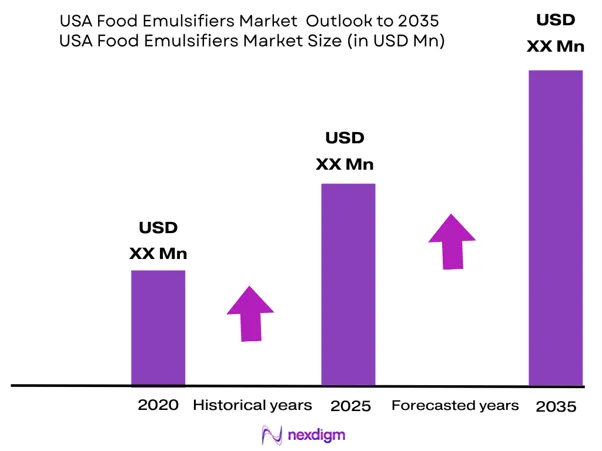
The USA Food Emulsifiers Market is valued at USD ~ million, based on a five-year historical analysis, and is forecast to grow at % CAGR during the forecast period. Demand is driven by industrial bakery, confectionery, dairy, frozen desserts, sauces, dressings, spreads, beverages and plant-based foods. U.S. food spending increased from USD 2.48 trillion to USD 2.58 trillion, while domestically produced food spending increased from USD 2.11 trillion to USD 2.17 trillion.The USA Food Emulsifiers Market is dominated by Chicago, Minneapolis, Des Moines, St. Louis, New York-New Jersey, Pennsylvania-Ohio, Dallas-Fort Worth, Atlanta, Wisconsin dairy clusters and California food innovation hubs. The Midwest dominates through soybean processing, lecithin availability, bakery inputs and oilseed feedstocks, while California and the Northeast dominate plant-based, specialty ingredient and natural formulation activity. U.S. GDP increased from USD 27.36 trillion to USD 29.18 trillion, supporting large-scale food manufacturing and ingredient consumption.
Market Segmentation
By Emulsifier Type
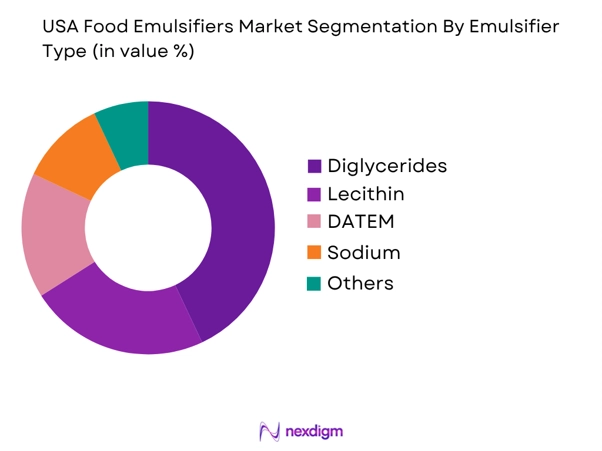
USA Food Emulsifiers Market is segmented by emulsifier type into mono- and diglycerides, lecithin, DATEM, sodium stearoyl lactylate, calcium stearoyl lactylate, polysorbates, sorbitan esters, PGPR, sucrose esters, polyglycerol esters and customized emulsifier blends. Recently, mono- and diglycerides have a dominant market share in the USA under the emulsifier type segmentation due to their broad use in industrial bakery, cakes, icings, margarines, spreads, frozen desserts, whipped toppings and convenience foods. Their dominance is linked to cost-in-use efficiency, strong compatibility with fats and oils, and multiple functional benefits including crumb softness, aeration, fat dispersion, anti-staling and emulsion stability. Mono- and diglycerides are also widely recognized in U.S. food formulation, with FDA’s 21 CFR framework identifying them as substances prepared from fats or oils or fat-forming acids. This gives manufacturers a familiar regulatory and technical base for scaling bakery, dairy and spread formulations.
By Application
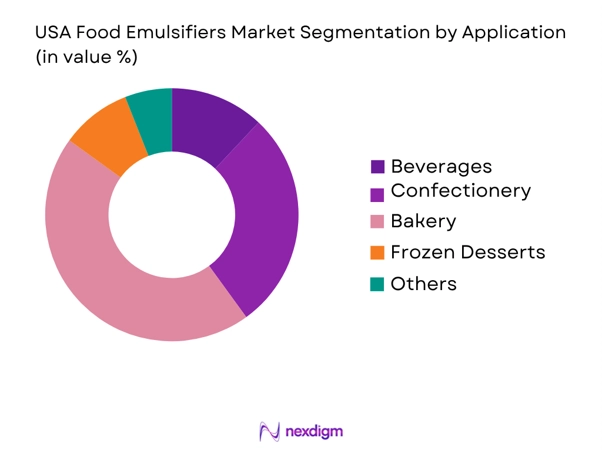
USA Food Emulsifiers Market is segmented by application into bakery products, confectionery and chocolate, dairy and frozen desserts, sauces, dressings, margarine, spreads, beverages, RTD drinks, plant-based meat, dairy alternatives, powdered mixes, nutritional products and foodservice premixes. Recently, bakery products have a dominant market share in the USA under the application segmentation due to the extensive use of emulsifiers in bread, buns, cakes, tortillas, donuts, muffins, pastries, cookies and frozen bakery products. Industrial bakeries use mono- and diglycerides, DATEM, SSL, CSL, lecithin and enzyme-emulsifier systems to improve dough strength, loaf volume, crumb structure, softness, moisture retention and shelf life. BLS notes that bakery product prices rose consistently across much of the three-year period beginning in January 2021, reinforcing pressure on manufacturers to use functional ingredients that improve process efficiency and reduce waste. Emulsifiers remain central to high-speed bakery lines and private label bakery production.
Competitive Landscape
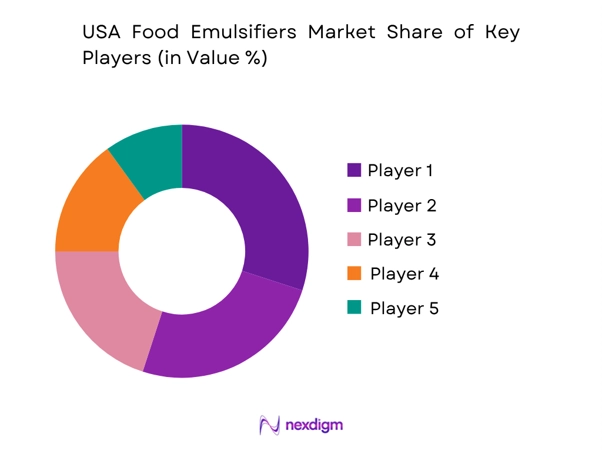
The USA Food Emulsifiers Market is served by integrated agribusiness companies, specialty emulsifier manufacturers, lecithin suppliers, bakery ingredient specialists, dairy formulation companies and clean-label ingredient providers. The market is technically mature but not static; competition is shifting from commodity emulsifiers toward source-specific lecithin, non-GMO systems, palm-free emulsifiers, enzyme-led replacements, application-specific bakery blends and plant-based texture solutions. Large food manufacturers prefer suppliers that combine FDA/GRAS documentation, feedstock traceability, pilot testing, national distribution and formulation troubleshooting.
| Company | Establishment Year | Headquarters | Core Emulsifier Focus | USA Market Role | Key Applications | Distribution Strength | Compliance Capability | Market-Specific Capability |
| ADM | 1902 | Chicago, Illinois, USA | ~ | ~ | ~ | ~ | ~ | ~ |
| Cargill Incorporated | 1865 | Wayzata, Minnesota, USA | ~ | ~ | ~ | ~ | ~ | ~ |
| Corbion | 1919 | Amsterdam, Netherlands | ~ | ~ | ~ | ~ | ~ | ~ |
| Palsgaard | 1917 | Juelsminde, Denmark | ~ | ~ | ~ | ~ | ~ | ~ |
| BASF Corporation | 1865 | Ludwigshafen, Germany | ~ | ~ | ~ | ~ | ~ | ~ |
USA Food Emulsifiers Market Analysis
Growth Drivers
Industrial bakery and packaged food manufacturing scale
USA Food Emulsifiers Market is driven by the scale of packaged food manufacturing, where mono- and diglycerides, lecithin, DATEM, SSL, CSL, polysorbates, PGPR and sorbitan esters are used for dough conditioning, crumb softness, aeration, anti-staling, fat dispersion, viscosity control and emulsion stability. USDA ERS reported total U.S. food spending of USD 2.51 trillion in 2025, while inflation-adjusted food expenditures increased from USD 2.49 trillion to USD 2.51 trillion between 2024 and 2025. BLS reported that food and beverage manufacturing employed about 2.1 million workers in 2024 and represented 16 workers out of every 100 manufacturing workers, the largest employment base among U.S. manufacturing industries. This supports emulsifier demand because bakery, confectionery, dairy, sauces, dressings, frozen desserts, nutritional powders and private-label foods require consistent texture, moisture retention and processing performance. Industrial bakeries remain especially important because emulsifiers improve high-speed line performance, reduce product staling and help manufacturers maintain softness and volume across national retail distribution.
Domestic oilseed feedstock and lecithin supply base
USA Food Emulsifiers Market benefits from a large domestic oilseed and lecithin feedstock base, especially soybean processing, which supports lecithin availability for chocolate, bakery, beverages, nutritional powders, sauces, dressings and plant-based food applications. USDA NASS reported U.S. soybean production of 4.37 billion bushels in 2024, with an average yield of 50.7 bushels per acre. USDA ERS also reported that U.S. soybean crush for marketing year 2025/26 was raised to 2.65 billion bushels, reflecting strong demand for soybean products and strong crush margins. This feedstock base is market-specific because soy lecithin is one of the most widely used food emulsifiers, while soybean oil and fatty acid streams also support mono- and diglyceride and other emulsifier inputs. Domestic sourcing reduces reliance on fully imported emulsifier supply and helps large ingredient suppliers serve bakeries, confectionery companies, dairy processors and foodservice manufacturers with traceable, scalable and FDA-documented emulsifier systems.
Market Challenges
Clean-label pressure and ultra-processed food scrutiny
USA Food Emulsifiers Market faces a challenge from clean-label pressure because food manufacturers increasingly need emulsifier systems that perform technically while appearing acceptable on ingredient labels. Mono- and diglycerides, polysorbates, DATEM and other functional emulsifiers are established in food processing, but consumer scrutiny of ultra-processed foods increases reformulation pressure for bakery, frozen dessert, sauces, dressings, plant-based foods and nutritional products. USDA ERS reported total food spending of USD 2.51 trillion in 2025, showing the large consumer-facing scale of the food system exposed to ingredient-label scrutiny. BLS reported that food and beverage manufacturing employed about 2.1 million workers in 2024, which indicates the broad industrial base affected by reformulation demands. The technical challenge is market-specific: removing or replacing a bakery emulsifier can reduce dough tolerance, loaf volume and crumb softness; replacing a dairy emulsifier can affect aeration and freeze-thaw stability; and replacing emulsifiers in chocolate or sauces can alter viscosity, separation and mouthfeel. Clean-label reformulation therefore requires pilot trials, sensory testing, shelf-life validation and FDA documentation review.
Regulatory documentation, allergen management and source-specific compliance
USA Food Emulsifiers Market is constrained by documentation and source-specific compliance requirements because emulsifiers must align with FDA food additive or GRAS frameworks, ingredient declaration rules, allergen considerations and customer specifications. FDA’s 21 CFR framework describes mono- and diglycerides as mixtures of glyceryl mono- and diesters prepared from fats or oils or fat-forming acids, while FDA’s food substance inventory lists mono- and diglycerides across food additive and GRAS regulatory references. This matters for manufacturers because intended use, source material, processing aid status, label naming, allergen exposure and non-GMO or organic compatibility must be checked before commercial use. The challenge is amplified by the scale of U.S. food processing: BLS reports food and beverage manufacturing employed about 2.1 million workers in 2024, and USDA ERS reports domestically produced food spending reached USD 2.17 trillion earlier, showing the breadth of products requiring documentation-ready inputs. Soy lecithin also introduces source-specific sensitivity for allergen and GMO claims, while sunflower lecithin and palm-free systems may require separate supply-chain verification and customer approval.
Market Opportunities
Sunflower lecithin, non-GMO and allergen-friendly emulsifier systems
USA Food Emulsifiers Market has a strong opportunity in sunflower lecithin, non-GMO and allergen-friendly emulsifier systems because food manufacturers need alternatives to soy-derived and palm-derived ingredients without sacrificing performance. USDA NASS reported soybean production of 4.37 billion bushels in 2024, demonstrating the scale of conventional soy-based feedstock, but this also highlights why manufacturers seeking differentiation may pursue source-diverse lecithin options. USDA ERS noted U.S. soybean crush of 2.65 billion bushels for MY 2025/26, reinforcing the size of soy-derived ingredient flows. Against that base, sunflower lecithin, non-GMO soy lecithin and certified emulsifier blends can serve chocolate, bakery, nutritional powders, infant-adjacent products, plant-based foods and beverages where label claims and allergen positioning matter. The opportunity is current rather than speculative: large food spending of USD 2.51 trillion in 2025 creates a broad reformulation base, while ingredient buyers increasingly evaluate emulsifiers by source, traceability, allergen profile, cost-in-use and functionality. Suppliers with dedicated sourcing, certificates, batch consistency and application support can capture premium formulation briefs.
Enzyme-led bakery systems and plant-based texture solutions
USA Food Emulsifiers Market has a growth opportunity in enzyme-led bakery systems and plant-based texture solutions because manufacturers need emulsifier performance with shorter labels, better shelf life and improved sensory quality. Bakery remains a critical opportunity area: BLS reported that food and beverage manufacturing employed about 2.1 million workers in 2024 and is projected to add the most jobs of any manufacturing industry over the 2024–2034 decade, reaching over 2.2 million workers by 2034. USDA ERS recorded total U.S. food spending of USD 2.51 trillion in 2025, indicating sustained demand for manufactured foods sold through retail, foodservice and private label channels. Emulsifier suppliers can target enzyme-emulsifier blends for breads, buns, tortillas, cakes and frozen bakery, where anti-staling, softness and high-speed processing are critical. Plant-based meat and dairy alternatives also require emulsifier systems that manage protein-fat-water interaction, juiciness, mouthfeel, heat stability and oil release. Suppliers that combine pilot-scale trials, clean-label positioning, FDA/GRAS documentation and application-specific blends can move beyond commodity emulsifiers into higher-value formulation partnerships.
Future Outlook
Over the forecast period, the USA Food Emulsifiers Market is expected to expand steadily through industrial bakery production, private label packaged foods, frozen dessert innovation, chocolate processing optimization, sauces and dressings, nutritional products and plant-based food formulation. Emulsifiers will remain critical for emulsion stability, aeration, dough conditioning, moisture retention, fat dispersion, viscosity control, anti-staling and mouthfeel improvement.
Bakery will remain the anchor application because breads, buns, tortillas, cakes, muffins, cookies and frozen bakery products require dough-strengthening, softness, volume and shelf-life performance. Enzyme-emulsifier blends will gain importance as manufacturers reduce synthetic-sounding ingredients while preserving processing performance.
Lecithin will continue to benefit from chocolate, bakery, nutritional powders, beverages and plant-based food usage. Sunflower lecithin will gain relevance in allergen-sensitive and non-GMO formulations, while soy lecithin will remain important due to domestic oilseed supply and cost efficiency.
Dairy and frozen desserts will remain a high-value application area. Emulsifiers will support aeration, fat destabilization, smoothness, ice-crystal control, whipping performance and freeze-thaw stability in ice cream, frozen novelties, whipped toppings and dairy alternatives.
Plant-based meat and dairy alternatives will create specialized demand for emulsifier systems that manage protein-fat-water interactions, juiciness, mouthfeel, texture and heat stability. This application will favour customized blends over single emulsifier ingredients.
Clean-label reformulation will shape future product development. Palm-free emulsifiers, non-GMO lecithin, organic-compatible systems, enzyme-based replacements and natural-origin emulsifier blends will gain relevance as food manufacturers respond to consumer scrutiny of ultra-processed foods and ingredient declarations.
Major Players
- ADM
- Cargill Incorporated
- Corbion
- Palsgaard
- BASF Corporation
- Kerry Group
- Ingredion Incorporated
- International Flavors & Fragrances
- AAK USA
- Bunge
- Sternchemie
- Lecico
- Lasenor USA
- Stepan Company
- Riken Vitamin USA
Key Target Audience
- Food emulsifier manufacturers
- Bakery, confectionery and snack manufacturers
- Dairy, frozen dessert and beverage manufacturers
- Plant-based food and alternative dairy manufacturers
- Sauce, dressing, margarine and spread manufacturers
- Ingredient distributors and specialty ingredient suppliers
- Investments and venture capitalist firms
- Government and regulatory bodies (U.S. Food and Drug Administration, U.S. Department of Agriculture, Federal Trade Commission, U.S. Customs and Border Protection, state food safety departments)
Research Methodology
Step 1: Identification of Key Variables
The initial phase involves constructing an ecosystem map covering emulsifier manufacturers, oilseed processors, lecithin suppliers, bakery ingredient companies, dairy ingredient suppliers, distributors, food processors and private label manufacturers. This step uses desk research, regulatory review, trade indicators and company-level mapping. The objective is to define variables such as emulsifier type, source, form, function, application, end user and distribution channel.
Step 2: Market Analysis and Construction
In this phase, historical data is compiled across food spending, food manufacturing, bakery activity, oilseed supply, dairy processing, confectionery demand, plant-based foods and ingredient procurement. The top-down approach evaluates national food expenditure and manufacturing indicators, while the bottom-up approach assesses emulsifier usage in bakery, confectionery, dairy, sauces, spreads, beverages and plant-based foods. This supports value, volume and segment-level modelling.
Step 3: Hypothesis Validation and Expert Consultation
Market hypotheses are validated through computer-assisted telephone interviews with emulsifier suppliers, lecithin producers, bakery technologists, dairy formulators, confectionery specialists, plant-based food developers and ingredient distributors. These consultations help verify mono- and diglycerides dominance, lecithin demand, clean-label substitution, application-level usage and regulatory documentation requirements. Expert inputs refine segmentation, competitive positioning and future outlook.
Step 4: Research Synthesis and Final Output
The final phase integrates secondary research, FDA regulatory review, company benchmarking, feedstock analysis, distributor checks and expert consultations into a consolidated market model. Data triangulation is applied across manufacturer demand, distributor movement, application usage and functional requirements. The final output includes market size, segmentation, competitive landscape, future outlook and strategic recommendations for USA Food Emulsifiers Market participants.

- Executive Summary
- Research Methodology (Market Definitions and Assumptions, Abbreviations, FDA Food Substance Mapping, 21 CFR Food Additive Mapping, GRAS Status Mapping, Emulsifier Functional Class Mapping, HS Code Mapping, Market Sizing Approach, Top-Down Analysis, Bottom-Up Analysis, Demand-Side Assessment, Supply-Side Assessment, Import-Export Assessment, Food Processor Procurement Checks, Bakery and Dairy Formulator Interviews, Ingredient Distributor Interviews, Primary Industry Interviews, Data Triangulation, Forecasting Framework, Limitations and Future Conclusions)

- Definition and Scope
- Market Evolution and Industry Genesis
- Timeline of Major Industry Developments
- Role of Emulsifiers in USA Packaged Food Manufacturing

- Growth Drivers (Expansion of Industrial Bakery and Packaged Foods, Demand for Texture and Shelf-Life Extension, Frozen Dessert and Dairy Product Innovation, Chocolate and Confectionery Processing Demand, Plant-Based Food Formulation Needs, Clean-Label Lecithin Adoption, Convenience Food and Ready Meal Consumption, Foodservice and Private Label Expansion)
- Market Challenges (FDA and 21 CFR Compliance Complexity, Clean-Label Pressure on Synthetic Emulsifiers, Soy Allergen and GMO Sensitivity, Palm-Based Emulsifier Sustainability Concerns, Raw Material Volatility in Soybean and Vegetable Oils, Reformulation Performance Risk, Consumer Scrutiny of Ultra-Processed Foods, Application-Specific Technical Validation Requirements)
- Market Opportunities (Sunflower Lecithin Expansion, Natural-Origin Emulsifier Systems, Organic and Non-GMO Emulsifier Blends, Enzyme-Based Bakery Emulsifier Replacement, Plant-Based Dairy and Meat Texture Systems, Low-Fat and Reduced-Sugar Texture Support, Chocolate Viscosity Optimization, Customized Bakery Anti-Staling Blends)
- Market Trends (Shift from Soy Lecithin to Sunflower Lecithin, Clean-Label Replacement of Synthetic Emulsifiers, Increased Use of Enzyme-Based Dough Systems, Growth of Plant-Based Texture Solutions, Demand for Allergen-Friendly Emulsifiers, Premium Frozen Dessert Stabilization, Sustainable Palm-Free Emulsifier Development, Customized Emulsifier Premixes)
- SWOT Analysis
- Porter’s Five Forces Analysis
- PESTLE Analysis

- By Market Value (2020-2025)
- By Consumption Volume (2020-2025)
- By Domestic Production Demand (2020-2025)

- By Emulsifier Type (In Value %)
Mono- and Diglycerides
Lecithin
DATEM
Sodium Stearoyl Lactylate
Calcium Stearoyl Lactylate
Polysorbates
Sorbitan Esters - By Source Type (In Value %)
Soy-Based Emulsifiers
Sunflower-Based Emulsifiers
Egg-Based Emulsifiers
Rapeseed/Canola-Based Emulsifiers
Palm-Based Emulsifiers - By Distribution Channel (In Value %)
Direct Sales to Food Manufacturers
Ingredient Distributors
Specialty Chemical Distributors
Bakery Ingredient Suppliers
Dairy Ingredient Suppliers
Confectionery Ingredient Suppliers - By Region (In Value %)
Northeast USA
Midwest USA
South USA
West USA

- Market Share of Major Players (By Value, Volume, Emulsifier Type, Source Type, Application, End User, Region, Distribution Channel, Domestic vs Imported Portfolio)
- Cross Comparison Parameters (Emulsifier Portfolio Breadth, Lecithin Source Diversity, FDA/GRAS Documentation Strength, Clean-Label and Non-GMO Product Range, Bakery and Confectionery Application Expertise, Plant-Based Formulation Capability, US Manufacturing and Warehousing Footprint, Technical Support and Pilot Trial Capability)
- SWOT Analysis of Major Players
- Detailed Profiles of Major Companies
ADM
Cargill Incorporated
Corbion
Palsgaard
BASF Corporation
Kerry Group
Ingredion Incorporated
IFF
AAK USA
Bunge
Sternchemie
Lecico
Lasenor USA
Stepan Company
Riken Vitamin USA

- Industrial Bakery Manufacturer Analysis
- Confectionery and Chocolate Manufacturer Analysis
- Dairy and Frozen Dessert Processor Analysis
- Beverage Manufacturer Analysis
- Sauce, Dressing and Spread Manufacturer Analysis
- Plant-Based Food Manufacturer Analysis

- By Market Value (2026-2035)
- By Consumption Volume (2026-2035)
- By Domestic Production Demand (2026-2035)


 Request a Sample
 Ask for Customization
 Get a Quote
 Enquire Now