
 Download PDF
Market Overview
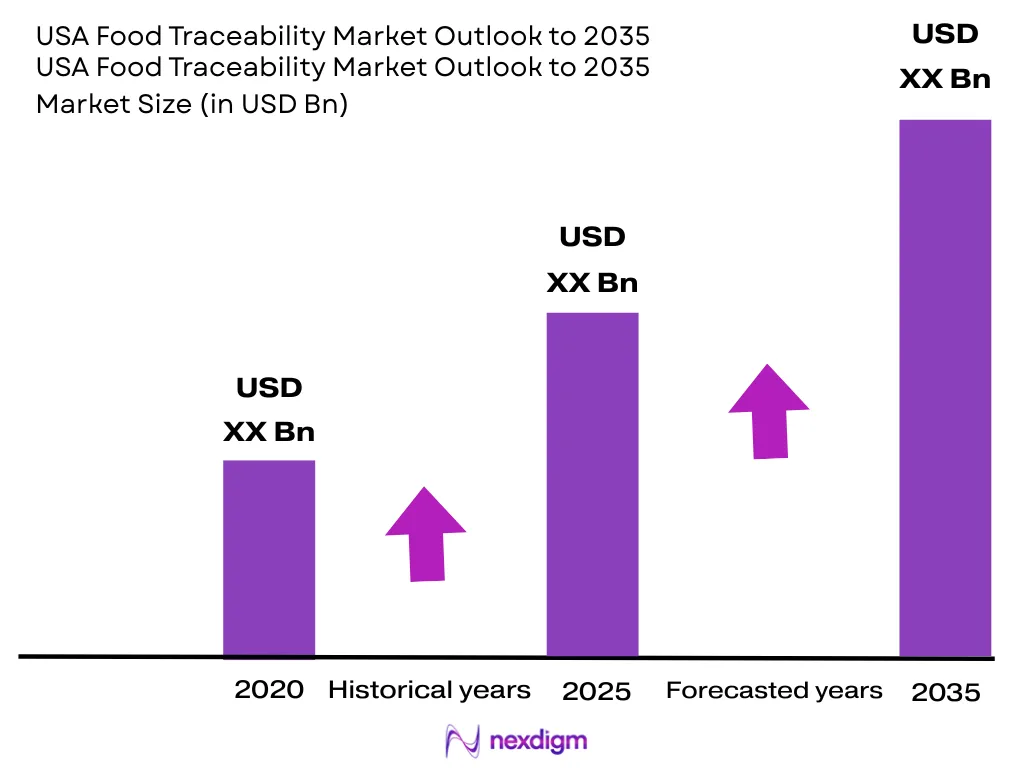
The USA Food Traceability Market was valued at USD ~ Billion in 2024 and is anticipated to expand at a CAGR of ~% during 2026–2035. The market is primarily driven by the U.S. Food and Drug Administration’s Food Safety Modernization Act (FSMA) Section 204 Food Traceability Rule, rising consumer demand for supply chain transparency, and continued adoption of blockchain, IoT, and artificial intelligence-based traceability platforms. The global food traceability and blockchain solutions market reached USD 41.56 billion in 2024 and is projected to reach USD 97.17 billion by 2032, expanding at a CAGR of 11.2%, with North America accounting for approximately 38.45% of total revenue in 2024, according to DataM Intelligence. The FSMA Food Traceability Rule, published in the Federal Register on November 21, 2022, requires businesses that manufacture, process, pack, or hold foods on the FDA’s Food Traceability List, including leafy greens, soft cheeses, shell eggs, nut butters, melons, tomatoes, peppers, sprouts, tropical tree fruits, and certain seafood, to maintain detailed Critical Tracking Events and Key Data Elements throughout the supply chain. While the original compliance date of January 20, 2026, was extended by 30 months to July 20, 2028, following the FDA’s August 2025 proposal and subsequent Congressional direction under the Continuing Appropriations Act, 2026, the rule continues to drive sustained investment in traceability infrastructure, particularly among large food manufacturers, distributors, and retailers seeking to maintain compliance readiness across bakery, dairy, beverages, meat, seafood, and processed food applications.
Market Segmentation
By Technology Type
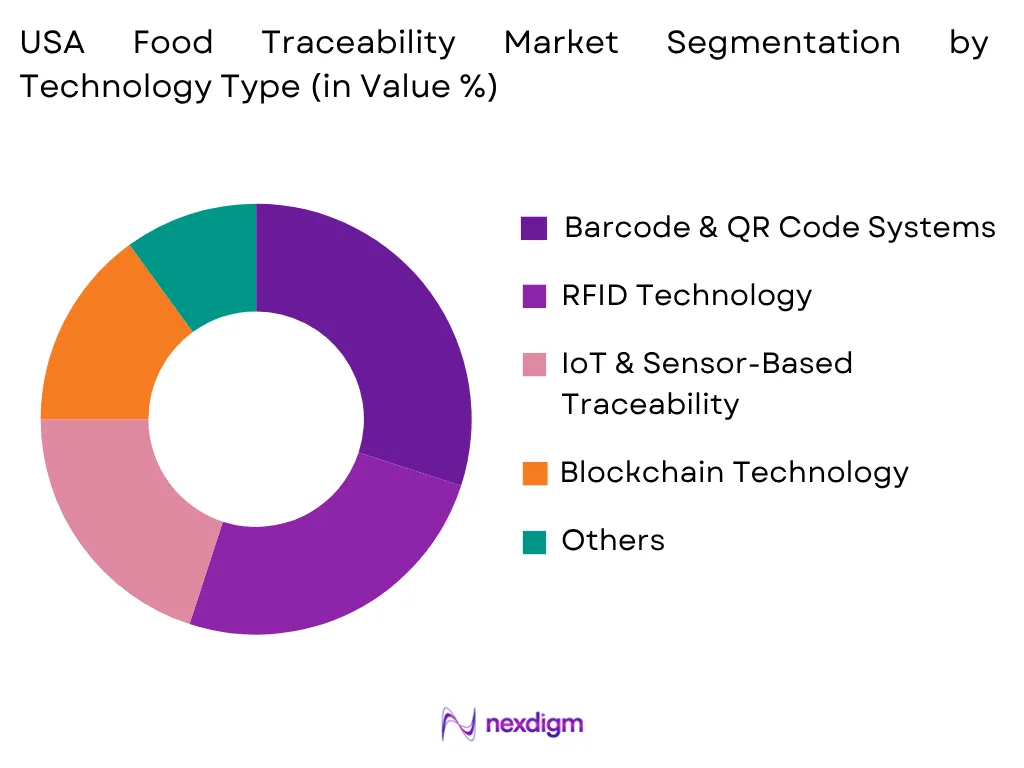
The USA Food Traceability Market is segmented by technology type into barcode & QR code systems, RFID technology, IoT & sensor-based traceability, blockchain technology, GPS & location tracking systems, and other traceability technologies. Barcode & QR code systems hold the dominant market share owing to their cost-effective deployment, compatibility with existing packaging and labeling infrastructure, and widespread use for lot, batch, and product identification across food supply chains. Barcode-based identification is commonly used at item and case levels, while QR codes enable digital access to product and traceability information. The FDA Food Traceability Rule’s emphasis on maintaining additional traceability records for foods on the Food Traceability List is also strengthening demand for standardized digital identification and data-sharing capabilities. RFID is gaining importance in warehouse and distribution operations because of non-line-of-sight reading capabilities, while IoT sensors support temperature and environmental monitoring across cold chains. Blockchain adoption remains comparatively emerging, with integration complexity and legacy-system interoperability continuing to influence commercial deployment.
By Application
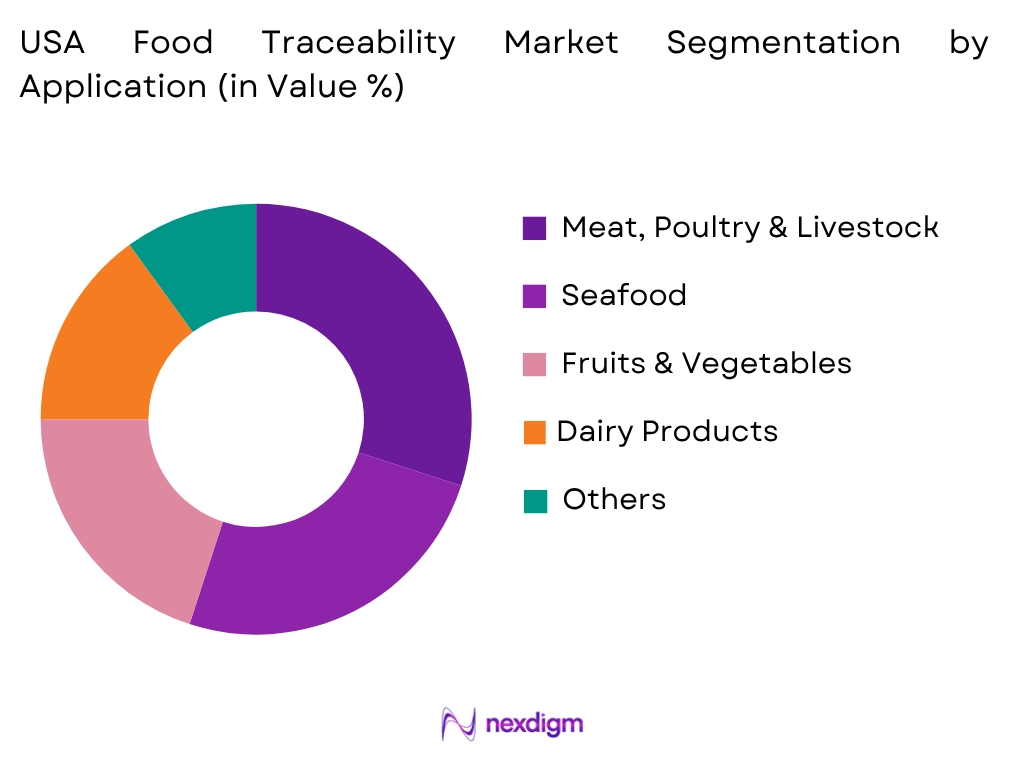
The Meat, Poultry & Livestock segment, together with the closely related Seafood segment, holds a leading share of the USA Food Traceability Market due to the high susceptibility of these products to pathogens and the critical need for rapid contamination source identification and recall management. This is reinforced by the FDA’s Food Traceability List, which designates numerous seafood categories, including certain finfish, smoked finfish, crustaceans, and molluscan shellfish, alongside meat and poultry-adjacent ready-to-eat products, as high-risk foods requiring enhanced recordkeeping. IBM Food Trust’s partnerships with major agricultural firms to integrate blockchain into livestock and dairy supply chains, announced in September 2025, further illustrate the segment’s technology adoption momentum. The Fruits & Vegetables segment also represents a significant application area, given that leafy greens, tomatoes, melons, cucumbers, and sprouts are explicitly named on the Food Traceability List following high-profile foodborne illness outbreaks linked to fresh produce.
Competitive Landscape
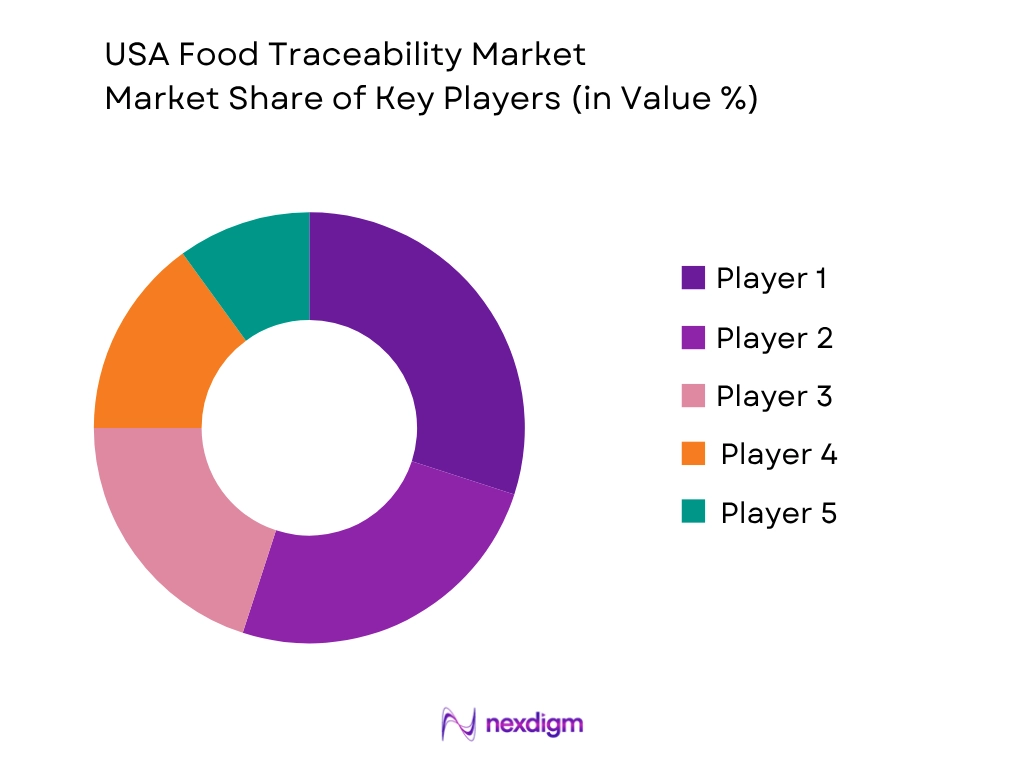
The USA Food Traceability Market is moderately consolidated, with established enterprise technology companies competing alongside specialized traceability software providers and cold chain hardware manufacturers. Competition is primarily based on platform interoperability, blockchain integration capability, regulatory compliance support for the FSMA 204 Food Traceability Rule, ease of supplier onboarding, and the ability to serve large-scale retail and foodservice compliance programs. Companies are increasingly pursuing strategic partnerships to expand platform capabilities, exemplified by iFoodDS and IBM’s September 2023 launch of iFoodDS Trace Exchange, which integrates with IBM Food Trust to help organizations comply with FSMA 204 requirements. Consolidation activity continues to reshape the competitive landscape, with acquisitions such as Agridence’s purchase of Farmer Connect enhancing digital supply chain offerings. Trustwell’s FoodLogiQ Connect platform, alongside IBM Food Trust, Zebra Technologies’ RFID and scanning solutions, Applied DNA Sciences’ molecular authentication technology, and SAP’s enterprise resource planning integrations, together represent the core competitive set serving large-scale U.S. food manufacturers and retailers.
| Company | Establishment Year | Headquarters | Primary Product Portfolio | Traceability Solution Portfolio
|
Deployment Presence | Major End-Use Industries | Key Strategic Focus | Certifications & Compliance |
| Trustwell (FoodLogiQ) | 2010 | ~ | ~ | ~ | ~ | ~ | ~ | ~ |
| IBM | 1911 | ~ | ~ | ~ | ~ | ~ | ~ | ~ |
| Zebra Technologies | 1969 | ~ | ~ | ~ | ~ | ~ | ~ | ~ |
| Applied DNA Sciences | 2002 | ~ | ~ | ~ | ~ | ~ | ~ | ~ |
| SAP | 1972 | ~ | ~ | ~ | ~ | ~ | ~ | ~ |
USA Food Traceability Market Analysis
Growth Drivers
FSMA Section 204 Food Traceability Rule Compliance
The USA Food Traceability Market is experiencing sustained growth due to the FDA’s FSMA Section 204 Food Traceability Rule, which requires businesses handling foods on the Food Traceability List to maintain detailed records of Critical Tracking Events and Key Data Elements, and to provide these records to the FDA within 24 hours of a request. Despite the compliance date being extended by 30 months from January 20, 2026, to July 20, 2028, following the FDA’s August 2025 proposal and subsequent Congressional direction, large food manufacturers, distributors, and retailers continue to invest in traceability infrastructure to maintain supply chain visibility and competitive positioning. Trustwell’s FoodLogiQ reported 28% year-over-year revenue growth in October 2024, driven by more than 2,400 customers deploying FoodLogiQ Connect for FSMA Traceability Rule Key Data Element tracking, supplier compliance monitoring, and recall event management, illustrating the sustained commercial momentum behind regulatory-driven traceability adoption even amid extended enforcement timelines.
Rising Foodborne Illness Burden and Retailer-Driven Compliance Programs
The persistent public health burden of foodborne illness in the United States continues to drive demand for enhanced food traceability solutions. Approximately 48 million Americans, or roughly 1 in 6 individuals, suffer from foodborne illnesses annually, with 128,000 hospitalizations and approximately 3,000 deaths, according to industry-cited public health data. This burden has prompted major retailers and foodservice operators, including Whole Foods Market, Sysco, and Walmart, to require supplier compliance with traceability platforms as a condition of continued business relationships, creating a cascading adoption effect throughout the supply chain. Walmart’s October 2025 expansion of blockchain-based traceability across fresh produce suppliers to enhance real-time transparency further illustrates how large retail buyers continue to drive traceability technology adoption independent of, and in advance of, mandatory regulatory enforcement deadlines.
Market Challenges
Small Grower Digital Divide and Fragmented Supply Chain Adoption
The USA Food Traceability Market faces significant challenges related to uneven technology adoption across the food supply chain, particularly among smaller producers. Approximately 40% of U.S. produce sector supply chain partners had no electronic traceability system in place as of 2024, creating a substantial implementation gap for full farm-to-retail traceability. This challenge is compounded by the fact that approximately 68% of U.S. farm operations generate less than USD 1 million in annual revenue, according to USDA National Agricultural Statistics Service data, limiting many small growers’ capacity to invest in electronic traceability systems, staff training, and ongoing compliance documentation. This digital divide creates operational complexity for large buyers seeking full supply chain visibility and requires traceability technology providers to develop simplified, cost-effective onboarding solutions tailored to smaller agricultural operations.
Regulatory Uncertainty from Compliance Date Extensions
The USA Food Traceability Market continues to navigate uncertainty stemming from the FDA’s extended and evolving compliance timeline for the FSMA Section 204 Food Traceability Rule. Following the original January 20, 2026, compliance date, the FDA proposed a 30-month extension to July 20, 2028, in August 2025, with the Continuing Appropriations Act of 2026 subsequently directing the FDA not to enforce the rule prior to that date. The FDA’s June 2026 public meeting on lot-level tracking flexibilities further signals the potential for additional modifications to the rule’s requirements. This ongoing regulatory evolution creates planning uncertainty for food companies and technology providers, who must balance continued investment in traceability infrastructure against the possibility of further changes to specific recordkeeping requirements before final enforcement begins.
Market Opportunities
USDA Pilot Programs and Blockchain Pathogen Tracking
Growing government support for advanced traceability technologies presents significant opportunities for market participants. In August 2025, the USDA initiated pilot programs using blockchain technology for pathogen tracking and contamination-source mapping in food recalls, while IBM Food Trust announced partnerships with major agricultural firms in September 2025 to integrate blockchain into livestock and dairy supply chains. These government and industry initiatives create opportunities for traceability technology providers to expand platform capabilities into new agricultural sectors and to demonstrate the public health value of blockchain-based contamination tracing, potentially accelerating both voluntary adoption and future regulatory support for enhanced traceability infrastructure across the U.S. food supply chain.
AI-Enhanced Traceability and Predictive Analytics
The integration of artificial intelligence with existing blockchain and IoT-based traceability platforms presents substantial growth opportunities. The global AI in food traceability market reached USD 3.60 billion in 2024 and is projected to reach USD 4.17 billion in 2025, with North America representing the dominant regional market, driven by strict FSMA-related food safety regulations and increasing consumer awareness of food sourcing. Companies including IBM, SAP, and Oracle continue to integrate AI-driven predictive analytics with their traceability and supply chain management platforms, enabling contamination prediction, spoilage forecasting, and logistics optimization. This convergence of AI, blockchain, and IoT technologies creates opportunities for traceability providers to move beyond basic compliance recordkeeping toward higher-value predictive food safety and supply chain optimization services for U.S. food manufacturers and retailers.
Future Outlook
The USA Food Traceability Market is expected to witness sustained expansion over the forecast period, supported by continued FSMA Section 204 compliance preparation, growing retailer-driven supplier traceability requirements, and increasing integration of blockchain, IoT, and AI technologies. Continued government support through USDA pilot programs and ongoing FDA engagement with industry on lot-level tracking flexibilities are expected to shape the market’s regulatory trajectory through the extended July 2028 enforcement date. The market is also likely to benefit from continued technology convergence, including AI-enhanced predictive analytics and expanded cold chain IoT monitoring, supporting long-term growth across meat, seafood, produce, dairy, and processed food supply chain applications.
Major Players
- IBM (Food Trust)
- Trustwell (FoodLogiQ)
- Zebra Technologies
- Applied DNA Sciences
- SAP
- Oracle
- HowGood
- FoodChain ID Group
- Sensitech (Carrier)
- Emerson Cargo Management
- Honeywell International
- SGS SA
- Wholechain
- TraceGains
- Repositrak
Key Target Audience
- Food Traceability Software and Platform Providers
- Food & Beverage Manufacturers
- Food Retailers and Grocery Chains
- Foodservice Operators and Distributors
- Cold Chain Logistics and Hardware Providers
- Meat, Seafood, and Produce Supply Chain Companies
- Investment and Venture Capitalist Firms
- Government and Regulatory Bodies (U.S. Food and Drug Administration (FDA), U.S. Department of Agriculture (USDA), Centers for Disease Control and Prevention (CDC))
- Technology Integrators and Compliance Consulting Firms
Research Methodology
Step 1: Identification of Key Variables
The research process begins with identifying the complete ecosystem of the USA Food Traceability Market, including software and platform providers, hardware manufacturers, system integrators, food and beverage processors, retailers, and regulatory authorities. Extensive secondary research is conducted using company annual reports, government publications, trade associations, customs statistics, industry journals, and proprietary databases to determine the variables influencing market demand, pricing, deployment, adoption, and technological developments.
Step 2: Market Analysis and Construction
Historical market information is collected and analyzed to estimate market size, deployment volumes, technology adoption trends, application-wise demand, and pricing trends. A combination of top-down and bottom-up approaches is used to estimate market revenues and validate segment-level performance. Adoption patterns across meat, seafood, produce, dairy, and processed foods are evaluated to establish an accurate representation of the industry.
Step 3: Hypothesis Validation and Expert Consultation
The preliminary findings are validated through Computer-Assisted Telephone Interviews (CATIs) and structured discussions with traceability software providers, procurement managers, distributors, food technologists, regulatory experts, and senior executives operating within the U.S. food industry. These interviews help verify market assumptions, competitive developments, technology adoption trends, pricing dynamics, and future investment opportunities while refining the overall market estimates.
Step 4: Research Synthesis and Final Output
The final stage integrates insights obtained from primary interviews with quantitative information collected through secondary sources. Data triangulation techniques are applied to reconcile differences between supply-side and demand-side estimates, ensuring robust market forecasting. The report is then reviewed through multiple quality assurance checkpoints to deliver a comprehensive analysis covering market size, segmentation, competitive landscape, future outlook, and strategic recommendations for industry stakeholders.

- Executive Summary
- Research Methodology (Market Definitions and Assumptions, Abbreviations, Market Sizing Approach, Top-Down Analysis, Bottom-Up Analysis, Demand-Side Assessment, Supply-Side Assessment, Primary Industry Interviews, Secondary Research Validation, Data Triangulation, Forecasting Framework, Limitations and Future Conclusions)

- Definition and Scope
- Market Evolution and Industry Genesis
- Timeline of Major Industry Developments
- Food Traceability Industry Value Chain Analysis
- Supply Chain Analysis

- Growth Drivers (FSMA Section 204 Food Traceability Rule Compliance, Rising Foodborne Illness Burden, Retailer-Driven Compliance Programs, Growth in Blockchain and IoT Adoption, Expansion of Cold Chain Monitoring, Premiumization and Transparency Demand)
- Market Challenges (Small Grower Digital Divide, Fragmented Supply Chain Adoption, Regulatory Uncertainty from Compliance Date Extensions, High Implementation Costs, Data Interoperability Complexity)
- Market Opportunities (USDA Pilot Programs and Blockchain Pathogen Tracking, AI-Enhanced Traceability and Predictive Analytics, Expansion into Livestock and Dairy Supply Chains, Smart Labeling and Packaging, Export-Oriented Compliance Solutions)
- Market Trends (Blockchain and AI Convergence, Growth of FSMA 204 Compliance Modules, Cold Chain IoT Monitoring, Consumer-Facing QR Code Transparency, Multi-Tier Supply Chain Interoperability)
- Government Regulations (FDA FSMA Section 204 Food Traceability Rule, Food Traceability List (FTL), Critical Tracking Events and Key Data Elements, Traceability Lot Code Requirements, USDA Food Safety Initiatives)
- Import and Export Analysis (Trade Volume, Major Import Sources, Export Destinations, HS Code Analysis, Trade Balance)
- Technology Landscape (Blockchain Platforms, RFID and Barcode Systems, IoT Cold Chain Sensors, AI and Predictive Analytics, Cloud-Based Traceability Platforms)
- Sustainability Assessment (Food Waste Reduction, Recall Efficiency, Supply Chain Transparency, Ethical Sourcing Verification, Carbon Footprint Tracking)
- PESTLE Analysis
- SWOT Analysis
- Porter’s Five Forces Analysis
- Stakeholder Ecosystem
- Competition Ecosystem

- By Market Value (2020-2025)
- By Volume of Deployments (2020-2025)
- By Average Selling Price (2020-2025)

- By Technology Type (In Value %)
Blockchain
RFID
Barcode & QR Code
GPS/GIS
IoT Sensors & Others - By Deployment Mode (In Value %)
Cloud-Based
On-Premise
Hybrid - By Application (In Value %)
Meat, Poultry & Livestock
Seafood
Fruits & Vegetables
Dairy Products
Bakery & Confectionery
Beverages
Processed Foods - By End User (In Value %)
Food Manufacturers
Food Retailers & Grocery Chains
Foodservice Operators
Distributors & Logistics Providers
Government & Regulatory Agencies - By Region (In Value %)
Midwest United States
South United States
West United States
Northeast United States

- Market Share of Major Players (By Value, Component, Technology, Application Industry, Deployment Mode)
- Cross Comparison Parameters (Platform Portfolio Breadth, Blockchain Integration Capability, Application Technical Support Capability, Deployment Capacity, Regulatory Compliance & Certifications, Food & Beverage Customer Base, Innovation & New Product Launch Frequency)
- SWOT Analysis of Major Players
- Pricing Analysis by Solution Category and Tier
- Deployment Capacity Analysis
- Manufacturing and Platform Footprint Analysis
- Distribution Network Analysis
- Innovation Benchmarking
- Detailed Profiles of Major Companies
IBM (Food Trust)
Trustwell (FoodLogiQ)
Zebra Technologies
Applied DNA Sciences
SAP
Oracle
HowGood
FoodChain ID Group
Sensitech (Carrier)
Emerson Cargo Management
Honeywell International
SGS SA
Wholechain
TraceGains
Repositrak

- Consumption Pattern Analysis (Deployment Scale, Integration Complexity, Product Category Penetration, Seasonal Demand, Reformulation Activity)
- Purchasing Criteria (Regulatory Compliance, Cost Efficiency, Interoperability, Scalability, Data Security, Supplier Onboarding Ease)
- Procurement and Supplier Selection Analysis
- Clean Label and Transparency Adoption Assessment
- Premium vs Conventional Solution Demand
- Product Attribute Preference Analysis (Data Accuracy, Real-Time Visibility, Ease of Integration, Scalability, Regulatory Alignment, User Friendliness)
- Consumer Health & Wellness Influence on Product Development
- Pain Point Analysis
- Decision-Making Process

- By Market Value (2026-2035)
- By Volume of Deployments (2026-2035)
- By Average Selling Price (2026-2035)


 Request a Sample
 Ask for Customization
 Get a Quote
 Enquire Now