
 Download PDF
Market Overview
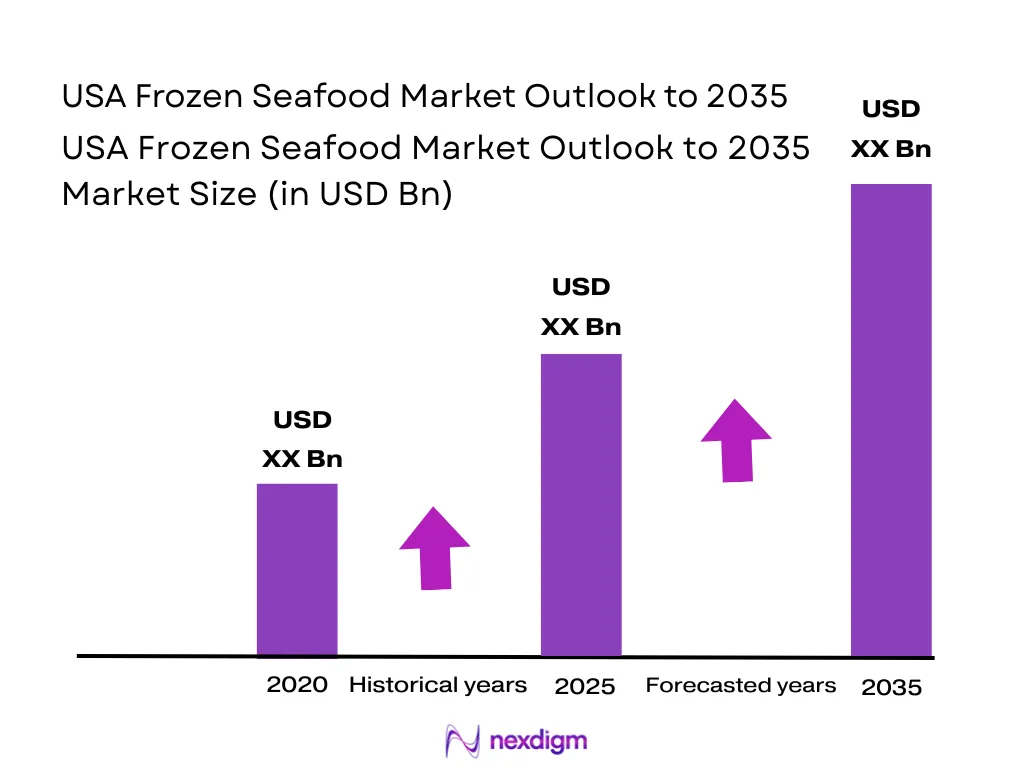
The USA frozen seafood retail market is valued at USD ~ billion, based on Circana’s latest 52-week retail scanner view across U.S. MULO+ channels. Frozen shrimp alone generated USD 4.1 billion, followed by frozen salmon at USD 1.0 billion and frozen pollock at USD 620 million, showing that demand is driven by high-frequency household protein purchases, long freezer life, and convenient at-home seafood preparation. The market is dominated by Alaska, Massachusetts, Washington, California, Florida, Texas, and New York because of their port infrastructure, cold-chain density, seafood consumption culture, import gateways, and processor-distributor networks. Dutch Harbor, Alaska remained the highest-volume U.S. seafood port with ~ million pounds landed, while New Bedford, Massachusetts led by landed value at USD ~ million, supported by scallops and premium seafood movement. The USA frozen seafood market is forecast to expand at a 3.4% CAGR during 2026-2035, using North America frozen seafood growth as the regional benchmark, with the region valued at USD 15.6 billion and projected to reach USD ~ billion by 2033.
Market Segmentation
By Product Type
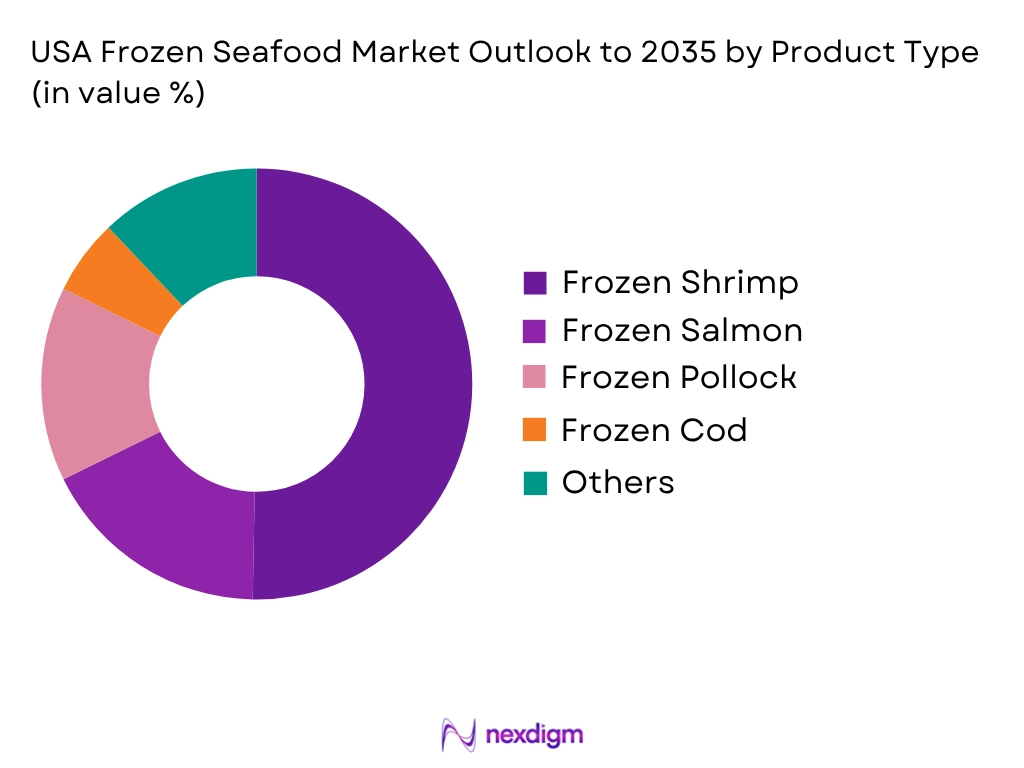
The USA frozen seafood market is segmented by product type into frozen shrimp, frozen salmon, frozen pollock, frozen cod and haddock, frozen crab and lobster, frozen scallops, mussels, clams and squid, and other frozen finfish and seafood mixes. Frozen shrimp dominates the market because it has the strongest cross-channel demand across retail, club stores, foodservice, and casual dining. Its dominance is supported by high household familiarity, portion flexibility, use in multiple cuisines, and broad availability in raw, cooked, peeled, deveined, breaded, and value-pack formats. Circana’s retail data shows frozen shrimp as the largest frozen species category with USD ~ billion in sales, materially ahead of frozen salmon and pollock. Shrimp also benefits from import scale from India, Ecuador, Indonesia, Vietnam, and other aquaculture hubs, enabling large retailers and private labels to maintain steady frozen assortments.
By Sales Channel
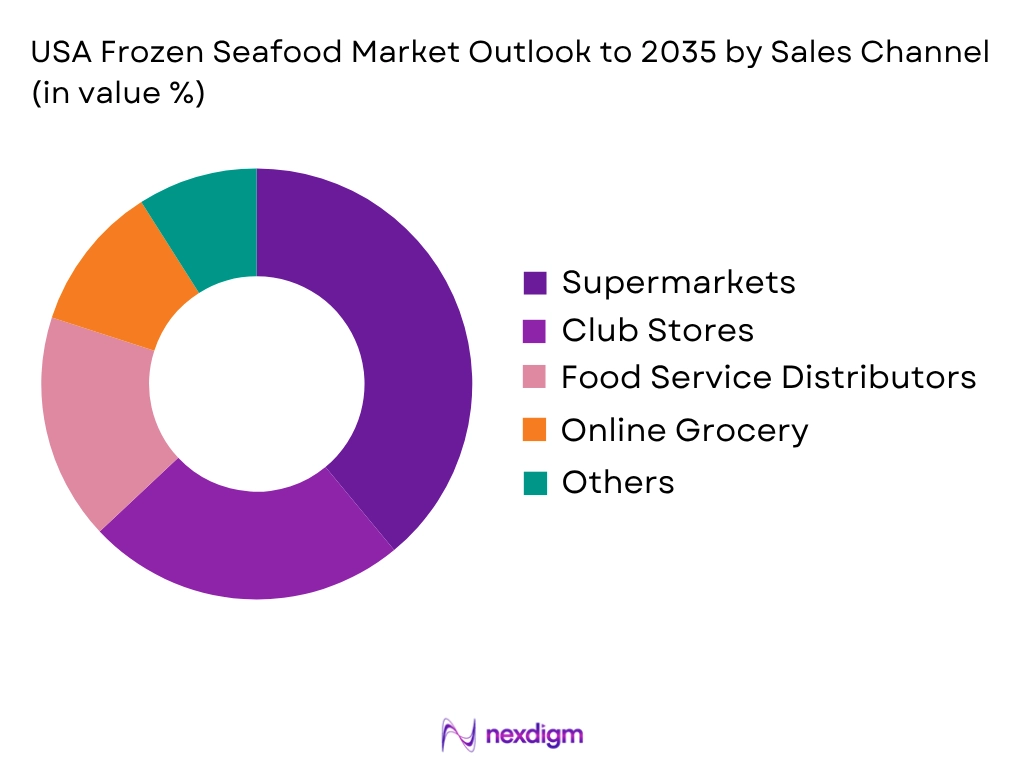
The USA frozen seafood market is segmented by sales channel into supermarkets and hypermarkets, club stores and wholesale retail, foodservice distributors, online grocery and direct-to-consumer frozen delivery, specialty seafood retailers, institutional and contract catering, and convenience and discount retail. Supermarkets and hypermarkets dominate because they provide the broadest frozen seafood assortment, regular promotional cycles, high freezer-door visibility, and access to both branded and private-label SKUs. Chains such as Walmart, Kroger, Costco, Albertsons, Publix, and regional grocers drive repeat purchases through shrimp bags, salmon portions, breaded fish, fish sticks, and value-added seafood meals. Retail dominance is also supported by household substitution from fresh seafood toward frozen formats when consumers seek lower waste, longer storage, and predictable pricing. Frozen seafood accounted for nearly half of U.S. retail seafood sales, showing the role of retail freezer infrastructure in market development.
Competitive Landscape
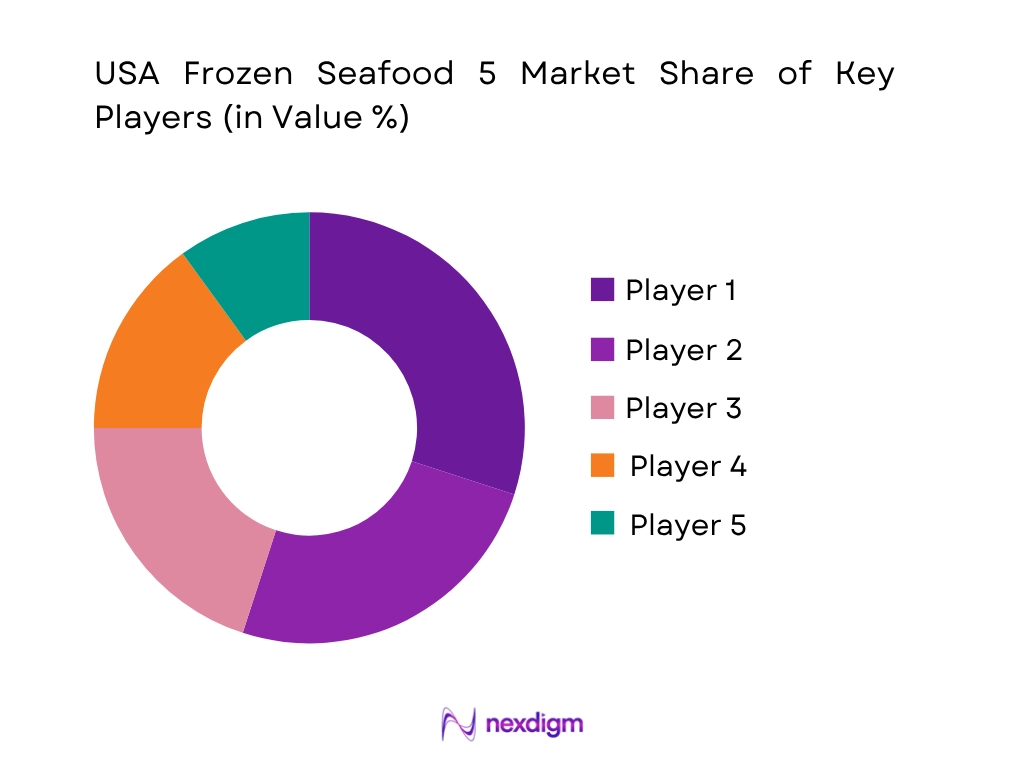
The USA frozen seafood market is moderately consolidated across vertically integrated processors, branded retail frozen seafood manufacturers, import-led seafood specialists, and foodservice suppliers. Trident Seafoods, High Liner Foods, Gorton’s, Aqua Star, and Pacific Seafood hold strong positions because they combine procurement scale, species depth, cold-chain capabilities, retail account access, and value-added processing. The competitive structure is shaped by shrimp and salmon sourcing, Alaska whitefish processing, private-label contracts, branded freezer visibility, and traceability compliance.
| Company | Establishment Year | Headquarters | Core Frozen Seafood Portfolio | Channel Strength | Sourcing Model | Processing Capability | Certification / Traceability Focus | Market Positioning |
| Trident Seafoods | 1973 | Seattle, Washington | ~ | ~ | ~ | ~ | ~ | ~ |
| High Liner Foods | 1899 | Lunenburg, Nova Scotia | ~ | ~ | ~ | ~ | ~ | ~ |
| Gorton’s Seafood | 1849 | Gloucester, Massachusetts | ~ | ~ | ~ | ~ | ~ | ~ |
| Aqua Star | 1990 | Seattle, Washington | ~ | ~ | ~ | ~ | ~ | ~ |
| Pacific Seafood | 1941 | Clackamas, Oregon | ~ | ~ | ~ | ~ | ~ | ~ |
USA Frozen Seafood Market Outlook to 2035
Growth Drivers
Large Consumer Base and High Household Purchasing Capacity Supporting Frozen Seafood Demand
The USA frozen seafood market is supported by a very large addressable consumer base and strong household purchasing capacity, which directly benefits frozen shrimp, salmon portions, pollock fillets, cod, crab, scallops, and ready-to-cook seafood packs sold through retail freezers. The World Bank records the U.S. population at 340,110,988 people and GDP at USD ~ trillion, with GDP per capita at USD 84,534. These macroeconomic indicators support broad consumer access to higher-value animal protein categories, including convenient frozen seafood. USDA ERS also reports that households in the middle-income quintile spent USD 9,097 on food, while households in the highest-income quintile spent USD 16,989 on food, showing the depth of grocery and meal-at-home spending capacity relevant to retail frozen seafood. For frozen seafood brands, this supports multi-pack shrimp bags, salmon portions, breaded fish, and premium wild-caught products across supermarkets, club stores, and online grocery channels.
Import-Led Availability Strengthening Year-Round Frozen Seafood Supply
The USA frozen seafood market is structurally driven by import-led product availability, because domestic landings alone cannot satisfy national seafood demand across shrimp, salmon, tuna, cod, crab, tilapia, pangasius, and other frozen species. USDA ERS reports that the top five seafood suppliers to the United States were Canada, Chile, India, Indonesia, and Vietnam, and the U.S. seafood trade deficit reached USD 20.6 billion. NOAA Fisheries also reports that the United States imported 6.3 billion pounds of edible seafood products and exported 2.5 billion pounds, demonstrating how import flows support frozen seafood assortment depth for retailers, club stores, and foodservice distributors. This is market-specific because frozen formats allow imported products to move through long-distance cold chains while maintaining shelf life, portion consistency, and year-round freezer availability. The World Bank’s USD ~ trillion U.S. GDP base further supports the country’s ability to absorb high-volume imported seafood through national grocery, restaurant, and institutional procurement networks.
Market Challenges
Import Dependence and Supplier Concentration Increasing Supply-Chain Exposure
The USA frozen seafood market faces a major challenge from import dependence and supplier concentration, especially for shrimp, salmon, tuna, tilapia, pangasius, and crab. USDA ERS identifies Canada, Chile, India, Indonesia, and Vietnam as the top five seafood suppliers to the United States, while the U.S. seafood trade deficit reached USD 20.6 billion. NOAA Fisheries further reports 6.3 billion pounds of edible seafood imports against 2.5 billion pounds of exports, showing that frozen seafood supply is heavily tied to foreign harvesting, aquaculture, processing, container logistics, port clearance, and cold-chain movement. Any disruption in these supplier corridors can affect frozen shrimp bags, salmon fillets, breaded seafood, and private-label seafood programs. The challenge becomes more relevant because the United States has a population of 340,110,988 people, creating a large and continuous food demand base that must be served reliably. For processors and retailers, this requires supplier diversification, inventory buffers, traceability systems, and contingency planning across species and origins.
Traceability, Food Safety, and Compliance Burden Across Imported Frozen Seafood
The USA frozen seafood market faces an operating challenge from traceability and food-safety compliance because imported frozen seafood must satisfy documentation, hazard-control, and chain-of-custody expectations. NOAA Fisheries states that the Seafood Import Monitoring Program covers more than 1,100 unique species across 13 species groups, requiring importers to report and retain harvest-to-entry data for products vulnerable to illegal fishing or seafood fraud. FDA’s fish and fishery products guidance, updated in 2024, also reflects current agency thinking on hazards and controls for seafood products, which is directly relevant to frozen shrimp, tuna, cod, crab, salmon, and shellfish processors. The compliance issue is amplified by the scale of U.S. demand the World Bank records 340,110,988 people and USD 84,534 GDP per capita, supporting a large consumer market where food safety failures can affect national retail and foodservice networks. For frozen seafood companies, compliance creates additional documentation, supplier-audit, testing, and recall-readiness requirements across every import lane and processing partner.
Market Opportunities
Premium and Value-Added Frozen Seafood Products for Higher-Income Food Shoppers
The USA frozen seafood market has a strong opportunity in premium and value-added products such as wild-caught salmon portions, cod loins, scallops, lobster tails, crab cakes, marinated shrimp, seafood meal kits, and air-fryer-ready breaded fish. USDA ERS reports that households in the highest-income quintile spent USD 16,989 on food, while middle-income households spent USD 9,097, showing a broad grocery expenditure base for upgraded frozen seafood propositions. The World Bank records GDP per capita at USD 84,534, supporting consumer capacity for premium protein formats, especially where products offer convenience, traceable origin, reduced waste, and consistent portioning. This opportunity is market-specific because frozen seafood can convert premium species into controlled, shelf-stable SKUs that fit supermarket, club-store, and e-commerce freezer formats. Companies can use vacuum skin packs, resealable bags, portioned fillets, and ready-to-cook seasoning systems to move beyond commodity shrimp and pollock into branded, private-label premium offerings.
Traceable and Compliance-Ready Frozen Seafood Supply Chains
The USA frozen seafood market has a future-facing opportunity in traceable, compliance-ready frozen seafood supply chains, especially for importers, processors, and retailers handling shrimp, tuna, cod, crab, salmon, and other high-risk species. NOAA Fisheries reports that SIMP includes more than 1,100 unique species across 13 species groups, creating a clear commercial opening for suppliers that can provide verified harvest data, chain-of-custody documentation, origin transparency, and importer-ready records. FDA’s seafood hazard-control guidance was updated in 2024, reinforcing the importance of food-safety management for fish and fishery products entering U.S. commerce. The opportunity is strengthened by a large consumption base: World Bank data shows 340,110,988 people in the United States and USD 28.75 trillion in GDP, supporting national-scale seafood procurement systems that reward reliable, auditable suppliers. Frozen seafood companies that invest in digital traceability, supplier audits, verified cold-chain records, and certification-aligned sourcing can differentiate with retailers, foodservice distributors, and institutional buyers.
Future Outlook
The USA frozen seafood market is expected to grow steadily as consumers continue to treat frozen seafood as a convenient, high-protein, lower-waste alternative to fresh seafood. Growth will be supported by retail freezer expansion, value-added seafood innovation, traceable sourcing, and broader use of IQF technology. Demand is expected to remain strongest in shrimp, salmon, Alaska pollock, cod, crab, scallops, and ready-to-cook seafood meals. Import dependence will remain high, making supplier diversification, port resilience, and regulatory compliance central to market strategy. Premiumization will be one of the strongest future themes. Retailers are expected to expand wild-caught Alaska salmon, cod loins, scallops, crab legs, and vacuum-packed seafood portions for consumers willing to pay for origin, sustainability, and convenience. Private-label seafood will also move beyond low-price shrimp bags into premium, responsibly sourced frozen SKUs. This will increase competitive pressure on mid-market brands that rely on commodity frozen seafood without differentiated traceability or preparation claims. Foodservice demand will recover through casual dining, quick-service restaurants, institutional buyers, and broadline distributors. Frozen seafood is well-suited for foodservice because it offers controlled portions, stable inventory, consistent yield, and predictable menu cost. Products such as breaded pollock, cod portions, shrimp baskets, crab cakes, and pre-marinated fillets will gain relevance as operators continue to manage labor constraints and kitchen simplification.
Major Players
- Trident Seafoods
- High Liner Foods
- Gorton’s Seafood
- Aqua Star
- Pacific Seafood
- SeaPak Shrimp & Seafood
- Mowi USA
- Thai Union North America
- Beaver Street Fisheries
- Slade Gorton
- Icicle Seafoods
- Peter Pan Seafood
- Eastern Fish Company
- King & Prince Seafood
- Phillips Foods
Key Target Audience
- Frozen seafood processors and value-added seafood manufacturers
- Seafood importers, exporters and trading companies
- Supermarket, hypermarket and club-store procurement teams
- Foodservice distributors and institutional seafood buyers
- Cold-chain logistics, reefer transport and frozen warehousing companies
- Investments and venture capitalist firms
- Aquaculture companies and wild-catch seafood operators
- Government and regulatory bodies
Research Methodology
Step 1: Identification of Key Variables
The initial phase involves constructing an ecosystem map of the USA frozen seafood market, covering harvesters, aquaculture suppliers, importers, processors, cold-chain operators, retailers, foodservice distributors, and regulators. Key variables include species mix, frozen format, channel revenue, average retail price per pound, import reliance, and certification status.
Step 2: Market Analysis and Construction
Historical market analysis is conducted using retail scanner data, seafood import data, port landing statistics, company product portfolios, and category-level frozen seafood performance. The market size is constructed by reconciling retail frozen seafood sales with species-level sales, foodservice demand indicators, and domestic seafood production linkages.
Step 3: Hypothesis Validation and Expert Consultation
Market hypotheses are validated through interviews with seafood importers, frozen seafood processors, retail category managers, foodservice distributors, cold-storage operators, and regulatory specialists. These discussions help verify product dominance, pricing structures, channel shifts, supply risks, and the adoption of sustainability-certified seafood.
Step 4: Research Synthesis and Final Output
The final phase synthesizes secondary datasets, trade indicators, company benchmarking, channel mapping, and expert inputs into a structured market model. The output includes market sizing, segmentation, competitive positioning, future outlook, risk assessment, and strategic recommendations for commercial decision-making in the USA frozen seafood market.

- Executive Summary
- Research Methodology (Market Definitions and Scope, Frozen Seafood Product Inclusion and Exclusion, Species-Level Classification, HS Code Mapping, Retail Scanner Validation, Foodservice Channel Mapping, Import-Export Reconciliation, Cold Chain Capacity Assessment, Top-to-Bottom Market Sizing, Bottom-to-Top Market Sizing, Primary Interviews with Importers/Processors/Distributors/Retail Buyers/Foodservice Operators, Trade Data Triangulation, Forecasting Assumptions, Limitations)

- Definition and Scope
- Market Genesis and Evolution
- USA Seafood Consumption Landscape
- Frozen Seafood Business Cycle
- Industry Operating Model
- Supply Chain and Value Chain Analysis

- Growth Drivers (Protein Diversification, Shelf-Life Advantage, Health Positioning, Retail Freezer Expansion, Ready-to-Cook Demand)
- Rising Demand for Convenient High-Protein Meals
- Strong Household Penetration of Frozen Foods
- Market Challenges (Import Exposure, Species Price Volatility, Labor Costs, Cold Chain Disruption, Quality Perception)
- Market Opportunities (White Space Products, Channel Expansion, Technology Adoption, Premiumization)
- Market Trends (Retail Merchandising, Product Innovation, Sustainability, Digital Grocery, Packaging Shift)
- Supply Chain Risk Analysis
- SWOT Analysis
- Porter’s Five Forces
- Stakeholder Ecosystem
- Competition Ecosystem

- By Value (2020-2025)
- By Volume (2020-2025)
- By Average Realization Price (2020-2025)

- By Product Form (In Value %)
Raw Frozen Seafood
Cooked Frozen Seafood
Breaded and Battered Frozen Seafood
Marinated, Sauced and Seasoned Frozen Seafood - By Sales Channel (In Value %)
Supermarkets and Hypermarkets
Club Stores and Wholesale Retail
Online Grocery and E-Commerce
Specialty Seafood Retailers Food service Distributors - By End User (In Value %)
Household Consumers
Restaurants and QSR Chains
Hotels and Catering
Institutional Buyers - By Distribution Channel (In Value %)
Retail Grocery
Club and Warehouse Stores
Foodservice Distributors
Online Grocery

- Cross Comparison Parameters (Species Portfolio Depth, Frozen SKU Architecture, Retail Freezer Distribution Reach, Foodservice Distributor Penetration, Import Sourcing Footprint, Cold Chain and Processing Capacity, Sustainability and Traceability Certifications, Price Positioning by Pound)
- Competitive Benchmarking by Channel
- Pricing Analysis of Major Players
- SWOT Analysis of Major Players
- Detailed Profiles of Major Companies
Trident Seafoods Corporation
High Liner Foods Inc.
Thai Union Group PCL
Mowi ASA
Cooke Inc.
Pacific Seafood Group
Gorton’s Seafood
Aqua Star
SeaPak Shrimp & Seafood Company
Beaver Street Fisheries
Channel Fish Processing Company
American Seafoods Group
Bornstein Seafoods
Phillips Foods Inc.
Maruha Nichiro Corporation

- Household Consumer Demand Analysis
- Grocery Retail Buyer Analysis
- Club Store Buyer Analysis
- Foodservice Operator Analysis
- Institutional Procurement Analysis
- Needs, Pain Points and Decision-Making Matrix

- By Value (2026-2035)
- By Volume (2026-2035)
- By Average Realization Price (2026-2035)


 Request a Sample
 Ask for Customization
 Get a Quote
 Enquire Now