
 Download PDF
Market Overview
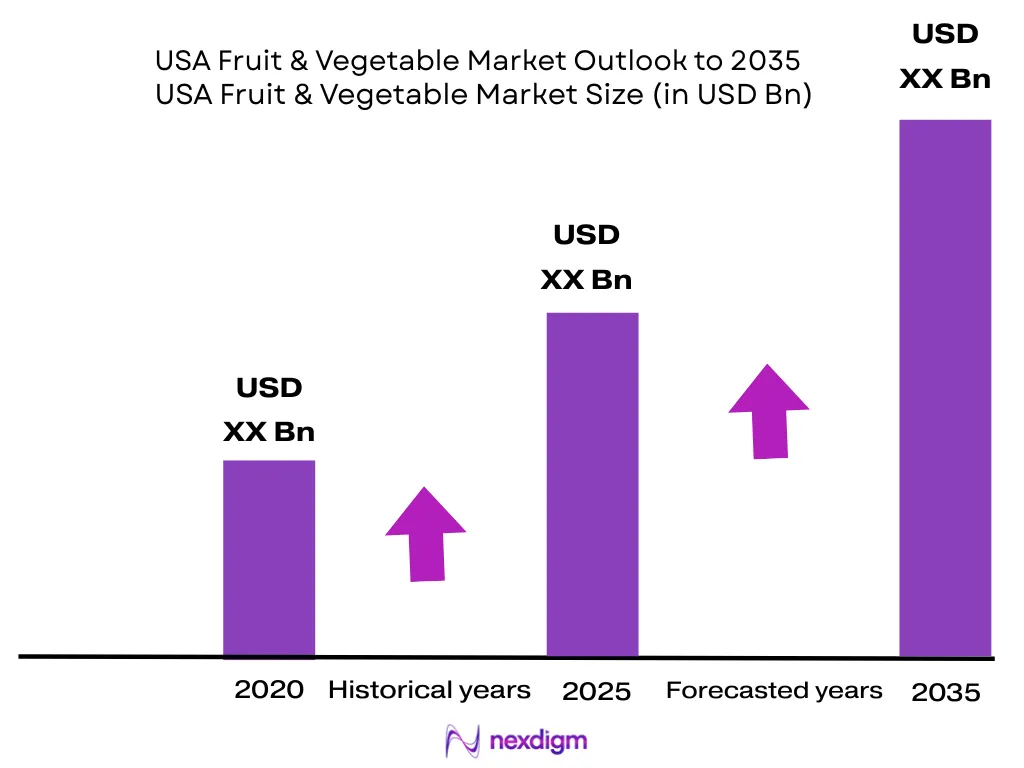
The USA Fruit and Vegetable Market is valued at USD ~ billion, based on a five-year historical analysis of fresh, frozen, dried and processed produce sales. The market is driven by health-led consumption, premium fresh produce, organic demand, online grocery adoption and convenience formats such as salad kits, cut fruit and ready-to-cook vegetables. The fresh fruits and vegetables category alone generated USD 134.85 billion, while noncitrus fruit production moved from 16.2 million tons to 15.9 million tons, reflecting production volatility despite strong consumer demand. The market is dominated by California, Washington, Florida, Arizona, Texas and Georgia due to crop diversity, irrigation infrastructure, long growing seasons, port access, packing facilities and established grower-shipper networks. California leads vegetable sales and remains the anchor for berries, grapes, citrus, lettuce, tomatoes and specialty crops. Washington is central to apples and pears, Florida supports citrus and winter vegetables, while Arizona strengthens winter lettuce and leafy-green supply. Vegetable and pulse availability reached 376 pounds per capita, showing the scale of domestic produce movement.
Market Segmentation
By Product Type
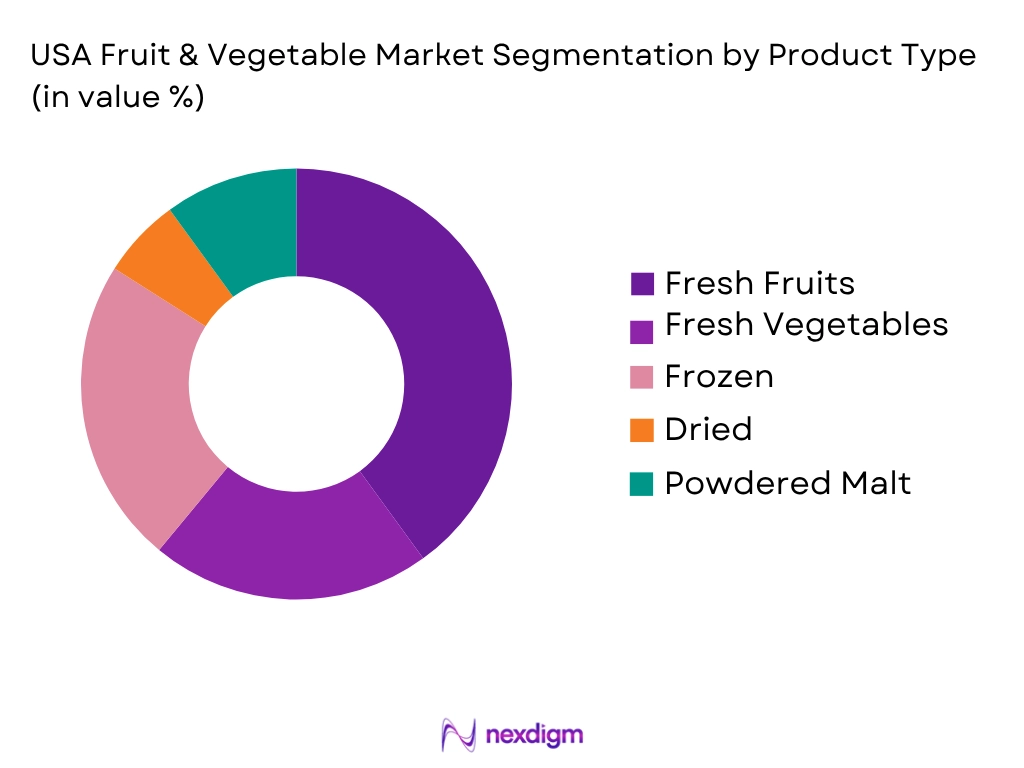
The USA Fruit and Vegetable Market is segmented by product type into fresh fruits, fresh vegetables, frozen fruits and vegetables, dried fruits and vegetables, and processed/canned/juice produce. Fresh fruits hold the dominant position because the segment benefits from high household penetration, premium berry demand, strong banana and apple basket frequency, growing avocado consumption and year-round import availability. Fresh fruits also command stronger retail merchandising, higher impulse purchase behavior and greater premiumization through branded berries, mandarins, table grapes and proprietary apple varieties. Retailers use fruit categories to drive perimeter traffic, while foodservice operators use fruits in smoothies, breakfast menus, salads, desserts and health-oriented offerings. The sub-segment also benefits from Mexico, Chile, Peru, Guatemala and Costa Rica supply flows that reduce seasonal gaps and support consistent shelf availability.
By Distribution Channel
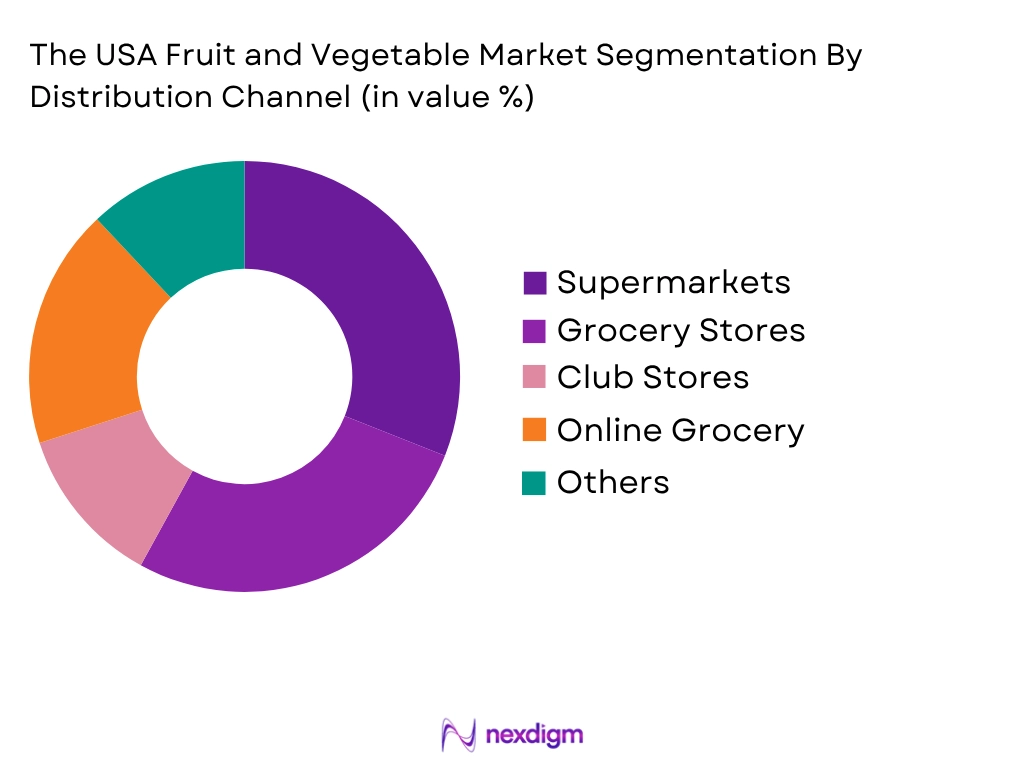
The USA Fruit and Vegetable Market is segmented by distribution channel into supermarkets and hypermarkets, grocery stores and specialty produce stores, club stores and mass merchandisers, online grocery and delivery platforms, and foodservice distributors and other channels. Supermarkets and hypermarkets dominate the market because they provide broad assortment depth, high-frequency replenishment, private label produce, promotional displays, fresh-cut sections, packaged salads, organic bays and regional sourcing programs in a single shopping environment. These stores also maintain advanced cold-chain handling, in-store quality checks, supplier scorecards and shrink-management systems. Their dominance is reinforced by weekly household grocery routines, strong basket-building around fresh departments, and the ability to cross-merchandise produce with meat, bakery, deli, dairy and meal-solution categories.
Competitive Landscape
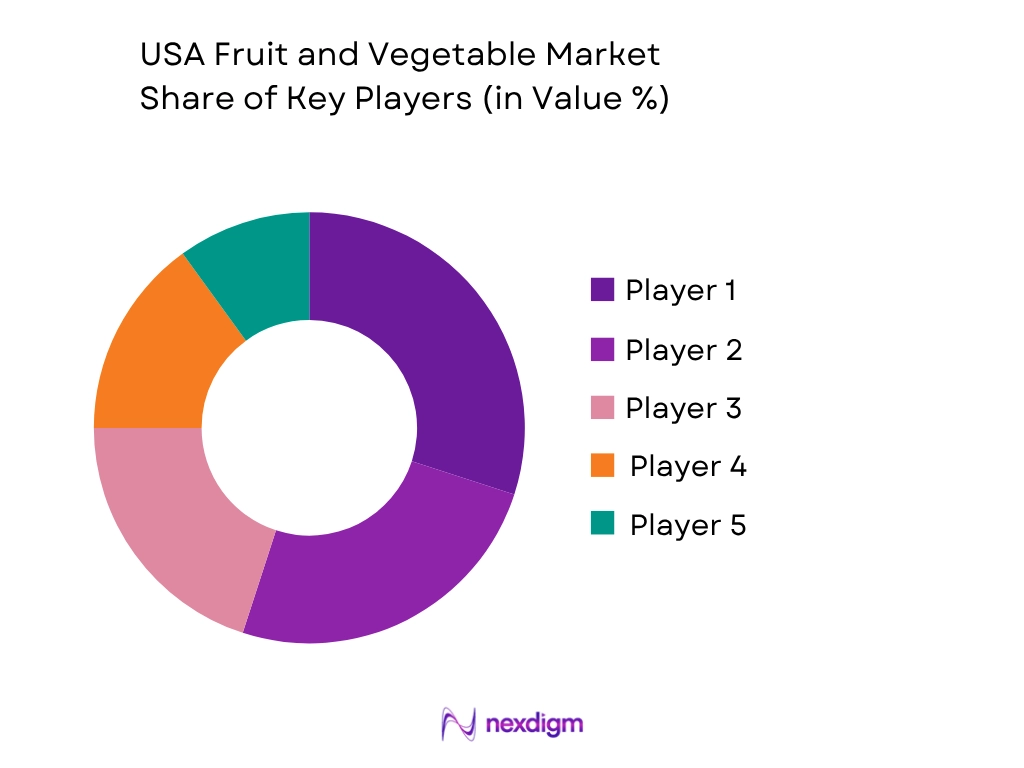
The USA Fruit and Vegetable Market is moderately consolidated at the branded grower-shipper, fresh-cut and import-distribution level, but highly fragmented at farm level. Large players such as Dole, Fresh Del Monte, Driscoll’s, Taylor Farms and The Wonderful Company dominate through integrated sourcing, national retail relationships, cold-chain assets, proprietary varieties, branded merchandising and year-round supply programs. Competition is shaped by reliability of supply, food-safety compliance, packaging innovation, organic capability and category specialization.
| Company | Establishment Year | Headquarters | Key Produce Categories | Business Model | Channel Strength | Supply Chain Footprint | Brand/Portfolio Strength | Market-Specific Advantage |
| Dole plc | 1851 | Dublin, Ireland / U.S. operations in Charlotte, North Carolina | ~ | ~ | ~ | ~ | ~ | ~ |
| Fresh Del Monte Produce Inc. | 1886 | Coral Gables, Florida | ~ | ~ | ~ | ~ | ~ | ~ |
| Driscoll’s Inc. | 1904 | Watsonville, California | ~ | ~ | ~ | ~ | ~ | ~ |
| Taylor Farms | 1995 | Salinas, California | ~ | ~ | ~ | ~ | ~ | ~ |
| The Wonderful Company | 1979 | Los Angeles, California | ~ | ~ | ~ | ~ | ~ | ~ |
USA Fruit and Vegetable Market Analysis
Growth Drivers
Strong Household Consumption Base Supports Frequent Fresh Produce Purchases
The USA Fruit and Vegetable Market is supported by a large consumer base and high purchasing capacity, which strengthens recurring demand for fresh fruits, vegetables, salads, cut produce and frozen produce. The World Bank reports the U.S. population at 340,110,988 people in 2024 and GDP per capita at USD 84,534.0 in 2024, indicating a broad, high-income consumption base for grocery and foodservice produce categories. Household final consumption expenditure reached USD 19,825,338,000,000 in 2024, according to World Bank-referenced national accounts data, which supports sustained grocery-store, club-store, online grocery and foodservice spending capacity. On the supply side, USDA NASS recorded 15.9 million tons of utilized production across 21 estimated noncitrus fruit crops in 2024, while grapes, apples and strawberries remained the three largest noncitrus crops. This combination of population depth, income scale and large fruit output supports demand for berries, apples, grapes, citrus, bananas, avocados, leafy greens and value-added produce.
Fresh and Value-Added Produce Demand is Supported by Large Vegetable Availability and Digital Grocery Reach
The USA Fruit and Vegetable Market is driven by the scale of vegetable availability and the ability of retailers to move produce through store and digital channels. USDA ERS reports total U.S. per capita vegetable and pulse availability at 376 pounds in 2024, keeping vegetables a major part of food consumption despite category pressure. USDA NASS also reported large 2024 output in key vegetables used across retail, foodservice and processing: tomatoes reached 236 million cwt, onions reached 77.1 million cwt, sweet corn reached 52.7 million cwt, head lettuce reached 41.8 million cwt, and romaine lettuce reached 39.1 million cwt. World Bank data shows 95 internet users per 100 people in the United States in 2024, which supports online grocery ordering, digital promotions, loyalty-based produce merchandising and rapid replenishment models. These indicators justify continued demand for salad kits, packaged greens, fresh-cut vegetables, meal-prep produce, frozen vegetable blends and e-commerce produce baskets.
Market Challenges
Production Volatility in Key Fruits and Vegetables Pressures Supply Consistency
The USA Fruit and Vegetable Market faces supply-side volatility because several important crops recorded lower output or acreage movement in 2024. USDA NASS reported utilized production of 15.9 million tons for 21 noncitrus fruit crops in 2024, lower than 16.2 million tons in 2023, showing reduced fruit availability in a category where retailers need year-round consistency. The same USDA report shows bearing acreage at 1.90 million acres for noncitrus fruits in 2024, with major deciduous crops accounting for 1.53 million acres, making crop output sensitive to weather, labor, irrigation and regional growing conditions. Vegetable production also showed crop-specific declines: tomatoes totaled 236 million cwt, carrots totaled 24.8 million cwt, cucumbers totaled 11.3 million cwt, spinach totaled 6.17 million cwt, and sweet potatoes totaled 24.7 million cwt in 2024, with each crop reflecting lower production versus the prior year in USDA reporting. With U.S. GDP per capita at USD 84,534.0, consumers can sustain demand, but output instability creates availability and procurement risks.
Labor Dependence Creates Operational Risk for Growers, Packers and Greenhouse Operators
The USA Fruit and Vegetable Market is exposed to labor risk because fruits, vegetables, nurseries and greenhouse crops require seasonal field labor, hand harvesting, grading, packing, sorting and cold-chain handling. The U.S. Department of Labor recorded 391,590 H-2A positions requested and 384,900 positions certified in FY2024, showing the scale of dependence on temporary agricultural labor for U.S. crop production. Within certified H-2A roles, 319,565 positions were for farmworkers and laborers in crop, nursery and greenhouse occupations, directly linking the labor pool to fruit, vegetable and controlled-environment agriculture operations. Florida had 47,416 certified positions, Georgia 43,436, California 37,511, Washington 35,884, and North Carolina 27,532, all important fruit, vegetable, berry, apple, citrus, greenhouse or fresh-produce states. This labor structure creates risk around harvest timing, product quality, packing capacity and service-level fulfillment for retailers. The macro backdrop adds pressure because the U.S. population reached 340,110,988 in 2024, expanding demand while the agricultural labor system remains highly seasonal.
Market Opportunities
Import-Backed Year-Round Supply Creates Opportunity for Distributor and Retail Expansion
The USA Fruit and Vegetable Market has a strong opportunity in import-backed year-round assortment planning, especially for berries, avocados, tomatoes, peppers, cucumbers, grapes, citrus and tropical fruits. USDA ERS notes that Mexico and Canada supplied most U.S. fresh vegetable imports in 2023, and USDA’s 2024 agricultural trade outlook forecast fresh fruit imports at USD 19.5 billion and fresh vegetable imports at USD 12.8 billion for FY2024. The opportunity is market specific because domestic production can be seasonal or weather constrained, while imports allow retailers and foodservice distributors to maintain stable SKU availability. USDA NASS reported 2024 grape utilized production at 5.40 million tons, including 872,610 tons for fresh market use and 4.53 million tons for processing, showing that domestic supply remains substantial but category balance depends on usage channel. The macro base is also supportive: World Bank reports U.S. GDP at USD 28.75 trillion in 2024 and population at 340,110,988, allowing importers, wholesalers and retailers to scale high-frequency fresh produce programs across a large consumer economy.
Organic, Controlled-Environment and Convenience Produce Have Scope for Channel Expansion
The USA Fruit and Vegetable Market has an opportunity in organic vegetables, greenhouse produce, hydroponic leafy greens, salad kits, cut fruit, washed vegetables and ready-to-cook produce formats. USDA ERS reported organic open-field tomatoes at 5.57 million cwt, organic potatoes at 5.25 million cwt, and organic lettuce at 3.9 million cwt in its 2024 vegetable outlook, showing that organic supply already exists across high-rotation vegetable categories. USDA NASS also reported 2024 fresh-market output for several convenience-led crops: head lettuce at 41.8 million cwt, romaine lettuce at 39.1 million cwt, leaf lettuce at 16.1 million cwt, carrots at 24.8 million cwt, and broccoli at 13.5 million cwt. These crops directly feed packaged salads, chopped vegetables, meal-prep kits and fresh-cut retail programs. World Bank data shows 95 internet users per 100 people in 2024, strengthening online grocery, subscription produce boxes and omnichannel merchandising for premium and convenience produce. The opportunity is therefore tied to channel modernization, not only crop output, as retailers can use digital baskets, private label, traceability and faster replenishment to expand fresh and value-added produce sales.
Future Outlook
The USA Fruit and Vegetable Market is expected to expand steadily, supported by demand for fresh, organic, locally sourced, convenient and nutrient-dense foods. The market is forecast to grow at a long-range CAGR of 3.9% during the forecast period. Growth will be led by berries, avocados, salad kits, fresh-cut vegetables, organic produce, greenhouse vegetables, frozen produce and online grocery. However, climate volatility, labor costs, food-safety compliance, shrink and import competition will remain major constraints. Fresh produce will remain the core revenue contributor, but value-added and convenience formats will outperform bulk commodities. Salad kits, cut fruit, snack packs, smoothie-ready frozen fruit and ready-to-cook vegetable blends will gain share as households prioritize speed, portion control and lower waste. Retailers will continue to use produce as a traffic driver, while foodservice demand will recover through bowls, salads, breakfast fruit, plant-forward menus and institutional nutrition programs. Controlled environment agriculture will gain relevance in tomatoes, cucumbers, peppers, leafy greens and herbs. Greenhouse and hydroponic production will reduce weather dependence and improve consistency, although energy cost and capital intensity will limit broad crop-level adoption. Imports from Mexico, Canada, Chile and Peru will remain central to supply continuity, particularly for avocados, berries, tomatoes, cucumbers, peppers, grapes and counter-seasonal fruit.
Major Players
- Dole plc
- Fresh Del Monte Produce Inc.
- Driscoll’s Inc.
- Taylor Farms
- The Wonderful Company
- Grimmway Farms
- Sunkist Growers
- Naturipe Farms
- Ocean Spray Cranberries Inc.
- Mastronardi Produce
- Bowery Farming
- Chiquita Brands International
- C.H. Robinson Worldwide
- Oppy
- Limoneira Company
Key Target Audience
- Grower-shippers and integrated produce companies
- Fresh-cut produce processors and salad kit manufacturers
- Supermarket chains, hypermarkets and grocery retailers
- Foodservice distributors and institutional food procurement companies
- Cold-chain logistics, reefer transport and produce warehousing companies
- Investments and venture capitalist firms
- Government and regulatory bodies (USDA, FDA, USDA NASS, USDA ERS, APHIS, EPA, U.S. Customs and Border Protection)
- Packaging, traceability and agri-technology solution providers
Research Methodology
Step 1: Identification of Key Variables
The initial phase involves constructing an ecosystem map of the USA Fruit and Vegetable Market, covering growers, packers, shippers, importers, wholesalers, retailers, foodservice distributors and processors. Key variables include crop type, production volume, import dependency, channel mix, retail pricing, organic penetration, cold-chain reach, shrink and value-added produce adoption.
Step 2: Market Analysis and Construction
Historical market analysis is conducted by evaluating production data, retail value, fresh produce sales, import-export flows, distribution channel movement and consumption indicators. The market model combines top-down industry valuation with bottom-up commodity-level analysis across fruits, vegetables, frozen produce, dried produce and processed produce formats.
Step 3: Hypothesis Validation and Expert Consultation
Market assumptions are validated through structured interviews with grower-shippers, produce buyers, category managers, distributors, fresh-cut processors, packaging suppliers and foodservice procurement heads. These consultations help verify price realization, channel margins, shrink rates, supplier concentration, seasonal procurement behavior and future growth drivers.
Step 4: Research Synthesis and Final Output
The final phase integrates secondary research, expert validation and proprietary market modelling into a structured market report. The output includes market size, growth outlook, segmentation, competitive benchmarking, target audience mapping and strategic recommendations for stakeholders operating across the USA fruit and vegetable value chain.

- Executive Summary
- Research Methodology (Market Definitions and Scope, Fruit & Vegetable Classification, Fresh/Processed/Frozen/Canned/Juice Inclusion, Farm-Gate vs Wholesale vs Retail Valuation, Volume Conversion Approach, USDA/ERS/NASS Harmonization, Retail Scanner Data Triangulation, Import-Export Mapping, Price Realization Approach, Primary Interviews with Growers/Shippers/Distributors/Retailers/Foodservice Operators, Bottom-Up Acreage-Yield-Production Model, Top-Down Consumption-Spend Model, Limitations and Forecast Assumptions)

- Definition and Scope
- Market Genesis and Evolution
- Industry Structure and Business Cycle
- Produce Value Chain Analysis
- Supply Chain Analysis

- Growth Drivers (Health-and-Wellness Consumption, Fresh Snacking, Plant-Forward Diets, Convenience Produce, Ethnic Cuisine Adoption, Retail Fresh Differentiation, Foodservice Menu Innovation, Organic Demand, Import-Led Availability, CEA Supply Expansion)
- Market Restraints and Challenges (Weather Volatility, Water Stress, Labor Availability, Wage Inflation, Food-Safety Recalls, Shrink, Freight Costs, Cold-Chain Capacity, Import Competition, Farm Consolidation)
- Market Opportunities (Export Market Diversification, Cold-Chain Investment, Organic Produce, Protected Cultivation, Digital Wholesale Platforms, Food Processing, Regional Branding, Traceability Systems)
- Market Trends (Consumer Claims, Channel Shifts, Crop Mix Changes, Technology Adoption, Packaging Innovation, Sustainability Metrics, Demand Signals)
- SWOT Analysis
- Porter’s Five Forces

- By Value (2020-2025)
- By Volume (2020-2025)
- By Average Selling Price (2020-2025)

- By Product Category (In Value %)
Fresh Fruits
Fresh Vegetables
Processed Fruits
Processed Vegetables
Value-Added Produce - By Fruit Type (In Value %)
Berries
Citrus Fruits
Apples and Pears
Grapes and Stone Fruits
Tropical and Subtropical Fruits - By Distribution Channel (In Value %)
Grocery Retail
Mass Merchandisers
Club Stores
Convenience Stores
Discount Retail - By Geography (In Value %)
West
Southeast
Northeast
Midwest
Southwest

- Market Share of Major Players (Value Share, Volume Share, Commodity Share, Channel Share, Regional Share)
- Cross Comparison Parameters (Commodity Portfolio Depth, Domestic Acreage and Grower Network, Import Sourcing Footprint, Packhouse and Fresh-Cut Capacity, Cold-Chain and Distribution Reach, Retail/Foodservice Account Penetration, Organic/Greenhouse/CEA Capability, Traceability and Food-Safety Compliance Infrastructure)
- SWOT Analysis of Major Players
- Pricing and SKU Benchmarking of Major Players
- Detailed Profiles of Major Companies
Dole plc
Fresh Del Monte Produce Inc.
Driscoll’s Inc.
Taylor Farms
The Wonderful Company
Grimmway Farms
Sunkist Growers
Naturipe Farms
Ocean Spray Cranberries Inc.
Mastronardi Produce
Bowery Farming
Chiquita Brands International
C.H. Robinson Worldwide
Oppy
Limoneira Company

- Household Consumer Analysis
- Grocery Retailer Analysis
- Foodservice Operator Analysis
- Food Processor Analysis
- Institutional Buyer Analysis

- By Value (2026-2035)
- By Volume (2026-2035)
- By Average Selling Price (2026-2035)


 Request a Sample
 Ask for Customization
 Get a Quote
 Enquire Now