
 Download PDF
Market Overview
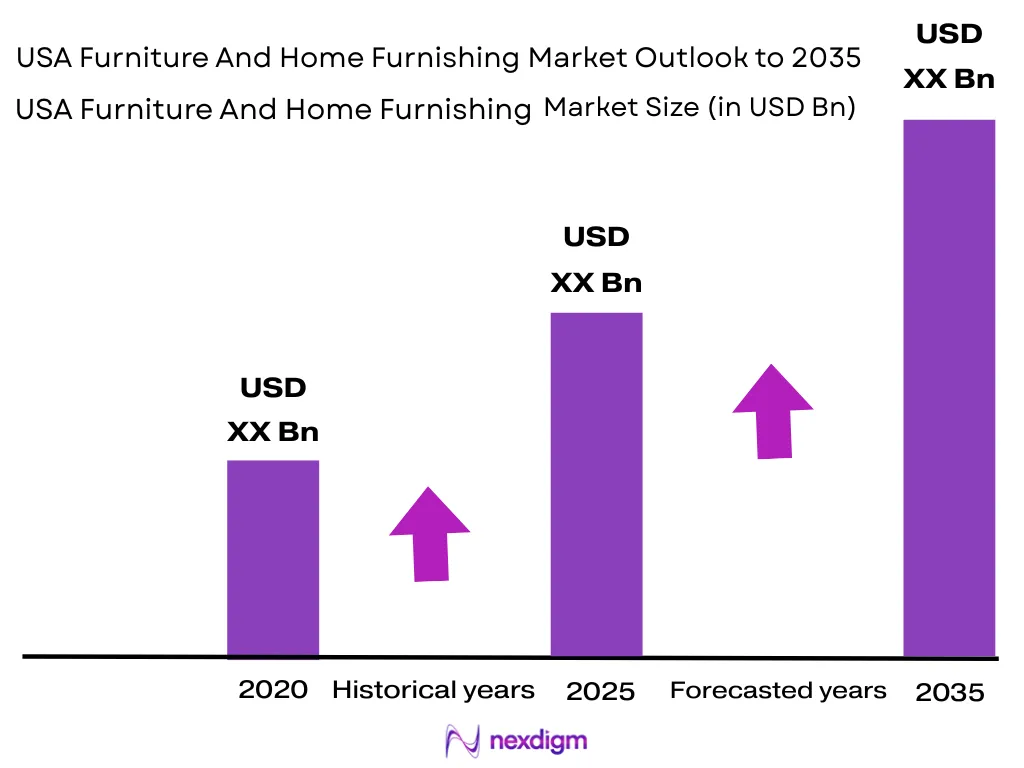
The USA Furniture And Home Furnishing Market is valued at USD ~ billion, based on the latest base-year market assessment, compared with a prior historical base supported by retail, housing, and furnishing demand indicators. Growth is driven by home renovation, household formation, replacement furniture demand, outdoor living, premium home décor, online furniture platforms, and category expansion across home furniture, flooring, textiles, lighting, wall décor, and accessories. The USA dominates North America due to its large household base, mature furniture retail infrastructure, high home improvement expenditure, and strong omnichannel retail ecosystem. New York, Los Angeles, Dallas-Fort Worth, Houston, Atlanta, Phoenix, Chicago, and Miami remain dominant demand clusters because they combine large metro populations, high-income households, active multifamily development, housing turnover, interior design activity, builder networks, and dense distribution infrastructure supporting bulky furniture delivery.
Market Segmentation
By Product Type
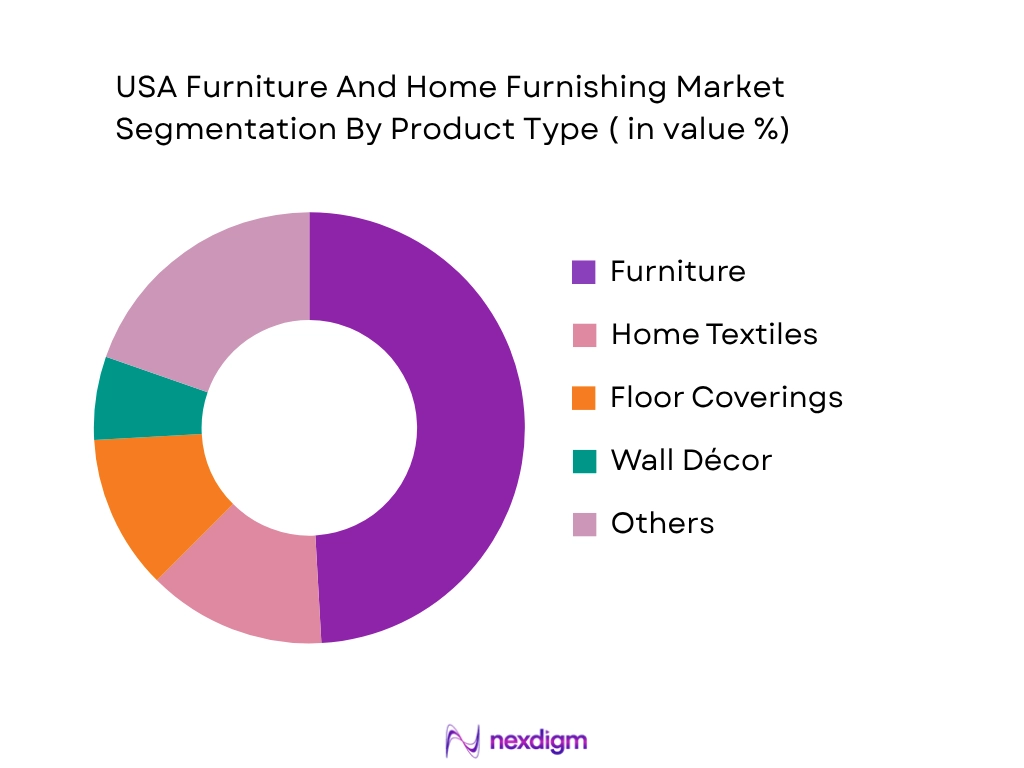
The USA Furniture And Home Furnishing Market is segmented by product type into furniture, home textiles, floor coverings, wall décor, and lighting and decorative accessories. Furniture has the dominant market share because it remains the highest-ticket and most essential category across residential and commercial spaces. Demand is led by sofas, sectionals, beds, dining sets, recliners, office desks, mattresses, outdoor seating, and storage units. The segment benefits from replacement cycles, home purchases, rental move-ins, renovation projects, and lifestyle-led room upgrades. Retailers also prioritize furniture because it improves average order value and supports attachment sales in rugs, lighting, textiles, and décor. In the USA, living room and dining room furniture remain central categories because open-plan homes, family gathering spaces, and entertainment-led room layouts encourage coordinated furniture purchases. Premium upholstery, modular sectionals, performance fabrics, and multifunctional furniture are expanding the segment further.
By End User
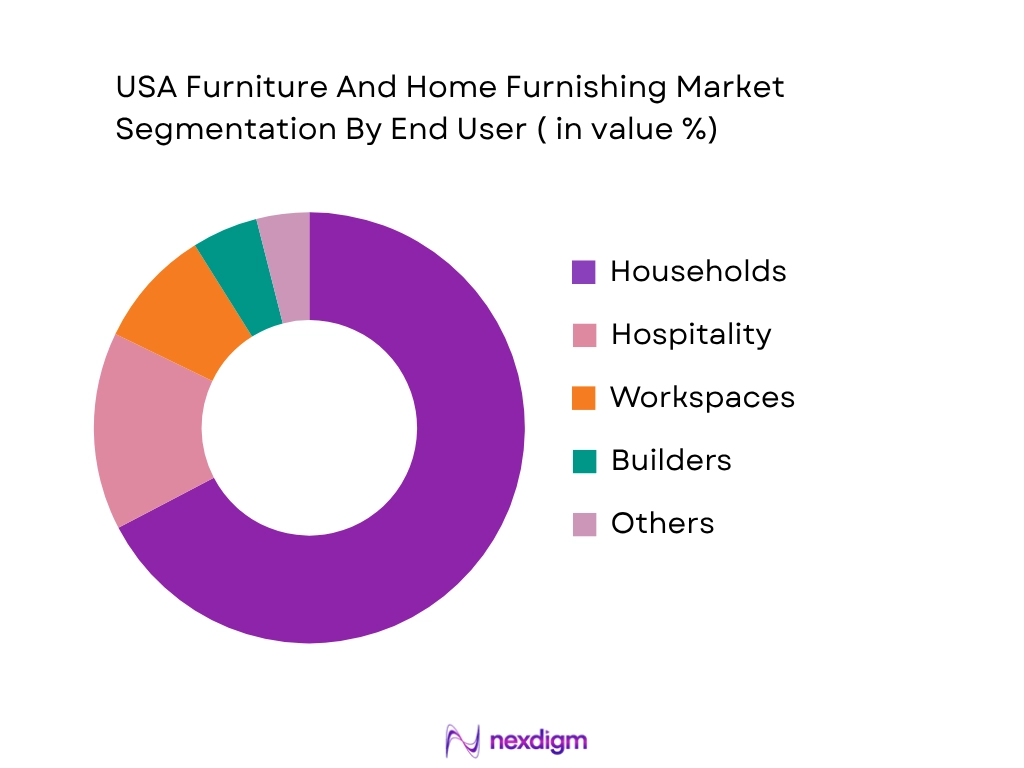
The USA Furniture And Home Furnishing Market is segmented by end user into residential households, hospitality and commercial spaces, corporate offices and workspaces, builders, developers and property managers, and institutional buyers. Residential households dominate because most furniture and furnishing purchases are triggered by move-ins, remodeling, replacement demand, household formation, remote work setup, nursery creation, seasonal refresh, and outdoor living upgrades. The residential segment also has broad product coverage, including sofas, mattresses, beds, dining furniture, rugs, curtains, lighting, storage, wall décor, and home textiles. Homeowners typically purchase higher-value pieces during remodeling cycles, while renters drive demand for compact, flat-pack, affordable, and multifunctional products. Online discovery, financing options, room-planning tools, and fast delivery have further increased residential purchase frequency. The segment is also supported by lifestyle trends such as pet-friendly upholstery, performance materials, sustainable furniture, and design-led home personalization.
Competitive Landscape
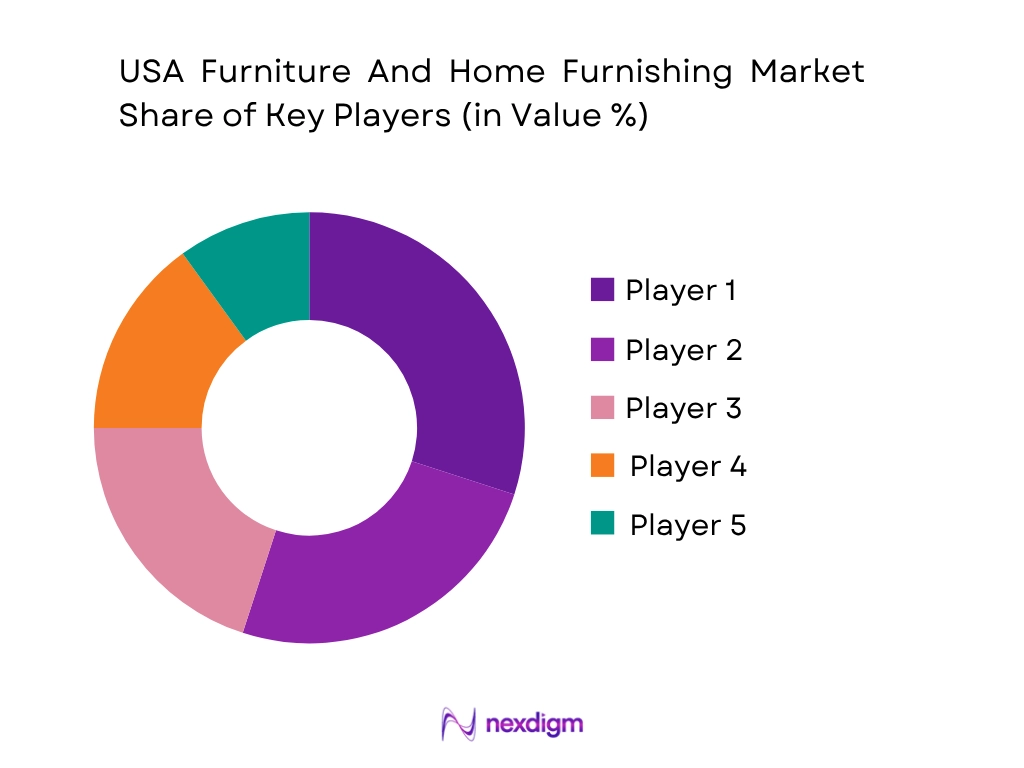
The USA Furniture And Home Furnishing Market is highly competitive, with large furniture manufacturers, specialty retailers, omnichannel home furnishing chains, online marketplaces, premium design-led brands, and discount furniture chains competing across price tiers. Ashley Furniture, IKEA, Wayfair, Williams-Sonoma, and RH influence the market through differentiated models: manufacturing scale, flat-pack affordability, online marketplace depth, premium lifestyle retail, and luxury gallery-led selling.
| Company | Establishment Year | Headquarters | Core Positioning | Product Strength | Sales Channel | Fulfillment Model | Price Tier | Market-Specific Capability |
| Ashley Furniture Industries | 1945 | Arcadia, Wisconsin | ~ | ~ | ~ | ~ | ~ | ~ |
| IKEA USA | 1943 | Conshohocken, Pennsylvania / Global HQ: Delft, Netherlands | ~ | ~ | ~ | ~ | ~ | ~ |
| Wayfair | 2002 | Boston, Massachusetts | ~ | ~ | ~ | ~ | ~ | ~ |
| Williams-Sonoma Inc. | 1956 | San Francisco, California | ~ | ~ | ~ | ~ | ~ | ~ |
| RH | 1979 | Corte Madera, California | ~ | ~ | ~ | ~ | ~ | ~ |
USA Furniture And Home Furnishing Market Analysis
Growth Drivers
Housing completions are expanding the addressable base for furniture and furnishing purchases
The USA Furniture And Home Furnishing Market is supported by a large pipeline of newly completed homes that require beds, sofas, dining sets, mattresses, rugs, lighting, storage, kitchen furnishings and décor after occupancy. The U.S. Census Bureau and HUD reported 1,627,900 privately owned housing completions in 2024, while 1,471,200 housing units were authorized by permits and 1,364,100 housing units were started in the same year. These numbers support downstream furnishing demand because every completed housing unit creates room-level requirements across living rooms, bedrooms, kitchens, bathrooms, home offices and outdoor spaces. The opportunity is also supported by home size: the Census Bureau reported the median size of a new single-family home sold at 2,210 square feet, giving retailers and manufacturers larger multi-room furnishing opportunities per household.
Large household base and income capacity support recurring replacement and room-refresh demand
The USA Furniture And Home Furnishing Market benefits from a broad household base and stable purchasing capacity. The U.S. Census Bureau’s household series shows 132,216 thousand households in 2024 and 134,790 thousand households in 2025, creating a large recurring base for replacement furniture, home textiles, mattresses, lighting and décor. The World Bank reported U.S. GDP at USD 28.75 trillion and GDP per capita at USD 84,534.0 in 2024, indicating strong macroeconomic capacity for discretionary home-related purchases. The U.S. Census Bureau series on real median household income also reported USD 83,730 in 2024, supporting mid-market and premium furnishing demand from households upgrading rooms, adding home-office setups, replacing mattresses, and purchasing outdoor furniture.
Market Challenges
High mortgage rates restrict housing turnover and delay furniture replacement cycles
The USA Furniture And Home Furnishing Market is challenged by elevated borrowing conditions because furniture demand is closely linked to home purchases, relocation and remodeling decisions. Freddie Mac reported the 30-year fixed-rate mortgage at 6.53 in the latest 2026 weekly release, while the Federal Reserve’s H.15 release showed the bank prime loan rate at 6.75 on June 3, 2026. These financing conditions make home purchases more difficult for many households, slowing move-triggered furniture purchases such as sofas, beds, dining sets, mattresses, storage systems and outdoor furniture. The U.S. Census Bureau also reported 1,471,200 permits in 2024, lower than 1,511,100 permits in 2023, showing weaker forward construction activity that can constrain future furnishing demand tied to new housing.
Housing-cost pressure limits discretionary spending on large-ticket furnishings
The USA Furniture And Home Furnishing Market faces pressure from household budget allocation because housing is the largest expense category for U.S. consumers. The U.S. Bureau of Labor Statistics reported average annual household expenditures of USD 78,535 in 2024, with housing expenditure at USD 26,266 per household and monthly housing expenditure at USD 2,189. This reduces flexibility for discretionary purchases such as premium sofas, bedroom sets, outdoor furniture, rugs, lighting and décor, especially for middle-income households. The challenge is reinforced by the Census Bureau’s real median household income figure of USD 83,730 in 2024, which shows that a large portion of household income is absorbed by essential spending before consumers allocate budgets to home furnishing upgrades.
Market Opportunities
Urban household density creates opportunity for compact, modular and multifunctional furnishings
The USA Furniture And Home Furnishing Market has a clear opportunity in compact, modular and multifunctional products because urban living supports demand for storage beds, sleeper sofas, extendable dining tables, foldable desks, wall-mounted storage, modular sectionals and small-space décor. World Bank data shows the U.S. urban population at 284,043,692 people in 2024, while the U.S. Census Bureau reported national population growth to 340.1 million people in 2024. The household base also expanded from 132,216 thousand households in 2024 to 134,790 thousand households in 2025, creating more occupied spaces requiring furniture and home furnishings. This supports future growth for retailers and manufacturers focused on apartment-friendly furniture, rental move-in bundles, ready-to-assemble formats and quick-delivery urban fulfillment models.
New-home size and completions support full-room furnishing, premium décor and outdoor living opportunities
The USA Furniture And Home Furnishing Market has future growth potential in full-room packages, premium décor, outdoor furniture and design-led merchandising because newly completed homes provide multiple furnishing touchpoints. The U.S. Census Bureau and HUD reported 1,627,900 housing completions in 2024, and the Census Bureau reported the median size of a new single-family home sold at 2,210 square feet. Larger homes create demand across living rooms, bedrooms, dining areas, kitchens, bathrooms, home offices, patios and storage spaces. This supports bundled selling of sofas, beds, mattresses, dining sets, rugs, lighting, wall décor, curtains and outdoor seating. The same construction pipeline also included 1,364,100 housing starts in 2024, giving suppliers, retailers and logistics firms a measurable current base for planning future inventory and fulfillment capacity.
Future Outlook
The USA Furniture And Home Furnishing Market is expected to expand steadily, supported by housing normalization, remodeling activity, rising design personalization, and continued digital penetration. The forecasted CAGR for the furniture market outlook is 6.87% for the forecast period. Growth will be shaped by the recovery in housing turnover, higher adoption of modular furniture, smart furniture, sustainable materials, and premium outdoor living. Retailers with omnichannel inventory visibility, efficient bulky-goods logistics, private-label strength, and financing options are expected to outperform. The market will increasingly shift from product-only selling to solution-led selling. Consumers are purchasing room packages, coordinated furniture collections, design consultations, custom upholstery, lighting bundles, rugs, and décor as integrated projects. This benefits retailers with strong merchandising, in-house design teams, trade programs, AR visualization, and reliable last-mile delivery. Online platforms will remain important, but physical stores will not disappear. Instead, showrooms, design centers, and experiential galleries will support high-consideration purchases such as sofas, mattresses, dining sets, outdoor furniture, and luxury furnishings. The strongest players will combine online discovery with in-person validation, financing, delivery scheduling, and post-sale support.
Major Players
- Ashley Furniture Industries
- IKEA USA
- Williams-Sonoma Inc.
- Wayfair Inc.
- RH
- La-Z-Boy Inc.
- Ethan Allen Interiors
- Haverty Furniture Companies
- Rooms To Go
- Raymour & Flanigan
- Bassett Furniture Industries
- Hooker Furnishings Corporation
- Arhaus
- Lovesac
- Sleep Number Corporation
Key Target Audience
- Furniture manufacturers and contract furniture producers
- Home furnishing retailers and specialty store chains
- Online furniture marketplaces and DTC home furnishing brands
- Real estate developers, builders and property management companies
- Hospitality owners and FF&E procurement teams
- Investments and venture capitalist firms
- Government and regulatory bodies
- Logistics, warehousing and white-glove delivery service providers
Research Methodology
Step 1: Identification of Key Variables
The initial phase involves constructing an ecosystem map covering manufacturers, importers, retailers, e-commerce marketplaces, home improvement chains, designers, builders, logistics providers, and end users in the USA Furniture And Home Furnishing Market. Key variables include furniture retail sales, home furnishing revenue, housing permits, remodeling demand, import exposure, store count, e-commerce penetration, average order value, and delivery economics.
Step 2: Market Analysis and Construction
The second phase involves compiling historical and current market data for furniture, home textiles, floor coverings, lighting, wall décor, outdoor furniture, and accessories. Revenue construction is carried out through top-down market sizing and bottom-up company-level analysis, supported by product category splits, retail channel analysis, end-user demand mapping, and pricing benchmarks across value, mid-market, premium, and luxury tiers.
Step 3: Hypothesis Validation and Expert Consultation
Market hypotheses are validated through discussions with furniture retailers, upholstery manufacturers, mattress brands, importers, distributors, interior designers, logistics operators, and commercial FF&E buyers. These consultations help verify category demand, pricing pressure, inventory movement, delivery challenges, regional demand clusters, consumer preferences, and channel-level profitability.
Step 4: Research Synthesis and Final Output
The final phase synthesizes secondary research, company disclosures, industry databases, primary interviews, and bottom-up triangulation into a validated market model. Findings are refined to assess market size, segmentation, competitive positioning, growth drivers, future outlook, and opportunity areas for stakeholders operating in the USA Furniture And Home Furnishing Market.

- Executive Summary
- Research Methodology (Market Definitions and Scope, NAICS Classification Mapping, Furniture vs Home Furnishing Boundary, Top-Down Market Sizing Approach, Bottom-Up Revenue Build-Up, Retail Sales Triangulation, Manufacturer Shipment Analysis, Import-Export Mapping, E-Commerce Revenue Estimation, Store Count Normalization, Average Ticket Assessment, Primary Interviews with Retailers/Manufacturers/Distributors/Interior Designers, Consumer Survey Framework, Trade Association Inputs, Data Validation Matrix, Limitations and Forecast Assumptions)

- Definition and Scope
- Market Genesis and Evolution
- Timeline of Major Business Model Shifts
- Industry Business Cycle
- Supply Chain and Value Chain Analysis

- Growth Drivers (Housing Turnover, Home Equity, Renovation Spending, Urban Apartment Demand, Aging Housing Stock, DTC Furniture Expansion, Premiumization)
- Market Challenges (High Mortgage Rates, Low Existing Home Sales, Consumer Price Sensitivity, Inventory Overhang, Freight Damage, Returns, Tariff Exposure)
- Market Opportunities (Design Services, Private Label, Circular Furniture, AI Room Planning, Modular Living, Trade Programs, Smart Furniture)
- Market Trends (Omnichannel Retail, Customization, Performance Fabrics, Fast Décor, Private Label, Sustainable Sourcing, Financing-Led Conversion)
- SWOT Analysis
- Porter’s Five Forces
- PESTLE Analysis

- By Revenue (2020-2025)
- By Volume (2020-2025)
- By Average Selling Price (2020-2025)

- By Product Category In Value %)
Living Room Furniture
Bedroom Furniture
Dining and Kitchen Furniture
Office and Home Office Furniture - By Room Type (In Value %)
Living Room
Bedroom
Dining Room
Kitchen
Bathroom - By Sales Channel (In Value %)
Furniture Specialty Stores
Home Furnishing Specialty Stores
Big-Box Home Improvement Retailers
Mass Merchandisers
Warehouse Clubs - By End User (In Value %)
Residential Homeowners
Renters
Multifamily Developers
Single-Family Builders
Hospitality Sector - By Region (In Value %)
Northeast
Midwest
South
West

- Market Share of Major Players (Revenue Share, Category Share, Channel Share, Store-Based Share, Online Share)
- Cross Comparison Parameters (Store Footprint, Online Revenue Mix, Average Order Value, Product Category Breadth, Private Label/Owned Brand Strength, Import and Tariff Exposure, Last-Mile/White-Glove Delivery Coverage, Financing and BNPL Penetration)
- SWOT Analysis of Major Players
- Pricing Analysis by Key SKUs
- Detailed Profiles of Major Companie
Ashley Furniture Industries
IKEA USA
Williams-Sonoma Inc.
Wayfair Inc.
RH
La-Z-Boy Inc.
Ethan Allen Interiors
Haverty Furniture Companies
Rooms To Go
Raymour & Flanigan
Bassett Furniture Industries
Hooker Furnishings Corporation
Arhaus
Lovesac
Sleep Number Corporation

- Residential Consumer Demand Analysis
- Commercial Buyer Demand Analysis
- Customer Purchase Journey
- Purchasing Power and Budget Allocation
- Needs, Desires and Pain Point Analysis

- By Revenue (2026-2035)
- By Volume (2026-2035)
- By Average Selling Price (2026-2035)


 Request a Sample
 Ask for Customization
 Get a Quote
 Enquire Now