
 Download PDF
Market Overview
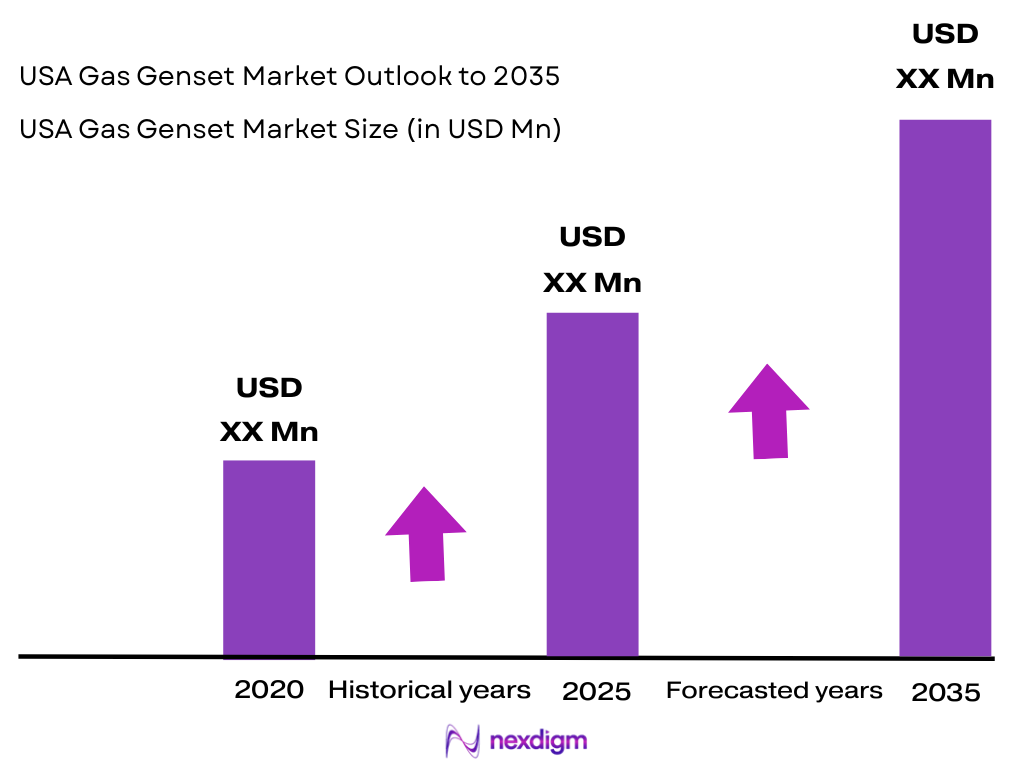
The USA Gas Genset Market was valued at USD ~ Million in 2024 and is anticipated to expand at a CAGR of ~% during 2026-2035. The market is primarily driven by rising demand for resilient backup power amid increasing grid outage frequency linked to extreme weather events, expansion of EV and battery gigafactory construction under the Inflation Reduction Act, and widespread availability of natural gas pipeline infrastructure across major manufacturing corridors that continues to support natural gas gensets as the preferred captive power alternative to diesel. According to industry estimates, the USA Gas Genset Market was valued at approximately USD ~ million in 2025 and is projected to grow at a CAGR of approximately 8.4%, reaching approximately USD ~ billion by 2035, while natural gas-based captive power adoption across new and battery manufacturing facility installations exceeded 38% in 2024. Rising demand from EV and battery gigafactory projects across the Southeast and Midwest for reliable, compliant backup and interim power, alongside continued reshoring of manufacturing capacity, is generating a step-change in demand across the natural gas and dual-fuel genset segments.
Market Segmentation
By Fuel Type
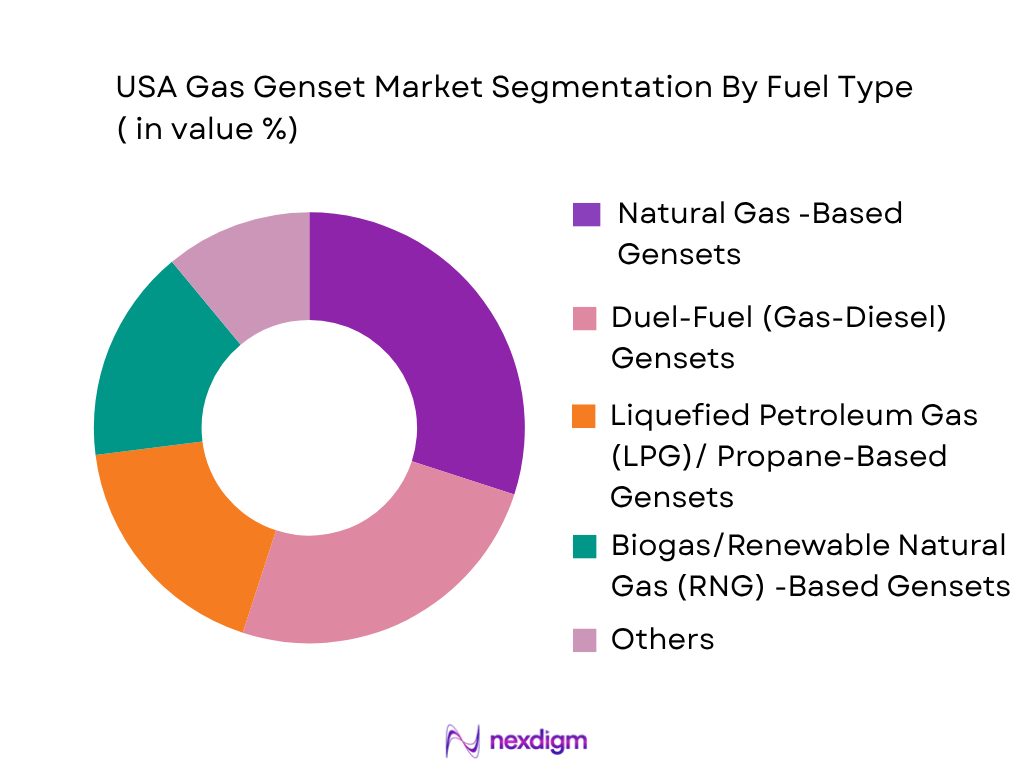
Among these, natural gas-based gensets continue to dominate the USA Gas Genset Market, with Caterpillar and Cummins together supplying a substantial share of installed capacity across manufacturing corridors in Michigan, Ohio, Tennessee, and Texas, supported by extensive interstate pipeline infrastructure connecting these industrial regions. Generac and Kohler continue to differentiate through dual-fuel and bi-fuel genset offerings that allow existing diesel genset fleet owners to transition gradually toward gas-based operation, positioning themselves as preferred partners for auto component manufacturers seeking to reduce operating costs and emissions without full capital replacement. Wärtsilä North America and Rolls-Royce Power Systems (MTU) Americas have carved out significant share in the high power rating segment, supplying large-scale gensets for EV and battery gigafactory campuses requiring continuous, high-capacity captive and interim power during phased construction and ramp-up. Renewable Natural Gas (RNG) and biogas genset adoption is gaining increasing importance as OEMs pursue corporate net-zero commitments, with Aggreko North America and Atlas Copco expanding rental fleet offerings that support flexible, sustainability-aligned power sourcing.
By Region
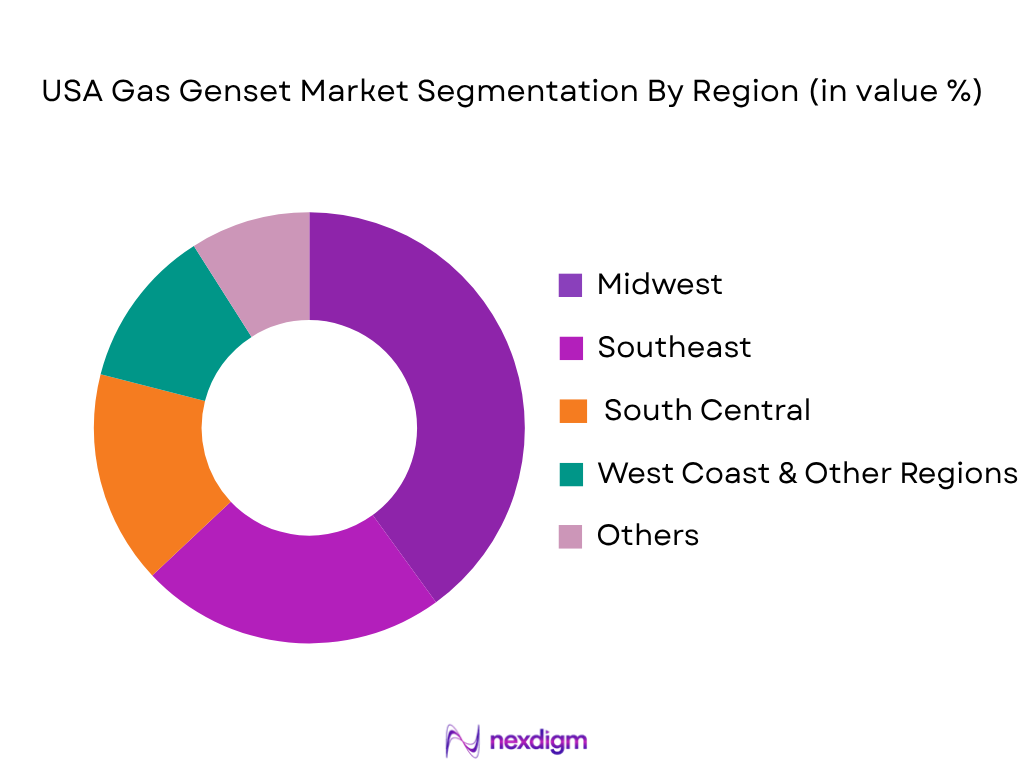
The Midwest, anchored by Michigan, Ohio, Indiana, and Illinois, remains the largest regional market within the USA Gas Genset Market by revenue and installed capacity, given its status as the traditional heart of American manufacturing and its mature natural gas pipeline network. The Southeast, spanning Tennessee, Kentucky, Alabama, South Carolina, and Georgia, continues to drive the fastest-growing demand as the region has become the primary destination for new EV and battery gigafactory investment, requiring substantial new captive and interim power capacity during construction and early operational phases. South Central Texas is witnessing strong growth in gas genset adoption supported by abundant in-state natural gas supply and continued expansion of vehicle and battery component manufacturing facilities. The West Coast and other regions, including California’s EV and battery manufacturing base, maintain steady but comparatively smaller demand, shaped in part by stricter CARB emission requirements that influence genset technology selection.
Competitive Landscape
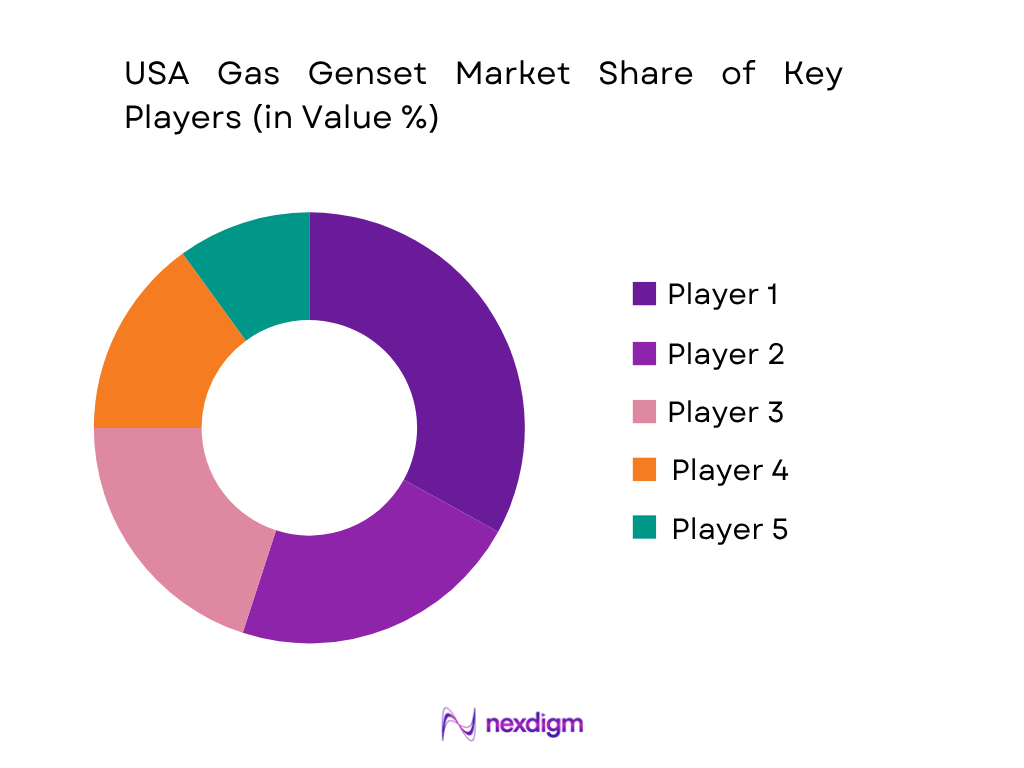
The USA Gas Genset Market is moderately concentrated around a small number of established genset manufacturers with strong distribution and service network coverage, with Caterpillar, Cummins, Generac, Kohler, and Rolls-Royce Power Systems (MTU) Americas together accounting for the substantial majority of installed capacity supplied to manufacturing and ancillary facilities across the country. Competition is primarily based on fuel efficiency and total cost of ownership, EPA and NFPA 110 regulatory compliance, after-sales service network coverage, power rating breadth, and remote monitoring and automation capability. Caterpillar maintains its position as a leading market participant through its extensive dealer network and broad power rating portfolio spanning OEM and gigafactory applications. Cummins continues to compete on domestic manufacturing scale and long-standing relationships with American and transplant OEMs, while Generac and Kohler target the mid-sized auto ancillary and dealership segment with dual-fuel and natural gas genset offerings. Wärtsilä North America and Rolls-Royce Power Systems (MTU) Americas continue to compete on large-capacity, continuous-duty gas power generation for gigafactory-scale projects, while Aggreko North America and Atlas Copco support flexible rental and interim power requirements during the construction phase of new EV and battery manufacturing facilities.
| Company | Establishment Year | Headquarters | Primary Service Portfolio | Product Portfolio
|
Network Presence | Major End-Use Industries | Key Strategic Focus | Certifications & Compliance |
| Caterpillar Inc. | 1925 | ~ | ~ | ~ | ~ | ~ | ~ | ~ |
| Cummins Inc. | 1919 | ~ | ~ | ~ | ~ | ~ | ~ | ~ |
| Generac Power Systems, Inc. | 1959 | ~ | ~ | ~ | ~ | ~ | ~ | ~ |
| Kohler Co. | 1873 | ~ | ~ | ~ | ~ | ~ | ~ | ~ |
| Rolls-Royce Power Systems (MTU) Americas | 1909 | ~ | ~ | ~ | ~ | ~ | ~ | ~ |
USA Gas Genset Market Analysis
Growth Drivers
Grid Resilience Demand and Gigafactory Construction Growth
The USA Gas Genset Market continues to be shaped decisively by rising demand for resilient backup power amid increasing grid outage frequency linked to extreme weather events, including hurricanes across the Southeast and winter storms across the Midwest and Texas, which continue to underscore the operational risk of relying solely on grid power for continuous manufacturing operations. Expansion of EV and battery gigafactory construction under the Inflation Reduction Act continues to generate substantial new demand for both interim construction-phase power and permanent backup power capacity at newly built facilities across the Southeast and Midwest. According to industry estimates, the USA Gas Genset Market is projected to grow at a CAGR of approximately 8.4% from its 2025 base of approximately USD 612 million, propelled in part by rising demand from EV and battery gigafactory projects for reliable, compliant backup and interim power that supports both construction timelines and long-term operational continuity.
Pipeline Infrastructure and Emission Standard-Driven Transition
Widespread availability of natural gas pipeline infrastructure across major manufacturing corridors continues to be a critical driver of market expansion, as extensive interstate and intrastate pipeline networks provide manufacturing facilities with reliable, cost-competitive access to natural gas as a genset fuel source. Tightening EPA emission standards for stationary engines, including NSPS and NESHAP requirements for reciprocating internal combustion engines, continue to favour natural gas gensets over conventional diesel alternatives given their comparatively lower particulate matter and NOx emissions profile. Reshoring and nearshoring of and battery manufacturing capacity to the United States continues to expand the addressable facility base requiring compliant captive power infrastructure, illustrating the scale of demand being generated across America’s reindustrialising manufacturing footprint.
Market Challenges
High Capital Cost and Permitting Delays
The USA Gas Genset Market faces significant challenges from the higher upfront capital cost of natural gas gensets relative to conventional diesel gensets, which continues to affect procurement decisions for cost-sensitive component manufacturers and dealership operators. Grid interconnection and permitting delays continue to affect new facility power infrastructure timelines, as manufacturers navigating utility interconnection queues and state-level air permitting processes increasingly turn to interim genset power to bridge construction-to-operation gaps. Complex EPA NSPS/NESHAP and state-level air permitting requirements, particularly in states with stricter environmental review processes, continue to require significant investment from manufacturers and facility operators seeking to introduce advanced, compliant gas genset systems.
Gas Price Volatility and Technician Shortages
Volatility in natural gas pricing, linked to regional Henry Hub benchmarks and basis differentials that can vary significantly by region, continues to introduce operating cost uncertainty that can affect the total cost of ownership advantage gas gensets hold over diesel alternatives in certain markets. Limited pipeline capacity and curtailment risk in certain high-growth manufacturing corridors, particularly where gigafactory investment has outpaced local gas infrastructure expansion, continues to pose supply reliability challenges for facility operators. Skilled technician shortage affecting installation and maintenance turnaround times continues to constrain service network responsiveness, particularly in newer manufacturing hubs across the Southeast where genset service infrastructure is still scaling to match rapid facility construction.
Market Opportunities
Gigafactory Expansion and Renewable Natural Gas Adoption
The continued expansion of battery and EV gigafactory construction across the Southeast and Midwest presents substantial opportunities for genset manufacturers willing to invest in distribution and service infrastructure tailored to these newly established manufacturing corridors. Growth of renewable natural gas and biogas-based genset adoption, aligned with corporate net-zero commitments among major OEMs, presents a significant opportunity for suppliers such as Aggreko North America and Atlas Copco to expand rental fleet offerings that support flexible, sustainability-aligned power sourcing. Expansion of microgrid and Combined Heat and Power (CHP) integration at large manufacturing campuses continues to expand the addressable market for suppliers capable of offering scalable, resilience-focused power architecture.
Dual-Fuel Retrofitting and Power-as-a-Service Growth
Rising preference for dual-fuel and bi-fuel retrofit kits among existing diesel genset fleet owners presents a significant opportunity for suppliers such as Generac and Kohler that offer cost-effective transition pathways for auto component manufacturers and dealerships unable to justify full capital replacement. Growth of genset rental and power-as-a-service models, supporting temporary construction-phase power needs at new gigafactory and assembly plant sites, presents a further opportunity for suppliers positioning flexible, scalable power solutions ahead of permanent grid interconnection. Federal and state incentive programs supporting resilient and lower-emission backup power infrastructure present an additional growth avenue for suppliers aligning product development with evolving policy priorities.
Future Outlook
The USA Gas Genset Market is expected to witness robust expansion over the forecast period, supported by continued growth in EV and battery gigafactory construction under the Inflation Reduction Act, ongoing reshoring of manufacturing capacity, and rising OEM and Tier-1 supplier-led adoption of natural gas, dual-fuel, and RNG genset systems across manufacturing and ancillary facilities. Continued investment in IoT-enabled remote monitoring, rental and power-as-a-service business models, and microgrid-integrated captive power generation is expected to further strengthen the market’s competitive landscape. Growing emphasis on grid resilience amid extreme weather risk and continued alignment with corporate net-zero commitments will continue to reshape investment decisions and competitive dynamics across the industry through 2035.
Major Players
- Caterpillar Inc.
- Cummins Inc.
- Generac Power Systems, Inc.
- Kohler Co.
- Rolls-Royce Power Systems (MTU) Americas
- Atlas Copco (QAS/QGS Power Solutions)
- Wärtsilä North America, Inc.
- Multiquip Inc.
- Briggs & Stratton, LLC
- Champion Power Equipment, Inc.
- Aggreko North America
- Himoinsa USA
- Doosan Portable Power
- FG Wilson (Caterpillar Brand)
- Vantage Power Systems
Key Target Audience
- OEMs and Vehicle Manufacturing Plants
- EV and Battery Gigafactory Developers and Operators
- Tier-1 and Tier-2 Component Suppliers
- Genset Manufacturers and Authorised Dealers
- Dealership and Aftersales Network Operators
- Investment and Venture Capitalist Firms
- Government and Regulatory Bodies (Environmental Protection Agency, Department of Energy, State Public Utility Commissions)
- Genset Rental and Power-as-a-Service Providers
Research Methodology
Step 1: Identification of Key Variables
The research process begins with identifying the complete ecosystem of the USA Gas Genset Market, including genset manufacturers, OEMs and component suppliers, gigafactory developers, and regulatory authorities. Extensive secondary research is conducted using company annual reports, government publications, regulatory agency disclosures, industry journals, and proprietary databases to determine the variables influencing market demand, pricing, unit shipment volume, and technological developments.
Step 2: Market Analysis and Construction
Historical market information is collected and analysed to estimate market size, unit shipment volume, application-wise demand, and pricing trends. A combination of top-down and bottom-up approaches is used to estimate market revenues and validate segment-level performance. Consumption patterns across OEM manufacturing plants, EV/battery gigafactory campuses, Tier-1 and Tier-2 component facilities, and dealership and aftersales networks are evaluated to establish an accurate representation of the industry.
Step 3: Hypothesis Validation and Expert Consultation
The preliminary findings are validated through Computer-Assisted Telephone Interviews (CATIs) and structured discussions with genset manufacturers, facility procurement managers, regulatory experts, and senior executives operating within the United States’ gas genset industry. These interviews help verify market assumptions, competitive developments, technology adoption trends, pricing dynamics, and future investment opportunities while refining the overall market estimates.
Step 4: Research Synthesis and Final Output
The final stage integrates insights obtained from primary interviews with quantitative information collected through secondary sources. Data triangulation techniques are applied to reconcile differences between supply-side and demand-side estimates, ensuring robust market forecasting. The report is then reviewed through multiple quality assurance checkpoints to deliver a comprehensive analysis covering market size, segmentation, competitive landscape, future outlook, and strategic recommendations for industry stakeholders.

- Executive Summary
- Research Methodology (Market Definitions and Assumptions, Abbreviations, Market Sizing Approach, Top-Down Analysis, Bottom-Up Analysis, Demand-Side Assessment, Supply-Side Assessment, Primary Industry Interviews, Secondary Research Validation, Data Triangulation, Forecasting Framework, Limitations and Future Conclusions)

- Definition and Scope
- Market Evolution and Industry Genesis
- Timeline of Major Industry Developments
- Gas Genset Industry Value Chain Analysis
- Supply Chain Analysis

- Growth Drivers (Rising Demand for Resilient Backup Power Amid Increasing Grid Outage Frequency Linked to Extreme Weather Events, Expansion of EV and Battery Gigafactory Construction Under the Inflation Reduction Act (IRA), Widespread Availability of Natural Gas Pipeline Infrastructure Across Major Manufacturing Corridors, Tightening EPA Emission Standards for Stationary Engines Favouring Natural Gas Over Diesel Gensets, Reshoring and Nearshoring of and Battery Manufacturing Capacity to the United States, Rising Adoption of Renewable Natural Gas (RNG) Aligned With Corporate Sustainability and ESG Commitments)
- Market Challenges (Higher Upfront Capital Cost of Natural Gas Gensets Relative to Conventional Diesel Gensets, Grid Interconnection and Permitting Delays Affecting New Facility Power Infrastructure Timelines, Complex EPA NSPS/NESHAP and State-Level Air Permitting Requirements, Volatility in Natural Gas Pricing Linked to Regional Henry Hub and Basis Differentials, Limited Pipeline Capacity and Curtailment Risk in Certain High-Growth Manufacturing Corridors, Skilled Technician Shortage Affecting Installation and Maintenance Turnaround Times)
- Market Opportunities (Expansion of Battery and EV Gigafactory Construction Across the Southeast and Midwest Requiring Reliable Interim and Backup Power, Growth of Renewable Natural Gas and Biogas-Based Genset Adoption Aligned With Corporate Net-Zero Commitments, Rising Preference for Dual-Fuel and Bi-Fuel Retrofit Kits Among Existing Diesel Genset Fleet Owners, Expansion of Microgrid and Combined Heat and Power (CHP) Integration at Large Manufacturing Campuses, Growth of Genset Rental and Power-as-a-Service Models Supporting Temporary Construction-Phase Power Needs, Federal and State Incentive Programs Supporting Resilient and Lower-Emission Backup Power Infrastructure)
- Market Trends (Rising Adoption of Natural Gas Gensets Across New EV and Battery Manufacturing Campuses in the Southeast and Midwest, Growth of Dual-Fuel and Bi-Fuel Genset Retrofitting Enabling Gradual Transition From Diesel, Increasing Integration of Remote Monitoring, Predictive Maintenance, and IoT-Enabled Genset Management Systems, Expansion of Rental and Genset-as-a-Service Business Models Supporting Construction-Phase and Peak-Shaving Demand, Growing Preference for Higher Power Rating Gensets Among Large-Scale Gigafactory and Assembly Plant Projects, Rising Focus on Microgrid-Integrated, Emission-Compliant Captive Power Amid Tightening State and Federal Environmental Regulations)
- Government Regulations (Environmental Protection Agency (EPA) New Source Performance Standards (NSPS) for Stationary Engines, EPA National Emission Standards for Hazardous Air Pollutants (NESHAP) for Reciprocating Internal Combustion Engines, National Fire Protection Association (NFPA) 110 Standard for Emergency and Standby Power Systems, State-Level Air Permitting Requirements Including California Air Resources Board (CARB) Regulations, Inflation Reduction Act (IRA) Manufacturing and Clean Energy Incentive Provisions, Occupational Safety and Health Administration (OSHA) Stationary Engine Safety Requirements)
- Import and Export Analysis (Trade Volume, Major Import Sources, Export Destinations, HS Code Analysis, Trade Balance)
- Infrastructure Availability Analysis (Interstate and Intrastate Natural Gas Pipeline Coverage Across Major Manufacturing Corridors, Genset Manufacturing and Assembly Plant Footprint Across Wisconsin, Georgia, and Texas, Tier-1 Supplier and OEM Dealer Service Network Presence, Testing and Certification Facility Availability via EPA-Certified Test Laboratories, Renewable Natural Gas Production and Injection Infrastructure Supporting RNG-Based Gensets)
- Technology Landscape (Spark-Ignition Natural Gas Genset Technology, Dual-Fuel and Bi-Fuel Compression-Ignition Genset Technology, Renewable Natural Gas (RNG) and Biogas Genset Systems, IoT-Enabled Remote Monitoring and Predictive Maintenance Systems, Microgrid and Combined Heat and Power (CHP) Integration Systems)
- Sustainability Assessment (Lower Particulate Matter and NOx Emissions Relative to Diesel Gensets, Reduced Carbon Footprint Through Renewable Natural Gas Adoption, Noise Reduction Benefits Supporting Local Community and Zoning Compliance, Lifecycle Emissions Reduction from Longer Engine Lifespans, Alignment With Corporate Net-Zero Commitments and Federal Clean Energy Policy Objectives)
- PESTLE Analysis
- SWOT Analysis
- Porter’s Five Forces Analysis
- Stakeholder Ecosystem
- Competition Ecosystem

- By Market Value (2020-2025)
- By Unit Shipment Volume (2020-2025)
- By Average Selling Price (2020-2025)

- By Fuel Type (In Value %)
Natural Gas-Based Gensets
Liquefied Petroleum Gas (LPG)/Propane-Based Gensets
Biogas/Renewable Natural Gas (RNG)-Based Gensets
Dual-Fuel (Gas-Diesel) Gensets - By Power Rating (In Value %)
Below 100 kW
100-500 kW
500-2000 kW
Above 2000 kW - By Application (In Value %)
Manufacturing Plants & Assembly Lines
Component and Ancillary Units
Vehicle Dealership and Service Centre Backup Power
Battery/EV Component Manufacturing and Gigafactory Facilities - By End User (In Value %)
Original Equipment Manufacturers (OEMs)
Tier-1 and Tier-2 Component Suppliers
Dealerships and Aftersales Networks
Logistics, Ports, and Export Yards - By Region (In Value %)
Midwest (Michigan, Ohio, Indiana, Illinois)
Southeast (Tennessee, Kentucky, Alabama, South Carolina, Georgia)
South Central (Texas)
West Coast & Other Regions (California, Pacific Northwest)

- Market Share of Major Players (By Value, Unit Shipment, Fuel Type, Power Rating, Region Served)
- Cross Comparison Parameters (Product Portfolio Breadth, Manufacturing and Distribution Capacity, OEM/Dealer Partnership Coverage, IoT and Remote Monitoring Integration Capability, Regulatory Compliance Track Record, Customer Base, Innovation & New Product Launch Frequency, Sustainability Initiatives)
- SWOT Analysis of Major Players
- Pricing Analysis by Fuel Type and Power Rating
- Manufacturing & Distribution Capacity Analysis
- Network Footprint Analysis
- Distribution Network Analysis
- Innovation Benchmarking
- Detailed Profiles of Major Companies
Caterpillar Inc.
Cummins Inc.
Generac Power Systems, Inc.
Kohler Co.
Rolls-Royce Power Systems (MTU) Americas
Atlas Copco (QAS/QGS Power Solutions)
Wärtsilä North America, Inc.
Multiquip Inc.
Briggs & Stratton, LLC
Champion Power Equipment, Inc.
Aggreko North America
Himoinsa USA
Doosan Portable Power
FG Wilson (Caterpillar Brand)
Vantage Power Systems

- Consumption Pattern Analysis (Unit Shipment Volume, Order Size Distribution, Power Rating Penetration by Facility Type, Seasonal Demand (Hurricane Season and Winter Storm-Linked Grid Outage Periods), Purchase vs Rental Order Activity)
- Purchasing Criteria (Fuel Efficiency and Total Cost of Ownership, Upfront Capital Cost, EPA and NFPA 110 Regulatory Compliance, Reliability and Load-Bearing Capacity, After-Sales Service Network Coverage, Remote Monitoring and Automation Capability)
- Procurement and Supplier Selection Analysis
- Purchase vs Rental/Leasing Adoption Assessment
- OEM-Authorised Dealer vs Independent Genset Supplier Assessment
- Product Attribute Preference Analysis (Fuel Flexibility, Load Management and Microgrid Integration Capability, Emission Compliance, Noise Levels, Cost Competitiveness, Durability Under Continuous Industrial Duty Cycles)
- Consumer Reliability Expectations
- Pain Point Analysis
- Decision-Making Process

- By Market Value (2026-2035)
- By Unit Shipment Volume (2026-2035)
- By Average Selling Price (2026-2035)


 Request a Sample
 Ask for Customization
 Get a Quote
 Enquire Now