

 Download PDF
Market Overview
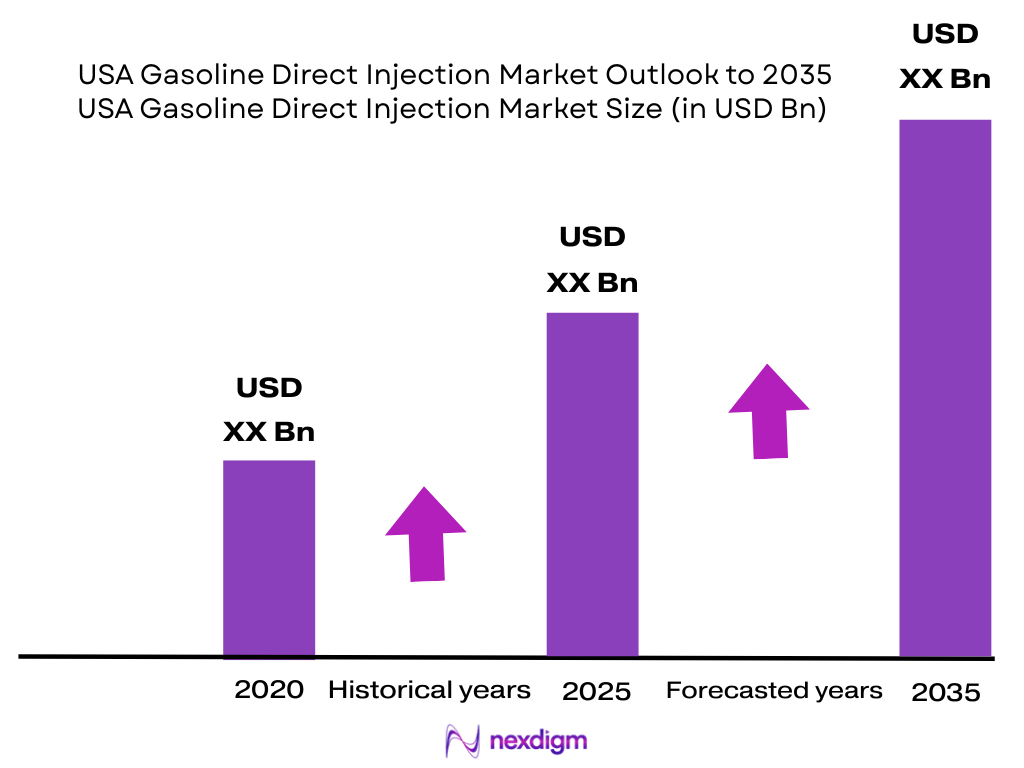
The USA Gasoline Direct Injection Market is valued at approximately USD ~ billion, supported by widespread GDI installation in gasoline light-duty powertrains. DOE reported GDI installation on 73% of light-duty vehicles in one recent production benchmark, while EPA subsequently recorded average new-vehicle fuel economy of 27.2 miles per gallon. GDI remains important because precise in-cylinder fuel metering supports higher compression, turbocharging, engine downsizing and hybrid gasoline powertrains. Detroit, Auburn Hills, Southfield and the wider Great Lakes automotive corridor, together with manufacturing regions in Ohio, Indiana, Kentucky, Tennessee and the southern United States, dominate USA GDI demand because they concentrate vehicle engineering, engine production, Tier-1 sourcing and fuel-system development. U.S. light-duty production is heavily oriented toward SUVs and pickups, with SUVs accounting for 57.82% and pickups 14.67% in a recent DOE production dataset, creating strong GDI content in higher-volume light-truck platforms. GDI has moved from an emerging efficiency technology to a mainstream gasoline-engine architecture in the United States. DOE notes that direct injection improves combustion by injecting gasoline directly into the cylinder and reported that adoption rose from only 2.3% of light-duty production in 2008 to roughly half within a decade and then to 73% in the referenced production benchmark. Its importance is particularly high in turbocharged engines, where accurate fuel delivery helps manage knock, charge cooling and torque density.
Market Segmentation
By Component Type
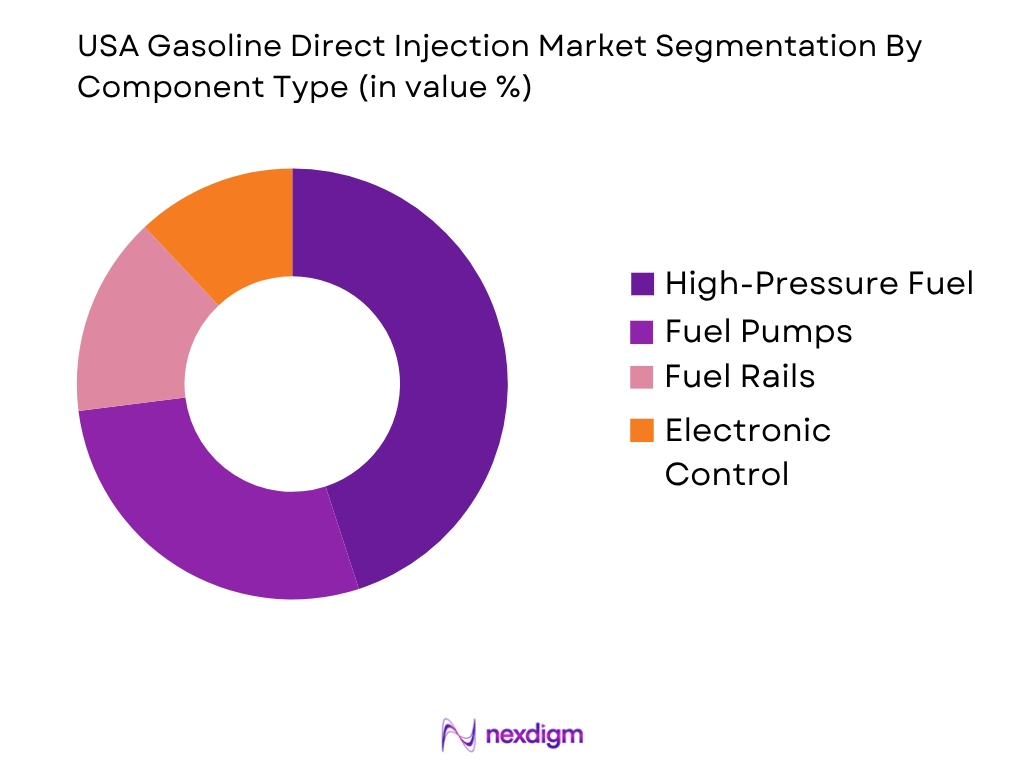
The USA Gasoline Direct Injection Market is segmented into high-pressure injectors, high-pressure fuel pumps, fuel rails and pressure-management components, and electronic/control and ancillary components. High-pressure fuel injectors represent the dominant modeled value segment because every GDI cylinder requires a precisely calibrated injector capable of repeatedly metering and atomizing fuel directly inside the combustion chamber. Four-, six- and eight-cylinder engines therefore require multiple high-value precision injectors per vehicle, compared with typically one primary high-pressure pump. Injector technology also carries substantial engineering content in nozzle geometry, solenoid control, spray targeting, sealing and resistance to deposits. Increasing injection pressure reinforces this value concentration because higher-pressure injectors require tighter manufacturing tolerances and more durable materials. Bosch describes direct injectors as the interface between the rail and combustion chamber, while PHINIA’s latest family supports operation beyond 500 bar. Replacement demand further supports this segment as the installed U.S. GDI vehicle population ages.
By Vehicle Type
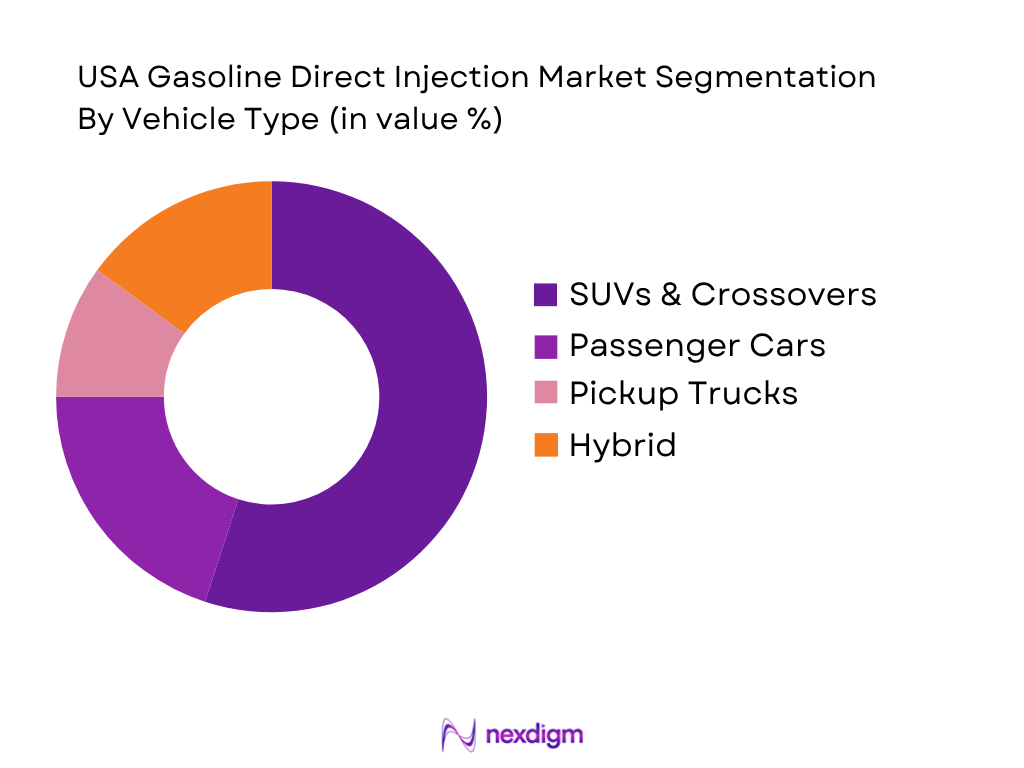
The USA Gasoline Direct Injection Market is segmented into SUVs and crossovers, passenger cars, pickup trucks, hybrid/PHEV vehicles and other light commercial vehicles. SUVs and crossovers represent the dominant modeled segment because the U.S. light-duty fleet has shifted decisively toward truck-based and crossover body styles. DOE data show SUVs alone accounted for 57.82% of U.S.-produced light-duty vehicles in its referenced production dataset, far exceeding the passenger-car contribution. Modern compact and midsize SUVs frequently use downsized turbocharged four-cylinder GDI engines, while larger models employ turbo six-cylinder or naturally aspirated direct-injection engines. This creates broad demand for injectors, high-pressure pumps, rails and pressure sensors across several displacement classes. Pickup trucks add another high-content GDI application through turbocharged gasoline engines and high-output V6/V8 platforms. Hybrid SUVs are particularly important for future development because GDI can remain embedded in the internal-combustion portion of electrified powertrains even as pure gasoline vehicle penetration declines.
Competitive Landscape
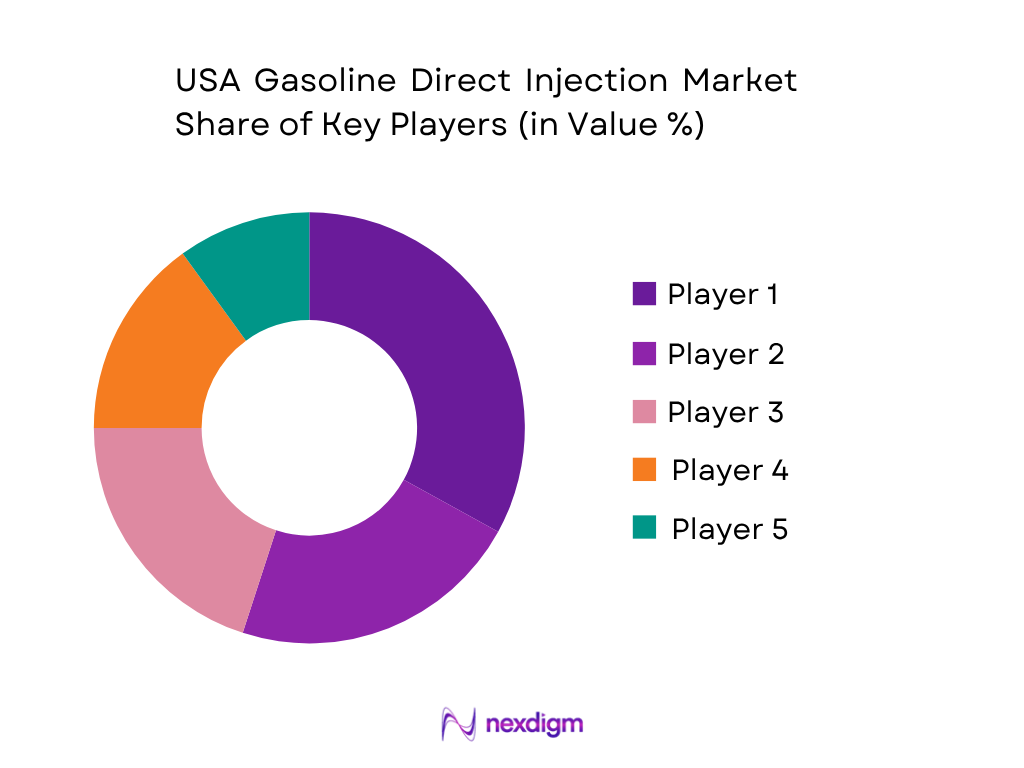
The USA Gasoline Direct Injection Market is concentrated around global fuel-system specialists with deep OEM engineering relationships. Bosch competes across the complete GDI architecture, including injectors, pumps and rails; PHINIA combines Delphi fuel-system technology with a major North American presence; Astemo supplies direct injectors and high-pressure pumps; DENSO maintains substantial U.S. automotive engineering infrastructure; and Stanadyne specializes in high-pressure fuel delivery. Competition increasingly centers on injection pressure, atomization quality, pump efficiency, ethanol compatibility, hybrid application capability and OEM platform qualification rather than component availability alone.
| Major Player | Establishment | Headquarters | GDI Portfolio | Maximum / Advanced Pressure Position | U.S. Presence | Hybrid-GDI Capability | Alternative-Fuel Capability | Aftermarket Position |
| Robert Bosch GmbH | 1886 | Gerlingen, Germany | ~ | ~ | ~ | ~ | ~ | ~ |
| DENSO Corporation | 1949 | Kariya, Japan | ~ | ~ | ~ | ~ | ~ | ~ |
| PHINIA / Delphi | 2023 as independent PHINIA | Auburn Hills, Michigan | ~ | ~ | ~ | ~ | ~ | ~ |
| Astemo Ltd. | 2021 current entity | Tokyo, Japan | ~ | ~ | ~ | ~ | ~ | ~ |
| Stanadyne | 1873 | Jacksonville, North Carolina | ~ | ~ | ~ | ~ | ~ | ~ |
USA Gasoline Direct Injection Market Analysis
Growth Drivers
High GDI Penetration Across U.S. Light-Duty Vehicles and Continued Efficiency Pressure
Gasoline direct injection remains deeply embedded in the U.S. light-duty powertrain base, creating sustained demand for high-pressure injectors, mechanical high-pressure pumps, fuel rails, pressure sensors and control electronics. The U.S. Department of Energy reported that 73 out of every 100 light-duty vehicles produced in its 2023 benchmark incorporated gasoline direct injection, demonstrating that GDI has evolved from a specialist technology into a mainstream gasoline-engine architecture. EPA’s subsequent model-year data show that 56 out of every 100 new vehicles used pure GDI engines and another 23 used combined GDI-port injection in model year 2024, meaning direct injection remained incorporated in the overwhelming majority of gasoline-engine configurations even as manufacturers diversified injection strategies. EPA also reported average new-vehicle fuel economy reaching 27.2 miles per gallon in model year 2024, compared with 27.1 miles per gallon in model year 2023, demonstrating continuing pressure to extract additional efficiency from light-duty powertrains. GDI directly supports this objective because injecting fuel into the combustion chamber provides tighter control over mixture preparation, enables higher effective compression ratios and works particularly well with turbocharging, variable valve timing and cylinder-management strategies. The broader U.S. economic environment supports the automotive production, engineering and replacement ecosystem surrounding these technologies. World Bank data place U.S. GDP at approximately USD 29.18 trillion in 2024, while GDP subsequently reached USD 30.77 trillion in 2025; IMF data indicate a national population of approximately 342.9 million people in 2026, supporting one of the world’s largest vehicle ownership and service bases. The IMF projects U.S. real GDP growth of 2.3 units per 100 units of output in 2026, while World Bank data record 2.2 units per 100 units of GDP growth in 2025, sustaining automotive servicing and parts replacement even as vehicle technology changes. For GDI suppliers, the key implication is that the market is supported not merely by new-engine installation but also by a rapidly ageing installed base. Vehicles equipped with GDI throughout the previous decade are now entering maintenance stages where injector deposits, pump wear, rail-pressure faults and sealing failures become increasingly relevant. Consequently, OEM demand and replacement demand coexist, providing an unusually broad commercial base for high-pressure fuel-system manufacturers.
SUV, Pickup and Turbocharged Gasoline Powertrain Concentration
The structure of U.S. vehicle demand strongly favors GDI because the market is increasingly concentrated in SUVs, crossovers and pickup trucks, categories in which gasoline direct injection is frequently combined with turbocharging or high-output naturally aspirated engines. U.S. Department of Energy data show that SUVs represented 57.82 vehicles out of every 100 light-duty vehicles produced in 2023, while pickups represented another 14.67 vehicles and passenger cars accounted for only 25.04 vehicles. This production mix is commercially important because compact and midsize SUVs commonly use turbocharged four-cylinder GDI engines, while larger SUVs and pickups employ high-output six- and eight-cylinder gasoline engines where precise high-pressure fueling is necessary under towing, acceleration and high-load operating conditions. More cylinders also increase injector content per vehicle: a six-cylinder GDI pickup requires six direct injectors, while a V8 application requires eight, meaning light-truck architecture can generate substantially greater injector content than a three- or four-cylinder compact car. DOE additionally reported turbocharging on 37 out of every 100 light-duty vehicles in the same technology benchmark where GDI reached 73, underscoring the strong technical relationship between engine downsizing, boosted combustion and direct fuel injection. Turbo-GDI systems require reliable fuel pressure during rapid torque transitions and elevated cylinder pressures, increasing the performance requirements imposed on injectors, pumps and rails. The scale of U.S. household consumption and industrial activity supports this vehicle mix. World Bank data show current-dollar U.S. GDP above USD 29 trillion in 2024, increasing to USD 30.77 trillion in 2025, while GDP per capita reached approximately USD 90,026.5 in 2025. IMF data indicate consumer-price inflation of 3.2 units per 100 consumer-price units in 2026, while projected real output growth remains positive at 2.3 units per 100 units of GDP. These macroeconomic conditions sustain demand for personal transportation, commercial pickups, utility vehicles and vehicle servicing even as financing conditions fluctuate. GDI component demand therefore benefits from the U.S. market’s preference for higher-mass, higher-output vehicles rather than relying solely on small passenger cars. The growth driver is especially relevant to suppliers capable of high-flow injectors and high-capacity pumps because turbocharged pickups and SUVs require greater fuel mass at full load than compact naturally aspirated vehicles. Hybridized SUVs and pickups add another layer of opportunity because the gasoline engine remains present but must meet stringent cold-start, transient and efficiency requirements. The resulting powertrain mix supports continued demand for high-pressure fuel-delivery technology even as battery-electric penetration expands.
Market Challenges
Battery-Electric Substitution and Reduced Long-Term Pure-Gasoline Platform Dependence
The most significant structural challenge for the USA Gasoline Direct Injection Market is the progressive substitution of combustion-only vehicles by battery-electric and highly electrified powertrains. GDI remains deeply penetrated in current gasoline platforms, but its future original-equipment opportunity increasingly depends on hybrids, plug-in hybrids and remaining gasoline applications rather than uninterrupted growth in pure internal-combustion engines. U.S. Department of Energy analysis highlights the fundamental efficiency gap between propulsion technologies: a typical battery-electric vehicle converts approximately 87 to 91 units of every 100 units of stored energy into usable vehicle energy when regenerative braking is considered, compared with roughly 30 units for a conventional gasoline vehicle. This efficiency differential gives automakers a strong technical incentive to allocate product-development capital toward electrified platforms where regulations, fuel savings and customer use cases support them. EPA’s latest technology data illustrate the changing gasoline architecture itself. Pure GDI was installed in 56 out of every 100 model-year 2024 vehicles, while combined GDI-port systems accounted for 23 vehicles, indicating that even within combustion engines OEMs are shifting toward more complex architectures rather than relying solely on standalone direct injection. EPA further reports record average fuel economy of 27.2 miles per gallon in model year 2024, showing the level of efficiency improvement manufacturers must continue delivering from the remaining combustion fleet. GDI suppliers therefore face two simultaneous risks: fewer future pure-gasoline platforms and greater engineering expenditure required for each surviving platform. A supplier that previously served a broad range of naturally aspirated and turbocharged engines may increasingly need to qualify components for hybrid duty cycles, alternative fuels, particulate-control strategies and combined port-direct injection. U.S. macroeconomic conditions do not remove this structural challenge. World Bank data show GDP above USD 29 trillion in 2024 and USD 30.77 trillion in 2025, demonstrating a large automotive economy, while IMF data show the population near 342.9 million in 2026 and projected real GDP expansion of 2.3 units per 100 units. The problem is therefore not an absence of economic activity; it is the reallocation of automotive investment within that activity. Battery-electric programs can eliminate the injector, high-pressure pump and fuel rail entirely, meaning every BEV platform substitutes away nearly the full GDI hardware content of an equivalent gasoline vehicle. Suppliers must consequently manage capacity carefully, avoid overinvestment in legacy production lines and pursue hybrid-GDI and aftermarket demand as stabilizing channels. The companies best positioned are those capable of extracting greater value from each remaining combustion platform through higher pressures, dual injection, advanced diagnostics and alternative-fuel compatibility rather than depending solely on rising GDI penetration.
Particulate Emissions, High-Pressure Complexity and Increasing Technical Requirements
A second challenge is that GDI’s combustion advantages are accompanied by demanding emissions and durability requirements that raise engineering complexity throughout the fuel system. Direct injection places gasoline directly inside the cylinder, improving control over combustion, but poor atomization, wall wetting and unfavorable cold-start conditions can increase particulate formation. EPA’s continued separation of GDI and combined GDPI technologies in its Automotive Trends assessment reflects the importance of injection architecture to emissions and efficiency performance. In model year 2024, EPA recorded 56 GDI vehicles and 23 GDPI vehicles for every 100 new vehicles, meaning manufacturers are increasingly balancing direct injection with port injection rather than assuming one architecture is optimal under all operating conditions. This places additional demands on fuel-system control software, injector response, rail-pressure regulation and engine calibration. Pressure levels are also rising. Current supplier systems span approximately 350 bar and extend beyond 500 bar, meaning an injector can experience hundreds of times atmospheric pressure repeatedly across billions of engine cycles. Such operating conditions require exceptionally precise nozzle geometries, hardened pump components, high-integrity seals and contamination control. Small dimensional or material deviations can alter spray patterns, create leakage or accelerate wear. The aftermarket faces parallel difficulty because technicians must diagnose low-pressure supply, mechanical pump output, rail-pressure sensor signals, injector electrical faults and combustion symptoms that can overlap with ignition or airflow problems. These requirements increase training and diagnostic-equipment needs for independent workshops. Macroeconomic conditions amplify the importance of efficient servicing. World Bank data show U.S. GDP per capita at approximately USD 90,026.5 in 2025, while the IMF projects inflation of 3.2 units per 100 consumer-price units in 2026. Even in a high-income market, higher general prices can increase consumer sensitivity to major vehicle repairs, encouraging owners to postpone component replacement or select remanufactured and aftermarket parts. At the manufacturing level, the U.S. economy’s USD 30.77 trillion GDP in 2025 provides a large industrial base, but high-precision GDI production competes for capital and technical talent with semiconductor, EV, battery and advanced-electronics investment. Suppliers must therefore justify continued spending on injector metrology, high-pressure pump testing and software integration as the market transitions. The technical challenge extends beyond component reliability to compliance risk: increasingly stringent tailpipe requirements mean injector spray quality, fuel pressure and cold-start calibration directly influence whether an engine family meets regulatory targets. Consequently, successful GDI suppliers require a combination of precision manufacturing, combustion expertise and software capability rather than conventional fuel-system production alone.
Market Opportunities
High-Pressure GDI, Combined Port-Direct Injection and Hybrid Powertrain Integration
The transition toward higher-value gasoline powertrains creates a major opportunity for GDI suppliers even as pure internal-combustion vehicle production becomes more exposed to electrification. EPA’s latest data show that model-year 2024 vehicles included 56 pure-GDI applications and 23 combined GDI-port applications for every 100 vehicles, demonstrating that direct injection remains central to advanced gasoline powertrains but is increasingly being integrated with complementary port injection. This dual-path architecture allows automakers to select direct or port fueling according to load, temperature, emissions and intake-valve requirements, increasing component and control content per engine. A GDPI engine can require both direct injectors and port injectors plus more sophisticated fuel-delivery software, creating a higher-value system than basic GDI alone. The same opportunity applies to hybrids. A hybrid gasoline engine may operate for fewer total hours, but it experiences repeated starts, rapid transitions between electric and combustion propulsion and strict cold-start emissions requirements. Accurate fuel atomization and rapid pressure buildup are therefore critical. High-pressure technology further increases value. Moving from approximately 200–350 bar architectures toward 500 bar and above can improve droplet formation and mixture preparation, providing a pathway to higher combustion efficiency and lower particulate formation. Manufacturers capable of producing precision injectors, durable high-pressure pumps and rail systems at these pressure classes can capture more engineering content per vehicle even if total gasoline-engine volume eventually declines. The current macroeconomic environment supports investment in this transition. World Bank data show U.S. GDP increased from more than USD 29 trillion in 2024 to USD 30.77 trillion in 2025, while GDP per capita reached USD 90,026.5. IMF data indicate a population of roughly 342.9 million in 2026, supporting a very large fleet base and aftermarket ecosystem, while projected GDP expansion remains positive at 2.3 units per 100 units of output. The opportunity is therefore both OEM- and service-driven. High-pressure systems introduced into new hybrid and turbocharged platforms create future replacement demand, while existing GDI vehicles already generate immediate aftermarket demand. Suppliers can differentiate through pressure capability, injector dynamic range, reduced pump noise, ethanol-resistant seals and integrated diagnostic support. Combined port-direct injection also gives established GDI companies an opportunity to defend their relevance in hybrid gasoline vehicles where OEMs seek extremely efficient combustion rather than eliminate the engine entirely. This makes hybridization a transition opportunity rather than solely a threat: every HEV or PHEV retaining a gasoline engine can continue to require sophisticated high-pressure fuel delivery, potentially with greater component complexity than the conventional vehicles it replaces.
Ageing Installed GDI Fleet and Expansion of Replacement, Remanufacturing and Diagnostic Services
The large installed population of direct-injection vehicles creates a substantial aftermarket opportunity that is increasingly independent of short-term new-vehicle powertrain decisions. DOE documented that gasoline direct injection had already reached 73 out of every 100 light-duty vehicles produced in 2023, following a multi-year adoption trajectory that began from only a small fraction of vehicles in the late 2000s. This means millions of GDI-equipped vehicles are progressively entering higher-mileage service intervals during 2024–2026, creating recurring requirements for injectors, high-pressure pumps, pressure sensors, seals and specialized cleaning or diagnostic services. Unlike many routine engine components, GDI hardware operates under particularly demanding conditions. Mechanical high-pressure pumps are camshaft-driven and repeatedly generate hundreds of bar of fuel pressure; injectors are mounted directly at the combustion chamber and exposed to heat, carbon formation and rapid pressure cycling. As vehicles age, faults can appear as difficult starting, misfires, reduced power, pressure codes or irregular combustion, creating demand not only for new components but also for professional testing and remanufacturing. This creates several commercial layers: OE replacement products for dealer networks, OE-equivalent parts for independent workshops, remanufactured injectors for price-sensitive owners, high-flow components for performance users and diagnostic equipment for repair businesses. The U.S. economy provides an unusually large base for such aftermarket development. World Bank data show the country generated approximately USD 29.18 trillion of economic output in 2024 and USD 30.77 trillion in 2025, while GDP per capita reached about USD 90,026.5 in 2025. IMF data put the national population at approximately 342.9 million in 2026, meaning the vehicle-servicing ecosystem operates across a very large consumer base. IMF inflation of 3.2 units per 100 consumer-price units in 2026 also increases the attractiveness of repair and component replacement relative to immediate vehicle replacement for some owners, particularly where the existing vehicle remains mechanically sound. GDI aftermarket companies can therefore expand injector bench testing, ultrasonic cleaning, spray-pattern validation, flow matching, pump diagnosis and remanufacturing programs. Digital fitment databases represent another opportunity because the installed fleet spans four-, six- and eight-cylinder architectures, pure GDI and GDPI systems, naturally aspirated and turbocharged applications. Accurate component identification can reduce returns and incorrect repairs. As pure-ICE OEM opportunities mature, the installed fleet can provide a longer demand tail than new-vehicle production alone, supporting specialist distributors and remanufacturers well into the next decade.
Future Outlook
The USA Gasoline Direct Injection Market is expected to expand at approximately ~ CAGR during 2026–2035, although growth will increasingly differ between original-equipment and aftermarket channels. Pure gasoline-engine GDI faces long-term competition from battery-electric vehicles, but GDI should remain relevant in conventional gasoline vehicles, hybrids and plug-in hybrids throughout the forecast period. The key change will be technology value per GDI system rather than simple penetration growth. GDI is already installed across a large portion of the U.S. light-duty production base, leaving less room for penetration-led expansion than during the previous decade. Future value creation is therefore expected to come from higher-pressure injectors, more efficient pumps, dual GDI-port architectures, advanced sensing and emissions-control integration. Hybridization provides an important bridge. EPA reports that hybrids, plug-in hybrids and battery-electric vehicles have continued to gain prominence, while advanced gasoline-engine technologies remain relevant within HEV and PHEV powertrains. A hybrid may reduce gasoline-engine running hours but can still require sophisticated fuel delivery to achieve low cold-start emissions and high thermal efficiency whenever the engine operates. Higher injection pressure is another major direction. PHINIA already markets 500+-bar GDI technology, and Marelli has commercialized a system capable of reaching 1,000 bar. Higher pressure can create finer fuel droplets and improve mixture preparation, supporting cleaner combustion and potentially addressing particulate-related drawbacks of conventional GDI. The aftermarket will also become increasingly important as millions of GDI-equipped vehicles move deeper into their service lives. High-pressure pumps, direct injectors, pressure sensors and seals experience demanding thermal and mechanical conditions, while injector deposits and fuel-system diagnostics require specialist repair capability. This creates a growing service ecosystem even if new pure-ICE production gradually moderates.
Major Players
- Robert Bosch GmbH / Bosch Mobility
- DENSO Corporation
- PHINIA Inc. / Delphi
- Astemo Ltd.
- Marelli
- Stanadyne
- Standard Motor Products
- Schaeffler / Vitesco Technologies Powertrain Operations
- Continental Automotive
- BorgWarner
- TI Fluid Systems
- Sensata Technologies
- GB Remanufacturing
- Nostrum High Performance
- Injector Dynamics
Key Target Audience
- Gasoline Direct Injection System Manufacturers
- High-Pressure Fuel Injector and Pump Manufacturers
- Passenger Vehicle, SUV and Pickup Truck OEMs
- Automotive Tier-1 and Tier-2 Powertrain Component Suppliers
- Automotive Parts Distributors and Independent Aftermarket Networks
- Engine Calibration, Performance and Remanufacturing Companies
- Investments and Venture Capitalist Firms
- Government and Regulatory Bodies (U.S. Environmental Protection Agency, U.S. Department of Energy, National Highway Traffic Safety Administration and U.S. Department of Transportation)
Research Methodology
Step 1: Identification of Key Variables
The initial phase constructs an ecosystem map covering vehicle OEMs, GDI system integrators, injector manufacturers, high-pressure pump suppliers, rail and pressure-sensor companies, engine-control suppliers, distributors and aftermarket workshops. The principal variables include gasoline vehicle production, GDI penetration, cylinder count, turbocharging, hybridization, injection pressure and component replacement frequency. Official EPA and DOE technology datasets are used to establish the underlying U.S. gasoline-powertrain environment. Supplier technical disclosures are then used to map pressure classes, fuel-system architectures and component content, allowing the analysis to separate conventional GDI, combined GDPI and higher-pressure systems.
Step 2: Market Analysis and Construction
The top-down analysis begins with U.S. light-duty vehicle production and gasoline-engine technology penetration before isolating GDI-equipped platforms. DOE’s reported 73% GDI penetration provides a critical technology benchmark, while EPA vehicle-type and powertrain data are used to allocate demand across passenger cars, SUVs, pickups and hybrid vehicles. The bottom-up model calculates injectors according to engine cylinder count and applies high-pressure pump, rail, sensor and controller content per engine. Separate assumptions are applied to four-cylinder turbo engines, six-cylinder light trucks, eight-cylinder applications and combined GDI-port architectures, where component density differs materially.
Step 3: Hypothesis Validation and Expert Consultation
Market hypotheses are validated through computer-assisted telephone interviews with GDI system manufacturers, automotive Tier-1 suppliers, powertrain engineers, aftermarket distributors, fuel-system specialists and independent repair workshops. Primary interviews test OEM sourcing patterns, injector pressure migration, pump configurations, component failure modes, GDPI penetration, hybrid-GDI requirements and service cycles. Expert inputs are subsequently compared against published supplier specifications such as Bosch’s 350-bar architecture and PHINIA’s 500+-bar systems.
Step 4: Research Synthesis and Final Output
The final phase triangulates vehicle technology data, supplier specifications, aftermarket observations and expert interviews. Original-equipment and replacement markets are estimated separately to prevent declining pure-gasoline platform growth from obscuring the expanding installed-base service opportunity. Forecast scenarios incorporate BEV substitution, hybrid growth, combined GDI-port injection, higher injection pressures, particulate-control requirements and ageing GDI vehicles. This framework produces independent forecasts for injector units, pump units, fuel rails, sensors and total system value.

- Executive Summary
- Research Methodology (Market Definitions and Assumptions, Abbreviations, GDI System Boundary, Top-Down Market Sizing, Bottom-Up Vehicle-Production Modelling, GDI Penetration Assessment, Injectors per Engine Calculation, High-Pressure Pump Content per Vehicle, Fuel Rail Content per Vehicle, Passenger Car Assessment, SUV and Pickup Assessment, Turbo-GDI Assessment, Hybrid-GDI Assessment, GDPI Dual-Injection Assessment, OEM Sourcing Analysis, Replacement-Cycle Assessment, Vehicle-Parc Analysis, Primary Industry Interviews, Supplier Interviews, Aftermarket Distributor Interviews, Demand-Side Assessment, Supply-Side Assessment, Data Triangulation, Forecasting Framework, Scenario Analysis, Limitations and Future Conclusions)

- Definition and Scope
- Evolution of Gasoline Fuel-Injection Technology
- Transition from Port Fuel Injection to Gasoline Direct Injection
- Evolution from GDI to Combined GDI-Port Fuel Injection Systems
- Gasoline Direct Injection System Architecture

- Growth Drivers (High GDI Penetration, Turbocharged Engine Adoption, SUV and Pickup GDI Fitment, Hybrid-GDI Expansion, Fuel-Economy Requirements, Engine Downsizing, Existing Vehicle Parc, Aftermarket Replacement)
- Market Challenges (BEV Substitution, GDI Particulate Emissions, Injector Deposits, High-Pressure Complexity, Warranty Exposure, Component Precision, Hybrid Engine Cycles, Price Competition)
- Market Opportunities (500+ Bar Injection, GDPI, Hybrid GDI, GPF, Ethanol Compatibility, Performance GDI, Aftermarket Replacement, Diagnostic Services)
- Market Trends (Higher Pressure, Dual Injection, Multiple Injection, Hybrid Integration, Software Calibration, GPF, Injector Miniaturisation, High-Flow Performance)
- SWOT Analysis
- Porter’s Five Forces Analysis
- PESTLE Analysis

- By Market Value (2020-2025)
- By GDI System Units (2020-2025)
- By High-Pressure Injector Units (2020-2025)

- By Component Type (In Value %)
High-Pressure GDI Fuel Injectors
High-Pressure Mechanical Fuel Pumps
High-Pressure Fuel Rails
Fuel Rail Pressure Sensors
Fuel Pressure Regulators - By Fuel-Injection Architecture (In Value %)
Pure Gasoline Direct Injection
Combined Direct and Port Fuel Injection
Sequential GDI
Multi-Pulse Direct Injection
Homogeneous-Charge Direct Injection - By Vehicle Type (In Value %)
Passenger Cars
Compact SUVs and Crossovers
Mid-Size SUVs
Full-Size SUVs - By Region (In Value %)
Midwest
South
Northeast
West

- Market Share of Major Players by Market Value
- Cross Comparison Parameters (Maximum GDI Injection Pressure Capability, High-Pressure Injector–Pump–Rail Portfolio Breadth, US OEM Gasoline Engine Platform Coverage, Turbo-GDI and Hybrid-GDI Application Capability, GDPI Dual-Injection System Capability, Ethanol and Alternative-Gasoline Compatibility, US OE–Aftermarket Distribution and Service Coverage, Injector Atomisation–Pump Efficiency–Particulate Reduction Technology Capability)
- SWOT Analysis of Major Players
- Detailed Profiles of Major Companies
Robert Bosch GmbH / Bosch Mobility
DENSO Corporation
PHINIA Inc. / Delphi
Astemo Ltd.
Marelli
Stanadyne
Standard Motor Products
Schaeffler / Vitesco Technologies Powertrain Operations
Continental Automotive
BorgWarner
TI Fluid Systems
Sensata Technologies
GB Remanufacturing
Nostrum High Performance
Injector Dynamics

- Passenger Vehicle OEM Demand
- Turbo-Petrol Engine Manufacturer Demand
- Independent Workshop Demand
- Aftermarket Distributor Demand
- Engine Remanufacturer Demand

- By Market Value (2026-2035)
- By GDI System Units (2026-2035)
- By High-Pressure Injector Units (2026-2035)


 Request a Sample
 Ask for Customization
 Get a Quote
 Enquire Now