
 Download PDF
Market Overview
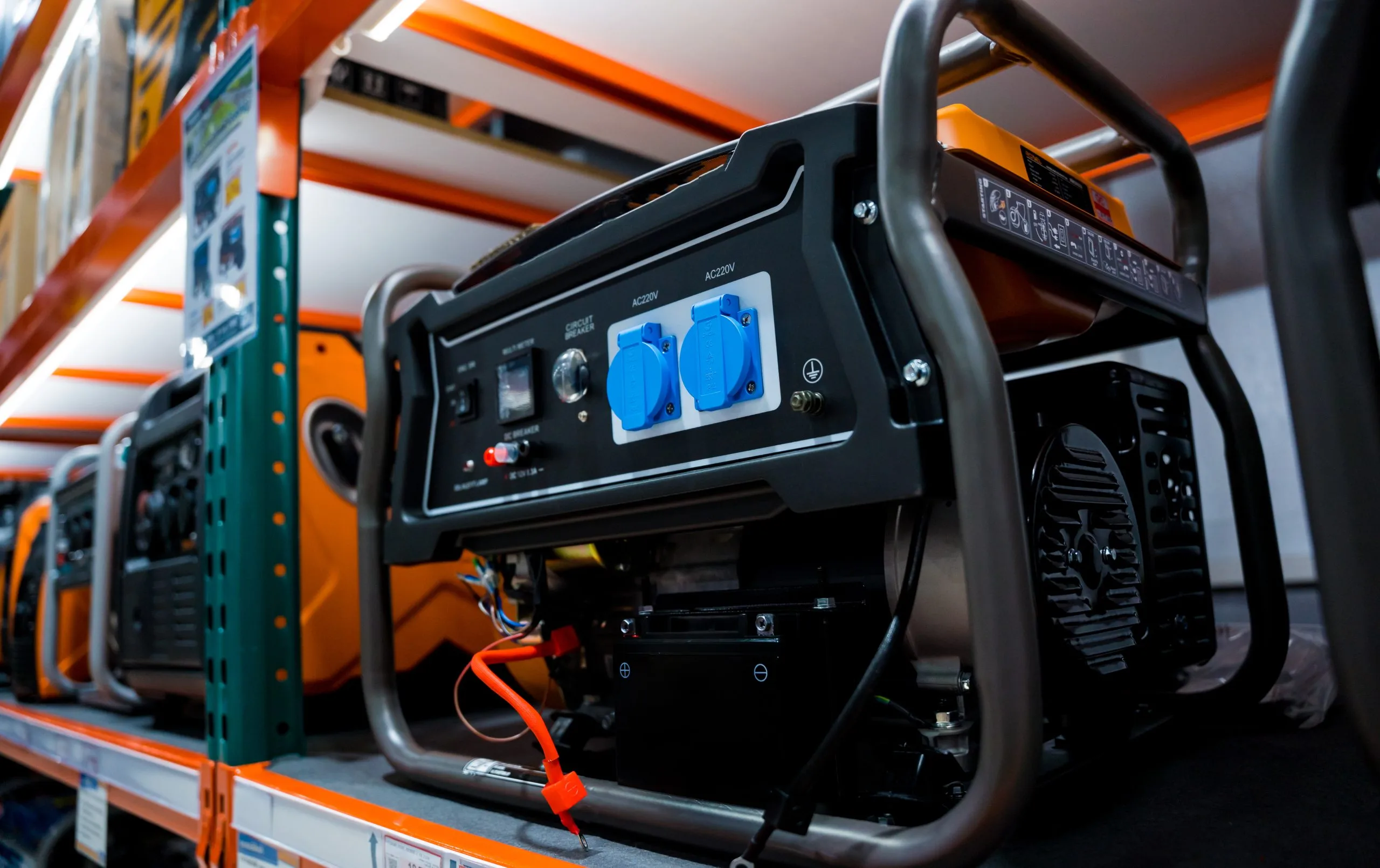
The USA Genset Market is valued at approximately ~ million, supported by severe grid-interruption exposure, residential backup requirements, construction activity and portable-power applications. The United States recorded 28 billion-dollar weather disasters followed by 27 events, while electricity customers experienced approximately 11 hours of interruptions in the latest annual reliability dataset. Hurricanes, severe storms and winter weather increase demand for gasoline generators capable of powering refrigerators, lighting, pumps, tools and essential household equipment. Texas, Florida, Louisiana, North Carolina and other Gulf Coast and southeastern states represent important demand centres because tropical cyclones, severe storms and extensive suburban housing create repeated backup-power requirements. Major events including Hurricanes Beryl, Helene and Milton accounted for 80% of nationwide interruption hours in the latest EIA dataset. Residential construction also strengthens addressable demand, with privately owned housing completions reaching an annualized 1,544,000 units in the latest December construction release.
Market Segmentation
By Generator Type
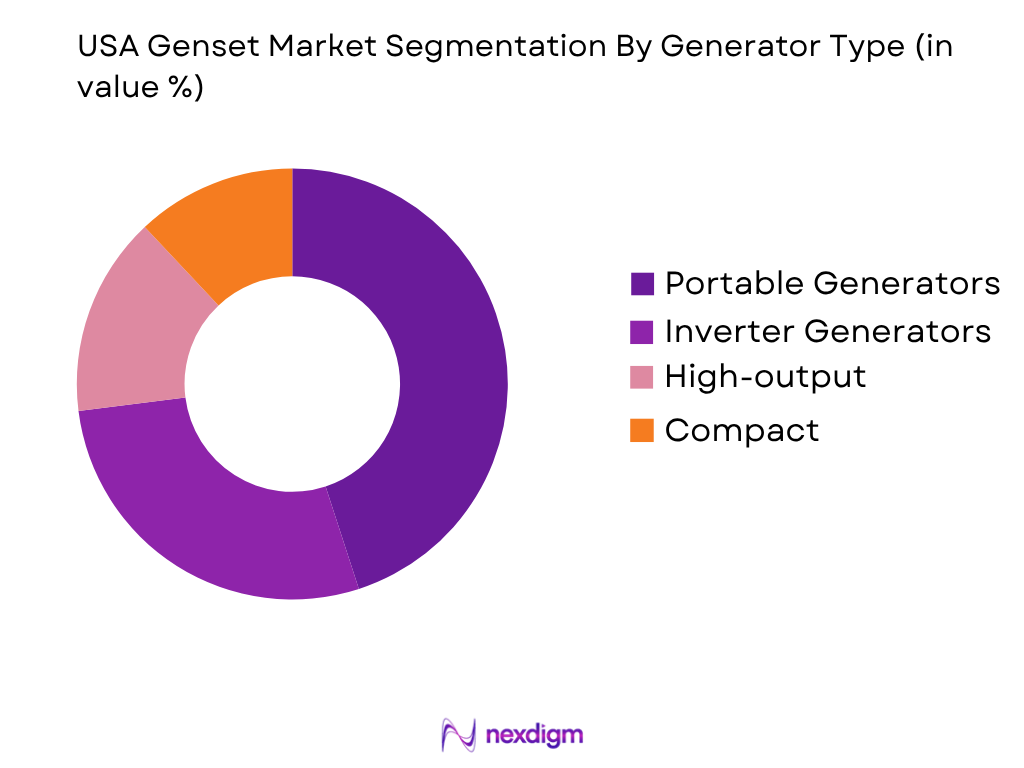
The USA Genset Market is segmented into conventional portable generators, inverter generators, high-output portable generators and compact recreational generators. Conventional portable gasoline generators hold the dominant market position because they combine relatively high electrical output, mobility and applicability across emergency home backup, construction sites, workshops and outdoor operations. Generac’s current portable portfolio extends from compact inverter products to units approaching 17,500 watts, demonstrating how gasoline-powered platforms can cover appliances, pumps, power tools and higher-load applications. Inverter generators are increasingly important because they provide cleaner output for laptops, communication equipment and sensitive electronics while reducing fuel consumption and noise. Honda’s EU2200i, for example, provides 2,200 watts and can operate for approximately 3.2 to 8.1 hours on one fuel tank depending on electrical load. Nonetheless, conventional open-frame generators retain strong relevance where wattage, durability and emergency backup capability outweigh requirements for minimum noise and compact dimensions.
By Power Rating
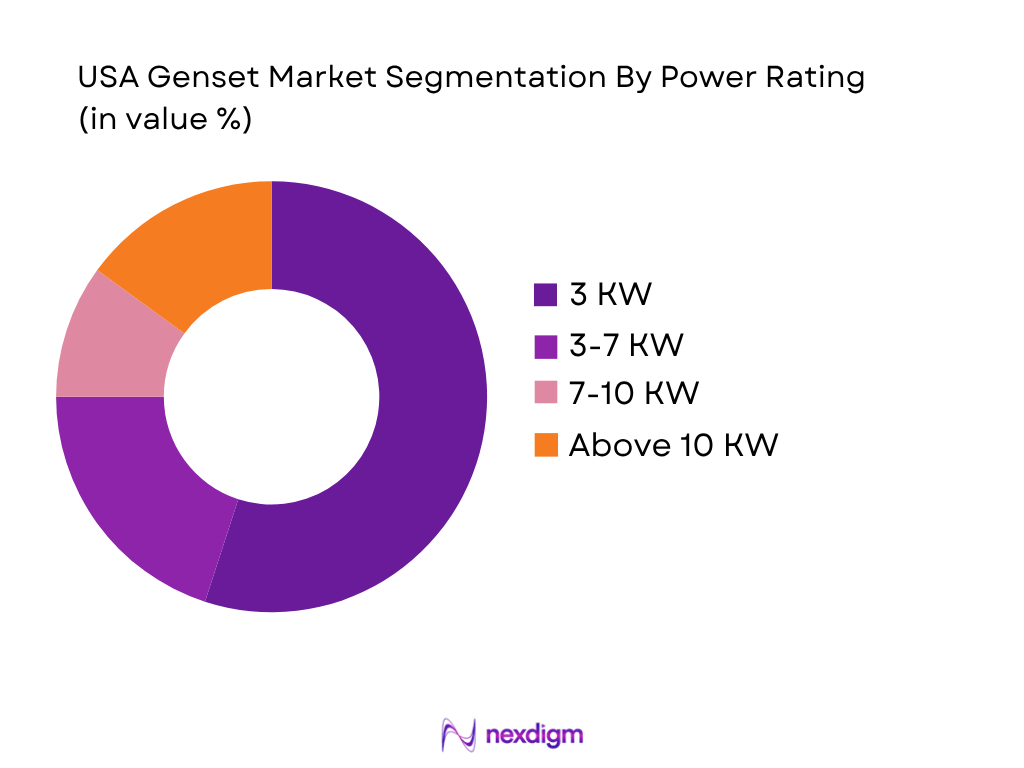
The USA Genset Market is segmented into below 3 kW, 3–7 kW, 7–10 kW and above 10 kW units. The 3–7 kW category holds the dominant position because it provides sufficient output for common emergency and jobsite requirements without reaching the size and weight associated with very high-output equipment. Units in this range can typically operate refrigerators, lighting circuits, furnaces, sump pumps, selected air-conditioning loads and construction tools depending on starting-current requirements. Honda markets gasoline generators ranging from approximately 1,000 watts to 7,000 watts, while Generac provides inverter and conventional offerings across progressively higher wattage levels. The category also aligns effectively with portable transfer-switch applications and RV requirements. Lower-powered products remain significant for camping, electronics and small appliance loads, whereas above-10-kW generators address larger residential backup, contractors and intensive temporary-power applications. Growing use of sensitive electronic devices is simultaneously encouraging inverter technology across several wattage categories rather than limiting inverter products to low-output recreational equipment.
Competitive Landscape
The USA Genset Market includes large domestic backup-power specialists, established engine manufacturers and consumer power-equipment brands. Generac competes across portable and high-output backup applications, while Honda maintains a strong position in premium inverter generators. Champion emphasizes gasoline, dual-fuel and inverter configurations, while Briggs & Stratton brings extensive small-engine engineering capabilities. Westinghouse Outdoor Power Equipment competes across portable gasoline and multi-fuel platforms. Competition increasingly centres on runtime, inverter quality, carbon-monoxide shutdown systems, starting wattage, portability and retail accessibility.
| Major Player | Establishment Year | Headquarters | Petrol Generator Portfolio | Output Coverage | Inverter Technology | CO Safety Technology | Multi-Fuel Capability | Key Distribution Position |
| Generac Power Systems | 1959 | Wisconsin, USA | ~ | ~ | ~ | ~ | ~ | ~ |
| Honda Power Equipment | 1948 | Tokyo, Japan | ~ | ~ | ~ | ~ | ~ | ~ |
| Champion Power Equipment | 2003 | California, USA | ~ | ~ | ~ | ~ | ~ | ~ |
| Briggs & Stratton | 1908 | Wisconsin, USA | ~ | ~ | ~ | ~ | ~ | ~ |
| Westinghouse Outdoor Power | Legacy Westinghouse brand | USA | ~ | ~ | ~ | ~ | ~ | ~ |
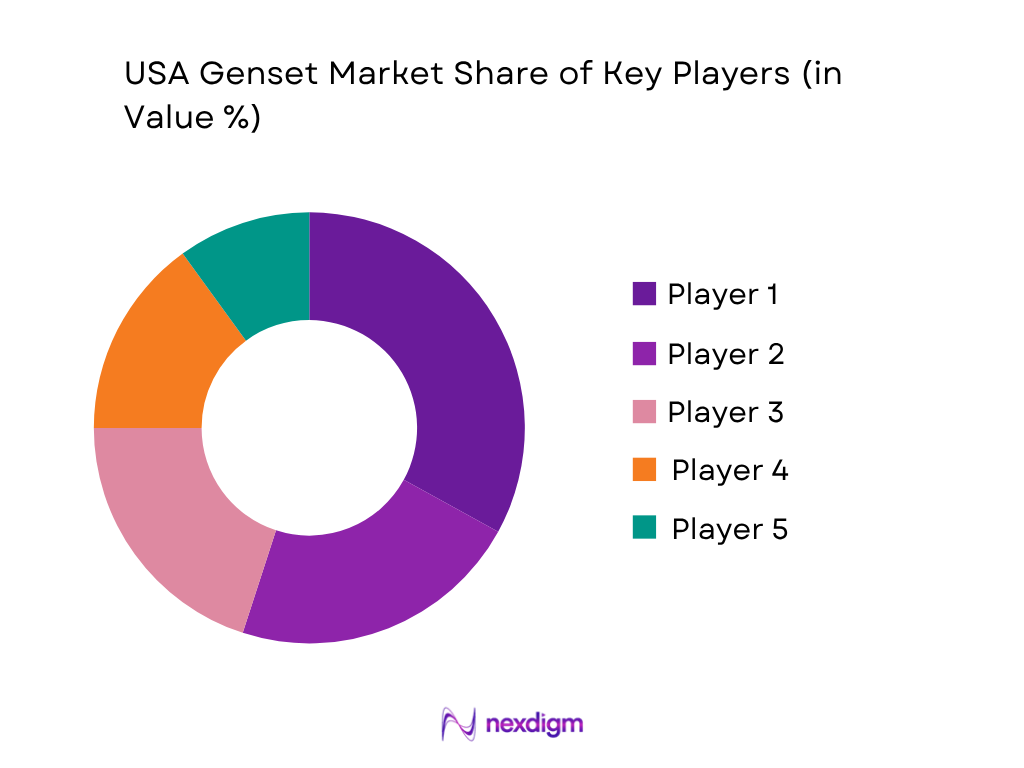
USA Genset Market Analysis
Growth Drivers
Increasing Grid Outage Exposure and Weather-Driven Backup Power Requirements
The USA Genset Market is being driven by increasing requirements for portable and mobile backup electricity during hurricanes, severe storms, tornadoes, floods, wildfires and extended utility interruptions. U.S. Energy Information Administration data shows that an average electricity customer experienced approximately 11 hours of interruptions during 2024, the highest outage duration recorded in a decade. Interruptions attributed to major events accounted for nearly 9 hours. Hurricane Beryl disconnected approximately 2.6 million Texas customers, Hurricane Helene affected 5.9 million customers across 10 states, and Hurricane Milton disconnected another 3.4 million Florida customers. South Carolina customers experienced nearly 53 hours without electricity during the same period. These events directly strengthen demand for petrol and multi-fuel portable generators used to operate refrigerators, lighting systems, pumps, communications equipment, power tools, recreational vehicles and emergency equipment where permanently installed standby generators are unavailable. NOAA recorded 27 major weather and climate disasters in the United States during 2024, including 17 severe storms, 5 tropical cyclones, 2 winter storms, 1 flooding event, 1 drought/heat event and 1 wildfire event. The country also experienced at least 1,735 confirmed tornadoes, increasing temporary-power requirements across disaster-prone states. The broader economic base supports purchasing and deployment of backup-power equipment, with World Bank data placing U.S. GDP at approximately USD 30.77 trillion in 2025. For genset suppliers, outage intensity creates recurring demand from homeowners, contractors, small businesses, emergency-response organisations, telecom maintenance teams and mobile service operators. Automotive and trailer-mounted configurations are particularly useful because equipment can be transported rapidly between outage locations instead of being dedicated permanently to one site. Growing weather volatility therefore strengthens demand for high-output portable gensets, electric-start models, transfer-ready units, inverter generators and dual-/tri-fuel systems capable of providing temporary electricity across residential, commercial and field-service applications.
Large Construction and Temporary-Power Activity Supporting Mobile Genset Utilisation
Construction and infrastructure activity represent another major growth driver because project sites frequently require temporary power before permanent grid connections become available and need mobile electricity for tools, lighting, pumps, compressors, temporary offices and maintenance equipment. U.S. Census Bureau data shows that construction activity reached USD 2,154.4 billion during 2024, compared with USD 2,023.7 billion in the preceding period. Private construction accounted for USD 1,661.7 billion, including USD 917.9 billion of residential construction and USD 743.8 billion of private non-residential construction. Public construction reached USD 492.7 billion, including USD 142.7 billion associated with highway construction and USD 105.2 billion involving educational construction. The scale of this activity creates a substantial installed user base for portable petrol gensets and larger trailer-mounted generating equipment. Residential development alone generated 1,364,100 housing starts and 1,627,900 housing completions during 2024, according to the Census Bureau and Department of Housing and Urban Development. Contractors often require generator power during framing, roofing, landscaping, repair and remote-site work where electrical connections are absent or unsuitable for heavy tool loads. Infrastructure and highway projects similarly require mobile equipment that can be moved along work zones as projects progress. Current activity remains extensive: U.S. construction spending was running at an annualised USD 2,210.2 billion in May 2026, demonstrating the continuing scale of potential temporary-power applications. The wider U.S. economy reached approximately USD 30.77 trillion in GDP during 2025, according to World Bank data, supporting high levels of capital formation, property development and infrastructure maintenance. Automotive genset manufacturers can therefore address contractors through compact petrol generators for handheld tools, mid-range units for multiple machines, towable systems for work sites and inverter models suitable for sensitive electronic equipment. Rental companies represent another significant channel because contractors frequently require generators for individual projects rather than permanent ownership.
Market Challenges
Rapid Expansion of Battery Storage and Alternative Backup-Power Technologies
The USA Genset Market faces an increasingly important substitution challenge from battery energy storage, solar-plus-storage systems and portable battery power stations. U.S. Energy Information Administration data indicates that utility-scale battery storage capacity exceeded 26 GW during 2024, after operators installed approximately 10.4 GW of additional battery capacity during the year. Battery deployment accelerated further, with 15 GW of new utility-scale storage installed during 2025, while total operational storage capacity reached 43.6 GW at the end of that year. Operators added another 8.3 GW during the first six months of 2026, increasing U.S. utility-scale battery capacity to nearly 52 GW. Although utility-scale storage is not a direct replacement for every automotive or portable genset application, this rapid technology development illustrates the broader shift toward electricity storage solutions that require no petrol, produce no local combustion exhaust and operate with substantially lower noise. Similar lithium-ion technologies are increasingly being incorporated into consumer portable power stations, mobile construction systems and residential backup packages, creating competition for smaller petrol generator categories. The competitive pressure is particularly relevant for applications requiring only several hours of electricity for telecommunications, electronic devices, lighting and small appliances. Petrol gensets retain substantial advantages where long-duration operation, rapid refuelling and higher continuous power are required, but manufacturers must increasingly demonstrate runtime and output advantages relative to batteries. World Bank data shows that the U.S. economy reached approximately USD 30.77 trillion in 2025, enabling significant investment in both conventional and alternative power technologies. Generator manufacturers are responding by developing hybrid-compatible units, inverter generators and systems capable of charging battery packs while simultaneously serving electrical loads. As battery capacity expands nationally, standalone gensets will increasingly compete within a broader temporary-power ecosystem rather than against other combustion generators alone. Product strategy will therefore need to emphasise high-load capability, rapid energy replenishment, severe-weather reliability and integration with storage systems.
Petrol Genset Safety, Emissions and Operating-Environment Constraints
Petrol-powered gensets face technical and regulatory challenges arising from carbon-monoxide production, combustion emissions, fuel handling, noise and requirements for safe outdoor operation. These limitations are particularly important in the United States because genset utilisation often rises sharply following major weather events, when users may attempt to position portable generators close to homes, garages or temporary shelters. The challenge has become more commercially relevant as outage exposure increases. U.S. electricity customers averaged approximately 11 hours without electricity in 2024, while major weather events produced nearly 9 hours of that outage duration. NOAA simultaneously recorded 27 billion-dollar weather and climate disasters, 1,735 confirmed tornadoes and more than 61,000 wildfires during the year. Consequently, generators may be operated by consumers under emergency conditions, increasing the importance of automatic carbon-monoxide shutoff systems, clear ventilation requirements, weather-resistant electrical connections and low-emission engine design. Petrol products also require fuel storage and repeated refuelling during prolonged outages, while fuel degradation can affect starting reliability when generators remain unused for long periods. These factors increase maintenance requirements relative to battery systems. Regulations covering small spark-ignition engines also require generator manufacturers to manage exhaust and evaporative emissions, adding engineering complexity to carburettors, fuel systems, catalytic technologies and engine calibration. Larger construction and commercial users encounter additional requirements involving workplace safety, noise exposure and fuel-storage practices. The challenge exists within a very large economic and operating environment: U.S. GDP reached approximately USD 30.77 trillion in 2025, while total construction activity exceeded USD 2.15 trillion during 2024, meaning portable generators must satisfy diverse residential, industrial and construction applications. Competitive suppliers therefore increasingly incorporate CO sensors, automatic shutdown, overload protection, low-oil shutdown, circuit breakers, enclosed inverter architecture and improved emissions-control systems. These technologies improve safety but also make the engineering and certification process more complex, particularly for manufacturers competing across different states and end-user categories.
Market Opportunities
Advanced Inverter, Hybrid and Smart-Connected Mobile Genset Development
Technological advancement represents a major future opportunity for the USA Genset Market as demand shifts from basic constant-speed generators toward inverter-equipped, electronically controlled and hybrid-compatible systems. The opportunity is supported by the scale of existing backup-power requirements: U.S. electricity customers experienced approximately 11 hours of interruptions during 2024, while Hurricane Beryl disconnected around 2.6 million customers in Texas, Helene affected 5.9 million customers across 10 states, and Milton disconnected 3.4 million Florida customers. These events create demand not only for electricity but for equipment that can operate efficiently across changing loads. Inverter generators can adjust engine speed according to electrical demand, while electronically managed systems can support cleaner output for laptops, telecommunications equipment, vehicle electronics and other sensitive loads. Connectivity creates additional opportunities through Bluetooth or Wi-Fi monitoring of runtime, load, maintenance hours, fuel availability and fault conditions. Hybridisation is especially relevant because battery storage is expanding rapidly. EIA recorded more than 26 GW of operational utility-scale battery storage capacity in 2024, rising to 43.6 GW at the end of 2025 and nearly 52 GW during the first half of 2026. This technology shift creates an opportunity rather than solely a threat: petrol gensets can be integrated with portable batteries, allowing the engine to operate periodically at an efficient load while stored electricity supports low-demand periods. Such configurations reduce continuous engine operation and address noise-sensitive residential, recreational and mobile-service applications. The U.S. economy, measured by World Bank at approximately USD 30.77 trillion in 2025, provides a substantial consumer and commercial base capable of adopting higher-specification equipment. Manufacturers can therefore differentiate through inverter architecture, remote start, app-based diagnostics, electronic fuel injection, automatic CO shutdown, parallel generator capability and battery-assisted starting. Future market development is likely to favour gensets positioned as intelligent components within flexible energy systems rather than isolated combustion machines.
Expansion of Mobile Resilience Solutions Across Disaster-Prone and Construction-Intensive States
A substantial opportunity exists for manufacturers, distributors and rental operators to develop mobile resilience solutions targeted at regions experiencing severe weather, prolonged grid outages and extensive construction activity. NOAA recorded 27 billion-dollar weather and climate disasters in 2024, comprising 17 severe-storm events, 5 tropical cyclones, 2 winter storms, 1 flooding event, 1 drought/heat event and 1 wildfire event. The United States additionally recorded at least 1,735 tornadoes and more than 61,000 wildfires, while approximately 8.8 million acres were affected by wildfire activity. These conditions create a geographically distributed requirement for portable generators that can be deployed rapidly after storms and other emergencies. EIA data demonstrates the regional severity of the problem: South Carolina electricity customers experienced nearly 53 hours of interruption during 2024, while Hurricane-driven outages affected millions of customers in Texas, Florida, North Carolina and surrounding states. Mobile gensets are valuable in such situations because units can be transported using service trucks, trailers or utility vehicles to homes, communications sites, emergency shelters, repair crews, pumping installations and temporary medical operations. The opportunity extends beyond disaster response. U.S. construction spending reached USD 2,154.4 billion during 2024, including USD 492.7 billion of public construction and USD 142.7 billion of highway construction, creating demand for mobile temporary electricity throughout infrastructure-development projects. The U.S. Census Bureau also recorded 1,364,100 privately owned housing starts and 1,627,900 housing completions, generating numerous temporary-power locations. With World Bank data placing U.S. GDP at approximately USD 30.77 trillion in 2025, the addressable economy supports specialised offerings rather than only standard retail generators. Opportunities include trailer-mounted fleets, rugged contractor units, storm-response rental inventories, parallel-capable gensets, remote monitoring, automatic transfer equipment and bundled maintenance services. Manufacturers that combine dependable equipment with rental partners, dealer service coverage and disaster-response logistics can transform episodic generator purchases into broader resilience-service relationships.
Future Outlook
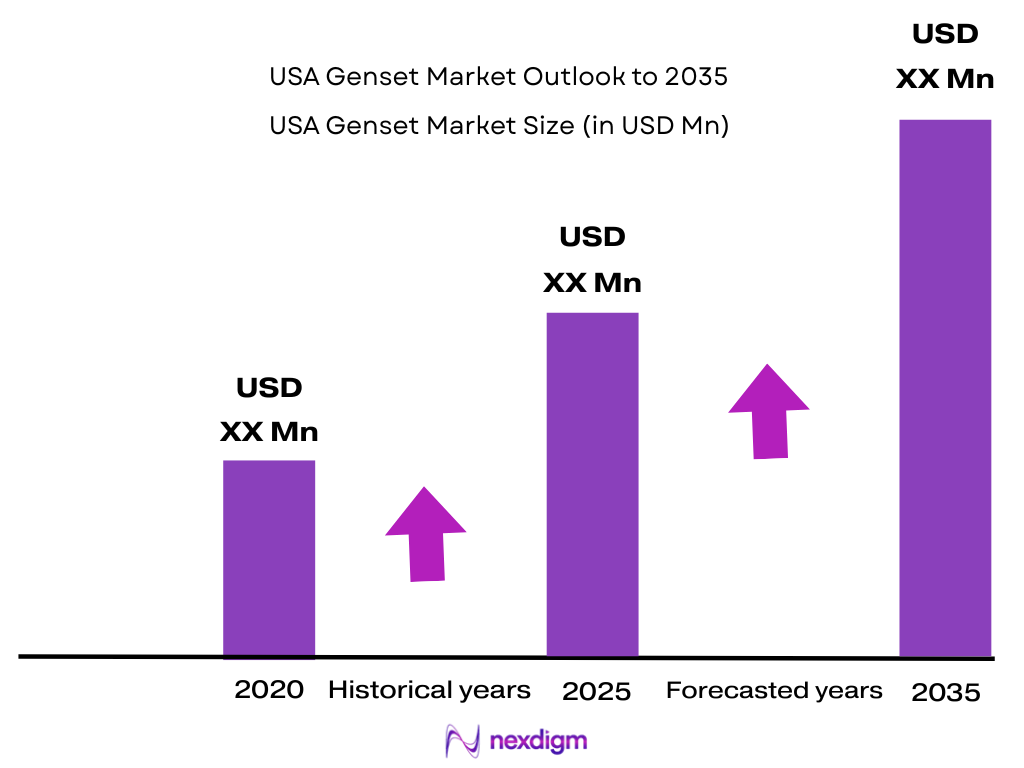
The USA Genset Market is forecast to expand at approximately ~ CAGR during 2026–2035, supported by recurring weather-related grid disruptions, increasing consumer focus on backup electricity and continued use of portable power in construction, outdoor recreation and mobile work applications. Growth will increasingly shift toward inverter generators that deliver lower noise, improved fuel efficiency and stable electricity for sensitive electronics. Manufacturers are also integrating digital runtime displays, electric start systems, Bluetooth connectivity and automatic carbon-monoxide shutdown technologies into gasoline-powered platforms. Petrol gensets will nevertheless face increasing competition from battery power stations, solar-plus-storage systems and permanent natural-gas standby generators. Their principal competitive advantages will remain rapid deployment, familiar gasoline availability, relatively high portable output and the ability to supply electricity independent of stationary infrastructure. Regulation will increasingly influence product architecture. EPA standards already regulate exhaust and evaporative emissions from small spark-ignition engines, while CPSC continues to focus heavily on carbon-monoxide hazards associated with portable generators.
Major Players
- Generac Power Systems
- Honda Power Equipment
- Champion Power Equipment
- Briggs & Stratton
- Westinghouse Outdoor Power Equipment
- DuroMax Power Equipment
- FIRMAN Power Equipment
- Yamaha Motor Corporation
- WEN Products
- Pulsar Products
- A-iPower
- Kohler Energy / Rehlko
- Pramac
- Powermate
- Sportsman Generators
Key Target Audience
- Genset manufacturers
- Portable power-equipment manufacturers
- Small spark-ignition engine manufacturers
- Generator distributors, dealers and home-improvement retailers
- Construction contractors and equipment-rental companies
- Residential backup-power and emergency-preparedness solution providers
- Investments and venture capitalist firms
- Government and regulatory bodies (U.S. Environmental Protection Agency, U.S. Consumer Product Safety Commission, Department of Energy, Federal Emergency Management Agency)
Research Methodology
Step 1: Identification of Key Variables
The initial phase constructs an ecosystem map covering petrol genset manufacturers, small-engine suppliers, distributors, retailers, equipment-rental companies, residential consumers and construction users. Critical variables include rated wattage, starting wattage, engine displacement, gasoline tank capacity, runtime, inverter architecture, noise performance, CO detection, portability, transfer-switch compatibility and application type.
Step 2: Market Analysis and Construction
Historical demand is assessed using generator shipment indicators, power-outage exposure, weather-related disruption data, residential construction activity and portable-power applications. Product-level analysis separates conventional open-frame generators from inverter generators and evaluates wattage classes, gasoline-engine configurations, runtime and end-use patterns. EIA reliability metrics and NOAA disaster records provide important external demand indicators.
Step 3: Hypothesis Validation and Expert Consultation
Market hypotheses are validated through CATIs and structured interviews with generator manufacturers, engine suppliers, dealers, equipment-rental companies, electrical contractors and home-improvement channel participants. Discussions evaluate storm-driven purchases, replacement behaviour, inverter adoption, CO-safety requirements, fuel preferences, dealer stocking patterns, wattage selection and changing competition from battery-storage products.
Step 4: Research Synthesis and Final Output
Bottom-up product analysis is triangulated with U.S. grid-reliability data, housing activity, weather-disaster records and manufacturer product portfolios. EPA nonroad spark-ignition requirements and CPSC generator safety guidance are incorporated to assess technology and regulatory influences. Company-level product specifications are then used to validate power-class, runtime and safety-feature assumptions before final market modelling.

- Executive Summary
- Research Methodology (Market Definitions and Assumptions, Generator Set Inclusion and Exclusion Criteria, kW/kVA Conversion Framework, Market Sizing Approach, Top-Down Analysis, Bottom-Up Unit Assessment, Installed-Base Analysis, Replacement Demand Assessment, OEM Shipment Analysis, Dealer and Rental Channel Assessment, Primary Industry Interviews, Data Triangulation, Scenario-Based Forecasting, Limitations and Future Conclusions)

- Definition and Scope
- Market Evolution and Industry Genesis
- Generator Set Ecosystem and Industry Structure
- Evolution of Portable, Standby and Mobile Power Solutions
- Generator Manufacturing and Component Value Chain

- Growth Drivers (Increasing Frequency and Duration of Grid Power Interruptions, Residential Demand for Automatic Backup Power)
- Market Challenges (Generator Carbon-Monoxide Safety Risks,Nonroad Engine Emission Compliance Requirements)
- Market Opportunities (Smart Connected Generator Systems, Remote Monitoring and Predictive Maintenance)
- Market Trends (Shift from Conventional Portable to Inverter Generators, Growing Dual-Fuel and Tri-Fuel Product Portfolios)
- Government Regulations (EPA Small Nonroad Spark-Ignition Engine Standards, EPA Nonroad Compression-Ignition Engine Standards)
- SWOT Analysis
- Porter’s Five Forces Analysis
- PESTLE Analysis

- By Market Value (2020-2025)
- By Generator Unit Shipments (2020-2025)
- By Installed Generator Capacity (2020-2025)

- By Power Rating (In Value %)
Below 3 kW
3–5 kW
5–10 kW
10–20 kW
20–50 kW - By Generator Configuration (In Value %)
Conventional Portable Generators
Portable Inverter Generators
Home Standby Generators
Commercial Standby Generator Sets
Industrial Standby Generator Sets - By Application (In Value %)
Emergency Backup Power
Residential Whole-House Backup
Partial Home Backup
Construction Site Power
Commercial Backup Power - By Region (In Value %)
Northeast
Midwest
South
West
Gulf Coast

- Market Share of Major Players
- Cross Comparison Parameters (Generator Power Range, Fuel-Type Portfolio and Multi-Fuel Capability, Portable, Standby and Mobile Product Breadth, Inverter Generator Capability, Automatic Transfer Switch and Load-Management Capability, CO Detection and Automatic Shutdown Technology, Remote Monitoring and Connected Generator Capability, Dealer, Installer and After-Sales Service Network)
- SWOT Analysis of Major Players
- Detailed Profiles of Major Companies
Generac Power Systems
Cummins Inc.
Kohler Home Energy / Rehlko
Caterpillar Inc.
Honda Power Equipment
Briggs & Stratton
Champion Power Equipment
Westinghouse Outdoor Power Equipment
DuroMax Power Equipment
FIRMAN Power Equipment
Atlas Copco
Wacker Neuson
Bobcat Portable Power
Multiquip Inc.
Yamaha Motor Power Products

- Residential Backup Power Requirement Assessment
- Whole-House versus Essential-Circuit Backup Preference
- Typical Household Load Requirement Analysis
- Home Generator Installation Decision Process
- Portable versus Standby Generator Purchase Decision

- By Market Value (2026-2035)
- By Generator Unit Shipments (2026-2035)
- By Installed Capacity (2026-2035)


 Request a Sample
 Ask for Customization
 Get a Quote
 Enquire Now