
 Download PDF
Market Overview
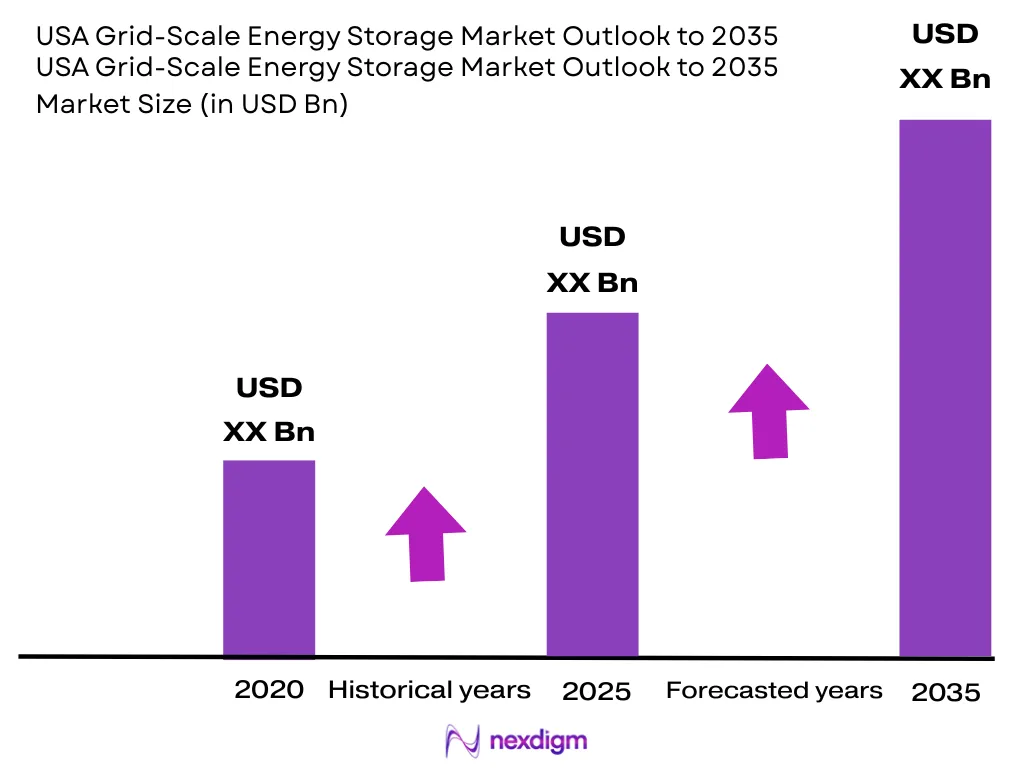
The USA Grid-Scale Energy Storage Market was valued at USD ~ Billion in 2024 and is anticipated to expand at a CAGR of ~% during 2026–2035. The market is primarily driven by the Investment Tax Credit under the Inflation Reduction Act, now preserved under the One Big Beautiful Bill Act, growing AI data center co-location storage demand, and utility renewable integration mandates across California, Texas, and the Southwest. The United States accounts for approximately 87.4% of North American energy storage revenues, according to SNS Insider, through its combination of IRA policy incentives, the most commercially active utility procurement market globally, and a rapidly growing residential storage segment, with North America valued at USD 6.8 billion in 2025 and holding a 37.2% share of the global grid energy storage market. U.S. grid-scale battery installations reached 12.3 GW in 2024, according to Evolvance Market Research, while Wood Mackenzie reported that the U.S. energy storage sector deployed 34.4 GWh in 2024, with Tesla accounting for over 90% of that deployment. The U.S. utility-scale energy storage market led growth in the first quarter of 2025, adding 1.5 GW/4 GWh of capacity, a 57% increase over the same period the prior year, while the residential storage market also saw its highest first quarter on record, with more than 450 MW installed, reflecting sustained momentum across grid-scale and behind-the-meter storage applications.
Market Segmentation
By Technology
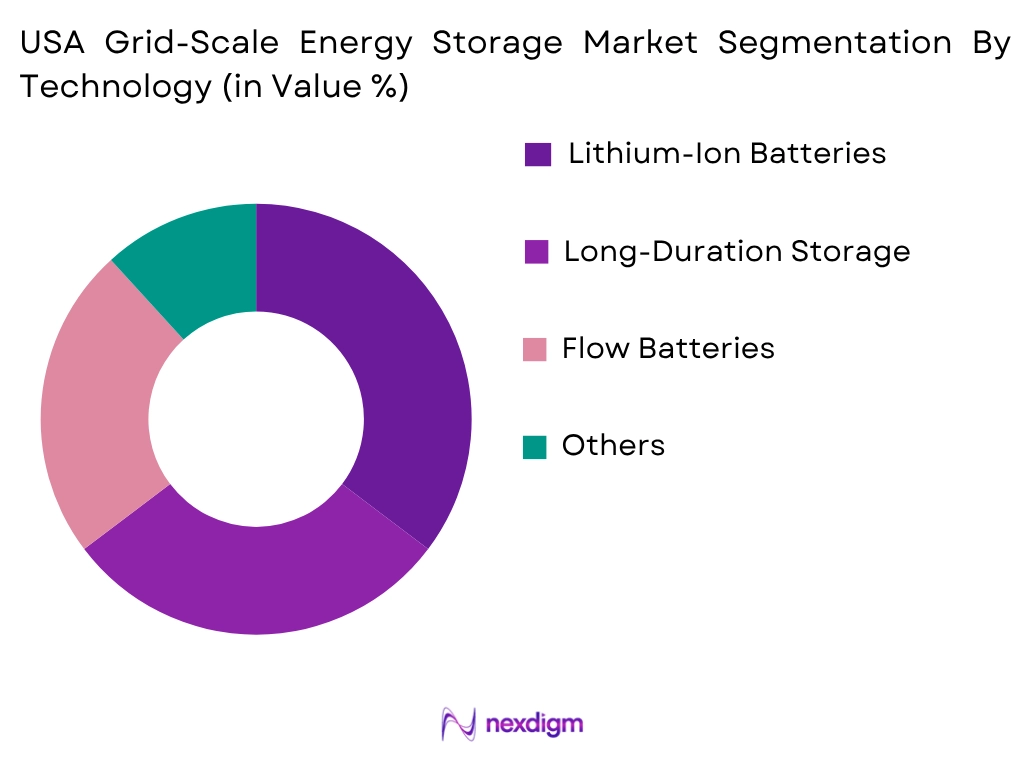
Among these, Lithium-Ion Batteries, particularly Lithium Iron Phosphate (LFP) chemistry, dominate the USA Grid-Scale Energy Storage Market, consistent with the global pattern in which LFP accounted for 69% of newly commissioned utility-scale battery storage projects in 2025, confirming the commercial dominance of affordable LFP chemistry in grid-scale applications. Tesla’s Megapack product line continues to anchor this segment, with the company accounting for over 90% of the 34.4 GWh deployed across the U.S. energy storage sector in 2024, according to Wood Mackenzie. Long-Duration Storage, including iron-air and other emerging chemistries, represents the fastest-growing technology segment, as the shift toward four-to-eight-hour long-duration storage systems continues to reshape procurement patterns in 2024 and 2025, driven by the need to address multi-hour renewable intermittency that shorter-duration lithium-ion systems cannot economically resolve at scale.
By Application
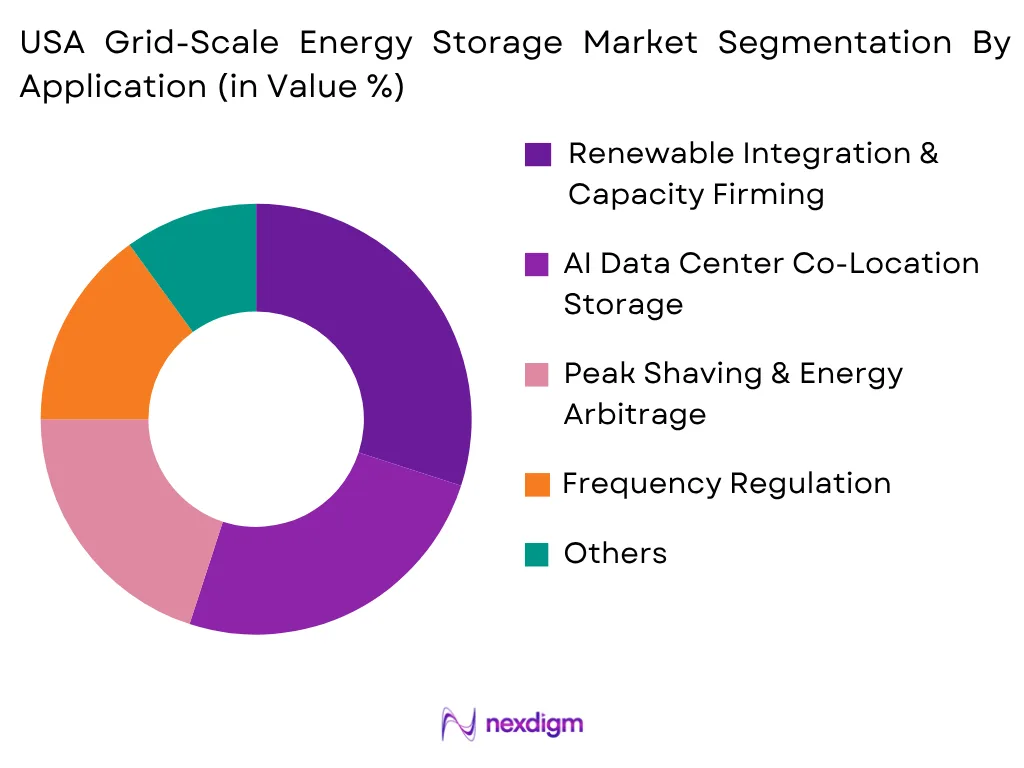
The Renewable Integration & Capacity Firming segment holds the largest application share of the USA Grid-Scale Energy Storage Market, reflecting utility renewable integration mandates and the accelerating global deployment of variable renewable energy that creates grid flexibility requirements only storage can address at scale. California’s duck curve energy arbitrage dynamics continue to anchor demand in the state, while Texas and the broader Southwest benefit from favorable solar irradiation and progressive renewable energy mandates that create the most commercially active storage procurement environment in the country. AI Data Center Co-Location Storage represents the fastest-growing application segment, as surging data center power demand increasingly positions battery storage as critical infrastructure for managing the load variability and grid interconnection constraints associated with large-scale AI computing facilities, a trend expected to accelerate substantially through the remainder of the decade.
Competitive Landscape
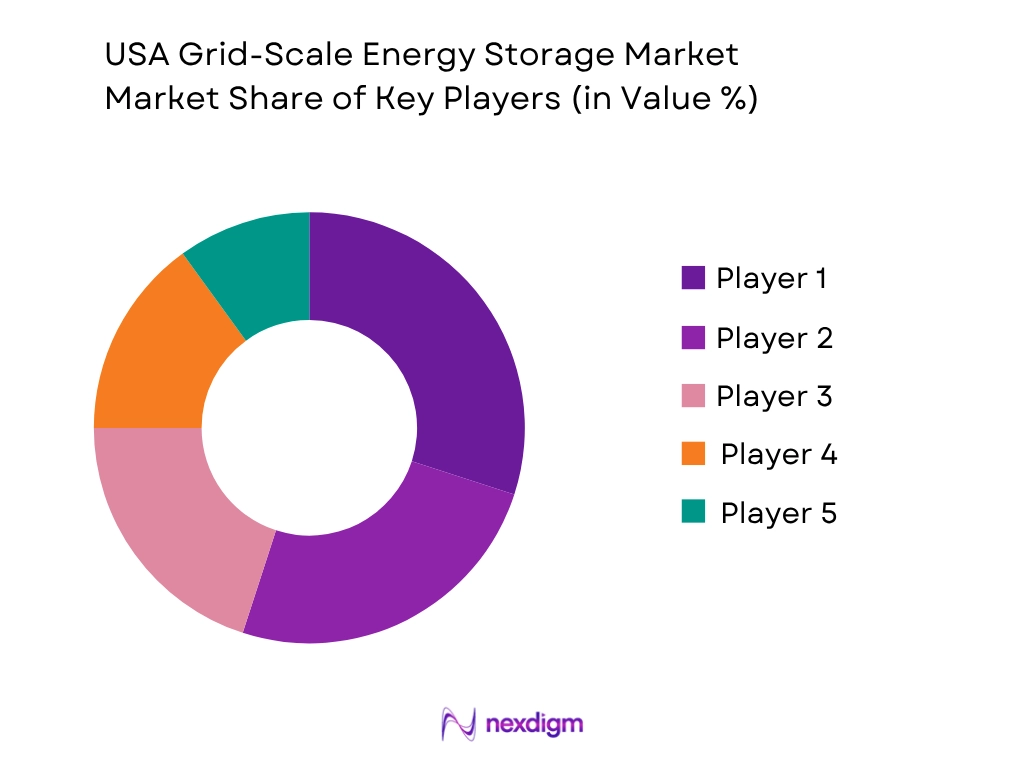
The USA Grid-Scale Energy Storage Market is highly concentrated at the deployment level, with Tesla accounting for over 90% of the 34.4 GWh deployed across the U.S. energy storage sector in 2024, according to Wood Mackenzie, while a broader set of system integrators, utilities, and technology developers compete across cell manufacturing, system integration, and digital energy management services. Competition is primarily based on battery chemistry capability, manufacturing capacity, software and services integration, and the ability to navigate IRA tax credit compliance and interconnection requirements. Fluence Energy, headquartered in Arlington, Virginia, reported fiscal year 2024 revenue of approximately USD 2.7 billion, up from USD 2.2 billion in FY2023, with backlog growing to approximately USD 5.3 billion by fiscal year 2025 and annual recurring revenue reaching USD 148 million, reflecting the company’s successful transition from one-time hardware sales toward higher-margin, longer-term software and services revenue. Fluence’s CEO has described ‘unprecedented demand for battery energy storage solutions globally, driven principally by the US market,’ confirming the commercial inflection underway. Form Energy continues to advance its iron-air long-duration battery technology, while GE Vernova, Honeywell, NextEra Energy, and AES Corporation continue to compete across grid-scale system integration, project development, and utility ownership models.
| Company | Establishment Year | Headquarters | Primary Product Portfolio | Energy Storage Portfolio
|
Manufacturing Presence | Major End-Use Industries | Key Strategic Focus | Certifications & Compliance |
| Tesla Energy (Tesla, Inc.) | 2003 | ~ | ~ | ~ | ~ | ~ | ~ | ~ |
| Fluence Energy, Inc. | 2018 | ~ | ~ | ~ | ~ | ~ | ~ | ~ |
| GE Vernova Inc. | 2024 | ~ | ~ | ~ | ~ | ~ | ~ | ~ |
| Honeywell International Inc. | 1906 | ~ | ~ | ~ | ~ | ~ | ~ | ~ |
| Form Energy Inc. | 2017 | ~ | ~ | ~ | ~ | ~ | ~ | ~ |
USA Grid-Scale Energy Storage Market Analysis
Growth Drivers
IRA Investment Tax Credit Preserved Under OBBBA
The USA Grid-Scale Energy Storage Market is experiencing sustained growth due to the Investment Tax Credit under the Inflation Reduction Act, which continues to offer meaningful capital expenditure reductions for storage developers and has been preserved under the subsequent One Big Beautiful Bill Act. U.S. grid-scale battery installations reached 12.3 GW in 2024, powered by IRA tax incentives that significantly improved project economics and brought institutional capital into the market, according to Evolvance Market Research. This policy-driven financial incentive framework, combined with more than USD 6 billion in Bipartisan Infrastructure Law funding, continues to serve as a primary catalyst for energy storage deployment, providing developers and utilities with improved project economics that have accelerated the transition of energy storage from a niche grid-balancing technology into mainstream utility infrastructure planning across the United States.
AI Data Center Co-Location Storage Demand
Surging artificial intelligence data center power demand continues to drive substantial growth in the USA Grid-Scale Energy Storage Market, as AI computing facilities increasingly require battery storage co-location to manage load variability and navigate grid interconnection constraints. This demand driver, identified alongside the IRA investment tax credit, California duck curve energy arbitrage, and utility renewable integration as a key growth catalyst by Wood Mackenzie, reflects the accelerating convergence between data center infrastructure development and grid-scale battery storage deployment. As hyperscale technology companies continue expanding AI computing capacity across the United States, battery storage developers and utilities are increasingly structuring co-location partnerships that combine renewable generation, storage, and data center load to manage grid interconnection timelines and provide the reliable, flexible power supply that AI workloads demand.
Market Challenges
Tesla’s Overwhelming Market Concentration
The USA Grid-Scale Energy Storage Market faces a distinctive structural challenge stemming from Tesla’s overwhelming market concentration, with the company accounting for over 90% of the 34.4 GWh deployed across the U.S. energy storage sector in 2024, according to Wood Mackenzie. This extreme concentration creates supply chain and pricing risk for utilities and developers who may face limited alternative supplier options at scale, while also raising questions about market resilience should Tesla’s Megapack production or delivery schedules face disruption. Competing system integrators and battery manufacturers must continue to differentiate through specialized applications, such as long-duration storage or software-enabled services, to carve out market share in a landscape where a single manufacturer commands such a dominant deployment share.
Interconnection Queue Backlogs and Grid Integration Delays
The USA Grid-Scale Energy Storage Market continues to navigate substantial interconnection queue backlogs that delay project development timelines. If all energy storage-related requests for proposals, site applications, and other utility proposals active at the end of 2024 take shape, U.S. utilities will add more than 18.5 GW of energy storage capacity, illustrating the scale of the current development pipeline awaiting interconnection approval and grid integration. This backlog reflects broader challenges within U.S. grid interconnection processes, which have historically struggled to keep pace with the rapid growth of renewable generation and storage project applications, creating uncertainty for developers regarding project timelines and requiring sustained regulatory attention to streamline interconnection procedures across regional transmission organizations and utility service territories.
Market Opportunities
Long-Duration Storage Technology Commercialization
The shift toward four-to-eight-hour long-duration storage systems, reshaping procurement patterns in 2024 and 2025, presents substantial opportunities for technology developers capable of commercializing storage chemistries beyond conventional lithium-ion systems. Form Energy’s continued development of iron-air long-duration battery technology exemplifies the innovation trajectory within this segment, targeting the multi-hour and multi-day renewable intermittency challenges that shorter-duration lithium-ion systems cannot economically address at scale. As utilities increasingly seek storage solutions capable of providing extended discharge duration to support deeper renewable energy penetration, companies capable of scaling long-duration technology to commercial deployment are well positioned to capture growing demand from utilities pursuing more ambitious decarbonization and grid reliability targets.
Software and Services Revenue Diversification
Growing opportunities exist for energy storage companies to diversify revenue beyond one-time hardware sales toward higher-margin, recurring software and services offerings. Fluence Energy’s growth in annual recurring revenue to USD 148 million by fiscal year 2025 demonstrates the company’s successful transition toward long-term software and services revenue streams that carry higher margins and more predictable cash flows compared with traditional hardware sales. As the USA Grid-Scale Energy Storage Market matures, companies capable of developing AI-powered grid management software, predictive maintenance platforms, and long-term service agreements are well positioned to capture increasing value from the growing installed base of grid-scale battery storage systems across the United States, reducing reliance on cyclical hardware procurement revenue.
Future Outlook
The USA Grid-Scale Energy Storage Market is expected to witness sustained expansion over the forecast period, supported by continued IRA tax credit availability under the One Big Beautiful Bill Act, growing AI data center co-location storage demand, and accelerating long-duration storage technology commercialization. Continued resolution of interconnection queue backlogs, alongside growing diversification into software and services revenue models, is expected to strengthen the market’s operational and financial resilience. The market is also likely to benefit from continued state-level procurement mandates across California, Texas, and New York, supporting long-term growth across renewable integration, frequency regulation, peak shaving, and AI data center co-location storage applications.
Major Players
- Tesla Energy (Tesla, Inc.)
- Fluence Energy, Inc.
- GE Vernova Inc.
- Honeywell International Inc.
- Form Energy Inc.
- NextEra Energy, Inc.
- AES Corporation
- ESS Inc.
- LG Energy Solution Ltd.
- Samsung SDI Co., Ltd.
- BYD Company Ltd.
- Sungrow Power Supply Co., Ltd.
- ABB Group
- Enphase Energy, Inc.
- SolarEdge Technologies, Inc.
Key Target Audience
- Grid-Scale Energy Storage Manufacturers and System Integrators
- Electric Utilities and Independent Power Producers
- Renewable Energy Project Developers
- Data Center and Hyperscale Technology Companies
- Battery Cell Manufacturers
- Grid Management Software Providers
- Investment and Venture Capitalist Firms
- Government and Regulatory Bodies (Federal Energy Regulatory Commission (FERC), U.S. Department of Energy (DOE), State Public Utility Commissions)
- Component Suppliers and Raw Material Providers
Research Methodology
Step 1: Identification of Key Variables
The research process begins with identifying the complete ecosystem of the USA Grid-Scale Energy Storage Market, including battery cell manufacturers, system integrators, project developers, utilities, and regulatory authorities. Extensive secondary research is conducted using company annual reports, government publications, trade associations, customs statistics, industry journals, and proprietary databases to determine the variables influencing market demand, pricing, installed capacity, and technological developments.
Step 2: Market Analysis and Construction
Historical market information is collected and analyzed to estimate market size, installed capacity, technology adoption trends, application-wise demand, and pricing trends. A combination of top-down and bottom-up approaches is used to estimate market revenues and validate segment-level performance. Deployment patterns across renewable integration, frequency regulation, and data center co-location are evaluated to establish an accurate representation of the industry.
Step 3: Hypothesis Validation and Expert Consultation
The preliminary findings are validated through Computer-Assisted Telephone Interviews (CATIs) and structured discussions with energy storage manufacturers, procurement managers, utility executives, regulatory experts, and senior executives operating within the U.S. energy industry. These interviews help verify market assumptions, competitive developments, technology adoption trends, pricing dynamics, and future investment opportunities while refining the overall market estimates.
Step 4: Research Synthesis and Final Output
The final stage integrates insights obtained from primary interviews with quantitative information collected through secondary sources. Data triangulation techniques are applied to reconcile differences between supply-side and demand-side estimates, ensuring robust market forecasting. The report is then reviewed through multiple quality assurance checkpoints to deliver a comprehensive analysis covering market size, segmentation, competitive landscape, future outlook, and strategic recommendations for industry stakeholders.

- Executive Summary
- Research Methodology (Market Definitions and Assumptions, Abbreviations, Market Sizing Approach, Top-Down Analysis, Bottom-Up Analysis, Demand-Side Assessment, Supply-Side Assessment, Primary Industry Interviews, Secondary Research Validation, Data Triangulation, Forecasting Framework, Limitations and Future Conclusions)

- Definition and Scope
- Market Evolution and Industry Genesis
- Timeline of Major Industry Developments
- Energy Storage Industry Value Chain Analysis
- Supply Chain Analysis

- Growth Drivers (IRA Investment Tax Credit Preserved Under OBBBA, AI Data Center Co-Location Storage Demand, California Duck Curve Energy Arbitrage, Utility Renewable Integration Mandates, Growth in Long-Duration Storage Procurement, State-Level Procurement Mandates in Texas and New York)
- Market Challenges (Tesla’s Overwhelming Market Concentration, Interconnection Queue Backlogs and Grid Integration Delays, Lithium-Ion Supply Chain Dependency on China, High Upfront Capital Costs, Regulatory Compliance Complexity)
- Market Opportunities (Long-Duration Storage Technology Commercialization, Software and Services Revenue Diversification, Domestic Battery Cell Manufacturing Expansion, AI-Powered Grid Management Software, Residential and C&I Storage Integration)
- Market Trends (Shift Toward 4-8 Hour Long-Duration Systems, Growth of AI-Powered Energy Management Software, Recurring Software and Services Revenue Models, Domestic Manufacturing Reshoring, Consolidation Through Mergers and Acquisitions)
- Government Regulations (FERC Order 841 Market Participation Rules, Inflation Reduction Act (IRA) Investment Tax Credit, One Big Beautiful Bill Act (OBBBA) ITC Provisions, State Renewable Portfolio Standards, Bipartisan Infrastructure Law Storage Funding)
- Import and Export Analysis (Trade Volume, Major Import Sources, Export Destinations, HS Code Analysis, Trade Balance)
- Raw Material Availability Analysis (Lithium, Iron, Graphite, Battery-Grade Nickel, Domestic Cell Manufacturing Capacity)
- Technology Landscape (Lithium Iron Phosphate (LFP) Battery Technology, Iron-Air Long-Duration Technology, AI-Powered Energy Management Software, Grid-Forming Inverter Technology, Battery Management Systems)
- Sustainability Assessment (Renewable Energy Integration, Domestic Manufacturing Carbon Footprint Reduction, Battery Recycling Initiatives, Grid Resilience Enhancement, Circular Economy for Battery Materials)
- PESTLE Analysis
- SWOT Analysis
- Porter’s Five Forces Analysis
- Stakeholder Ecosystem
- Competition Ecosystem

- By Market Value (2020-2025)
- By Installed Capacity (2020-2025)
- By Average Selling Price (2020-2025)

- By Technology (In Value %)
Lithium-Ion Batteries (LFP & NMC)
Flow Batteries
Long-Duration Storage (Iron-Air & Others) - By Duration (In Value %)
Short-Duration (Under 4 Hours)
Long-Duration (4-8 Hours & Beyond) - By Application (In Value %)
Renewable Integration & Capacity Firming
Frequency Regulation
Peak Shaving & Energy Arbitrage
AI Data Center Co-Location Storage
Transmission & Distribution Deferral - By Ownership Model (In Value %)
Utility-Owned
Independent Power Producer (IPP) / Merchant
Commercial & Industrial (C&I) - By Region (In Value %)
California
Texas
Southwest
Northeast & Other Regions

- Market Share of Major Players (By Value, Installed Capacity, Technology, Application, Duration)
- Cross Comparison Parameters (Product Portfolio Breadth, Battery Chemistry Capability, Application Technical Support Capability, Manufacturing Capacity, Regulatory Compliance & Certifications, Utility Customer Base, Innovation & New Product Launch Frequency)
- SWOT Analysis of Major Players
- Pricing Analysis by Product Category and Duration Class
- Production Capacity Analysis
- Manufacturing Footprint Analysis
- Distribution Network Analysis
- Innovation Benchmarking
- Detailed Profiles of Major Companies
Tesla Energy (Tesla, Inc.)
Fluence Energy, Inc.
GE Vernova Inc.
Honeywell International Inc.
Form Energy Inc.
NextEra Energy, Inc.
AES Corporation
ESS Inc.
LG Energy Solution Ltd.
Samsung SDI Co., Ltd.
BYD Company Ltd.
Sungrow Power Supply Co., Ltd.
ABB Group
Enphase Energy, Inc.
SolarEdge Technologies, Inc.

- Consumption Pattern Analysis (Deployment Scale, Project Size, Product Category Penetration, Seasonal Demand, Repowering Activity)
- Purchasing Criteria (Regulatory Compliance, Cost Efficiency, Round-Trip Efficiency, Cycle Life, Real-Time Monitoring, Supplier Reliability)
- Procurement and Supplier Selection Analysis
- Sustainable Energy Adoption Assessment
- Premium vs Conventional Storage Demand
- Product Attribute Preference Analysis (Round-Trip Efficiency, Cycle Life, Real-Time Monitoring, Scalability, Safety Certification, Software Integration)
- Grid Resilience and Reliability Influence on Product Development
- Pain Point Analysis
- Decision-Making Process

- By Market Value (2026-2035)
- By Installed Capacity (2026-2035)
- By Average Selling Price (2026-2035)


 Request a Sample
 Ask for Customization
 Get a Quote
 Enquire Now