

 Download PDF
 Download PDF
Market Overview
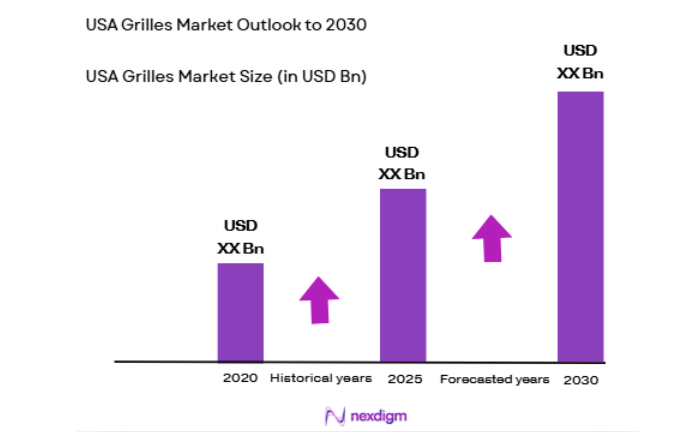
The USA grilles market is valued at approximately USD ~ billion based on a recent historical assessment derived from U.S. Census Bureau construction spending data and OICA vehicle production statistics, reflecting combined demand from automotive front-end assemblies, HVAC ventilation systems, and architectural façade applications. Growth is primarily driven by sustained light vehicle production exceeding ~ units annually and non-residential construction expenditure above USD ~ trillion, both of which directly increase installation volumes for airflow and styling grille components.
Major metropolitan manufacturing and construction corridors including Detroit, Chicago, Houston, Los Angeles, and Atlanta dominate the USA grilles market due to concentration of automotive OEM plants, HVAC system integrators, sheet-metal fabrication clusters, and large-scale commercial real estate development. These regions benefit from integrated supply chains, skilled metalworking labor, logistics infrastructure, and proximity to end-use industries, enabling cost-efficient production and rapid deployment of automotive and building ventilation grille systems across multiple application sectors.
Market Segmentation
By Product Type
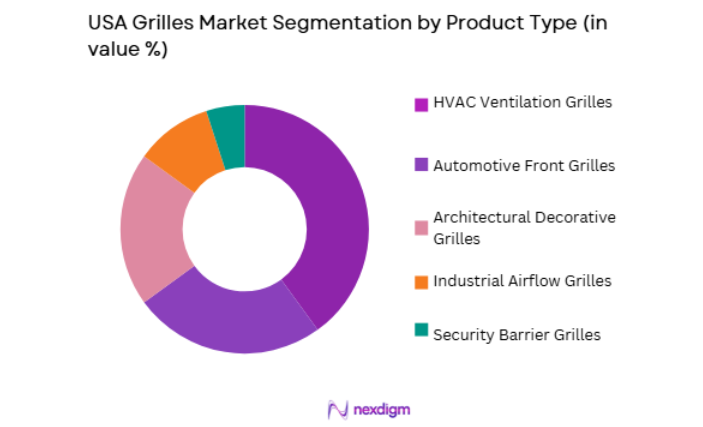
USA Grilles market is segmented by product type into automotive front grilles, HVAC ventilation grilles, architectural decorative grilles, security barrier grilles, and industrial airflow grilles. Recently, HVAC ventilation grilles has a dominant market share due to factors such as nationwide commercial building retrofits, stringent indoor air quality standards, and sustained non-residential construction activity. Demand patterns favor ventilation components because every commercial and institutional building requires multiple grille installations across supply, return, and exhaust air systems. Additionally, energy efficiency regulations and building modernization programs have increased replacement cycles for legacy ventilation hardware, reinforcing sustained procurement volumes across healthcare, education, and office infrastructure projects.
By End-Use Application
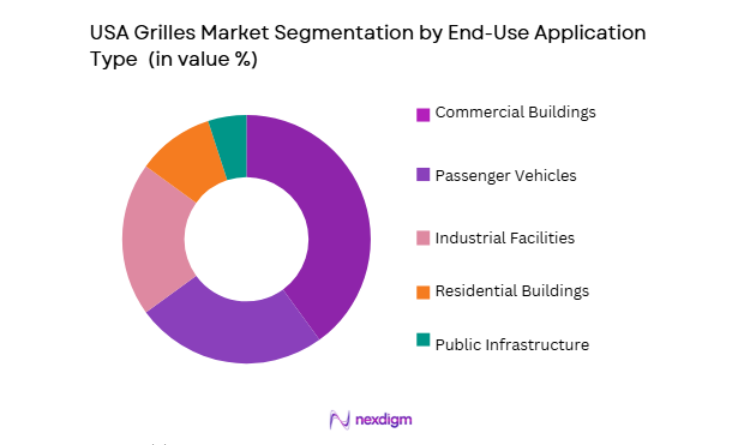
USA Grilles market is segmented by end-use application into commercial buildings, passenger vehicles, industrial facilities, residential buildings, and public infrastructure. Recently, commercial buildings has a dominant market share due to factors such as large floor-area ventilation requirements, high grille density per installation, and regulatory compliance for airflow distribution and fire safety. Commercial construction generates extensive demand because HVAC systems in offices, hospitals, airports, and retail complexes require multiple grille units per zone, far exceeding automotive or residential installation volumes. Continuous renovation of aging building stock and expansion of healthcare and logistics facilities further sustains dominant consumption across the commercial building sector.
Competitive Landscape
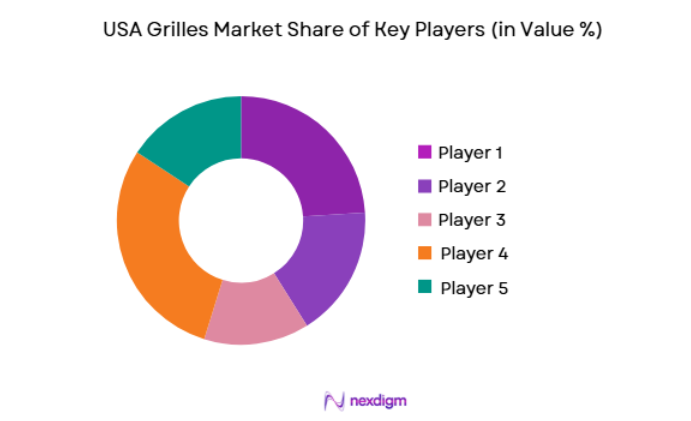
The USA grilles market exhibits moderate consolidation, with large HVAC component manufacturers and automotive exterior system suppliers holding significant influence through OEM supply agreements and national distribution networks. Market leaders benefit from scale manufacturing, standardized product portfolios, and established relationships with construction contractors and vehicle assemblers. Smaller regional fabricators remain active in custom architectural and retrofit segments, while global automotive suppliers dominate high-volume front-grille production through integrated plastics and metal forming technologies.
| Company Name | Establishment Year | Headquarters | Technology Focus | Market Reach | Key Products | Revenue | Primary End-Use |
| Magna International | 1957 | Canada | ~ | ~ | ~ | ~ | ~ |
| Plastic Omnium | 1946 | France | ~ | ~ | ~ | ~ | ~ |
| SRG Global | 2009 | USA | ~ | ~ | ~ | ~ | ~ |
| Greenheck Fan Corporation | 1947 | USA | ~ | ~ | ~ | ~ | ~ |
| Ruskin Company | 1958 | USA | ~ | ~ | ~ | ~ | ~ |
USA Grilles Market Analysis
Growth Drivers
Expansion of Commercial HVAC Infrastructure Modernization
The expansion of commercial HVAC infrastructure modernization is a primary growth driver for the USA grilles market because ventilation grilles are essential terminal components in every air distribution system across offices, hospitals, airports, warehouses, and educational facilities. Aging building stock constructed before modern energy and air-quality standards requires extensive retrofit programs that replace outdated airflow terminals with high-efficiency grille assemblies. Federal and state indoor air quality initiatives have accelerated replacement cycles, particularly in healthcare and public infrastructure facilities where airflow control is critical for occupant safety. Commercial construction spending consistently exceeds one trillion dollars annually, sustaining large-scale installation demand for ventilation hardware. Each commercial HVAC system integrates dozens to hundreds of grille units across supply and return ducts, multiplying consumption volumes relative to other grille applications. Growth in logistics and data center construction further increases airflow component density due to high cooling loads and precision ventilation requirements. Advanced building codes emphasizing airflow balancing, acoustic control, and fire compliance also mandate upgraded grille specifications. Consequently, modernization programs across commercial infrastructure generate persistent and high-volume procurement demand that structurally expands the USA grilles market.
Automotive Front-End Styling and Functional Integration Demand
Automotive front-end styling and functional integration demand significantly drives the USA grilles market because the grille has evolved from a simple airflow opening into a complex brand-defining and aerodynamic component in modern vehicles. Passenger vehicle production in the United States remains above ten million units annually, ensuring a stable baseline for grille installation volumes across OEM manufacturing lines. Automakers increasingly integrate active shutter systems, radar transparency zones, and sensor housings into grille assemblies to support thermal management and advanced driver assistance systems. This functional convergence raises component complexity and unit value, elevating revenue contribution per vehicle platform. Electric vehicles introduce new design requirements where grilles transition toward decorative and aerodynamic panels while maintaining brand identity, creating fresh demand for specialized grille architectures. Consumer preference for distinctive front-end aesthetics also intensifies aftermarket customization demand, especially in pickup trucks and sport utility vehicles. Tier-one exterior suppliers invest in advanced plastics, coatings, and lightweight metal forming technologies to meet styling and performance requirements. As vehicles incorporate more integrated front-end modules, grille systems remain central structural and visual elements, reinforcing sustained growth across automotive applications.
Market Challenges
Volatility in Metal and Polymer Raw Material Pricing
Volatility in metal and polymer raw material pricing poses a significant challenge to the USA grilles market because production relies heavily on aluminum, steel, and engineering plastics whose prices fluctuate with global commodity cycles and petrochemical feedstock costs. Manufacturers face margin compression when input prices rise rapidly while long-term supply contracts restrict immediate price adjustments to customers. Automotive OEM procurement agreements often lock component pricing across model cycles, transferring raw-material risk to grille suppliers. HVAC grille manufacturers also compete in price-sensitive construction markets where contractors prioritize low procurement costs, limiting the ability to pass through material increases. Supply chain disruptions and trade tariffs further amplify cost instability across imported metals and resins used in grille fabrication. Frequent price swings complicate inventory planning and production scheduling, increasing financial exposure for mid-scale fabricators. Smaller regional producers with limited purchasing power are particularly vulnerable to bulk material cost surges. Persistent commodity volatility therefore constrains profitability and investment capacity across the USA grilles industry.
Fragmented Standards and Certification Compliance Requirements
Fragmented standards and certification compliance requirements challenge the USA grilles market because products must meet diverse automotive safety, building ventilation, fire resistance, and airflow performance regulations across multiple jurisdictions and applications. HVAC grilles used in commercial buildings must satisfy airflow distribution, acoustic performance, and fire damper integration standards defined by mechanical codes and safety authorities. Automotive grilles require compliance with pedestrian protection, crashworthiness, and sensor compatibility regulations, increasing engineering complexity and testing costs. Certification processes vary across states and municipalities for construction products, requiring repeated approvals for similar grille designs. Manufacturers must maintain extensive documentation, testing data, and quality assurance procedures to demonstrate compliance across product categories. Smaller firms often lack resources to navigate certification frameworks, limiting market entry and innovation. Continuous regulatory updates related to energy efficiency and safety also necessitate product redesign and recertification expenditures. Consequently, fragmented compliance landscapes raise development costs and slow product introduction across the USA grilles market.
Opportunities
Adoption of Smart and Active Airflow Control Grille Systems
Adoption of smart and active airflow control grille systems presents a major opportunity in the USA grilles market as buildings increasingly integrate intelligent HVAC management technologies for energy efficiency and occupant comfort optimization. Smart ventilation terminals equipped with adjustable louvers, sensors, and automated control interfaces enable dynamic airflow balancing across commercial spaces. These systems improve indoor air quality while reducing energy consumption by regulating air distribution based on occupancy and environmental conditions. Demand for intelligent building solutions is expanding in offices, hospitals, and data centers seeking operational efficiency and sustainability certification. Integration with building management systems transforms grilles from passive components into active airflow devices, raising technological value and pricing potential. Manufacturers can differentiate products through connectivity, materials innovation, and precision airflow engineering. Retrofit programs for legacy HVAC systems offer substantial replacement opportunities for smart grille solutions. As buildings transition toward automated environmental control, intelligent grille technologies represent a high-growth segment within the USA grilles industry.
Growth in Electric Vehicle Exterior Styling Components
Growth in electric vehicle exterior styling components offers a significant opportunity for the USA grilles market because electrified powertrains alter front-end architecture while preserving consumer demand for distinctive vehicle identity. Electric vehicles require reduced cooling airflow compared with combustion vehicles, enabling designers to reimagine grille structures as aesthetic and aerodynamic surfaces. This shift encourages development of illuminated, patterned, and sensor-integrated grille panels that differentiate electric vehicle brands. Automotive manufacturers seek lightweight, corrosion-resistant, and radar-transparent materials suitable for advanced driver assistance systems and autonomous sensing technologies. Suppliers specializing in decorative and functional grille assemblies can expand into premium electric vehicle platforms where styling innovation commands higher margins. Rapid expansion of electric vehicle production in North America creates new OEM sourcing opportunities for grille manufacturers. Customization and personalization trends in electric vehicles further expand aftermarket demand for specialized grille designs. As electrification reshapes automotive front-end architecture, grille components remain central visual elements, enabling sustained growth potential across emerging vehicle platforms.
Future Outlook
The USA grilles market is expected to expand steadily over the next five years supported by continued commercial construction activity, HVAC modernization programs, and evolving automotive front-end design requirements. Technological integration of active airflow systems and electric vehicle styling elements will increase product value and complexity. Regulatory emphasis on indoor air quality and energy efficiency will further sustain ventilation grille demand. Domestic manufacturing investment and infrastructure development are also anticipated to reinforce long-term consumption across automotive and building sectors.
Major Players
- Magna International
- Plastic Omnium
- SRG Global
- Greenheck Fan Corporation
- Ruskin Company
- Nailor Industries
- Hart & Cooley
- KEES Inc.
- AirGuide Manufacturing
- Krueger HVAC
- A.J. Manufacturing
- Anemostat
- Grille Tech Inc.
- Trox USA
- Lindab
Key Target audience
- Automotive OEM manufacturers
- HVAC system manufacturers
- Commercial construction contractors
- Industrial facility operators
- Real estate developers
- Automotive aftermarket distributors
- Investments and venture capitalist firms
- Government and regulatory bodies
Research Methodology
Step 1: Identification of Key Variables
Key market variables including automotive production volume, commercial construction spending, HVAC installation density, material pricing trends, and regulatory standards were identified to define structural demand drivers and segmentation boundaries within the USA grilles market.
Step 2: Market Analysis and Construction
Demand modeling integrated vehicle production data, building floor-area construction statistics, and HVAC component ratios to estimate grille consumption volumes across automotive and construction sectors, forming the baseline market size framework.
Step 3: Hypothesis Validation and Expert Consultation
Industry interviews with HVAC engineers, automotive exterior designers, and sheet-metal fabricators validated installation densities, product lifecycles, and procurement structures, ensuring alignment between modeled assumptions and operational realities.
Step 4: Research Synthesis and Final Output
Quantitative demand estimates and qualitative industry insights were synthesized into a unified market structure covering segmentation, competitive dynamics, growth drivers, and future opportunities across automotive and ventilation grille applications.

- Executive Summary
- Research Methodology (Definitions, Scope, Industry Assumptions, Market Sizing Approach, Primary & Secondary Research Framework, Data Collection & Verification Protocol, Analytic Models & Forecast Methodology, Limitations & Research Validity Checks)

- Market Definition and Scope
- Value Chain & Stakeholder Ecosystem
- Regulatory / Certification Landscape
- Sector Dynamics Affecting Demand
- Strategic Initiatives & Infrastructure Growth

- Growth Drivers
Rising vehicle customization demand in automotive aftermarket
Expansion of commercial construction and HVAC installations
Increasing focus on airflow efficiency and aesthetic façade elements - Market Challenges
Volatility in aluminum and steel raw material costs
Intense competition from low-cost imported grille products
Complex certification requirements in building ventilation systems - Market Opportunities
Growth in electric vehicle styling differentiation components
Retrofitting of aging HVAC infrastructure in commercial buildings
Adoption of smart ventilation and airflow control grille systems - Trends
Integration of active shutter grille technologies in vehicles
Use of laser-cut and 3D patterned architectural grille designs
Shift toward corrosion-resistant composite grille materials - Government regulations
- SWOT analysis
- Porters 5 forces

- By Market Value, 2019-2025
- By Installed Units, 2019-2025
- By Average System Price, 2019-2025
- By System Complexity Tier, 2019-2025

- By System Type (In Value%)
Automotive Front Grilles
HVAC Ventilation Grilles
Architectural Decorative Grilles
Security Barrier Grilles
Industrial Airflow Grilles - By Platform Type (In Value%)
Passenger Vehicles
Commercial Vehicles
Residential Buildings
Commercial Buildings
Industrial Facilities - By Fitment Type (In Value%)
OEM Integrated Grilles
Aftermarket Replacement Grilles
Custom Fabricated Grilles
Modular Retrofit Grilles
Surface Mounted Grilles - By EndUser Segment (In Value%)
Automotive Manufacturers
Construction Contractors
Facility Management Firms
Industrial Plant Operators
Architectural Design Firms - By Procurement Channel (In Value%)
Direct OEM Supply Contracts
Construction Material Distributors
Automotive Aftermarket Retailers

- Market Share Analysis
- Cross Comparison Parameters (Material Type, Application Sector, Manufacturing Process, Distribution Channel, Price Tier, Design Complexity, Corrosion Resistance, Installation Method)
- SWOT Analysis of Key Competitors
- Pricing & Procurement Analysis
- Key Players
Magna International
SRG Global
Plastic Omnium
Toyo Roki Manufacturing
Edscha Group
A.L.P. Lighting Components
Ruskin Company
Nailor Industries
Metal Industries Inc.
Titus HVAC
Greenheck Fan Corporation
Hart & Cooley
Construction Specialties
Lindab Group
Trox USA

- Automotive OEMs emphasize brand identity through grille design differentiation
- Commercial builders prioritize airflow performance and compliance in HVAC grilles
- Industrial operators demand durability and corrosion resistance in harsh environments
- Architects integrate decorative grilles for façade aesthetics and ventilation balance

- Forecast Market Value, 2026-2030
- Forecast Installed Units, 2026-2030
- Price Forecast by System Tier, 2026-2030
- Future Demand by Platform, 2026-2030


 Request a Sample
 Ask for Customization
 Get a Quote
 Enquire Now