
 Download PDF
Market Overview
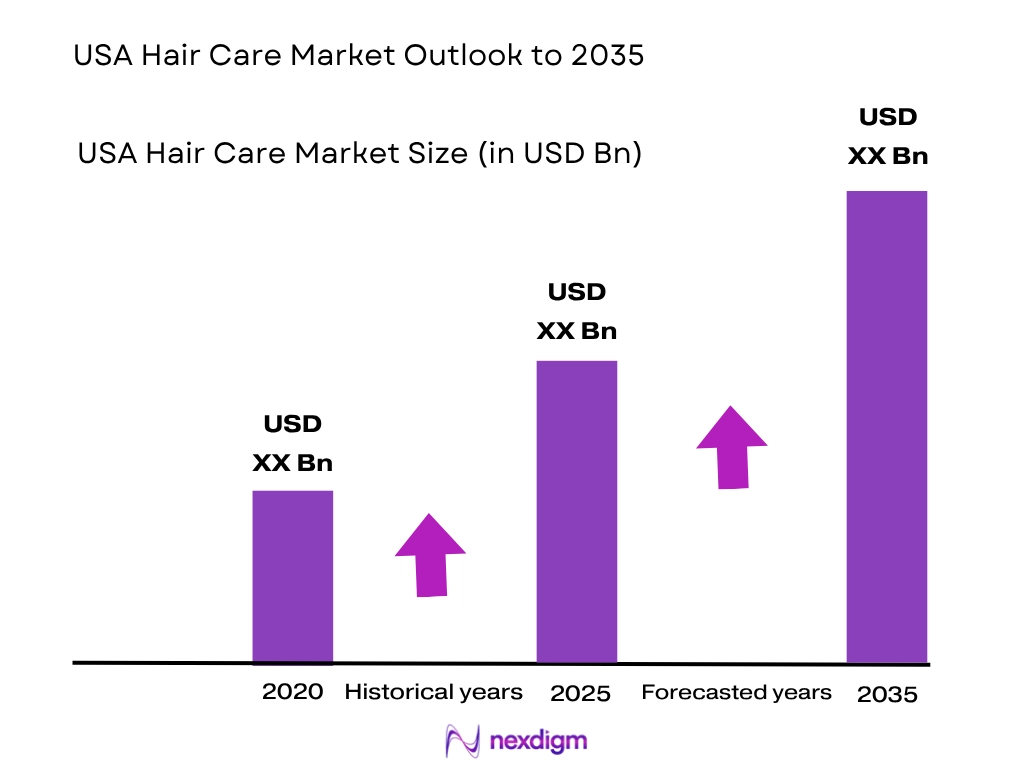
The USA Hair Care Market is valued at USD ~billion, with a long-range forecast value of USD ~ billion and a forecast CAGR of 5.01% through the long-term forecast period. The prior-year industry benchmark from Arizton placed the U.S. hair care market at USD ~ billion, showing that market expansion is being driven by shampoo penetration, natural ingredients, personalized formulations, e-commerce access, scalp-health products, and social-media-led purchasing behavior.
The market is concentrated in high-population, high-retail-density urban clusters such as New York, Los Angeles, Chicago, Houston, Phoenix, Dallas, Miami, Atlanta, San Francisco, and Washington, D.C. New York has 8,478,072 residents, Los Angeles 3,878,704, Chicago 2,721,308, Houston 2,390,125, and Phoenix 1,673,164, supporting strong demand through beauty retail, salons, multicultural hair care, premium stores, and online fulfillment density. Cities also grew across regions from the prior base, with Southern and Western cities accelerating.
Market Segmentation
By Product Type
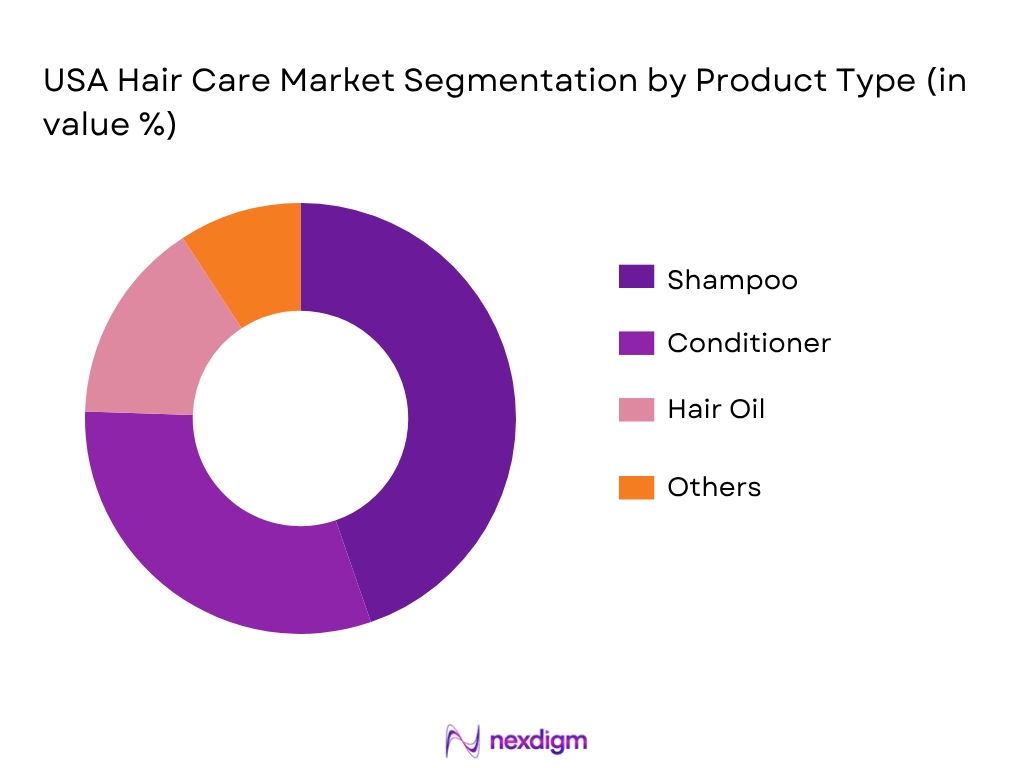
USA Hair Care Market is segmented by product type into shampoo, conditioner, hair oil, and others. Shampoo holds the dominant market share because it is the most frequently replenished hair care product and functions as the entry point for most hair routines. The segment benefits from broad household penetration, use across age and gender groups, and high SKU specialization in anti-dandruff, volumizing, moisturizing, sulfate-free, color-protection, curl-specific, and scalp-care variants. Conditioner remains a strong companion category, but shampoo leads because consumers generally buy cleansing products more consistently than treatment products. Hair oil is gaining traction through natural, ethnic, scalp-nourishment, and influencer-led routines, but its adoption is still narrower than shampoo in mass retail. Market Research Future identifies shampoo as the dominant product type and gives the highest valuation band for shampoo among reported product segments.
By Distribution Channel
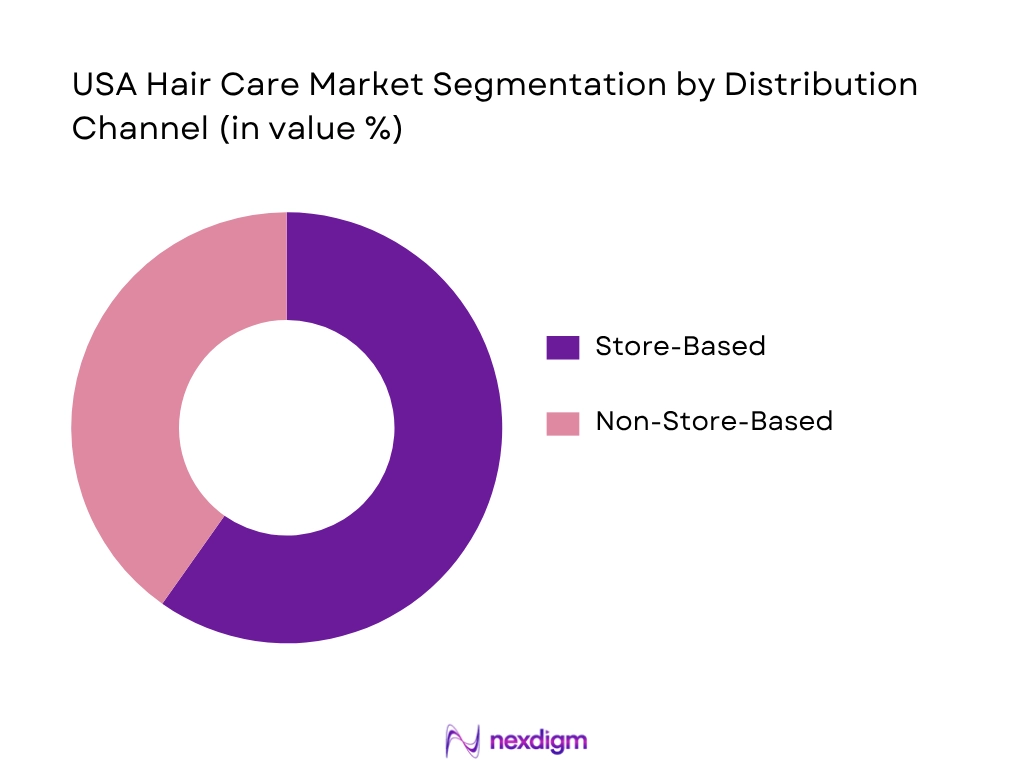
USA Hair Care Market is segmented by distribution channel into store-based and non-store-based channels. Store-based retail dominates because hair care remains a tactile, replenishment-led category where consumers compare pack size, fragrance cues, claims, promotions, and shelf placement before purchase. Supermarkets, mass merchandisers, drugstores, specialty beauty retailers, and salon retail continue to shape brand discovery and routine building, especially for shampoo, conditioner, hair color, and styling products. Physical channels also benefit from immediate availability and promotional bundling. Non-store-based channels are growing faster as Amazon, brand DTC websites, subscription models, TikTok Shop, and retailer apps expand product discovery, reviews, personalized quizzes, and replenishment convenience. However, store-based channels retain dominance due to legacy brand visibility, family-size formats, retailer promotions, and professional salon recommendation loops.
Competitive Landscape
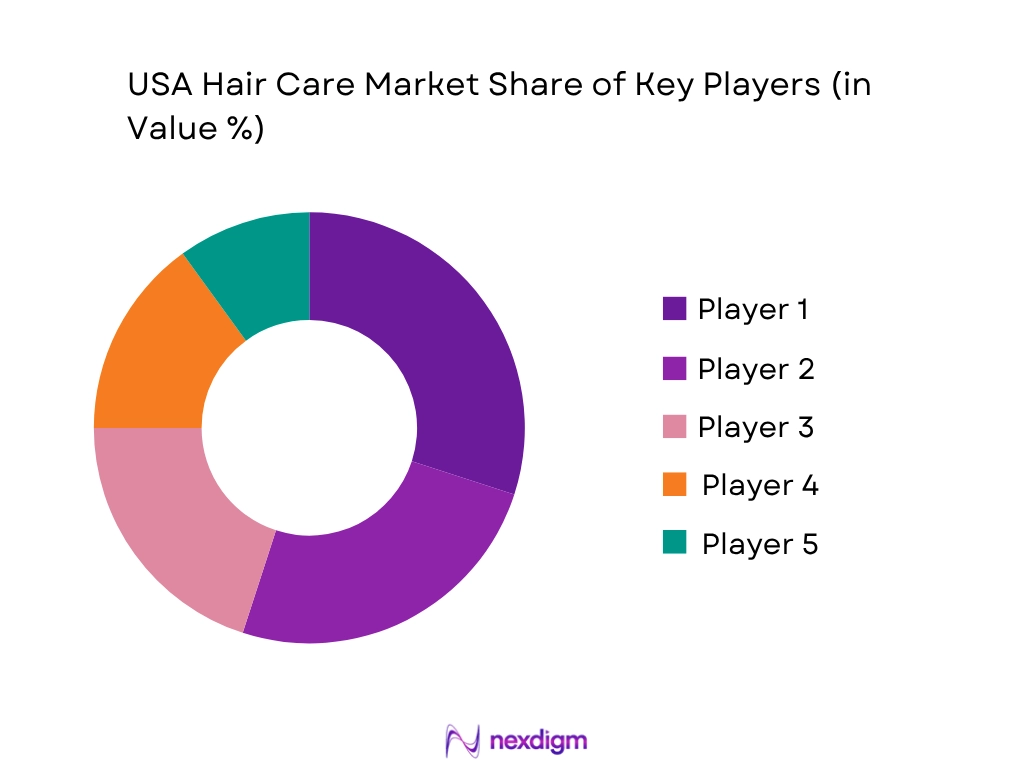
The USA Hair Care Market is led by multinational beauty and consumer goods companies with strong brand portfolios across mass, masstige, prestige, professional salon, scalp care, styling, color, and treatment categories. Procter & Gamble, L’Oréal, Unilever, Henkel, and Kao compete through differentiated claim platforms, broad retail access, salon credibility, influencer marketing, and ingredient-led innovation. The landscape is competitive but not fragmented at the top, as major players control leading brands while indie and premium specialists shape innovation in bond repair, clean beauty, textured hair, and scalp health. Market Research Future lists Procter & Gamble, L’Oréal, Unilever, Estée Lauder, Henkel, Shiseido, Revlon, and Kao among key companies.
| Company | Establishment Year | Headquarters | Key U.S. Hair Care Brands | Core Product Strength | Channel Strength | Premium / Professional Exposure | Scalp / Treatment Focus | Digital & Social Commerce Position |
| Procter & Gamble | 1837 | Cincinnati, Ohio, USA | ~ | ~ | ~ | ~ | ~ | ~ |
| L’Oréal | 1909 | Clichy, France | ~ | ~ | ~ | ~ | ~ | ~ |
| Unilever | 1929 | London, United Kingdom | ~ | ~ | ~ | ~ | ~ | ~ |
| Henkel | 1876 | Düsseldorf, Germany | ~ | ~ | ~ | ~ | ~ | ~ |
| Kao Corporation | 1887 | Tokyo, Japan | ~ | ~ | ~ | ~ | ~ | ~ |
USA Hair Care Market Analysis
Growth Drivers
Premiumization
Premiumization in the USA Hair Care Market is supported by strong household purchasing capacity, large consumer depth, and continued spending on personal-care routines. The U.S. economy recorded USD 28.75 trillion in GDP and USD 84,534.0 GDP per capita, creating a high-income base for trade-up products such as bond-repair shampoos, salon-grade conditioners, scalp serums, leave-in treatments, hair masks, and prestige styling products. The country also had 340,110,988 people, giving hair care brands a large replenishment-led consumer pool across mass, masstige, prestige, and professional channels. BEA data shows personal consumption expenditure on personal care at USD 412.696 billion, compared with USD 387.556 billion in the prior annual base, indicating that consumers continued allocating expenditure to grooming and beauty categories despite inflation pressure. BLS also reported 135,760,000 consumer units and average income before taxes of USD 104,207, supporting higher basket formation for multi-step routines. For hair care companies, this strengthens demand for premium claims such as sulfate-free, silicone-free, color-safe, keratin-inspired, bond-building, and dermatologist-inspired scalp care.
Scalp Health
Scalp health is a core growth driver because the hair care routine is shifting from cleansing-only behavior toward treatment-led management of dandruff, irritation, buildup, oiliness, thinning, and sensitivity. The U.S. population base of 340,110,988 consumers supports broad demand for anti-dandruff shampoos, scalp serums, exfoliating scalp scrubs, itch-relief treatments, and hair-density products. Government health data reinforces the relevance of skin and scalp sensitivity: CDC/NCHS reported that 31.7 out of every 100 U.S. adults had a diagnosed seasonal allergy, eczema, or food allergy; 7.7 out of every 100 adults had diagnosed eczema; and women reported diagnosed eczema at 9.5 out of every 100 adults versus 5.7 among men. While eczema is not limited to the scalp, these figures support consumer sensitivity toward skin-barrier claims, fragrance scrutiny, mild surfactants, and dermatologist-inspired positioning in scalp-contact hair products. BLS also shows 260,460 hairdressers, hairstylists, and cosmetologists employed in personal care services, creating a professional advisory layer that can recommend scalp-specific shampoos, treatments, and post-color maintenance routines.
Market Challenges
Ingredient Scrutiny
Ingredient scrutiny is intensifying in the USA Hair Care Market because shampoos, conditioners, styling products, hair sprays, dry shampoos, hair colorants, scalp serums, and leave-in treatments remain direct-contact consumer products. FDA describes MoCRA as the most significant expansion of FDA cosmetic authority since 1938, adding stronger obligations for safety substantiation, product listing, facility registration, adverse event reporting, and records access. Serious adverse events must be reported within 15 business days, and additional medical information received within 1 year must also be submitted within 15 business days. Facility registration must be renewed every 2 years, while each marketed cosmetic product must be listed with FDA and updated annually. The ingredient-risk environment is also moving toward PFAS scrutiny: FDA reported 51 PFAS used in 1,744 cosmetic formulations and evaluated the 25 most frequently used PFAS. It also identified 11 U.S. states with legislation prohibiting intentionally added PFAS in cosmetics and at least 8 other states with proposed restrictions. For hair care, this raises compliance pressure around fragrance, preservatives, colorants, conditioning polymers, aerosols, scalp claims, and long-wear styling formulas.
Aerosol Concerns
Aerosol concerns are market-specific for U.S. hair care because dry shampoo, hair finishing spray, texture spray, root touch-up spray, shine spray, and aerosol color products depend on propellant systems, inhalation safety, flammability handling, and VOC compliance. California Air Resources Board states that chemically formulated consumer products, including personal care products, are a significant source of VOC emissions and that consumer products are the largest source category of VOC and LVP-VOC emissions in California’s South Coast and statewide inventories. CARB regulations cover more than 130 consumer product categories and have reduced VOC emissions by about 50 between 1990 and 2020 relative to uncontrolled levels, yet the agency notes that consumer product emissions increased as population and usage grew. The regulatory framework also covers aerosol-related categories through Article 2 consumer products rules and Article 3 aerosol coating product rules, while Article 5 previously addressed the Hairspray Credit Program before repeal. For hair care brands, aerosol concerns affect propellant sourcing, VOC formulation limits, non-aerosol dry shampoo development, packaging claims, and retailer acceptance of spray-based SKUs.
Opportunities
White Space
White space in the USA Hair Care Market is strongest in under-addressed routines where consumers need targeted solutions rather than generic shampoo-conditioner products. The U.S. population of 340,110,988, GDP per capita of USD 84,534.0, and net migration of 1,230,663 indicate a large, diverse, and replenishment-driven consumer base for textured hair care, scalp-specific products, men’s thinning solutions, children’s detanglers, protective-style maintenance, gray-coverage maintenance, and fragrance-sensitive routines. BLS data shows 260,460 hairdressers, hairstylists, and cosmetologists in personal care services, 16,810 in general merchandise retailers, and 10,090 in health and personal care retailers, giving brands multiple professional and retail touchpoints for educating consumers on regimen gaps. CDC/NCHS data showing 7.7 out of every 100 adults with diagnosed eczema also supports white space for mild, hypoallergenic, fragrance-conscious, and scalp-barrier-positioned hair care. Opportunity areas include co-wash, bond repair for textured hair, scalp serums for protective styles, non-aerosol dry shampoo, color-safe scalp care, and dermatologist-inspired anti-irritation products.
Product Innovation
Product innovation in the USA Hair Care Market is supported by regulatory modernization, large personal-care expenditure, and demand for safer, more specific formulations. BEA/FRED reports personal care consumption expenditure of USD 412.696 billion, compared with USD 387.556 billion in the prior annual base, giving manufacturers a broad macro-consumption base for new formulas in scalp care, bond repair, dry shampoo alternatives, hair-density serums, color-care treatments, and curl-specific styling. FDA’s MoCRA framework creates a clearer innovation environment by requiring safety substantiation records, adverse-event systems, facility registration renewal every 2 years, and product listing updates. FDA also reported 51 PFAS in 1,744 cosmetic formulations and evaluated the 25 most frequently used PFAS, creating room for PFAS-free, low-irritation, and transparent-ingredient positioning. CARB’s VOC framework creates additional innovation pressure for aerosol-heavy hair care formats, especially dry shampoo and finishing sprays, because more than 130 consumer product categories are already subject to VOC limits. Innovation opportunity therefore lies in waterless non-aerosol powders, refillable packaging, microbiome-oriented scalp care, mild surfactant systems, heat-protection polymers, and professional-grade at-home treatment formats.
Future Outlook
The USA Hair Care Market is expected to expand steadily, supported by the shift from basic cleansing to routine-based hair wellness. Growth will be driven by scalp-first care, personalized products, clean formulations, salon-quality at-home treatments, digital discovery, and multicultural product specialization. The market is forecast to grow at a 5.01% CAGR, reaching USD 30.6 billion by the long-term forecast horizon. Premiumization will remain a key growth theme as consumers move from basic shampoo-conditioner routines toward bond repair, leave-in treatments, scalp serums, glosses, masks, and texture-specific styling products. Hair care is increasingly borrowing from skincare, with consumers seeking ingredients such as peptides, ceramides, hyaluronic acid, rosemary oil, caffeine, and microbiome-supporting actives. Regulatory pressure under MoCRA will also raise the importance of safety substantiation, product listing, adverse event systems, and claim discipline.
Major Players
- L’Oréal USA
- Procter & Gamble
- Unilever
- Henkel
- Kao Corporation
- The Estée Lauder Companies
- Wella Company
- Kenvue
- Olaplex Holdings
- Amika
- Moroccanoil
- Madison Reed
- Function of Beauty
- Church & Dwight
- Revlon
Key Target Audience
- Hair care product manufacturers
- Beauty and personal care brand owners
- Salon chains and professional salon distributors
- Specialty beauty retailers and mass merchandisers
- E-commerce marketplaces and DTC beauty platforms
- Packaging, fragrance, surfactant, and active ingredient suppliers
- Investments and venture capitalist firms
- Government and regulatory bodies: U.S. Food and Drug Administration, Federal Trade Commission, Consumer Product Safety Commission, U.S. Customs and Border Protection, Environmental Protection Agency
Research Methodology
Step 1: Identification of Key Variables
The initial phase involves constructing an ecosystem map for the USA Hair Care Market across brand owners, contract manufacturers, ingredient suppliers, packaging suppliers, retailers, salons, distributors, and digital platforms. Key variables include product type, distribution channel, price tier, hair concern, hair texture, claims platform, and regulatory compliance exposure.
Step 2: Market Analysis and Construction
Historical market values, product-level revenue ranges, channel revenue bands, salon business indicators, retail sales benchmarks, and company portfolio data are compiled to build the market model. The analysis evaluates shampoo, conditioner, hair oil, store-based retail, non-store-based retail, professional influence, and e-commerce contribution to revenue generation.
Step 3: Hypothesis Validation and Expert Consultation
Market hypotheses are validated through discussions with industry stakeholders including hair care brand managers, retail category buyers, salon distributors, stylists, packaging suppliers, and ingredient providers. These consultations help test assumptions on product velocity, consumer trade-up, scalp-care demand, salon retail conversion, private label competition, and digital shelf performance.
Step 4: Research Synthesis and Final Output
The final stage integrates secondary data, company portfolio mapping, category-level benchmarks, expert inputs, and bottom-up channel analysis. The output is normalized to ensure consistency across product type, distribution channel, competitive positioning, growth drivers, and long-term forecast assumptions for the USA Hair Care Market.

- Executive Summary
- Research Methodology
- (Market Definitions and Assumptions, Hair Care Category Inclusions, Shampoo and Conditioner Sizing Logic, Hair Color and Styling Product Classification, Salon vs Retail Channel Mapping, SKU-Level Price Benchmarking, Household Penetration Mapping, Professional Product Demand Estimation, Omnichannel Revenue Triangulation, Primary Interviews with Retailers Salons Distributors and Brand Managers, Consumer Routine Mapping, Limitations and Forecast Assumptions)

- Definition and Scope
- Market Genesis
- Evolution of Hair Care Routines
- Timeline of Major Players
- Business Cycle
- Supply Chain and Value Chain Analysis
- Manufacturing and Contract Manufacturing Ecosystem
- Ingredient and Formulation Ecosystem
- Retail Shelf and Digital Shelf Ecosystem
- Salon-to-Retail Conversion Model
- Consumer Journey and Hair Routine Architecture

- Growth Drivers(Premiumization, Scalp Health, Bond Repair, Textured Hair Care, Social Commerce, Professional-at-Home Treatments, Aging Population, Multicultural Demand)
- Market Challenges (Ingredient Scrutiny, Aerosol Concerns, Retail Competition, SKU Proliferation, Price Sensitivity, Salon Traffic Volatility, Counterfeit Risk, Claims Substantiation)
- Opportunities (White Space, Product Innovation, Channel Expansion, Consumer Education, Professional Partnerships, Multicultural Assortment, Personalization)
- Trends (Bond Repair, Scalp Health, Glossing, Curl Definition, Heat Protection, Rosemary Oil, Peptides, Fragrance-Led Hair Care, Sustainable Packaging)
- Government Regulation (MoCRA, FDA Cosmetics Oversight, Product Listing, Facility Registration, Adverse Event Reporting, GMP, Labeling, Safety Substantiation)
- SWOT Analysis (Brand Equity, Formulation Innovation, Channel Reach, Price Competition, Regulatory Burden, Premium Growth, Private Label Threat, Social Commerce Volatility)
- Stakeholder Ecosystem (Brand Owners, Contract Manufacturers, Ingredient Suppliers, Packaging Suppliers, Retailers, Salon Distributors, Stylists, Dermatologists, Influencers, Marketplaces, Consumers)
- Porter’s Five Forces (Brand Switching, Retailer Bargaining Power, Ingredient Supplier Power, Substitute Products, New Indie Brand Entry, Professional Channel Barriers)
- Pricing and Margin Analysis (ASP by Product Type, Price Tier Spread, Promotional Depth, Pack Size, Concentration Claims, Salon Markup, Marketplace Discounting)
- Retail and Digital Shelf Analysis (Shelf Share, Search Rank, Ratings and Reviews, Subscription Share, Sponsored Listings, Retailer Exclusives, Omnichannel Fulfilment)
- Import, Manufacturing, and Sourcing Analysis (Active Ingredients, Surfactants, Fragrance Oils, Packaging Resins, Contract Manufacturing, Domestic Filling, Global Brand Imports)
- Patent, Claims, and Innovation Landscape (Bonding Technologies, Scalp Actives, Anti-Frizz Polymers, Hair Growth Claims, Clean Formulation Claims, Heat Protection Claims)

- By Value (2020-2025)
- By Volume (2020-2025)
- By Average Selling Price (2020-2025)
- By Household Penetration (2020-2025)
- By Per Capita Hair Care Spend (2020-2025)
- By Retail vs Professional Revenue Contribution (2020-2025)
- By Mass vs Prestige Revenue Contribution (2020-2025)

- By Product Type (In Value%)
Shampoo
Conditioner
Hair Masks and Treatments
Hair Styling Products
Hair Colorants
Dry Shampoo
Scalp Care Products
Hair Growth and Anti-Thinning Products - By Hair Concern (In Value%)
Damage Repair
Scalp Health
Frizz and Humidity Control
Hair Thinning and Density
Color Protection and Gray Coverage - By Hair Type and Texture (In Value%)
Straight Hair
Wavy Hair
Curly Hair
Coily and Textured Hair
Fine and Thinning Hair
Color-Treated and Chemically Treated Hair - By Format and Formulation (In Value%)
Liquid and Cream Formats
Spray and Aerosol Formats
Powder and Waterless Formats
Oil and Serum Formats
Solid and Sustainable Formats - By Price Tier (In Value%)
Mass
Masstige
Prestige
Professional
Luxury Salon - By Distribution Channel (In Value%)
Supermarkets and Hypermarkets
Drugstores and Pharmacies
Mass Merchandisers
Specialty Beauty Retailers
Salon and Professional Stores
E-Commerce Marketplaces
Brand DTC Websites
Social Commerce - By Consumer Group (In Value%)
Women
Men
Children and Teens
Gen Z
Millennials
Multicultural and Textured-Hair Consumers - By Usage Occasion and End User (In Value%)
Daily Hair Routine
Weekly Treatment Routine
Salon Maintenance Routine
At-Home Color Routine
Styling and Event Routine - By Region (In Value%)
Northeast
Midwest
South
West
Urban and Suburban Clusters

- Market Share of Major Players (By Value Share, By Volume Share, By Product Type, By Price Tier, By Channel)
- Cross Comparison Parameters (SKU Architecture, Price Tier Positioning, Active Ingredient and Claim Platform, Hair Concern Coverage, Texture Inclusivity, Salon/Professional Affiliation, Retail Channel Footprint, DTC and Social Commerce Strength)
- Competitive Benchmarking Matrix (Product Breadth, Hero SKUs, Pricing Ladder, Claim Differentiation, Retailer Presence, Salon Penetration, Innovation Cadence, Creator Visibility)
- SWOT Analysis of Major Players (Brand Equity, Formulation Advantage, Channel Dependence, Regulatory Exposure, Portfolio Gaps, Premiumization Potential)
- Pricing Analysis Basis SKUs for Major Players (Shampoo ASP, Conditioner ASP, Mask ASP, Treatment ASP, Hair Color ASP, Styling Product ASP, Pack Size, Cost per Ounce)
- Brand Positioning Analysis (Mass Family Care, Dermatologist-Inspired Scalp Care, Clean Beauty, Prestige Bond Repair, Professional Salon Authority, Textured Hair Expertise)
- Distribution Strategy Analysis (Walmart, Target, CVS, Walgreens, Ulta Beauty, Sephora, Sally Beauty, SalonCentric, Amazon, Brand DTC, Professional Salons)
- Marketing and Influencer Strategy Analysis (TikTok Virality, Stylist Education, Celebrity Endorsements, Retail Media, Sampling, Loyalty Programs, Before/After Content)
- Recent Developments and M&A Analysis (Premium Hair Acquisitions, Professional Portfolio Expansion, DTC Brand Scaling, Retailer Exclusive Launches, Ingredient-Led Innovation)
- Detailed Profiles of Major Companies
L’Oréal USA
Procter & Gamble
Unilever
Henkel
Kao Corporation
The Estée Lauder Companies
Wella Company
Kenvue
Olaplex Holdings
Amika
Moroccanoil
Madison Reed
Function of Beauty
Church & Dwight
Revlon

- Consumer Demand and Utilization (Wash Frequency, Conditioner Usage, Treatment Frequency, Styling Frequency, Color Maintenance Frequency)
- Purchasing Power and Basket Economics (ASP Sensitivity, Multipack Adoption, Premium Trade-Up, Subscription Bundles, Salon Product Spend)
- Needs, Desires, and Pain Point Analysis (Damage, Dryness, Frizz, Hair Loss, Scalp Itch, Dandruff, Curl Definition, Gray Coverage, Product Build-Up)
- Decision-Making Process (Stylist Recommendation, Dermatologist Recommendation, TikTok Discovery, Amazon Reviews, Retailer Loyalty, Ingredient Claims, Before/After Content)
- Consumer Cohort Analysis (Gen Z Experimenters, Millennial Premium Regimen Buyers, Textured-Hair Consumers, Men’s Hair Loss Buyers, Gray-Coverage Buyers, Salon Loyalists)
- Purchase Journey Mapping (Awareness, Trial, Routine Formation, Replenishment, Regimen Expansion, Brand Advocacy)
- Brand Loyalty and Switching Analysis(Price Promotions, Claims Credibility, Fragrance Preference, Texture Compatibility, Salon Endorsement, Viral Product Cycles)

- By Value (2026-2035)
- By Volume (2026-2035)
- By Average Selling Price (2026-2035)
- By Retail vs Professional Revenue Contribution (2026-2035)
- By Mass vs Prestige Revenue Contribution (2026-2035)
- By Online vs Offline Revenue Contribution (2026-2035)


 Request a Sample
 Ask for Customization
 Get a Quote
 Enquire Now