

 Download PDF
Market Overview
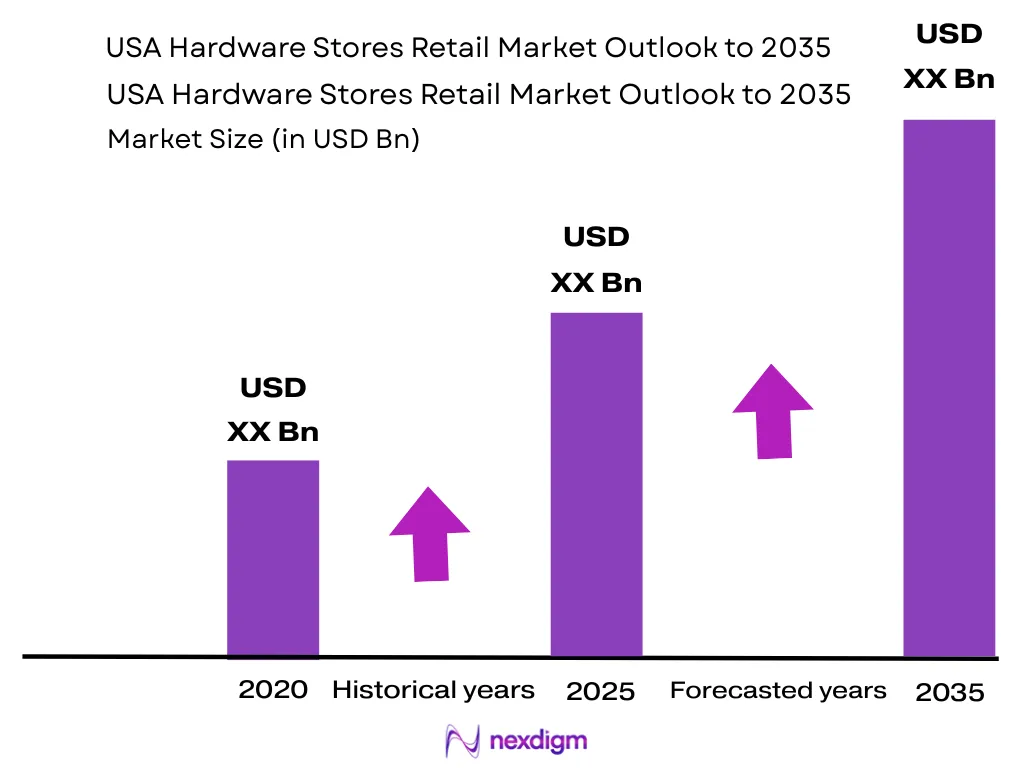
The USA Hardware Stores Retail Market is valued at USD ~ billion, based on a five-year historical assessment, and is forecasted to grow at 5.00% CAGR during the 2026-2035 period. Demand is driven by home repair, maintenance, tools, builders’ hardware, plumbing, electrical, paint and Pro contractor purchases. Home Depot sales moved from USD 152.7 billion to USD 159.5 billion, while Lowe’s U.S. sales moved from USD 86.4 billion to USD 83.7 billion. Texas, Florida, California, North Carolina, Georgia and large metro areas such as Atlanta, Dallas-Fort Worth, Houston, Phoenix, Tampa and Los Angeles dominate the USA Hardware Stores Retail Market because they combine housing growth, suburban migration, contractor density, weather-related repairs and dense big-box coverage. U.S. permit offices authorized 1,478,000 privately owned housing units, while Home Depot operated 2,025 U.S. stores and Lowe’s operated 1,748 U.S. stores, supporting broad hardware retail access.
Market Segmentation
By Product Category
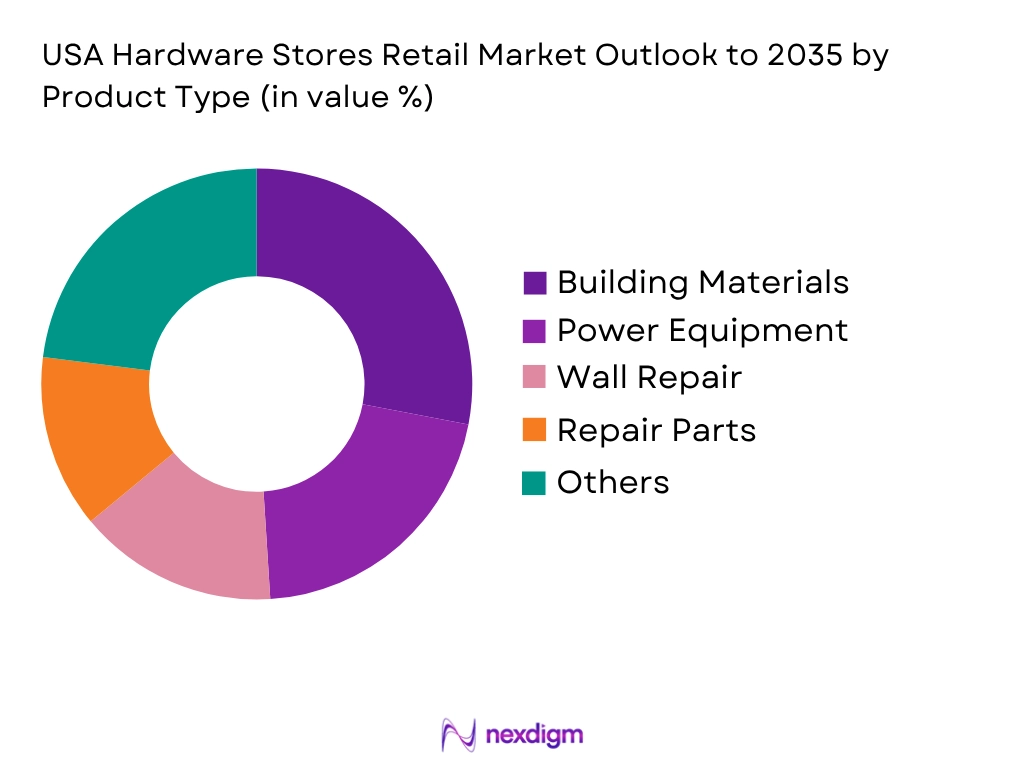
USA Hardware Stores Retail Market is segmented by product category into building materials, tools and power equipment, paint and sundries, plumbing, electrical and lighting, and lawn and garden hardware. Recently, building materials, lumber and rough hardware have a dominant market share in the USA under product category, due to their direct link with repair, maintenance, remodel, contractor demand and jobsite procurement. Building materials also carry strong basket attachment because projects usually require fasteners, sealants, adhesives, hand tools, safety products, paint, plumbing parts and electrical supplies. Home Depot’s annual reporting identifies building materials as a major product line that includes building materials, electrical, lumber, millwork and plumbing, and notes positive comparable sales in Building Materials. This supports the segment’s dominance across both Pro and DIY purchase missions.
By Store Format
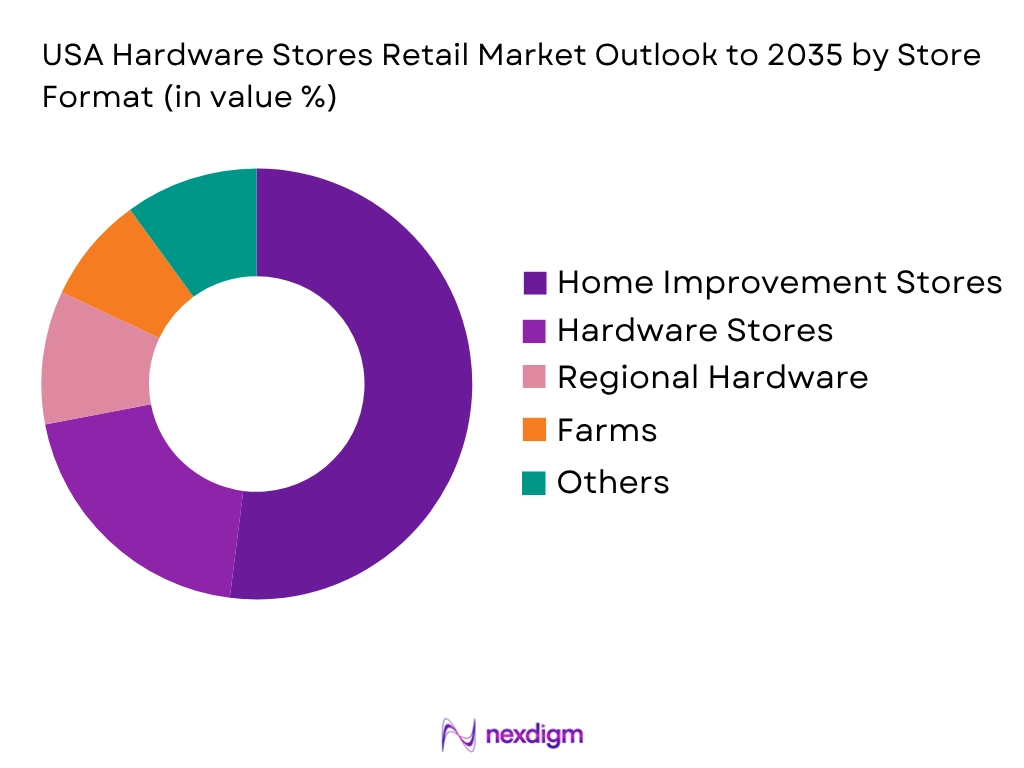
USA Hardware Stores Retail Market is segmented by store format into big-box home improvement stores, cooperative-affiliated independent hardware stores, regional hardware chains, farm and ranch hardware retailers, online hardware platforms and neighborhood independent stores. Recently, big-box home improvement stores have a dominant market share in the USA under store format, due to their national footprint, deep inventory, Pro desks, tool rental, garden centers, building materials adjacency, private labels, installation services and omnichannel fulfilment. Home Depot and Lowe’s together operate thousands of U.S. locations and sell across hardware, lumber, plumbing, electrical, paint, tools, outdoor living and repair categories. Big-box retailers dominate larger project baskets because Pro customers and homeowners can purchase both core hardware and adjacent building materials in one trip. Independent and cooperative stores remain important for convenience, service intensity and rural coverage, but big-box scale gives stronger assortment and fulfilment advantages.
Competitive Landscape
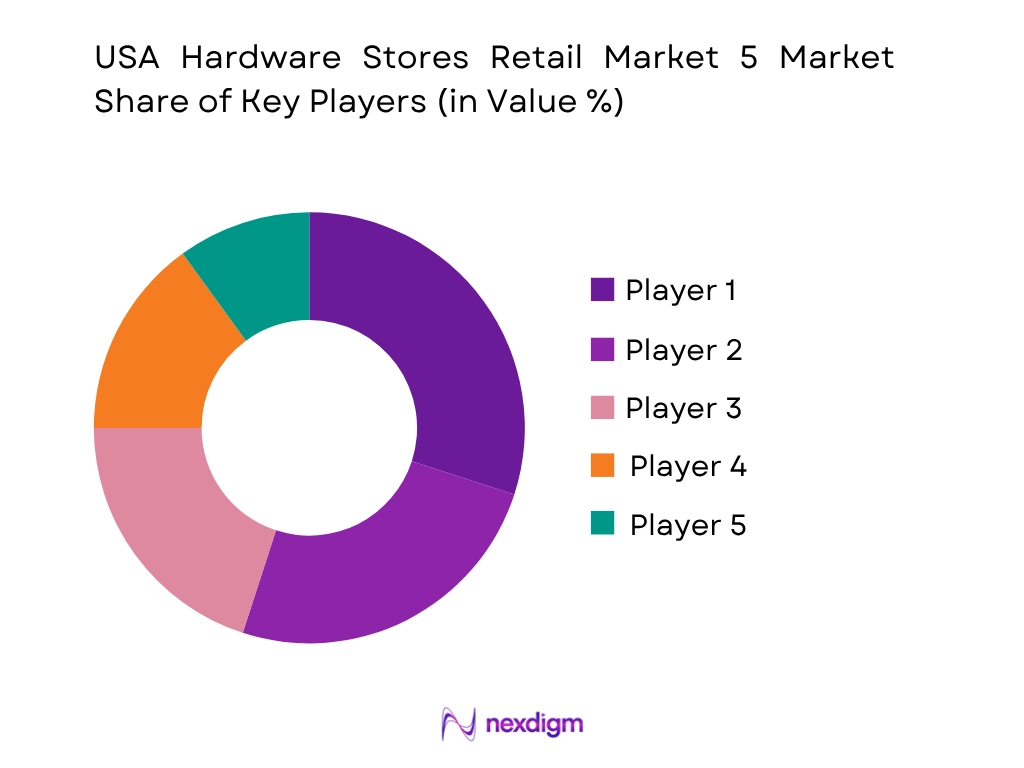
The USA Hardware Stores Retail Market is concentrated at the top through Home Depot and Lowe’s, while Ace Hardware, Menards and Harbor Freight compete through cooperative, regional and value-tool models. Home Depot is the largest home improvement retailer, Lowe’s maintains a national DIY and Pro footprint, Ace leads neighborhood hardware through local ownership, Menards dominates the Midwest value/home improvement format, and Harbor Freight specializes in private-label tools and equipment. Competition is shaped by store density, Pro penetration, SKU breadth, private brands, BOPIS, tool rental, distribution scale and associate expertise.
| Company | Establishment Year | Headquarters | Store / Network Footprint | Core Categories | Customer Focus | Omnichannel Capability | Market-Specific Strength | Competitive Position |
| The Home Depot | 1978 | Atlanta, Georgia | ~ | ~ | ~ | ~ | ~ | ~ |
| Lowe’s Companies | 1921 | Mooresville, North Carolina | ~ | ~ | ~ | ~ | ~ | ~ |
| Ace Hardware | 1924 | Oak Brook, Illinois | ~ | ~ | ~ | ~ | ~ | ~ |
| Menards | 1960 | Eau Claire, Wisconsin | ~ | ~ | ~ | ~ | ~ | ~ |
| Harbor Freight Tools | 1977 | Calabasas, California | ~ | ~ | ~ | ~ | ~ | ~ |
USA Hardware Stores Retail Market
Growth Drivers
Aging and Expanding Housing Base Supporting Repair, Maintenance and Hardware Replacement
The USA Hardware Stores Retail Market is supported by a large housing base that continuously requires tools, fasteners, locks, plumbing parts, electrical fittings, paint, sealants, ladders and safety products. The U.S. had 146,740,964 total housing units and 132,737,146 occupied housing units in the 2024 American Community Survey, while Census permit offices authorized 1,478,000 privately owned housing units in 2024. This creates steady demand for both repair-driven purchases and new-home finishing products. The macroeconomic base is also strong, with World Bank reporting U.S. GDP at USD 28.75 trillion, GDP per capita at USD 84,534.0, and population at 340,110,988 people in 2024. Hardware retailers benefit because every occupied unit generates recurring replacement demand for screws, hinges, bulbs, filters, valves, caulk, batteries and hand tools.
Weather-Linked Repair Demand Supporting Emergency and Seasonal Hardware Purchases
Weather-related repairs are a direct demand driver for U.S. hardware stores because storms, floods, freezes, heat events and hurricanes create urgent purchases of generators, tarps, plywood, sump pumps, extension cords, batteries, flashlights, roof patching, snow tools, gloves, sealants and water-damage repair products. NOAA recorded 27 confirmed weather and climate disaster events with losses exceeding USD 1 billion each in the United States in 2024, including severe storms, tropical cyclones, flooding, drought and wildfire events. These incidents support emergency repair baskets and seasonal replenishment at hardware stores, particularly in coastal, tornado-prone, wildfire-prone and snowbelt regions. The broader consumption base is substantial: World Bank reports U.S. final consumption expenditure at USD 23,832.60 billion in 2024, while GDP reached USD 28.75 trillion, enabling household and contractor spending on recovery, maintenance and preparedness items.
Market Challenges
Housing-Cycle Pressure Affecting Large Project and Contractor-Linked Hardware Demand
The USA Hardware Stores Retail Market faces pressure when housing construction or renovation activity softens, because large project baskets usually include fasteners, power tools, lumber-adjacent hardware, plumbing components, electrical supplies, paint, fixtures and safety equipment. Census construction data showed private construction at USD 1,661.7 billion in 2024, residential construction at USD 917.9 billion, and nonresidential construction at USD 743.8 billion; however, monthly 2026 releases show residential project activity can weaken when mortgage rates, material availability and labor conditions affect new construction and remodeling. This creates uneven demand for Pro desks, jobsite delivery and bulk-purchase categories. The macro base remains large, with World Bank reporting U.S. GDP at USD 28.75 trillion and GDP per capita at USD 84,534.0 in 2024, but hardware retailers remain exposed to housing-cycle volatility because fewer moves and delayed remodels reduce big-ticket project frequency.
Labor and Store-Service Constraints in an Advice-Led Retail Category
Hardware retail depends heavily on knowledgeable store associates because customers often need part matching, project guidance, product compatibility checks, repair advice, key cutting, paint support, tool selection, plumbing troubleshooting and electrical safety guidance. BLS/FRED data for retail trade hardware stores shows the employment index at 116.614 in 2024, compared with 112.412 in 2023, indicating continued labor reliance in the sector. At the same time, BLS describes building material and garden equipment and supplies dealers as an employer-survey-based workforce category covering hardware-adjacent retail jobs. For independent hardware stores, staffing gaps can immediately affect service quality, conversion and repeat visits because small repair missions often depend on accurate associate advice. The macro environment is large enough to sustain demand, with World Bank population at 340,110,988 people and GDP per capita at USD 84,534.0 in 2024, but skilled retail labor remains a store-level constraint.
Market Opportunities
BOPIS, Local Fulfilment and Inventory Visibility for Urgent Repair Missions
U.S. hardware retailers have a strong opportunity to expand buy-online-pick-up-in-store, curbside pickup, ship-from-store and local delivery because hardware purchases are often urgent, SKU-specific and mission-driven. Census identifies building material and garden equipment and supplies dealers under NAICS 444, covering home centers, paint stores, hardware stores, other building material dealers, outdoor power equipment stores, and garden supply stores, making store inventory breadth critical for repair missions. The U.S. had 149,006 thousand housing units in Q1 2026, up from 148,712 thousand in Q4 2025, creating a larger installed base for replacement parts, tools and maintenance consumables. World Bank’s 2024 macro indicators—340,110,988 people, USD 28.75 trillion GDP and USD 84,534.0 GDP per capita—support digital fulfilment investment because retailers can serve dense homeowner and contractor demand through stores as fulfilment nodes.
Weatherization, Energy-Efficiency and Home-Resilience Products for Existing Housing Stock
Hardware stores have a future growth opportunity in weatherization and home-resilience products, including insulation, caulk, sealants, LED lighting, smart thermostats, water-saving fixtures, battery-powered tools, generators, surge protectors, sump pumps and storm-preparedness products. The opportunity is supported by the existing housing base: the 2024 ACS recorded 146,740,964 total housing units, including 86,635,506 owner-occupied units, a direct customer pool for repair and efficiency upgrades. NOAA’s 27 billion-dollar weather and climate disasters in 2024 also reinforce the need for preparedness and post-event repair. The macro base gives room for formal retail investment, with World Bank reporting U.S. GDP at USD 28.75 trillion and final consumption expenditure at USD 23,832.60 billion in 2024. Retailers that localize assortments by climate zone can capture demand from coastal storm, wildfire, snowbelt and heat-exposed markets.
Future Outlook
The USA Hardware Stores Retail Market is expected to grow steadily over the forecast period, supported by repair-and-maintenance demand, aging housing stock, Pro contractor purchasing, weather-related repairs, BOPIS adoption, tool rental and private-label expansion. Elevated home prices and mortgage-rate lock-in are expected to keep many homeowners focused on repair, maintenance, small remodels, painting, plumbing fixes and energy-efficiency upgrades rather than full relocation. Big-box retailers will continue strengthening Pro programs, jobsite delivery, digital inventory visibility and same-day pickup. Cooperative and independent hardware stores will compete through proximity, associate advice, local assortment and home-preservation categories. Growth opportunities will be strongest in tools, repair consumables, paint, plumbing, electrical, smart home, outdoor power equipment, battery-powered tools, storm-preparedness products and rental services.
Major Players
- The Home Depot
- Lowe’s Companies
- Ace Hardware
- Menards
- Do it Best
- True Value
- Tractor Supply Company
- Harbor Freight Tools
- Northern Tool + Equipment
- Orgill
- McCoy’s Building Supply
- Aubuchon Company
- Blain’s Farm & Fleet
- Fleet Farm
- Amazon
Key Target Audience
- Hardware store chains and home improvement retailers
- Independent hardware store owners and cooperative-affiliated dealers
- Building materials, tools, plumbing and electrical product manufacturers
- Pro contractor supply companies and jobsite fulfilment operators
- Home improvement distributors and wholesale buying groups
- E-commerce hardware platforms and omnichannel fulfilment providers
- Investments and venture capitalist firms
- Government and regulatory bodies
Research Methodology
Step 1: Identification of Key Variables
The initial phase involves constructing an ecosystem map encompassing all major stakeholders within the USA Hardware Stores Retail Market. This includes big-box retailers, independent stores, cooperatives, wholesalers, manufacturers, contractors, DIY homeowners, landlords, property managers and e-commerce platforms. The objective is to identify key variables such as product category mix, store format, Pro demand, DIY demand, fulfilment channel and regional housing drivers.
Step 2: Market Analysis and Construction
In this phase, historical data is compiled and analyzed for the USA Hardware Stores Retail Market. This includes retail sales, store footprint, category mix, Pro penetration, housing permits, repair demand, omnichannel adoption and major competitor performance. Revenue estimates are validated through top-down market sizing and bottom-up mapping of store formats, SKU categories, regional demand and customer cohorts.
Step 3: Hypothesis Validation and Expert Consultation
Market hypotheses are developed and validated through computer-assisted telephone interviews with hardware retailers, cooperative members, category managers, Pro desk managers, tool distributors, paint suppliers and contractor buyers. These consultations provide operational insights into basket size, SKU velocity, stockout risk, service expectations, BOPIS usage, Pro account demand and category-level margin pressure.
Step 4: Research Synthesis and Final Output
The final phase involves synthesizing secondary data, company filings, store footprint mapping, category benchmarking, expert inputs and regional housing indicators. Direct engagement with retailers and suppliers validates segmentation, competitive positioning, fulfilment trends and future growth channels. The final output provides structured analysis on market size, segmentation, competition, future outlook, target audiences and recommendations.

- Executive Summary
- Research Methodology (Market definitions and assumptions, abbreviations, NAICS classification, hardware retailer scope, home center overlap treatment, independent dealer mapping, cooperative retail structure, market sizing approach, top-down and bottom-up triangulation, store-level productivity analysis, SKU basket audit, Pro customer interview framework, DIY shopper interview framework, distributor and wholesaler validation, limitations and future conclusions)

- Definition and Scope
- Overview Genesis
- Timeline of Major Players
- Business Cycle
- Supply Chain and Value Chain Analysis

- Growth Drivers (Aging housing stock, repair and maintenance needs, Pro customer spending, homeownership, weather events, BOPIS adoption, private-label expansion)
- Market Challenges (Housing turnover slowdown, big-ticket project deferral, labour constraints, shrink, inventory carrying cost, online price transparency)
- Opportunities (Pro loyalty, repair-first demand, home services, rental services, rural expansion, digital inventory, energy-efficiency products)
- Market Trends (Repair-over-remodel, connected retail, AI inventory planning, smaller urban formats, local services, private-brand premiumization)
- Government Regulation (Product safety, OSHA-related products, EPA chemical rules, VOC standards, battery disposal, state building codes, consumer protection)
- SWOT Analysis
- Stakeholder Ecosystem
- Porter’s Five Forces

- By Retail Sales Value (2020-2025)
- By Store Count (2020-2025)
- By Average Sales Per Store (2020-2025)

- By Product Category (In Value %)
Hand Tools and Power Tools
Fasteners, Builders’ Hardware and Rough Hardware
Paint, Sundries and Wall Repair
Plumbing Supplies and Fixtures
Electrical and Lighting - By Store Format (In Value %)
Big-Box Home Improvement Stores
Cooperative-Affiliated Independent Hardware Stores
Regional Hardware Chains
Neighborhood Hardware Stores
Farm, Ranch and Rural Hardware Retailers - By Sales Channel (In Value %)
In-Store Walk-In Retail
Buy Online Pick Up In Store
Buy Online Deliver From Store
Ship-to-Home E-Commerce
Pro Account and Jobsite Delivery - By Region (In Value %)
South
West
Midwest
Northeast
Rural and Non-Metro Markets

- Market Share of Major Players (Retail sales value, store count, Pro customer contribution, online sales contribution, regional footprint)
- Cross Comparison Parameters (Store footprint, Pro customer program strength, SKU assortment breadth, private-label and exclusive brand portfolio, omnichannel and BOPIS capability, distribution-center network, rental and installed-service offering, cooperative or franchise support model)
- SWOT Analysis of Major Players
- Pricing Analysis Basis SKUs (Cordless drill, paint gallon, faucet repair kit, electrical outlet, deck screw box, lawn mower, grill, key duplication, tool rental)
- Detailed Profiles of Major Companies
The Home Depot
Lowe’s Companies
Ace Hardware
Menards
Do it Best
True Value
Tractor Supply Company
Harbor Freight Tools
Northern Tool + Equipment
Orgill
McCoy’s Building Supply
Aubuchon Company
Blain’s Farm & Fleet
Fleet Farm
Amazon

- DIY Homeowner Analysis
- Pro Contractor Analysis
- Remodeler and Renovation Professional Analysis
- Property Manager and Facility Buyer Analysis
- Rural and Agricultural Customer Analysis

- By Retail Sales Value (2026-2035)
- By Store Count (2026-2035)
- By Average Sales Per Store (2026-2035)


 Request a Sample
 Ask for Customization
 Get a Quote
 Enquire Now