
 Download PDF
Market Overview
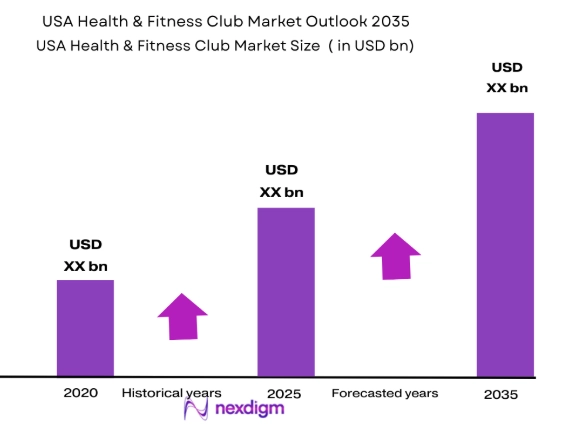
The USA Health & Fitness Club Market is assessed at USD ~ billion in 2025, based on a triangulated five-year historical analysis using fitness facility membership growth, club revenue benchmarks, franchise expansion, consumer wellness spending, and post-pandemic recovery in gym attendance. The market is supported by commercial gyms, boutique studios, premium clubs, personal training, group fitness, recovery services, and corporate wellness partnerships. Fitness facility membership in the United States reached a record 77 million members in 2024, while total customer penetration, including aggregator users and pay-as-you-go participants, reached 31.0% according to the Health & Fitness Association.
The United States remains one of the largest fitness markets globally due to its large consumer base, high urban and suburban gym penetration, strong franchise ecosystem, and consumer spending on wellness. The U.S. population reached 340.1 million on July 1, 2024, providing a broad addressable base for gyms, boutique studios, wellness clubs, corporate fitness programs, and senior fitness formats.
Market Segmentation
By Club Type
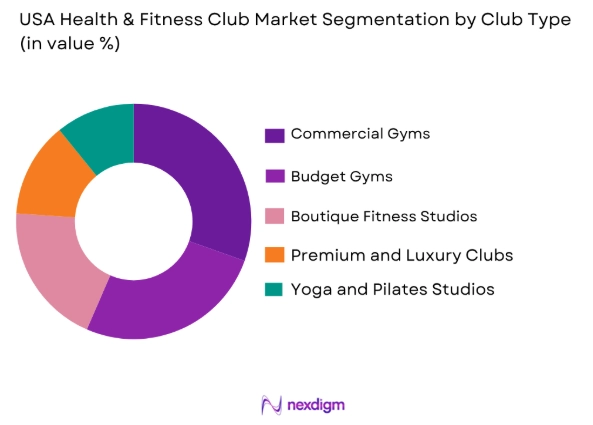
The USA Health & Fitness Club Market is segmented by club type into commercial gyms, budget gyms, premium clubs, boutique fitness studios, yoga and Pilates studios, CrossFit and functional training studios, wellness clubs, and sports and athletic clubs. Recently, commercial gyms and budget gyms have maintained strong market share due to wide accessibility, large facility footprints, affordable monthly pricing, and national chain expansion. Budget fitness chains attract members through low-cost subscriptions, extended operating hours, simple equipment access, and high convenience. Boutique studios continue to grow because consumers increasingly seek specialized, community-led, instructor-driven formats such as Pilates, yoga, HIIT, indoor cycling, barre, and functional training. Premium and luxury clubs remain concentrated in high-income urban and suburban markets, where consumers value lifestyle amenities, spa services, recovery rooms, cafés, coworking spaces, and high-touch personal training.
By Revenue Stream
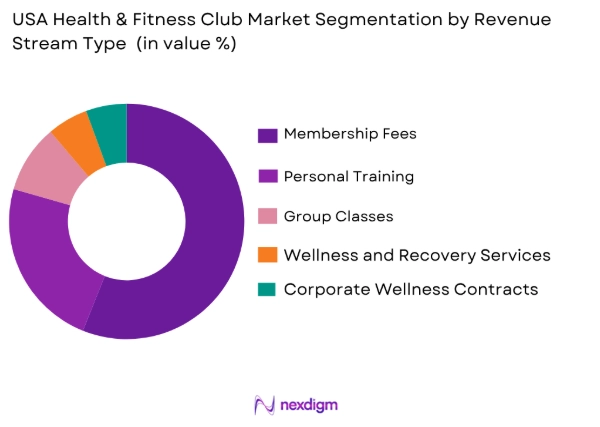
The USA Health & Fitness Club Market is segmented by revenue stream into membership fees, personal training, group classes, wellness and recovery services, nutrition and supplement sales, digital subscriptions, merchandise, and corporate wellness contracts. Recently, membership fees have dominated revenue contribution because recurring subscriptions remain the primary monetization model for most gyms and fitness clubs. Personal training and small group training are important margin-enhancing revenue streams, especially for mid-market and premium clubs. Recovery services such as sauna, stretching, compression therapy, cold plunge, red-light therapy, and wellness lounges are emerging as high-value add-ons as clubs reposition from basic exercise facilities toward holistic wellness destinations.
Competitive Landscape
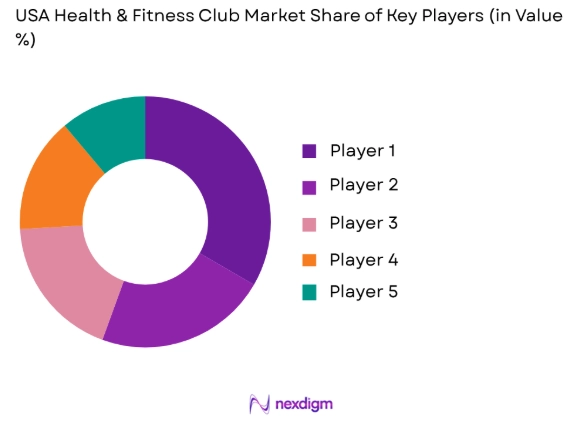
The USA Health & Fitness Club Market is moderately fragmented, with national chains, regional operators, boutique fitness franchises, luxury clubs, nonprofit fitness centers, and independent gyms competing across price points and service formats. Planet Fitness, LA Fitness, Life Time, Equinox, Anytime Fitness, Crunch Fitness, Gold’s Gym, Orangetheory Fitness, F45 Training, Club Pilates, and YMCA are among the most visible operators. Competition is shaped by monthly membership pricing, location density, equipment quality, personal training capability, class variety, operating hours, digital app experience, brand community, contract flexibility, cleanliness, amenities, and recovery services. Budget gyms compete on affordability and convenience, boutique studios compete on instructor-led specialization and community, while premium clubs compete on lifestyle, service quality, and wellness amenities.
| Company | Establishment Year | Headquarters | Key Format | Main Channel Strength | Price Positioning | Franchise Presence | Digital Availability | Market Positioning |
| Planet Fitness | 1992 | Hampton, New Hampshire | ~ | ~ | ~ | ~ | ~ | ~ |
| LA Fitness | 1984 | Irvine, California | ~ | ~ | ~ | ~ | ~ | ~ |
| Life Time | 1992 | Chanhassen, Minnesota | ~ | ~ | ~ | ~ | ~ | ~ |
| Equinox | 1991 | New York, New York | ~ | ~ | ~ | ~ | ~ | ~ |
| Anytime Fitness | 2002 | Woodbury, Minnesota | ~ | ~ | ~ | ~ | ~ | ~ |
| Crunch Fitness | 1989 | New York, New York | ~ | ~ | ~ | ~ | ~ | ~ |
| Orangetheory Fitness | 2010 | Boca Raton, Florida | ~ | ~ | ~ | ~ | ~ | ~ |
| Club Pilates | 2007 | Irvine, California | ~ | ~ | ~ | ~ | ~ | ~ |
USA Health & Fitness Club Market Dynamics
Growth Drivers
Rising Fitness Facility Membership Penetration
The USA Health & Fitness Club Market is supported by rising participation in structured fitness environments as consumers increasingly prioritize physical activity, weight management, preventive health, and community-based exercise. Fitness facility membership rose 5.6% in 2024, following 5.8% growth in 2023, while one in four Americans aged six and older held a fitness facility membership. This reflects strong recovery from pandemic disruptions and indicates that gyms and clubs are now benefiting from renewed routine-based fitness behavior. Budget gyms, premium clubs, boutique studios, and hybrid fitness formats are all capturing different consumer groups. Rising participation also supports higher demand for personal training, group classes, strength equipment, app-based engagement, and wellness add-ons.
Expansion of Wellness, Strength, and Longevity-Oriented Fitness
The USA Health & Fitness Club Market is benefiting from growing consumer interest in strength training, Pilates, yoga, mobility, recovery, low-impact fitness, and longevity-focused wellness services. Consumers are no longer viewing gyms only as places for cardio or weight loss; they increasingly expect facilities to support broader health goals such as muscle maintenance, flexibility, stress reduction, injury prevention, and active aging. Health clubs are responding by adding recovery lounges, saunas, stretching zones, mobility programs, compression therapy, and wellness amenities. The Health & Fitness Association noted rising participation in yoga and Pilates among U.S. fitness facility members. This trend helps clubs improve retention, increase average revenue per member, and differentiate from low-cost competitors.
Market Challenges
High Churn and Member Retention Pressure
The USA Health & Fitness Club Market faces ongoing retention challenges because many consumers join gyms during seasonal peaks, especially in January, spring, and pre-summer periods, but reduce attendance or cancel once motivation declines. This creates pressure on operators to continuously invest in engagement, onboarding, app reminders, personal training trials, group classes, and loyalty programs. Younger consumers are also more willing to switch between gyms, boutique studios, digital fitness apps, outdoor activities, and at-home workouts. High churn affects revenue visibility, marketing efficiency, and profitability, especially for budget gyms and boutique studios dependent on recurring memberships. Operators must focus on community, personalization, habit formation, and measurable progress to sustain member activity.
Rising Operating Costs
Fitness clubs face rising operating cost pressure from commercial rent, utilities, equipment financing, maintenance, cleaning, insurance, technology systems, and labor. Premium clubs and boutique studios are especially exposed because their business models depend on prime locations, experienced trainers, high-quality instructors, strong service standards, and upgraded amenities. Equipment replacement cycles, locker-room maintenance, HVAC needs, music licensing, liability coverage, and digital booking systems further increase fixed costs. At the same time, price-sensitive consumers may resist membership fee increases, especially in the budget and mid-market segments. This puts pressure on margins and forces operators to improve utilization, increase ancillary revenue, renegotiate leases, optimize staffing, and introduce higher-value services.
Opportunities
Corporate Wellness and Insurance Partnerships
The USA Health & Fitness Club Market has a strong opportunity in corporate wellness, employer-subsidized memberships, insurance-linked fitness benefits, and preventive health partnerships. Employers increasingly view physical activity as a tool for improving productivity, reducing absenteeism, supporting mental health, and strengthening employee retention. Health insurers and Medicare Advantage plans also use fitness benefits to encourage preventive care and healthier lifestyles. Clubs with broad geographic coverage, digital check-in systems, flexible membership structures, and usage reporting are well positioned to serve enterprise and insurance partners. These partnerships can create stable recurring revenue, reduce customer acquisition costs, and introduce gyms to large member pools beyond traditional retail walk-in traffic.
Senior Fitness and Preventive Health Programs
The USA Health & Fitness Club Market has a growing opportunity in senior fitness as the population ages and older adults place greater emphasis on mobility, balance, strength, flexibility, fall prevention, and chronic disease management. Low-impact training, aquatic fitness, chair yoga, Pilates, resistance training, stretching, and medically adjacent wellness programs can support demand from older members. Senior consumers often value safe environments, trained instructors, accessible facilities, community interaction, and insurance-supported memberships. Clubs that design age-friendly programs can improve daytime utilization, diversify their membership base, and build partnerships with healthcare providers, senior living communities, and Medicare-linked fitness benefit programs. This segment supports long-term, preventive-health-oriented market growth.
Future Outlook
The USA Health & Fitness Club Market is expected to grow steadily through 2035, supported by rising fitness membership penetration, growth in boutique fitness, expansion of budget gyms, recovery of in-person exercise habits, and higher consumer spending on wellness. One market estimate places the U.S. health and fitness club market at USD 45.8 billion in 2025, increasing to USD 71.5 billion by 2035, at a CAGR of 5.2% from 2026 to 2035. This should be treated as a third-party market estimate and validated with primary research before final publication.
Major Players
- Planet Fitness
- LA Fitness
- Life Time Group Holdings
- Equinox
- Anytime Fitness
- Crunch Fitness
- Gold’s Gym
- Orangetheory Fitness
- F45 Training
- Club Pilates
- Pure Barre
- CycleBar
- 24 Hour Fitness
- Blink Fitness
- EOS Fitness
- YMCA
- VASA Fitness
- Snap Fitness
- Chuze Fitness
- Local Independent Gyms and Boutique Studios
Key Target Audience
- Health and fitness club operators
- Gym chains and franchise owners
- Boutique fitness studio operators
- Personal training companies
- Fitness equipment manufacturers and suppliers
- Corporate wellness providers
- Health insurance companies
- Digital fitness and fitness app platforms
- Real estate developers and retail landlords
- Private equity and venture capital firms
- Government and public health agencies
- Research and consulting firms
Research Methodology
Step 1: Identification of Key Variables
The initial phase involves constructing an ecosystem map for the USA Health & Fitness Club Market, covering gym chains, franchise operators, boutique studios, independent gyms, premium clubs, personal trainers, equipment suppliers, digital fitness platforms, corporate wellness buyers, and insurance-linked fitness programs. Key variables include number of facilities, membership base, pricing tier, service mix, club format, average monthly fee, retention rate, personal training adoption, and regional penetration.
Step 2: Market Analysis and Construction
In this phase, historical demand is assessed using fitness facility membership data, gym revenue benchmarks, club count indicators, consumer wellness spending, franchise expansion trends, and employment data for fitness trainers and instructors. Revenue construction follows a bottom-up approach by mapping membership fees, personal training, group classes, recovery services, digital subscriptions, corporate wellness contracts, and ancillary sales across budget, mid-market, boutique, and premium club formats.
Step 3: Hypothesis Validation and Expert Consultation
Market hypotheses are validated through structured discussions with gym operators, franchise owners, boutique studio managers, personal trainers, corporate wellness buyers, fitness equipment suppliers, and real estate leasing specialists. These interviews help test assumptions around budget gym expansion, boutique studio growth, pricing sensitivity, member churn, personal training adoption, and recovery-service monetization.
Step 4: Research Synthesis and Final Output
The final phase consolidates secondary data, primary interviews, channel checks, pricing benchmarks, and company-level observations into a unified market model. The synthesis validates market size, segmentation, competitive positioning, and forecast trajectory. The output is reviewed for consistency with macro indicators such as population growth, consumer wellness spending, labor availability, franchise development, and digital fitness adoption.

- Executive Summary
- Research Methodology (Market Definitions and Assumptions, Abbreviations, Market Sizing Approach, Bottom-Up Revenue Mapping, Membership and Footfall Mapping, Demand-Side and Supply-Side Triangulation, Primary Interviews with Gym Operators, Franchise Owners, Boutique Studio Operators, Fitness Equipment Suppliers, Personal Trainers, Corporate Wellness Buyers, and Digital Fitness Platforms, Regulatory Mapping Framework, Data Validation Models, Limitations and Future Assumptions)

- Definition and Scope
- Evolution of Health & Fitness Club Market in the USA
- Public Health, Wellness, and Preventive Healthcare Linkages with Fitness Club Consumption
- Business Cycle and Demand Seasonality
- Membership, Subscription, and Ancillary Revenue Value Chain
- Role of Employer Wellness Programs and Insurance Partnerships
- Franchise, Independent, Boutique, and Premium Club Landscape
- Digital Fitness and Hybrid Membership Integration

- Growth Drivers
Rising Health and Wellness Awareness
Increasing Fitness Facility Membership Penetration
Growth of Boutique and Specialized Fitness Formats
Rising Demand for Strength Training, Functional Fitness, Yoga, and Pilates
Expansion of Budget Gym Chains and Franchise Models
Employer Wellness and Insurance-Linked Fitness Benefits
Higher Adoption of Hybrid Fitness and Mobile App-Based Engagement
Growing Senior Fitness and Longevity-Oriented Wellness Demand - Market Challenges
High Member Churn and Shorter Membership Tenure
Rising Rent, Labor, Equipment, and Utility Costs
Competition from At-Home and Digital Fitness Platforms
Seasonality in Membership Sign-Ups
Price Competition Among Budget Chains
Instructor and Trainer Retention Challenges
Economic Sensitivity of Discretionary Fitness Spending
Market Saturation in Major Urban Areas - Opportunities
Expansion of Recovery, Wellness, and Longevity Services
Growth of Corporate Wellness and Preventive Healthcare Partnerships
Senior Fitness and Medicare Advantage Program Partnerships
Personal Training and Small Group Training Upselling
AI-Enabled Fitness Coaching and Member Retention Tools
Expansion into Suburban and Secondary Markets
Premiumization Through Spa, Recovery, and Lifestyle Amenities
Franchise-Led Expansion of Low-Cost and Boutique Fitness Models - Trends
Shift Toward Strength Training and Functional Fitness
Growth of Pilates, Yoga, and Low-Impact Fitness
Rise of Hybrid Fitness Memberships
Increasing Use of Wearables and App-Based Fitness Tracking
Expansion of Recovery Services: Sauna, Cold Plunge, Compression, Stretching
Demand for Community-Led Fitness Experiences
Growth of Women-Focused and Inclusive Fitness Spaces
Digital-First Member Acquisition and Retention Campaigns - Regulatory Landscape
Health and Safety Compliance
Employment and Trainer Certification Considerations
ADA Accessibility Requirements
Local Zoning and Facility Licensing
Data Privacy for Fitness Apps and Wearables
Consumer Contract and Auto-Renewal Regulations
Insurance and Liability Requirements - SWOT Analysis
- Stakeholder Ecosystem
- Porter’s Five Forces

- USA Health & Fitness Club Market Size, 2020–2025
- By Value, 2020–2025
- By Number of Members, 2020–2025
- By Number of Facilities, 2020–2025
- By Average Monthly Membership Fee, 2020–2025
- By Franchise vs Independent Club Contribution, 2020–2025

- By Club Type (In Value %)
Commercial Gyms
Boutique Fitness Studios
Premium and Luxury Fitness Clubs
Budget Gyms
Health Clubs and Wellness Centers
CrossFit and Functional Training Studios
Yoga and Pilates Studios
Women-Only Fitness Clubs
Sports and Athletic Clubs - By Membership Type (In Value %)
Monthly Memberships
Annual Memberships
Pay-As-You-Go Memberships
Class-Based Packages
Corporate Memberships
Family Memberships
Student and Youth Memberships
Senior and Medicare-Linked Memberships - By Revenue Stream (In Value %)
Membership Fees
Personal Training
Group Classes
Spa, Recovery, and Wellness Services
Nutrition and Supplement Sales
Fitness Apparel and Merchandise
Digital Fitness Subscriptions
Corporate Wellness Contracts
Food and Beverage Sales - By End User (In Value %)
Gen Z Consumers
Millennials
Gen X Consumers
Baby Boomers and Seniors
Working Professionals
Students
Athletes and Sports Enthusiasts
Weight Management Users
Rehabilitation and Preventive Health Users - By Distribution / Acquisition Channel (In Value %)
Direct Club Walk-Ins
Mobile Apps and Websites
Third-Party Fitness Aggregators
Corporate Wellness Partnerships
Insurance and Medicare Advantage Programs
Social Media and Influencer Marketing
Referral Programs
Franchise Network Sales - By Price Segment (In Value %)
Low-Cost / Budget Segment
Mid-Market Segment
Premium Segment
Luxury Segment
Specialized Boutique Segment - By Service Offering (In Value %)
Cardio and Strength Training
Group Fitness Classes
Personal Training
Functional Training
Yoga and Pilates
HIIT and Bootcamp
Cycling Studios
Recovery, Sauna, and Wellness Services
Aquatics and Sports Facilities
Digital and Hybrid Fitness Programs - By Region (In Value %)
Northeast
Midwest
South
West
California
Texas
Florida
New York
Key Metropolitan Markets
Emerging Suburban and Secondary-City Markets

- Market Share Analysis
- Cross Comparison Parameters (Revenue by Club Format, Number of Locations, Membership Base, Average Monthly Fee, Franchise Presence, Digital App Strength, Personal Training Contribution, Group Class Portfolio, Brand Positioning, Corporate Wellness Presence, Recovery and Wellness Service Availability)
- SWOT Analysis of Key Players
- Pricing Benchmarking
- Company Profiles
Planet Fitness
LA Fitness
Life Time Group Holdings
Equinox
Anytime Fitness
Crunch Fitness
Gold’s Gym
Orangetheory Fitness
F45 Training
Club Pilates
Pure Barre
CycleBar
24 Hour Fitness
Blink Fitness
EOS Fitness
YMCA
VASA Fitness
Snap Fitness
Chuze Fitness
Local Independent Gyms and Boutique Studios

- Demand Patterns and Workout Behavior
- Membership Frequency and Attendance Patterns
- Class Participation and Training Behavior
- Personal Training Adoption
- Brand Loyalty and Switching Patterns
- Purchase Decision Factors
- Price Sensitivity Analysis
- Customer Journey Mapping
- Pain Points and Unmet Needs
- Retention and Cancellation Behavior

- By Value, 2026–2035
- By Number of Members, 2026–2035
- By Number of Facilities, 2026–2035
- By Average Monthly Membership Fee, 2026–2035
- By Franchise vs Independent Club Contribution, 2026–2035


 Request a Sample
 Ask for Customization
 Get a Quote
 Enquire Now