
 Download PDF
Market Overview
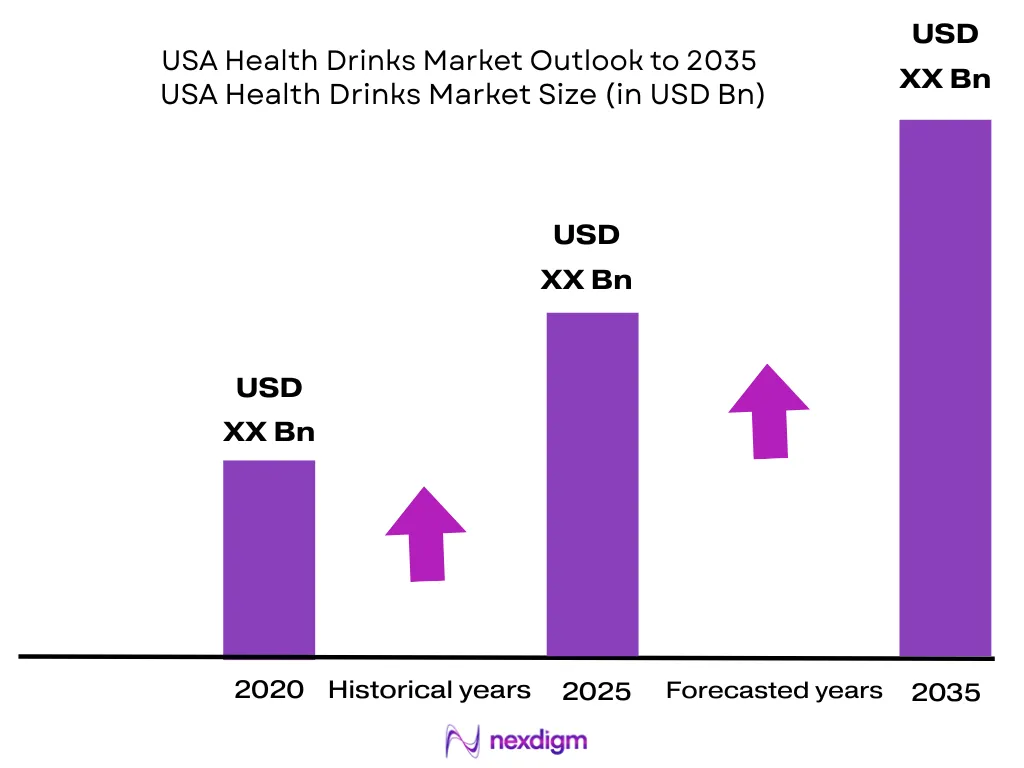
The USA Health Drinks Market is valued at USD ~ billion, based on historical revenue reported for functional drinks, with the broader U.S. functional beverage market also cited at USD ~ billion and forecast to reach USD ~ billion by the near term. Growth is driven by energy drinks, nutraceutical drinks, sports hydration, zero-sugar formats, and wellness-led beverages. Energy drinks alone are cited at USD 18.6 billion, followed by sports drinks at USD 10.4 billion, showing strong category concentration. New York, Los Angeles, Chicago, Houston, Phoenix, Dallas, San Diego, and San Jose dominate demand due to dense urban populations, premium retail penetration, fitness-oriented consumers, and stronger cold-vault availability. New York city has 8,478,072 residents, Los Angeles has 3,878,704, Chicago has 2,721,308, and Houston has 2,390,125, creating high-volume immediate-consumption demand. California, Texas, New York, and Florida also have strong beverage bottling infrastructure and large retail networks.
Market Segmentation
By Product Type
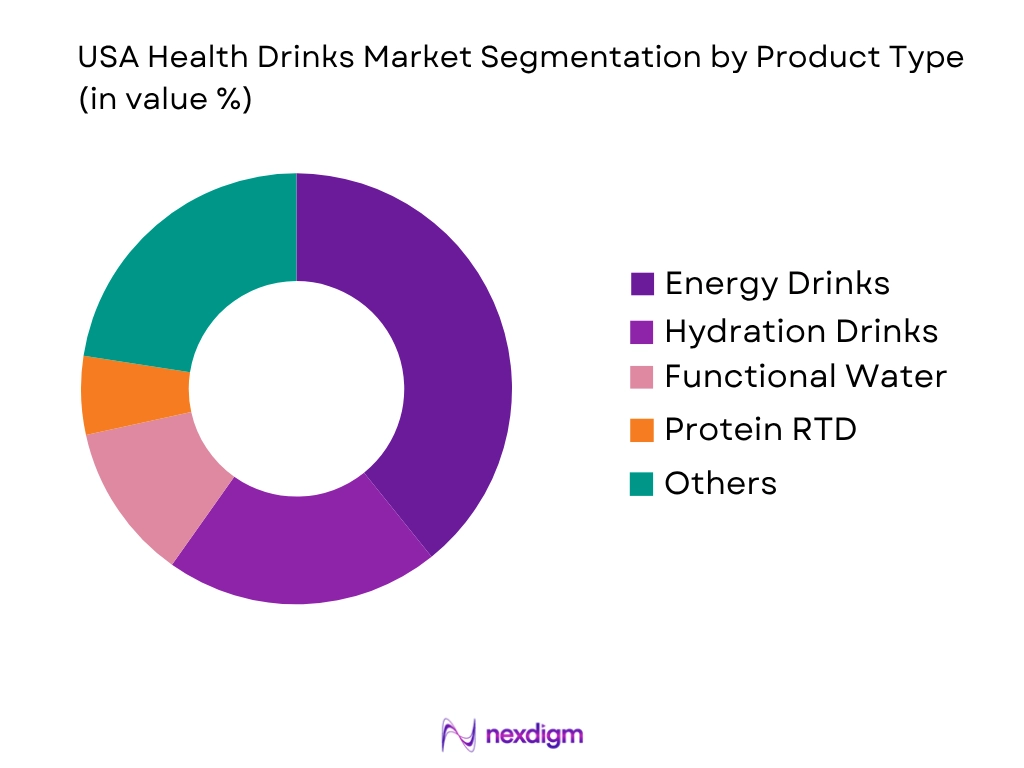
The USA Health Drinks Market is segmented by product type into energy drinks, sports and hydration drinks, functional water, protein RTD drinks, kombucha, probiotic drinks, functional juices, and functional RTD tea and coffee. Energy drinks dominate the product type segmentation because they combine mass-market availability, strong cold-vault placement, high repeat consumption, and functional positioning around alertness, metabolism, and active lifestyle use. Brands such as Red Bull, Monster, Celsius, C4, Ghost, Alani Nu, and Rockstar have built national visibility through convenience stores, gyms, gaming, motorsports, college marketing, and social media-led trial. The segment also benefits from zero-sugar reformulation and better-for-you energy positioning, which has widened its appeal beyond traditional male consumers toward women, working professionals, and fitness-oriented consumers. Energy drinks are cited as the largest U.S. functional beverage category, with sports drinks ranking second.
By Distribution Channel
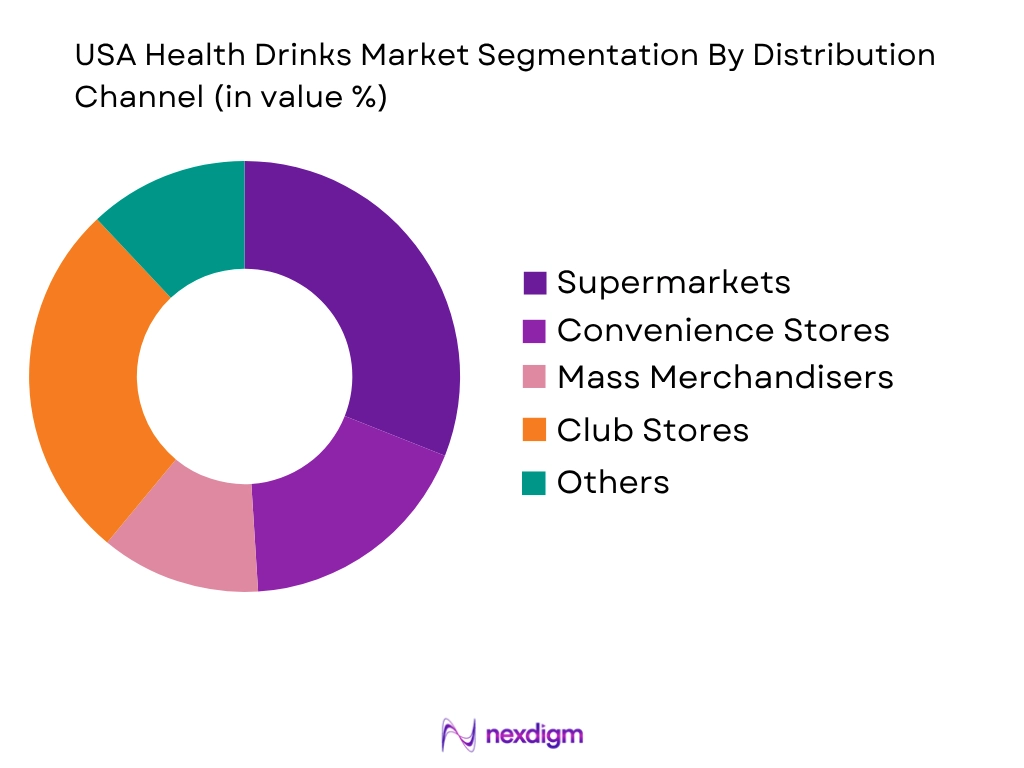
The USA Health Drinks Market is segmented by distribution channel into supermarkets and hypermarkets, convenience stores and gas stations, mass merchandisers, club stores, online marketplaces, DTC, drug stores, natural specialty retailers, gyms, foodservice, and vending. Supermarkets and hypermarkets dominate because they provide the broadest functional beverage assortment across shelf-stable, chilled, multipack, premium, and everyday wellness formats. These outlets also support consumer comparison across brands, flavors, pack sizes, sugar profiles, and functional claims such as hydration, energy, gut health, immunity, and protein. Large grocery chains provide endcap promotions, refrigerated displays, loyalty coupons, private label exposure, and weekly purchase frequency, which makes them central to household penetration. Convenience stores remain critical for energy drinks and single-serve hydration, but supermarkets lead broader category recruitment and recurring family-basket purchases.
Competitive Landscape
The USA Health Drinks Market is consolidated around multinational beverage companies and fast-scaling functional challengers. PepsiCo and The Coca-Cola Company dominate hydration and sports drinks through Gatorade, Propel, BODYARMOR, Powerade, smartwater, and vitaminwater. Monster, Red Bull, Celsius, Nutrabolt, and Keurig Dr Pepper compete aggressively in energy drinks. The competitive landscape is also being reshaped by acquisitions, including Keurig Dr Pepper’s majority stake in Ghost and Celsius’ acquisition of Alani Nu.
| Company | Establishment Year | Headquarters | Key Health Drink Brands | Dominant Category | Core Channel Strength | Functional Positioning | Recent Strategic Move | Market-Specific Strength |
| PepsiCo, Inc. | 1965 | Purchase, New York | ~ | ~ | ~ | ~ | ~ | ~ |
| The Coca-Cola Company | 1886 | Atlanta, Georgia | ~ | ~ | ~ | ~ | ~ | ~ |
| Monster Beverage Corporation | 1935 | Corona, California | ~ | ~ | ~ | ~ | ~ | ~ |
| Red Bull North America | 1987 | Santa Monica, California | ~ | ~ | ~ | ~ | ~ | ~ |
| Celsius Holdings, Inc. | 2004 | Boca Raton, Florida | ~ | ~ | ~ | ~ | ~ | ~ |
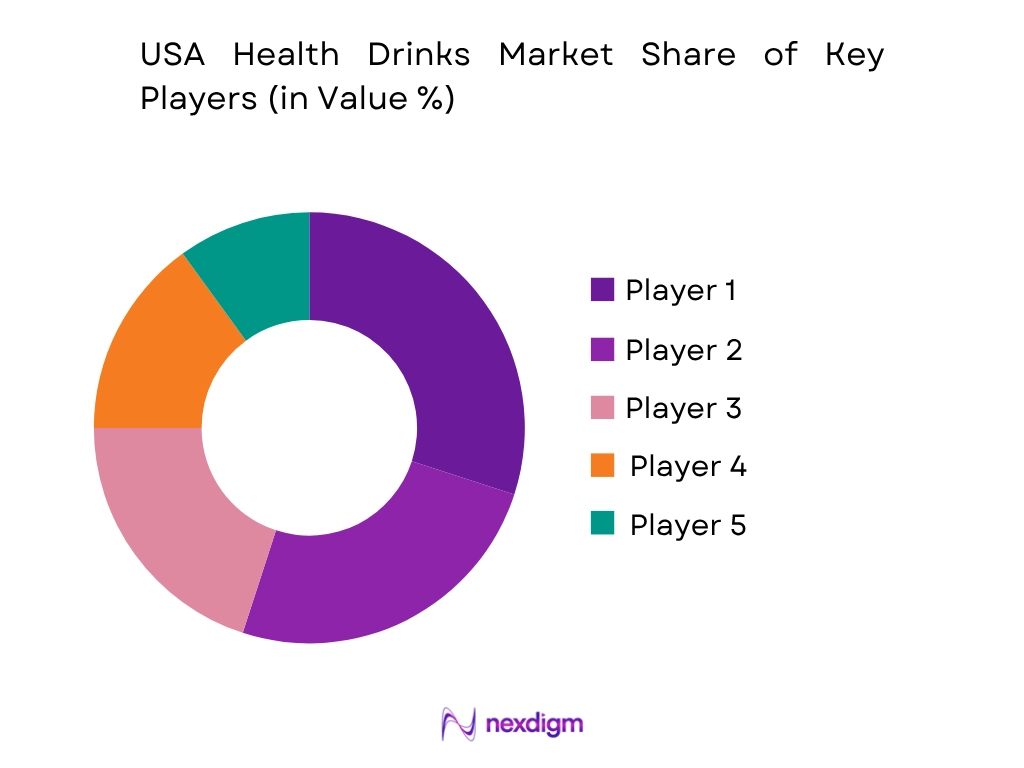
USA health drinks Market Analysis
Growth Drivers
Fitness-Led Functional Hydration and Energy Consumption
The USA health drinks market is supported by a large active-consumer base that increasingly links beverage consumption with hydration, recovery, energy, and performance. In 2024, the United States had 340,110,990 people according to World Bank population data, creating a broad consumer base for single-serve functional beverages, sports hydration drinks, protein RTDs, and energy drinks. Adult activity behavior also supports market-specific demand: CDC data shows 47.2 adults per 100 met federal aerobic activity guidelines in 2024, while 52.3 men per 100 and 42.4 women per 100 met these guidelines. Among adults aged 18–34, 54.0 adults per 100 met aerobic activity guidelines, making younger consumers highly relevant for gym, convenience-store, campus, and sports-channel beverage demand. The World Bank also reports U.S. GDP per capita at USD 84,534 in 2024, supporting premium functional beverage purchases tied to electrolyte blends, zero-sugar energy, added protein, nootropics, and recovery positioning. This creates strong pull for brands positioned around daily hydration, workout preparation, post-workout recovery, and functional energy.
Dense Urban Retail Access and Digitally Connected Consumers
The USA health drinks market benefits from dense urban retail networks, high internet penetration, and frequent immediate-consumption occasions across supermarkets, convenience stores, gyms, offices, campuses, and delivery platforms. World Bank data records 95 internet users per 100 people in the United States in 2024, supporting discovery and repeat purchase through online marketplaces, brand websites, retail media, influencer campaigns, and digital couponing. The same World Bank dataset shows GDP at USD 28.75 trillion in 2024, reflecting the scale of consumer-facing retail infrastructure that enables national distribution for functional beverages. Large city populations further concentrate demand: New York had 8,478,072 residents, Los Angeles had 3,878,704 residents, Chicago had 2,721,308 residents, and Houston had 2,390,125 residents in Census Bureau city estimates. These cities support high beverage turnover because consumers have access to cold-vault convenience stores, premium grocery, gyms, foodservice, universities, workplaces, and last-mile delivery. For health drinks, this creates strong conditions for single-serve energy drinks, functional waters, protein beverages, kombucha, probiotic drinks, and prebiotic soda trial.
Market Challenges
Sugar Scrutiny and Obesity-Linked Reformulation Pressure
The USA health drinks market faces pressure from public-health scrutiny around sugar, calories, and obesity, particularly for energy drinks, sports drinks, functional juices, sweetened teas, and wellness drinks carrying health-oriented claims. CDC data released for adult obesity shows that in 2024 all U.S. states and territories had adult obesity prevalence of at least 25 adults per 100, with the Midwest at 35.9 adults per 100, the South at 34.5 adults per 100, the West at 30.2 adults per 100, and the Northeast at 30.3 adults per 100. This environment increases consumer, retailer, and regulator attention on added sugar disclosures and better-for-you formulation. FDA labeling guidance identifies the Daily Value for added sugars as 50 grams per day based on a 2,000-calorie daily diet. This matters directly for health drinks because sweetened functional beverages must balance taste, energy, hydration, gut-health, and performance claims with sugar reduction, sweetener acceptance, and transparent nutrition labeling. Brands that rely on high-sugar recipes may face weaker shelf differentiation as retailers prioritize zero-sugar, low-sugar, and no-added-sugar alternatives.
Regulatory Complexity Around “Healthy,” Ingredient Safety, and Functional Claims
The USA health drinks market faces rising compliance complexity because functional beverages often use health-forward language around hydration, gut health, immunity, focus, relaxation, energy, and recovery. The FDA announced its updated “healthy” nutrient content claim final rule on December 19, 2024, and the rule became effective on April 28, 2025, creating a clearer but stricter framework for products that want to use “healthy” positioning on labels. FDA Daily Value references also include 50 grams for added sugars, 2,300 milligrams for sodium, 20 grams for saturated fat, 28 grams for dietary fiber, and 4,700 milligrams for potassium, all of which affect formulation and label review for health drinks. FDA’s Human Foods Program also lists 2026 priorities around food chemical safety, nutrition, and microbiological food safety, including post-market safety reviews of chemicals such as phthalates, propylparaben, BHA, and BHT. This creates direct risk for beverages using preservatives, colors, botanicals, adaptogens, caffeine systems, probiotics, or novel functional ingredients. Brands must invest in substantiation, testing, label governance, and legal review before scaling claims across national retail.
Market Opportunities
Low-Sugar, Protein, Fiber, and Metabolic Wellness Beverages
The USA health drinks market has a strong opportunity in low-sugar functional beverages, protein RTDs, fiber-enriched drinks, electrolyte beverages, and metabolic wellness formats. The opportunity is supported by current public-health data rather than future estimates. CDC obesity data shows at least 25 adults per 100 living with obesity in every U.S. state and territory in 2024, while the Midwest recorded 35.9 adults per 100 and the South recorded 34.5 adults per 100. FDA nutrition labeling guidance sets added sugars at 50 grams per day for a 2,000-calorie diet, while the Daily Value for protein is 50 grams and dietary fiber is 28 grams. These numbers create a clear product-development runway for beverages positioned around satiety, muscle maintenance, sugar reduction, digestive wellness, and daily nutrition. Health drink brands can use this environment to develop zero-sugar hydration, clear protein drinks, probiotic beverages, prebiotic sodas, and meal-support drinks that speak to consumers seeking better nutrition without conventional soft-drink sugar loads. The opportunity is strongest where brands combine credible nutrient delivery with clean taste, convenience, and transparent labeling.
Omnichannel Expansion Through Online, Urban, and High-Frequency Retail Occasions
The USA health drinks market has an opportunity to deepen omnichannel distribution across grocery, convenience, club, e-commerce, DTC, gyms, workplaces, and foodservice. World Bank data records 95 internet users per 100 people in the United States in 2024, giving health drink brands a large digitally reachable audience for subscriptions, flavor drops, influencer-led launches, personalized bundles, and retail-media conversion. The World Bank also records U.S. GDP per capita at USD 84,534 in 2024, supporting premium health drink trial across higher-value formats such as kombucha, probiotic drinks, prebiotic soda, functional water, protein RTDs, and clean energy drinks. Dense city populations strengthen the retail opportunity: New York had 8,478,072 residents, Los Angeles had 3,878,704 residents, Chicago had 2,721,308 residents, and Houston had 2,390,125 residents in Census Bureau city estimates. These urban markets offer high-frequency consumption points—commutes, gyms, campuses, offices, convenience stores, and delivery apps—making them attractive launch pads for functional beverage brands. Companies can use digital targeting and retail availability together to convert discovery into repeat purchase.
Future Outlook
The USA Health Drinks Market is projected to expand steadily, with the U.S. functional beverages market expected to grow at a CAGR of 6.68% during the forecast period and reach USD 98.99 billion by the end of the outlook period. Growth will be supported by energy drinks, prebiotic soda, protein RTDs, functional hydration, and low-sugar wellness beverages. Over the next decade, growth will shift from simple refreshment to measurable functionality. Brands will compete on ingredient credibility, sugar reduction, flavor innovation, retail visibility, and targeted use occasions. GLP-1 adoption is expected to affect beverage occasions by increasing demand for light, protein-rich, fiber-based, and electrolyte-focused products. Regulatory scrutiny around claims, caffeine, influencer marketing, and functional ingredient substantiation will also shape product development.
Major Players
- PepsiCo, Inc.
- The Coca-Cola Company
- Monster Beverage Corporation
- Red Bull North America, Inc.
- Celsius Holdings, Inc.
- Keurig Dr Pepper Inc.
- Danone North America
- Nestlé Health Science
- The Vita Coco Company, Inc.
- Suja Life, LLC
- Health-Ade LLC
- GT’s Living Foods LLC
- Nutrabolt
- Congo Brands
- Hint, Inc.
Key Target Audience
- Functional beverage manufacturers
- Energy drink and sports hydration brands
- Bottling companies and co-packers
- Supermarket, convenience store, club store, and mass retail chains
- Ingredient suppliers and functional formulation companies
- Investments and venture capitalist firms
- Private equity firms and strategic acquirers
- Government and regulatory bodies (U.S. Food and Drug Administration, Federal Trade Commission, U.S. Department of Agriculture, Consumer Product Safety Commission)
Research Methodology
Step 1: Identification of Key Variables
The initial phase involves mapping the USA Health Drinks Market ecosystem across functional beverage manufacturers, retailers, distributors, co-packers, ingredient suppliers, and consumer cohorts. Key variables include product type, functional claim, sugar profile, price per ounce, channel penetration, cold-vault access, and retail velocity.
Step 2: Market Analysis and Construction
Historical market revenues are compiled from credible secondary sources, company filings, syndicated research references, retailer observations, and public market intelligence. Product-level construction is performed through bottom-up mapping of energy drinks, sports drinks, functional water, protein RTDs, kombucha, probiotic beverages, and functional juices.
Step 3: Hypothesis Validation and Expert Consultation
Market hypotheses are validated through discussions with beverage distributors, retail category managers, co-packers, functional ingredient suppliers, and brand executives. These interviews help test assumptions around SKU velocity, channel economics, trade spend, price architecture, repeat purchase, and consumer adoption patterns.
Step 4: Research Synthesis and Final Output
The final stage integrates desk research, primary insights, competitive benchmarking, and segment-level triangulation. The output is reconciled through top-down and bottom-up approaches to ensure consistency across market size, segmentation, channel structure, competitive positioning, and future outlook.

- Executive Summary
- Research Methodology (Market Definitions and Scope, Functional Claim Classification, Beverage Taxonomy, Health Drink Inclusion/Exclusion Criteria, Top-Down Market Sizing, Bottom-Up SKU Mapping, Retail Scanner Validation, Channel Checks, Brand Benchmarking, Consumer Cohort Inputs, Primary Interviews, Trade Margin Analysis, Forecasting Assumptions, Limitations)

- Definition and Scope
- Market Genesis and Evolution
- Health Drinks Category Architecture
- Timeline of Major Category Shifts
- Business Cycle and Category Maturity
- Supply Chain and Value Chain Analysis

- Growth Drivers (Health and Wellness Adoption, Functional Benefits, Fitness Culture, Zero Sugar Shift, Gut Health Demand, Premiumization, Convenience, Gen Z Consumption, Retail Expansion)
- Market Challenges (Regulatory Scrutiny, Claim Substantiation, Sugar Concerns, Caffeine Limits, Ingredient Costs, Shelf Competition, Retail Fees, Consumer Skepticism)
- Market Opportunities (White Space Mapping, Premium Wellness, Clinical Credibility, Personalization, Women’s Health, Longevity, GLP-1 Adjacent Nutrition)
- USA Health Drinks Market Trends (Zero Sugar, Clean Label, Protein RTD, Prebiotic Soda, Functional Water, Kombucha, Adaptogens, Premium Flavors, Sustainable Packaging)
- SWOT Analysis
- Porter’s Five Forces

- By Value (2020-2025)
- By Volume (2020-2025)
- By Average Retail Price (2020-2025)

- By Product Category (In Value %)
Energy Drinks
Sports and Hydration Drinks
Functional and Enhanced Water
Protein RTD and Meal Replacement Drinks
Kombucha and Fermented Functional Drinks - By Ingredient Platform (In Value %)
Caffeine-Based Formulations
Electrolyte-Based Formulations
Probiotic Cultures
Prebiotic Fiber and Synbiotics
Dairy Protein and Whey Protein - By Distribution Channel (In Value %)
Supermarkets and Grocery Chains
Convenience Stores and Gas Stations
Club Stores and Warehouse Retail
Mass Merchandisers
Drug Stores and Pharmacy Chains - By Region (In Value %)
Northeast
Midwest
South
West
Urban Metro Clusters

- Market Share of Major Players (Value Share, Volume Share, Category Share, Channel Share, Retail Velocity)
- Cross Comparison Parameters (Functional Claim Portfolio, Retail Distribution Reach, Cold-Vault Penetration, SKU and Flavor Breadth, Average Price per Ounce, Sugar-Calorie Profile, Ingredient Differentiation, Social Media and Influencer Strength)
- SWOT Analysis of Major Players
- Pricing Analysis of Major Players
- Detailed Profiles of Major Companies
PepsiCo, Inc.
The Coca-Cola Company
Keurig Dr Pepper Inc.
Monster Beverage Corporation
Red Bull North America, Inc.
Celsius Holdings, Inc.
Danone North America
Nestlé Health Science
The Vita Coco Company, Inc.
Suja Life, LLC
Health-Ade LLC
GT’s Living Foods LLC
Nutrabolt
Congo Brands
Hint, Inc.

- Market Demand and Utilization
- Purchasing Power and Budget Allocation
- Needs, Desires, and Pain Point Analysis
- Decision-Making Process
- Consumption Occasion Analysis

- By Value (2026-2035)
- By Volume (2026-2035)
- By Average Retail Price (2026-2035)


 Request a Sample
 Ask for Customization
 Get a Quote
 Enquire Now