

 Download PDF
 Download PDF
Market Overview
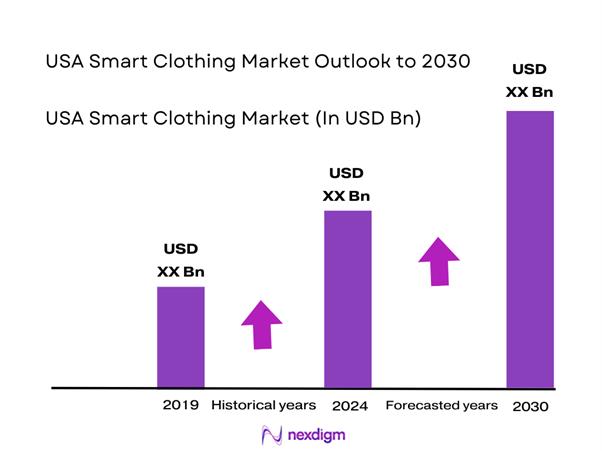
The USA smart clothing market is valued at USD ~ million, following a five-year historical analysis and driven by an expanding mix of sensor-embedded activewear, medical-grade remote monitoring garments, and workplace safety e-textiles. Growth is reinforced by improving wash durability of conductive yarns, better Bluetooth/edge modules, and stronger app ecosystems that convert raw biometrics into actionable insights for consumers, clinicians, and coaches. The market’s near-term momentum is also supported by increasing commercialization pathways across sports performance, chronic care, and defense wearables.
Within the USA, adoption and commercialization are most concentrated in innovation-heavy metros where wearable tech R&D, performance sports ecosystems, and digital health procurement overlap. The San Francisco Bay Area anchors sensing/IoT and platform software; Boston benefits from hospital systems and medtech translation; New York supports fashion-tech partnerships and brand-led go-to-market; Los Angeles scales athlete/influencer-led performance categories; and Austin contributes hardware/product engineering and connected-device startup density. The USA also remains a leading global demand center for smart clothing because it combines premium athleisure spend, employer wellness programs, and institutional buyers (health systems and defense).
Market Segmentation
By Textile Intelligence Level
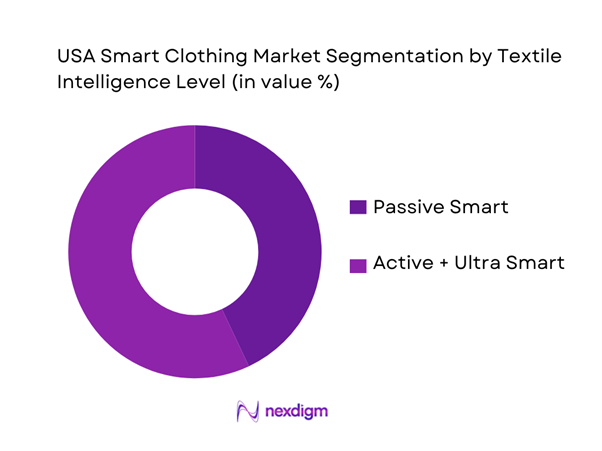
The USA smart clothing market is segmented by textile intelligence level into passive smart and active/ultra-smart systems. Recently, passive smart holds a leading share because it delivers the strongest “value-to-friction” ratio: reliable biometric capture (heart rate, respiration patterns, movement signals) without introducing heavy batteries, aggressive actuation hardware, or complex calibration workflows. Passive architectures also integrate better with existing consumer ecosystems—phones, watches, coaching apps—so the garment becomes a data surface rather than a standalone device. This supports faster retail scaling, simpler warranty handling, and higher repeat purchase intent, especially in sports/fitness tops, socks, and workwear base layers where comfort and wash durability remain purchasing gatekeepers.
By Go-to-Market Channel
The USA smart clothing market is segmented by distribution channel into offline and online. Recently, offline dominates because smart clothing still behaves like a “try-and-trust” category: buyers want fit confirmation, comfort validation, and confidence that embedded electronics won’t compromise washability or skin feel. Offline also supports assisted selling—explaining sensor placement, sizing guidance, app pairing, and expected data outputs—reducing returns and improving activation rates (i.e., users actually pairing and using the garment). In parallel, institutional pathways (sports teams, physiotherapy networks, employer wellness partners) often originate in offline or partner-led channels, which accelerates fleet deployments and repeat replenishment orders.

Competitive Landscape
The USA smart clothing market shows selective consolidation: a smaller set of companies capture mindshare through either (a) biometric accuracy + software analytics, (b) sports performance credibility, or (c) clinical partnerships and care pathways, while materials leaders enable the ecosystem through conductive fibers, coatings, and integration know-how.
| Company | Established | Headquarters | Core Smart-Clothing Focus | Sensor / Material Stack | Primary Use-Case Strength | Platform / App Depth | Channel Model | Differentiation Lever |
| Under Armour | 1996 | USA | ~ | ~ | ~ | ~ | ~ | ~ |
| Ralph Lauren | 1967 | USA | ~ | ~ | ~ | ~ | ~ | ~ |
| Sensoria | 2013 | USA | ~ | ~ | ~ | ~ | ~ | ~ |
| Siren | 2015 | USA | ~ | ~ | ~ | ~ | ~ | ~ |
| Hexoskin (Carré Technologies) | 2006 | Canada | ~ | ~ | ~ | ~ | ~ | ~ |

USA Smart Clothing Market Analysis
Growth Drivers
Connected fitness attach-rate expansion
The USA smart clothing market’s connected-fitness attach-rate is expanding because the consumer “hardware + app” behavior is already normalized at national scale, and smart garments are increasingly positioned as a comfort-first extension of that ecosystem (training load, recovery, posture, gait, and respiration). The macro base is supportive: the United States is a USD ~ economy and has a population of ~, which sustains large addressable pools for premium athleisure and subscription-based fitness experiences. On the demand side, chronic-risk prevalence increases the value of continuous tracking in everyday wear: ~ people in the U.S. had diabetes, and ~ people died from cardiovascular disease—both signals that “always-on” measurement (movement + cardio proxies) is moving beyond sports into lifestyle risk management. On the commerce side, the digitized buying funnel is already large: U.S. retail e-commerce sales were USD ~ in one quarter, supporting D2C onboarding for smart apparel bundles, firmware/app updates, and replacement cycles (pods, bands, and compatible base layers).
Employer safety and ergonomics digitization
Smart clothing adoption in U.S. employers is being pulled by measurable safety and productivity outcomes, especially in environments where musculoskeletal strain, fatigue, heat stress, and repetitive-motion risks create direct operational disruption. The need is quantifiable: private industry employers reported ~ nonfatal workplace injuries and illnesses, and total fatal work injuries were ~. These are the kinds of high-frequency events where employers increasingly look for technology that improves early detection and coaching—e.g., posture/strain detection shirts, smart PPE base layers, and connected wear that flags high-risk patterns before incidents. The macro backbone matters because safety tech budgets correlate with overall business activity: the U.S. economy at USD ~ and population of ~ supports large industrial, logistics, construction, and manufacturing labor bases where “ergonomics at scale” becomes a data problem. Smart clothing also fits procurement behavior: garments can be issued like PPE, refreshed on predictable cycles, and paired with dashboards for EHS reporting. This turns smart apparel from a consumer novelty into a workforce analytics tool, accelerating pilots with safety managers and insurers when the data feeds existing compliance routines and incident reduction programs.
Challenges
Washability reliability and product returns
Washability remains a core friction because smart clothing must survive real-world laundry cycles without degrading sensor signal quality, conductivity, or adhesive/seam integrity—yet the product is still bought, worn, and washed like apparel. The economic consequence is elevated returns, replacements, and warranty burdens, especially when brands distribute at scale through retail where “trial + return” is common. The U.S. market context amplifies the impact: clothing, footwear, and related services spending is USD ~, so even a small reliability failure rate can translate into very large absolute reverse-logistics volumes for brands operating nationally. Safety and compliance pressure adds another layer: detachable electronics (pods/modules) sit inside the broader battery safety spotlight. For example, the U.S. Consumer Product Safety Commission recalled about ~ Anker power banks due to lithium-ion overheating fire/burn hazards—an illustration of how battery-related failures drive recall costs, reputational damage, and stricter QA expectations across consumer electronics categories that smart apparel increasingly resembles. Macro scale increases scrutiny: in a USD ~ economy with ~ consumers, regulators, retailers, and insurers push for clearer durability validation, safer modular designs, and simpler “remove-before-wash” mechanisms to avoid mass failure events.
Comfort, fit variability, and sizing complexity
Comfort and fit variability is a uniquely hard challenge for smart clothing because data quality depends on consistent sensor-to-body contact, yet apparel sizing and body shapes are inherently variable. Unlike watches or rings, garments must perform across different torso lengths, compression preferences, and movement patterns, and small fit issues can cause noisy signals (false heart-rate spikes, respiration misreads, posture drift) that erode user trust quickly. This challenge is magnified by the scale of U.S. apparel consumption: clothing alone is USD ~ in annual PCE terms, meaning smart clothing is entering a category with massive SKU variety, frequent promotions, and high return expectations. At the same time, the U.S. health context increases the importance of reliable fit-based measurement: ~ people had diabetes and cardiovascular disease deaths were ~, pushing use cases beyond “gym analytics” into health-adjacent monitoring where inaccurate readings can create anxiety, non-adherence, or clinical skepticism. Macro conditions support large-scale experimentation but also intensify competition: a USD ~ economy and ~ people enable many brands to enter, making it easier for consumers to abandon products that feel uncomfortable or confusing.
Opportunities
Clinical-grade smart garments
Clinical-grade smart garments are a growth opportunity because U.S. healthcare has both large covered populations and high chronic disease burden, creating demand for continuous, low-friction monitoring beyond spot checks. The scale anchor is clear: Medicare enrollment is approximately ~ beneficiaries, and disease burden is substantial with ~ people living with diabetes and ~ cardiovascular disease deaths—conditions where monitoring adherence, recovery, and early warning signals can meaningfully improve care pathways. Interoperability tailwinds can increasingly support program deployment: national exchange activity shows ~ organizations live and ~ documents shared since go-live, indicating that data-sharing infrastructure is becoming more routinized—useful when smart garment insights need to flow into clinical workflows and longitudinal records. Macro capability supports sustained innovation investment: the U.S. economy at USD ~ enables hospitals, payers, and digital health providers to fund pilots and integration work, especially when garments reduce patient burden compared with multi-device kits. The opportunity for smart clothing vendors is to win trust through validated signal accuracy, security-by-design, and care-pathway partnerships, positioning garments as “medical-grade passive monitoring” rather than fitness accessories.
Bundled vitals and monitoring kits
Bundled vitals and monitoring kits (smart base-layer + detachable module + app + optional clinician/employer dashboard) are a near-term opportunity because they align with how U.S. buyers prefer to adopt health and safety tech: as a complete workflow rather than a standalone garment. The demand foundation is strong: chronic conditions and cardiovascular risk remain high (diabetes affecting ~ people; cardiovascular disease deaths at ~), and large institutional populations exist (Medicare enrollment around ~). On the commerce and enablement side, the U.S. digital purchasing and servicing ecosystem makes bundles easier to distribute and maintain: retail e-commerce sales were USD ~ in a single quarter, which supports D2C onboarding, replacement shipments, and subscription renewals tied to analytics features. At the same time, the bundle approach can reduce returns by standardizing setup and fit guidance (a key smart clothing barrier) and by offering modular serviceability—swap the pod, keep the garment—if designs meet safety expectations. Macro scale supports repeat cycles: a USD ~ economy and ~ consumers mean even focused vertical bundles (cardio rehab, diabetes wellness, warehouse ergonomics) can scale meaningfully without needing universal adoption.
Future Outlook
The USA smart clothing market is expected to expand as comfort-first electronic textiles, better battery/energy management, and improved sensor fusion make garments more dependable in everyday use. Growth should be strongest where measurable outcomes exist—athlete load management, chronic care monitoring, workforce safety, and defense readiness—while mass retail adoption improves as products become easier to size, pair, wash, and service. The market’s winners are likely to be those that combine validated signal quality with clear user workflows and credible channels.
Major Players
- Under Armour
- Nike
- adidas
- Ralph Lauren
- Sensoria
- Siren
- Hexoskin
- Athos
- AiQ Smart Clothing
- DuPont de Nemours
- Toray Industries
- Wearable X
- Myontec
- MYZONE
Key Target Audience
- Sportswear & performance apparel brands
- Consumer electronics & wearable device OEMs
- Professional sports teams, leagues, and performance institutes
- Healthcare providers & integrated delivery networks
- Health insurers & employer benefits administrators
- Industrial employers & safety program owners
- Investments and venture capitalist firms
- Government and regulatory bodies
Research Methodology
Step 1: Identification of Key Variables
We build a stakeholder ecosystem map across brands, e-textile component suppliers, module makers, app platforms, channel partners, and institutional buyers. Desk research is combined with database screening to define key variables such as sensor modalities, wash-durability claims, regulatory exposure, and channel economics.
Step 2: Market Analysis and Construction
We compile historical market signals and construct the market using a triangulated approach across revenues, shipment proxies, and channel checks. We assess penetration by end-use cluster (sports, healthcare, workplace safety) and validate adoption drivers through buyer workflows and replenishment patterns.
Step 3: Hypothesis Validation and Expert Consultation
We validate hypotheses via structured expert interviews (brand product heads, sports scientists, e-textile engineers, clinical partners, and distributors). These discussions confirm attach rates, activation drop-offs, return drivers, and typical implementation barriers.
Step 4: Research Synthesis and Final Output
We synthesize insights into segment attractiveness, competitive positioning, and go-to-market plays. Findings are cross-verified through bottom-up vendor mapping and top-down checks against published market baselines, ensuring internal consistency and defensible assumptions.

- Executive Summary
- Research Methodology (Market Definitions & Smart-Clothing Scope Boundaries, Inclusion/Exclusion: Smart Textiles vs Wearable Accessories, Assumptions for Attach-Rate of Pods/Modules, Market Sizing Framework: Top-Down + Bottom-Up, Primary Interviews: OEMs/Brands, Textile Mills, EMS, Digital Health Buyers, Channel Checks: DTC/Amazon/Sporting Retail, Data Triangulation & Validation, Limitations & Sensitivity Checks)

- Definition and Scope
- Market Genesis and Adoption Waves
- Ecosystem Evolution
- Business Cycle and Demand Seasonality

- Growth Drivers
Connected fitness attach-rate expansion
Employer safety and ergonomics digitization
Remote patient monitoring program expansion
Athleisure premiumization and lifestyle branding
Data monetization by apparel brands and platforms - Challenges
Washability reliability and product returns
Comfort, fit variability, and sizing complexity
Battery safety and detachable pod failures
Data privacy, consent, and compliance friction
Interoperability and platform integration gaps - Opportunities
Clinical-grade smart garments
Bundled vitals and monitoring kits
Industrial safety and ergonomics workwear
Subscription-led data and insights monetization
Licensing of smart textile platforms to apparel brands - Trends
Detachable pod-based smart clothing designs
Emergence of textile computing platforms
Machine-learning-driven signal quality enhancement
Hybrid apparel and digital coaching models
Advances in conductive materials and printed electronics - Regulatory & Policy Landscape
- SWOT Analysis
- Stakeholder & Ecosystem Analysis
- Porter’s Five Forces Analysis
- Competitive Intensity & Ecosystem Mapping

- By Value, 2019–2024
- Installed Base of Smart Clothing Garments, 2019–2024
- Service Revenue Mix, 2019–2024

- By Fleet Type (in Value %)
Smart Tops and Shirts
Smart Bras and Base Layers
Smart Socks and Footwear-Integrated Apparel
Smart PPE and Workwear
Smart Compression and Recovery Wear - By Application (in Value %)
Sports Performance
Fitness and Wellness
Remote Patient Monitoring
Chronic Disease Support
Elderly Monitoring and Fall Risk - By Technology Architecture (in Value %)
Knitted and Woven Conductive Yarns
Printed Electronics on Textiles
Embroidered Circuits
Laminated or Flexible PCB Inserts
Detachable Pod Architectures
- By Connectivity Type (in Value %)
Bluetooth
Wi-Fi
Cellular-Enabled Gateways
Offline Store-and-Forward
API and SDK Enabled Platforms - By End-Use Industry (in Value %)
Consumers
Sports Teams and Trainers
Hospitals and Healthcare Providers
Payers and Insurers
Employers and Occupational Health - By Region (in Value %)
Northeast
Midwest
South
West

- Market Share Assessment of Major Players
- Cross Comparison Parameters (Sensor modality coverage, textile integration method, washability and durability claims, power and detachable pod strategy, app and data platform depth, regulatory and clinical validation posture, manufacturing and EMS scale, US go-to-market strength)
- SWOT of Major Players
- Partnership and Ecosystem Mapping
- Detailed Profiles of Major Companies
Nike
Adidas
Under Armour
Ralph Lauren
Sensoria
Hexoskin
Myant
Athos
Siren
Wearable X
Xenoma
AiQ Smart Clothing
DuPont
Jabil

- Sports teams, trainers, and performance institutes
- Hospitals and healthcare providers
- Payers and insurers
- Employers and occupational health programs
- Lifestyle and fitness consumers

- By Value, 2025–2030
- Installed Base of Smart Clothing Garments, 2025–2030
- Service Revenue Mix, 2025–2030


 Request a Sample
 Ask for Customization
 Get a Quote
 Enquire Now