
 Download PDF
Market Overview
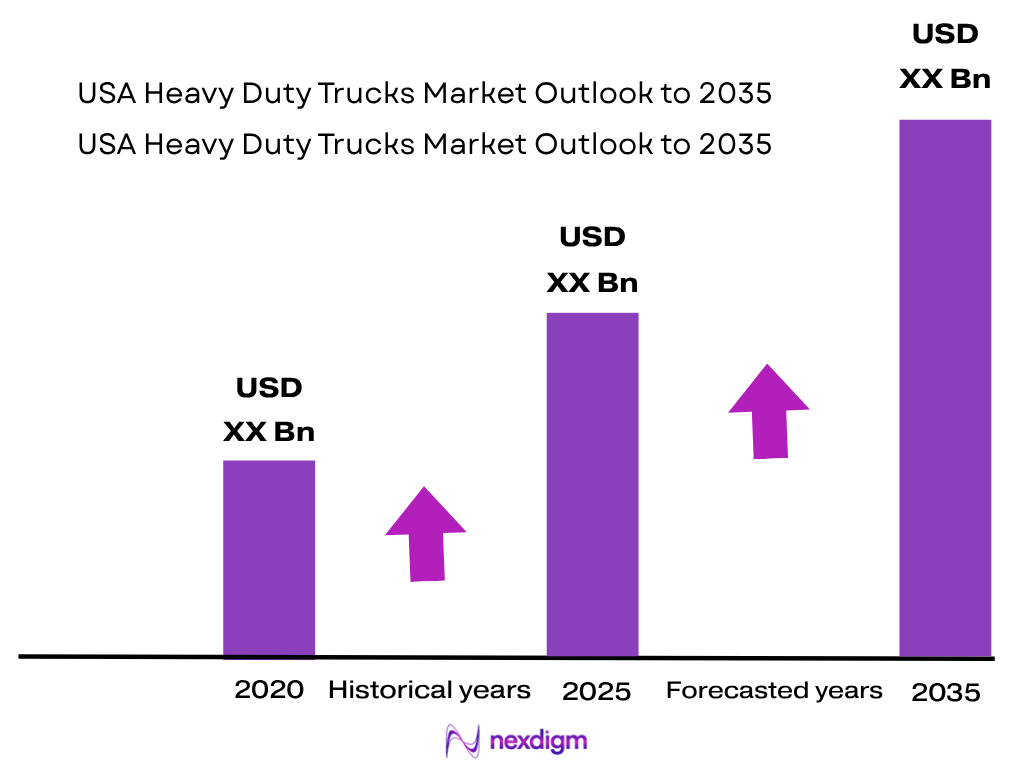
The USA Heavy Duty Trucks Market is valued at approximately ~USD XX billion, based on the requested placeholder valuation. Class 8 retail truck sales reached approximately 330,168 units in the latest annual observation compared with 315,952 units in the preceding observation. Demand is supported by long-haul freight, regional distribution, construction, utilities and vocational fleets, while replacement requirements across aging fleet populations sustain purchases of tractors and straight trucks.
California and Texas represent major U.S. heavy-duty truck demand centers because of extensive freight corridors, ports, distribution networks, industrial activity and large registered truck populations. Federal Highway Administration records show 17,113,763 registered trucks in California and 15,933,517 registered trucks in Texas in the latest reporting period. Los Angeles–Long Beach benefits from port drayage and logistics activity, while Dallas–Fort Worth and Houston benefit from interstate freight, warehousing, construction, energy and regional distribution operations.
Market Segmentation
By Vehicle Class
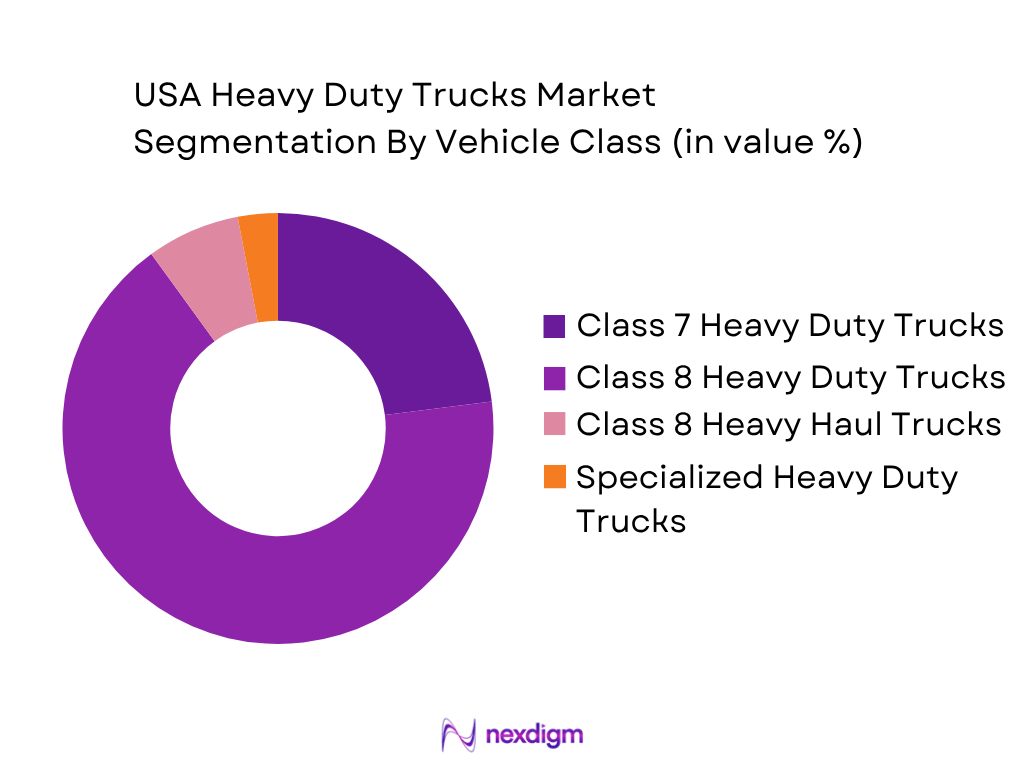
The USA Heavy Duty Trucks Market is segmented by vehicle class into Class 7 heavy-duty trucks, Class 8 heavy-duty trucks, Class 8 heavy-haul vehicles and specialized heavy-duty trucks. Class 8 trucks hold the dominant market share because they are the standard platform for long-haul tractor-trailer transportation, high-capacity regional freight and demanding vocational operations. The category includes sleeper tractors, day-cab tractors and severe-duty configurations serving truckload carriers, private fleets, construction companies, refuse operators and specialized transport fleets. Class 8 demand also benefits from the scale of interstate freight transportation and replacement cycles among large fleets that accumulate substantial annual mileage. Manufacturers including Freightliner, Kenworth, Peterbilt, International, Volvo and Mack maintain extensive Class 8 portfolios with diesel, natural-gas and increasingly battery-electric configurations. Class 7 vehicles retain an important position in vocational, municipal and urban applications but generally operate at lower gross vehicle weight ratings and are less dominant in long-distance freight. The depth of Class 8 applications therefore gives the segment the strongest overall position within the U.S. heavy-duty truck ecosystem.
By Application Type
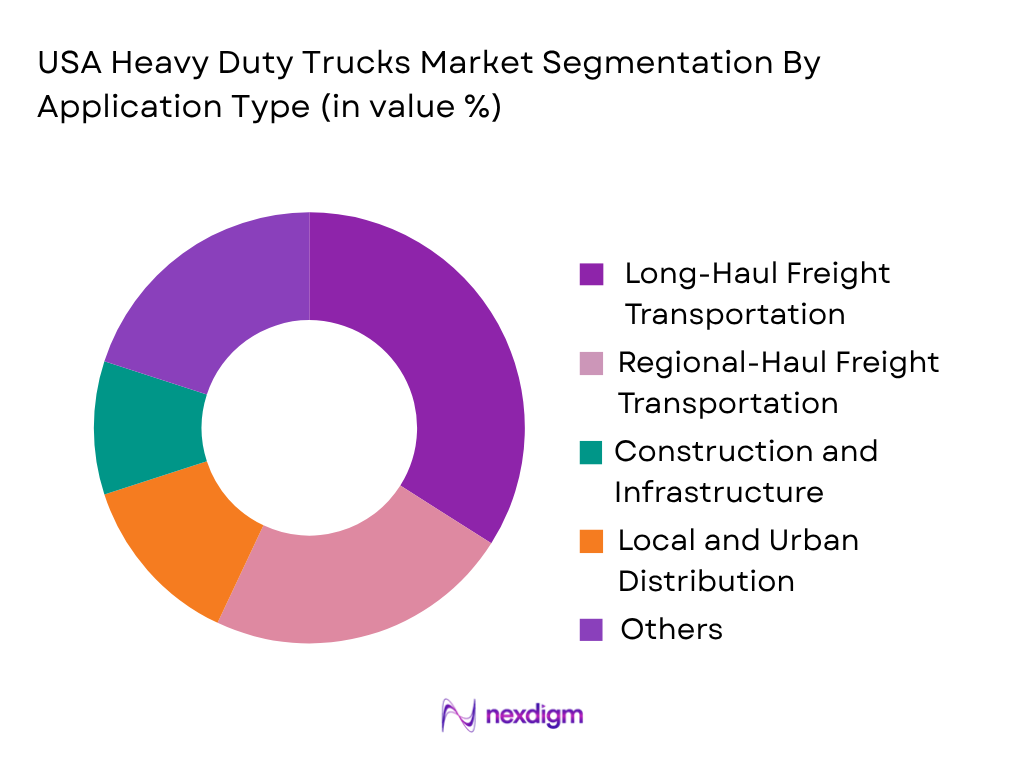
The USA Heavy Duty Trucks Market is segmented by application into long-haul freight transportation, regional-haul freight transportation, local distribution, construction and infrastructure, refuse and municipal operations, port and drayage transportation, energy and industrial applications and specialized heavy transport. Long-haul freight transportation holds the dominant market share because heavy tractor-trailers remain fundamental to moving manufactured goods, retail merchandise, food products, automotive components and industrial inputs between U.S. regions. Long-haul fleets typically operate Class 8 sleeper tractors with high annual mileage, making them major purchasers of replacement trucks, engines, automated manual transmissions, aerodynamic equipment and fleet telematics. Regional-haul operations represent another substantial segment as retailers and manufacturers increasingly operate large distribution networks closer to consumption centers. Construction and vocational demand provides diversification from the freight cycle through dump trucks, concrete mixers, utility trucks and severe-service chassis. Port drayage represents a strategically important application because California and other freight hubs are becoming early deployment locations for battery-electric and other zero-emission Class 8 trucks.
Competitive Landscape
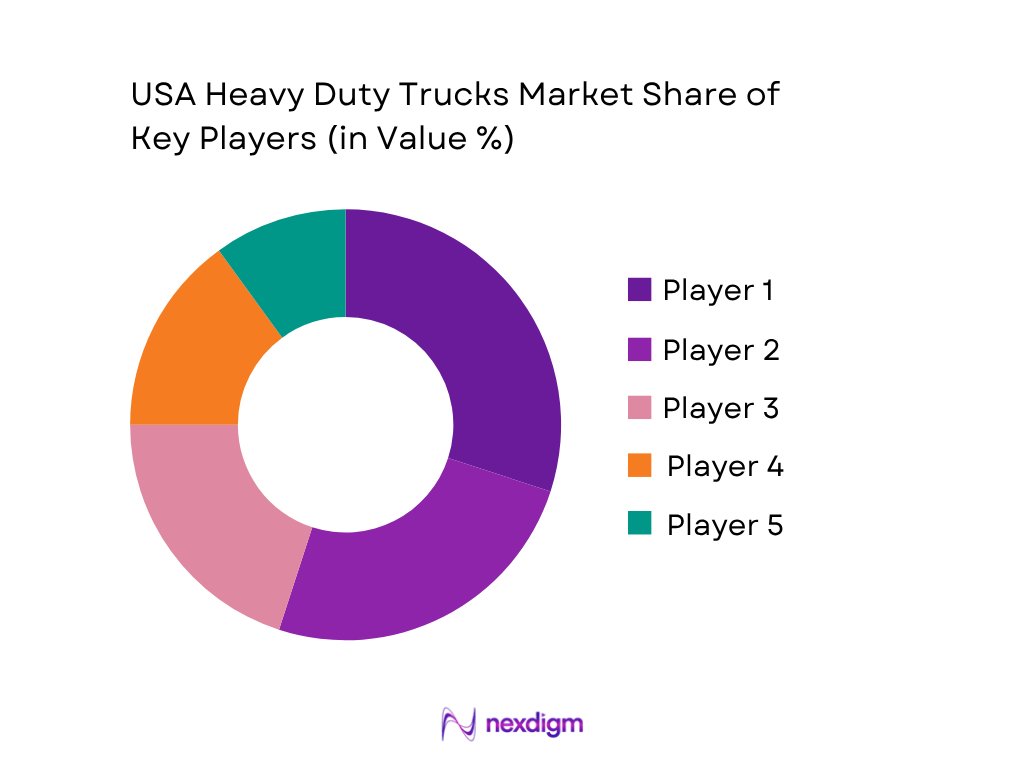
The USA Heavy Duty Trucks Market is concentrated around established manufacturers with strong Class 8 tractor portfolios, vocational platforms, domestic assembly plants, captive or integrated powertrains and nationwide dealer networks. Freightliner, Kenworth, Peterbilt, International, Volvo and Mack collectively shape purchasing standards across long-haul, regional-haul and vocational trucking. Competition increasingly extends beyond diesel horsepower and durability toward fuel efficiency, integrated drivetrains, uptime services, telematics, advanced driver-assistance technologies and battery-electric truck readiness.
| Company | Establishment Year | Headquarters | Heavy-Duty Portfolio | Core Powertrain Capability | Tractor Coverage | Vocational Capability | Zero-Emission Capability | U.S. Manufacturing / Service Presence |
| Daimler Truck North America | 1942 | Portland, Oregon | ~ | ~ | ~ | ~ | ~ | ~ |
| PACCAR Inc. | 1905 | Bellevue, Washington | ~ | ~ | ~ | ~ | ~ | ~ |
| Volvo Trucks North America | 1927 | Greensboro, North Carolina | ~ | ~ | ~ | ~ | ~ | ~ |
| Mack Trucks | 1900 | Greensboro, North Carolina | ~ | ~ | ~ | ~ | ~ | ~ |
| International Motors | 1902 | Lisle, Illinois | ~ | ~ | ~ | ~ | ~ | ~ |
USA Heavy Duty Trucks Market Analysis
Growth Drivers
Expanding Cross-Border Truck Freight Supports Class 8 Tractor Demand
Cross-border freight activity is strengthening demand for heavy-duty tractors used on U.S.–Canada and U.S.–Mexico corridors, particularly around Texas, Michigan, California, Arizona and major inland logistics hubs. Bureau of Transportation Statistics data show that trucks moved USD 1,031,807,657,234 of U.S. trade with Canada and Mexico in 2024. Truck-carried transborder freight increased further to USD 1,039,019,725,335 in 2025, demonstrating the continuing dependence of North American supply chains on road freight. Total U.S.–Mexico freight reached USD 872,833,677,052 in 2025, while U.S.–Canada freight totaled USD 712,761,384,216, creating substantial operating requirements for Class 8 day-cab and sleeper tractors serving border crossings, distribution centers and manufacturing corridors. Federal Highway Administration data additionally recorded 3,482,896 combination trucks registered in 2024, with these vehicles collectively traveling 192,520 million vehicle-miles. Each registered combination truck averaged 55,276 miles during the year, indicating intensive utilization across the long-haul freight network. The broader economic environment reinforces this freight base: World Bank data place U.S. GDP at USD 28.751 trillion in 2024 and GDP per capita at USD 84,534. This combination of large merchandise flows, intensive tractor utilization and economic scale sustains recurring demand for Class 8 truck purchases and fleet replacement.
Large Heavy-Truck Operating Base and Highway Utilization Drive Replacement Demand
The scale and utilization intensity of the U.S. truck fleet create a structural growth driver for heavy-duty truck replacement, particularly for Class 7–8 tractors and vocational vehicles exposed to high annual mileage. Federal Highway Administration data show 3,482,896 combination trucks registered in 2024, alongside 12,599,614 single-unit trucks. Combination trucks accumulated 192,520 million vehicle-miles, while single-unit trucks traveled 137,080 million vehicle-miles, resulting in a combined 329,600 million truck vehicle-miles across the national highway network. Combination trucks averaged 55,276 miles per registered vehicle, considerably higher than the 10,880 miles recorded for single-unit trucks, demonstrating the particularly demanding operating cycle faced by long-haul and regional tractors. Interstate rural highways alone accounted for 59,367 million combination-truck miles, while urban interstate routes accounted for another 49,968 million miles, highlighting extensive use across both intercity and metropolitan freight corridors. Such mileage accelerates wear on engines, transmissions, braking systems, tires, aftertreatment systems and chassis components and supports recurring fleet replacement requirements. The World Bank reports U.S. GDP of USD 28.751 trillion in 2024 and a population of 340,110,988, providing an exceptionally large consumption and production economy dependent on road-based goods movement. The breadth of this operating base supports continuing demand for sleeper tractors, day cabs, straight trucks and vocational heavy-duty platforms.
Market Challenges
Freight Corridor Volatility Creates Uneven Heavy-Duty Fleet Utilization
Freight volatility remains a major challenge for the USA Heavy Duty Trucks Market because tractor replacement decisions are closely connected with route utilization, shipment activity and fleet asset productivity. Bureau of Transportation Statistics data show total U.S. freight with Canada and Mexico at USD 1,585,595,061,268 in 2025, compared with USD 1,601,091,093,713 in 2024. The composition also shifted materially: U.S.–Canada freight totaled USD 712,761,384,216 in 2025, while U.S.–Mexico freight reached USD 872,833,677,052, creating different equipment requirements across northern and southern freight corridors. Trucks nevertheless carried USD 1,039,019,725,335 of transborder freight in 2025, illustrating that fleets must maintain substantial tractor capacity even when overall cross-border flows fluctuate. FHWA records further show 3,482,896 registered combination trucks in 2024 supporting 192,520 million vehicle-miles of activity, with an average 55,276 miles per truck. This large fixed fleet base makes utilization changes strategically important because carriers cannot immediately rebalance tractors, drivers, terminals and maintenance capacity when freight lanes weaken or shift geographically. World Bank data place U.S. GDP at USD 28.751 trillion in 2024, demonstrating that the challenge is not insufficient economic scale but the cyclical and geographically uneven allocation of freight activity. This volatility can extend replacement cycles among exposed fleets while increasing demand unpredictability for heavy-duty OEMs and dealers.
Emissions Transition Increases Powertrain and Infrastructure Complexity
The heavy-duty emissions transition creates a significant challenge because U.S. truck manufacturers and fleets must manage diesel optimization, alternative fuels and zero-emission technologies simultaneously rather than moving through a single standardized powertrain pathway. The Environmental Protection Agency issued its Heavy-Duty Vehicles Phase 3 final rule on March 29, 2024, covering vocational vehicles and tractors including day cabs and sleeper cabs from model year 2027 onward. EPA identified approximately 72 million U.S. residents living near truck freight routes, underscoring the regulatory focus on heavy-duty vehicle emissions. At the operational level, FHWA recorded 3,482,896 combination trucks and 12,599,614 single-unit trucks in 2024, showing the enormous installed fleet that cannot transition uniformly. Combination trucks consumed 27,066,130 thousand gallons of fuel during the year, while single-unit trucks consumed 17,022,466 thousand gallons, demonstrating continued dependence on combustion powertrains. Meanwhile, DOE’s National Zero-Emission Freight Corridor Strategy began implementation in 2024 to coordinate heavy-duty charging and hydrogen infrastructure, highlighting that vehicle technology and infrastructure must develop together. U.S. GDP reached USD 28.751 trillion in 2024, according to the World Bank, giving the economy substantial capacity for technology transition, but OEMs must still support existing diesel fleets while developing battery-electric, hydrogen, hybrid and increasingly efficient combustion platforms.
Market Opportunities
Zero-Emission Regional, Drayage and Dedicated Trucks Create a New Growth Platform
Zero-emission heavy-duty trucks represent a substantial future growth opportunity in applications where routes are predictable, vehicles return to depots and charging or hydrogen infrastructure can be concentrated around freight hubs. Current federal infrastructure activity provides a tangible base for this development. The Department of Energy reported more than 173,000 publicly available EV chargers in the United States in 2024, while at least 40 U.S.-based EV charger production facilities had been announced or opened. The National Zero-Emission Freight Corridor Strategy launched in 2024 specifically targets medium- and heavy-duty vehicle charging and hydrogen refueling infrastructure, initially concentrating deployment around major freight hubs and National Highway Freight Network corridors. The addressable operating base is already substantial: FHWA recorded 3,482,896 combination trucks and 12,599,614 single-unit trucks in 2024, with urban combination trucks traveling 87,048 million vehicle-miles and urban single-unit trucks traveling 85,467 million vehicle-miles. These operating patterns create opportunities for battery-electric tractors in drayage, regional haul, terminal, refuse and dedicated distribution applications where daily mileage is more controllable than long-haul operations. World Bank data report U.S. GDP of USD 28.751 trillion in 2024 and population of 340,110,988, supporting a large freight consumption base. Current infrastructure deployment and fleet scale therefore establish a measurable foundation for future battery-electric and fuel-cell heavy-duty truck penetration.
High-Utilization Fleet Modernization Creates Opportunities for Efficient and Connected Trucks
The intensity of U.S. heavy-duty truck utilization creates a future opportunity for OEMs offering more efficient integrated powertrains, automated transmissions, predictive maintenance, remote diagnostics, telematics and aerodynamic tractor platforms. FHWA data show that 3,482,896 registered combination trucks traveled 192,520 million vehicle-miles in 2024, averaging 55,276 miles per vehicle. Combination trucks consumed 27,066,130 thousand gallons of fuel, while the broader single-unit and combination-truck fleet consumed 44,088,596 thousand gallons. Rural interstate routes alone generated 59,367 million combination-truck miles, with urban interstates contributing another 49,968 million miles, demonstrating that a large proportion of heavy-duty fleet assets operate repeatedly across high-speed freight corridors where powertrain efficiency, uptime and predictive maintenance can materially affect fleet productivity. Transborder activity further supports modernization demand: trucks transported USD 1,031,807,657,234 of trade with Canada and Mexico in 2024 and USD 1,039,019,725,335 in 2025, according to the Bureau of Transportation Statistics. The World Bank places U.S. GDP at USD 28.751 trillion in 2024 and GDP per capita at USD 84,534, supporting a large commercial transportation economy capable of adopting higher-technology fleet assets. These current operating statistics create future opportunities for connected Class 8 tractors, integrated diesel powertrains, alternative-fuel trucks and fleet-management systems designed to reduce downtime across high-mileage applications.
Future Outlook
The USA Heavy Duty Trucks Market is forecast to expand at approximately ~X.X% CAGR during 2026–2035, based on the requested placeholder forecast. Future market development will be shaped by fleet replacement cycles, freight activity, construction and infrastructure demand, tighter emissions requirements and the gradual commercialization of battery-electric and alternative-fuel heavy-duty trucks. Diesel trucks are expected to remain central to long-haul and severe-duty operations because these applications demand high range, rapid refueling, established maintenance infrastructure and substantial payload capability. However, manufacturers will continue improving combustion efficiency through integrated engine-transmission calibration, automated manual transmissions, aerodynamic tractors, downsped drivetrains and predictive powertrain controls.
Zero-emission adoption will develop most rapidly in applications with predictable routes, depot parking and high vehicle utilization, including port drayage, regional distribution, refuse operations and dedicated fleets. The U.S. Department of Energy’s National Zero-Emission Freight Corridor Strategy establishes a framework for charging and hydrogen infrastructure across major freight hubs and corridors, while federal heavy-duty emissions policy continues to influence OEM technology planning.
Major Players
- Daimler Truck North America LLC – Freightliner / Western Star Heavy Duty Trucks
- PACCAR Inc. – Kenworth / Peterbilt Heavy Duty Trucks
- Volvo Trucks North America – VNL / VNR / VHD Heavy Duty Trucks
- Mack Trucks, Inc. – Heavy Duty Tractor and Vocational Trucks
- International Motors, LLC – International LT / RH / HX / HV Trucks
- Hino Motors Sales U.S.A., Inc. – Hino XL Series Heavy Duty Trucks
- Tesla, Inc. – Tesla Semi Battery Electric Class 8 Tractor
- Autocar, LLC – Severe Duty and Vocational Heavy Duty Trucks
- Battle Motors, Inc. – Heavy Duty Vocational Trucks
- Oshkosh Corporation – Specialty and Vocational Heavy Duty Vehicles
- BYD Motors LLC – Battery Electric Heavy Duty Trucks
- Hyundai Motor Company – XCIENT Fuel Cell Heavy Duty Trucks
- Orange EV – Electric Class 8 Yard and Terminal Trucks
- TICO Manufacturing – Pro-Spotter Heavy Duty Terminal Tractors
- Capacity Trucks – Heavy Duty Terminal and Yard Tractors
Key Target Audience
- Heavy Duty Truck Manufacturers
- Heavy Duty Engine, Transmission and Drivetrain Manufacturers
- Truckload, Less-than-Truckload and Private Fleet Operators
- Heavy Duty Truck Dealers, Distributors and Aftermarket Service Networks
- Logistics, Freight, Construction and Vocational Fleet Operators
- Charging Infrastructure, Hydrogen Fueling and Fleet Energy Providers
- Investments and Venture Capitalist Firms
- Government and Regulatory Bodies (U.S. Department of Transportation, Federal Motor Carrier Safety Administration, Federal Highway Administration, National Highway Traffic Safety Administration, U.S. Environmental Protection Agency, U.S. Department of Energy)
Research Methodology
Step 1: Identification of Key Variables
The initial phase involves constructing an ecosystem map encompassing heavy-duty truck OEMs, engine and transmission suppliers, fleets, dealers, leasing providers, component manufacturers and infrastructure providers operating in the USA Heavy Duty Trucks Market. Desk research is used to identify critical variables such as Class 7–8 demand, tractor configuration, vocational applications, fleet replacement cycles, freight activity, powertrain mix, manufacturing capacity and dealer coverage.
Step 2: Market Analysis and Construction
Historical market information is analyzed using both top-down and bottom-up approaches. Class 7 and Class 8 registrations, retail sales, OEM production, fleet replacement requirements and application-level demand are assessed alongside platform-level analysis of sleeper tractors, day cabs, vocational trucks and alternative-powertrain vehicles. These indicators are reconciled to develop market segmentation and demand estimates.
Step 3: Hypothesis Validation and Expert Consultation
Market hypotheses are validated through structured discussions and computer-assisted telephone interviews with fleet operators, truck dealers, component suppliers, leasing providers and heavy-duty vehicle specialists. Consultations assess fleet purchasing cycles, vehicle specification preferences, uptime requirements, diesel versus zero-emission adoption, service accessibility, residual-value considerations and application-specific operating requirements.
Step 4: Research Synthesis and Final Output
The final stage triangulates OEM-level, fleet-level and regulatory evidence to create a consolidated assessment of the USA Heavy Duty Trucks Market. Top-down indicators are cross-checked with model-level and application-level findings from the bottom-up analysis. The resulting framework evaluates truck demand, technology development, competitive positioning, fleet requirements and future opportunities across conventional and zero-emission heavy-duty platforms.

- Executive Summary
- Research Methodology (Market Definition and Scope, USA Heavy Duty Truck Taxonomy, Class 7 and Class 8 Vehicle Classification, Gross Vehicle Weight Rating Mapping, Tractor and Vocational Truck Classification, Fleet Population Assessment, New Truck Registration Assessment, OEM Production and Shipment Mapping, Freight Demand Assessment, Fleet Replacement Analysis, Diesel and Alternative Powertrain Mapping, Dealer and Service Network Assessment, Market Sizing Framework)

- Definition and Scope
- USA Heavy Duty Truck Industry Evolution and Technology Development
- Heavy Duty Truck Manufacturing and Assembly Process
- Heavy Duty Truck Value Chain Analysis
- USA Heavy Duty Truck Supply Chain Analysis
- Engine, Transmission, Axle, Cab and Chassis Ecosystem Analysis
- USA Heavy Duty Truck Manufacturing Footprint and Localization Assessment
- Fleet Procurement, Dealer and Heavy Duty Truck Service Framework

- Growth Drivers (Expansion of Truck Freight Activity, Fleet Replacement Demand, Growth of Regional Distribution Networks, E-Commerce Freight Movement, Infrastructure and Construction Activity, Manufacturing and Industrial Freight Demand, Port and Intermodal Transportation, Increasing Demand for Higher-Uptime Fleet Operations)
- Market Challenges (Freight Cycle Volatility, Fleet Capital Requirements, Driver Availability Constraints, Diesel Emissions Compliance Complexity, Heavy Duty Truck Maintenance Requirements, Charging Infrastructure Constraints, Zero-Emission Truck Payload Trade-Offs, Battery Weight and Range Constraints)
- Market Opportunities (Battery Electric Regional Haul Trucks, Zero-Emission Drayage Trucks, Hydrogen Fuel Cell Long Haul Applications, Natural Gas and Renewable Natural Gas Trucks, Autonomous-Ready Heavy Duty Platforms, Advanced Fleet Telematics, Predictive Maintenance, Integrated High-Efficiency Powertrains)
- Market Trends (Integrated Engine-Transmission Powertrains, Downsped Drivetrains, Automated Manual Transmission Adoption, Aerodynamic Tractor Optimization, Predictive Cruise Control, Connected Truck Platforms, Over-the-Air Software Updates, Battery Electric Tractor Deployment)
- Regulatory and Standards Landscape (Federal Motor Carrier Safety Administration Safety Requirements, Department of Transportation Commercial Vehicle Requirements, National Highway Traffic Safety Administration Heavy Duty Vehicle Standards, Environmental Protection Agency Heavy Duty Engine and Vehicle Emissions Standards, Heavy Duty Greenhouse Gas Standards, Federal Heavy Highway Vehicle Use Tax, Electronic Logging Device Requirements, Hours-of-Service Regulations, California Air Resources Board Heavy Duty Vehicle Requirements)
- SWOT Analysis
- Porter’s Five Forces Analysis
- PESTLE Analysis
- Stakeholder Ecosystem
- Competition Ecosystem

- By Market Value (2020-2025)
- By New Heavy Duty Truck Sales Volume (2020-2025)
- By Class 7 Truck Sales Volume (2020-2025)
- By Class 8 Truck Sales Volume (2020-2025)
- By Heavy Duty Tractor Sales Volume (2020-2025)
- By Vocational Truck Sales Volume (2020-2025)

- By Vehicle Class (In Value %)
Class 7 Heavy Duty Trucks
Class 8 Heavy Duty Trucks
Class 8 Heavy Haul Trucks
Specialized Heavy Duty Trucks - By Truck Configuration (In Value %)
Truck Tractors
Straight Trucks
Vocational Trucks
Severe Service Trucks
Heavy Haul Tractors
Terminal and Yard Tractors
Specialty Heavy Duty Trucks - By Application Type (In Value %)
Long Haul Freight Transportation
Regional Haul Freight Transportation
Local and Urban Distribution
Port and Drayage Operations
Construction and Infrastructure
Refuse and Waste Management
Oil and Gas Transportation
Mining and Heavy Haul Operations
Utilities and Public Services
Municipal and Government Fleets
Food and Beverage Distribution
Automotive Logistics
Tank and Bulk Transportation
Logging and Forestry
Specialized Heavy Transport - By Powertrain Type (In Value %)
Diesel Internal Combustion Trucks
Renewable Diesel Compatible Trucks
Compressed Natural Gas Trucks
Renewable Natural Gas Trucks
Liquefied Natural Gas Trucks
Battery Electric Heavy Duty Trucks
Hydrogen Fuel Cell Heavy Duty Trucks
Hybrid Electric Heavy Duty Trucks
Other Alternative Fuel Heavy Duty Trucks - By Fleet Ownership Type (In Value %)
Large For-Hire Truckload Fleets
Less-than-Truckload Fleets
Private Corporate Fleets
Dedicated Contract Carriage Fleets
Owner-Operators
Regional and Local Fleets
Construction Fleets
Municipal and Government Fleets
Refuse and Waste Fleets
Port and Drayage Fleets
Leasing and Rental Fleets
Specialized Heavy Haul Fleets - By Region (In Value %)
Northeast USA
Midwest USA
South USA
West USA
Texas Freight and Energy Corridor
California Freight and Port Corridor
Great Lakes Manufacturing Corridor
Southeast Logistics Corridor
Gulf Coast Petrochemical Corridor
Pacific Northwest Freight Corridor
Mountain West Freight Corridor
Other USA

- Market Share of Major Players (By Revenue, Unit Sales, Class 7 Trucks, Class 8 Trucks, Truck Tractors, Vocational Trucks, Powertrain Type, Fleet Application)
- Cross Comparison Parameters (Class 7 and Class 8 Tractor and Vocational Portfolio Breadth, Diesel Powertrain and Integrated Engine-Transmission Capability, Battery Electric and Hydrogen Fuel Cell Truck Readiness, Payload GCWR and Axle Configuration Coverage, Long Haul Regional Haul Drayage and Vocational Application Coverage, Dealer Service Network Parts Availability and Uptime Support, Fleet Telematics ADAS Connectivity and Autonomous-Ready Capability, USA Manufacturing Footprint and Zero-Emission Fleet Infrastructure Support)
- SWOT Analysis of Major Players
- Competitive Positioning Matrix
- Product and Technology Portfolio Benchmarking
- Pricing and Distribution Network Benchmarking
- Market Entry Strategy Assessment
- Detailed Profiles of Major Companies
Daimler Truck North America LLC – Freightliner / Western Star Heavy Duty Trucks
PACCAR Inc. – Kenworth / Peterbilt Heavy Duty Trucks
Volvo Trucks North America – VNL / VNR / VHD Heavy Duty Trucks
Mack Trucks, Inc. – Anthem / Pinnacle / Granite / LR Heavy Duty Trucks
International Motors, LLC – International LT / RH / HX / HV Trucks
Hino Motors Sales U.S.A., Inc. – Hino XL Series Heavy Duty Trucks
Tesla, Inc. – Tesla Semi Battery Electric Class 8 Tractor
Autocar, LLC – ACX / DC-64 Severe Duty and Vocational Trucks
Battle Motors, Inc. – Heavy Duty Vocational Trucks
Oshkosh Corporation – Specialty and Vocational Heavy Duty Vehicles
BYD Motors LLC – Battery Electric Heavy Duty Trucks
Hyundai Motor Company – XCIENT Fuel Cell Heavy Duty Trucks
Orange EV – Electric Class 8 Yard and Terminal Trucks
TICO Manufacturing – Pro-Spotter Heavy Duty Terminal Tractors
Capacity Trucks – Heavy Duty Terminal and Yard Tractors

- Fleet Buyer Segmentation
- Fleet Procurement Behaviour
- OEM and Dealer Selection Criteria
- Fleet Buyer Pain Points
- Powertrain and Technology Adoption Assessment
- Replacement and Repurchase Behaviour

- By Market Value (2026-2035)
- By New Heavy Duty Truck Sales Volume (2026-2035)
- By Class 7 Truck Sales Volume (2026-2035)
- By Class 8 Truck Sales Volume (2026-2035)
- By Heavy Duty Tractor Sales Volume (2026-2035)
- By Vocational Truck Sales Volume (2026-2035)


 Request a Sample
 Ask for Customization
 Get a Quote
 Enquire Now