
 Download PDF
Market Overview
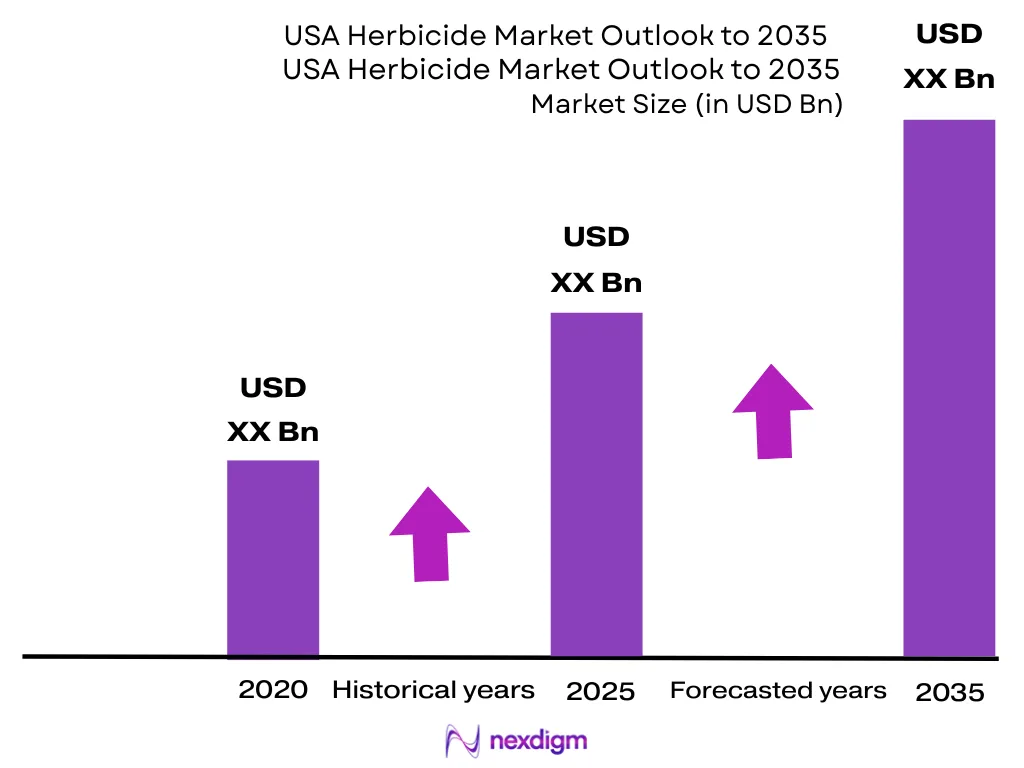
The USA Herbicide Market is valued at USD ~ billion, based on a back-cast from Mordor Intelligence’s published U.S. herbicide benchmarks of USD ~ billion and USD ~ billion for the next two annual market points. Demand is driven by row-crop acreage, herbicide-tolerant seed systems, resistant weeds, and reduced-tillage farming. USDA reported corn planted area moving from 94.64 million acres to 91.48 million acres, while soybean acreage increased from 83.60 million acres to 86.10 million acres. The market is concentrated across the Corn Belt, Great Plains, Delta, Texas, California, and the Southeast because these regions combine large row-crop acreage, high weed pressure, and commercialized crop input channels. Iowa, Illinois, Indiana, Nebraska, Minnesota, Texas, Arkansas, Mississippi, Missouri, North Dakota, and California remain critical demand centers. USDA’s acreage data shows soybean area expanding to 86.10 million acres, while corn remained above 91.47 million acres, sustaining herbicide demand across corn-soybean rotation states.
Market Segmentation
By Crop Type
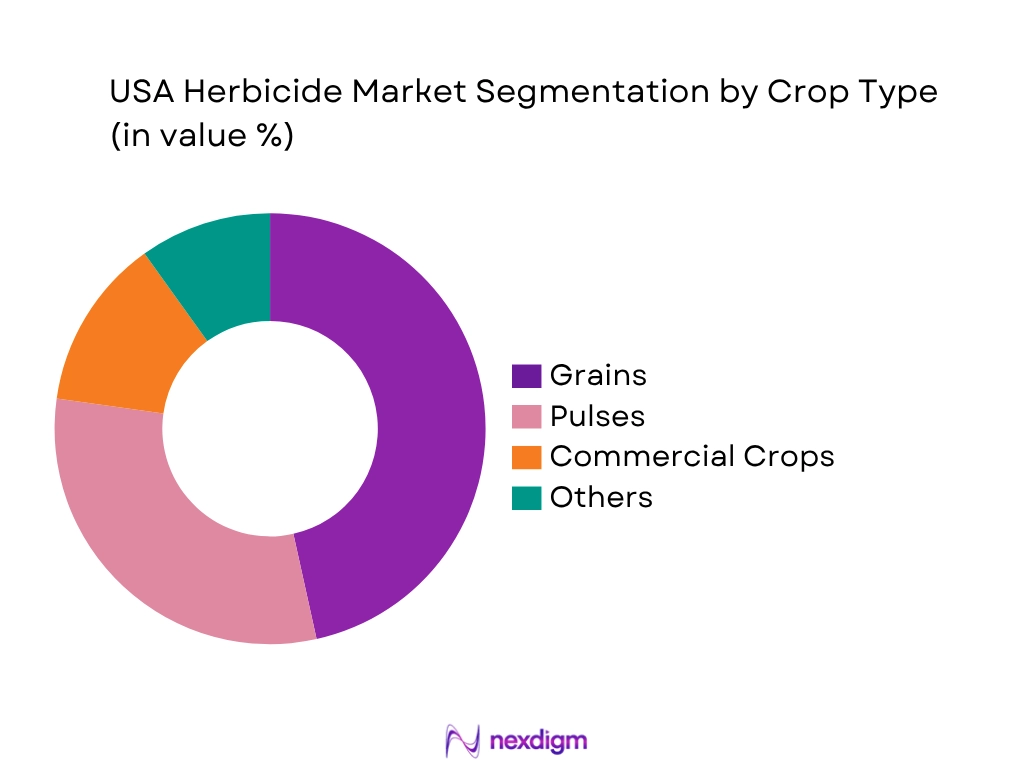
The USA Herbicide Market is segmented by crop type into grains and cereals, pulses and oilseeds, commercial crops, fruits and vegetables, and turf, ornamental and non-crop use. Grains and cereals hold the dominant share because corn, wheat, rice, sorghum, and barley require extensive pre-emergence and post-emergence weed control across broad-acre systems. Corn remains the most important herbicide-consuming crop because growers use atrazine, acetochlor, S-metolachlor, mesotrione, glyphosate, glufosinate, and HPPD-based premixes to manage grasses and broadleaf weeds. Large-scale mechanized farms also rely on chemical weed control to reduce cultivation passes, preserve soil moisture, and protect yield potential. Mordor Intelligence identifies grains and cereals as the leading crop segment in the U.S. herbicide market.
By Application Mode
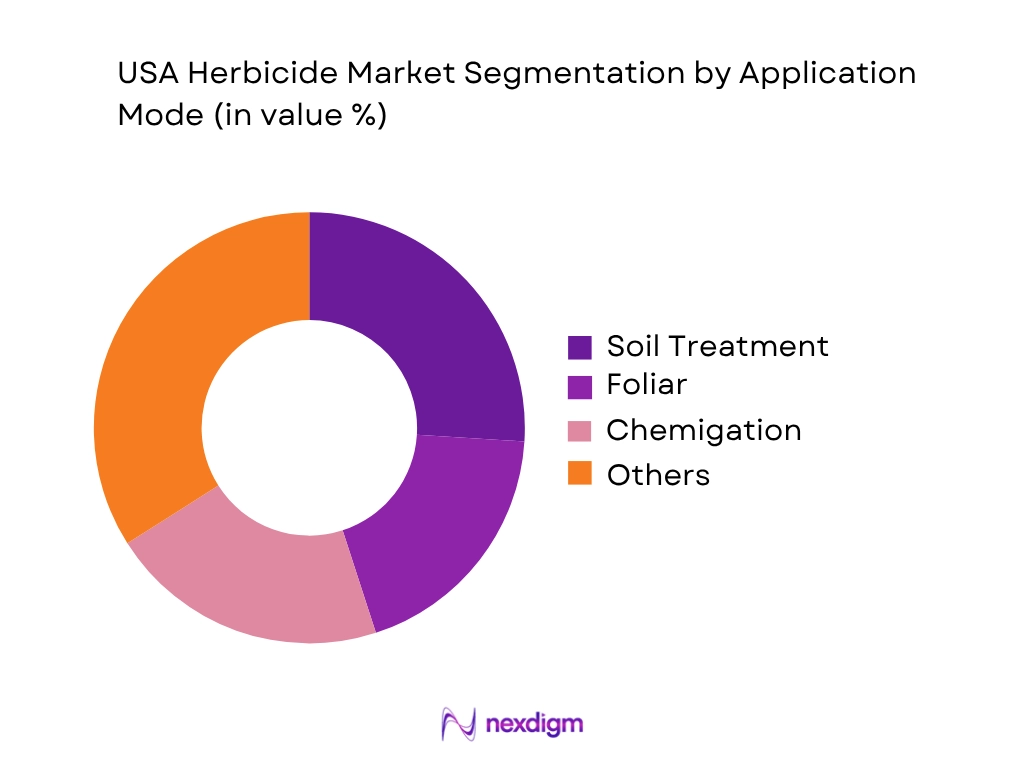
The USA Herbicide Market is segmented by application mode into soil treatment, foliar application, chemigation, fumigation, and precision spot spraying. Soil treatment leads the market because U.S. growers increasingly use pre-emergence residual herbicides to control waterhemp, Palmer amaranth, marestail, kochia, lambsquarters, foxtail, and ryegrass before weed emergence. This segment benefits from conservation tillage, no-till farming, and layered residual programs in corn, soybean, cotton, and wheat. Soil-applied herbicides are also preferred because they reduce early-season weed competition, improve crop establishment, and lower the need for rescue applications. Mordor Intelligence identifies soil treatment as the leading U.S. herbicide application mode.
Competitive Landscape
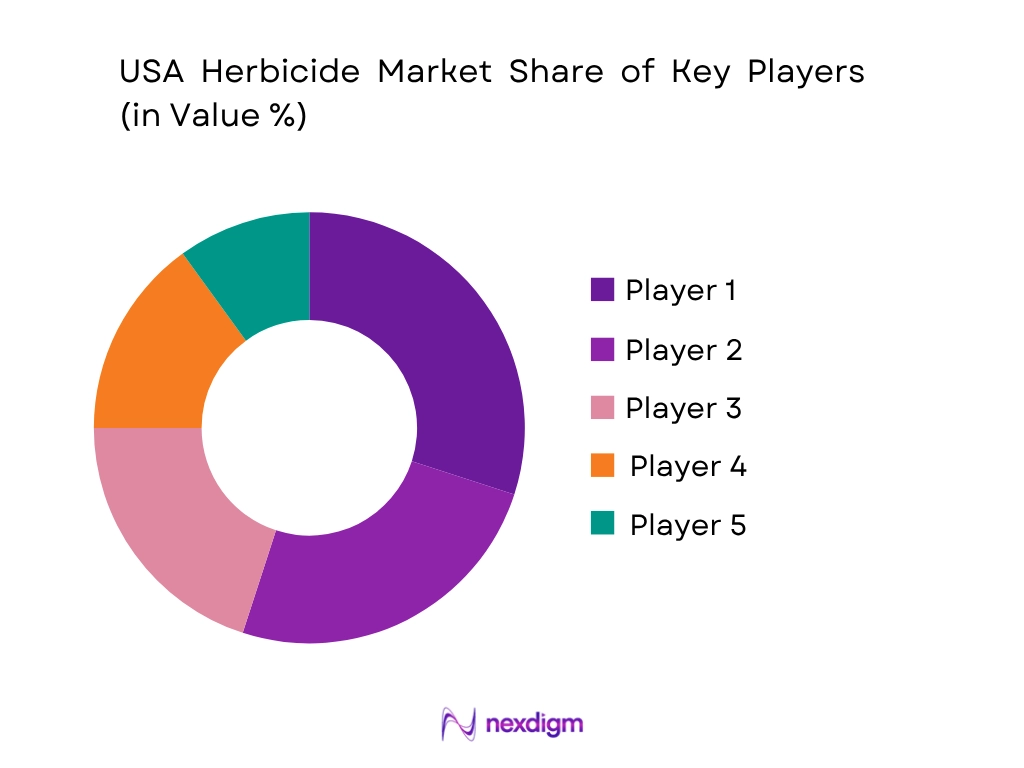
The USA Herbicide Market is moderately consolidated, led by Bayer, BASF, Corteva Agriscience, Syngenta, and Nufarm. These companies dominate through herbicide-tolerant crop platforms, branded active ingredients, proprietary premixes, EPA registrations, retailer relationships, and agronomic advisory programs. Competition is shaped by glyphosate generics, dicamba and 2,4-D regulatory scrutiny, glufosinate supply, residual chemistry innovation, and precision spraying partnerships. Reuters reported that U.S. farmers have increasingly shifted toward cheaper generic crop chemicals, pressuring large manufacturers.
| Company | Establishment Year | Headquarters | Key Herbicide Brands / Portfolio | Crop Focus | Route-to-Market Strength | Technology Linkage | Regulatory Exposure | Strategic Position |
| Bayer CropScience | 1863 | Leverkusen, Germany | ~ | ~ | ~ | ~ | ~ | ~ |
| BASF Agricultural Solutions | 1865 | Ludwigshafen, Germany | ~ | ~ | ~ | ~ | ~ | ~ |
| Corteva Agriscience | 2019 | Indianapolis, USA | ~ | ~ | ~ | ~ | ~ | ~ |
| Syngenta Crop Protection | 2000 | Basel, Switzerland | ~ | ~ | ~ | ~ | ~ | ~ |
| Nufarm Americas | 1956 | Melbourne, Australia | ~ | ~ | ~ | ~ | ~ | ~ |
USA Herbicide Market Analysis
Growth Drivers
Large Row-Crop Acreage Sustaining Herbicide Application Demand
The USA Herbicide Market is strongly supported by the country’s large planted base across corn, soybean, wheat, cotton, and rice, where chemical weed control remains central to yield protection. Corn planted area stood at 91.5 million acres, soybean planted area reached 86.1 million acres, all wheat planted area stood at 47.2 million acres, cotton planted area reached 11.7 million acres, and rice planted area stood at 2.94 million acres in the latest USDA acreage release. These crops require pre-plant burndown, pre-emergence residuals, post-emergence herbicides, and rescue applications, particularly in broad-acre mechanized systems. The macroeconomic setting also supports farm input demand, as the United States recorded USD 28.75 trillion in GDP and USD 84,534.0 GDP per capita in World Bank data, reflecting the scale of the domestic economy that supports advanced agricultural input purchasing. Herbicide demand is therefore anchored by extensive cultivated acreage, commercial crop intensity, and high-capacity farm input infrastructure.
Continued Corn-Soybean Production Intensity and Stored Grain Volume
The USA Herbicide Market is driven by the operational intensity of corn and soybean systems, which require repeated weed-control programs across millions of acres. USDA reported U.S. corn production at 14.9 billion bushels, while soybean production reached 4.26 billion bushels in the latest crop production data. Soybean planted area stood at 81.2 million acres, while growers harvested 80.4 million acres, keeping herbicide use highly relevant in soybean rotations where glyphosate, glufosinate, 2,4-D, dicamba alternatives, PPO inhibitors, and residual herbicides remain critical. USDA also reported 9.02 billion bushels of corn stocks, 2.10 billion bushels of soybean stocks, and 1.30 billion bushels of wheat stocks, confirming the large grain pipeline that depends on weed-free crop establishment. The broader macroeconomic base remains supportive, with World Bank reporting U.S. GDP at USD 28.75 trillion and GDP per capita at USD 84,534.0, enabling capital-intensive farm input systems.
Market Challenges
Regulatory Disruption Around Dicamba-Based Herbicide Programs
The USA Herbicide Market faces a major challenge from regulatory disruption in over-the-top dicamba use for dicamba-tolerant soybean and cotton. The Federal Register states that the District of Arizona vacated registrations for three dicamba products: XtendiMax with VaporGrip Technology, Engenia Herbicide, and Tavium Plus VaporGrip Technology. EPA issued an existing stocks order on February 14, 2024, revised it on March 12, 2024, and specified that the affected products were no longer registered for sale or distribution except as authorized. This directly affects herbicide program planning for soybean and cotton growers because dicamba-based systems were used for difficult broadleaf weeds such as Palmer amaranth and waterhemp. The challenge is amplified by the country’s large soybean and cotton base: USDA recorded 86.1 million acres of soybeans and 11.7 million acres of cotton planted. World Bank macro data shows a USD 28.75 trillion U.S. economy, but regulatory uncertainty still disrupts input selection and inventory planning.
Environmental Compliance Burden Under Herbicide Strategy Rules
The USA Herbicide Market faces increasing compliance pressure from the EPA’s herbicide strategy under the Endangered Species Act. EPA states that its Herbicide Strategy is designed to reduce herbicide exposure for over 900 federally endangered and threatened species and designated critical habitats before completing effects determinations and consultations. This creates label-management complexity for manufacturers, ag retailers, applicators, and growers because future herbicide use must increasingly consider runoff, erosion, spray drift, buffer practices, and mitigation measures. The compliance challenge is especially relevant across large-acre field crops: USDA reported 91.5 million acres of corn, 86.1 million acres of soybeans, 47.2 million acres of wheat, and 2.94 million acres of rice, all of which may use conventional herbicides in crop-specific programs. Although World Bank data shows the U.S. economy at USD 28.75 trillion with USD 84,534.0 GDP per capita, the regulatory burden can slow launches, complicate labels, and raise execution risk for herbicide suppliers.
Market Opportunities
Precision and Residual Herbicide Programs for Expanding Corn Acreage
The USA Herbicide Market has a strong opportunity in precision application, layered residual programs, and crop-specific weed-control packages for corn. USDA’s latest planting intentions indicate producers intend to plant 95.3 million acres of corn, while corn stocks totaled 9.02 billion bushels, showing that corn remains a large-scale production system requiring disciplined early-season weed control. Corn growers use soil-applied residuals, HPPD inhibitors, atrazine alternatives, acetochlor, S-metolachlor, mesotrione premixes, glyphosate, and glufosinate programs to manage grasses and broadleaf weeds. The opportunity for manufacturers lies in offering formulations that fit pre-emergence residual layering, post-emergence rescue treatments, and digital prescription spraying. The macroeconomic backdrop supports this shift because World Bank data records U.S. GDP at USD 28.75 trillion and GDP per capita at USD 84,534.0, reflecting a high-capacity agricultural economy able to adopt advanced agronomy tools. Current acreage and stock levels support future demand for higher-efficacy herbicide systems without relying on market-size or growth-rate assumptions.
Specialty Crop, Nursery, Turf, and Protected-Culture Weed Control
The USA Herbicide Market has an opportunity in specialty crop, nursery, turf, ornamental, and protected-culture weed-control applications, where crop safety, residue management, and labor substitution are more important than commodity-scale volume. USDA NASS released the 2024 Census of Horticultural Specialties in 2026, reporting USD 18.3 billion in floriculture, nursery, and specialty crop sales, covering greenhouse, nursery, sod, plugs, aquatic plants, vegetable seeds, transplants, and other horticultural products. These systems require selective herbicides, pre-emergence nursery formulations, non-crop vegetation control, turfgrass herbicides, and low-residue weed-control options. The opportunity is particularly relevant for California, Florida, Oregon, Washington, North Carolina, and other specialty-crop states where growers manage high-value crops and sensitive production environments. The macroeconomic environment supports premium input adoption, as World Bank data records U.S. GDP at USD 28.75 trillion and GDP per capita at USD 84,534.0. Current horticulture production data supports future demand for crop-safe, label-compliant herbicide solutions in non-row-crop channels.
Future Outlook
The USA Herbicide Market is expected to grow steadily, with a forecasted CAGR of 2.8% during 2026-2035, using IndexBox’s long-range U.S. value outlook as the most direct public source for the 2035 horizon. Growth will be shaped by resistant weed pressure, low-volatility auxin formulations, glufosinate adoption, residual herbicide premixes, conservation tillage, and precision application technologies. However, glyphosate litigation, dicamba regulation, paraquat restrictions, state-level pesticide controls, and generic price competition will moderate revenue growth. Demand will remain strongest in corn, soybean, cotton, wheat, rice, and specialty-crop systems. The Corn Belt will continue using layered pre-emergence and post-emergence programs, while the Delta and Southeast will rely on aggressive Palmer amaranth and pigweed control programs. California and Western specialty crop regions will support premium herbicide demand because mechanical and hand weeding costs remain high. Precision sprayers, drone scouting, and AI weed detection will reduce blanket spray volumes but increase demand for targeted, higher-value formulations.
Major Players
- Bayer CropScience
- BASF Agricultural Solutions
- Corteva Agriscience
- Syngenta Crop Protection
- Nufarm Americas
- FMC Corporation
- UPL Limited
- ADAMA Agricultural Solutions
- Albaugh LLC
- American Vanguard Corporation / AMVAC
- Valent U.S.A.
- Sumitomo Chemical America
- Gowan Company
- Drexel Chemical Company
- WinField United / Land O’Lakes
Key Target Audience
- Herbicide manufacturers and formulators
- Crop protection chemical distributors
- Agricultural retailers and cooperatives
- Seed trait and biotechnology companies
- Precision agriculture and smart spraying companies
- Large commercial farming enterprises and custom applicators
- Investments and venture capitalist firms
- Government and regulatory bodies
Research Methodology
Step 1: Identification of Key Variables
The initial phase involves constructing an ecosystem map of the USA Herbicide Market, covering manufacturers, active ingredient suppliers, formulators, distributors, ag retailers, cooperatives, custom applicators, and growers. Key variables include planted acreage, treated acreage, active ingredient mix, crop type, application timing, weed resistance, EPA registration status, and price per treated acre.
Step 2: Market Analysis and Construction
The second phase involves analyzing historical market value, crop acreage, herbicide usage, application modes, and active ingredient demand. Public sources such as USDA NASS, EPA pesticide databases, company annual reports, product labels, and industry publications are mapped against bottom-up estimates from crop-level herbicide programs and average spend per acre.
Step 3: Hypothesis Validation and Expert Consultation
Market hypotheses are validated through structured discussions with agronomists, ag retailers, crop protection distributors, manufacturers, formulation specialists, and large growers. These interviews test assumptions on glyphosate substitution, glufosinate demand, dicamba restrictions, residual herbicide adoption, generic pricing, and precision spraying economics.
Step 4: Research Synthesis and Final Output
The final stage consolidates primary insights, secondary data, and bottom-up calculations into a validated market model. The output includes market size, CAGR, segmentation, competitive benchmarking, regulatory outlook, channel analysis, and actionable recommendations for manufacturers, distributors, investors, and technology providers operating in the USA Herbicide Market.

- Executive Summary
- Research Methodology (Market Definitions and Assumptions, Product Inclusion and Exclusion, Active Ingredient Mapping, Crop-Acreage Normalization, Treated Acre Approach, Value–Volume Triangulation, Distributor and Retailer Interviews, Farm Input Dealer Checks, EPA Registration Review, USDA Chemical-Use Data Mapping, Limitations and Forecast Assumptions)

- Definition and Scope
- Market Genesis and Evolution
- Timeline of Herbicide Technology Shifts
- Business Cycle and Seasonality
- Herbicide Value Chain and Supply Chain Analysis

- Growth Drivers (Rising Labor Costs, Herbicide-Tolerant Crop Systems, No-Till Farming, Resistant Weed Pressure, High-Value Crop Protection, Precision Application)
- Market Challenges (EPA Registration Risk, Off-Target Movement, Herbicide Resistance, Commodity Price Volatility, Generic Price Pressure, Litigation Exposure)
- Market Opportunities (Bio-Herbicides, Low-Volatility Formulations, Residual Premixes, Digital Agronomy, Specialty Crop Weed Control, Resistance Stewardship)
- Market Trends (Tank-Mix Complexity, Seed-Chemistry Bundling, Digital Labels, Stewardship Programs, Sustainability Claims, Application Technology)
- SWOT Analysis
- Porter’s Five Forces Analysis

- By Value (2020-2025)
- By Volume (2020-2025
- By Treated Acres (2020-2025)

- By Active Ingredient (In Value %)
Glyphosate
Glufosinate
Dicamba
Atrazine
Residual Chloroacetamides - By Crop Type (In Value %)
Corn
Soybean
Cotton
Wheat and Small Grains
Rice - By Distribution Channel (In Value %)
Agricultural Retailers
Farmer Cooperatives
National and Regional Distributors
Direct Manufacturer Sales
Online and Digital Input Platforms - By Geography (In Value %)
Midwest and Corn Belt
Delta and Mid-South
Great Plains
Southeast

- Market Share of Major Players (Revenue Share, Volume Share, Treated Acre Influence, Branded Formulation Share)
- Cross Comparison Parameters (Active Ingredient Portfolio Breadth, Herbicide Mode-of-Action Coverage, Trait-System Linkage, EPA Registration Strength, Residual Herbicide Pipeline, Distribution and Ag Retail Network, Price per Treated Acre, Resistance Management and Stewardship Programs)
- SWOT Analysis of Major Players (Portfolio Strength, Regulatory Risk, Generic Exposure, Innovation Capability)
- Detailed Profiles of Major Companies
Bayer CropScience
Corteva Agriscience
Syngenta Crop Protection
BASF Agricultural Solutions
FMC Corporation
UPL Limited
ADAMA Agricultural Solutions
Nufarm Americas
American Vanguard Corporation / AMVAC
Albaugh LLC
Valent U.S.A.
Sumitomo Chemical America
Gowan Company
Drexel Chemical Company
WinField United / Land O’Lakes

- Market Demand and Utilization
- Farm Input Budget Allocation
- Purchasing Decision Process
- Grower Pain Point Analysis
- Product Selection Criteria

- By Value (2026-2035)
- By Volume (2026-2035)
- By Treated Acres (2026-2035)


 Request a Sample
 Ask for Customization
 Get a Quote
 Enquire Now