

 Download PDF
Market Overview
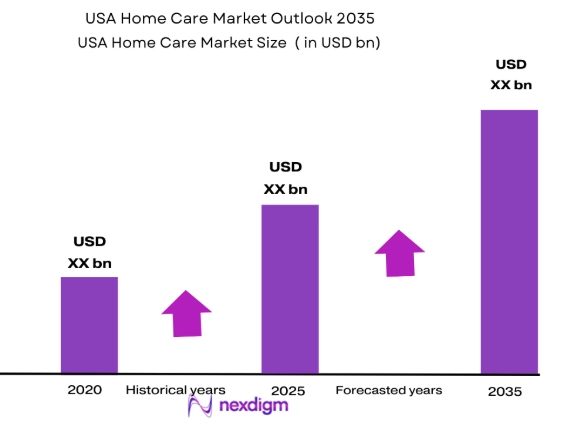
The USA home care market demonstrates substantial scale based on a recent historical assessment, with an estimated valuation of approximately USD ~ billion, driven by increasing demand for in-home healthcare services, chronic disease prevalence, and an aging population requiring long-term care solutions. Expansion is further supported by rising healthcare costs, prompting a shift toward cost-efficient home-based care models, along with technological integration such as remote patient monitoring and telehealth services that enhance accessibility and efficiency across diverse patient groups.
Dominance within the USA home care market is largely concentrated in urbanized states such as California, Texas, Florida, and New York, where dense populations and advanced healthcare infrastructure drive higher service utilization. These regions benefit from strong reimbursement frameworks, higher disposable incomes, and a large elderly population. Additionally, suburban and metropolitan areas exhibit stronger provider networks and workforce availability, enabling efficient service delivery, while regulatory support and awareness programs further strengthen adoption rates across these key geographic hubs.
Market Segmentation
By Service Type
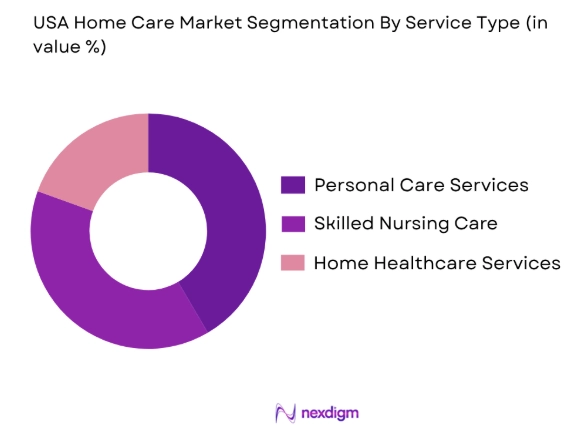
USA home care market is segmented by service type into personal care services, home healthcare services, and companion care services. Recently, home healthcare services have a dominant market share due to factors such as increasing demand for skilled nursing, physical therapy, and chronic disease management at home. The rising prevalence of conditions such as diabetes, cardiovascular diseases, and post-surgical recovery needs has significantly boosted reliance on professional healthcare services delivered at home. Moreover, reimbursement support from Medicare and Medicaid encourages patients to opt for clinical home care solutions instead of hospital stays. Strong provider networks and technological integration, including remote monitoring, also contribute to the dominance of this segment.
By End User
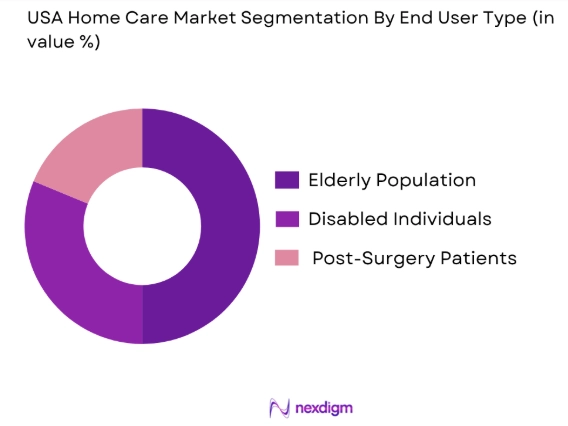
USA home care market is segmented by end user into elderly population, disabled individuals, and post-acute care patients. Recently, the elderly population has a dominant market share due to factors such as increasing life expectancy, higher incidence of chronic illnesses, and a growing preference for aging in place. This demographic requires continuous assistance with daily activities and medical supervision, driving consistent demand for home care services. Government programs and insurance coverage further support this segment, while family preferences for home-based solutions over institutional care reinforce its leading position in the market.
Competitive Landscape
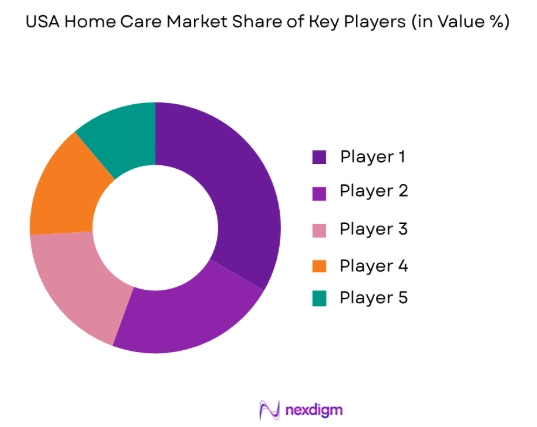
The USA home care market is moderately consolidated, with a mix of large national providers and numerous regional and local agencies. Major players exert significant influence through expansive service networks, acquisitions, and integration of advanced healthcare technologies. Competitive dynamics are shaped by service quality, workforce availability, regulatory compliance, and partnerships with healthcare institutions, while smaller providers compete through localized service offerings and personalized care delivery.
| Company Name | Establishment Year | Headquarters | Technology Focus | Market Reach | Key Products | Revenue | Service Coverage Model |
| Amedisys Inc. | 1982 | USA | ~ | ~ | ~ | ~ | ~ |
| LHC Group | 1994 | USA | ~ | ~ | ~ | ~ | ~ |
| Brookdale Senior Living | 1978 | USA | ~ | ~ | ~ | ~ | ~ |
| Kindred Healthcare | 1985 | USA | ~ | ~ | ~ | ~ | ~ |
| Visiting Angels | 1998 | USA | ~ | ~ | ~ | ~ | ~ |
USA Home Care Market Analysis
Growth Drivers
Aging Population Growth Rate
The USA home care market is strongly influenced by the rapid increase in the aging population, which continues to expand the demand for long-term and continuous care services delivered at home. Older adults are more susceptible to chronic illnesses and mobility limitations, creating sustained need for assistance with daily activities and medical care. This demographic shift is further reinforced by increasing life expectancy and improved healthcare access, which keeps individuals living longer but often with complex care requirements. Families are increasingly preferring home-based care solutions over institutional settings, which supports market growth. Additionally, government programs and insurance coverage contribute to affordability, ensuring wider access to services.
Rising Chronic Disease Prevalence
The growing prevalence of chronic diseases such as diabetes, cardiovascular disorders, and respiratory conditions significantly drives the demand for home care services in the USA. Patients with long-term conditions require continuous monitoring, medication management, and rehabilitation, which are effectively delivered in home settings. This shift reduces hospital readmissions and healthcare costs while improving patient comfort and adherence to treatment plans. Technological advancements, including telehealth and remote monitoring, further enhance chronic disease management at home. Increasing awareness about preventive care and early diagnosis also supports demand. Overall, chronic disease burden remains a critical factor shaping sustained growth in the home care market.
Market Challenges
Caregiver Shortage Index
The USA home care market faces a persistent shortage of qualified caregivers, which limits service capacity and impacts the quality of care delivery. The demand for caregivers continues to rise, but workforce supply remains constrained due to factors such as low wages, demanding job conditions, and limited career progression opportunities. This imbalance creates operational challenges for providers, leading to increased workloads and burnout among existing staff. Rural areas are particularly affected due to limited workforce availability. Providers must invest heavily in recruitment and training, increasing operational costs. Addressing this shortage is essential for maintaining service continuity and ensuring patient satisfaction across the market.
Regulatory Compliance Burden:
Complex and evolving regulatory requirements present a significant challenge for home care providers operating in the USA market. Providers must comply with federal and state regulations, including licensing, quality standards, and reporting obligations, which require substantial administrative effort and financial resources. Variations in state-level policies add further complexity, making it difficult for organizations to standardize operations. Compliance failures can result in penalties and reputational risks, affecting business sustainability. Smaller providers often struggle more due to limited resources. Continuous updates in healthcare policies require ongoing adaptation, increasing operational uncertainty. These regulatory burdens can hinder market expansion and innovation efforts.
Opportunities
Medicaid Home and Community-Based Services Expansion
The expansion of Medicaid Home and Community-Based Services creates significant opportunities for the USA home care market by increasing access to affordable care for a broader population. These programs allow eligible individuals to receive care in their homes instead of institutional settings, promoting independence and improving quality of life. Increased funding and policy support encourage service providers to expand their offerings and reach underserved communities. This expansion also drives demand for skilled and non-skilled care services. As more states adopt and enhance these programs, market penetration is expected to improve, creating sustainable growth opportunities for home care providers.
Technology-Enabled Care Coordination
The integration of technology in care coordination presents a strong opportunity for the USA home care market by improving efficiency and patient outcomes. Digital platforms enable seamless communication between caregivers, healthcare providers, and patients, ensuring better management of care plans. Remote monitoring devices and telehealth solutions allow real-time tracking of patient health, reducing the need for hospital visits. Data analytics enhances decision-making and personalized care delivery. These technologies also optimize workforce utilization and reduce operational costs. As adoption increases, providers can scale services more effectively, making technology-driven care coordination a key growth opportunity in the evolving home care landscape.
Future Outlook
The USA home care market is expected to experience sustained growth over the next five years, driven by demographic shifts and increasing healthcare demand. Technological advancements such as telehealth and AI-driven monitoring will enhance care delivery efficiency. Regulatory frameworks are likely to evolve to support home-based care expansion. Rising patient preference for personalized care and cost-effective treatment models will further strengthen market momentum.
Major Players
- Amedisys Inc.
- LHC Group
- Brookdale Senior Living
- Kindred Healthcare
- Visiting Angels
- Home Instead
- Addus HomeCare
- Comfort Keepers
- BrightStar Care
- Encompass Health
- Interim HealthCare
- Senior Helpers
- Bayada Home Health Care
- Almost Family
- Right at Home
Key Target Audience
- Hospitals and healthcare systems
- Home healthcare providers
- Insurance companies
- Pharmaceutical companies
- Medical device manufacturers
- Investments and venture capitalist firms
- Government and regulatory bodies
- Senior living operators
Research Methodology
Step 1: Identification of Key Variables
Comprehensive identification of demand drivers, supply factors, regulatory influences, and technological trends impacting the USA home care market. Variables are mapped based on relevance and impact on market performance.
Step 2: Market Analysis and Construction
Data is aggregated from secondary sources, industry databases, and financial reports to construct the market size and segmentation. Analytical models are applied to ensure consistency and accuracy.
Step 3: Hypothesis Validation and Expert Consultation
Findings are validated through consultations with industry experts, healthcare professionals, and key stakeholders. Assumptions are tested to ensure alignment with real-world market dynamics.
Step 4: Research Synthesis and Final Output
All insights are consolidated into a structured report, ensuring clarity, accuracy, and actionable intelligence. Final outputs are reviewed for consistency and reliability.

- Executive Summary
- Research Methodology (Market Definitions and Scope of Home Care Services, Service Classification Framework, Medicare, Medicaid, Private Pay, and Insurance Data Utilization Approach, Primary Interviews with Home Care Agencies, Caregivers, Payers, and Industry Experts, Bottom-Up Client Volume Modelling, Top-Down Healthcare Expenditure Validation, Assumptions on Reimbursement Rates, Care Hours, and Wage Structures, Limitations and Data Triangulation Techniques, TAM/SAM/SOM Modelling Framework Based on Care Demand and Service Penetration)

- Definition and Scope
- Evolution of the Home Care Ecosystem in the USA
- Timeline of Regulatory and Reimbursement Reforms
- Healthcare Delivery Lifecycle Integration
- Value Chain Analysis
- Stakeholder Ecosystem

- Growth Drivers
Aging Population Growth Rate
Rising Chronic Disease Prevalence
Shift from Institutional Care to Home-Based Care
Medicare and Medicaid Support
Caregiver Demand Growth
Remote Patient Monitoring Adoption - Market Challenges
Caregiver Shortage Index
Wage Inflation Pressure
Regulatory Compliance Burden
Reimbursement Rate Pressure
Quality and Safety Concerns
High Staff Turnover Rate - Opportunities
Medicaid Home and Community-Based Services Expansion
Technology-Enabled Care Coordination
Untapped Private Pay Market
Rural Home Care Access Expansion
AI-Based Scheduling and Care Management
Post-Acute Care Partnerships - Market Trends
Hospital-at-Home Adoption
Telehealth Integration
Remote Patient Monitoring Penetration
Value-Based Home Care Models
Caregiver Marketplace Platforms
Consolidation and M&A Activity - Government Regulations
- SWOT Analysis
- Porter’s Five Forces
- Healthcare Digitization Impact
- Care Delivery Integration Analysis

- By Value, 2020-2025
- By Number of Clients Served, 2020-2025
- By Average Revenue per Client, 2020-2025
- By Care Hours Delivered, 2020-2025

- By Service Type (In Value %)
Personal Care Services
Skilled Nursing Care
Home Healthcare Services - By End User (In Value %)
Elderly Population
Disabled Individuals
Post-Surgery Patients - By Payment Source (In Value %)
Medicare
Medicaid
Private Pay
Private Health Insurance
Veterans Affairs Programs
Long-Term Care Insurance - By Care Setting (In Value %)
Home-Based Care
Community-Based Care
Assisted Living-Linked Home Care
Remote Patient Monitoring-Enabled Care - By Provider Type (In Value %)
Franchise Home Care Agencies
Independent Home Care Agencies
Hospital-Affiliated Providers
Non-Profit Providers
Technology-Enabled Home Care Platforms - By Region (In Value %)
Northeast
Midwest
South
West

- Market Share of Major Players
- By Revenue
- By Client Volume
- By Care Hours Delivered
- By Geographic Coverage
- TAM Coverage Ratio
- Cross Comparison Parameters (Service Portfolio Breadth, Average Caregiver Hourly Rate, Number of Caregivers, State Coverage Network, Medicare/Medicaid Certification Status, Digital Platform Capability, Client Retention Rate, Caregiver Retention Rate, Quality Ratings)
- SWOT Analysis of Major Players
- Pricing Benchmarking
- Detailed Profiles of Major Companies
Amedisys Inc.
LHC Group
Enhabit Home Health & Hospice
Bayada Home Health Care
Visiting Angels
Home Instead
Right at Home
Comfort Keepers
Interim HealthCare
Addus HomeCare
BrightStar Care
Aveanna Healthcare
Maxim Healthcare Services
AccentCare
Center Well Home Health

- Client Demographics and Demand Patterns
- Care Hours Utilization Analysis
- Cost Sensitivity and Price Elasticity
- Compliance and Documentation Burden
- Pain Point Analysis
- Decision-Making Criteria
- End User TAM Analysis

- By Value, 2026-2035
- By Number of Clients Served, 2026-2035
- By Average Revenue per Client, 2026-2035
- By Care Hours Delivered, 2026-2035


 Request a Sample
 Ask for Customization
 Get a Quote
 Enquire Now