
 Download PDF
Market Overview
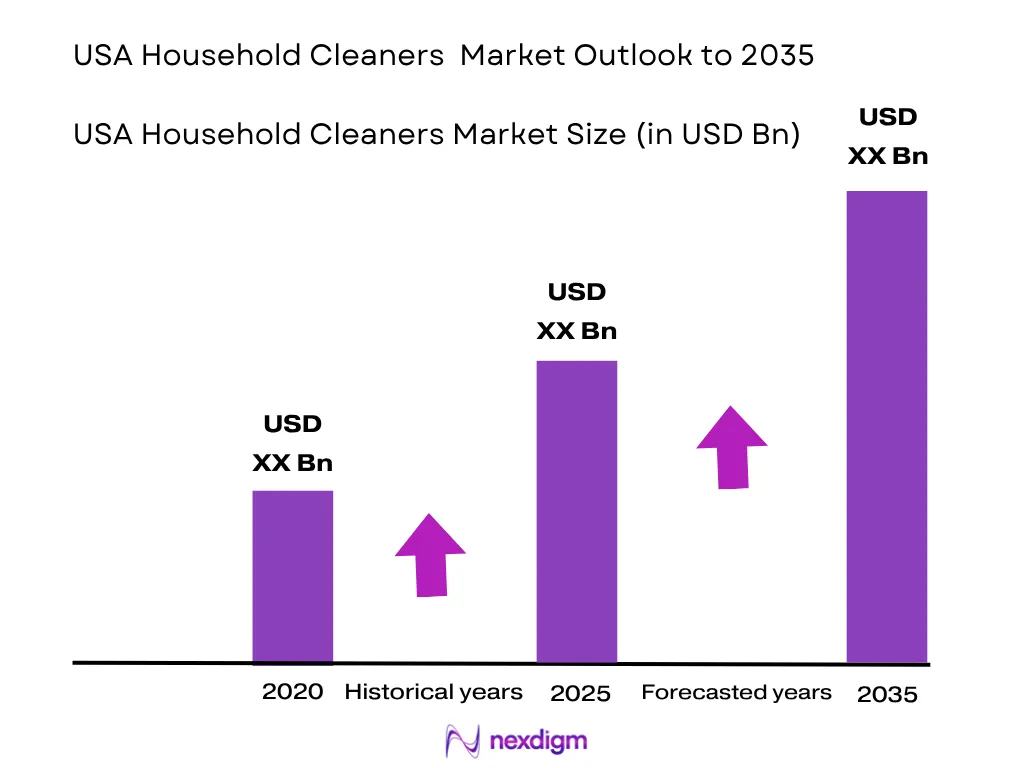
The USA Household Cleaners Market is valued at USD ~ billion, based on Nexdigm’s latest historical market revenue assessment for household cleaners, while adjacent natural household cleaners generated USD ~ billion in revenue, indicating clear premiumization within eco-positioned formulations. Growth is driven by recurring household usage, disinfecting routines, kitchen and bathroom cleaning frequency, online replenishment, and demand for ready-to-use sprays, wipes, concentrates, and refill systems. EPA List N also supports disinfectant credibility by identifying products expected to kill SARS-CoV-2 when used as directed.
The USA Household Cleaners Market is concentrated around large urban and suburban demand clusters such as New York, Los Angeles, Chicago, Houston, Phoenix, Dallas-Fort Worth, Atlanta, Miami, and Seattle because these locations combine dense housing, high retail coverage, large apartment stocks, premium grocery chains, club stores, e-commerce penetration, and stronger adoption of disinfecting, fragrance-free, natural, and refillable cleaners. New York city has 8,478,072 residents, Los Angeles 3,878,704, Chicago 2,721,308, Houston 2,390,125, and Phoenix 1,673,164, creating high-frequency replenishment markets.
Market Segmentation
By Product Type
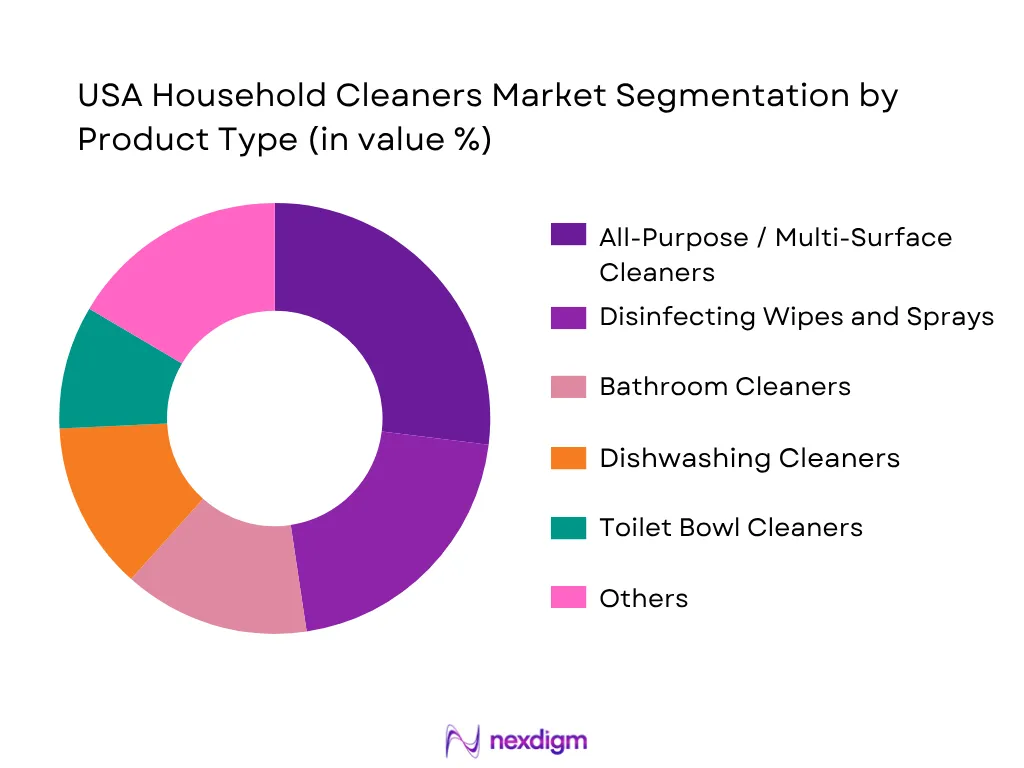
USA Household Cleaners Market is segmented by product type into all-purpose cleaners, bathroom cleaners, toilet bowl cleaners, glass cleaners, floor cleaners, kitchen cleaners, dishwashing cleaners, disinfecting wipes and sprays, bleach cleaners, and specialty cleaners. All-purpose and multi-surface cleaners dominate the market because they serve the widest range of household cleaning occasions, including countertops, tables, appliances, sinks, hard floors, and general touchpoints. The segment benefits from broad mass-retail shelf space, high brand recognition, frequent promotional activity, and consumer preference for products that reduce the need for multiple cleaners. Disinfecting wipes and sprays are also structurally important because EPA-registered claims, fast contact times, and post-pandemic hygiene habits have made them routine household stock-up items. Speciality cleaners remain fragmented but valuable, particularly for drains, stainless steel, hardwood, pet messes, and limescale.
By Distribution Channel
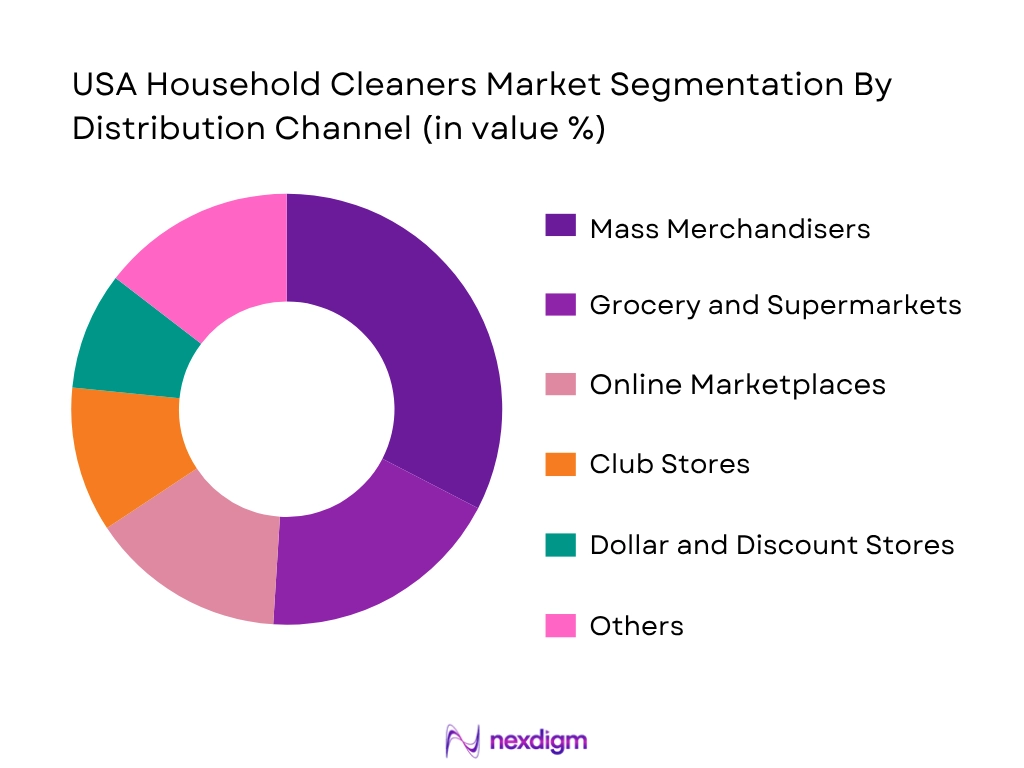
USA Household Cleaners Market is segmented by distribution channel into mass merchandisers, grocery and supermarkets, club stores, dollar and discount stores, drugstores, home improvement stores, online marketplaces, direct-to-consumer subscriptions, and natural/specialty retail. Mass merchandisers dominate because household cleaners are replenishment-led, price-sensitive, and frequently purchased with groceries, paper products, laundry care, and personal care. Walmart, Target, and similar chains offer broad SKU depth across national brands, private label, economy packs, disinfecting wipes, refill bottles, and promotional bundles. Grocery remains relevant for routine replenishment, while club stores capture bulk packs and high-volume households. Online marketplaces are growing through subscribe-and-save, ratings, multi-packs, and heavy product assortments, but many consumers still prefer offline purchasing because cleaners are bulky, urgent, and promotion-driven.
Competitive Landscape
The USA Household Cleaners Market is led by large CPG companies with strong household penetration, extensive retail distribution, deep brand portfolios, and strong innovation pipelines. P&G, Clorox, SC Johnson, Reckitt, and Church & Dwight compete across disinfectants, wipes, sprays, dish care, bathroom cleaners, floor care, and specialty cleaners. The market is competitive but not purely fragmented; national brands control consumer trust and shelf visibility, while private-label and eco-native challengers pressure price, packaging, and sustainability claims. EPA-registered disinfectants and verified claims remain important differentiators.
| Company | Establishment Year | Headquarters | Key Household Cleaner Brands | Core Product Strength | Active Ingredient / Formulation Focus | Channel Strength | Sustainability / Refill Positioning | Competitive Edge |
| Procter & Gamble | 1837 | Cincinnati, Ohio | ~ | ~ | ~ | ~ | ~ | ~ |
| The Clorox Company | 1913 | Oakland, California | ~ | ~ | ~ | ~ | ~ | ~ |
| SC Johnson | 1886 | Racine, Wisconsin | ~ | ~ | ~ | ~ | ~ | ~ |
| Reckitt | 1999 | Slough, United Kingdom | ~ | ~ | ~ | ~ | ~ | ~ |
| Church & Dwight | 1846 | Ewing, New Jersey | ~ | ~ | ~ | ~ | ~ | ~ |
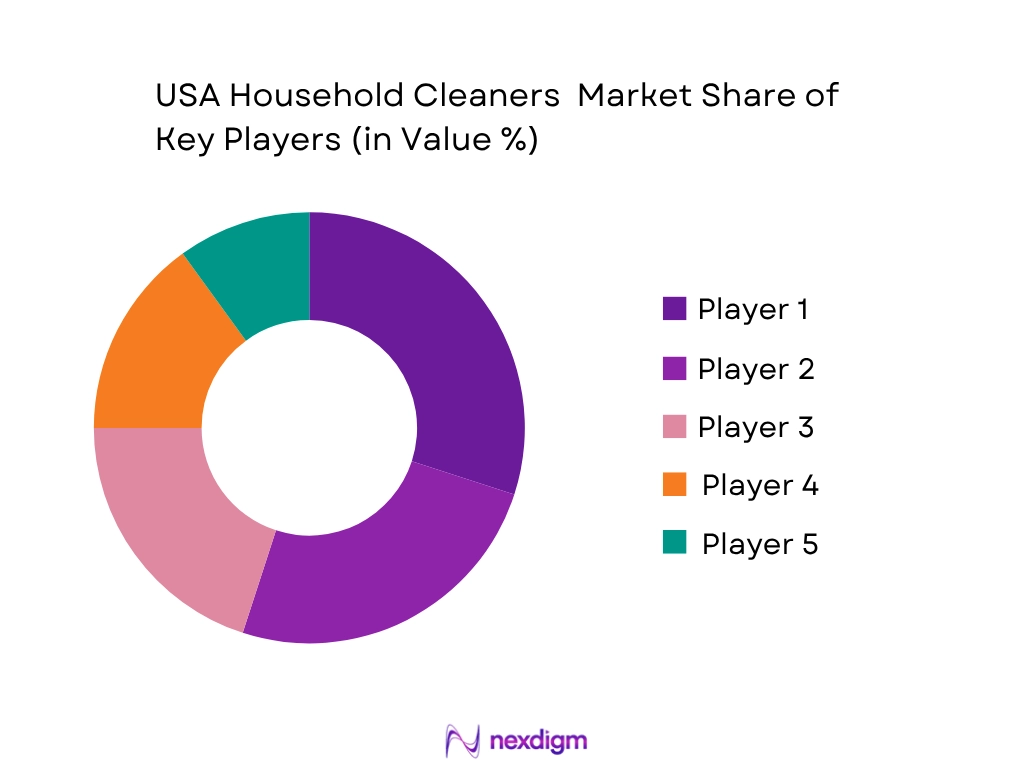
USA Household Cleaners Market Analysis
Growth Drivers
Higher Hygiene Awareness
Higher hygiene awareness is strengthening the USA Household Cleaners Market because households continue to associate surface cleaning with protection against respiratory and gastrointestinal illness. The CDC states that each year the U.S. records about 2,500 reported norovirus outbreaks, and norovirus is the leading cause of acute gastroenteritis across all age groups, which keeps bathroom, toilet, kitchen, bleach, and disinfectant cleaners relevant in routine household use. CDC respiratory-virus guidance also recommends cleaning frequently touched surfaces, creating continued relevance for sprays, wipes, and surface disinfectants in households with children, seniors, and high-contact living spaces. The demand base is structurally large: the U.S. resident population reached 340,110,988, while the country had 146,770,711 housing units and 1,478,000 building permits, supporting recurrent demand for cleaning products across existing and newly added homes. Daily behavior also supports cleaner consumption: BLS American Time Use Survey data shows Americans spent 2.01 hours per day on household activities, including 0.40 hours on interior cleaning and 0.17 hours on laundry-related activities. Macroeconomic support is also visible in World Bank data, with U.S. household and NPISH final consumption expenditure at USD 19,825,338,000,000, giving households a large spending base for recurring essential home-care categories. For household cleaner companies, this means hygiene-led demand is not limited to one product type; it supports disinfecting sprays, wipes, toilet cleaners, bathroom cleaners, kitchen degreasers, bleach-based products, and multi-surface cleaners used across daily and weekly cleaning occasions. The strongest commercial impact is seen where brands combine EPA-registered efficacy, short contact-time instructions, child-safe storage communication, and surface compatibility for countertops, bathroom fixtures, floors, and appliance surfaces.
Convenience Formats
Convenience formats are driving the USA Household Cleaners Market because consumers increasingly prefer products that reduce preparation time, simplify dosage, and fit fast cleaning occasions. Ready-to-use trigger sprays, disinfecting wipes, dishwasher pods, mop cartridges, refill tablets, and concentrated refills benefit from the same household activity base captured by BLS, where Americans spent 2.01 hours per day on household activities and 0.40 hours per day on interior cleaning. These figures support demand for formats that compress effort during daily cleaning routines. The U.S. housing base also provides scale: Census QuickFacts records 146,770,711 housing units, while FRED’s Census-linked household series records 132,216,000 households in 2024 and 134,790,000 households in 2025, increasing the number of addresses where household cleaner replenishment occurs. Convenience is also supported by digital buying behavior. U.S. Census Bureau e-commerce data shows retail e-commerce sales reached USD 308.9 billion on a seasonally adjusted basis in the fourth quarter of 2024 and USD 352.9 billion on an unadjusted basis, giving bulky home-care categories better access to multipacks, subscribe-and-save replenishment, and online product discovery. Macroeconomic conditions reinforce this channel shift: World Bank data places U.S. GDP at USD 28,750,956,130,000 and household final consumption expenditure at USD 19,825,338,000,000, indicating a high-consumption economy where recurrent household products can scale through mass retail and online fulfillment. In market-specific terms, convenience formats win because they reduce mixing, measuring, dwell-time confusion, and storage complexity. Wipes solve immediate disinfection needs, pods solve dishwashing dosage, sprays solve multi-surface cleaning, and refill tablets reduce storage bulk while preserving the reusable-bottle proposition.
Market Challenges
Chemical Safety Perception
Chemical safety perception is a material challenge for the USA Household Cleaners Market because consumers use these products in enclosed kitchens, bathrooms, children’s rooms, pet areas, and food-preparation zones. Safety concerns are reinforced by national poison-exposure infrastructure: America’s Poison Centers reports that 55 U.S. poison centers provided telephone guidance for nearly 2,100,000 human poison exposures, equal to 1 poison exposure every 15 seconds. The National Poison Data System logged 2,418,426 closed encounters, including 2,092,689 human exposures and 34,919 animal exposures, while household cleaning substances ranked among the most common exposure categories for children aged five years or less. This directly affects household cleaner positioning because bleach, quaternary ammonium disinfectants, drain openers, oven cleaners, toilet gels, descalers, and aerosolized bathroom cleaners carry perceived risks related to inhalation, skin contact, accidental ingestion, mixing incompatibility, and child access. EPA List N guidance reinforces the need for correct product use: EPA states that disinfectants on List N are for surfaces, not humans, and children should not use these products. Macroeconomic scale makes this challenge commercially significant: World Bank data shows household final consumption expenditure of USD 19,825,338,000,000, while Census records 129,227,496 households across the 2020–2024 period and 2.53 persons per household, meaning safety perception plays out across a very large household base. For brands, the issue is not only product toxicity; it is label clarity, storage instructions, child-resistant closures where applicable, fragrance sensitivity, asthma/allergy positioning, pet-safe communication, and compatibility with food-contact surfaces. Products that fail to communicate safe use risk losing trust even when their efficacy is strong.
Greenwashing Risk
Greenwashing risk is a challenge in the USA Household Cleaners Market because brands increasingly use environmental language such as plant-based, biodegradable, recyclable, refillable, non-toxic, fragrance-free, low-waste, and safer chemistry to differentiate products. The issue is commercially important because household cleaners are frequently packaged in plastic bottles, trigger sprays, wipe canisters, pouches, cartons, and refill systems, all of which can carry environmental claims. The FTC Green Guides are central to this risk because they are designed to help marketers avoid misleading environmental claims, covering general environmental benefit claims, recyclable claims, recycled-content claims, degradable claims, compostable claims, free-of claims, and non-toxic claims. The FTC Green Guides have been revised in 1992, 1996, 1998, and 2012, and the latest review attracted 7,066 public comments, showing significant regulatory and stakeholder scrutiny. This matters for household cleaners because a vague “eco-friendly” label on a multi-surface spray, wipe canister, dish soap refill, or bathroom cleaner can be interpreted more broadly than the company intends. Macroeconomic and household scale amplify reputational exposure: World Bank data places U.S. GDP at USD 28,750,956,130,000, while household final consumption expenditure is USD 19,825,338,000,000, supporting a large consumer market where claim disputes can affect national retail listings, packaging redesigns, and digital shelf conversion. The FTC also states that green claims must be truthful, and its consumer guidance specifically warns that companies promote products as safe for people or the environment. For market participants, the key challenge is substantiation: claims around refillability, recycled plastic, biodegradability, safer ingredients, and non-toxic use must be specific, evidence-backed, and consistent across label, website, retailer content, and marketplace listings.
Opportunities
Waterless Cleaning
Waterless cleaning creates a future growth opportunity in the USA Household Cleaners Market because tablets, powders, pods, sheets, and concentrated starter kits reduce shipped water, lower storage bulk, and simplify refill behavior for households already accustomed to compact formats. The current household base supports this opportunity: U.S. Census data records 146,770,711 housing units, and the Census-linked FRED household series records 132,216,000 households in 2024 and 134,790,000 households in 2025, giving waterless cleaners a large addressable installed base for reusable bottles, refill packs, and online replenishment. Urban density also supports adoption because compact living spaces favor smaller packs; World Bank data places the U.S. urban population level at 83.52 per 100 people, indicating a heavily urbanized consumer base where storage-saving formats have practical relevance. Product-development infrastructure is also improving. EPA added 29 chemicals to the Safer Chemical Ingredients List in 2024, including colorants, preservatives, processing aids, additives, polymers, solvents, and surfactants, giving formulators more options for safer, high-performing cleaning products. EPA’s Safer Choice product search also covers all-purpose cleaners, dish soaps, floor cleaners, and tub-and-tile cleaners, which are precisely the categories where tablet, powder, and refill systems can be commercialized. Macroeconomic support is visible in World Bank household final consumption expenditure of USD 19,825,338,000,000, indicating a large recurring household-spend base for cleaner innovation. For brands, waterless cleaning is especially attractive in multi-surface sprays, bathroom cleaners, glass cleaners, hand dish soap, dishwasher additives, and floor cleaners. The opportunity is strongest when brands offer durable bottles, clear dilution instructions, strong fragrance control, credible safer-chemistry substantiation, and refills that fit mass retail, DTC subscriptions, and online marketplace multipacks.
Concentrated Refills
Concentrated refills represent a future growth opportunity in the USA Household Cleaners Market because they align with three active market realities: high household count, e-commerce replenishment, and regulatory scrutiny around environmental claims. U.S. Census data shows 146,770,711 housing units, while FRED records 134,790,000 households in 2025, expanding the refillable-cleaner address base. The cleaning behavior case is also strong: BLS records 2.01 hours per day spent on household activities, 0.40 hours on interior cleaning, and 0.67 hours on food preparation and cleanup, supporting demand for reusable-bottle refills across kitchens, bathrooms, floors, and general surfaces. E-commerce is an important enabler because concentrated refills are lightweight, compact, and subscription-compatible; U.S. Census Bureau data shows retail e-commerce sales of USD 308.9 billion on a seasonally adjusted basis in the fourth quarter of 2024 and USD 1,233.7 billion for 2025. This digital infrastructure gives refill brands shelf space beyond physical stores and allows brands to sell starter kits, refill bundles, and multi-scent packs. EPA’s Safer Choice product search includes all-purpose cleaners, dish soaps, floor cleaners, laundry products, and tub-and-tile cleaners, while the agency’s safer-chemistry program added 29 chemicals to the Safer Chemical Ingredients List in 2024, creating a stronger formulation base for concentrated products. World Bank data supports the macro demand base through household final consumption expenditure of USD 19,825,338,000,000. The commercial opportunity is strongest where refills clearly show use instructions, bottle compatibility, surface compatibility, ingredient disclosure, and verified environmental claims, because FTC scrutiny makes vague “green” messaging risky.
Future Outlook
The USA Household Cleaners Market is forecast to expand at a 5.2% CAGR for the long-range forecast period, supported by recurring cleaning needs, higher household hygiene expectations, product premiumization, and channel expansion. Forecast momentum will be strongest in disinfecting formats, natural household cleaners, refill systems, and specialized surface-care products. Natural household cleaners are expected to outpace conventional cleaners, with the U.S. natural household cleaner category projected to grow at 11.8% CAGR in the available outlook period. Future growth will be shaped by five structural forces: premium fragrance systems, validated disinfection claims, low-waste packaging, surface-specific cleaning, and digital shelf conversion. Brands with credible claim substantiation will outperform generic “green” products because regulators and consumers are scrutinizing biodegradable, non-toxic, recyclable, and plant-based claims. The FTC Green Guides and EPA Safer Choice ecosystem will remain important for environmental and ingredient-related positioning.
Major Players
- Procter & Gamble
- The Clorox Company
- SC Johnson
- Reckitt
- Church & Dwight
- Colgate-Palmolive
- Unilever
- Seventh Generation
- Grove Collaborative
- Blueland
- Bona
- Libman Company
- Armaly Brands
- Jelmar
- Henkel
Key Target Audience
- Household cleaner manufacturers
- Home care and hygiene product brand owners
- Retail chains and mass merchandisers
- E-commerce marketplaces and online grocery platforms
- Private-label manufacturers and contract formulators
- Chemical ingredient, fragrance, trigger-sprayer, and packaging suppliers
- Investments and venture capitalist firms
- Government and regulatory bodies (U.S. Environmental Protection Agency, Federal Trade Commission, Consumer Product Safety Commission, California Air Resources Board)
Research Methodology
Step 1: Identification of Key Variables
The initial phase involves constructing an ecosystem map for the USA Household Cleaners Market, covering brand owners, retailers, private-label suppliers, ingredient companies, packaging providers, e-commerce platforms, and regulatory authorities. Key variables include product format, active ingredient, household penetration, SKU velocity, retail channel, claims, pricing, and pack architecture.
Step 2: Market Analysis and Construction
Historical market revenue is compiled through published market databases, company disclosures, retail category scans, e-commerce assortment analysis, and product-level price benchmarking. The market build-up evaluates cleaner type, channel presence, unit pricing, promotional intensity, refill adoption, disinfectant registration, and natural-cleaner penetration to construct category-level revenue estimates.
Step 3: Hypothesis Validation and Expert Consultation
Market hypotheses are validated through structured discussions with category managers, home-care manufacturers, distributors, packaging suppliers, formulators, and retail buyers. These consultations test assumptions on cleaning frequency, private-label pressure, price per ounce, product substitution, surface-specific demand, and the commercial impact of EPA-registered disinfectant claims.
Step 4: Research Synthesis and Final Output
The final stage triangulates top-down market sizing with bottom-up SKU and company-level assessment. Competitive benchmarking, segmentation modeling, regulatory review, and future-growth analysis are synthesized to produce a validated report covering market size, CAGR, segmentation, competitive landscape, key audiences, and strategic outlook.

- Executive Summary
- Research Methodology (Market definitions and assumptions, household cleaner taxonomy, SKU-level price normalization, retail scanner triangulation, e-commerce assortment mapping, top-down expenditure approach, bottom-up brand/SKU revenue build-up, primary interviews with retailers/distributors/brand managers, EPA-registered disinfectant mapping, limitations and future conclusions)

- Definition and Scope
- Market Genesis and Evolution
- Timeline of Major Household Cleaner Brands
- Business Cycle and Replacement Cycle
- Household Cleaning Occasion Mapping
- Supply Chain and Value Chain Analysis
- Manufacturing and Co-Packing Ecosystem
- Retail Shelf Architecture and Planogram Logic
- Consumer Cleaning Behavior and Usage Frequency
- Role of Hygiene, Convenience, Scent, Safety, and Sustainability

- Growth Drivers (Higher hygiene awareness, convenience formats, dual-income households, pet ownership, premium scents, e-commerce replenishment, sustainable cleaning adoption)
- Market Challenges (Chemical safety perception, greenwashing risk, private-label undercutting, EPA compliance, raw material volatility, retailer shelf competition)
- Opportunities (Waterless cleaning, concentrated refills, pet-safe positioning, fragrance-free products, robotic-cleaning compatible liquids, subscription cleaning kits)
- Trends (Scent-led loyalty, disinfectant normalization, low-waste packaging, concentrated formats, private label premiumization, TikTok cleaning routines, cleanfluencer-led discovery)
- Government Regulation and Compliance (EPA FIFRA registration, disinfectant label compliance, FTC Green Guides, ingredient disclosure, VOC limits, packaging and recycling claims)
- Consumer Decision Journey (Need recognition, scent preference, efficacy trust, price per use, claim validation, repeat purchase, household stock-up)
- Household Cleaner Value Chain (Chemical suppliers, fragrance houses, packaging suppliers, formulators, co-packers, brand owners, retailers, e-commerce platforms, waste/recycling ecosystem)
- Pricing and Promotion Analysis (Everyday price, temporary price reductions, coupons, bundle packs, club packs, subscribe-and-save, price per ounce, price per wipe, price per dishwasher load)
- SWOT Analysis (Brand equity, shelf power, efficacy claims, regulatory exposure, sustainability innovation, private-label threat)
- Porter’s Five Forces (Supplier concentration, retailer bargaining power, private-label threat, substitutes, formulation differentiation, entry barriers)
- Stakeholder Ecosystem (CPG manufacturers, retailers, EPA, FTC, ACI, suppliers, distributors, e-commerce platforms, households, waste-management players)
- Competition Ecosystem (National brands, challenger eco brands, private labels, DTC refill brands, specialty surface-care brands)

- By Value (2020-2025)
- By Volume (2020-2025)
- By Average Selling Price (2020-2025)
- By Price per Ounce / Price per Use (2020-2025)
- By Household Penetration (2020-2025)
- By Purchase Frequency (2020-2025)
- By Unit Sales (2020-2025)
- By Retail and E-Commerce Sell-Out Value (2020-2025)

- By Product Type (In Value%)
All-Purpose / Multi-Surface Cleaners
Bathroom Cleaners
Toilet Bowl Cleaners
Glass and Window Cleaners
Floor Cleaners
Kitchen Cleaners and Degreasers
Dishwashing Cleaners
Disinfecting Wipes and Sprays
Bleach and Chlorine-Based Cleaners
Specialty Household Cleaners - By Application Area (In Value%)
Kitchen Surfaces
Bathroom Surfaces
Floors
Glass and Mirrors
Drains and Plumbing Fixtures
Pet and Odor-Prone Areas - By Formulation / Active Ingredient (In Value%)
Quaternary Ammonium-Based Cleaners
Bleach / Sodium Hypochlorite-Based Cleaners
Hydrogen Peroxide-Based Cleaners
Acid-Based Cleaners
Surfactant-Based Cleaners
Enzyme-Based Cleaners
Plant-Derived / Biobased Formulations - By Product Format (In Value%)
Ready-to-Use Sprays
Wipes
Concentrates and Dilutables
Refill Tablets and Powders
Pods and Unit-Dose Formats
Gels, Foams, Creams, and Pastes - By Distribution Channel (In Value%)
Mass Merchandisers
Grocery and Supermarkets
Club Stores
Dollar and Discount Stores
Drugstores
Home Improvement Stores
Online Marketplaces
Direct-to-Consumer and Subscription - By Price Tier (In Value%)
Economy and Value
Mainstream Branded
Premium Performanc
Natural / Eco Premium
Private Label - By Packaging Type (In Value%)
Trigger Bottles
Wipe Canisters and Soft Packs
Refill Pouches and Refill Bottles
Aerosol Cans
Bulk Jugs and Club Packs
Tablets, Sachets, and Cartons - By Claim Type (In Value%)
Disinfection and Sanitization Claims
Performance Claims
Safety and Sensitivity Claims
Sustainability Claims
Sensory Claims - By Household Type (In Value%)
Families with Children
Pet-Owning Households
Health-Sensitive Households
Premium Urban Households
Value-Oriented Households - By Region (In Value%)
Northeast
Midwest
South
West

- Market Share of Major Players (Value share, volume share, SKU share, retail shelf share, e-commerce share, Product Type, Distribution Channel, by Price Tier, category leadership by cleaner type)
- Cross Comparison Parameters (Company Overview, Product Portfolio Coverage, Active Ingredient / Formulation Platform, EPA Disinfectant Registration and Kill Claims, SKU Count and Pack Architecture, Price per Ounce / Price per Use, Retail Channel Penetration, E-Commerce Search Visibility, Sustainability Credentials and Refill Portfolio, Scent and Fragrance-Free Range, Recent Launches, Brand Positioning, Manufacturing / Co-Packing Footprint, Distribution Strength, Promotional Strategy, Strength, Weakness, Revenue Contribution from Home Care, Unique Value Offering)
- SWOT Analysis of Major Players (Brand trust, category depth, innovation speed, regulatory exposure, private-label vulnerability, sustainability credibility)
- Pricing Analysis Basis Major SKUs (Trigger sprays, disinfecting wipes, toilet bowl cleaners, glass cleaners, dish liquids, dishwasher pods, floor cleaners, refill packs)
- Product Claim Benchmarking (Disinfects, sanitizes, kills 99.9%, grease-cutting, streak-free, plant-based, fragrance-free, biodegradable, septic-safe, pet-safe positioning)
- Retail Shelf and Digital Shelf Benchmarking (Shelf facings, pack sizes, ratings, review count, search rank, subscription availability, bundle strategy)
- Detailed Profiles of Major Companies
Procter & Gambl
The Clorox Company
SC Johnso
Reckitt
Henkel
Church & Dwight
Colgate-Palmolive
Unilever
Seventh Generation
Grove Collaborative
Blueland
Bona
Libman Company
Armaly Brands
Jelmar

- Market Demand and Utilization (Cleaning frequency, surface count per household, wipe/spray usage, dishwashing load frequency)
- Purchasing Power and Budget Allocation (Monthly cleaning spend, price per use, stock-up behavior, promotional sensitivity)
- Consumer Needs, Desires, and Pain Points (Fast action, germ kill, scent, no residue, pet/child safety, surface compatibility, low plastic waste)
- Decision-Making Process (Brand trust, claim recognition, shelf visibility, online reviews, price-pack equation, certifications)
- Customer Cohort Analysis (Eco-first buyers, disinfectant-first buyers, fragrance-first buyers, value-first buyers, pet households, premium surface-care buyers)
- Retail Shopper Behavior (Basket attachment, aisle navigation, end-cap response, coupon use, bulk buying, online replenishment)
- B2C vs Small-Business Crossover Demand (Home offices, short-term rentals, home daycare, residential cleaning services, professional-grade household products)

- By Value (2026-2035)
- By Volume (2026-2035)
- By Average Selling Price (2026-2035)
- By Price per Use (2026-2035)
- By Household Penetration (2026-2035)
- By Channel Sales Mix (2026-2035)
- By Sustainable / Refillable Cleaner Revenue (2026-2035)
- By Disinfecting Product Revenue (2026-2035)


 Request a Sample
 Ask for Customization
 Get a Quote
 Enquire Now