
 Download PDF
Market Overview
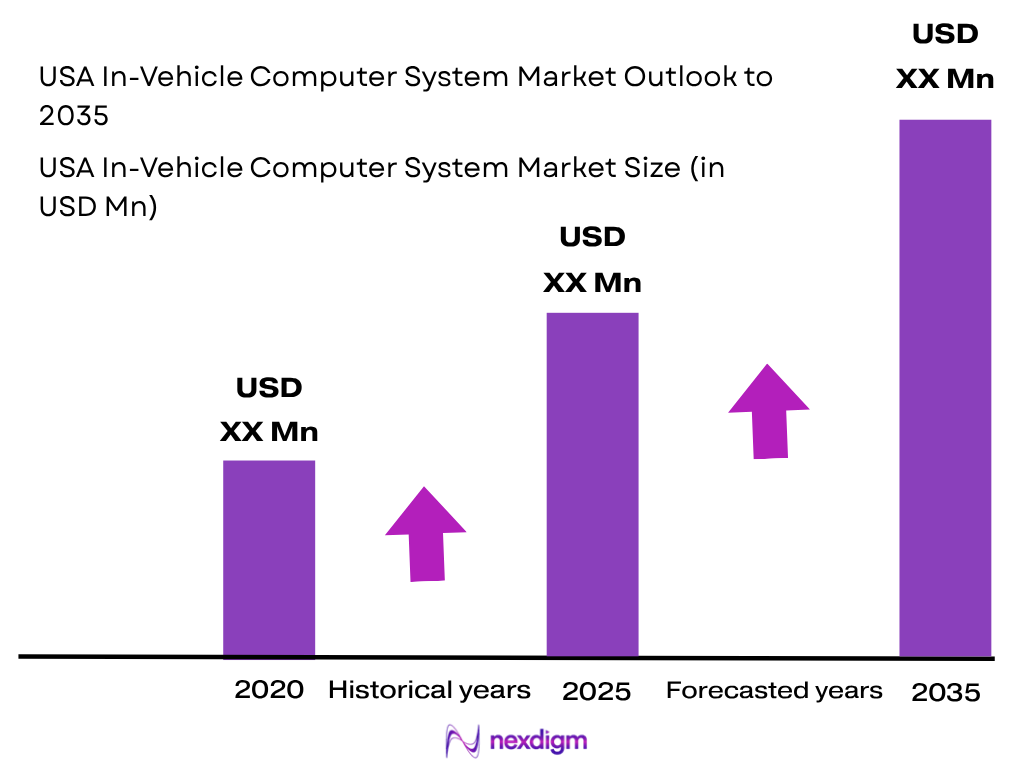
The USA In-Vehicle Computer System Market is valued at ~USD XX million, based on historical demand analysis, and is projected to expand at ~XX% CAGR during 2026–2035. Demand is supported by transportation, warehousing, public-safety, utility, and fleet digitalization. Transportation and warehousing employment added 136,000 positions in the latest period, after remaining broadly unchanged in the preceding period, while the sector supported approximately 6.6 million employees, reinforcing the addressable base for rugged and connected vehicle computing.
Los Angeles, Dallas-Fort Worth, Chicago, Houston, and major Northeast logistics corridors are important deployment centers because they combine freight transportation, warehousing, public-safety fleets, utilities, ports, and distribution operations. Los Angeles handled 8,629,681 container TEUs in the preceding period and 10,297,352 TEUs in the latest period, creating intensive demand for yard, port, forklift, and fleet computing. Dallas-Fort Worth additionally employed 408,710 transportation and material-moving workers, supporting large-scale mobile workforce technology deployment.
Market Segmentation
By Product Type
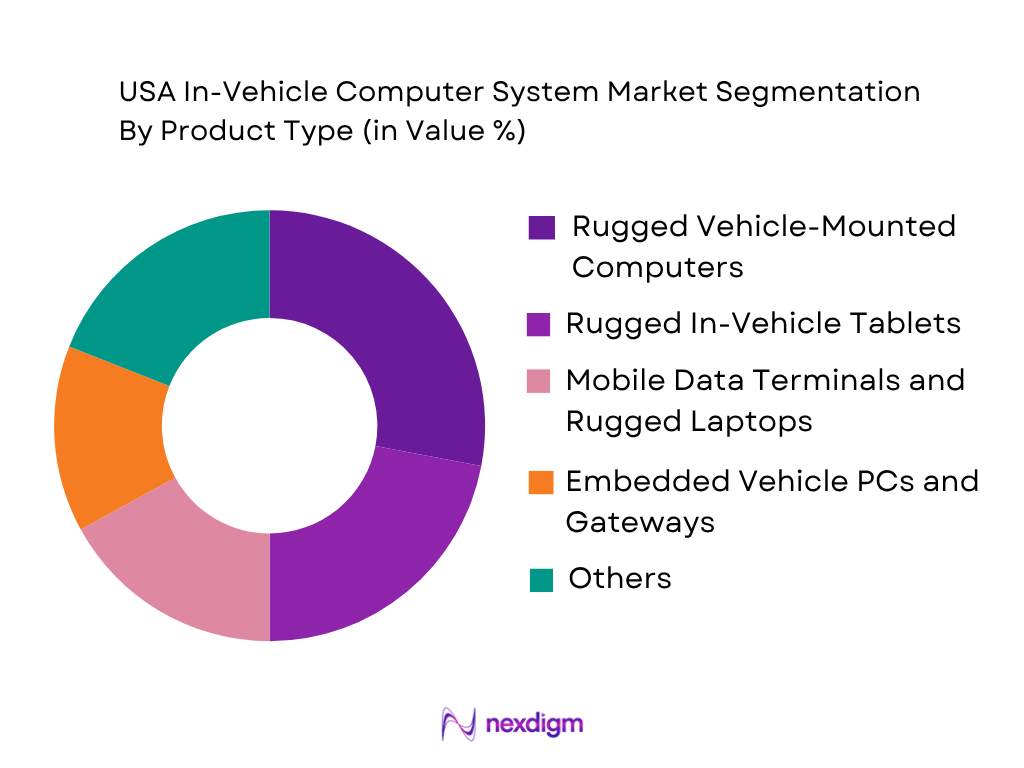
The USA In-Vehicle Computer System Market is segmented into rugged vehicle-mounted computers, rugged tablets, mobile data terminals, embedded PCs, telematics computers, AI edge systems, and centralized automotive compute platforms. Rugged vehicle-mounted computers hold the dominant modeled market share because they serve a broad installed base across warehousing, distribution centers, ports, manufacturing facilities, forklifts, freight yards, and material-handling fleets. Their fixed mounting, vibration resistance, environmental protection, vehicle power integration, and persistent wireless connectivity make them suitable where consumer-grade devices cannot maintain operational reliability. Zebra specifically positions vehicle-mounted computers for forklifts, tuggers, warehouses, yards, manufacturing, and distribution, while Honeywell’s Thor platform targets distribution centers, manufacturing plants, freight operations, and cold-storage applications. Rugged tablets and laptops remain particularly important in police, fire, EMS, utility, and field-service vehicles because detachable computing allows personnel to move between the vehicle and field environment. Embedded and AI systems are strategically important as fleets adopt video analytics, telematics gateways, ADAS processing, sensor fusion, and increasingly centralized compute architectures.
By End-User Industry
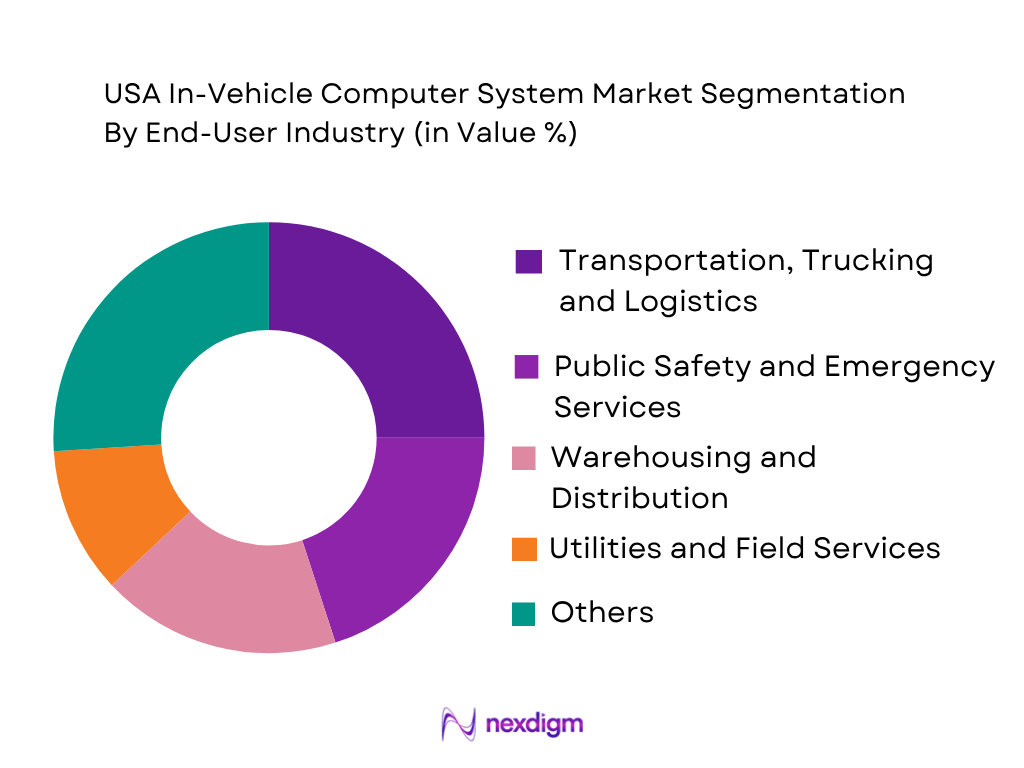
The USA In-Vehicle Computer System Market is segmented into transportation and logistics, public safety, warehousing, utilities, manufacturing, construction and ports, transit, government fleets, and automotive OEM applications. Transportation, trucking, and logistics represent the dominant modeled segment because commercial operators require continuous access to dispatch applications, navigation, telematics, electronic workflow systems, fleet diagnostics, cargo information, route optimization, and driver communications. The wider U.S. transportation and warehousing industry supported approximately 6.6 million workers, with warehousing and storage and truck transportation representing the two largest employment categories. Vehicle computers extend these enterprise applications directly into trucks, delivery fleets, forklifts, yard tractors, and other mobile assets. Warehousing is closely connected to this segment because vehicle-mounted computers allow forklift operators to interact with warehouse-management systems, inventory databases, barcode applications, receiving processes, and picking workflows without leaving their vehicles. Zebra identifies receiving, cross-docking, picking, work-in-progress, and yard management as primary vehicle-computer applications, illustrating the breadth of logistics-related use cases.
Competitive Landscape
The USA In-Vehicle Computer System Market includes rugged-computing specialists, enterprise mobility vendors, industrial computing companies, and automotive edge-compute technology providers. Competition is increasingly based on much more than processor performance. Vendors differentiate through ruggedization, mounting and docking ecosystems, operating-system longevity, 5G connectivity, vehicle power management, CAN and peripheral integration, AI processing, cybersecurity, and centralized fleet-device management. The market is consequently evolving from standalone vehicle hardware toward connected computing platforms integrated with enterprise and cloud environments.
| Company | Establishment Year | Headquarters | Primary In-Vehicle Computing Portfolio | Ruggedization Capability | 5G / Mobile Connectivity | Vehicle Integration Capability | Edge AI Capability | Primary Market Focus |
| Panasonic Connect | 1918* | Tokyo, Japan | ~ | ~ | ~ | ~ | ~ | ~ |
| Getac Technology Corporation | 1989 | New Taipei City, Taiwan | ~ | ~ | ~ | ~ | ~ | ~ |
| Zebra Technologies | 1969 | Lincolnshire, Illinois, USA | ~ | ~ | ~ | ~ | ~ | ~ |
| Honeywell | 1906 | Charlotte, North Carolina, USA | ~ | ~ | ~ | ~ | ~ | ~ |
| Advantech | 1983 | Taipei, Taiwan | ~ | ~ | ~ | ~ | ~ | ~ |
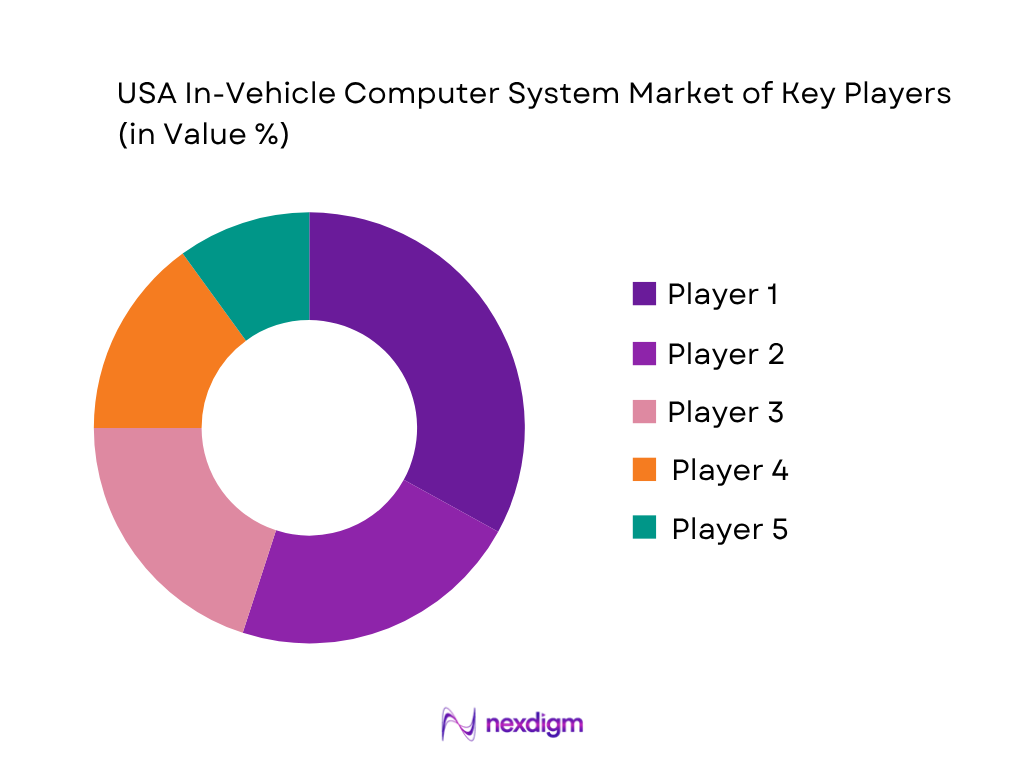
USA In-Vehicle Computer System Market Analysis
Growth Drivers
Public Safety Fleet Digitalization
The digital transformation of public safety fleets is accelerating demand for advanced in-vehicle computer systems capable of supporting real-time communication, computer-aided dispatch, video analytics, and mobile command operations. Police, emergency medical services, and fire departments are increasingly replacing conventional mobile terminals with rugged vehicle computers that integrate navigation, incident management, cameras, and secure communication networks. The expansion of connected public safety infrastructure is supported by the growing investment in nationwide broadband communication systems. The First Responder Network Authority (FirstNet) ecosystem continues expanding, with more than 27,000 public safety agencies and organizations actively using the network, increasing demand for reliable onboard computing platforms. The U.S. Census Bureau reported that the country had more than 330 million residents, creating increasing requirements for efficient emergency response coverage and digitally enabled public services. Government agencies are adopting vehicle-mounted computing systems to improve response coordination, reduce manual reporting workload, and enable access to cloud-based applications from field locations. The integration of AI-powered cameras, automated license plate recognition, and predictive analytics is further increasing processing requirements inside emergency vehicles. These developments are strengthening demand for rugged computers designed for continuous operation under harsh conditions.
Expansion of Commercial Fleet Telematics
The expansion of commercial fleet telematics is a major driver for USA in-vehicle computer system adoption as logistics operators, transportation companies, and service fleets increasingly depend on real-time vehicle monitoring and operational analytics. Commercial vehicles require onboard computing platforms to process GPS tracking, driver behavior information, maintenance diagnostics, fuel optimization data, and connected fleet applications. The U.S. Department of Transportation reported that the United States transportation sector includes more than 280 million registered vehicles, creating a large installed base requiring digital management solutions. The Federal Motor Carrier Safety Administration continues regulating millions of commercial drivers and carriers, increasing demand for technology solutions that improve compliance, safety monitoring, and operational visibility. Growth in e-commerce distribution networks has further increased the requirement for connected fleet management systems across delivery vehicles, warehouse transportation fleets, and last-mile operations. Modern fleet computers are increasingly incorporating edge processing capabilities to analyze vehicle data locally and reduce dependency on cloud communication. The adoption of 5G connectivity, advanced telematics platforms, and AI-based driver monitoring solutions is increasing the computing requirements of commercial vehicles. These trends are encouraging fleet operators to upgrade from basic tracking devices toward integrated in-vehicle computing platforms.
Market Challenges
High Rugged Hardware Acquisition Cost
High acquisition costs associated with rugged in-vehicle computers remain a significant challenge for adoption among small and medium fleet operators. Unlike consumer-grade computing devices, vehicle computers require specialized designs capable of operating under vibration, extreme temperature variations, dust exposure, and continuous usage conditions. These systems often require industrial-grade processors, reinforced enclosures, extended lifecycle components, and cybersecurity features, increasing complexity compared with standard computing hardware. The U.S. Bureau of Transportation Statistics reported that the transportation sector includes millions of commercial vehicles operated by businesses of different sizes, creating cost sensitivity among smaller fleet owners. Many operators face difficulties balancing investments in advanced computing systems with other fleet modernization requirements such as vehicle replacement, maintenance, and compliance upgrades. Additionally, installation costs increase because vehicle computers often require integration with cameras, sensors, communication modules, and existing fleet management platforms. The need for specialized mounting systems, power management solutions, and technical installation services adds further complexity. As vehicle computing requirements expand toward AI processing and connected applications, hardware specifications continue becoming more advanced, creating additional cost pressure. These financial barriers can slow adoption among price-sensitive commercial fleet segments despite long-term operational benefits.
Legacy CAD and Fleet Software Integration
Integration challenges between modern in-vehicle computer systems and existing computer-aided dispatch (CAD), fleet management, and enterprise software platforms represent a major limitation for organizations upgrading their vehicle technology infrastructure. Many public safety agencies and commercial fleet operators continue operating legacy software environments that were not designed for modern connected vehicle architectures. The U.S. Department of Homeland Security and public safety organizations have emphasized interoperability requirements because emergency response systems rely on multiple communication and operational platforms. Vehicle computers must integrate with dispatch systems, mapping applications, video platforms, databases, and communication networks while maintaining reliability and cybersecurity. Compatibility issues can increase deployment timelines and require additional software customization. The growing complexity of connected vehicles is also increasing cybersecurity requirements, as onboard computers process sensitive operational information and communicate with external networks. The National Institute of Standards and Technology has highlighted the importance of cybersecurity frameworks for connected systems due to increasing digital infrastructure exposure. Fleet operators must therefore invest not only in hardware but also in software modernization, cybersecurity protection, and employee training. These integration challenges create barriers for organizations seeking rapid deployment of advanced in-vehicle computing solutions.
Market Opportunities
AI-Enabled In-Vehicle Edge Computers
AI-enabled in-vehicle edge computers represent a significant opportunity as vehicles increasingly require localized data processing for safety, automation, and operational efficiency applications. Edge computing allows vehicles to analyze sensor data, video feeds, and operational information directly inside the vehicle rather than relying entirely on cloud systems. The U.S. Department of Transportation continues supporting connected vehicle research initiatives focused on improving transportation safety through intelligent systems and vehicle communication technologies. Increasing deployment of cameras, LiDAR systems, driver monitoring technologies, and AI-based analytics is creating demand for higher-performance onboard processors. Commercial fleets are adopting AI computing platforms for applications including predictive maintenance, route optimization, driver behavior analysis, and automated inspection systems. The growth of artificial intelligence infrastructure in the United States is supported by increasing investment in semiconductor manufacturing and advanced computing capabilities through national technology initiatives. AI-enabled vehicle computers can support multiple applications simultaneously, including fleet video analytics, autonomous navigation assistance, and real-time decision-making. This creates opportunities for suppliers developing automotive-grade processors, rugged edge computers, and integrated software platforms. As vehicles become increasingly software-defined, AI processing capability is becoming a critical requirement for future transportation systems.
Secure Zero-Trust Vehicle Computing
Secure zero-trust vehicle computing is emerging as an important opportunity due to increasing cybersecurity requirements across connected transportation systems. Modern in-vehicle computers manage sensitive data including vehicle location, operational information, passenger details, and communication networks, creating greater cybersecurity exposure. The Cybersecurity and Infrastructure Security Agency (CISA) has emphasized the importance of zero-trust security approaches for protecting connected digital infrastructure. Transportation operators are increasingly seeking computing platforms with secure authentication, encrypted communication, remote monitoring, and threat detection capabilities. Commercial fleets, public safety agencies, and government transportation organizations require secure vehicle systems because connected vehicles increasingly exchange information with cloud platforms, mobile devices, and external networks. The expansion of 5G-connected vehicles and vehicle-to-everything communication increases the importance of cybersecurity-ready computing architectures. Zero-trust vehicle computers can provide continuous verification of users, devices, and applications while limiting unauthorized access. This creates opportunities for technology providers offering secure hardware modules, cybersecurity software integration, and protected edge computing platforms. As connected mobility ecosystems expand, cybersecurity capability will become a key differentiation factor for in-vehicle computer system suppliers.
Future Outlook
The USA In-Vehicle Computer System Market is expected to transition from isolated mobile data terminals toward connected, software-managed edge-computing platforms. Public-safety digitization, commercial-fleet automation, logistics modernization, V2X infrastructure, AI-enabled video processing, and 5G connectivity will broaden the role of computing inside commercial and specialized vehicles. Traditional rugged laptops, tablets, and vehicle-mount terminals will remain important where workers need direct interaction with CAD, WMS, GIS, dispatch, fleet, or enterprise applications. Their role will increasingly be complemented by embedded computers capable of handling telematics, sensor processing, video feeds, diagnostics, and local AI inference.
A major technology opportunity is emerging around V2X edge computing. The U.S. Department of Transportation is actively pursuing national deployment of secure, interoperable V2X communications using the dedicated 5.895–5.925 GHz spectrum. In its V2X Accelerator initiative, USDOT awarded approximately USD 60 million to deployment programs in Arizona, Texas, and Utah to test and demonstrate advanced interoperable V2X networks. Such deployments require vehicle-side processors, communication units, secure gateways, roadside computing, positioning hardware, and software capable of handling low-latency data exchange.
Major Players
- Panasonic Connect
- Getac Technology Corporation
- Zebra Technologies Corporation
- Brady Corporation / Honeywell Productivity Solutions
- Datalogic S.p.A.
- Advantech Co., Ltd.
- Winmate Inc.
- JLT Mobile Computers
- NEXCOM International Co., Ltd.
- DT Research, Inc.
- Durabook Americas
- MobileDemand
- Dell Technologies
- NVIDIA Corporation
- Qualcomm Technologies, Inc.
Key Target Audience
- Rugged In-Vehicle Computer and Mobile Device Manufacturers
- Commercial Fleet and Transportation Operators
- Public Safety and Emergency Response Organizations
- Warehousing, Distribution and Material-Handling Operators
- Automotive OEMs and Connected Vehicle Technology Providers
- Fleet Telematics, Vehicle Integration and Upfitting Companies
- Investments and Venture Capitalist Firms
- Government and Regulatory Bodies (U.S. Department of Transportation, Federal Motor Carrier Safety Administration, Federal Communications Commission, National Institute of Standards and Technology)
Research Methodology
Step 1: Identification of Key Variables
The initial phase establishes an ecosystem map for the USA In-Vehicle Computer System Market covering rugged-computing manufacturers, semiconductor vendors, fleet operators, vehicle OEMs, system integrators, public-safety agencies, logistics businesses, and industrial users. Key variables include installed vehicle base, device penetration, hardware type, operating system, connectivity, replacement cycles, ruggedization level, end-user application, and vehicle integration requirements.
Step 2: Market Analysis and Construction
Historical demand is assessed through top-down analysis of fleet populations, transportation activity, warehousing operations, public-safety deployments, connected-vehicle programs, and enterprise mobility adoption. Bottom-up analysis estimates annual systems deployed across commercial vehicles, emergency fleets, forklifts, utilities, industrial vehicles, and automotive embedded applications, incorporating device type, replacement frequency, configuration, and deployment channel.
Step 3: Hypothesis Validation and Expert Consultation
Market hypotheses are validated through computer-assisted telephone interviews with rugged-device vendors, fleet technology managers, system integrators, public-safety technology specialists, warehouse operators, telematics providers, and vehicle upfitters. These discussions evaluate product replacement cycles, procurement requirements, connectivity preferences, operating-system migration, installation considerations, ruggedness requirements, cybersecurity, and the adoption of AI-enabled vehicle computing.
Step 4: Research Synthesis and Final Output
Primary findings are triangulated with government transportation statistics, company product portfolios, regulatory information, public procurement indicators, connected-vehicle deployments, and industry operating data. Bottom-up device estimates are reconciled against top-down fleet and end-user demand. The final analysis integrates market segmentation, competitive positioning, hardware architecture, software requirements, connectivity, V2X adoption, replacement demand, and future edge-computing opportunities.

- Executive Summary
- Research Methodology (Market Definition and Scope, In-Vehicle Computing Architecture Classification, Hardware-Software-Connectivity Ecosystem Mapping, Installed Fleet Assessment, Public Safety Fleet Analysis, Commercial Fleet Assessment, Warehouse and Material-Handling Vehicle Assessment, OEM Embedded Compute Analysis, Demand-Side Interviews, Supply-Side Interviews, Top-Down Market Sizing, Bottom-Up Device Installation Modeling, Replacement Cycle Assessment, ASP Benchmarking, Data Triangulation, Forecasting Framework, Assumptions and Limitations)

- Definition and Scope
- Evolution of In-Vehicle Computing Systems
- Transition from Mobile Data Terminals to Connected Edge Computing
- In-Vehicle Computer Hardware and Software Architecture
- Vehicle Computing Ecosystem
- In-Vehicle Computing Value Chain
- Hardware Component Supply Chain
- Vehicle Integration and Installation Ecosystem
- Embedded Computing and Rugged Mobile Computing Ecosystem
- Public Safety Mobile Data Computing Ecosystem

- Growth Drivers (Public Safety Fleet Digitalization, FirstNet-Compatible Mobile Computing Adoption, Expansion of Commercial Fleet Telematics, Growth of 5G-Connected Vehicle Systems, Rising Edge AI Processing Requirements, Warehouse and Distribution Automation, V2X Infrastructure Deployment, Increasing Mobile Workforce Digitalization)
- Market Challenges (High Rugged Hardware Acquisition Cost, Vehicle Installation Complexity, Legacy CAD and Fleet Software Integration, Automotive Cybersecurity Exposure, Device Lifecycle and Operating System Obsolescence, Power and Thermal Constraints, Network Coverage Variability, Driver Distraction and Human-Machine Interface Risk)
- Market Opportunities (AI-Enabled In-Vehicle Edge Computers, V2X Computing Nodes, Multi-Network Public Safety Computers, Centralized Software-Defined Vehicle Compute, Fleet Video Analytics, Satellite-5G Connectivity Integration, Autonomous Fleet Edge Computing, Secure Zero-Trust Vehicle Computing)
- Market Trends (Transition from Fixed MDTs to Dockable Rugged Devices, Windows-to-Android Migration in Industrial Vehicle Computing, GPU and NPU Acceleration, Fanless Embedded Computing, Multi-Display Vehicle Workstations, OTA Device Management, Vehicle Ethernet Adoption, AI Camera Integration, Domain Consolidation, Cloud-to-Vehicle Computing)
- Government Regulations and Standards (USDOT V2X Deployment Framework, FCC Vehicle Communications Requirements, FMCSA Electronic Logging Requirements, NIST Cybersecurity Framework, FIPS Security Requirements, CJIS Security Requirements, FirstNet Device Certification, Federal Motor Vehicle Safety Considerations)
- SWOT Analysis
- Porter’s Five Forces Analysis
- PESTLE Analysis

- By Market Value (2020-2025)
- By Installed System Base (2020-2025)
- By Annual Unit Shipments (2020-2025)
- By New Installation Demand (2020-2025)
- By Replacement and Upgrade Demand (2020-2025)
- By Hardware Revenue (2020-2025)
- By Software and Device Management Revenue (2020-2025)
- By Vehicle Integration and Support Revenue (2020-2025)

- By Product Type (In Value %)
Fixed-Mount Vehicle Computers
Mobile Data Terminals
Rugged Vehicle-Mounted Tablets
Rugged In-Vehicle Laptops
Embedded Fanless Vehicle PCs
Vehicle Telematics Computers
AI Edge Computing Systems
Centralized Automotive Compute Platforms - In-Vehicle Gateway Computers
- By Installation Architecture (In Value %)
Permanent Fixed-Mount Systems
Docked and Detachable Systems
Dashboard-Mounted Systems
Console-Mounted Systems
Embedded Headless Computing Systems
Trunk-Mounted Computing Systems
Multi-Display Integrated Systems
Centralized Domain Computing Systems - By Computing Architecture (In Value %)
x86 Processor-Based Systems
ARM Processor-Based Systems
Automotive System-on-Chip Platforms
GPU-Accelerated Computing Systems
NPU and AI Accelerator-Based Systems
Hybrid CPU-GPU Computing Systems
Multi-Domain Central Compute Platforms - By Operating System (In Value %)
Windows-Based Systems
Android-Based Systems
Linux-Based Systems
QNX-Based Systems
Real-Time Operating Systems
Proprietary Automotive Operating Systems
Virtualized Multi-OS Platforms - By Connectivity Technology (In Value %)
4G LTE-Enabled Systems
5G-Enabled Systems
FirstNet-Compatible Systems
Wi-Fi Enabled Systems
Bluetooth-Enabled Systems
GNSS/GPS-Integrated Systems
Vehicle Ethernet Systems
CAN / CAN-FD Integrated Systems
V2X-Enabled Systems
Multi-Network Connectivity Systems
Satellite-Connected Vehicle Systems - By Vehicle Type (In Value %)
Police Patrol Vehicles
Fire and Emergency Response Vehicles
Emergency Medical Service Vehicles
Commercial Trucks
Light Commercial Vehicles
Delivery Vans
Utility Service Vehicles
Construction and Mining Vehicles
Forklifts and Material-Handling Vehicles
Transit Buses
Rail and Specialty Transportation Vehicles
Passenger Vehicles with Advanced Embedded Compute
Autonomous and Robotaxi Platforms

- Market Share of Major Players (By Revenue, Unit Shipments, Product Form Factor, End-User Vertical, Public Safety Deployment, Commercial Fleet Deployment)
- Cross Comparison Parameters (Product Portfolio Breadth, Ruggedization and MIL-STD Capability, In-Vehicle Mounting and Docking Ecosystem, 5G and FirstNet Connectivity Capability, Edge AI and GPU Computing Capability, Vehicle I/O and Telematics Integration, Public Safety and Commercial Fleet Installed Base, Device Lifecycle and Remote Management Capability)
- SWOT Analysis of Major Players
- Pricing and Total Cost of Ownership Analysis (Device Acquisition, Docking Hardware, Mounting Equipment, Connectivity Modules, Installation, Software Support, Replacement Cycle)
- Detailed Profiles of Major Companies
Panasonic Connect
Getac Technology Corporation
Zebra Technologies Corporation
Brady Corporation / Honeywell Productivity Solutions
Datalogic S.p.A.
Advantech Co., Ltd.
Winmate Inc.
JLT Mobile Computers
NEXCOM International Co., Ltd.
DT Research, Inc.
Durabook Americas
MobileDemand
Dell Technologies
NVIDIA Corporation
Qualcomm Technologies, Inc.

- Public Safety Vehicle Computing Assessment
- Commercial Truck Fleet Computing Assessment
- Utility and Field-Service Fleet Analysis
- Warehouse and Material-Handling Vehicle Analysis
- Ports and Intermodal Computing Analysis
- Transit and Municipal Fleet Computing Analysis

- By Market Value (2026-2035)
- By Installed System Base (2026-2035)
- By Annual Unit Shipments (2026-2035)
- By New Installation Demand (2026-2035)
- By Replacement and Upgrade Demand (2026-2035)
- By Hardware Revenue (2026-2035)
- By Software and Device Management Revenue (2026-2035)
- By Vehicle Integration and Support Revenue (2026-2035)


 Request a Sample
 Ask for Customization
 Get a Quote
 Enquire Now