

 Download PDF
Market Overview
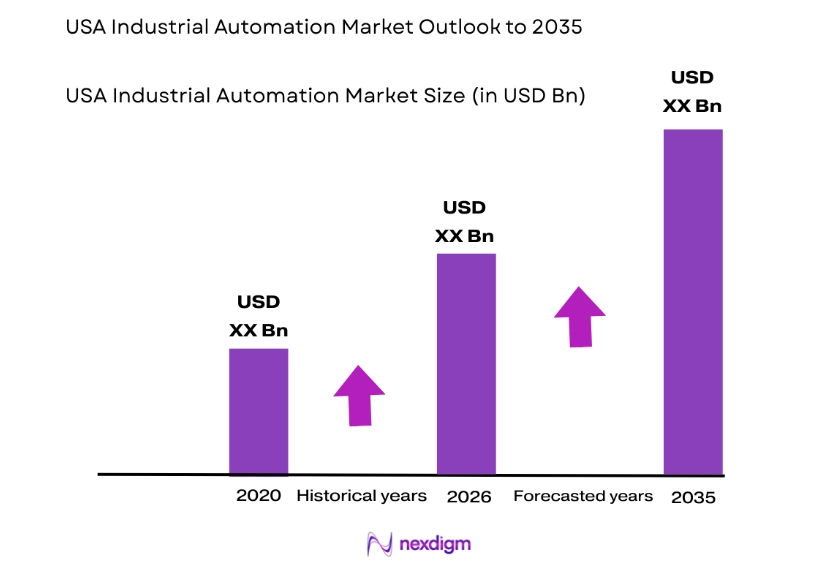
The USA Industrial Automation market is projected to reach USD ~ billion in 2024, driven by the increasing demand for advanced automation technologies across manufacturing industries. Automation solutions are increasingly adopted to reduce labor costs, enhance operational efficiency, and improve product quality, leading to significant market growth. The demand for robotics, artificial intelligence (AI), and machine learning technologies is particularly notable, as industries embrace smarter automation systems to optimize their production lines and reduce downtime.
Key regions such as California, Texas, and Ohio dominate the industrial automation market due to their strong industrial base, advanced manufacturing ecosystems, and significant investments in technology. These regions are home to a high concentration of manufacturers in sectors like automotive, aerospace, and consumer goods, all of which heavily rely on automation technologies. The technological infrastructure, combined with skilled labor availability and supportive government initiatives, propels the market forward in these locations.
Market Segmentation
By Product Type
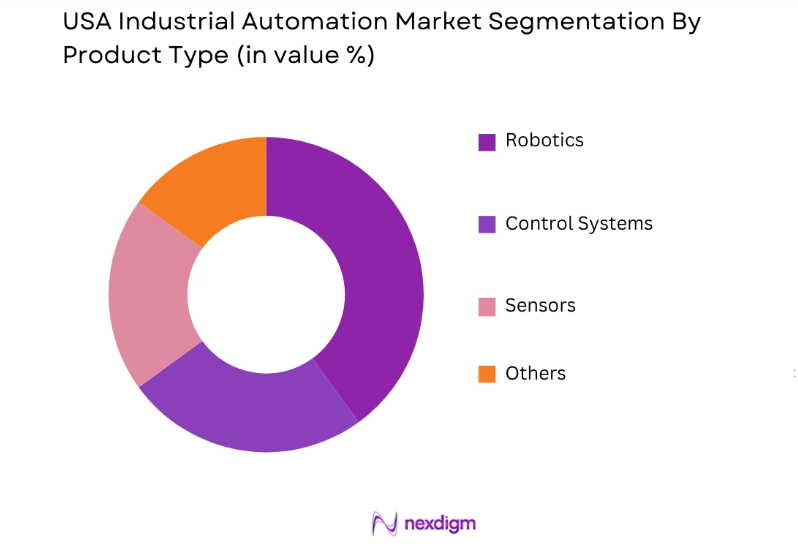
The USA Industrial Automation market is segmented by product type into robotics, control systems, sensors, and others. Recently, robotics has seen a dominant market share due to its increasing integration into manufacturing processes to enhance production efficiency, reduce operational costs, and improve product precision. The growing adoption of collaborative robots (cobots) that work alongside human workers, as well as AI-driven robots that enable more adaptive and intelligent manufacturing systems, has made robotics an essential segment. This shift is fueled by technological advancements and increasing labor costs, which make automation systems more cost-effective and efficient.
By End-User Industry
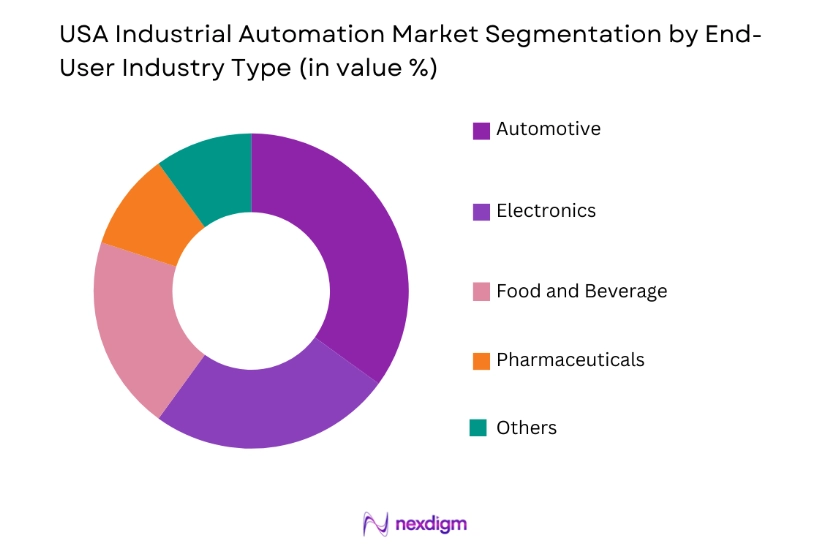
The USA Industrial Automation market is segmented by end-user industry into automotive, electronics, food and beverage, pharmaceuticals, and others. Among these, the automotive industry has a dominant market share driven by the need for mass production and the adoption of advanced automation for precise assembly, welding, and testing of vehicle components. The automotive sector continues to be a leader in automation adoption, especially in robotics, to meet increasing demand for high-quality, cost-efficient vehicles while maintaining consistency and speed in production. The sector’s push for Industry 4.0 technologies also drives the dominance of this segment.
Competitive Landscape
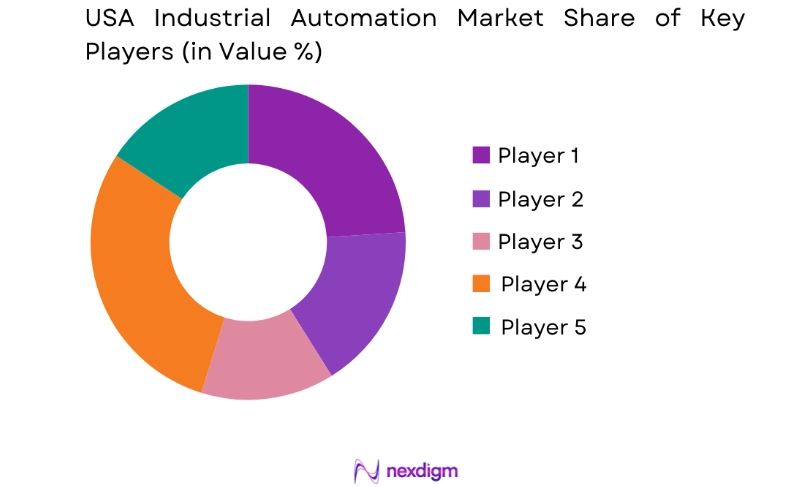
The competitive landscape of the USA Industrial Automation market is characterized by a mix of established global leaders and emerging players. Large multinational corporations dominate the sector, leveraging their technological expertise and global reach. Companies are increasingly focusing on mergers and acquisitions to enhance their market positions, while also investing heavily in research and development to innovate new solutions that cater to the ever-growing demand for smart manufacturing. Competitive strategies often involve strategic partnerships, product diversification, and the incorporation of artificial intelligence and machine learning into automation systems.
| Company Name | Establishment Year | Headquarters | Technology Focus | Market Reach | Key Products | Revenue | Additional Parameter |
| Siemens | 1847 | Munich, Germany | ~ | ~ | ~ | ~ | ~ |
| Rockwell Automation | 1903 | Milwaukee, USA | ~ | ~ | ~ | ~ | ~ |
| ABB | 1988 | Zurich, Switzerland | ~ | ~ | ~ | ~ | ~ |
| Honeywell International | 1906 | Morris Plains, USA | ~ | ~ | ~ | ~ | ~ |
| Mitsubishi Electric | 1921 | Tokyo, Japan | ~ | ~ | ~ | ~ | ~ |
USA Industrial Automation Market Analysis
Growth Drivers
Technological Advancements in Robotics
Robotics has been a key driver of the USA Industrial Automation market due to the integration of advanced technologies such as artificial intelligence (AI), machine learning, and Internet of Things (IoT) for more efficient and flexible manufacturing. The adoption of collaborative robots (cobots) alongside human workers helps manufacturers meet high-volume production targets while reducing operational costs. Additionally, AI-driven robots enable intelligent decision-making and adaptive behavior on the production line, ensuring minimal downtime and greater efficiency in the production process. As businesses continue to adopt robotics to streamline manufacturing operations and improve product quality, the demand for robotic solutions is expected to rise significantly, fueling the market’s growth.
Government Support for Automation Initiatives
Government initiatives aimed at promoting industrial modernization and automation are key growth drivers in the USA Industrial Automation market. The U.S. government has introduced various initiatives, including grants, tax incentives, and policies that support the adoption of automation technologies in industries such as manufacturing, automotive, and electronics. These policies aim to enhance the competitiveness of American industries on a global scale by improving efficiency and reducing labor costs. The government’s focus on advancing technologies like artificial intelligence, IoT, and machine learning in manufacturing processes has created a conducive environment for automation growth.
Market Challenges
High Initial Capital Investment
A major challenge for the USA Industrial Automation market is the high initial capital required to implement advanced automation systems. While automation offers significant long-term benefits, including reduced labor costs and improved productivity, the upfront cost of purchasing and installing robotics, control systems, and sensors can be prohibitively expensive for smaller businesses. This high initial investment can deter companies from adopting automation solutions, especially in sectors with tight profit margins. As a result, manufacturers may hesitate to upgrade their production lines, hindering overall market growth in the short term.
Workforce Resistance to Change
Despite the clear benefits of industrial automation, resistance from the workforce is another challenge. Many workers are concerned about job displacement due to automation technologies such as robotics and artificial intelligence. This resistance can create barriers to the widespread adoption of industrial automation, particularly in industries with significant labor forces. While automation can help reduce manual labor, the perception of job loss can hinder its acceptance among employees. Overcoming this challenge requires educational programs, retraining initiatives, and communication strategies that emphasize the complementary role of automation in the workplace.
Opportunities
Integration of AI in Manufacturing
The integration of artificial intelligence in manufacturing processes presents a significant opportunity for the USA Industrial Automation market. AI-powered automation systems can enhance production efficiency, minimize errors, and improve decision-making by analyzing real-time data from sensors, robots, and machines. AI can also predict maintenance needs, preventing costly downtime and ensuring uninterrupted production. As more industries embrace smart manufacturing, the demand for AI-based automation solutions is expected to rise. Companies that innovate and integrate AI technologies into their automation systems will be well-positioned to lead the market.
Expansion of Industrial IoT
The expansion of Industrial Internet of Things (IoT) technologies provides substantial opportunities for the USA Industrial Automation market. IoT-enabled devices allow manufacturers to gather real-time data from machines, sensors, and control systems, providing valuable insights into production performance. This data-driven approach can optimize production schedules, improve predictive maintenance, and reduce downtime. As more industries adopt IoT solutions, the demand for connected automation systems is likely to increase, offering companies new opportunities to improve operational efficiency and reduce costs.
Future Outlook
The future of the USA Industrial Automation market looks promising, with continued advancements in robotics, artificial intelligence, and IoT technologies expected to drive significant growth. Over the next five years, industries will increasingly adopt automation solutions to improve operational efficiency, reduce costs, and meet growing demand. Regulatory support and government initiatives aimed at fostering technological innovation will also play a crucial role in the market’s expansion. As automation technologies become more affordable and accessible, smaller manufacturers will also be able to adopt these solutions, further broadening the market.
Major Players
- Siemens
- Rockwell Automation
- ABB
- Honeywell International
- Mitsubishi Electric
- General Electric
- Emerson Electric
- Schneider Electric
- Yokogawa Electric
- FANUC Corporation
- Beckhoff Automation
- Omron Corporation
- Bosch Rexroth
- Rexroth Automation
- Hitachi Ltd
Key Target Audience
- Investments and venture capitalist firms
- Government and regulatory bodies
- Manufacturing industry leaders
- Automation technology developers
- Industrial equipment distributors
- Automation system integrators
- Enterprises seeking digital transformation
Research Methodology
Step 1: Identification of Key Variables
Key variables impacting the market, such as technological advancements, market demand, and competitive forces, are identified to form the basis of the research.
Step 2: Market Analysis and Construction
An in-depth analysis of market trends, segmentation, and competitive landscape is conducted to construct an accurate and comprehensive view of the market.
Step 3: Hypothesis Validation and Expert Consultation
Expert consultations and industry feedback are used to validate hypotheses and refine assumptions regarding market trends and growth drivers.
Step 4: Research Synthesis and Final Output
The findings from the analysis and expert consultations are synthesized into a final report, highlighting market trends, opportunities, and challenges.

- Executive Summary
- Research Methodology (Definitions, Scope, Industry Assumptions, Market Sizing Approach, Primary & Secondary Research Framework, Data Collection & Verification Protocol, Analytic Models & Forecast Methodology, Limitations & Research Validity Checks)

- Market Definition and Scope
- Value Chain & Stakeholder Ecosystem
- Regulatory / Certification Landscape
- Sector Dynamics Affecting Demand

- Growth Drivers
Increasing Demand for Automation in Automotive Manufacturing
Growth of Smart Factories and Industry 4.0 Initiatives
Government Support for Manufacturing Automation and Digitalization - Market Challenges
High Initial Capital Expenditure for Industrial Automation Systems
Skill Shortages in Robotics and Automation Engineering
Integration Complexity with Existing Legacy Systems - Market Opportunities
Development of Automation Solutions for Small and Medium-Sized Enterprises
Expansion of Automation Systems in Logistics and Distribution Centers
Growth of Predictive Maintenance and Industrial IoT Solutions - Trends
Increasing Adoption of Collaborative Robots in Manufacturing
Rise in Artificial Intelligence and Machine Learning Integration in Industrial Systems - Government Regulations
- SWOT Analysis
- Porter’s Five Forces

- By Market Value, 2020-2025
- By Installed Units, 2020-2025
- By Average System Price, 2020-2025
- By System Complexity Tier, 2020-2025

- By System Type (In Value%)
Industrial Robotics Systems
Programmable Logic Controllers
Distributed Control Systems
Supervisory Control and Data Acquisition Systems
Industrial Machine Vision Systems - By Platform Type (In Value%)
Automotive Manufacturing Automation Platforms
Electronics and Semiconductor Manufacturing Platforms
Energy and Utilities Automation Platforms
Logistics and Warehouse Automation Platforms - By Fitment Type (In Value%)
New Industrial Automation Installations
Retrofit Automation for Existing Facilities
Integrated Smart Factory Automation Systems
Modular Industrial Automation Solutions - By End User Segment (In Value%)
Automotive and Industrial Manufacturing
Electronics and Semiconductor Manufacturing
Energy and Utilities Sector

- Market Share Analysis
- Cross Comparison Parameters (Automation System Flexibility, Integration Capability, Robotics Portfolio, Industry Application, R&D Investment, Pricing Strategy, After-Sales Service Network)
- SWOT Analysis of Key Competitors
- Pricing & Procurement Analysis
- Key Players
Siemens AG
ABB Ltd
Schneider Electric
Rockwell Automation
Mitsubishi Electric
Honeywell International
Emerson Electric
Yokogawa Electric Corporation
Bosch Rexroth
Omron Corporation
Fanuc Corporation
KUKA AG
Hitachi Industrial Equipment Systems
Delta Electronics
Keyence Corporation

- Automotive Manufacturers Deploying Robotics for Increased Efficiency
- Electronics Manufacturers Using Automation for Precision and Speed
- Energy Operators Utilizing Automation for Grid and Infrastructure Monitoring
- Logistics Companies Implementing Automation for Warehouse Optimization

- Forecast Market Value, 2026-2035
- Forecast Installed Units, 2026-2035
- Price Forecast by System Tier, 2026-2035
- Future Demand by Platform, 2026-2035


 Request a Sample
 Ask for Customization
 Get a Quote
 Enquire Now