

 Download PDF
 Download PDF
Market Overview
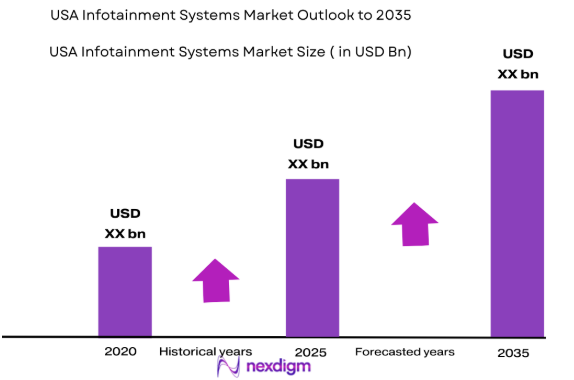
The USA Infotainment Systems market is valued at approximately USD ~ billion based on a recent historical assessment, driven by strong integration of digital cockpit technologies across passenger and commercial vehicles and sustained adoption of connected vehicle platforms. Automotive manufacturers are embedding advanced multimedia displays, navigation, and telematics systems as standard features, while software-defined vehicle architectures and smartphone integration ecosystems accelerate demand for high-performance infotainment hardware and cloud-connected in-vehicle services across new vehicle production volumes.
The United States dominates the North American infotainment systems landscape due to its large automotive production base, advanced technology ecosystem, and concentration of leading OEMs and suppliers. Cities such as Detroit, San Jose, and Austin lead adoption through automotive R&D clusters, semiconductor and software innovation hubs, and electric vehicle manufacturing investments. Strong consumer preference for connected driving experiences and high disposable income levels further sustain infotainment system penetration across premium and mid-segment vehicles nationwide.
Market Segmentation
By Product Type
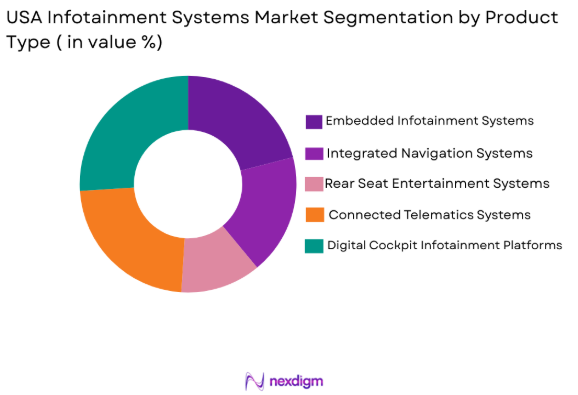
USA Infotainment Systems market is segmented by product type into embedded infotainment systems, integrated navigation systems, rear seat entertainment systems, connected telematics infotainment systems, and digital cockpit infotainment platforms. Recently, digital cockpit infotainment platforms has a dominant market share due to factors such as demand patterns, brand presence, infrastructure availability, or consumer preference.
By Platform Type
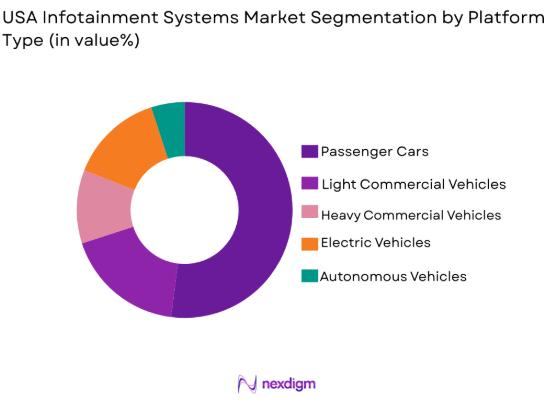
USA Infotainment Systems market is segmented by platform type into passenger vehicles, light commercial vehicles, heavy commercial vehicles, electric vehicles, and autonomous vehicles. Recently, passenger vehicles has a dominant market share due to factors such as demand patterns, brand presence, infrastructure availability, or consumer preference.
Competitive Landscape
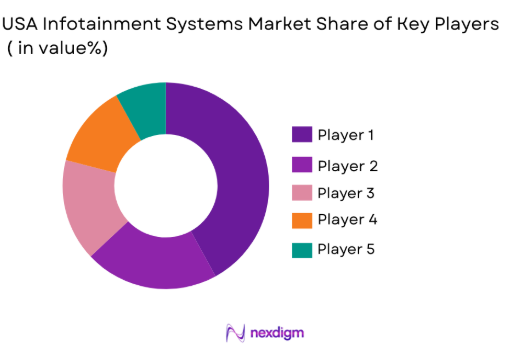
The USA Infotainment Systems market exhibits moderate consolidation led by global automotive electronics suppliers and specialized infotainment platform developers collaborating closely with vehicle manufacturers. Major players maintain competitive advantage through software integration capability, display technology innovation, and scalable digital cockpit architectures across vehicle platforms. Strategic partnerships between semiconductor firms, software developers, and OEMs are intensifying, enabling end-to-end infotainment ecosystems that combine hardware, operating systems, connectivity, and user interface technologies across mass and premium automotive segments.
|
Company Name |
Establishment Year | Headquarters | Technology Focus | Market Reach | Key Products | Revenue | Automotive OEM Integration Depth |
| Harman International | 1980 | USA | ~ | ~ | ~ | ~ | ~ |
| Panasonic Automotive | 1918 | Japan | ~ | ~ | ~ | ~ | ~ |
| Bosch Mobility | 1886 | Germany | ~ | ~ | ~ | ~ | ~ |
| Continental Automotive | 1871 | Germany | ~ | ~ | ~ | ~ | ~ |
| Visteon Corporation | 2000 | USA | ~ | ~ | ~ | ~ | ~ |
USA Infotainment Systems Market Analysis
Growth Drivers
Connected Vehicle and Digital Cockpit Adoption Across Automotive Platforms
The USA automotive sector is undergoing a structural transition toward software-defined vehicle architectures in which infotainment systems serve as the central human-machine interface linking navigation, entertainment, connectivity, and vehicle control domains into a unified cockpit environment. Automakers are integrating multi-display clusters, augmented reality head-up displays, and AI-enabled voice assistants to differentiate user experience and brand identity in increasingly competitive vehicle markets. Consumer expectations for seamless smartphone mirroring, streaming media access, and real-time cloud services have made infotainment capability a core purchase decision factor rather than an optional add-on feature. Electric vehicles and premium internal combustion models increasingly deploy centralized computing platforms that consolidate infotainment, telematics, and advanced driver assistance visualization within shared hardware architectures. Semiconductor advances in automotive-grade processors and graphics units enable high-resolution displays and complex user interfaces while maintaining functional safety compliance. Software update capability through over-the-air infrastructure allows automakers to introduce new infotainment features throughout vehicle life cycles, extending revenue streams and improving customer retention. Ride-sharing and mobility service fleets also demand integrated infotainment platforms to enhance passenger engagement and fleet management connectivity. Regulatory emphasis on driver assistance visualization and safety alerts further embeds infotainment displays into core vehicle functionality. These converging technological and market factors collectively accelerate infotainment system penetration across nearly all new vehicles manufactured and sold in the United States automotive market.
Expansion of In-Vehicle Connectivity Ecosystems and Subscription Services
Automotive infotainment platforms in the United States are evolving from hardware-centric head units into cloud-connected digital ecosystems supporting navigation services, streaming media, telematics diagnostics, and vehicle personalization applications delivered through embedded connectivity modules. Automakers and technology suppliers are deploying 4G and 5G communication modules to enable continuous vehicle-to-cloud data exchange, real-time traffic and mapping updates, and remote vehicle monitoring interfaces accessible through mobile applications. Subscription-based infotainment services such as connected navigation, satellite entertainment, in-vehicle commerce, and advanced voice assistants are creating recurring revenue opportunities beyond initial vehicle sales, reshaping supplier business models. Integration of app stores within vehicle operating systems allows third-party developers to deliver entertainment, productivity, and mobility services directly to drivers and passengers. Commercial fleet operators increasingly rely on infotainment-linked telematics dashboards for route optimization, driver behavior analytics, and compliance monitoring, strengthening demand across logistics and transport sectors. Partnerships between automotive OEMs and technology companies accelerate development of integrated infotainment ecosystems combining hardware, operating systems, and cloud platforms. Consumer acceptance of subscription digital services across smartphones and smart homes transfers directly into expectations for connected vehicles. Enhanced cybersecurity architectures and data privacy controls enable secure service delivery and regulatory compliance within connected infotainment environments. As vehicles become connected digital platforms rather than standalone mechanical assets, infotainment systems act as the gateway interface for monetizable services, sustaining long-term market growth across the United States automotive ecosystem.
Market Challenges
Cybersecurity and Data Privacy Risks in Connected Infotainment Platforms
Increasing connectivity within automotive infotainment systems exposes vehicles to cyber intrusion risks affecting both user data and vehicle control domains, creating significant design and compliance challenges for manufacturers and suppliers. Infotainment platforms process sensitive information including location data, personal preferences, communication records, and connected device credentials, making them high-value targets for cyberattacks and unauthorized data extraction. Integration between infotainment networks and vehicle electronic control units can create potential attack pathways impacting safety-critical functions if insufficient network segmentation and encryption safeguards exist. Regulatory frameworks in the United States require strict cybersecurity management systems and data privacy protections, increasing development complexity and certification costs for infotainment suppliers. Continuous software update requirements to address vulnerabilities demand long-term lifecycle support infrastructure and secure over-the-air deployment architectures. Automotive manufacturers must coordinate cybersecurity standards across diverse supply chains involving semiconductor vendors, software developers, and connectivity providers. Consumer trust concerns regarding data collection and surveillance capabilities within connected vehicles may influence purchasing behavior and feature acceptance. Insurance and liability implications associated with cyber breaches in connected vehicles increase financial risk exposure for OEMs and technology providers. Ensuring robust cybersecurity resilience across rapidly evolving infotainment ecosystems remains a persistent structural challenge shaping product development and deployment strategies across the United States market.
Rapid Technology Obsolescence and Integration Complexity in Automotive Infotainment Systems
Automotive infotainment technologies evolve at a pace closer to consumer electronics than traditional automotive components, creating mismatch between vehicle development cycles and digital technology lifecycles. Vehicles remain in production for multiple years while display technologies, processors, connectivity standards, and software platforms advance annually, increasing risk of outdated infotainment performance within new vehicles. Automakers must balance long-term reliability requirements with consumer expectations for smartphone-like responsiveness and feature currency, complicating platform design decisions. Integration of infotainment with vehicle electronics architectures, advanced driver assistance displays, telematics modules, and connectivity hardware introduces system complexity requiring extensive validation and compatibility testing. Multi-supplier ecosystems involving hardware manufacturers, operating system providers, and software application developers increase coordination challenges and integration risk. Cost pressures within competitive automotive markets constrain adoption of latest infotainment technologies across mass-market vehicle segments. Maintaining backward compatibility with mobile devices and digital ecosystems across model lifetimes adds further development overhead. Supplier dependency risks arise when proprietary infotainment software stacks limit automaker flexibility and upgrade capability. These structural technology and integration challenges collectively slow innovation deployment and increase engineering investment requirements across the United States infotainment systems market.
Opportunities
AI-Driven Personalization and Intelligent Human-Machine Interface Development
Artificial intelligence integration within automotive infotainment platforms enables adaptive user interfaces capable of learning driver preferences, contextual behavior, and usage patterns to deliver personalized content, navigation suggestions, and vehicle settings recommendations. Voice assistants integrated with natural language processing allow intuitive control of vehicle functions, media selection, and connected services without manual interaction, improving safety and user convenience. Machine learning algorithms can analyze driving habits, location history, and time-of-day usage to preconfigure infotainment displays and content streams proactively. Passenger recognition and profile synchronization across vehicles create seamless digital identity experiences across mobility ecosystems. Integration of AI-based predictive maintenance alerts and vehicle diagnostics within infotainment dashboards enhances functional utility beyond entertainment applications. Automotive manufacturers differentiate brand experience through proprietary intelligent interface ecosystems embedded within digital cockpit platforms. Partnerships between automotive suppliers and AI software developers accelerate deployment of cognitive infotainment capabilities across new vehicle architectures. Consumer demand for personalized digital experiences across devices extends naturally into vehicle environments, reinforcing acceptance of AI-enabled infotainment interfaces. As intelligent human-machine interfaces become central to vehicle interaction, infotainment systems transition from passive displays to adaptive digital companions, opening substantial innovation and revenue opportunities across the United States automotive market.
Integration of Immersive Entertainment and In-Vehicle Digital Services Ecosystems
Automotive infotainment platforms are evolving into immersive digital environments supporting high-definition video streaming, gaming applications, augmented reality navigation, and interactive passenger entertainment across multiple vehicle displays. Advancements in display resolution, graphics processors, and in-vehicle connectivity enable cinema-grade entertainment experiences within vehicles, particularly in electric and autonomous mobility concepts emphasizing passenger comfort. Rear-seat entertainment systems increasingly integrate streaming platforms, productivity applications, and cloud gaming services accessible through infotainment interfaces. Autonomous driving progression will expand passenger free time, increasing demand for immersive infotainment content and interactive services during travel. Integration of e-commerce and location-based digital services within infotainment systems enables in-vehicle transactions such as food ordering, parking payments, and travel bookings. Automotive OEMs and content providers collaborate to deliver branded entertainment ecosystems embedded within vehicle operating systems. Fleet mobility services adopt infotainment entertainment features to enhance passenger satisfaction and differentiation in ride-sharing markets. Regulatory evolution toward driver monitoring and safe content delivery frameworks will enable broader infotainment functionality deployment. As vehicles transform into connected living spaces, immersive infotainment ecosystems create new business models and sustained growth pathways across the United States infotainment systems industry.
Future Outlook
The USA Infotainment Systems market is expected to expand steadily as vehicles transition toward fully digital cockpit architectures and software-defined platforms. Advances in AI interfaces, immersive displays, and cloud connectivity will deepen infotainment integration with vehicle control and mobility services. Regulatory focus on cybersecurity and driver safety interfaces will shape system design standards. Growing electric vehicle production and connected mobility ecosystems will sustain long-term demand for advanced infotainment platforms across automotive segments.
Major Player
- Harman International
- Panasonic Automotive Systems
- Bosch Mobility Electronics
- Continental Automotive
- Denso Corporation
- Visteon Corporation
- AptivPLC
- Alpine Electronics
- Clarion Co Ltd
- Pioneer Corporation
- Garmin Ltd
- Sony AutomotiveSystems
- Valeo SA
- HyundaiMobis
- MagnetiMarelli
Key Target Audience
- Automotive OEMs
- Infotainment system suppliers
- Semiconductor manufacturers
- Software platform developers
- Electric vehicle manufacturers
- Fleet and mobility operators
- Investments and venture capitalist firms
- Government and regulatory bodies
Research Methodology
Step 1: Identification of Key Variables
Core variables including infotainment system penetration rates, vehicle production volumes, digital cockpit adoption levels, connectivity integration, and supplier technology capabilities were identified. Market boundaries were defined across passenger and commercial vehicle segments. Technology layers spanning hardware, software, and services were mapped. Regulatory and consumer demand indicators were incorporated to establish analytical scope.
Step 2: Market Analysis and Construction
Supply-side analysis assessed automotive OEM strategies, infotainment platform suppliers, and semiconductor ecosystems. Demand-side evaluation examined vehicle segment adoption, consumer digital feature preferences, and connectivity usage patterns. Market sizing models integrated vehicle production data with infotainment installation rates. Value chain mapping and competitive positioning frameworks structured the market architecture.
Step 3: Hypothesis Validation and Expert Consultation
Industry hypotheses were validated through consultation with automotive electronics engineers, digital cockpit architects, infotainment software developers, and mobility service specialists. Supplier technology roadmaps and OEM platform strategies were cross-checked against adoption trends. Data triangulation across production statistics, supplier revenues, and technology deployment validated assumptions. Regulatory and cybersecurity frameworks were incorporated.
Step 4: Research Synthesis and Final Output
Validated data and insights were synthesized into structured market models covering segmentation, competition, technology trends, and growth drivers. Quantitative estimates were aligned with qualitative technology adoption patterns. Strategic implications for suppliers and OEMs were derived. Final outputs were compiled into a comprehensive infotainment systems market assessment for the United States automotive sector.

- Executive Summary
- Research Methodology (Definitions, Scope, Industry Assumptions, Market Sizing Approach, Primary & Secondary Research Framework, Data Collection & Verification Protocol, Analytic Models & Forecast Methodology, Limitations & Research Validity Checks)

- Market Definition and Scope
- Value Chain & Stakeholder Ecosystem
- Regulatory / Certification Landscape
- Sector Dynamics Affecting Demand
- Strategic Initiatives & Infrastructure Growth

- Growth Drivers
Rising Consumer Demand for Connected In-Vehicle Experiences
Expansion of Electric and Software Defined Vehicle Architectures
Integration of Smartphones and Digital Ecosystems with Vehicles
Automaker Shift Toward Digital Cockpit Platforms
Growth in Autonomous and Semi-Autonomous Driving Features - Market Challenges
High Integration Complexity with Vehicle Electronics Architecture
Cybersecurity Risks in Connected Infotainment Systems
Rapid Technology Obsolescence and Upgrade Cycles
Cost Pressures on Automakers and Suppliers
Compatibility Issues Across Vehicle Platforms - Market Opportunities
Expansion of Subscription Based In-Vehicle Services
Adoption of AI Driven Personalization in Infotainment
Growth of Over the Air Software Upgrade Ecosystems - Trends
Transition Toward Fully Integrated Digital Cockpits
Increased Use of Large Format Curved Displays
Voice and Gesture Based Human Machine Interfaces
Cloud Native Infotainment Software Platforms
Integration of Entertainment Streaming Services in Vehicles - Government Regulations & Defense Policy
Vehicle Cybersecurity Compliance Standards
Driver Distraction and Safety Interface Regulations
Data Privacy Rules for Connected Vehicle Platforms
SWOT Analysis
Stakeholder and Ecosystem Analysis
Porter’s Five Forces Analysis
Competition Intensity and Ecosystem Mapping

- By Market Value, 2019-2025
- By Installed Units, 2019-2025
- By Average System Price, 2019-2025
- By System Complexity Tier, 2019-2025

- By System Type (In Value%)
Embedded Infotainment Systems
Integrated Navigation Systems
Rear Seat Entertainment Systems
Connected Telematics Infotainment Systems
Digital Cockpit Infotainment Platforms - By Platform Type (In Value%)
Passenger Vehicles
Light Commercial Vehicles
Heavy Commercial Vehicles
Electric Vehicles
Autonomous Vehicles - By Fitment Type (In Value%)
OEM Factory Installed Systems
Dealer Installed Systems
Aftermarket Retrofit Systems
Modular Upgrade Systems
Software Defined Infotainment Systems - By End User Segment (In Value%)
Private Vehicle Owners
Fleet Operators
Ride Hailing Service Providers
Commercial Transport Operators
Government and Public Safety Agencies - By Procurement Channel (In Value%)
Direct OEM Contracts
Supplier Integration
Aftermarket Retail Distribution
Online Automotive Electronics Platforms
Fleet Procurement Programs - By Material / Technology (in Value %)
Touchscreen Display Systems
Voice Recognition Interfaces
AI Based Infotainment Software
Cloud Connected Infotainment Platforms
Augmented Reality Head Up Displays

- Market structure and competitive positioning
Market share snapshot of major players
(CrossComparison Parameters (Display Technology, Connectivity Features, Software Platform, Integration Capability, Vehicle Compatibility)) - SWOT Analysis of Key Competitors
- Pricing & Procurement Analysis
- Porter’s Five Forces Analysis
- Key Players
Harman International
Panasonic Automotive Systems
Bosch Mobility Electronics
Continental Automotive
Denso Corporation
Visteon Corporation
Aptiv PLC
Alpine Electronics
Clarion Co Ltd
Pioneer Corporation
Garmin Ltd
Sony Automotive Systems
Valeo SA
Hyundai Mobis
Magneti Marelli

- Passenger vehicle buyers prioritizing connectivity and multimedia features
- Fleet operators demanding telematics enabled infotainment systems
- Ride hailing platforms integrating passenger entertainment solutions
- Commercial transport users adopting navigation and fleet infotainment tools

- Forecast Market Value, 2026-2030
- Forecast Installed Units, 2026-2030
- Price Forecast by System Tier, 2026-2030
- Future Demand by Platform, 2026-2030


 Request a Sample
 Ask for Customization
 Get a Quote
 Enquire Now