
 Download PDF
Market Overview
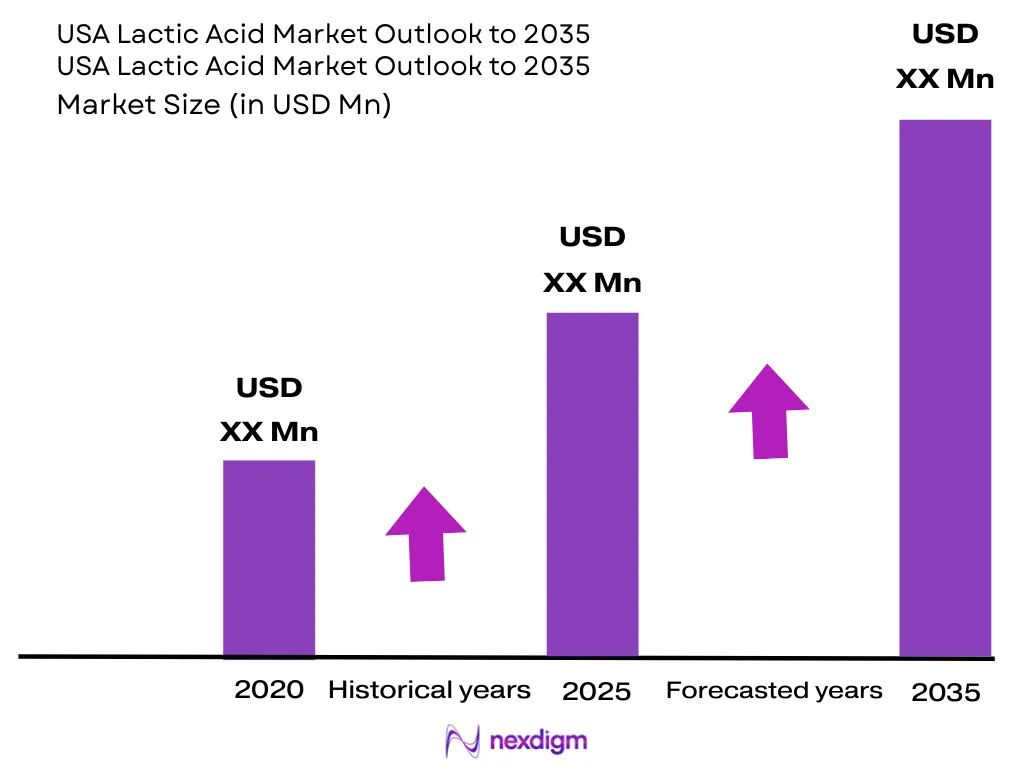
The USA Lactic Acid Market was valued at USD ~ Million in 2025 and is anticipated to expand at a CAGR of 6.5% during 2026–2034, according to IMARC Group. The United States accounted for approximately 41.5% of the global lactic acid market in 2024, making it the largest single-country market worldwide, according to Grand View Research. The market is primarily driven by rising demand for polylactic acid (PLA) in compostable packaging, the country’s robust USD 200 billion biomedical device industry, and continued growth in the food and beverage sector, where lactic acid is widely used as a preservative, acidulant, and flavoring agent. The U.S. Food and Drug Administration (FDA) recognizes lactic acid as Generally Recognized as Safe (GRAS) for general-purpose food additive use, providing a well-established regulatory pathway across bakery, dairy, beverages, and processed food applications. California’s Senate Bill 54, which requires all single-use plastic packaging sold in the state to be recyclable or compostable by 2032, is expected to serve as a de facto national standard given California’s USD 3.7 trillion economy, further reinforcing demand for lactic acid-derived bioplastics such as NatureWorks’ Ingeo PLA.
Market Segmentation
By Raw Material
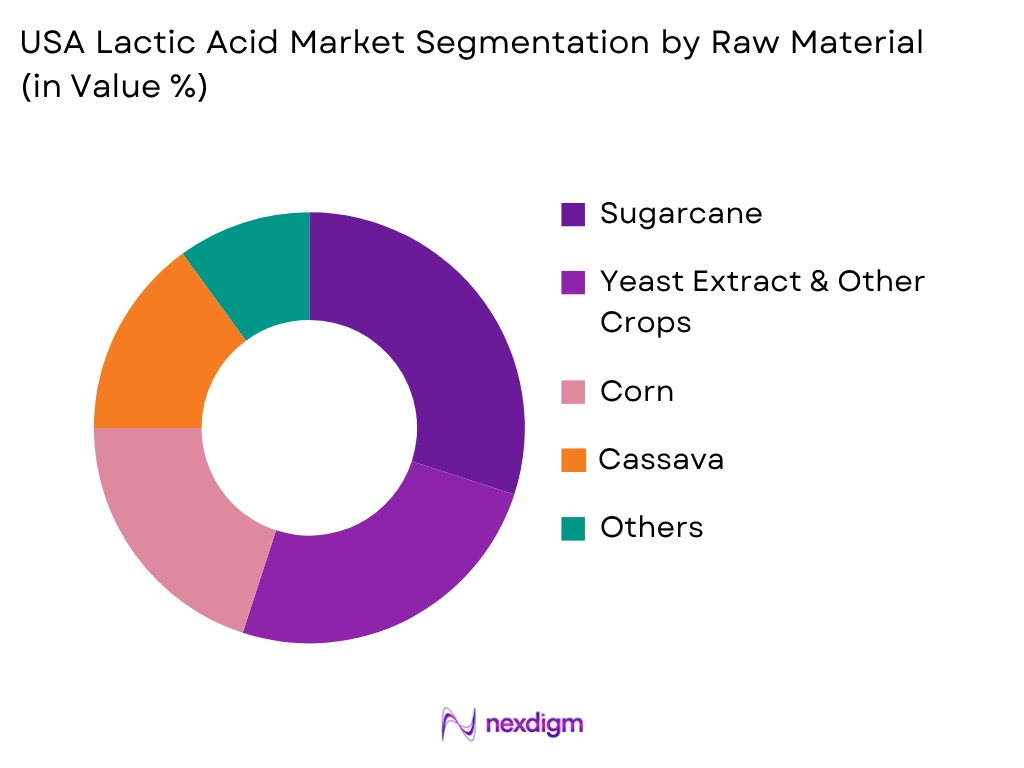
Among these, Sugarcane holds the largest revenue share of the USA Lactic Acid Market, accounting for approximately 41.73% of the raw material segment in 2024, owing to its cost-effectiveness, high sucrose content, and established fermentation infrastructure. Corn remains a significant secondary feedstock, particularly for polylactic acid production, benefiting from the U.S. Midwest’s extensive corn wet-milling infrastructure and consistent supply chains supported by companies such as ADM and Cargill. Yeast Extract represents the fastest-growing raw material segment, reflecting increasing interest in alternative and by-product-derived fermentation substrates that reduce reliance on traditional agricultural commodities. This raw material diversification allows U.S. lactic acid manufacturers to manage feedstock cost volatility while maintaining flexibility across food-grade, industrial-grade, and polymer-grade lactic acid production.
By Application
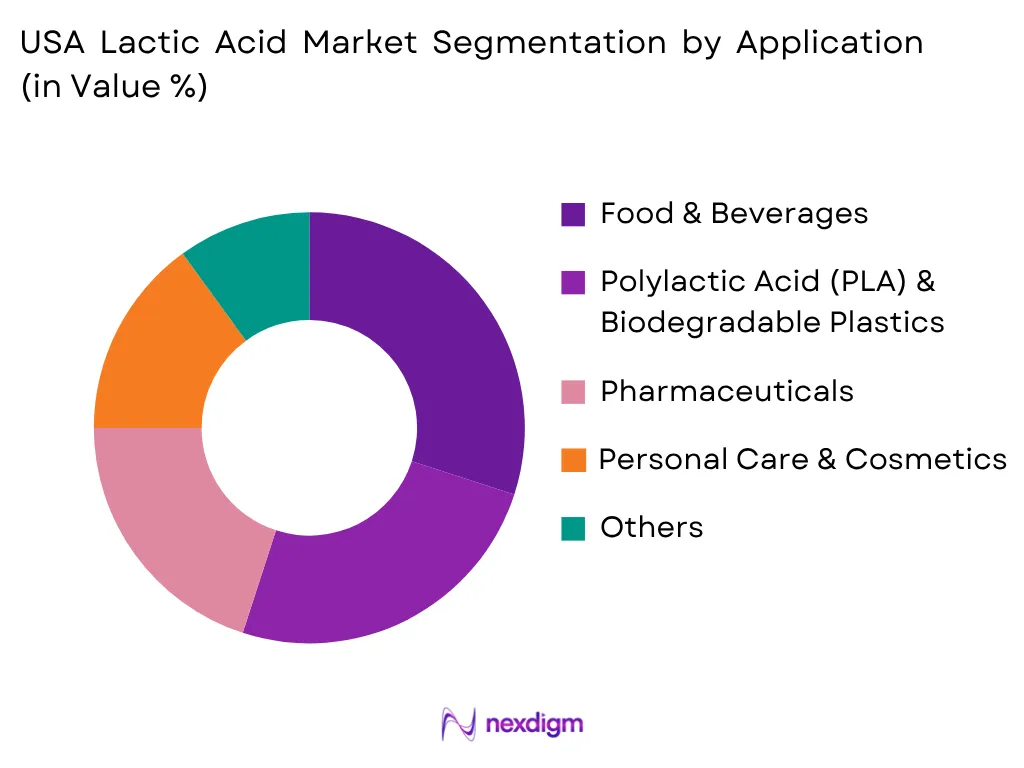
The Food & Beverages segment holds the largest share, accounting for approximately 40% of the global lactic acid market in 2024, owing to widespread use of lactic acid as a preservative, pH regulator, and flavor enhancer across dairy, bakery, beverages, and fermented food products. The Polylactic Acid (PLA) and Biodegradable Plastics segment represents the fastest-growing application, driven by California’s Senate Bill 54 and similar state-level packaging mandates, as well as growing adoption of compostable packaging among e-commerce and meal-kit companies. The Pharmaceutical segment continues to see steady growth, supported by the United States’ position as home to the world’s largest medical device industry, valued at approximately USD 200 billion, where lactic acid and its polymer derivatives are used extensively in controlled drug release systems, biodegradable orthopedic implants, and tissue engineering scaffolds.
Competitive Landscape
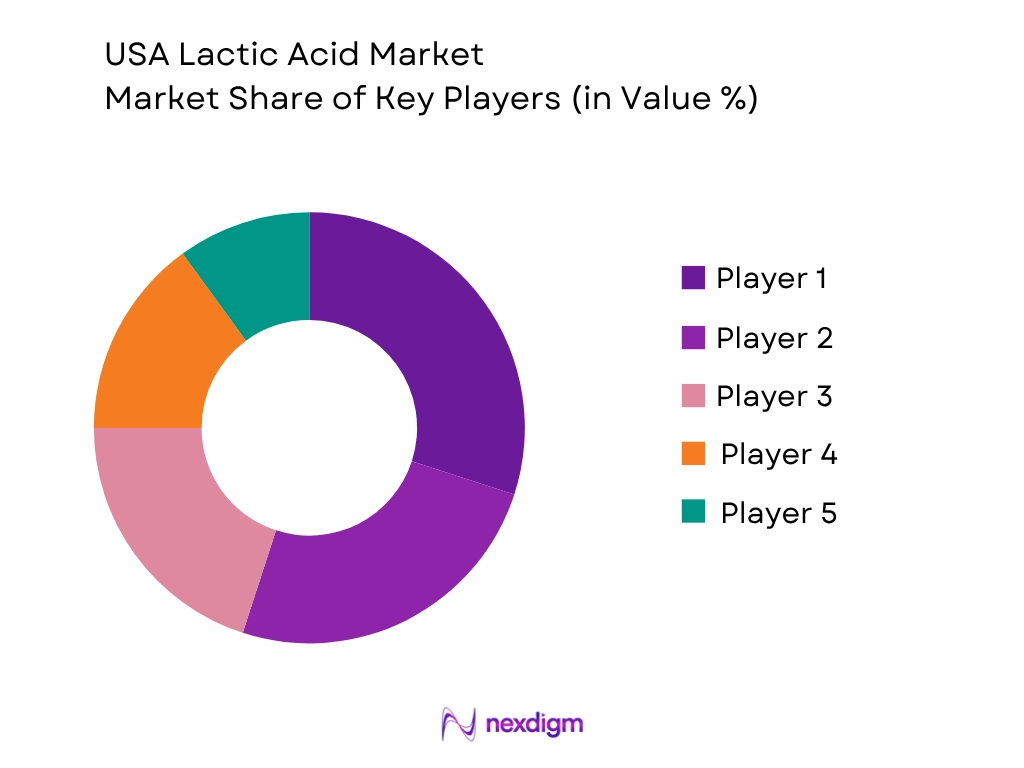
The USA Lactic Acid Market is moderately consolidated, with domestic agribusiness and biotechnology companies operating alongside multinational chemical manufacturers. Competition is primarily based on production capacity, feedstock integration, PLA polymerization capability, regulatory compliance with FDA GRAS standards, and the ability to offer cost-competitive, high-purity lactic acid grades for food, pharmaceutical, and bioplastics applications. Companies are increasingly investing in vertical integration, extending upstream into lactic acid production, which represents up to 60% of PLA conversion cost, and downstream into film extrusion and compounding. NatureWorks LLC, headquartered in Minnetonka, Minnesota, maintains global market leadership in PLA and lactic acid-derived polymers, leveraging strong North American manufacturing capacity to provide tariff-hedged supply for domestic quick-service restaurant chains and packaging converters.
| Company | Establishment Year | Headquarters | Primary Product Portfolio | Lactic Acid Portfolio
|
Manufacturing Presence | Major End-Use Industries | Key Strategic Focus | Certifications & Compliance |
| NatureWorks LLC | 2002 | ~ | ~ | ~ | ~ | ~ | ~ | ~ |
| Cargill | 1865 | ~ | ~ | ~ | ~ | ~ | ~ | ~ |
| ADM (Archer Daniels Midland) | 1902 | ~ | ~ | ~ | ~ | ~ | ~ | ~ |
| BASF | 1865 | ~ | ~ | ~ | ~ | ~ | ~ | ~ |
| Corbion | 2013 | ~ | ~ | ~ | ~ | ~ | ~ | ~ |
USA Lactic Acid Market Analysis
Growth Drivers
California SB 54 and State-Level Bioplastics Mandates
The USA Lactic Acid Market is experiencing sustained growth due to California’s Senate Bill 54, which requires all single-use plastic packaging sold in the state to be recyclable or compostable by 2032. Given California’s USD 3.7 trillion economy and its historical role as a trendsetter in plastics regulation, this requirement is widely expected to function as a de facto national standard, prompting packaging manufacturers and brand owners nationwide to specify lactic acid-derived polylactic acid (PLA) in place of conventional petroleum-based plastics. Municipal bans covering more than 120 North American and European cities have similarly pushed meal-kit and food delivery companies to specify certified-compostable PLA overwraps, creating sustained downstream demand for U.S.-produced lactic acid. This regulatory momentum, combined with NatureWorks’ continued Ingeo PLA capacity expansion, is reinforcing long-term demand growth for lactic acid across the U.S. packaging value chain.
Robust US Biomedical Device Industry
The United States is home to the world’s largest medical device industry, valued at approximately USD 200 billion, creating substantial and consistent demand for pharmaceutical-grade lactic acid and its polymer derivatives, including poly(lactic-co-glycolic acid) (PLGA). These materials are used extensively in controlled drug release systems, biodegradable orthopedic implants, and tissue engineering scaffolds, benefiting from lactic acid’s biocompatibility and predictable degradation properties. An aging U.S. population, combined with rising rates of chronic and lifestyle-related diseases, continues to drive demand for advanced medical technologies incorporating biodegradable polymers, further reinforcing the strategic importance of the pharmaceutical and biomedical application segment within the broader USA Lactic Acid Market.
Market Challenges
Competition from Lower-Cost Asian PLA and Lactic Acid Imports
U.S. lactic acid and PLA manufacturers face intensifying competition from lower-cost Chinese producers, who benefit from integrated lactic-acid and PLA production parks that reduced delivered resin costs by 18-22% between 2024 and 2025. Chinese entrants leveraging low-cost corn or cassava feedstocks have been able to sell spot cargoes that land in Los Angeles at approximately USD 200 per ton below U.S. domestic quotes, even after applicable duties. This pricing pressure requires U.S. manufacturers such as NatureWorks to compete on the basis of tariff-hedged domestic supply reliability and sustainability credentials rather than price alone, creating ongoing margin pressure across the value chain.
High Production Costs and Energy-Intensive Fermentation
Lactic acid and PLA manufacturing relies on energy-intensive fermentation and polymerization processes, and feedstock prices for corn, sugarcane, and other biomass sources can fluctuate significantly, resulting in unit costs that remain materially higher than those of commodity petroleum-based plastics. These cost dynamics limit lactic acid-derived bioplastic adoption in price-sensitive applications and require continued investment in fermentation efficiency and yield improvement to remain cost-competitive. Additionally, only a limited number of U.S. composting facilities currently accept compostable plastics, with just 185 sites nationwide covering approximately 12% of the population as of 2025, and tipping fees running 20-30% above standard organics processing due to extended 90-120 day PLA degradation cycles, creating infrastructure-related adoption barriers.
Market Opportunities
Expansion of Compostable Packaging Amid Municipal Bans
The growing number of municipal single-use plastic bans, now covering more than 120 North American and European cities, presents substantial opportunities for U.S. lactic acid and PLA manufacturers. The e-commerce and meal-kit sector’s continued boom has driven strong demand for certified-compostable PLA overwraps and packaging films, creating a durable growth channel for domestically produced lactic acid. As additional states consider legislation similar to California’s SB 54, manufacturers with established domestic production capacity and compostability certifications are well positioned to capture incremental demand from packaging converters and brand owners seeking to comply with evolving state-level sustainability mandates.
USDA BioPreferred Program and Domestic Bioplastics Investment
The USDA’s BioPreferred Program continues to support domestic lactic acid and PLA production, having allocated USD 12 million in grants in 2023 for bioplastics research and innovation. This federal support, combined with continued private investment in high-heat and durable PLA grade development for automotive and consumer goods applications, creates opportunities for U.S. manufacturers to diversify beyond traditional packaging applications. Fiber-reinforced PLA composites achieving heat-deflection temperatures suitable for automotive interior components, alongside nucleated Ingeo grades that eliminate energy-intensive annealing steps, illustrate the innovation pipeline supporting long-term market expansion for domestically produced lactic acid across higher-value industrial applications.
Future Outlook
The USA Lactic Acid Market is expected to witness sustained expansion over the forecast period, supported by continued state-level bioplastics regulation, growth in the country’s biomedical device industry, and rising demand for compostable packaging across e-commerce and foodservice channels. Continued NatureWorks and Cargill capacity investments, alongside USDA-supported innovation in high-performance PLA grades, are expected to strengthen the market’s competitive position relative to lower-cost Asian imports. The market is also likely to benefit from continued FDA regulatory clarity and growing consumer and corporate sustainability commitments, supporting long-term growth across food and beverage, pharmaceutical, personal care, and bioplastics packaging applications.
Major Players
- NatureWorks LLC
- Cargill
- ADM (Archer Daniels Midland)
- Corbion
- BASF
- Galactic S.A.
- Musashino Chemical Laboratory
- Henan Jindan Lactic Acid Technology
- Danimer Scientific
- Futerro
- Mitsubishi Chemical Corporation
- Toray Industries
- Synbra Technology
- Zhejiang Hisun Biomaterials
- Unitika Ltd.
Key Target Audience
- Lactic Acid and Polylactic Acid Manufacturers
- Food & Beverage Processing Companies
- Packaging and Bioplastics Companies
- Pharmaceutical and Medical Device Manufacturers
- Personal Care and Cosmetics Manufacturers
- Industrial Cleaning Product Manufacturers
- Investment and Venture Capitalist Firms
- Government and Regulatory Bodies (U.S. Food and Drug Administration (FDA), U.S. Department of Agriculture (USDA), California Department of Resources Recycling and Recovery (CalRecycle))
- Ingredient Distributors and Industrial Raw Material Suppliers
Research Methodology
Step 1: Identification of Key Variables
The research process begins with identifying the complete ecosystem of the USA Lactic Acid Market, including raw material suppliers, lactic acid and PLA manufacturers, ingredient distributors, food and beverage processors, packaging converters, and regulatory authorities. Extensive secondary research is conducted using company annual reports, government publications, trade associations, customs statistics, industry journals, and proprietary databases to determine the variables influencing market demand, pricing, production, consumption, and technological developments.
Step 2: Market Analysis and Construction
Historical market information is collected and analyzed to estimate market size, production volumes, import-export activity, application-wise demand, and pricing trends. A combination of top-down and bottom-up approaches is used to estimate market revenues and validate segment-level performance. Consumption patterns across food and beverages, pharmaceuticals, personal care, and bioplastics packaging are evaluated to establish an accurate representation of the industry.
Step 3: Hypothesis Validation and Expert Consultation
The preliminary findings are validated through Computer-Assisted Telephone Interviews (CATIs) and structured discussions with lactic acid and PLA manufacturers, procurement managers, distributors, food technologists, regulatory experts, and senior executives operating within the U.S. bio-based chemicals industry. These interviews help verify market assumptions, competitive developments, technology adoption trends, pricing dynamics, and future investment opportunities while refining the overall market estimates.
Step 4: Research Synthesis and Final Output
The final stage integrates insights obtained from primary interviews with quantitative information collected through secondary sources. Data triangulation techniques are applied to reconcile differences between supply-side and demand-side estimates, ensuring robust market forecasting. The report is then reviewed through multiple quality assurance checkpoints to deliver a comprehensive analysis covering market size, segmentation, competitive landscape, future outlook, and strategic recommendations for industry stakeholders.

- Executive Summary
- Research Methodology (Market Definitions and Assumptions, Abbreviations, Market Sizing Approach, Top-Down Analysis, Bottom-Up Analysis, Demand-Side Assessment, Supply-Side Assessment, Primary Industry Interviews, Secondary Research Validation, Data Triangulation, Forecasting Framework, Limitations and Future Conclusions)

- Definition and Scope
- Market Evolution and Industry Genesis
- Timeline of Major Industry Developments
- Lactic Acid Industry Value Chain Analysis
- Supply Chain Analysis

- Growth Drivers (California SB 54 and State-Level Bioplastics Mandates, Robust US Biomedical Device Industry, Rising Consumption of Processed Foods, Expansion of Compostable Packaging, Growth in Personal Care Applications, Premiumization of Food Products)
- Market Challenges (Feedstock Price Volatility, Competition from Lower-Cost Asian PLA Imports, High Production Costs, Energy-Intensive Fermentation Processes, Regulatory Compliance Complexity)
- Market Opportunities (Expansion of Compostable Packaging Amid Municipal Bans, USDA BioPreferred Program Investment, High-Heat and Durable PLA Grade Development, Functional Food Innovation, Export-Oriented Manufacturing)
- Market Trends (Growth of Bio-Based Chemicals, Vertical Integration into Lactic Acid Production, Clean Label Food Preservation, Compostable Packaging Adoption, Multi-Functional Applications)
- Government Regulations (FDA GRAS Food Additive Status, 21 CFR Food Additive Regulations, California SB 54 Packaging Requirements, USDA BioPreferred Program, Labeling Requirements)
- Import and Export Analysis (Trade Volume, Major Import Sources, Export Destinations, HS Code Analysis, Trade Balance)
- Raw Material Availability Analysis (Sugarcane, Corn, Cassava, Sugar Beet, Molasses, Microbial Fermentation Substrates)
- Technology Landscape (Fermentation Technologies, Polymerization Technologies, Purification Technologies, Precision Biotechnology, Stability Enhancement Technologies)
- Sustainability Assessment (Renewable Feedstocks, Carbon Footprint Reduction, Biodegradability, Waste Valorization, Circular Economy Initiatives)
- PESTLE Analysis
- SWOT Analysis
- Porter’s Five Forces Analysis
- Stakeholder Ecosystem
- Competition Ecosystem

- By Market Value (2020-2025)
- By Volume Consumption (2020-2025)
- By Average Selling Price (2020-2025)

- By Raw Material (In Value %)
Sugarcane
Corn
Cassava
Beet & Sugar Molasses
Yeast Extract & Other Crops - By Application (In Value %)
Food & Beverages
Polylactic Acid (PLA) & Biodegradable Plastics
Pharmaceuticals
Personal Care & Cosmetics
Industrial Applications - By Distribution Channel (In Value %)
Direct Sales to Manufacturers
Ingredient Distributors
Industrial Chemical Suppliers
Online B2B Ingredient Platforms - By End User (In Value %)
Food & Beverage Manufacturers
Packaging Companies
Pharmaceutical & Medical Device Manufacturers|
Personal Care Manufacturers
Industrial Cleaning Product Manufacturers - By Region (In Value %)
Midwest United States
South United States
West United States
Northeast United States

- Market Share of Major Players (By Value, Volume, Raw Material, Application Industry, Product Category)
- Cross Comparison Parameters (Product Portfolio Breadth, PLA Integration Capability, Application Technical Support Capability, Manufacturing Capacity, Regulatory Compliance & Certifications, Food & Beverage Customer Base, Innovation & New Product Launch Frequency)
- SWOT Analysis of Major Players
- Pricing Analysis by Product Category and SKU
- Production Capacity Analysis
- Manufacturing Footprint Analysis
- Distribution Network Analysis
- Innovation Benchmarking
- Detailed Profiles of Major Companies
NatureWorks LLC
Cargill
ADM (Archer Daniels Midland)
Corbion
BASF
Galactic S.A.
Musashino Chemical Laboratory
Henan Jindan Lactic Acid Technology
Danimer Scientific
Futerro
Mitsubishi Chemical Corporation
Toray Industries
Synbra Technology
Zhejiang Hisun Biomaterials
Unitika Ltd.

- Consumption Pattern Analysis (Industrial Usage, Batch Size, Product Category Penetration, Seasonal Demand, Reformulation Activity)
- Purchasing Criteria (Purity Grade, Regulatory Compliance, Cost Efficiency, Optical Isomer Ratio, Shelf Life, Supply Reliability)
- Procurement and Supplier Selection Analysis
- Clean Label Adoption Assessment
- Premium vs Conventional Product Demand
- Product Attribute Preference Analysis (Purity Consistency, Optical Purity, Thermal Stability, Solubility, Natural Origin, Label Friendliness)
- Consumer Health & Wellness Influence on Product Development
- Pain Point Analysis
- Decision-Making Process

- By Market Value (2026-2035)
- By Volume Consumption (2026-2035)
- By Average Selling Price (2026-2035)


 Request a Sample
 Ask for Customization
 Get a Quote
 Enquire Now