
 Download PDF
Market Overview
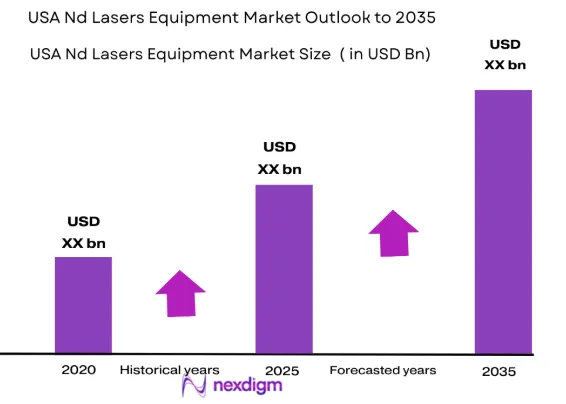
The USA Nd lasers equipment market is poised for growth, driven by advancements in laser technology and increasing demand across key sectors like manufacturing, medical, and defense. The market has been valued at approximately USD ~ billion in 2024, primarily attributed to the demand for high-precision lasers in industries such as automotive manufacturing, aerospace, medical devices, and research. The significant rise in the adoption of laser technology for cutting, welding, and microfabrication applications has substantially contributed to the market’s expansion. Additionally, the growing trend toward automation and Industry 4.0 is further supporting the market’s growth trajectory, making Nd lasers essential for precision tasks.
The USA is home to several dominant cities leading the Nd lasers equipment market, particularly those involved in high-tech manufacturing and defense applications. States like California, Texas, and Ohio are recognized hubs for laser technology adoption due to their strong presence in aerospace, automotive, and semiconductor industries. The concentration of industrial and research facilities in these regions is driving the demand for advanced laser solutions. Furthermore, major defense contractors located in these states contribute significantly to the overall market share, supporting the USA’s dominance in the global Nd laser equipment landscape.
Market Segmentation
By Product Type
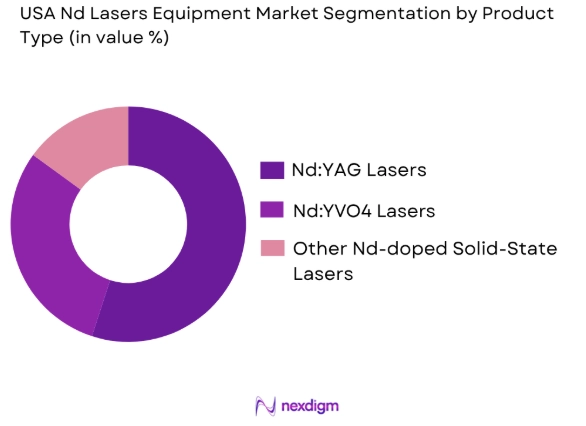
The USA Nd lasers equipment market is segmented by product type into Nd:YAG lasers, Nd:YVO4 lasers, and other Nd-doped solid-state lasers. Nd:YAG lasers dominate the market segment due to their versatility and widespread use in industries such as material processing and medical devices. Their ability to provide high-output power while maintaining beam quality has made them the preferred choice for precision applications like welding, cutting, and surface treatment. Moreover, the increasing demand in medical aesthetics and cosmetic surgery further amplifies the demand for Nd:YAG lasers. As such, this product type holds the largest market share, owing to its well-established technology and adaptability across multiple industries.
By Power Output
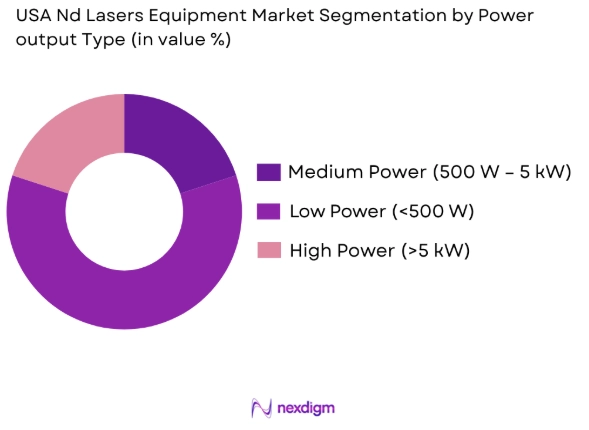
The power output segmentation reveals that medium power Nd lasers (500 W – 5 kW) dominate the market. This power range is ideal for industrial material processing applications such as welding, cutting, and engraving. Medium-power Nd lasers strike the right balance between performance and efficiency, making them popular in manufacturing processes that require precision without excessive energy consumption. This segment’s dominance is also attributed to the widespread adoption of these systems across automotive, aerospace, and semiconductor industries, where precise manufacturing is critical.
Competitive Landscape
The USA Nd lasers equipment market is highly competitive, with several key players offering advanced solutions tailored to different industry needs. Major players include IPG Photonics, Coherent, and TRUMPF, with these companies dominating the market due to their extensive R&D capabilities, robust product portfolios, and strategic global presence. The competitive landscape is characterized by technological innovation, with these leaders continually enhancing laser power and beam quality. The presence of large multinational corporations and established suppliers strengthens market consolidation, making it challenging for smaller players to gain significant market share.
| Company Name | Establishment Year | Headquarters | Technology Focus | Market Reach | Key Products | Revenue (USD) | Market-Specific Parameter |
| IPG Photonics | 1990 | Oxford, Massachusetts | ~ | ~ | ~ | ~ | ~ |
| Coherent Inc. | 1966 | Santa Clara, California | ~ | ~ | ~ | ~ | ~ |
| Trumpf | 1923 | Ditzingen, Germany | ~ | ~ | ~ | ~ | ~ |
| Han’s Laser | 1996 | Shenzhen, China | ~ | ~ | ~ | ~ | ~ |
| Rofin-Sinar Technologies | 1993 | Plymouth, Michigan | ~ | ~ | ~ | ~ | ~ |

USA Nd Lasers Equipment Market Analysis
Market Drivers
Precision Manufacturing Demand
The United States remains a leading manufacturing economy with manufacturing value added reported at USD 2,913.11 billion in 2024, reaching an all‑time high output level. This reflects sustained demand for high precision manufacturing processes in industries such as aerospace, medical devices, and advanced machinery production, where tolerances often require micrometer‑level accuracy and repeatability. Precision demanding sectors like computer and electronic products, and motor vehicles, recorded substantial value added growth between 2013 and 2023, underscoring structural manufacturing strength. Such industrial complexity supports continued uptake of Nd laser systems, which are suited to micromachining, engraving, and tight‑tolerance welding tasks in advanced manufacturing environments.
Industry 4.0 & Automated Laser Systems Integration
Industry 4.0 frameworks promoting connected and automated production have become a central theme in U.S. manufacturing competitiveness initiatives. The federal Manufacturing USA Program, backed by agencies including NIST, coordinates investment in advanced manufacturing technologies and workforce integration to support automation and digitalization across production ecosystems. Nd laser systems, when integrated with robotics, computer numerical control (CNC) platforms, and real‑time monitoring tools, improve throughput, reduce variability, and support smart factory objectives. The strategic emphasis on advanced manufacturing networks reinforces the structural demand for laser‑based automation solutions in reshoring, high‑precision fabrication, and integrated digital manufacturing.
Challenges
High capital and operational costs
Advanced Nd laser equipment and associated automation infrastructure require significant upfront capital investments that can restrict procurement by smaller manufacturers. The laser systems themselves, combined with integrated motion control, safety enclosures, and automation modules, represent major fixed cost commitments, while operating expenses for servicing, calibration, and consumables remain constant. These costs can be a barrier to adoption in cost‑sensitive manufacturing facilities, particularly where production runs are intermittent or volumes are lower. With U.S. manufacturing output heavily tied to large durable goods industries and capital‑intensive sectors, companies must balance investment in high‑precision technology against broader capital budgeting within a USD 2.9 trillion manufacturing economy context.
Need for specialized skills and technical complexity
Modern laser systems and automation require workforce capabilities beyond traditional manufacturing skills. According to advanced manufacturing workforce analysis, there is a sustained shift in requirements where digital, technical, and adaptive competencies are essential to support Industry 4.0 technologies. While manufacturing employment in the U.S. accounted for 12.76 million jobs as of December 2024, there is documented emphasis on digital and technical skills development to effectively manage automated systems and laser‑enabled processes. The complexity of programming, maintaining, and optimizing such systems places pressure on existing talent pipelines, particularly as precision tool operators and advanced robotics technicians are in short supply without targeted training programs.
Opportunities
Custom Engineered Laser Solutions for EV & Battery Production
Electric vehicle (EV) manufacturing in the U.S. drives demand for specialized processing technologies, including Nd lasers for welding, trimming, and battery tab welding tasks. Through September 2024, companies announced USD 208.8 billion in EV manufacturing investments, corresponding to an estimated 240,000 jobs focused on EV supply chain facilities nationwide. EV manufacturing involves advanced battery module and pack fabrication, where precise laser solutions improve joint consistency and component integration. As the EV sector expands beyond traditional internal combustion production, demand for high‑precision engineered solutions such as Nd lasers will support complex assembly requirements in battery production.
Additive Manufacturing Laser Systems
Additive manufacturing (AM) adoption represents a significant opportunity for Nd laser equipment, as many AM processes rely on laser‑based powder bed fusion or directed energy deposition for complex part fabrication. In 2022. AM’s role in producing lightweight, intricate designs aligns with laser system capabilities for part consolidation and near‑net‑shape production. Government and industry initiatives supporting advanced manufacturing enhance AM infrastructure, creating additional avenues for laser systems in production environments transitioning from prototyping to full‑scale additive workflows.
Future Outlook
Over the next five years, the USA Nd lasers equipment market is expected to experience significant growth, driven by the increased adoption of precision manufacturing in the automotive, aerospace, and medical device sectors. Continuous advancements in laser technology, such as the development of ultrafast and high-power lasers, will further fuel demand. Additionally, the shift towards automation in manufacturing processes and the growing focus on eco-friendly, energy-efficient technologies will create new opportunities for Nd lasers in emerging applications. The market is also set to benefit from the rise of Industry 4.0 and an increase in R&D investments in laser-based solutions across different industries.
Major Players
- IPG Photonics
- Coherent
- TRUMPF
- Newport Corporation
- Lumentum Holdings
- Han’s Laser Technology Industry Group Co., Ltd.
- Laserline GmbH
- Amada Miyachi America, Inc.
- Bystronic Laser AG
- Rofin-Baasel Lasertech (Coherent Group)
- GSI Group, Inc.
- Synova SA
- Oxford Lasers Limited
- Trumpf Laser GmbH
- SUSS MicroTec AG
Key Target Audience
- Investments and Venture Capitalist Firms
- Government and Regulatory Bodies (e.g., FDA, DOE)
- Laser Manufacturers and OEMs
- Industrial Manufacturers (Automotive, Aerospace, etc.)
- Medical Device Manufacturers
- Defense and Military Contractors
- Research and Development Institutions
- System Integrators and Suppliers of Nd Laser Solutions
Research Methodology
Step 1: Identification of Key Variables
This phase focuses on identifying the critical factors that influence the Nd lasers market in the USA. Secondary research is utilized to gather detailed information from industry reports, public databases, and company publications, creating a comprehensive ecosystem map. The goal is to understand the various market forces and pinpoint the drivers and barriers for market growth.
Step 2: Market Analysis and Construction
The analysis phase consolidates historical market data and trends. This involves assessing market penetration, sector-specific laser usage, and revenue data to build a robust market model. The construction phase ensures that all relevant information on adoption rates and technology evolution is factored into the forecast model.
Step 3: Hypothesis Validation and Expert Consultation
Expert consultations will be carried out with key industry stakeholders, including manufacturers, end-users, and R&D experts. Insights from these consultations will validate initial hypotheses, ensuring that the conclusions drawn are based on up-to-date industry insights and ground-level observations.
Step 4: Research Synthesis and Final Output
The final phase involves synthesizing research data from both primary and secondary sources. This comprehensive analysis will then be compiled into actionable insights, which will form the foundation of the market report. This phase includes verifying and refining data with the help of industry experts to ensure accuracy.

- Executive Summary
- Research Methodology (Market Definitions & Scope, Nd Laser Classification, Assumptions, Abbreviations, Data Sources, Market Modeling Approach, Forecasting Methodology, Primary & Secondary Research Mix, Estimation Techniques, Data Limitation)

- Nd Laser Equipment – Technology Landscape Market Genesis & Evolution
- Regulatory & Standardization Overview
- Supply & Value Chain Mapping
- Technology Readiness & Innovation Maturity Curve

- Growth Drivers
Precision Manufacturing Demand (Micromachining & Tolerance Constraints)
Industry 4.0 & Automated Laser Systems Integration
Medical & Aesthetic Sector Penetration
R&D Investment and Technological Advancements - Challenges
High capital and operational costs
Need for specialized skills and technical complexity
High Deployment and Manufacturing Costs
Regulatory Hurdles and Safety Standards - Opportunities
Custom Engineered Laser Solutions for EV & Battery Production
Additive Manufacturing Laser Systems
Predictive Maintenance & IoT Enabled Laser Platforms
Expansion in Solar Panel Manufacturing - Technology Trends
High Peak Power Ultrafast Pulse Development
Green / UV Frequency Conversion Applications
Laser Beam Shaping & Multi‑Axis Integration Module Offerings - SWOT Analysis
- Porter’s Five Forces

- By Revenue, 2020-2025
- By Unit Shipments, 2020-2025
- By Installed Base, 2020-2025
- By Average Selling Price Dynamics, 2020-2025

- By Product Type (In Value %)
Nd:YAG Laser Systems
Nd:YVO4 Laser Systems
Other Nd‑doped Solid-State Lasers - By Power Output (In Value %)
Low Power (<500 W)
Medium Power (500 W – 5 kW)
High Power (>5 kW) - By Pulse Regime (In Value %)
Continuous‑Wave (CW) Nd Lasers
Pulsed (ns, ps, fs) Nd Lasers - By Application Segment (In Value %)
Precision Cutting & Microfabrication (Statistical Usage % by Value)
Welding / Joining of Metals & Alloys
Surface Treatment & Peening
Medical & Aesthetic Treatment Applications
Defense & Directed Energy Prototypes - By End Industry (In Value %)
Automotive Manufacturing
Aerospace & Defense Fabrication
Electronics & Semiconductor Processing
Medical Device Manufacturing
Research & Academia

- Market Shares of Major Players
- Cross Comparison Parameters (Laser Portfolio Breadth, R&D Intensity, Application Capability Coverage, Installed Base Footprint, ASP Trends, After‑Sales Services, Warranty, System Integration Strength, Channel Network Penetration, Production Capacity, Intellectual Property Position)
- Detailed Company Profiles
IPG Photonics Corporation
Coherent, Inc.
TRUMPF GmbH + Co. KG
Newport Corporation
Lumentum Holdings, Inc.
Jenoptik AG
Han’s Laser Technology Industry Group Co., Ltd.
Laserline GmbH
Amada Miyachi America, Inc.
Bystronic Laser AG
Haas Laser Tech USA
Rofin‑Baasel Lasertech (Coherent Group)
GSI Group, Inc.
Synova SA
Oxford Lasers Limited

- End‑User Purchase Criteria & Preferences
- Budgeting & Capital Allocation Trends
- After‑Sales Service & Lifetime Support Expectations
- Decision‑Making Workflow in OEM vs Tier‑1 Customers

- By Revenue, 2026-2035
- By Unit Shipments, 2026-2035
- By Installed Base, 2026-2035
- By Average Selling Price Dynamics, 2026-2035


 Request a Sample
 Ask for Customization
 Get a Quote
 Enquire Now