
 Download PDF
 Download PDF
Market Overview
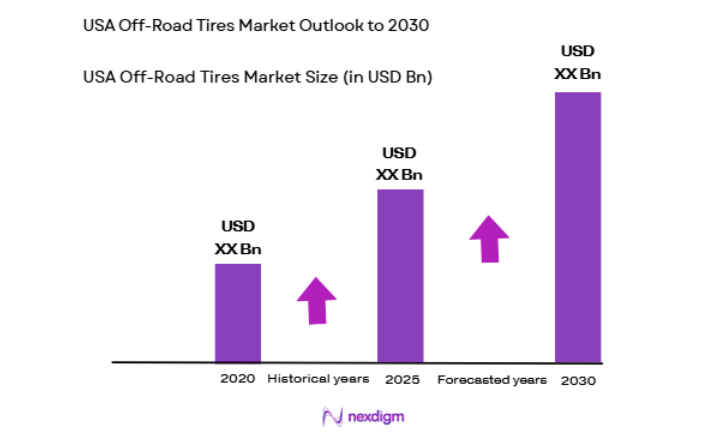
The USA off-road tires market is valued at approximately USD ~ billion based on a recent historical assessment derived from U.S. light truck and SUV tire replacement demand statistics and specialty tire segment revenues, reflecting combined OEM fitment and aftermarket upgrade demand across pickup trucks, SUVs, ATVs, and utility vehicles. Market growth is driven by strong pickup and SUV ownership exceeding 140 million vehicles and rising participation in off-road recreation, overlanding, and motorsport activities requiring specialized high-traction tire systems across diverse terrain conditions nationwide.
Key off-road recreation and vehicle markets including Texas, California, Arizona, Colorado, and Utah dominate the USA off-road tires market due to high pickup and SUV density, extensive desert and trail terrain, and strong off-road enthusiast communities. These regions benefit from off-road parks, motorsport events, and outdoor tourism economies that accelerate tire wear and replacement cycles. Concentration of specialty tire retailers and vehicle modification workshops further supports regional dominance in both consumption and distribution of off-road tire products.
Market Segmentation
By Product Type
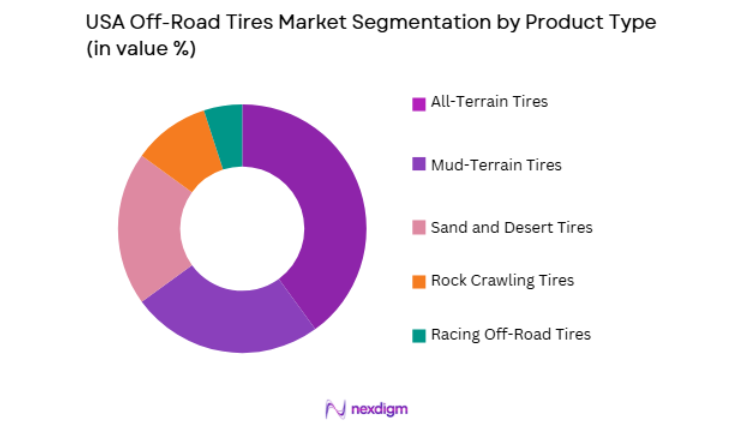
USA Off-Road Tires market is segmented by product type into all-terrain tires, mud-terrain tires, sand and desert tires, rock crawling tires, and racing off-road tires. Recently, all-terrain tires has a dominant market share due to factors such as versatile performance across mixed surfaces, compatibility with daily driving, and widespread pickup and SUV adoption. All-terrain tires balance on-road comfort with off-road traction, making them suitable for general consumers who use vehicles for both commuting and recreation. OEMs frequently install all-terrain variants on off-road trim packages, and aftermarket buyers prefer them for durability and usability across multiple terrains, reinforcing dominant adoption.
By Vehicle Type
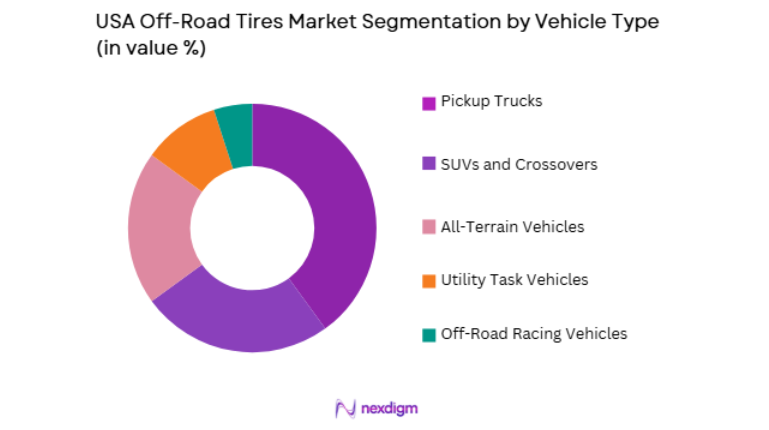
USA Off-Road Tires market is segmented by vehicle type into pickup trucks, SUVs and crossovers, all-terrain vehicles, utility task vehicles, and off-road racing vehicles. Recently, pickup trucks has a dominant market share due to factors such as highest off-road usage rates, heavy-duty load requirements, and strong aftermarket modification culture. Pickup trucks are widely used for recreation, overlanding, agriculture, and utility work, requiring durable and high-traction tire solutions. Their large wheel wells support oversized off-road tires, and OEM off-road packages frequently include specialized tires, ensuring strong installation and replacement demand across both consumer and commercial applications.
Competitive Landscape
The USA off-road tires market is highly competitive with major global tire manufacturers dominating premium and OEM segments, while niche brands compete in specialized terrain and motorsport categories. Leading firms leverage advanced tread design, reinforced sidewalls, and proprietary rubber compounds to differentiate performance across terrain conditions. Strong distribution through tire dealer networks, off-road retailers, and motorsport channels provides scale advantage, while enthusiast-driven brand loyalty reinforces market positioning among key consumer segments.
| Company Name | Establishment Year | Headquarters | Technology Focus | Market Reach | Key Products | Revenue | Terrain Specialization |
| BFGoodrich | 1870 | USA | ~ | ~ | ~ | ~ | ~ |
| Goodyear Tire & Rubber | 1898 | USA | ~ | ~ | ~ | ~ | ~ |
| Michelin | 1889 | France | ~ | ~ | ~ | ~ | ~ |
| Toyo Tire | 1945 | Japan | ~ | ~ | ~ | ~ | ~ |
| Nitto Tire | 1949 | Japan | ~ | ~ | ~ | ~ | ~ |
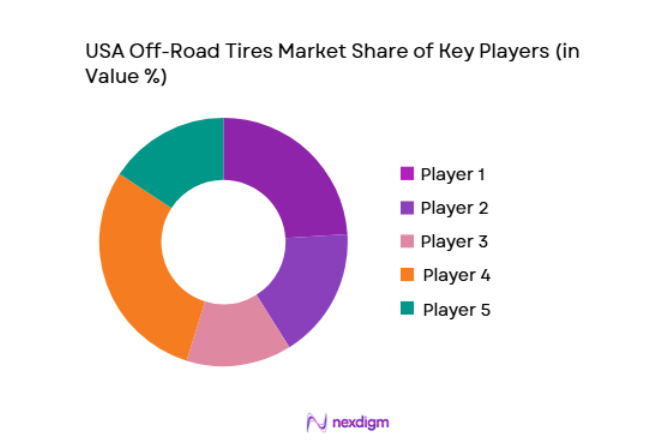
USA Off-Road Tires Market Analysis
Growth Drivers
Expansion of Off-Road Recreation, Overlanding, and Adventure Vehicle Usage
Expansion of off-road recreation, overlanding, and adventure vehicle usage is a primary growth driver for the USA off-road tires market because specialized tires are essential performance components for vehicles operating on trails, deserts, rocks, and mixed terrain environments. Participation in off-road travel, camping, and backcountry exploration has increased significantly across the United States, supported by national park access, off-road parks, and adventure tourism culture. Pickup trucks and SUVs are widely modified with lift kits and oversized tires to improve ground clearance and traction. Overlanding travel requires durable tires capable of carrying heavy loads across long distances and varied surfaces. Enthusiast communities promote off-road modifications including tire upgrades as foundational performance enhancements. Motorsports and recreational trail events further increase wear and replacement frequency. Retailers and specialty shops actively market terrain-specific tire solutions. As outdoor mobility lifestyles expand nationwide, specialized off-road tire demand continues to rise across both recreational and utility vehicle segments.
Increasing Adoption of Off-Road Trim Packages in Pickup Trucks and SUVs
Increasing adoption of off-road trim packages in pickup trucks and SUVs significantly drives the USA off-road tires market because automakers increasingly offer factory-equipped off-road variants featuring specialized suspension, wheels, and tires. Popular vehicle models include off-road editions with all-terrain or mud-terrain tires installed as standard equipment, expanding OEM fitment volumes. Consumers seeking adventure capability prefer factory-engineered off-road packages that include matched tire systems. OEM installation ensures compatibility and durability certification, encouraging adoption among mainstream buyers beyond enthusiast segments. Larger wheel arches and lifted suspension designs enable fitment of aggressive tread tires. Marketing of rugged lifestyle imagery further strengthens consumer appeal. Fleet operators in construction, agriculture, and energy sectors also select off-road packages for terrain capability. Shared tire platforms across multiple vehicle models increase production scale for tire manufacturers. The proliferation of factory off-road vehicle variants therefore structurally expands OEM and replacement demand in the USA off-road tires market.
Market Challenges
Accelerated Wear and Replacement Costs in Extreme Terrain Operation
Accelerated wear and replacement costs in extreme terrain operation present a major challenge in the USA off-road tires market because off-road tires experience significantly higher abrasion, puncture risk, and structural stress compared with standard highway tires. Rocky surfaces, sharp debris, mud, and sand environments accelerate tread wear and sidewall damage, reducing tire lifespan. Oversized tires with aggressive tread patterns also generate higher rolling resistance and uneven wear on paved roads. Consumers using off-road tires for mixed driving conditions face frequent replacement cycles and higher ownership costs. Commercial operators and fleets experience substantial maintenance expenses due to heavy-duty usage. Premium off-road tires incorporate reinforced materials that increase purchase price. Enthusiasts may accept cost but mainstream users can be discouraged. Warranty claims and performance expectations further pressure manufacturers. Balancing durability with affordability therefore remains a persistent challenge across the USA off-road tires market.
Natural Rubber Supply Volatility and Raw Material Cost Fluctuation
Natural rubber supply volatility and raw material cost fluctuation challenge the USA off-road tires market because off-road tires require high rubber content and specialized compounds to deliver traction and durability across harsh terrain. Global rubber supply is influenced by agricultural output, climate variation, and geopolitical trade dynamics, creating price instability. Synthetic rubber and reinforcing materials such as carbon black also experience petrochemical cost swings. Tire manufacturers face margin pressure when raw material costs rise rapidly while retail prices remain competitive. Off-road tires use thicker tread blocks and reinforced sidewalls, increasing material intensity relative to passenger tires. Inventory planning becomes difficult under volatile input pricing. Smaller specialty brands are particularly exposed to cost surges. Long-term OEM supply contracts limit price adjustments. Sustained raw material volatility therefore constrains profitability and pricing stability across the USA off-road tires industry.
Opportunities
Development of Advanced Hybrid All-Terrain Compound and Tread Technologies
Development of advanced hybrid all-terrain compound and tread technologies presents a major opportunity in the USA off-road tires market because consumers increasingly seek tires capable of delivering both highway comfort and off-road traction without compromise. Hybrid tread designs combining mud-terrain block geometry with all-terrain noise reduction features are gaining popularity. Advanced rubber compounds improve wear resistance while maintaining flexibility for traction across diverse surfaces. Manufacturers can differentiate products through proprietary compound formulations and computer-optimized tread patterns. These innovations appeal to mainstream pickup and SUV owners who use vehicles across mixed environments. OEMs also prefer versatile tires suitable for daily driving and off-road branding. Premium hybrid tires command higher margins and brand loyalty. As consumer expectations shift toward multi-purpose performance, hybrid all-terrain technologies represent a strong growth pathway in the USA off-road tires market.
Expansion of Electric Off-Road and Utility Vehicle Tire Segment
Expansion of electric off-road and utility vehicle tire segment offers significant opportunity in the USA off-road tires market because electric pickup trucks, SUVs, ATVs, and utility vehicles introduce new performance requirements for torque handling, weight capacity, and noise reduction. Electric vehicles generate instant torque that increases traction demand and tread stress. Heavier battery packs require higher load-rated tire structures. Electric off-road vehicles also prioritize low noise and efficiency, encouraging specialized tread and compound design. Manufacturers can develop EV-specific off-road tires optimized for torque distribution and durability. Growth of electric utility vehicles in agriculture, recreation, and industrial use expands addressable demand. OEM partnerships for electric off-road vehicle platforms provide long-term supply potential. As electrification expands beyond highways into off-road mobility, EV-compatible off-road tires represent an emerging high-value segment in the USA off-road tires market.
Future Outlook
The USA off-road tires market is expected to grow steadily over the next five years driven by continued pickup and SUV off-road adoption, expansion of outdoor recreation travel, and proliferation of factory off-road vehicle variants. Advanced tread and compound technologies will enhance durability and versatility. Electric off-road vehicles will create new tire performance requirements. Premium oversized and hybrid all-terrain tires will gain share. Strong enthusiast and utility demand is projected to sustain long-term market expansion.
Major Players
- BFGoodrich
- Goodyear Tire & Rubber
- Michelin
- Bridgestone
- Yokohama Tire
- Cooper Tire
- Toyo Tire
- Nitto Tire
- Falken Tire
- Hankook Tire
- Kumho Tire
- Maxxis International
- General Tire
- Dick Cepek Tires
- Pro Comp Tires
Key Target Audience
- Automotive OEM manufacturers
- Tire distributors and dealers
- Off-road vehicle manufacturers
- Fleet operators
- Agriculture and forestry operators
- Motorsport teams
- Investments and venture capitalist firms
- Government and regulatory bodies
Research Methodology
Step 1: Identification of Key Variables
Key variables including pickup and SUV ownership, off-road recreation participation, tire replacement cycles, terrain usage intensity, and OEM off-road package adoption were identified to define structural demand drivers in the USA off-road tires market.
Step 2: Market Analysis and Construction
Market sizing integrated vehicle parc data, off-road tire fitment ratios, and aftermarket replacement rates across pickup, SUV, ATV, and utility vehicle segments to estimate total demand across OEM and aftermarket channels.
Step 3: Hypothesis Validation and Expert Consultation
Consultations with tire engineers, off-road retailers, and vehicle modification specialists validated terrain performance requirements, replacement frequency, pricing structures, and technology trends influencing off-road tire demand.
Step 4: Research Synthesis and Final Output
Quantitative modeling and qualitative insights were synthesized into a comprehensive framework covering segmentation, competitive dynamics, technological evolution, and growth outlook across the USA off-road tires market.

- Executive Summary
- Research Methodology (Definitions, Scope, Industry Assumptions, Market Sizing Approach, Primary & Secondary Research Framework, Data Collection & Verification Protocol, Analytic Models & Forecast Methodology, Limitations & Research Validity Checks)

- Market Definition and Scope
- Value Chain & Stakeholder Ecosystem
- Regulatory / Certification Landscape
- Sector Dynamics Affecting Demand
- Strategic Initiatives & Infrastructure Growth

- Growth Drivers
Rising off-road recreation and overlanding participation
Increasing pickup truck and SUV off-road variants
Expansion of off-road motorsport events - Market Challenges
High wear rates in extreme terrain usage
Price sensitivity in aftermarket tire segment
Supply volatility in natural rubber materials - Market Opportunities
Development of advanced all-terrain compound technologies
Growth in electric off-road vehicle tire demand
Expansion of premium performance off-road tire segment - Trends
Shift toward hybrid all-terrain tread designs
Adoption of reinforced sidewall technologies
Increasing demand for oversized off-road tires - Government regulations
- SWOT analysis
- Porters 5 forces

- By Market Value, 2019-2025
- By Installed Units, 2019-2025
- By Average System Price, 2019-2025
- By System Complexity Tier, 2019-2025

- By System Type (In Value%)
All-Terrain Tires
Mud-Terrain Tires
Sand and Desert Tires
Rock Crawling Tires
Racing Off-Road Tires - By Platform Type (In Value%)
Pickup Trucks
SUVs and Crossovers
All-Terrain Vehicles
Utility Task Vehicles
Off-Road Racing Vehicles - By Fitment Type (In Value%)
OEM Factory Off-Road Tires
Aftermarket Performance Tires
Reinforced Heavy-Duty Tires
Beadlock Compatible Tires
Low-Pressure Off-Road Tires - By EndUser Segment (In Value%)
Off-Road Enthusiasts
Commercial Off-Road Operators
Agriculture and Forestry Users
Military and Defense Vehicles
Motorsport Teams - By Procurement Channel (In Value%)
Automotive Tire Dealers
Specialty Off-Road Retailers
Online Tire Platforms

- Market Share Analysis
- Cross Comparison Parameters (Tread Pattern, Terrain Performance, Durability Rating, Tire Size Range, Price Tier, Sidewall Strength, Load Capacity, Rubber Compound Type, Puncture Resistance, Traction Index, Weight Class, Beadlock Compatibility)
- SWOT Analysis of Key Competitors
- Pricing & Procurement Analysis
- Key Players
BFGoodrich
Goodyear Tire & Rubber
Michelin
Bridgestone
Yokohama Tire
Cooper Tire
Toyo Tire
Nitto Tire
Falken Tire
Hankook Tire
Kumho Tire
Maxxis International
General Tire
Dick Cepek Tires
Pro Comp Tires

- Pickup and SUV owners drive aftermarket upgrades
- Motorsport teams require high-performance tires
- Commercial operators demand durability and traction
- Defense users require rugged terrain capability

- Forecast Market Value, 2026-2030
- Forecast Installed Units, 2026-2030
- Price Forecast by System Tier, 2026-2030
- Future Demand by Platform, 2026-2030


 Request a Sample
 Ask for Customization
 Get a Quote
 Enquire Now