

 Download PDF
Market Overview
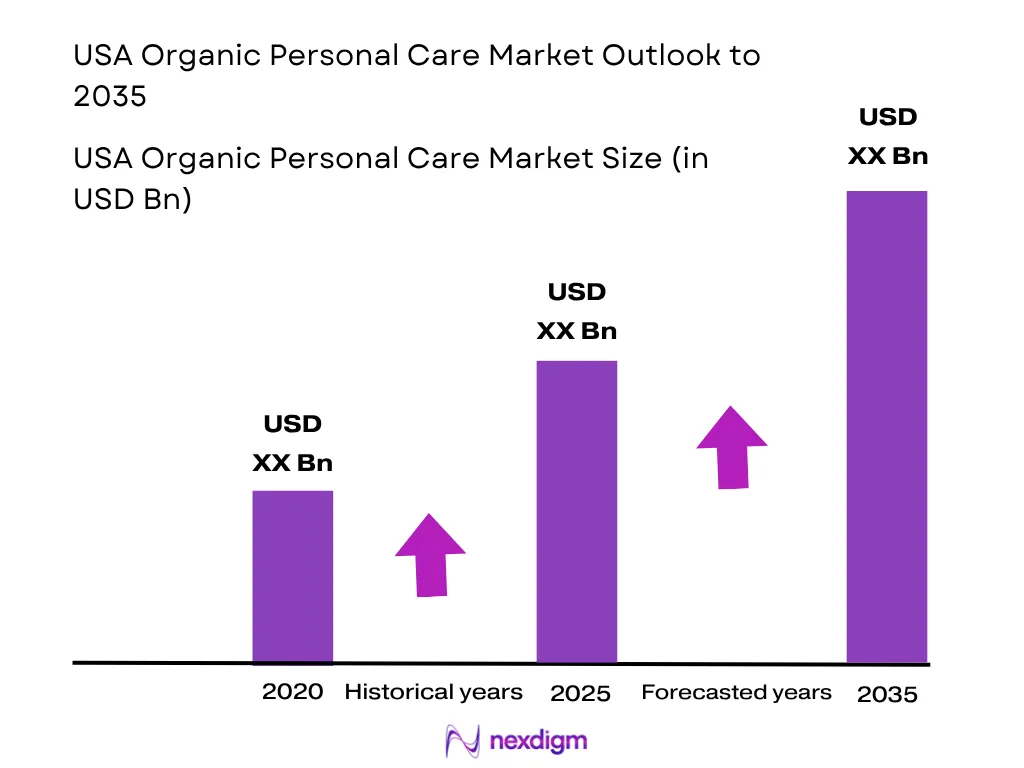
The USA Organic Personal Care market is valued at USD ~ billion, reflecting consistent growth due to an increasing preference for organic and clean beauty products. The demand is driven by consumer awareness about sustainability, health-conscious ingredients, and the growing desire for cruelty-free, non-toxic, and eco-friendly products. Consumers are increasingly seeking natural alternatives to conventional personal care products, with a notable increase in premium spending on skincare, haircare, and baby care products. The market’s growth is bolstered by strong e-commerce platforms and expanding availability in natural and specialty retail stores.
The USA leads the organic personal care market due to its large consumer base, established retail infrastructure, and high consumer demand for wellness-driven products. California and New York are key hubs, influenced by high levels of health and environmental consciousness. Furthermore, countries in the European Union, such as Germany and France, also hold significant market shares due to their stringent regulations on organic product certification and rising consumer interest in organic and sustainable beauty solutions. These regions lead because of favorable consumer perceptions, government policies supporting organic standards, and an established retail ecosystem.
Market Segmentation
By Product Category
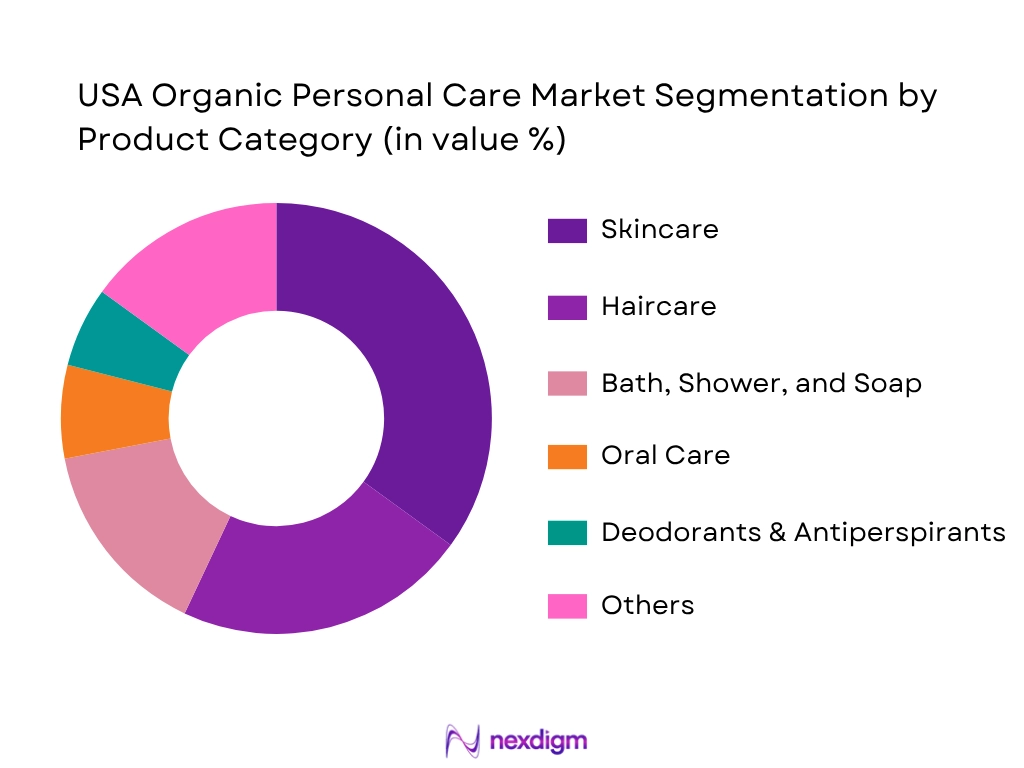
The USA Organic Personal Care market is segmented by product category into skin care, hair care, bath and shower products, oral care, deodorants and antiperspirant alternatives, baby and mom care, men’s grooming, sun care, and intimate care. Among these, the skincare segment holds the dominant market share due to growing consumer awareness about skincare ingredients and the shift towards clean and organic formulations. The rise in demand for anti-aging, hydration, and acne-fighting products further strengthens the skincare segment. Brands are investing in product innovation, natural ingredients, and eco-friendly packaging, which appeals to the growing number of conscious consumers.
By Organic Certification Type
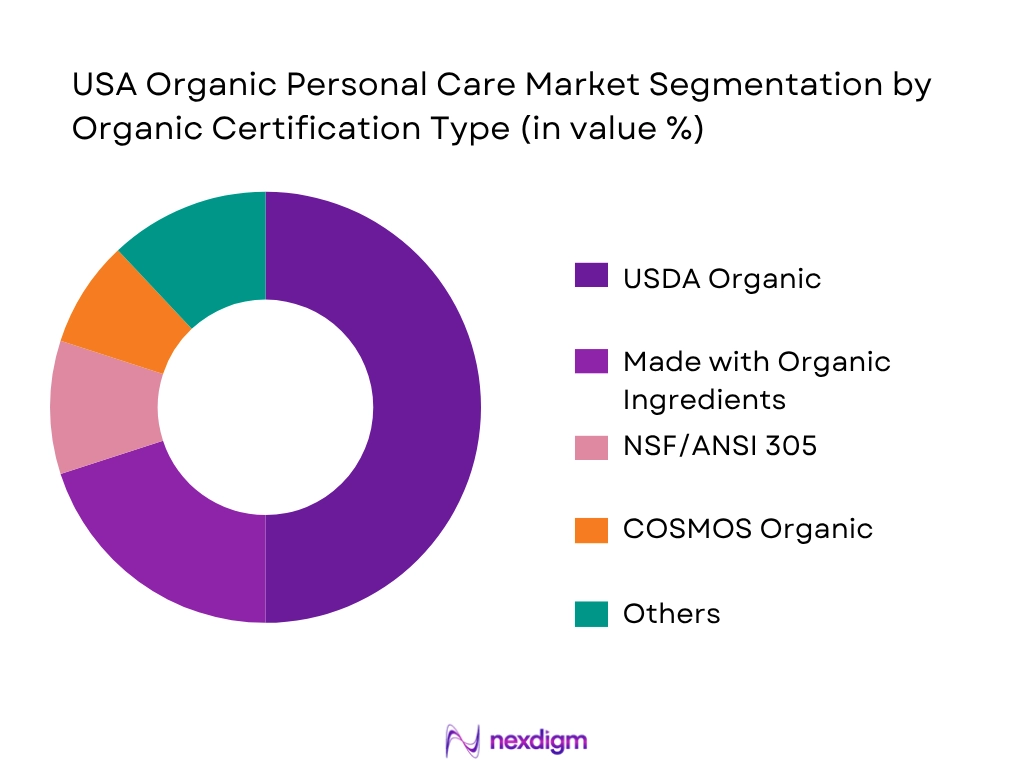
The market is also segmented based on organic certification types, such as USDA Organic, Made with Organic Ingredients, NSF/ANSI 305, COSMOS Organic, and other private standards. The USDA Organic certification type leads in this segment, as it is recognized widely and trusted by consumers. The certification is associated with high-quality standards for organic ingredients, boosting its popularity. Furthermore, consumers view the USDA Organic seal as a mark of authenticity and transparency in ingredient sourcing, enhancing brand loyalty. This certification type ensures a competitive advantage, especially in premium skincare products and baby care items.
Competitive Landscape
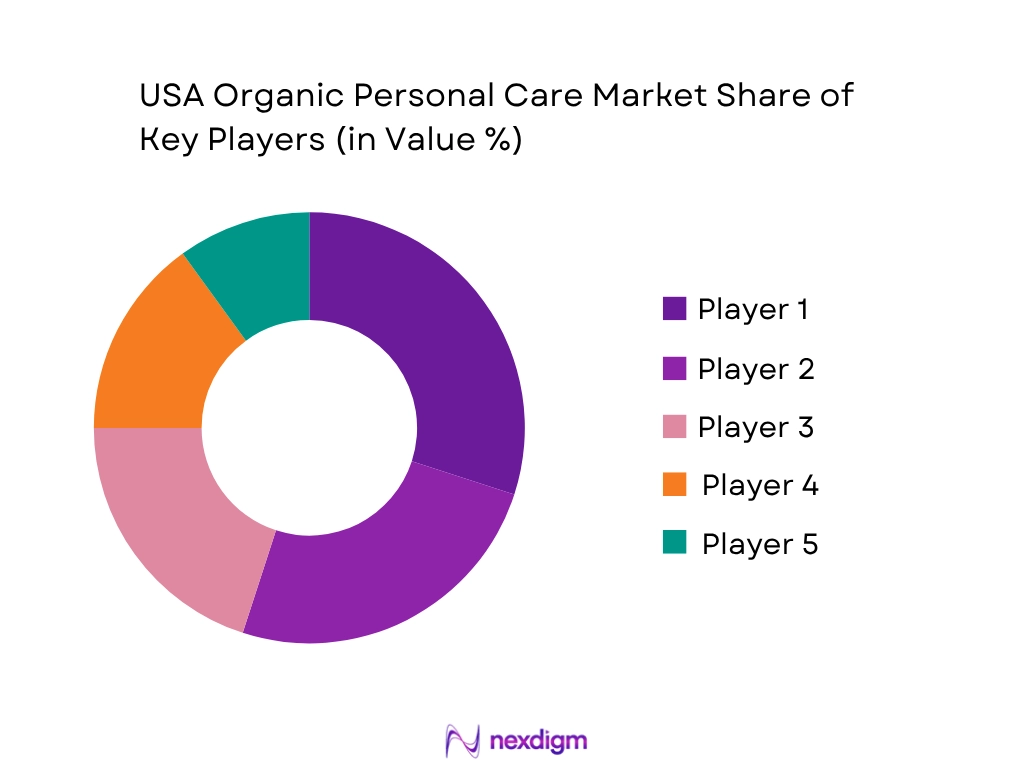
The USA Organic Personal Care market is highly competitive with several leading players, both global and local. The presence of both established multinational brands and emerging organic beauty companies drives the market forward. Companies like Burt’s Bees, Dr. Bronner’s, and Weleda lead the market due to their long-standing reputation for organic and ethical production processes. These brands dominate the market due to their extensive distribution networks, strong brand loyalty, and ability to innovate in clean beauty formulations.
| Company Name | Establishment Year | Headquarters | Product Offering | Market Position | Certifications | Revenue (USD) | Retail Presence | E-Commerce Share |
| Burt’s Bees | 1984 | Durham, NC, USA | ~ | ~ | ~ | ~ | ~ | ~ |
| Dr. Bronner’s | 1948 | Vista, CA, USA | ~ | ~ | ~ | ~ | ~ | ~ |
| Weleda | 1921 | Schwäbisch Gmünd, Germany | ~ | ~ | ~ | ~ | ~ | ~ |
| Avalon Organics | 1994 | Lebanon, NJ, USA | ~ | ~ | ~ | ~ | ~ | ~ |
| Honest Company | 2011 | Los Angeles, CA, USA | ~ | ~ | ~ | ~ | ~ | ~ |
USA Organic Personal Care Market Analysis
Growth Drivers
USDA Seal Trust
The USDA Organic seal has become a powerful symbol of authenticity and trust in the organic personal care market. According to the USDA, organic sales in the U.S. have reached USD 60 billion in 2023, with USDA-certified organic products gaining significant consumer trust due to their compliance with strict regulatory standards. This trust is especially crucial in the personal care segment, where consumers are increasingly wary of misleading labeling. The 2024 USDA Organic Agriculture Report indicates that the total value of certified organic production continues to rise, with organic food sales driving a large portion of the market growth. In 2024, the USDA’s organic certification program has grown to encompass over 34,000 certified organic operations across the U.S. As consumer demand for transparency and product integrity grows, products bearing the USDA seal of approval are likely to see continued strong demand. This trust in organic certifications is critical as consumers prioritize brands that ensure the safety and environmental sustainability of their purchases, especially in skincare, hair care, and baby care.
Wellness Convergence and Premiumization
The U.S. consumer market is experiencing a significant shift toward premiumization and wellness convergence, especially in the organic personal care sector. As consumers become more health-conscious, their preferences are leaning toward products that support both physical and mental well-being. A report from the World Bank in 2024 suggests that U.S. consumer spending on health-related products is expected to surpass USD 500 billion by 2025, with a notable increase in demand for organic and sustainable personal care items. Premiumization, where consumers opt for higher-end products that offer superior benefits, is further driving this shift. For instance, the increasing demand for high-quality organic skincare products that are dermatologically tested, cruelty-free, and free of harmful chemicals is reflected in the growth of luxury organic skincare brands. Additionally, wellness convergence, where health, beauty, and fitness intersect, is reshaping the beauty market. This trend is reinforced by data from the U.S. Department of Commerce, showing a significant rise in spending on organic beauty products that also cater to mental health, such as aromatherapy and natural stress-relief products. The wellness trend is aligning perfectly with organic beauty products, enhancing their appeal to a broader audience.
Market Restraints
Certification Cost
The high cost of obtaining organic certifications remains a barrier to entry for smaller companies in the U.S. personal care market. In 2024, the U.S. Department of Agriculture (USDA) estimates that small businesses face costs ranging from USD 2,000 to USD 5,000 to get USDA Organic certification, depending on the complexity of their operations. These fees can be a significant obstacle for emerging brands, particularly in the highly competitive beauty sector. The costs associated with maintaining organic certification are also ongoing, as companies must renew their certification annually. For many small-scale producers, the financial burden of certification, coupled with the stringent requirements for product sourcing and processing, may deter them from entering the organic personal care market. Moreover, a report by the National Agricultural Statistics Service (NASS) highlights that in 2024, 34% of farmers have expressed concerns about the increasing costs of organic certification and its impact on profitability. Such high costs can prevent many businesses from competing in the organic segment, limiting market growth.
Formulation Complexity
Organic personal care products face significant formulation challenges due to the complexity of sourcing and blending organic ingredients that meet both consumer expectations and regulatory standards. A study published by the FDA in 2024 showed that formulation complexity remains a critical challenge for organic personal care companies. For example, creating stable and effective products without synthetic preservatives, fragrances, and dyes while ensuring they meet organic standards can be difficult and expensive. Organic ingredients often have limited shelf life, which can affect product stability and efficacy. This is particularly challenging in the production of natural skincare products, where ingredients like essential oils, plant extracts, and botanicals must be sourced sustainably and formulated to retain their potency without compromising safety or performance. The FDA’s Cosmetics Program has noted that in 2024, approximately 15% of organic personal care brands report issues related to the stability of their formulations due to these challenges. This complexity increases the overall cost of production and limits innovation in the sector, thereby hindering market expansion.
Market Opportunities
Category Whitespace
The organic personal care market has significant whitespace opportunities, especially in niche categories that have not yet been fully tapped. For example, the demand for organic personal care products tailored for specific skin types and conditions, such as sensitive skin and eczema, is on the rise. According to data from the U.S. National Institutes of Health (NIH), in 2024, approximately 31 million Americans suffer from eczema, creating an increasing demand for organic products formulated for sensitive skin. This unmet need presents an opportunity for organic brands to innovate and capture market share by developing targeted products for these underserved consumer segments. Additionally, there is a growing opportunity in the organic men’s grooming segment, which remains underdeveloped compared to women’s skincare. Reports indicate that men are becoming more conscientious about their skincare routines, with a notable increase in the adoption of organic personal care products. For instance, a survey by the U.S. Census Bureau in 2024 revealed that more than 10% of U.S. men are purchasing organic grooming products, representing a largely untapped market segment. As these gaps are addressed, new product lines and innovations in personal care will continue to drive market growth.
Sensory-Led Innovation
Sensory-led innovation is rapidly emerging as a key opportunity in the organic personal care market. Consumers are increasingly looking for products that provide a holistic sensory experience, such as enhanced fragrance, texture, and overall usability, in addition to being organic. In 2024, the global sensory beauty market was valued at over USD 22 billion, with consumers demanding more multi-sensory experiences from their skincare and personal care products. Companies are responding to this demand by creating organic products that incorporate pleasant aromas, unique textures, and a luxurious feel, while still adhering to organic standards. Products that engage multiple senses, sight, touch, smell are particularly appealing to the wellness-conscious consumer. Data from the U.S. Department of Commerce in 2024 highlights that consumer interest in sensorial products has risen by 14%, with fragrances and textures becoming key factors in purchasing decisions for organic skincare products. This shift presents opportunities for companies to differentiate themselves in a crowded market by offering products that not only meet organic standards but also appeal to the growing demand for enhanced sensory experiences.
Future Outlook
Over the next decade, the USA Organic Personal Care market is poised for sustained growth. Driven by continued consumer demand for sustainable, clean beauty products, innovations in organic formulations, and increasing awareness about environmental and health-related concerns, the market is expected to grow significantly. Government regulations supporting organic certification and sustainability, alongside rising disposable incomes, will further bolster the adoption of organic personal care products. Additionally, the increasing availability of organic products through e-commerce channels will ensure further market penetration.
Major Players
- Burt’s Bees
- Dr. Bronner’s
- Weleda
- Avalon Organics
- Honest Company
- The Body Shop
- Lush
- Kiehl’s
- Aveda
- Oriflame
- Weleda
- Juice Beauty
- Acure
- Badger Balm
- Alaffia
Key Target Audience
- Investments and Venture Capitalist Firms
- Government and Regulatory Bodies (e.g., FDA, USDA)
- Organic Product Manufacturers
- Retailers and Distributors
- E-Commerce Marketplaces
- Beauty and Personal Care Industry Associations
- Pharmaceutical and Wellness Companies
- Private Label Brands
Research Methodology
Step 1: Identification of Key Variables
In this phase, we identified and mapped the key stakeholders in the organic personal care industry. The focus was on consumer behavior, certification standards, and distribution channels. Secondary research was used to gather data from industry reports, public databases, and government resources.
Step 2: Market Analysis and Construction
We analyzed the USA Organic Personal Care market by studying historical trends, consumer preferences, and pricing strategies. This involved looking at historical data, consumer surveys, and market research reports to understand the growth trajectory.
Step 3: Hypothesis Validation and Expert Consultation
To validate the market insights, we conducted expert consultations with industry professionals from manufacturers, certification bodies, and retailers. These consultations helped us refine the hypotheses regarding growth drivers and challenges within the market.
Step 4: Research Synthesis and Final Output
The final phase involved synthesizing the collected data from various sources and consulting experts to create a comprehensive market report. This ensured that the final analysis was robust, accurate, and reflective of the current trends within the organic personal care industry.

- Executive Summary
- Research Methodology [Market Definitions and Boundary Conditions, Secondary Research Architecture, Research Framework, Top-to-Bottom Market Sizing Approach, Bottom-to-Top Market Sizing Approach, Forecasting Framework, Data Triangulation and Reconciliation, Assumptions, Limitations, and Validation Notes]

- Definition and Scope
- Market Genesis and Evolution
- Certification and Labeling Architecture
- Regulatory Boundary Between Organic Claims and Cosmetic Compliance
- Value Chain and Supply Chain Structure
- Import Dependence, Traceability, and Fraud-Control Architecture
- Business Cycle and Demand Seasonality
- Ecosystem Mapping

- Growth Drivers [ingredient safety concerns, USDA seal trust, wellness convergence, premiumization, baby/sensitive-skin demand]
- Market Restraints [certification cost, formulation complexity, price premium, shelf competition, regulatory fragmentation]
- Market Opportunities [category whitespace, sensory-led innovation, sensitive-skin, refill, premium private label, digital discovery]
- Market Trends [clinical-organic convergence, ingredient-led discovery, microbiome, social commerce, value polarization]
- Regulatory Landscape [USDA/NOP, FDA/MoCRA, FTC Green Guides, California ingredient reporting, retailer compliance standards]
- Sustainability and Circularity Analysis [PCR use, recyclability, refill adoption, waterless formats, carbon/waste messaging]
- Ingredient and Claims Analysis [organic content %, hero actives, restricted lists, “free-from” depth, clinical proof, claim overlap]
- Value Chain and Supply Chain Analysis [farm-to-extract flow, import dependencies, converter margins, fill-finish nodes, quality controls]
- Pricing Dynamics and Margin Stack [input-cost pass-through, promotional cadence, gross margin, contribution margin, channel economics]
- Private Label vs Branded Landscape [price gap, trust gap, innovation rate, certification depth, shelf productivity]
- SWOT Analysis of Industry
- Stakeholder Ecosystem (Suppliers, Retailers, Distributors, Government)
- Porter’s Five Forces Analysis
- Competitive Landscape Overview

- By Value (2020-2025)
- By Volume (2020-2025)
- By Average Selling Price (2020-2025)
- By Category Contribution (2020-2025)
- By Channel Contribution (2020-2025)

- By Product Category [In Value%]
Skin Care
Hair Care
Bath, Shower, and Soap
Oral Care
Deodorants and Antiperspirant Alternatives
Baby and Mom Care
Men’s Grooming
Sun Care
Intimate Care - By Organic Certification Type [In Value%]
USDA Organic
Made with Organic Ingredients
NSF/ANSI 305
COSMOS ORGANIC
COSMOS NATURAL / Other Private Standards
Organic-Positioned but Non-Certified Claims - By Price Tier [In Value%]
Mass
Masstige
Prestige
Premium-Luxury Botanicals - By Distribution Channel [In Value%]
Natural and Specialty Retail
Food, Drug, and Mass Retail
Club and Value Retail
Beauty Specialty Retail
E-Commerce Marketplaces
Brand-Owned DTC
Professional, Spa, and Practitioner Channels - By End User [In Value%]
Women
Men
Babies and Kids
Teens and Young Adults
Pregnancy and Postpartum
Sensitive-Skin / Eczema-Prone Consumers - By Packaging Format [In Value%]
Bottles
Tubes
Pumps and Dispensers
Jars and Tubs
Sticks and Balms
Bars and Solid Formats
Refill Packs and Concentrates - By Region [In Value %]
Northeast
Midwest
South
West

- Competitive Landscape and Market Concentration [top-player share, fragmentation, emerging-brand pressure, portfolio breadth]
- Market Share of Major Players by Value and Volume [overall share, category share, channel share, branded vs private label]
- Cross Comparison Parameters [USDA/COSMOS/NSF certification coverage, Clean/Free-From claims penetration, Organic SKU count, Retail distribution points/ACV, DTC penetration %, Average ASP for organic SKUs, Ingredient sourcing traceability score, Sustainability/refill-packaging circularity score]
- Category-Claim Benchmarking [baby-safe, sensitive-skin, lip care, soap, scalp care, deodorant, oral care, sun care]
- SKU Pricing and Pack Architecture Analysis [price per oz/ml, promo depth, assortment ladder, size normalization]
- SWOT Analysis [Major Competitors]
- Manufacturing Footprint and Capacity Analysis [owned plants, co-manufacturing mix, fill-finish capability, domestic/import split, batch flexibility]
- Certifications, Claims, and Innovation Benchmarking [USDA seal use, NSF/COSMOS use, clinical proof, new-launch cadence, hero ingredients]
- Recent M&A, Partnerships, Retail Expansion, and Strategic Moves [distribution wins, collaborations, portfolio extensions, investment activity]
- Detailed Profiles of Major Companies
Bees
The Honest Company
Dr. Bronner’s
Avalon Organics
Weleda
EO Products
Alaffi
Juice Beauty
True Botanicals
OSEA
ACURE
California Baby
Badger
Babo Botanicals
Tom’s of Maine

- Buyer Cohort Profiling [age, income, household type, condition-led needs, wellness orientation]
- Purchase Drivers and Barriers [seal trust, safety perception, efficacy, scent, value, availability]
- Shopper Journey and Decision Funnel [awareness source, trial trigger, review influence, conversion friction, repurchase trigger]
- Channel Behavior Analysis [discovery channel, purchase channel, replenishment channel, basket mission]
- E-Commerce, DTC, and Social Commerce Analysis [traffic source, CAC, conversion rate, subscription mix, repeat rate]
- Basket Composition and Repurchase Economics [cross-sell, attach rate, replenishment cycle, bundle uptake]
- Retailer and Practitioner Influence [buyer gatekeeping, shelf standards, dermatologist/esthetician/pediatric endorsement]

- By Value (2026-2035)
- By Volume (2026-2035)
- By Average Selling Price (2026-2035)
- By Category Growth Contribution (2026-2035)
- By Channel Growth Contribution (2026-2035)


 Request a Sample
 Ask for Customization
 Get a Quote
 Enquire Now