
 Download PDF
Market Overview
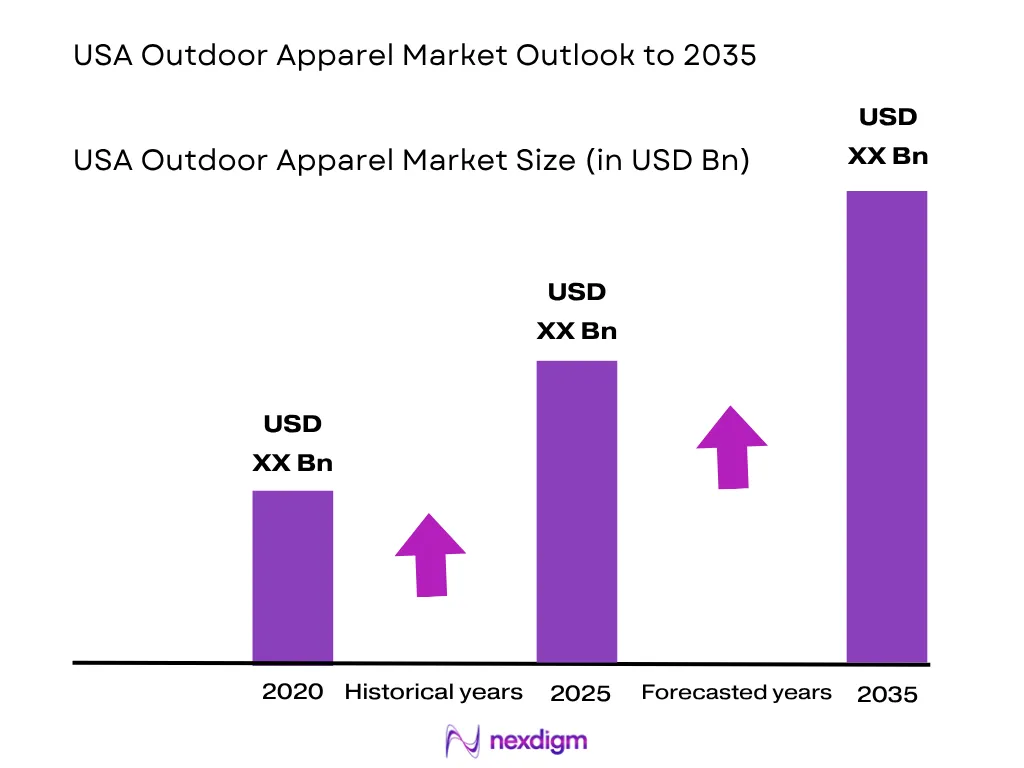
The USA Outdoor Apparel Market is a substantial and mature segment within the broader apparel industry, valued at approximately USD ~ billion in 2025 according to Nexdigm’s five‑year historical analysis of industry sales and retail performance data in the United States. The Market is projected to grow at an estimated CAGR of 6.7% during the 2026–2035 period, expanding significantly as consumer appetite for versatile, high‑performance, and sustainable apparel continues to strengthen. This valuation reflects strong consumer demand for technical outdoor clothing across hiking, backpacking, camping, snow sports, and lifestyle uses, driven by increased participation in outdoor activities, heightened focus on health and fitness, and sustained premiumization of performance gear. These forces have pushed consumers toward higher‑priced, function‑driven apparel, fueling market growth.
The market’s dominance is concentrated in cities and states with established outdoor cultures and high participation in outdoor activities. California, with its favorable year‑round climate and extensive national parks, leads due to consistent consumer demand and high discretionary spending capacity. Colorado and Washington State also exert significant influence, driven by proximity to major outdoor recreation hubs and robust retail infrastructures. New York remains a key distribution and trend gateway, connecting urban outdoor lifestyle trends with broader national consumption patterns.
Market Segmentation
By Product Category
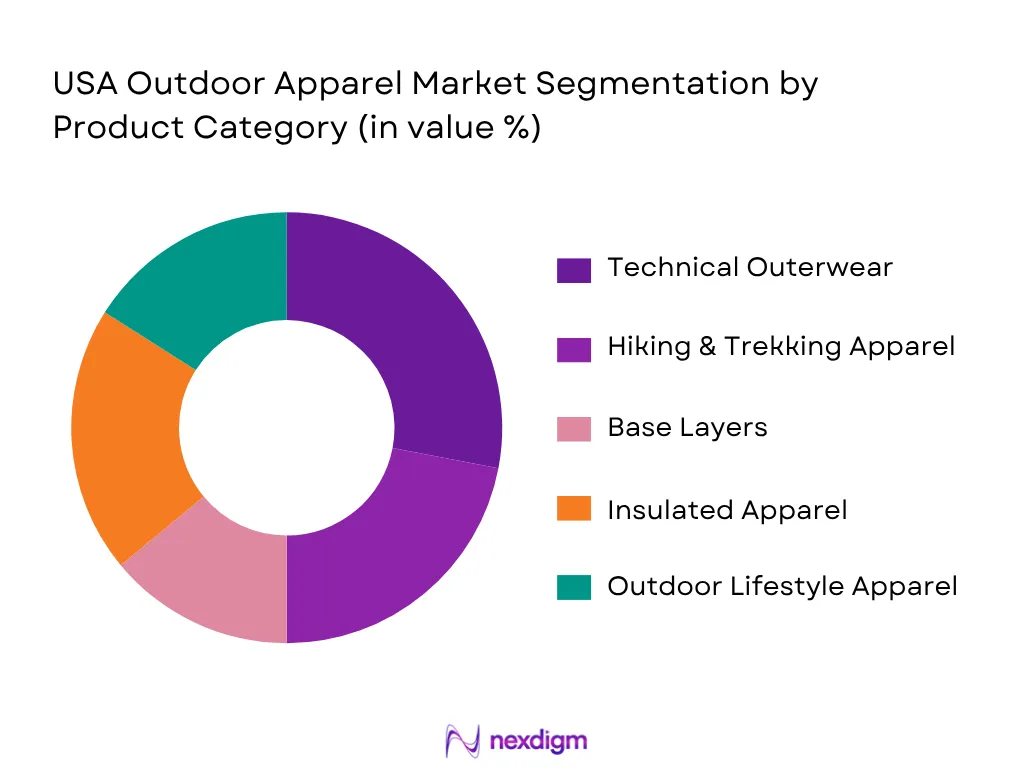
The USA Outdoor Apparel market is segmented by product into Technical Outerwear, Hiking & Trekking Apparel, Base Layers, Insulated Apparel, and Outdoor Lifestyle Apparel. Technical Outerwear holds the largest market portion due to its fundamental performance benefits (weather protection, breathability, layering compatibility) that resonate across active outdoor participants and urban consumers seeking functional fashion. Consumers increasingly designate outerwear as a primary purchase due to its versatility across seasons and activities, making it a higher‑value product category with robust retail turnover. Demand is particularly strong for waterproof and insulated shells designed for variable environments, which boosts sales relative to other categories. Outdoor lifestyle apparel, while not as performance‑centric, benefits from crossover appeal into fashion and everyday wear, supporting its steady share.
By Distribution Channel
The USA Outdoor Apparel market is categorized into Specialty Outdoor Retail, E‑Commerce Platforms, Department/Big‑Box Retail, and Direct‑to‑Consumer Stores. Specialty Outdoor Retail dominates due to its tailored focus, expert staffing, and deep assortments that align with performance‑oriented consumer needs. Brands benefit from these niche retailers’ credibility and trusted consumer engagement, particularly for high‑end technical gear. E‑Commerce has seen substantial growth from both pure online players and brand DTC channels, driven by convenience and digital discovery tools, making it an increasingly competitive segment. Department and big‑box channels maintain relevance for value buyers and broad distribution, while DTC stores support brand loyalty and personalized experiences, albeit from a smaller base. 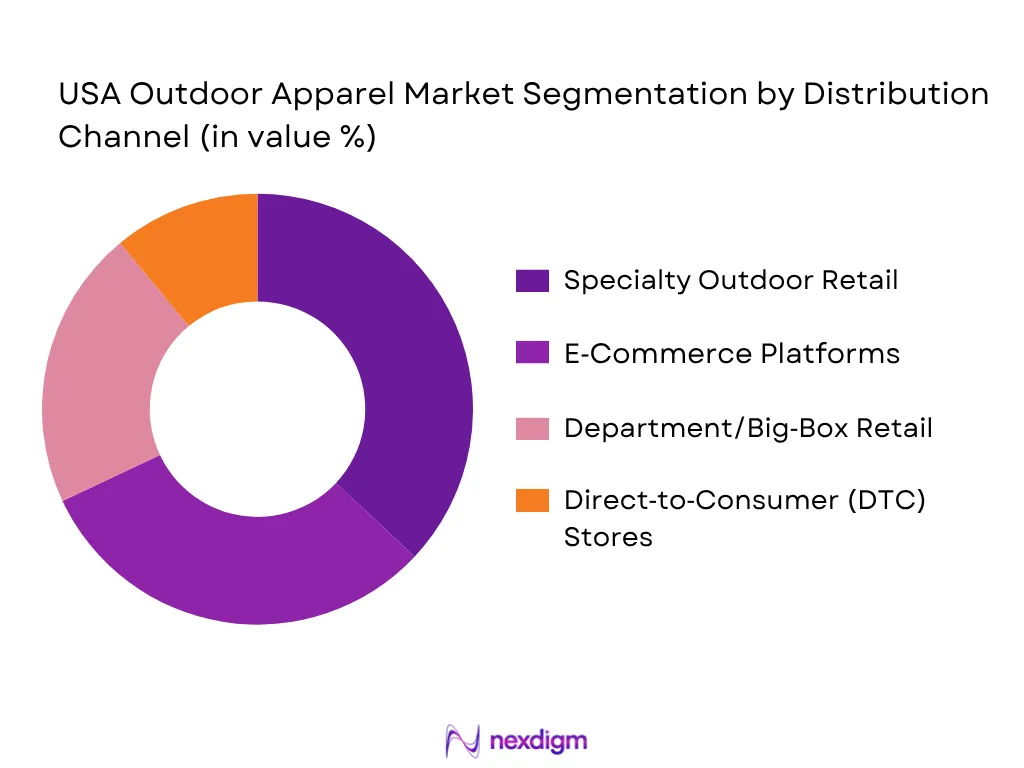
Competitive Landscape
The competitive structure of the USA Outdoor Apparel Industry reflects a mix of long‑standing heritage brands and innovative challengers that drive material, design, and channel strategies to capture consumer segments. The market features strong influence from key players leveraging global supply chains, multi‑channel distribution, and brand heritage to maintain consumer engagement and growth. Competitive consolidation exists around value tiering and omnichannel capabilities that maximize reach, while newer entrants focus heavily on sustainable materials and direct‑to‑consumer strategies to differentiate. Distribution through specialty outdoor retailers and digital platforms remains critical for brands seeking broad penetration and performance positioning.
| Company | Est. Year | Headquarters | Product Diversity | Channel Reach | Innovation Investment | Brand Equity | Sustainability Focus |
| The North Face | 1966 | USA | ~ | ~ | ~ | ~ | ~ |
| Patagonia | 1973 | USA | ~ | ~ | ~ | ~ | ~ |
| Columbia Sportswear | 1938 | USA | ~ | ~ | ~ | ~ | ~ |
| REI Co‑op | 1938 | USA | ~ | ~ | ~ | ~ | ~ |
| Arc’teryx | 1989 | Canada | ~ | ~ | ~ | ~ | ~ |
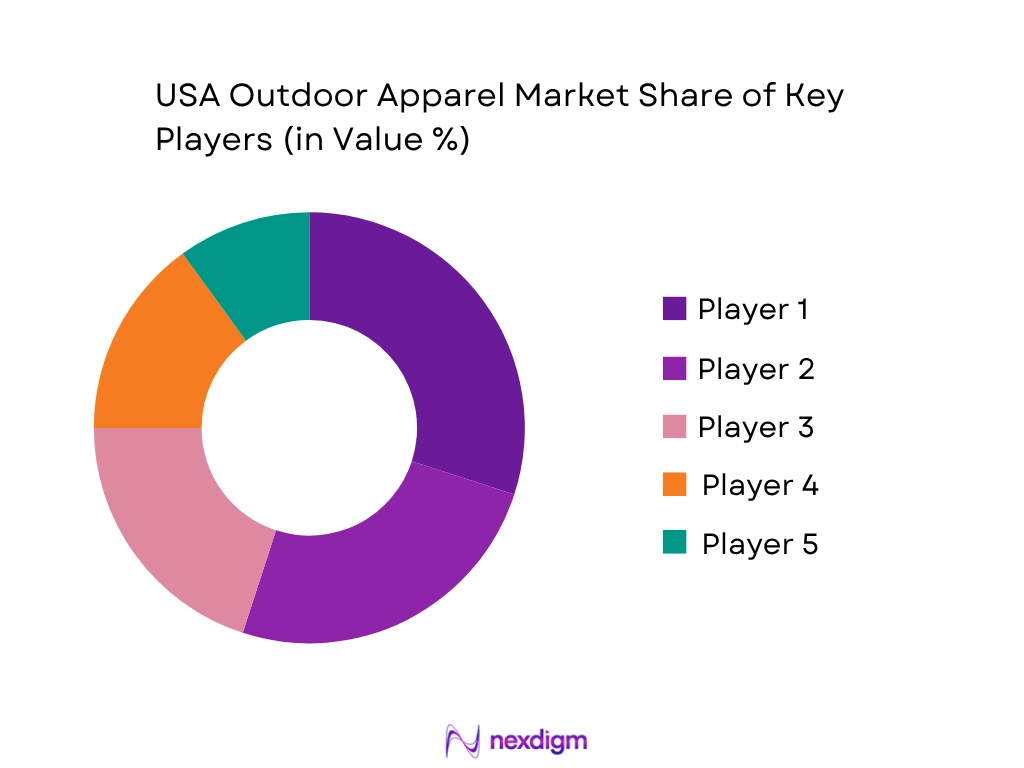
USA Outdoor Apparel Market Analysis
Growth Drivers
Performance & Technical Innovation
The demand for performance‑oriented and technically engineered outdoor apparel in the United States has been reinforced by broader economic activity and outdoor participation patterns. According to the U.S. Bureau of Economic Analysis, the outdoor recreation economy contributed USD 696.7 billion to U.S. GDP in 2024, accounting for 2.4 percent of total national GDP, indicating substantial engagement in activities that require specialized gear and clothing. This level of economic participation reflects not only travel and leisure spending but also the associated demand for functional outdoor apparel designed to withstand weather extremes and diverse terrain. Active consumers are seeking garments with advanced moisture‑management, thermal regulation, and abrasion‑resistance properties, informed by a growing base of outdoor workers and recreational athletes. Simultaneously, the U.S. workforce and active population remain high: the population reached 340,110,988 in 2024, sustaining a broad consumer base with discretionary purchasing power for higher‑performance apparel. These macro drivers show that performance and technical innovation are central catalysts for outdoor apparel demand, as consumers increasingly prioritize gear capable of optimizing activity performance and comfort in varied environments.
Outdoor Recreation Participation
Active outdoor participation in the USA acts as a key upstream driver for outdoor apparel consumption. Federal economic statistics from the U.S. Bureau of Economic Analysis show that conventional outdoor recreation activities including hiking, boating, and snow activities accounted for nearly 29.5 percent of total outdoor recreation value added in 2024, with activities like boating and RVing contributing USD 38.4 billion and USD 27.5 billion respectively to national value added. These significant monetary contributions reflect widespread engagement in outdoor activities that inherently require specialized apparel for comfort, protection, and safety. Higher participation in these activities corresponds with increased sales of rugged garments designed for specific performance needs (e.g., breathable outerwear, thermal insulation, UV protection, water repellency). The strong U.S. consumer capacity with a GDP of USD 28.75 trillion in 2024 supports discretionary spending on outdoor leisure and related gear. As consumers invest in multi‑day trips, eco‑tourism, and adventure sports, the demand for apparel capable of meeting varied climatic, physical, and functional requirements is increasingly embedded in consumer spending behavior.
Market Challenges
Raw Material Price Volatility
Volatility in raw material pricing has emerged as a challenge for U.S. outdoor apparel producers and brands due to its direct impact on input costs and supply‑chain stability. Data from TradingEconomics’ commodity price indices show that cotton a fundamental fiber in textile production was trading around 80.95 U.S. cents per pound in May 2026, with prices rising 23.36 percent compared to the prior year, reflecting swings in commodity markets and agricultural supply availability. The World Bank’s raw material price indices indicate that raw material prices, which include fibers, saw marginal movement in early 2024, influenced by broader agricultural commodity shifts and supply expectations. These fluctuations make budgeting and procurement challenging for apparel manufacturers who must secure consistent volumes of cotton, polyester, nylon, and blended fibers under volatile cost conditions. Price unpredictability at the raw material stage particularly for cotton and synthetics tied to global energy and fertilizer inputs can complicate product cost forecasting and compress margins for outdoor apparel firms operating amid tight retail pricing expectations. Especially when macroeconomic conditions (such as energy and fertilizer price shifts) influence commodity indices, brands may face increased pressure to absorb cost variations or pass on pricing to consumers, both of which have direct implications for competitiveness.
Supply Chain Disruptions
Supply chain disruptions remain a significant operational challenge for the USA outdoor apparel market, affecting lead times and inventory planning. Although industry‑specific supply chain metrics are limited in publicly available government data, broader trade data and economic indicators illustrate friction points. For example, U.S. merchandise trade trends in 2024 showed continued complexity in import dynamics, with general merchandise imports and exports reflecting changing global patterns, while apparel supply chain insights from reputable industry reporting confirm that U.S. seaborne apparel imports fell by 18 percent in a recent period, indicating slowed inbound flows for textiles and finished goods. These logistics constraints are amplified by global maritime bottlenecks, port congestion, and tariff uncertainties, creating instability in the flow of raw materials (such as technical fabrics) and finished outdoor products into the U.S. market. With a national consumer base underpinned by broad internet connectivity and a large working population, disruptions in delivery timelines can lead to stockouts or over‑stock scenarios that squeeze cash flow. This challenge is compounded when apparel producers rely on international sourcing networks for fabric and trim components, increasing exposure to geopolitical shifts and logistical delays. As a result, supply chain resilience strategies including multi‑sourcing and inventory buffering — have become imperative to maintaining continuity in product availability.
Market Opportunities
Sustainable & Circular Product Lines
The demand for sustainable and circular outdoor apparel product lines in the U.S. aligns with broader shifts in global fiber production patterns and consumer consciousness about environmental impact. Global fiber production reached 124 million tonnes in 2023, and although this is a worldwide figure, the significant scale of fiber output underscores the critical role of material innovation and sustainable raw materials in apparel value chains — particularly as brands seek to reduce reliance on virgin fossil‑based synthetics and promote recycled content. Industry data show that production of recycled polyester fibers and certified animal fibers is increasing in absolute tonnage, despite challenges in scaling textile recycling. As U.S. consumers exhibit greater environmental awareness, driven by education and policy dialogue around sustainability, opportunities arise for outdoor apparel brands that can integrate recycled materials, lower‑impact dyeing technologies, and circular design principles into core product offerings. With macro indicators showing a population of 340 million individuals in the United States in 2024, a large consumer base is present that can influence market directions through purchase decisions. Brands that prioritize eco‑innovation and transparent supply chain practices are positioned to capture loyalty among environmentally conscious segments of the outdoor apparel market.
Direct‑to‑Consumer Expansion
Expansion of direct‑to‑consumer (DTC) channels presents a clear opportunity for outdoor apparel brands seeking to strengthen margins and consumer relationships. While sector‑specific DTC figures are primarily proprietary, macroeconomic indicators illustrate a robust U.S. economy that supports consumer spending power and digital engagement. The U.S. had GDP per capita of USD 84,534 in 2024, implying strong average income levels that can sustain discretionary purchases through convenient channels. High internet penetration supports DTC expansion, with 95 percent of the population using the internet in 2024, enabling brands to reach and transact directly with consumers through online platforms. Outdoor apparel customers increasingly prefer personalized shopping experiences, rapid fulfillment, and brand communities that digital ecosystems support. DTC expansion allows brands to leverage first‑party consumer data, control brand narratives, and reduce dependency on wholesale intermediaries. In addition to digital growth, physical brand‑owned stores can serve as experience centers, further unifying online and offline engagement. The strength of the digital economy combined with high consumer connectivity in the U.S. suggests that investments in DTC infrastructure and strategies will amplify brand reach, enhance loyalty programs, and unlock higher lifetime value per customer.
Future Outlook
- The USA Outdoor Apparel market is positioned for sustained growth over the next decade driven by:
- Continued expansion of outdoor recreation activities with broad demographic participation.
- Increasing consumer preference for sustainable and performance‑oriented apparel that crosses over into everyday lifestyle use.
- Greater adoption of omnichannel retail models combining digital efficiency with experiential in‑store engagement.
- Advances in fabric technologies that enhance comfort, durability, and adaptability to variable environments.
Integrated digital initiatives and brand loyalty programs will support consumer engagement, while growth in direct‑to‑consumer sales and customized offerings will enable companies to capture higher margins and personalized consumer value.
15 Major Players
- The North Face
- Patagonia
- Columbia Sportswear
- REI Co‑op
- Arc’teryx
- Mountain Hardwear
- Outdoor Research
- Black Diamond
- Marmot
- Eddie Bauer
- Nike ACG
- Under Armour
- Prana
- Fjällräven
- Timberland
Key Target Audience
- Apparel & Outdoor Retail Buyers / Merchants
- Brand & Product Development Teams at Outdoor Companies
- Private Equity & Venture Capital Investment Firms
- Distribution & Logistics Decision Makers
- Procurement Leaders at Specialty Retail Chains
- Brand Licensing & Partnership Strategy Departments
- Government and Regulatory Bodies (e.g., U.S. Consumer Product Safety Commission, U.S. Trade Representative)
- Sports & Recreation Event Planners / Outfitters
Research Methodology
Step 1: Identification of Key Variables
The research commenced by mapping all critical stakeholders in the USA Outdoor Apparel ecosystem, including manufacturers, retailers, distributors, and consumer groups. Secondary data sources such as industry reports, company filings, and trade associations were collated to identify market drivers, restraints, and historical trends.
Step 2: Market Analysis and Construction
Historical data on sales value, unit volume, channel performance, and price structures were compiled and analyzed. Multiple data validation checks, cross‑referencing retail audit data with public financials, ensured accurate segmentation and baseline market sizing for 2023–2024. Analytical modeling techniques provided reliable estimates of revenue and category performance.
Step 3: Hypothesis Validation and Expert Consultation
Market hypotheses were tested through interviews with industry executives, category buyers at specialty retailers, and product innovation leaders. This provided operational insights and contextual validation of key drivers such as omnichannel growth and fabric innovation, informing forecast assumptions.
Step 4: Research Synthesis and Final Output
Final analysis included deep integration of quantitative data with qualitative industry insights. Scenario forecasting models assessed growth trajectories through 2035, combining bottom‑up channel analysis with top‑down macroeconomic and outdoor participation trends, resulting in robust and validated projections.

- Executive Summary
- Research Methodology Definitions, Scope and Inclusion Criteria, Market Sizing and Forecasting Framework (Volume, Value, ASP, CAGR), Data Normalization & Harmonization Approach, Primary Research Coverage, Panel Calibration and Outlier Treatment, Model Assumptions and Confidence Intervals, Bias Mitigation and Quality Control Protocols)

- Market Genesis and Evolution
- Market Lifecycle
- Outdoor Apparel Value Chain
- Supply Chain Dynamics
- Retail Channel Economics
- Demand Framework

- Growth Drivers (Performance & Technical Innovation, Outdoor Recreation Participation, Premiumization & Brand Loyalty, Digital & Omni-Channel Expansion, Sustainability & Eco-Friendly Fabrics, Climate & Seasonal Demand, Health & Fitness Trends)
- Market Challenges (Raw Material Price Volatility, Supply Chain Disruptions, Channel Cannibalization, Counterfeit & Grey Market Products, Price Sensitivity, Inventory & Seasonal Stock Management)
- Opportunities (Sustainable & Circular Product Lines, Direct-to-Consumer Expansion, Rental & Resale Models, Customization & Personalization Services, Connected/Wearable Apparel, Private Label Partnerships, E-Commerce Penetration)
- Emerging Trends (Technical & Smart Fabrics, Influencer & Social Media Marketing, Seasonal Capsule Collections, Sustainable Packaging & Brand Messaging, Hybrid Apparel for Urban + Outdoor, Product Personalization by Activity)
- Regulatory Environment (FTC Textile Labeling Compliance, CPSIA & Safety Standards, Tariff & Trade Regulations, Environmental & Labor Compliance, OEKO-TEX / Bluesign Certifications, Advertising & Claims Verification, Packaging Sustainability Guidelines)
- Porter’s Five Forces Analysis (New Entrants, Supplier Power, Buyer Power, Substitutes, Competitive Rivalry)
- SWOT Analysis (Market Level) (Strengths: Brand Equity & Technical Performance; Weaknesses: Price Sensitivity & Inventory Risk; Opportunities: Sustainability & Direct-to-Consumer Channels; Threats: Supply Chain Disruption & Competitive Saturation)
- Value Chain & Supply Chain Analysis (Raw Materials – Polyester, Nylon, Wool, Recycled Fabrics, Technical Laminates; Domestic Manufacturing vs Imports; Production Lines & Capacity; Logistics & Distribution Hubs; Retail & Wholesale Channels; Quality Testing & Certification; Returns & Reverse Logistics)
- Consumer Purchase Behavior & Retail Analytics (Purchase Frequency by Category, Basket Affinity & Cross-Sell, Brand Loyalty & Retention, Online vs In-Store Preferences, Social Media Influence, Seasonal & Weather-Driven Buying, Consumer Willingness-to-Pay for Sustainability & Technical Features)

- By Value (2020-2025)
- By Volume (2020-2025)
- By Average Selling Price Trends (2020-2025)
- By Consumption Intensity (2020-2025)
- By Inventory & Sell‑Through Metrics (2020-2025)

- By Category (In Value%)
Technical Outerwear
Hiking & Trekking Apparel
Performance Base Layers
Insulated Apparel
Active Outdoor Lifestyle Apparel - By Fabric & Technology (n Value%)
Synthetic
Natural
Recycled & Sustainable Materials
Technical Laminates & Membranes - By Distribution Channel (In Value%)
Specialty Outdoor Retailers
Department Stores & Big‑Box
E‑Commerce (Brand DTC, Marketplaces)
Wholesale B2B (Outfitting, Corporate) - By Consumer Demographic (Penetration %)
Gender (Men / Women / Unisex)
Age Cohorts (Millennial Outdoor Enthusiasts, Gen Z)
Income Bands (Mass, Upper Mass, Premium) - By End‑Use Activity (In Value%)
Hiking & Backpacking
Camping
Trail Running
Snow Sports
Water & Coastal Activities

- Market Share & Positioning (Market Share by Value & Volume, Category-Level Share – Technical Outerwear, Hiking & Trekking, Insulated Apparel, Base Layers, Lifestyle Apparel, Channel-Based Market Share – Specialty Retail, E-Commerce, Department Stores, Wholesale)
- Cross-Comparison Parameters (Company Overview, Product Portfolio Depth & Technical Features, Pricing Architecture – Value/Core/Premium/Luxury, Channel Mix & Distribution Footprint, R&D & Innovation Pipeline, Sustainability & Eco-Credentials, Marketing & Consumer Engagement Strategy, Inventory Management & Fulfillment Capability)
- SWOT Analysis of Major Players (Strengths: Brand Equity, Technical Expertise; Weaknesses:
Limited Direct-to-Consumer Reach, Price Sensitivity; Opportunities: Expansion into Sustainability & Digital Channels; Threats: Competitive Saturation, Supply Chain Disruptions) - Pricing Analysis & SKU Benchmarking (ASP by Segment, Promotional Intensity, Channel Price Variance, Discount & Loyalty Program Impact, Gross Margin Benchmarks, Premium vs Value Brand Positioning, Online vs Offline Economics)
- Product Innovation & R&D Tracking (Technical Fabric Launches, Smart & Connected Apparel, Eco-Friendly Material Integration, Limited Edition & Capsule Collections, Product Personalization Options, Activity-Specific Innovation)
- Distribution & Channel Performance (Specialty Retail Penetration, Big-Box/Department Store Footprint, E-Commerce Growth & Conversion Metrics, Omni-Channel Fulfillment, Subscription & Rental Partnerships, International vs Domestic Sales)
- Marketing & Consumer Engagement (Brand Awareness Campaigns, Social Media & Influencer Marketing, Loyalty Programs, Sponsorship & Event Marketing, Community Engagement, Seasonal Promotions & Product Launches, Content Strategy & Digital Storytelling)
- 15 Detailed Competitor Profiles
The North Face
Patagonia
Columbia Sportswear
REI Co‑op
Arc’teryx
Mountain Hardwear
Outdoor Research
Black Diamond
Marmot
Eddie Bauer
Nike ACG
Under Armour
Prana
Fjällräven
Timberland

- Demographic Profiling (Age Cohorts – Gen Z, Millennials, Gen X, Baby Boomers; Gender – Male, Female, Unisex; Income Segments – Mass, Upper Mass, Premium; Household Type – Urban, Suburban, Rural; Outdoor Participation Frequency)
- Psychographic & Lifestyle Insights (Adventure & Performance Orientation, Sustainability & Eco-Conscious Mindset, Fitness & Health Prioritization, Brand Affinity & Loyalty, Lifestyle Aspirations, Tech-Savvy/Connected Consumers)
- Behavioral Patterns (Purchase Frequency by Category, Seasonal & Weather-Driven Buying, Channel Preferences – Online vs In-Store, SKU Affinity & Basket Composition, Product Trial & Repeat Purchase, Subscription / Rental Adoption, Discount Sensitivity)
- Buying Decision Drivers (Technical Performance & Material Innovation, Brand Reputation, Price & Value Perception, Sustainability & Ethical Sourcing, Fit & Comfort, Versatility Across Activities, Peer & Social Influence, Promotions & Loyalty Programs)
- Customer Segmentation & Cohort Analysis (High-Engagement Outdoor Enthusiasts, Casual Outdoor Users, Urban Lifestyle/Hybrid Users, Eco-Conscious Shoppers, Premium Brand Seekers, Digital-First Buyers)
- Digital & E-Commerce Behavior (Online Browsing & Research Patterns, Mobile vs Desktop Engagement, Social Media Influence – Instagram, TikTok, YouTube, Influencers, Online Reviews & Ratings, Omni-Channel Conversion Rates, Online Basket Size & AOV)
- Retail & In-Store Insights (Store Visit Frequency, Try-On & Fitting Behavior, Cross-Sell & Up-Sell Metrics, Loyalty Card & CRM Data Utilization, Seasonal Promotions Impact, In-Store vs Event-Based Engagement)
- Pain Points & Consumer Needs (Size & Fit Challenges, Technical Performance Gaps, Price vs Quality Perception, Limited Product Availability in Desired Channels, Sustainability Awareness vs Product Options, Returns & Exchange Friction, Desire for Customization & Personalization)
- Customer Lifetime Value & Retention Analysis (Brand Loyalty Index, Repeat Purchase Rate, Engagement via Membership Programs, Subscription Services Adoption, Impact of Personalized Recommendations, Churn & Retention Drivers, Advocacy & Word-of-Mouth Influence)
- Emerging Consumer Trends (Preference for Eco-Friendly & Recycled Materials, Multi-Functional Apparel for Urban + Outdoor Use, Customizable & Limited Edition Collections, Social Media-Driven Purchase Decisions, Hybrid Outdoor & Lifestyle Apparel Demand, Health & Wellness-Oriented Apparel Choices)

- By Market Value Forecast (20206-2035)
- By Unit Volume Forecast (20206-2035)
- By ASP & Margin Forecast (20206-2035)
- By Channel‑Wise Revenue Projections (20206-2035)


 Request a Sample
 Ask for Customization
 Get a Quote
 Enquire Now