
 Download PDF
Market Overview
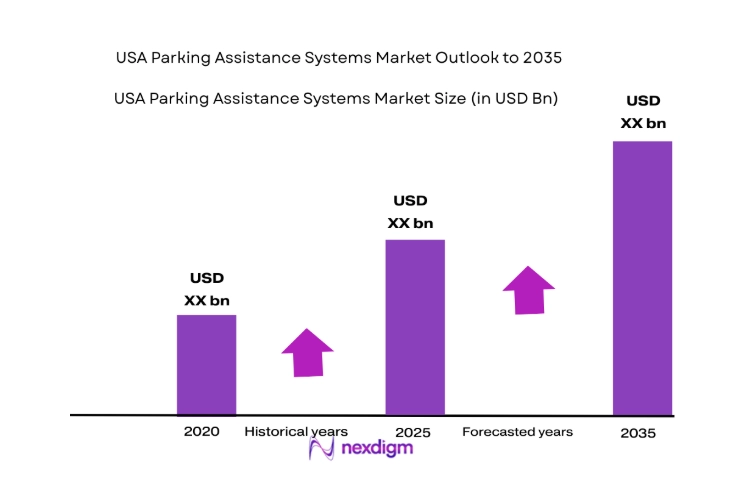
The USA Parking Assistance Systems market generated approximately USD ~ Billion based on a recent historical assessment, driven by increasing integration of advanced driver assistance systems across passenger vehicles and light commercial vehicles. Federal rear visibility safety requirements, issued by the National Highway Traffic Safety Administration, significantly accelerated the installation of camera-based and sensor-based systems. Rising production of electric vehicles and premium SUVs further strengthened demand for ultrasonic sensors, radar modules, and automated parking platforms across OEM manufacturing facilities nationwide.
Key automotive regions including Michigan, California, and Texas dominate the USA Parking Assistance Systems market due to concentrated vehicle assembly plants, advanced semiconductor ecosystems, and strong research capabilities. Detroit remains central because of established OEM headquarters and supplier clusters, while Silicon Valley leads software and AI algorithm development for sensor fusion technologies. Texas supports growth through expanding electric vehicle manufacturing hubs and logistics infrastructure, reinforcing technological commercialization and scalable deployment nationwide.
Market Segmentation
By Product Type
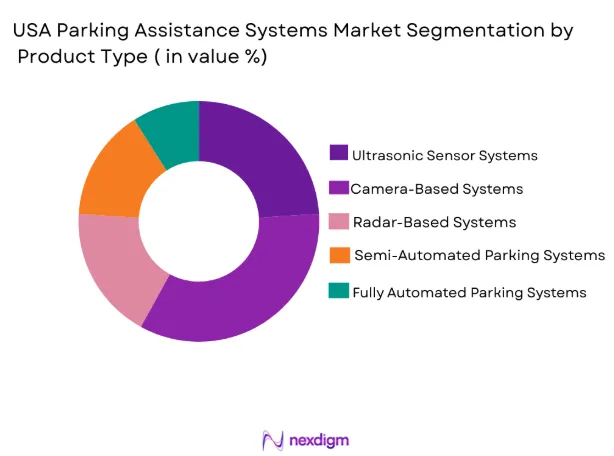
USA Parking Assistance Systems market is segmented by product type into Ultrasonic Sensor Systems, Camera-Based Systems, Radar-Based Systems, Semi-Automated Parking Systems, and Fully Automated Parking Systems. Recently, Camera-Based Systems has a dominant market share due to strong consumer demand for rear-view visibility, regulatory compliance requirements, and widespread OEM integration in mid-range and premium vehicles. Enhanced imaging resolution, surround-view capabilities, and declining camera module costs further strengthen adoption. Infrastructure readiness and established supply chains allow faster deployment compared to radar-heavy systems.
Platform Type
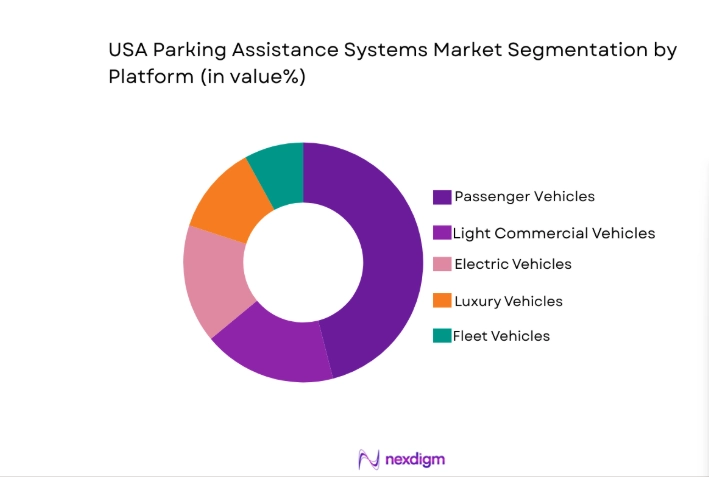
The USA Parking Assistance Systems market is segmented by platform type into Passenger Vehicles, Light Commercial Vehicles, Electric Vehicles, Luxury Vehicles, and Fleet Vehicles. Passenger Vehicles hold the dominant position due to higher production volumes and mandatory rear visibility compliance across mass-market segments. Electric Vehicles are expanding rapidly as centralized electronic architectures support advanced sensor fusion integration. Luxury Vehicles maintain strong penetration of fully automated parking systems driven by premium feature differentiation. Fleet Vehicles are gradually adopting scalable parking assistance solutions to reduce collision risks and operational costs.
Competitive Landscape
The USA Parking Assistance Systems market exhibits moderate consolidation with dominant participation from global automotive technology providers. Major players leverage strong OEM partnerships, integrated sensor portfolios, and advanced AI capabilities to maintain competitive positioning. Continuous R&D investments and strategic collaborations with semiconductor manufacturers influence market concentration and technological advancement.
|
Company Name |
Establishment Year | Headquarters | Technology Focus | Market Reach | Key Products | Revenue | Sensor Integration Capability |
| Robert Bosch GmbH | 1886 | Germany | ~ | ~ | ~ | ~ | ~ |
| Continental AG | 1871 | Germany | ~ | ~ | ~ | ~ | ~ |
| Denso Corporation | 1949 | Japan | ~ | ~ | ~ | ~ | ~ |
| Magna International | 1957 | Canada | ~ | ~ | ~ | ~ | ~ |
| Valeo SA | 1923 | France | ~ | ~ | ~ | ~ | ~ |
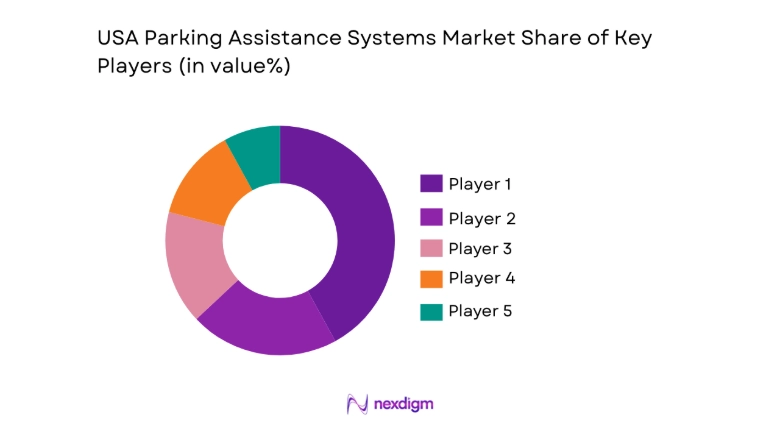
USA Parking Assistance Systems Market Analysis
Growth Drivers
Rising Integration of Advanced Driver Assistance Systems in Mid-Range Vehicles
Increasing consumer demand for enhanced vehicle safety and convenience has significantly accelerated the integration of parking assistance systems into mid-range vehicle categories across the United States. Automakers are rapidly standardizing rear cameras, ultrasonic sensors, and semi-automated parking technologies in compact SUVs and sedans to differentiate product offerings. Regulatory mandates requiring rear visibility compliance have further strengthened OEM adoption rates across mass-market segments. Improvements in semiconductor manufacturing and declining sensor costs are enabling cost-efficient deployment of advanced parking modules. Growing urban congestion is also encouraging drivers to adopt automated assistance technologies that reduce parking-related collisions. Increased vehicle electrification supports integrated electronic architectures compatible with advanced sensor fusion. Tier-1 suppliers are forming long-term contracts with OEMs to scale production capabilities. Consumer awareness regarding driver assistance technologies continues to expand through marketing and dealership education programs. These structural demand drivers collectively reinforce sustained expansion in the USA Parking Assistance Systems market.
Expansion of Electric Vehicle Production and Sensor Fusion Platforms
The rapid expansion of electric vehicle manufacturing facilities across the United States is creating strong demand for integrated parking assistance technologies embedded within centralized electronic architectures. Electric vehicles typically adopt advanced digital dashboards and unified control systems that seamlessly support multi-sensor parking platforms. Manufacturers are increasingly integrating radar, camera, and ultrasonic technologies within EV platforms to enable automated parking and remote maneuvering capabilities. Growing investments in domestic battery production and EV assembly infrastructure strengthen overall system demand. Enhanced software capabilities and over-the-air update mechanisms allow performance optimization of parking systems after vehicle delivery. Increasing federal and state incentives supporting electric mobility indirectly stimulate adoption of advanced driver assistance features. Technology partnerships between OEMs and semiconductor firms improve sensor accuracy and processing speeds. Consumer perception associating electric vehicles with advanced technology further elevates expectation for automated parking features. These combined factors substantially contribute to the structural growth of the USA Parking Assistance Systems market.
Market Challenges
High System Integration Costs and Electronic Complexity
Despite strong adoption trends, high integration costs associated with multi-sensor platforms remain a critical challenge for the USA Parking Assistance Systems market. Advanced radar modules, high-resolution camera units, and processing ECUs significantly increase vehicle bill of materials costs. Complex wiring architectures and calibration requirements add to manufacturing expenses. Entry-level vehicle manufacturers face margin pressures that limit standardization of premium parking features. Semiconductor supply constraints may elevate component pricing volatility. Software interoperability challenges across different sensor manufacturers increase development timelines. Cybersecurity vulnerabilities in connected parking systems require additional compliance investments. Warranty claims and maintenance complexity further elevate lifecycle costs. These cost-related constraints slow penetration in lower price vehicle segments across the national automotive industry.
Software Reliability and Calibration Limitations in Diverse Urban Conditions
Parking assistance systems rely heavily on software algorithms that interpret sensor data in real time, and inconsistent performance in complex urban environments remains a technical challenge. Poor weather conditions such as heavy rain or snow can reduce camera clarity and sensor accuracy. Dense urban layouts with irregular parking spaces increase algorithmic complexity. Frequent recalibration requirements after minor vehicle impacts create maintenance burdens. Sensor misalignment may lead to false detections or inaccurate distance measurement. Integration with legacy vehicle electronic control units can create compatibility constraints. Rapid technological evolution shortens product life cycles and increases upgrade costs. Consumer dissatisfaction due to inconsistent performance may affect brand perception. These technical reliability concerns represent ongoing barriers to seamless market expansion.
Opportunities
Development of Fully Automated and Remote Parking Technologies
Growing advancements in artificial intelligence and high-performance computing create substantial opportunity for fully automated and remote parking systems across the United States automotive market. OEMs are investing in hands-free and smartphone-controlled parking capabilities that enhance driver convenience. Integration with 360-degree surround-view cameras and advanced radar modules enables precise maneuvering in confined spaces. Increasing consumer familiarity with automation technologies accelerates acceptance. Smart city initiatives may support connected parking infrastructure compatibility. Expansion of autonomous driving research enhances algorithmic accuracy for low-speed maneuvering. Strategic collaborations between automotive and technology firms encourage innovation. Over-the-air software updates enable continuous improvement post-sale. These technological advancements present long-term expansion opportunities for the USA Parking Assistance Systems market.
Integration with Smart Infrastructure and Connected Urban Mobility Ecosystems
The evolution of connected vehicle ecosystems presents a major opportunity for integrating parking assistance systems with smart city infrastructure across metropolitan regions. Connected parking platforms can communicate with digital parking meters and traffic management systems to optimize space utilization. Cloud-based analytics enhance system accuracy and predictive guidance. Expansion of 5G connectivity supports real-time data exchange between vehicles and infrastructure. Municipal investments in intelligent transportation networks create supportive deployment environments. Fleet operators may adopt centralized parking management systems integrated with vehicle sensors. Growing emphasis on sustainable urban mobility aligns with reduced congestion initiatives. Technology vendors can develop subscription-based software upgrades for enhanced parking analytics. These integration prospects significantly strengthen future revenue potential within the USA Parking Assistance Systems market.
Future Outlook
The USA Parking Assistance Systems market is expected to witness sustained expansion over the next five years driven by increasing electric vehicle production and ongoing advancements in sensor fusion technologies. OEM standardization of automated parking modules across mid-segment vehicles will further strengthen demand. Regulatory emphasis on vehicle safety compliance and digital integration will accelerate technology adoption. Continuous innovation in AI-based parking algorithms and connected mobility ecosystems will enhance system efficiency and scalability.
Major Players
- Robert Bosch GmbH
- Continental AG
- Denso Corporation
- Magna International
- Valeo SA •AptivPLC
- ZF Friedrichshafen AG
- Hyundai Mobis
- Hella GmbH
- Panasonic Automotive Systems
- Texas Instruments
- NXP Semiconductors
- Infineon Technologies
- Mobileye Global
- Gentex Corporation
Key Target Audience
- Automotive OEM Manufacturers
- Automotive Suppliers
- Electric Vehicle Manufacturers
- Fleet Operators
- Investments and venture capitalist firms
- Government and regulatory bodies
- Automotive Component Distributors
- Semiconductor Manufacturers
Research Methodology
Step 1: Identification of Key Variables
Comprehensive identification of demand-side and supply-side variables influencing the USA Parking Assistance Systems market was conducted. Key factors such as regulatory mandates, OEM production volumes, and technology adoption rates were analyzed. Macro-economic and industry-specific drivers were incorporated to establish variable interdependencies.
Step 2: Market Analysis and Construction
Quantitative and qualitative data were collected from public filings, government databases, and automotive industry reports. Market size estimation was constructed using a bottom-up approach based on vehicle production and system penetration rates. Cross-validation ensured accuracy of aggregated revenue figures.
Step 3: Hypothesis Validation and Expert Consultation
Preliminary findings were validated through structured consultations with automotive engineers, supply chain specialists, and ADAS technology experts. Industry interviews supported refinement of segmentation assumptions and growth factors. Adjustments were implemented based on expert insights and validation checks.
Step 4: Research Synthesis and Final Output
All validated data points were synthesized into structured analytical frameworks. Competitive positioning, market dynamics, and financial benchmarks were integrated into the final report. Quality assurance protocols ensured consistency, reliability, and analytical coherence across sections.

- Executive Summary
- Research Methodology (Definitions, Scope, Industry Assumptions, Market Sizing Approach, Primary & Secondary Research Framework, Data Collection & Verification Protocol, Analytic Models & Forecast Methodology, Limitations & Research Validity Checks)

- Market Definition and Scope
- Value Chain & Stakeholder Ecosystem
- Regulatory / Certification Landscape
- Sector Dynamics Affecting Demand
- Strategic Initiatives & Infrastructure Growth

- Growth Drivers
Rising adoption of advanced driver assistance systems in mid-range vehicles
Increased urban congestion driving demand for automated parking
Federal vehicle safety mandates encouraging integration of detection systems
Growth in electric vehicle production requiring integrated ADAS platforms
Consumer demand for enhanced convenience and reduced parking-related accidents - Market Challenges
High integration costs for advanced automated parking modules
Complex calibration and maintenance requirements
Software interoperability issues across multi-sensor systems
Limited adoption in entry-level vehicle segments
Cybersecurity risks in connected vehicle architectures - Market Opportunities
Expansion of AI-enabled autonomous parking capabilities
Integration with smart city infrastructure and connected parking ecosystems
Development of cost-efficient modular sensor platforms for mass-market vehicles - Trends
Shift toward 360-degree surround view camera integration
Increased sensor fusion combining radar, camera, and ultrasonic inputs
Growth in hands-free and remote parking features
Rising collaboration between OEMs and semiconductor companies
Adoption of over-the-air software updates for parking systems - Government Regulations & Defense Policy
Federal Motor Vehicle Safety Standards related to rear visibility compliance
National Highway Traffic Safety Administration safety technology guidelines
Data privacy regulations governing connected vehicle data transmission - SWOT Analysis
- Stakeholder and Ecosystem Analysis
- Porter’s Five Forces Analysis
- Competition Intensity and Ecosystem Mapping

- By Market Value, 2019-2025
- By Installed Units, 2019-2025
- By Average System Price, 2019-2025
- By System Complexity Tier, 2019-2025

- By System Type (In Value%)
Ultrasonic Sensor-Based Parking Assistance
Camera-Based Surround View Systems
Radar-Based Parking Detection Systems
Semi-Automated Parking Systems
Fully Automated Parking Assist Systems - By Platform Type (In Value%)
Passenger Vehicles
Light Commercial Vehicles
Electric Vehicles
Luxury Vehicles
Autonomous Vehicle Platforms - By Fitment Type (In Value%)
OEM Factory-Fitted Systems
Aftermarket Retrofit Kits
Modular Sensor Integration
Integrated ADAS Suites
Cloud-Connected Parking Solutions - By EndUser Segment (In Value%)
Individual Vehicle Owners
Fleet Operators
Ride Sharing Companies
Logistics Service Providers
Automotive OEM Manufacturers - By Procurement Channel (In Value%)
Direct OEM Procurement
Supplier Contracts
Aftermarket Retail Distribution
Online Automotive Platforms
Fleet Procurement Agreements - By Material / Technology (in Value %)
Ultrasonic Sensors
Short-Range Radar Modules
CMOS Camera Systems
AI-Based Image Processing Software
Sensor Fusion Platforms

- Market structure and competitive positioning
Market share snapshot of major players - Cross Comparison Parameters (Technology Portfolio, Sensor Accuracy, OEM Partnerships, Pricing Strategy, Software Integration Capability)
- SWOT Analysis of Key Competitors
- Pricing & Procurement Analysis
- Key Players
Robert Bosch GmbH
Continental AG
Denso Corporation
Magna International Inc
Valeo SA
Aptiv PLC
ZF Friedrichshafen AG
Hyundai Mobis
Hella GmbH
Panasonic Automotive Systems
Texas Instruments Automotive
NXP Semiconductors
Infineon Technologies
Mobileye Global Inc
Gentex Corporation

- Passenger vehicle owners prioritize safety and convenience integration
- Fleet operators focus on accident reduction and insurance cost optimization
- Ride-sharing services demand scalable and durable ADAS integration
- OEM manufacturers emphasize system differentiation and value addition

- Forecast Market Value, 2026-2030
- Forecast Installed Units, 2026-2030
- Price Forecast by System Tier, 2026-2030
- Future Demand by Platform, 2026-2030


 Request a Sample
 Ask for Customization
 Get a Quote
 Enquire Now